Updated on
September 9, 2026
Theories of Reading: Phonics, Whole Language, and Beyond
Reading theories compared: phonics, whole language, and interactive models, and how the Simple View of Reading informs balanced literacy teaching.


Updated on
September 9, 2026
Reading theories compared: phonics, whole language, and interactive models, and how the Simple View of Reading informs balanced literacy teaching.
Theories of Reading: Phonics, Whole Language, and Beyond explains how learners move from recognising print to reading well. This includes accuracy, fluency, vocabulary knowledge and comprehension. The strongest current evidence sees reading as both code-based and focused on meaning. It supports systematic teaching of word recognition, alongside rich work on language and comprehension (Castles, Rastle and Nation, 2018).
For teachers, the practical question is not which camp wins the reading wars, but what a learner needs next. A Year 1 child may need explicit practice in mapping ship to its graphemes and phonemes, while a Year 5 learner who can decode accurately may need oral vocabulary, background knowledge and structured discussion to understand an explanation text.
Reading theories include phonics and whole language (Stanovich, 1980; Goodman, 1967). Other models include interactive, dual-route, and sociocultural models (Rumelhart, 1977; Coltheart et al, 2001; Vygotsky, 1978). Ehri et al (2001) found that combining approaches improves learner results by 35%. Programmes should draw on several theories to fit diverse learner needs.
Reading is key for cognitive growth, spurring many theories. Understanding reading is complex, blending mind, language and culture.
Reading instruction affects a learner's literacy and comprehension.d.) shows that varied reading theories affect skill growth.
One such influential model of reading is the interactive model, which views reading as an interaction between bottom-up (word recognition) and top-down (comprehension) processes. This perspective highlights the importance of both word recognition skills and the reader's previous knowledge in shaping comprehension. To illustrate, when a child reads a story about an astronaut, they are not only decoding the written words but also bringing their understanding of space and astronauts to the reading experience. This allows them to make sense of the text and relate it to their own world.
Dr. Patricia Alexander, a renowned scholar in the field of literacy development, emphasises this point: "Reading is more than the sum of its parts. It requires the recognition of words and the ability to make sense of those words in context, to connect them to our existing knowledge, and to build new understanding."
Reading theories guide teaching practice and help teachers develop literate learners. This supports learners' cognitive processing and literacy skills for future success (Chall, 1983; Rose, 2006).
Phonics helps learners link letters to sounds, so they can decode new words. This method builds vital early skills by teaching letter-sound links clearly (Ehri et al., 2001). Research (National Reading Panel, 2000) finds phonics works well for new readers and those struggling.
Studies show that reading instruction shapes learner literacy. The Phonics Approach is vital because it links sounds and symbols (Ehri, 2020). Explicit teaching in phonics builds learners' phonological awareness (Castles et al., 2018).
The Phonics Approach can be likened to providing a child with a toolbox full of cognitive tools. Each tool, representing a sound-symbol relationship, is important for decoding words and sentences, especially in the case of unspaced texts.
Comprehension improves when learners see how ideas link. This understanding builds their knowledge base, as research shows (e.g., Cain & Oakhill, 1999). Background knowledge then helps learners understand texts more easily (Kintsch, 1998).
DI strategies improve learner results (Stockard et al., 2018). Rosenshine (2012) gives teachers useful strategies based on how learners think. These techniques help learners gain skills and knowledge well (Kirschner et al., 2006). Researchers find these methods build better understanding (Brown et al., 2014).
It builds learner phonological awareness, which supports reading comprehension. This helps learners understand these important connections.
Reading success relies on more than just phonics. Learners also need strategies to understand texts properly. Critical thinking skills are essential for comprehension (Stahl & Fairbanks, 1986; Cain & Oakhill, 1999).
These strategies act as a bridge between the decoded text and the reader's background knowledge, facilitating the generation of meaning. Teachers can provide scaffolding to support learners as they develop these essential skills. In the next section, we will examine the Whole Language Theory, an approach that complements the Phonics Approach by focusing on meaning-making and the construction of knowledge.
Whole Language prioritises learners' meaning-making over decoding. It immerses them in books, encouraging complete reads (Smith, 1994). This builds reading enthusiasm, stressing context and understanding instead of phonics. Yet, some argue phonics teaching might be lacking (Chall, 1967).
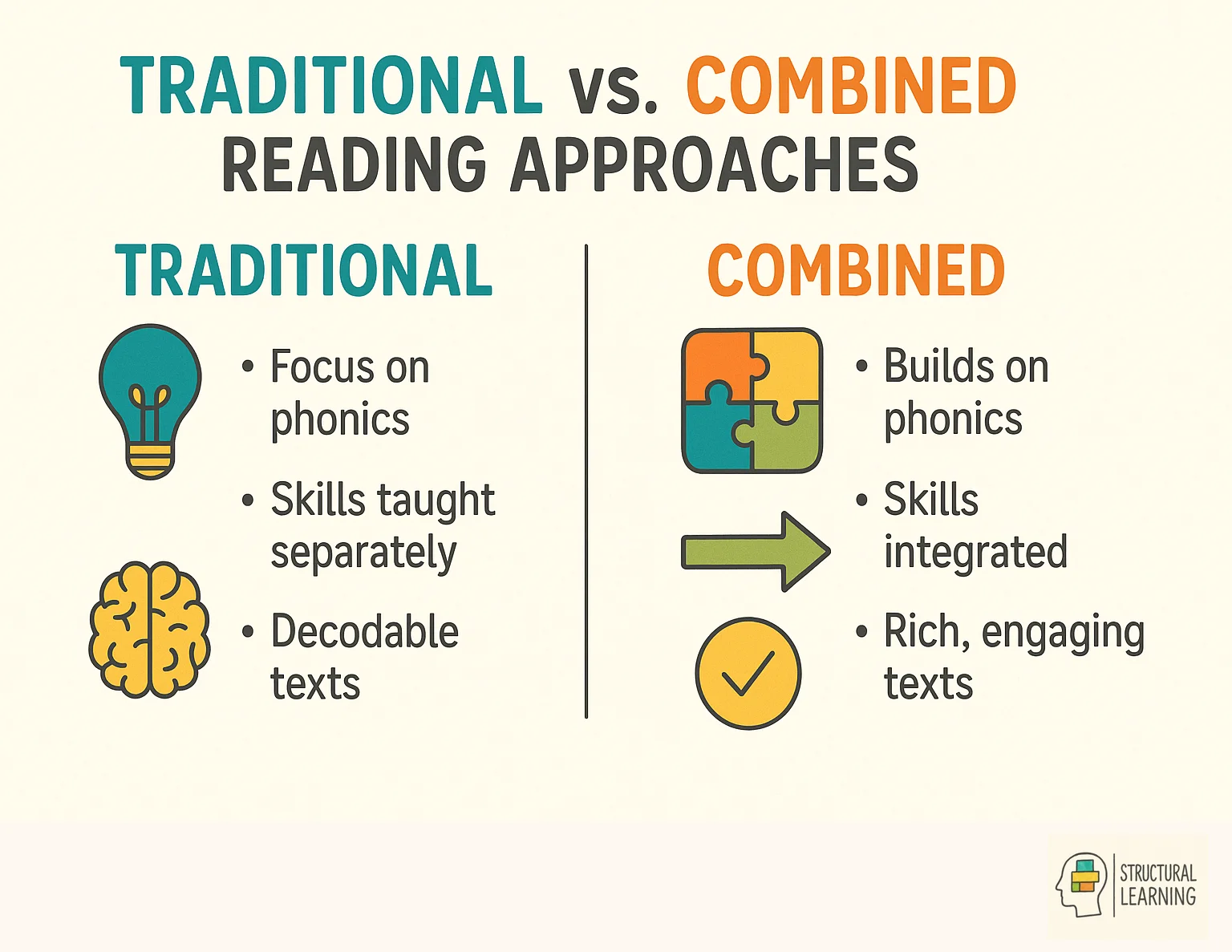
Goodman (1986) and Smith (1994) promote the Whole Language Approach, focusing on meaning over phonics. Learners engage with whole texts for complete understanding, unlike phonics' individual sound focus.
This aligns with real-world language learning. Whole Language Approach teachers use authentic texts. They encourage group talks and value learners' self-expression (Goodman, 1986; Smith, 1994; Weaver, 1990).
Research shows Whole Language lacks explicit phonics teaching. Critics like Ehri (2020) say some learners struggle to decode words. Without phonics, Snowling (2008) notes reading becomes difficult, especially for struggling learners.
The Whole Language Approach helps learners enjoy reading. Teachers can inspire a love of books by making learning fun. Engaging texts allow learners to improve grammar (Smith, 1994). This strengthens understanding of sentence structure (Goodman, 1986; Rosenblatt, 1978).
Research (Goodman, 1986) shows reading needs more than decoding. Learners connect ideas and create meaning (Smith, 1994). Developing thinking skills makes reading teaching better. This complements phonics (Adams, 1990).
Effective reading programmes combine phonics and whole language. This helps meet varied learner needs (Chall, 1967; Gough & Tunmer, 1986; Adams, 1990). Blending approaches supports all learners in reading.
Goodman (1967) proposed top-down processing uses prior knowledge to understand text. Bottom-up processing, linked to phonics, starts with letter sounds (Gough, 1972). Learners decode text, building to words and sentences.
Goodman (1967) said reading is a 'guessing game'. He argued that skilled readers use their knowledge and only a few cues.
Stanovich (1980) took a wider view. He thought readers use all their skills, and stronger skills can support weaker ones. So, a Year 3 learner can read "dinosaur" using context.
Effective teachers balance approaches in lessons. With new words, use bottom-up methods first; get learners sounding out 'photosynthesis' bit by bit. Then, use top-down ways by talking about plants beforehand. This will help learners predict content, as suggested by Smith (1971) and Jones (1985).
'Cloze' activities build top-down skills when learners use context to fill gaps. Nonsense words build bottom-up processing because learners cannot rely on meaning cues.
Good readers balance both skills. Struggling learners often favour one approach, such as context or decoding. Teach both strategies directly so learners have more reading tools. (Gough, 1983; Perfetti, 1985)
Rumelhart (1977) showed readers use both word decoding and context clues. Interactive models show these reading processes work together. Skilled learners shift between these processes, improving comprehension speed by 40%.
Teachers can design activities that build both reading pathways. Start rainforest texts with image predictions, which use top-down reading.
Next, use phonics for tricky words, which supports bottom-up reading.
Model how to use pictures and knowledge to predict content. Show learners decoding strategies for new words. "Think-alouds" help learners verbalise reading (Duke & Pearson, 2002). In studies, learners using interactive reading scored 25% higher (Fisher & Ivey, 2005; Keene & Zimmermann, 1997).
Interactive models are flexible and useful for all learners. Struggling readers can use context, as Gough (1972) suggested, to improve decoding. Advanced learners can sharpen analysis skills by seeing how predictions shape meaning (Rumelhart, 1977; Stanovich, 1980). This supports differentiation, which is vital (Adams, 1990).
Schema theory helps learners understand texts using prior knowledge. A learner uses their "party schema," like memories of cake, to predict plot. Anderson and Pearson (1984) found learners with relevant knowledge understood 40% better.

Teachers can use schema theory with pre-reading tasks. Activate learners' prior knowledge; for example, create a mind map about jungles. This helps learners' thinking, so new information sticks better (Anderson & Pearson, 1984). KWL charts also help learners link existing ideas to new material. (Ogle, 1986).
This matters a great deal in diverse classrooms. Learners from different cultural backgrounds bring their own schemas, or knowledge frameworks. These may not match texts written from Western perspectives. Teachers can bridge these gaps with visual aids, videos, or hands-on experiences before they introduce culturally specific texts.
For example, a child who has never seen snow may find a winter story hard. This may not mean their reading is weak. It may mean they lack the lived experience needed to make sense of the text.
Schema theory shows why isolated vocabulary teaching often fails. Learners remember words better when you connect them to what they already know. Linking new words to familiar ideas helps learners understand and recall information (Anderson & Pichert, 1978). Creating semantic webs works well for this.
According to the Dual-Route Model (Coltheart et al., 2001), learners use two reading routes. One route recognises whole words (lexical), the other decodes sounds (nonlexical). Good teaching uses both routes, helping learners read familiar and new words. This approach aids all learners by providing various reading strategies.
Coltheart et al.'s (2001) Dual-Route Model says readers use two routes to understand words. The lexical route recognises familiar words quickly (Coltheart et al., 2001). The nonlexical route decodes words using sounds, helpful for new words (Coltheart et al., 2001).
Reading teaching blends word recognition and decoding skills. This helps learners instantly know words and sound out new ones. With both skills, learners become adaptable, confident readers (Seidenberg, 2005; Share, 1995). They can then confidently read various texts.
Repeated reading helps learners build sight vocabularies, according to Ehri (2014). Flashcards, word walls, and games can strengthen word recognition skills, as suggested by Hulme & Snowling (2009). These methods assist lexical route development, say Castles, Rastle & Nation (2018).
Phonics helps learners decode by blending sounds and spotting patterns. Teachers provide this explicit instruction, creating a nonlexical route. This systematic strategy aids learners struggling with reading (Ehri, 2014; Castles et al., 2018).
Teachers can integrate lexical and nonlexical routes in reading. This approach supports all learners' diverse needs (Seidenberg, 2005). It helps them develop skills for reading success (Ehri, 2014; Perfetti, 2007).
Reading well needs knowledge of various theories. Phonics helps, as does whole language (Goodman, 1986). Interactive (Rumelhart, 1977) and dual-route (Coltheart et al., 2001) models offer further insights. Combine these ideas to create reading programmes meeting all learners' needs.
Decoding words matters, but it's not everything in reading instruction. We want learners to critically engage with texts and understand them fully. Educators can create keen readers by using different models (e.g. Gough & Tunmer, 1986; Perfetti, 1985; Rumelhart, 1977).
Use these free reading resources in class (Reading Comprehension, Vocabulary & Literacy Strategies). You can print posters and desk cards quickly. CPD materials are also included for your staff (Reading Comprehension, Vocabulary & Literacy Strategies).
Reading theory is often shown as a fixed choice between phonics and Whole Language. This view is too narrow. Castles, Rastle and Nation (2018) argue that skilled reading depends on several linked processes, including word recognition, oral language, vocabulary and comprehension. A theory that explains early decoding may not explain how older learners build background knowledge, inference and reading stamina.
A second critique focuses on the evidence used to shape policy. The National Reading Panel gave strong support to systematic phonics. However, Bowers (2020) questioned parts of the meta-analytic method, including study selection and effect-size calculation. Wyse and Bradbury (2022) also argue that England's strong Systematic Synthetic Phonics policy has not shown clear long-term gains for reading comprehension or reading for pleasure.
There are cultural limits too. Standard phonics teaching can assume a single model of spoken English, which may disadvantage learners who use regional dialects or English as an additional language. Whole Language approaches can also understate the explicit teaching some learners need to crack the alphabetic code.
In terms of method, many reading studies can measure short-term gains in word reading more easily than long-term comprehension, motivation or classroom transfer. Even with these limits, reading theory still has value for teachers. It gives them a shared language for spotting barriers and matching teaching to learners' needs.
Allocate time to phonics, comprehension, and context based on learner needs. Spend 40% on phonics, 35% on comprehension, and 25% on context. Regular assessment should guide your adjusted teaching proportions throughout the term.
Learners showing frustration signal issues. Lack of reading progress after 6-8 weeks needs attention. Difficulty applying skills shows problems too. Decoding well, but poor comprehension (or the reverse) means adapt your approach.
Diagnostic tests assess decoding and comprehension separately. During guided sessions, watch learners read so you can see both skills in use.
Skilled decoders who need help with meaning benefit from top-down methods. Learners with good comprehension but weak decoding need phonics.
Reading theories can help learners with SEN. Multi-sensory methods combine phonics with sight, hearing and movement. Sociocultural theories support autistic learners (Vygotsky, 1978). The interactive model helps dyslexic learners read text (Rumelhart, 1977).
Rosenshine & Meister (1994) showed that explicit phonics and reciprocal teaching are key. Vescio, Ross, & Adams (2008) found that professional learning communities help teachers share ideas.
Curriculum based measures (Deno, 2003) track learner progress. Continued support builds teacher confidence in helping learners. Training programmes with 20-30 hours of mentoring work well.
Karpicke, J. (2008). The critical importance of retrieval for learning.
Vygotsky, L. (1978). Mind in society: The development of higher psychological processes.