Updated on
October 9, 2026
Visible Learning: A Practical Teacher Guide to Hattie
A practical guide to Visible Learning and Hattie’s research, with classroom questions, evidence limits and ways to connect teaching choices to learner work.


Updated on
October 9, 2026
A practical guide to Visible Learning and Hattie’s research, with classroom questions, evidence limits and ways to connect teaching choices to learner work.
What is visible learning?
Visible Learning is John Hattie's synthesis of research on the influences that shape learner achievement. The 2009 book drew on over 800 meta-analyses and compared results through effect sizes. Its central idea is that teachers examine their impact while learners understand their goals, progress and next steps.
A large research synthesis raises a useful question: which claims about teaching deserve our trust? Hattie's rankings make those claims easy to compare. The harder task is to examine how the evidence was gathered. This guide connects the research, its critics and the evidence teachers collect in class.
On this page
John Hattie is an education researcher and Melbourne Laureate Professor Emeritus at the University of Melbourne. He is best known for comparing research on the influences that shape learner achievement.
His books connect that research with teaching. Read the original synthesis for the argument and the later teacher guide for its classroom use. The University of Melbourne lists his emeritus role.
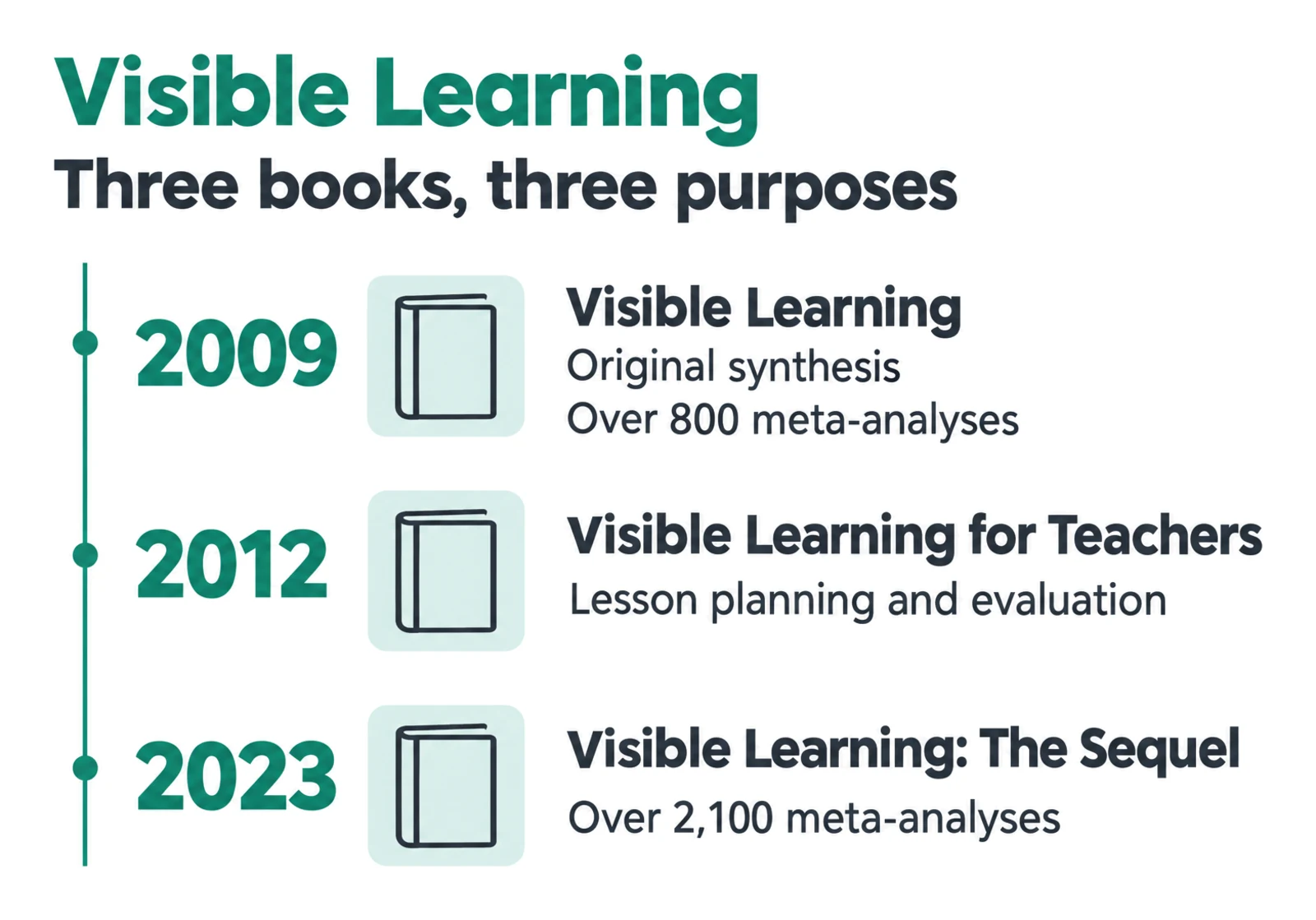
The original Visible Learning book (2009) ranked 138 influences on achievement. It drew on over 800 meta-analyses, each combining results from several studies. Visible Learning: The Sequel (2023) expanded the synthesis to over 2,100 meta-analyses and more than 350 influences. Those counts belong to different editions. The chart below uses the separately updated MetaX database, with its version stated.
Visible Learning and visual learning answer different questions. The first asks what helps learners make progress. The second uses pictures and diagrams to show an idea or a process.
Here, visual refers to the material used, rather than a label for a learner. A map may help show how two ideas connect. Visible Learning asks what the learner's explanation tells us about their understanding. The teacher uses that response to choose the next step.
Hattie's Visible Learning is usually cited as the 2009 book. Its publisher's reference link records an online release in 2008. The book brought together over 800 meta-analyses covering more than 50,000 studies and about 80 million learners. The Sequel (2023) reports over 2,100 meta-analyses. The earlier date and smaller database belong to the original work.
Hattie used a common effect-size scale to compare influences on achievement. The 0.40 hinge point was an average in that synthesis. It helps frame a question about the evidence. It gives no fixed conversion from a teaching method to a year's progress for every learner.
Hattie (2009) and Black & Wiliam (1998) help teachers keep learning in focus. Feedback, formative assessment, and metacognition help learners make better progress. Use methods backed by research; don't just follow trends.
Read the 2009 Visible Learning book for its research findings and the 2012 teacher guide for lesson planning. Choose the 2023 Sequel for a later account with more studies and updated conclusions.
The books serve different jobs. Start with the original if you want to study the method. Choose the teacher guide when you want to plan a lesson and check its impact. Read the Sequel to see how the argument developed.
An effect size expresses the size of a result on a shared scale. It lets readers compare findings reported through different tests or measures. To interpret it, check the comparison, the outcome and the learners involved. Those details help explain what the number means (Hattie, 2009).
Effect sizes can help teachers choose a question for professional development. Compare a method's reported result with other evidence on the same question. Read the dated chart below alongside its source pages. For a decision about resources, also consider the cost and effort required.
A useful reading task is to compare Hattie's synthesis with the Education Endowment Foundation (EEF) Teaching and Learning Toolkit. Both draw on research, but their labels and outcome scales differ. Hattie's chart reports effect sizes. The EEF tools further down this page report additional months of progress.
When John Hattie published Visible Learning in 2009, he brought together 800 meta-analyses. These covered more than 50,000 studies and roughly 80 million learners. He used Cohen's d to compare effects across studies. Cohen's d is a standardised measure of the difference between a treatment group and a control group, expressed in standard deviations (Cohen, 1988).
Under a normal-distribution model with equal spreads, d = 1.0 places the treatment-group mean at about the 84th percentile of the comparison group. Cohen's familiar benchmarks are 0.20, 0.50 and 0.80 for small, medium and large effects. Their usefulness depends on the research setting (Cohen, 1988).
Hattie called d = 0.40 the hinge point. It was the average effect across the influences in the original synthesis. He used it to mark the zone of desired effects. Treat that benchmark as part of his argument, alongside the questions about method discussed below.
An influence above 0.40 sits above that reference point in the synthesis. To judge its use, ask: does the study address these learners, this subject and this task? Then consider the type of evidence and the size of the result (Hattie, 2009).
For example, a trial might compare two groups taught with different methods and report the difference in their test scores on a standardised scale. A meta-analysis combines such results for a shared question. The reader then checks how similar those questions and methods were.
Kraft (2020) argues that effect sizes need benchmarks suited to the studies being read. An effect that looks small under Cohen's conventions may be substantial in a field trial. His framework asks readers to consider study features, costs and whether an intervention can work at scale.
This chart uses Visible Learning MetaX, version 1.4, updated February 2026 and checked on 2 October 2026. It ranks ten influences discussed in this guide. It is a selected comparison, rather than the database's overall top ten. The 2009 book's over 800 meta-analyses and the Sequel's over 2,100 belong to their respective editions.
The table reports the database's weighted mean effect size, d. Larger values describe larger average results in the evidence grouped under that label. Read the study count and the category's source page alongside the value. The hinge point helps frame questions, while the methods determine what conclusions are justified.
| Influence | Weighted mean d | Meta-analyses | Read alongside the number |
|---|---|---|---|
| 1. Collective teacher efficacy | 1.34 | 3 | Shared belief and action across a team; inspect how the relationship was studied. |
| 2. Teacher credibility | 1.20 | 1 | Learners' views of teacher trust and expertise; one meta-analysis underlies this estimate. |
| 3. Self-reported grades | 0.96 | 6 | Prediction of achievement; this category concerns a relationship, rather than a teaching treatment. |
| 4. Argumentation / Classroom discussion | 0.86 | 5 | The kind of discussion and the learning task both matter. |
| 5. Teacher clarity | 0.85 | 3 | Check which features of goals, explanations and examples were measured. |
| 6. Meta-cognition strategies | 0.59 | 22 | Ask how learners were taught to plan, check and review their approach. |
| 7. Direct instruction | 0.56 | 8 | Check the teaching programme and the comparison used. |
| 8. Scaffolding and situated learning | 0.50 | 7 | A broad category: inspect the support, setting and point at which help was removed. |
| 9. Feedback | 0.50 | 10 | Check the information learners received, when they received it and how they used it. |
| 10. Formative evaluation | 0.39 | 8 | Check what evidence was gathered and what teaching response followed. |
The largest number in this selection is collective teacher efficacy. That is a team-level influence. Self-reported grades concern how well learners predict achievement. These labels describe different questions, so a comparison needs more than a single number.
Some older charts use shorter category names and different values. The current MetaX category is Scaffolding and situated learning, while discussion sits under Argumentation / Classroom discussion. Use the full name and date when citing a figure. Changes can reflect both the research included and the way it is grouped.
The chart above lists ten influences often discussed in Hattie's work, from teacher teamwork and clear teaching to feedback, discussion and the ways learners plan and check their work. It also includes teacher credibility, grade predictions, scaffolding, direct instruction and formative evaluation.
The chart supplies that selection. Some entries are relationships or school-level influences. Choose a teaching move that addresses a learning need, then check its effect in learner work. Combining several high numbers gives no valid forecast for a lesson.
Print the effect size chart and lesson check to read each influence beside its caveat. Then plan one check on your next lesson.
MetaX is the online database for Visible Learning, where you can look up each influence, see its effect size and find the studies used to work out that average. It also shows how much research each entry draws on and how stable the average is likely to be.
The database's methodology page explains its measures. Record the version and full influence name when you cite a value. Read the studies beneath an entry before applying its average to a new setting.
Hattie's synthesis is useful for comparing research claims. Its rankings need careful interpretation because studies differ in their methods, learners and outcomes. An average can hide those differences.
Terhart (2011) reviews the promise and limits of this large synthesis. Read it beside Higgins and Simpson's (2011) review for an academic assessment of how the evidence is combined. The key question is whether a shared average preserves the differences that matter for a decision.
Cheung and Slavin (2016) show that study features can change reported effect sizes. Sample size, publication status and who designed the outcome test all matter. A result measured by a test made for the intervention can differ from one measured by an independent test.
Cheung and Slavin (2016) examined 645 studies. Reported effects were roughly twice as large in published studies, small studies and studies using tests designed by the researchers. This matters when comparing influences backed by different kinds of tests. The larger estimate may partly reflect how the study was carried out.
| Study | What it helps us check | Question for a decision |
|---|---|---|
| Cheung and Slavin, 2016 | How study features affect reported results. | Who designed the test, and how closely does it match the intervention? |
| Kraft, 2020 | Benchmarks, study features, cost and wider use. | What would this result mean after allowing for costs and delivery? |
| Wrigley, 2018 | The limits and policy uses of broad research summaries. | Which details disappear when the research becomes a ranking? |
Wrigley (2018) examines the technical limits and policy uses of research summaries, including Hattie and the EEF Toolkit. Wecker and Vogel (2017) also question how far the available database and procedures support a comprehensive synthesis. These critiques concern the route from evidence to broad conclusions.
Wrigley (2018) examines what broad statistical summaries lose when they become tools for policy. A ranking groups evidence into labels, while a teaching decision concerns a particular task and setting. Read the underlying research before treating the label as a recommendation. That check connects the summary back to the question it can answer.
Wecker and Vogel (2017) question whether the database and procedures can comprehensively integrate educational research under current publication practices. Their critique concerns the scope of the synthesis. The scale of a database and the completeness of its coverage are separate questions.
Kraft's (2020) framework adds another question: what makes an effect worthwhile in this setting? Consider the comparison used, costs and the demands of wider implementation. A large number alone does not tell a school how much staff time a method requires or whether the gains will last.
The same argument is running among teachers on X, away from the journals.
Three short posts from teachers on how far to trust the synthesis, and what it asks of a school.
I for sure think that he used statistics on terrible data, but I would not call that science.
How do you feel about Hattie’s research on different strategies of teaching? I often hear people dogging lectures and direct instruction, but I’ve always seen the most success with direct instruction.
There aren't any quick wins and you can't expect an initiative to yield results if you don't invest the time. The problem is that in schools time is always in such short supply.
These criticisms give reasons to inspect the evidence, not to accept or reject the whole framework from a headline. Treat the rankings as a starting point for inquiry. Check the studies, compare other syntheses and decide what evidence would justify a change to teaching.
Hattie and Zierer (2018) describe ten mindframes: ways of thinking about the teacher's role and the evidence of learning. Their book asks teachers to examine how they judge impact, respond to feedback and work with colleagues. These habits give a purpose to the methods a teacher chooses.
One mindframe treats the teacher as an evaluator of impact. The teacher asks what learners understand after a lesson and what that evidence suggests about the next teaching move.
Teachers do this by gathering proof of learner progress and then adapting their teaching. Another mindframe sees learning as finding and fixing errors, so classrooms treat mistakes as data (Hattie & Zierer, 2018).
The dialogue mindframe asks teachers to listen as well as explain. Learner responses show where an explanation needs to change.
Mindframes involve teachers seeing teamwork as a key duty. They should believe all learners can improve and use learning intentions for planning. Hattie and Zierer (2018) contrasted mindframes with teaching methods. Teachers can use techniques without seeing feedback as personally meaningful.
Mindframes aid teacher training. Hargreaves and Fullan (2012) found shared data analysis improves schools. Effective training links beliefs to teaching skills. Teachers, use observations and assessments for your feedback, not just the learner's.
The table paraphrases the ten mindframe themes for study. Read it alongside Hattie and Zierer's (2018) book for the full argument. The entries are ways of thinking about teaching, rather than ten separate methods to add to a lesson.
| Mindframe theme | Core belief |
|---|---|
| 1. Evaluate impact | Check what teaching changes in learner work. |
| 2. Learn from assessment | Use assessment to review the teaching. |
| 3. Work with colleagues | Compare evidence and plan a shared response. |
| 4. Act as a change agent | Expect improvement and choose actions that help. |
| 5. Take on challenge | Treat a demanding task as a chance to learn. |
| 6. Give and use feedback | Use feedback received as well as feedback given. |
| 7. Teach through dialogue | Listen to learners and respond to their thinking. |
| 8. Share a language of success | Help learners understand the goal and quality. |
| 9. Build positive relationships | Create trust that supports honest learning talk. |
| 10. Focus on learning | Keep discussion centred on what learners understand. |
The mindframes give teachers shared terms for discussing their work. A team might compare how it uses assessment, feedback and learner talk, then choose one aspect to examine more closely. Use the evidence from that inquiry to review the choice (Hattie and Zierer, 2018).
Hattie and Donoghue (2016) explain Visible Learning data with a learning model. Their research suggests some strategies fail if taught at the wrong phase. Learners gain less when strategies are used at unsuitable times, they state.
Hattie's research shows feedback often boosts learning. Yet, feedback can also have no impact or a negative effect. Hattie and Timperley (2007) say feedback levels matter. Effective feedback targets the right learner need.
| Feedback level | Meaning and use |
|---|---|
| Task feedback (FT) | Task feedback (FT) tells learners if answers are right or wrong. It is common in classrooms but less helpful for learning (Hattie & Timperley, 2007). Use it to fix basic errors before moving on. |
| Process feedback (FP) | Process feedback (FP) looks at how learners complete tasks. It helps improve strategies, building skills that can transfer (Wiggins, 1998). |
| Self-regulation feedback (FR) | Self-regulation feedback (FR) helps learners check their own work. Research shows that this information helps them learn effectively and builds metacognition, the ability to think about their own learning. |
| Self feedback (FS) | Self feedback (FS) focuses directly on the learner. Hattie and Timperley found that FS is less effective and can be harmful, while Dweck (1999) said praising learners as "clever" lowers their willingness to take risks. |
Use feedback to show what to do next. In this original classroom example, a teacher asks, "You found the pattern. Does it also work with negative numbers?" This targets the learner's approach. "How did you check your answer?" prompts the learner to monitor their work. These illustrate process and self-regulation feedback in Hattie and Timperley's (2007) model. Praise alone does not identify a next step.
Self-reported grades concern how accurately learners predict their achievement. The older figure quoted in the original synthesis was d = 1.44 (Hattie, 2009). The dated chart above gives the current MetaX value. Kuncel, Crede and Thomas (2005), and Mabe and West (1982), examined predictions of results.
Learners with accurate self-predictions understand their knowledge (Hattie). This accuracy comes from past feedback and clear assessments. Regular feedback helps learners measure new learning. Hattie found that learners knowing what they know can guide their learning best.
Learning intentions link to classroom practice. Teachers, share clear success criteria, so learners assess their work. This builds calibration, connected to grades (Andrade & Valtcheva, 2009). Rubrics improve writing more than open tasks. They give learners external standards (Andrade & Valtcheva, 2009).
Black and Wiliam (1998) found self and peer assessment work best with clear criteria. Learners need specific feedback and transparent tasks to understand their progress. Teachers should not be the only source of evaluation.
Bandura's (1977) idea of self-efficacy fits alongside Hattie's later work. Self-efficacy is a learner's belief they can succeed. Bandura (1977) says this differs from self-esteem. It predicts a learner's effort, mainly with hard tasks.
Bandura (1997) described four sources of self-efficacy. Mastery experiences are successful challenges, and they help learners believe they can improve. This supports Hattie's findings on growth.
Learners also build self-belief through vicarious experience, when they see peers succeed. Verbal persuasion works best when teachers praise effort, not ability. Physiological states show readiness, so lowering test anxiety can improve learner results.
Hattie and Timperley (2007) showed task and process feedback help learners see real progress. This creates mastery. Self-level feedback focuses on worth, not skill. Bandura explained why this rarely helps; it misses the point. Teachers understanding this use specific feedback, showing genuine progress.
Collective teacher efficacy applies the idea of efficacy to staff working together. Teams can discuss what learner work shows and use shared successes to build confidence. The dated chart gives the current research estimate. Check the underlying evidence before drawing conclusions about the effect of a particular school initiative.
Clarke's work (2005, 2014) explains classroom routines for learning intentions and success criteria. It helps distinguish what learners are asked to do from what they are meant to learn. Read it alongside Hattie's account to connect a broad research argument with the choices made when planning a lesson.
Clarke (2001) says a task differs from a learning intention. Tasks are activities learners do, like writing. Learning intentions are what learners will learn, like using evidence. Clarke found mixing these reduces learning gains. Learners transfer knowledge better when they understand the learning (Clarke, 2001).
Clarke suggests learners create success criteria together. Ask, "What makes you feel you met the learning goal?" This helps learners understand quality, says Clarke (2001). Learners self-regulate better when they help build criteria. Clarke's research suggests this works well for writing tasks.
Clarke (2001) suggests checking that lesson aims describe learning as well as the activity. Invite learners to discuss what quality looks like, then compare their judgements with the criteria. Look for revisions that improve the work. Use those revisions to decide whether another example or explanation is needed.
Sweller's cognitive load theory (Sweller, 1988; Sweller, van Merrienboer & Paas, 1998) explains Hattie's learning phases. Rushing learners from surface to deep learning causes performance issues Hattie noted. The theory outlines three types of load on working memory. Working memory holds around four items (Cowan, 2001).
Intrinsic load reflects subject difficulty (Sweller, 1988). Complex topics raise intrinsic load for the learner. Teachers can sequence learning to build basic knowledge structures. Surface learning develops these structures and reduces load.
Activity design creates extraneous load (Chandler & Sweller, 1991). Unclear materials raise this load and hinder learners. Visuals and examples reduce extraneous load during lessons. Learners use effort to create knowledge structures; this is germane load (Sweller, Ayres & Kalyuga, 2011).
Kalyuga et al. (2003) describe how the value of support changes as knowledge grows. Worked examples help novices see an approach to a task. Experienced learners may need less support. Check what learners already understand, then reduce the help as they become able to work on their own.
Scaffolding, according to cognitive load theory, should fade gradually for classroom use. Break complex tasks into worked examples (Sweller, 1988) before learners tackle problems. Assessment tasks must match each learner's current knowledge (Clark, 2009; Kalyuga, 2007).
Rosenshine's (2012) principles come from cognitive science research. Studies of expert teachers also inform the work, as does learning support research. These ten principles fit Hattie's work since they use similar evidence. Both researchers see clear, structured teaching as key for learner progress.
| Rosenshine principle | Related Hattie influence | Useful connection |
|---|---|---|
| Begin with a short review of previous learning | Retrieval practice / spaced learning | Review what learners can retrieve. |
| Present new material in small steps | Direct instruction (surface phase) | Build knowledge in manageable steps. |
| Ask many questions and check understanding | Formative evaluation | Use answers to choose the next teaching move. |
| Provide models and worked examples | Worked examples | Show the reasoning as well as the answer. |
| Guide practice during initial learning | Teacher clarity / scaffolding | Offer support while checking understanding. |
| Check for understanding throughout | Feedback (task level) | Respond to the errors learners reveal. |
| Aim for a high success rate (80% +) | Self-reported grades (calibrated expectation) | Use success to judge readiness for the next task. |
| Provide scaffolds for difficult tasks | Scaffolding | Reduce support as understanding grows. |
| Require and monitor independent practice | Self-regulation / metacognitive strategies | Check learners can use the approach on their own. |
| Engage learners in weekly and monthly review | Spaced practice | Revisit knowledge after a gap. |
Rosenshine (2012) studied lesson techniques using Sweller's cognitive science. Hattie's (2009) meta-analyses found similar effects in schools. Teachers can use both sets of ideas, as Rosenshine's practices match Hattie's findings.
Use the table to compare the two accounts. Rosenshine describes teaching routines, while Hattie compares broad influences on achievement. A connection between them helps explain a choice of routine. It gives no valid numerical forecast for a lesson that includes all ten principles.
Year 8, science, diffusion. Ask learners to explain why particles spread through a space. Compare the explanations with a model answer, then ask learners to revise one sentence.
Look for: an explanation that links movement with a change from a more crowded to a less crowded area. If learners only say particles spread, revisit the model before the next problem.
Year 5, English, writing an introduction. Compare two introductions and name the stronger use of evidence. Ask learners to revise one sentence against that criterion.
Look for: a revision that strengthens the evidence. If the change is only spelling or neatness, model how evidence supports the point before another revision.
In class, the research becomes a check on understanding. Learners know the goal, see examples of quality and receive feedback they can use. In a Year 5 writing lesson, they might compare two introductions, name the stronger use of evidence and revise one sentence. The teacher then checks whether the revision meets the goal.
The teacher and the learner have different jobs in this loop. Teachers gather evidence and decide how to respond. Learners explain their thinking and judge their progress against clear criteria. This connects Hattie's work with other education researchers who study feedback and assessment. Compare these accounts in the overview of learning theories.
Read the influence name before the number. A result for feedback may combine several forms of feedback and several kinds of task. A result for grade predictions asks a different question from a trial of a teaching method. Compare the evidence behind the labels before drawing a conclusion.
The figures help readers compare broad patterns across studies. A teacher still needs to ask what was taught, how learning was assessed and which learners took part. Those details show how closely a study matches the task at hand (Hattie, 2009).
The Visible Learning model places strong emphasis on:
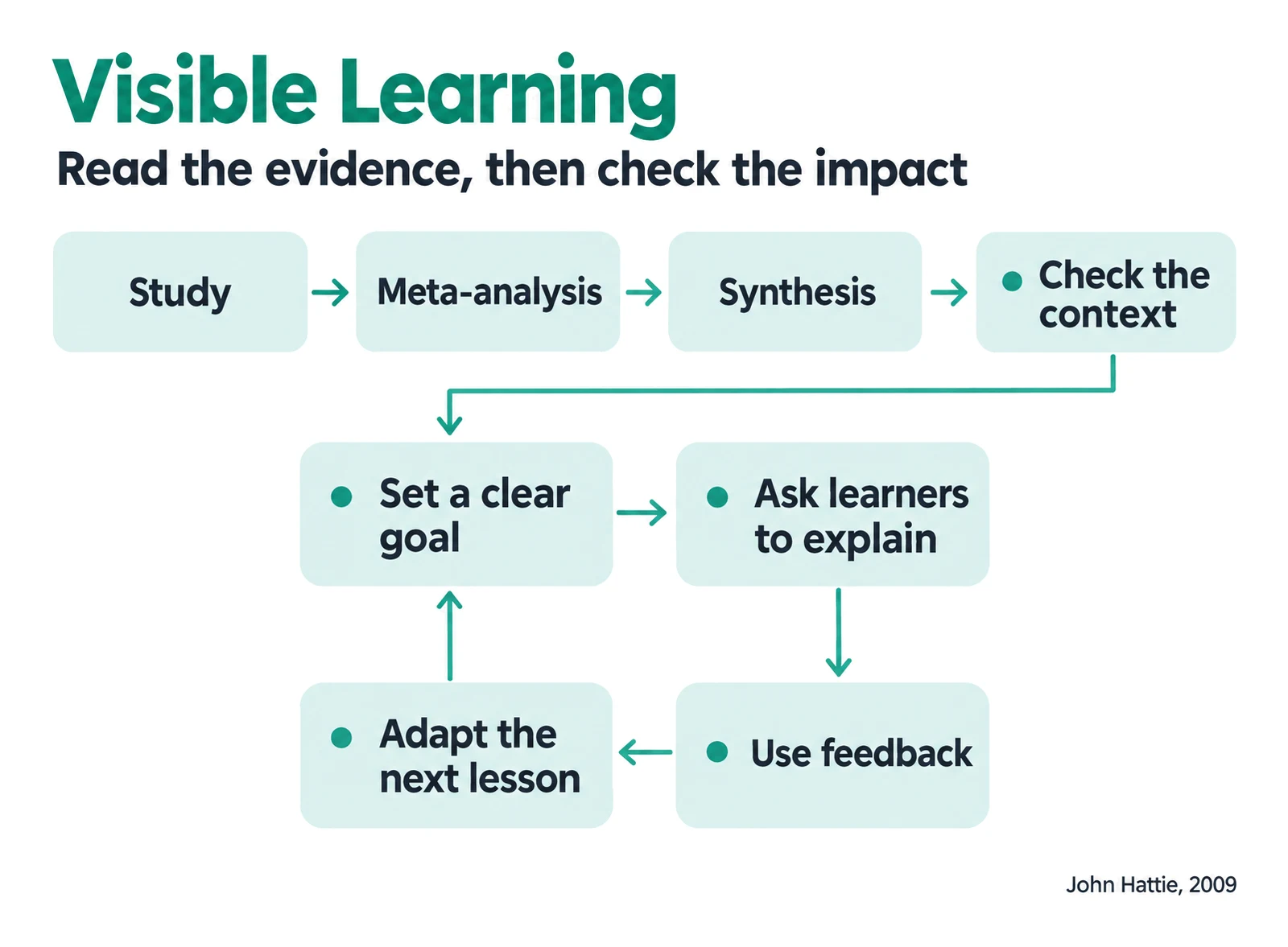
Hattie (2012) stated teachers watch how learners progress. Teachers change lessons based on what works, Black and Wiliam (1998) found. Christodoulou (2017) showed effective teachers make daily informed decisions.
Key Principles of Visible Learning:
| Principle | What it means |
|---|---|
| Clarity and Goal-Setting, | learners must understand what they're learning and why it matters. |
| Feedback-Informed Practice, | Teachers continuously adjust instruction based on assessment evidence. |
| Learner Ownership, | Learners are active participants who reflect on and take responsibility for their progress. |
A displayed goal is useful when learners understand it and can use it to judge their work. Ask them to explain the goal in their own words. Their explanation gives the teacher a quick check on whether the intended learning is clear (Hattie, 2012).
The same approach can support discussion between teachers. Bring a piece of work or a learner explanation to the discussion. Agree what it shows, then choose one change to teaching and decide what evidence would show whether that change helped.
The effect-size chart near the start of this guide gives a dated, readable comparison. Check its category names and source version before using a ranking.
Feedback, formative evaluation and collective teacher efficacy appear in different versions of the Visible Learning rankings. Use the dated chart near the start of this guide for a consistent comparison. Then inspect the study details and test the teaching move against learner work.
Visible Learning changes classrooms; Hattie (2012) says share learning goals and success criteria. Learners grasp aims and how to achieve them. Teachers check learner understanding using assessments and questions. Instruction changes based on this. Black and Wiliam (1998) found learners self-assess and give feedback, building shared responsibility.
Visible learning involves teachers stating lesson aims and success criteria clearly (Hattie, 2009). Teachers check learner understanding with regular assessments. They then change teaching based on feedback. Teachers guide learners to see where they are and what to do next (Black & Wiliam, 1998; Wiliam, 2011).
John Hattie's Visible Learning synthesis drew on over 800 meta-analyses covering more than 50,000 studies and about 80 million learners. Later visible learning synthesis meta-analyses relating to achievement extend that evidence base, so the list should not be treated as fixed. A larger effect size usually signals a stronger average effect, but it does not remove the need for professional judgement. In practice, visible learners can:
| Learner action |
|---|
| Set learning goals; |
| Express what they are learning; |
| Describe the next steps in their learning; |
| Know what to do when they are stuck; |
| See mistakes as opportunities for additional learning; |
| Take feedback. |
Weinstein and Acee (2020) found that independent learners achieve better outcomes. Rosenshine's (2012) principles give teachers a clear structure for effective teaching. They combine modelling, guided practice and regular checks for understanding. Zimmerman (2002) showed that clear direction helps learners develop self-regulation.
Visible thinking relies on strong questioning. Teachers use questions to check learner understanding, guiding progress. Thinking routines combined with this help make thinking clear (Ritchhart, Church & Morrison, 2011).
Hattie (2009) showed visual tools help learning. Graphic organisers connect ideas for learners. Novak (1998) and Ausubel (2000) found these tools let learners track knowledge.
Hattie (2009) says learners need varied support. Teachers change strategies for learners with special needs. This helps all learners take part effectively.
Understanding information processing helps teachers support learning. Hattie (2009) says working memory is limited, so learners need support with thinking. Willingham (2009) and Sweller (1988) suggest lessons should take these limits into account.
Learner motivation matters for visible learning success. Learners who see progress and know goals become more invested. This boosts ownership of their education (Hattie, 2012; Deci & Ryan, 2000). Compare this account of motivation with self-determination theory.
Hattie uses 0.40, the average effect across the influences in his synthesis, as a point of comparison. An effect size and a month figure come from different methods and different sets of studies, so read the two views side by side and keep each number with its source.
Collective teacher efficacy, teacher clarity and direct instruction have no matching Toolkit strand, so the EEF view lists them without a figure.
Sources: Visible Learning MetaX, version 1.4 (February 2026), weighted mean effect sizes; EEF Teaching and Learning Toolkit strand pages. Both read on 5 October 2026.
Teachers and learners benefit from clear teaching. Hattie's research shows feedback, classroom discussion and formative evaluation can raise learner achievement when they are implemented with care. These practices also give teachers evidence they can use during the lesson.
Sweller's cognitive load theory (1988) explains why worked examples and staged support can help novices focus on the content. Wiliam's formative assessment work (2011) asks teachers to use feedback to change the next teaching move, as well as the learner's answer.
Teachers must assess their impact on learners. Collect evidence of learning using exit tickets, discussion, mini-whiteboards and journals (Hattie, 2012). Seeing what works lets teachers change practice and improve learner outcomes (Black & Wiliam, 1998). Responsive teaching, based on learning evidence, matters most (Christodoulou, 2017).
Collective teacher efficacy is teachers' shared belief that they can improve learning through their work together. The dated MetaX chart above reports this team-level influence. Bandura (1977, 1997) developed the wider idea of efficacy: belief in the capacity to act successfully. The comparison needs care because a shared belief differs from a specific teaching method.
Donohoo (2017) linked Bandura's theory to school improvement. She found that six factors build collective teacher efficacy, which is teachers' shared belief that they can improve learning.
These factors include having a say in decisions, sharing goals, knowing colleagues' work, and having good staff relationships. Donohoo (2017) also says leaders should respond to teacher worries, because weak support makes it harder for teachers to improve results.
Shared beliefs on impact boost staff actions. Teachers expect more from every learner (Donohoo, Hattie and Eells, 2018). They support struggling learners, avoiding blame. Staff share results, moving past solo work. Learners see consistent high standards across the board.
For school leaders, the message is practical: build ways for staff to work together before buying another programme. A school may buy a literacy intervention, but get less from it if departments still work alone. Leaders are more likely to see stronger results when they protect shared planning time, lesson study and careful review of learner evidence.
Staff can build shared confidence by examining learner work, planning a response and reviewing what changed. The evidence of progress matters alongside the belief. Protect time for that inquiry before adding another initiative. A team's confidence should be linked to what learners can explain or do.
Hattie (2012) shows learning intentions clarify aims. Learners understanding purpose and quality improves results, says Clarke. Learning intentions use clear language, focusing on skills not tasks (Clarke).
Success criteria make clear what learners should achieve. Wiliam showed that co-creation can boost learner engagement. Specific, measurable criteria help learners check their progress. Sadler (1989) found that they link to learning intentions and help learners understand quality.
Share learning intentions and success criteria clearly. Refer to them often during lessons. Learners can use them for self-reflection during activities. Review these criteria at the end so learners can judge their progress.
Visible Learning Plus is a professional learning programme from Corwin and its partners. It helps schools use Hattie's research through shared planning, staff development and review of learner progress.
It is the commercial training route associated with the research. The books and database provide separate reading routes. The programme's professional learning page describes workshops and support. Evaluate a proposed programme against a defined learning need, its cost and the evidence you will collect.
For a Visible Learning PDF, use an authorised publisher or library route for the book. Alternatively, make a personal reading summary from the dated chart and lesson check in this guide.
The chart above is an original summary of ten selected influences. It keeps its source version visible. For the complete research argument, follow the book links in the reading guide. The existing Teaching Essentials pack below offers separate classroom resources.
Visible Learning for Teachers (2012) translates the research into planning, teaching and evaluation. A useful summary follows three moments: choose evidence before the lesson, respond to it during teaching, and review progress afterwards.
This is an original lesson check based on the principles discussed here. For a Visible Learning for Teachers PDF, use the publisher or your library for an authorised edition. The summary supports planning alongside the full book.
Download this free Complete Teaching Essentials Bundle resource pack for your classroom and staff room. Includes printable posters, desk cards and continuing professional development (CPD) materials.
Teachers should sequence teaching carefully. Use explicit instruction first, followed by group work as learners grasp concepts. Avoid rushing to deep learning; it causes overload (Kirschner, Sweller and Clark, 2006). Sufficient surface knowledge avoids this.
Teacher clarity concerns how well learners understand the teaching. Fendick (1990) describes clear organisation, explanations and examples. Showing how work will be judged also helps make the task clear. Use the dated MetaX chart for the current estimate, then check whether learners understand the goal in this lesson.
In practice, learners should be able to explain the goal, why it matters and how they will judge their work. Share learning intentions and success criteria, then check learners' explanations. The clarity estimate in the dated chart describes a research average. To assess value for money, also examine the time and resources involved.
Feedback varies in classrooms, say Hattie and Timperley (2007), despite its proven impact. They identified four feedback levels. These levels each affect learner progress in different ways.
| Feedback level | Classroom example and response |
|---|---|
| Task-level feedback | addresses correctness: is this answer right or wrong, and what needs to be changed? This is the most common type of teacher feedback and also one of the most effective when it is specific. Telling a learner their calculation is incorrect because they forgot to carry the tens gives them precise information to act on. Vague corrections such as “try again” give task-level feedback without any useful signal. |
| Process-level feedback | targets the strategies used to complete a task. It helps learners understand how they are working, not just whether the work is right. Comments such as “you found the main idea quickly because you looked at the opening sentence of each paragraph first” teach a method. That method transfers to future tasks, not just to this one. |
| Self-regulation feedback | operates at the level of how learners monitor and direct their own learning. It builds independence by helping learners evaluate their own work, set goals, and know when to seek help. Teachers who model self-questioning strategies, such as “how do I know when I’ve understood this well enough?”, are providing self-regulation feedback. |
| Self-level feedback | addresses the person rather than the performance, and is the least effective of the four levels. Praise such as “you’re so clever” or “well done, you’re brilliant at this” feels positive. It gives learners no information about what they did, how they did it, or what to do next. In some cases it can be counterproductive, encouraging learners to avoid challenge so that their self-image as “clever” remains intact. Formative assessment practice that combines task and process feedback consistently produces stronger results than generic praise alone. |
Predict, then reveal
How well do you actually know the research? For each teaching approach, drag the slider to predict its impact, in additional months of progress per year, then we'll show you the figure from the Education Endowment Foundation's Teaching & Learning Toolkit, and how close you got.
Your calibration
| Approach | Months | Cost |
|---|
Figures are months of additional progress from the EEF Teaching and Learning Toolkit (verified June 2026).
Hattie and Timperley (2007) show that feedback can influence learning, but the strongest feedback in visible learning flows from learner to teacher. Exit tickets, hinge questions and draft annotations tell the teacher what learners understood, what they guessed and where the explanation failed.
Link feedback to learning intentions and success criteria. Instead of marking right or wrong, address patterns in learner understanding and adjust the next lesson.
Specific praise such as "your evidence strengthens the argument; now apply it to the conclusion" gives learners information they can use. Peer feedback and self-assessment improve learning when criteria are clear (Black & Wiliam, 1998). Learners then become more accurate judges of their own progress.
Teachers in Visible Learning classrooms talk about learner progress often. They treat formative assessment as an information system, not a marking routine (Wiliam, 2011). Exit tickets, peer feedback and mini-whiteboard checks help teachers decide the next teaching move.
Share learning intentions and success criteria clearly. Then involve learners in judging their own work. Self-assessment builds metacognition and self-regulation. Learners learn to monitor, direct and adjust their approach, instead of waiting for the teacher to diagnose every gap.
Traffic lights, one-minute summaries and rubric-based peer assessment only help when teachers use the evidence they give. Use assessment data to change groups, explanations, examples or practice tasks. This creates more responsive classrooms (Black & Wiliam, 1998; Hattie, 2012). Respond quickly to what went well and to errors (Sadler, 1989).
Hattie's Visible Learning helps teachers and learners see progress. Learners should understand learning goals and how to track development. This approach values teaching's impact on learner success (Hattie, 2009). Teachers guide learning and adjust lessons based on data.
Share lesson aims and success criteria clearly. Learners need to understand what they're learning. Check learner understanding with questions and quick assessments during lessons. Adapt your teaching based on this, as Hattie (2012) suggests. Teach learners to self-assess and offer useful feedback, as Black and Wiliam (1998) advise.
Visible Learning helps learners actively set goals and track progress. Teachers gain evidence-based strategies: Hattie (2009) found feedback scores 0.7. Formative evaluation reaches 0.9, Hattie (2009) showed. Teachers understand learning from the learner's view and use evidence to guide choices.
The 0.40 hinge point is the average effect in Hattie's original synthesis, used to identify a zone of desired effects. It is a reference point, rather than a statistical-significance test or a guarantee of a year's learning. Read it alongside study quality and context.
Learners should say what they learn and why, plus seek feedback and set goals. See learners self-assessing work and giving peer feedback (Black & Wiliam, 1998). Teaching choices then better meet learner needs, using ongoing lesson assessment evidence (Hattie & Timperley, 2007).
Teachers often share objectives, but do learners know how to self-assess? Many collect data without adjusting lessons (Hattie, 2009). Some think posting intentions equals Visible Learning, but it needs learner input and feedback loops (Fisher & Frey, 2012).
Bandura, A. (1977). Social learning theory.
Hattie, J. (2009). Visible learning.
Kirschner, P. (2006). Why minimal guidance during instruction does not work.
Rosenshine, B. (2012). Principles of instruction.
Sweller, J. (1988). Cognitive load during problem solving.
Wiliam, D. (2011). Embedded formative assessment.
Visible learning, based on Hattie's (2009) research, gives practical tools. Research by Marzano (2003) and Black & Wiliam (1998) also supports it. These studies help teachers understand how learners learn best in class.
The original Visible Learning book is usually cited as 2009. Its publisher's reference link records an online release in 2008. It brings together over 800 meta-analyses. Use the book for the original argument and the dated MetaX chart for today's database values.
Hattie, J. (2009)
Hattie's original work (2009) ranked 138 influences on achievement. Historical examples include feedback (d = 0.73), teacher clarity (d = 0.75) and formative evaluation (d = 0.90). These figures belong to that book. The dated chart earlier in this guide gives current MetaX values for comparison.
Visible Learning for Teachers: Maximizing Impact on Learning 1,147 citations
Hattie, J. (2012)
This book uses meta-analysis for classroom plans. Hattie asks that teachers "know thy impact". Checking their impact helps teachers improve their practice. The book gives checklists, lesson plans, and self-checks based on research.
The Power of Feedback 6,378 citations
Hattie, J. and Timperley, H. (2007)
Hattie and Timperley's (2007) model has four feedback levels. These are task, process, self-regulation, and self. Research shows task and process feedback works best. Self praise gives learners the smallest boost, according to Kluger and DeNisi (1996). Use this model to improve learner progress (Wiliam, 2011).
Teachers Make a Difference: What Is the Research Evidence? 1,310 citations
Hattie, J. (2003)
Hattie (2003) estimated that teachers account for about 30% of the variance in learner achievement. This makes it the top school factor. Expert teachers challenge learners and expect much, research shows (Wright et al., 1997). This work informed Hattie's (2009) visible learning framework.
Embedding Formative Assessment: Practical Techniques for K-12 Classrooms
Wiliam, D. (2011)
Wiliam supports Hattie's visible learning research. He suggests five formative assessment strategies for teachers. These include clarifying learning aims and leading class discussions. Learners can also teach each other (Wiliam, 2011; Hattie, 2009).