Updated on
August 24, 2026
Adlerian Psychology: Core Ideas, Evidence and Limits
Adlerian psychology is Alfred Adler's theory of purposeful, socially situated behaviour. Explore its core concepts, later developments, evidence and important limits.


Updated on
August 24, 2026
Adlerian psychology is Alfred Adler's theory of purposeful, socially situated behaviour. Explore its core concepts, later developments, evidence and important limits.
What is Adlerian psychology?
Adlerian psychology, also called Individual Psychology, is Alfred Adler's historical theory that people form an organised style of life and pursue goals within a social world. Its core ideas include inferiority feelings, striving, social interest and purposive behaviour. These concepts remain influential, but many are difficult to test and should not be used to diagnose a learner's hidden motives.
Adlerian psychology, also called Individual Psychology, is Alfred Adler's historical theory. It says people form an organised style of life. They also pursue goals within a social world. Key ideas include inferiority feelings, striving, social interest and purposeful behaviour.
Many of these ideas are hard to test. They must not be used to diagnose a learner's hidden motives.
This article separates Adler's theory, Dreikurs's educational ideas, current Adlerian therapy and modern research. The modern work covers birth order and school belonging. Clear boundaries make the history easier to study and safer to use.
See the Learning Theories collection for other accounts.
Individual Psychology is Adler's account of personality and mental distress. Here, individual does not mean separate or self-focused. It means an indivisible whole. Thought, feeling, action, relationships and social conditions form one pattern.
Adler presented this as a theory, not a proven model of all behaviour.
Adler also explained conduct in terms of purpose. He asked which direction an action seemed to take. He then asked which imagined goal seemed to guide it. This is a teleological view.
The term means that a future aim helps explain present conduct. Past events are not the only possible cause. In Understanding Human Nature, Adler described mental life as goal-directed (Adler, 1927).
This claim is historical theory, not a modern law that gives each act one hidden aim. Context, learning, emotion, health, relationships and living conditions can shape conduct. An observer can also read an action wrongly.
A careful account therefore says that Adler interpreted behaviour as purposeful. It does not say that a teacher or therapist can read a goal from one act.
Adler left Freud's early psychoanalytic movement in 1911. Their split was not one simple dispute. Adler rejected an account built mainly around instinct and psychosexual conflict. He gave more weight to the whole person and social ties.
Felt limits, compensation and movement towards goals also became central. His work formed a distinct branch of psychodynamic theory.
Adler published an early study of organ inferiority in 1907. The Neurotic Constitution first appeared in German in 1912. It set out Individual Psychology in more detail. Later English works show how Adler's terms and focus changed.
Those works included The Practice and Theory of Individual Psychology (1924). They also included Understanding Human Nature (1927) and The Education of Children (1930). What Life Could Mean to You followed in 1931. The dates show how Adler's ideas grew.
Freud and Adler do not fit a simple past versus future contrast. Freud also wrote about conflict, fantasy and social life. Adler did not deny that childhood mattered. The main difference lies in focus and form of explanation.
Adler put more weight on social life and purposeful striving. Classical psychoanalysis put more weight on other forces. A fuller comparison belongs with Freud's theories. Jungian psychology marks another distinct break from Freud.
Individual Psychology links several ideas. Adler saw each person as a whole with a distinct life pattern. He linked felt inferiority with efforts to grow or gain control. He also stressed social interest and goals.
These concepts describe Adler's theory. They are not proven laws or tools for reading hidden motives.
Adler opposed accounts that split a person into rival parts. Individual Psychology looks for a pattern across thought, feeling and action. It is also idiographic. This means it seeks the distinct shape of one life.
It does not place everyone into a few fixed types.
Holism guides how the theory is built. It does not prove that a therapist has understood the whole person. Researchers still need sound measures, rival accounts and evidence that could prove them wrong.
Modern personality theories use other concepts and research methods. A shared theme does not prove a direct line between them.
Adler saw inferiority feelings as a common part of human growth. Children face need, limits and dependence. Adults also face comparison, doubt and failure. In his account, a felt weakness can prompt compensation.
Compensation means an effort to build skill, safety or control elsewhere.
The phrase inferiority complex can sound like a diagnosis. It is not a current clinical diagnosis. It should not be applied when someone withdraws, boasts or avoids a task. Seeking reassurance does not prove it either.
Each of those actions can have many meanings. Scholarly writing should name inferiority and compensation as Adlerian concepts. It should not claim they caused one person's conduct.
Adler used superiority to mean movement from a felt minus to a felt plus. The exact wording varies by date and translation. It can mean mastery, completion, importance or perfection. It need not mean power over other people.
The direction of this striving mattered in Adler's theory. He set useful social contribution against defensive or competitive personal gain.
Readers can compare this idea with later growth-based accounts. One example is humanistic psychology. Yet the two traditions are not the same. Similar terms do not prove the same source, meaning or evidence.
Gemeinschaftsgefühl has several English translations. They include social interest, community feeling and social feeling. The idea became central to Adler's mature theory. It concerns cooperation, contribution and life with other people.
Adler saw social interest as a sign of psychological health. He did not mean popularity or ease with others. The idea is wider and more value-based than a belonging score. It includes service to the common good.
Recent scholarship has returned to this social and equal-rights part of Adler's work (McCluskey, 2022). That work helps readers understand the history. It is not a trial of Adlerian methods (McCluskey, 2022).
Adler drew on Hans Vaihinger's account of useful fictions. People may guide their conduct through imagined end points. They may seek full safety, freedom from weakness or a vital role. In Adler's model, such a goal need not be conscious.
The goal need not be possible either.
Fictional finalism can help scholars discuss stories and hopes. It also poses a problem for testing. An inferred goal can be used to explain almost any act after it occurs. The theory may then become hard to prove wrong.
A careful account treats fictional finalism as a way to interpret conduct. It must also ask what evidence would support another explanation.
Style of life means how a person sees self, others and the world. Adler thought it formed early. He said it shaped goals, hopes and coping. The term does not mean habits of shopping, exercise or leisure.
It is not a classroom learning style.
Later Adlerian therapists built forms of lifestyle assessment. These are not checklists for teachers. A learner's silence, reluctance or disagreement cannot prove a style of life. Using the term as a label would also clash with Adler's focus on the whole person.
Fair assessment draws on more than one source.
Adler used family constellation for a child's perceived place and ties within a family. Birth order became its best-known part. Popular accounts give fixed traits to each sibling position. Modern evidence does not support such broad personality types.
Rohrer, Egloff and Schmukle studied large samples in three countries. The samples came from Germany, the United Kingdom and the United States. The study found no lasting birth-order effects on broad personality traits. A small link with intellect-related results remained (Rohrer et al., 2015).
This finding is a major test of broad birth-order types. It poses a clear challenge to those claims. Family position should not predict a learner's personality, drive or educational need.
Early recollections served a different role in Adler's work. He treated chosen memories as signs of a person's present outlook. They were not perfect records that directly caused later conduct. Research has tested links between memory content and other factors.
That evidence remains limited.
One early study linked recollections with vocational choice. Its results gave only partial and mixed support (Holmes and Watson, 1965).
Memory is rebuilt during recall. Suggestion and confirmation bias can shape its meaning. Trained therapists may discuss early memories in suitable therapy. Education staff should not use them to infer trauma, personality or causes of conduct.
Normal safeguarding, SEND and mental-health referral routes remain separate. Memory work must not replace them.
Rudolf Dreikurs and other writers extended Adler's influence in education. Dreikurs proposed four mistaken goals: undue attention, power, revenge and assumed inadequacy. He also promoted encouragement, shared decisions and logical consequences. These ideas became well known in later Adlerian classroom books (Dreikurs and Soltz, 1964; Dreikurs, 1968).
They are later proposals, not findings proved by Adler.
The difference in authorship matters. The four goals are not a controlled Adler finding from 1930. They form a later Dreikursian guide. Some practice books use an adult's feelings and a child's reply to infer a goal.
That does not make the four groups a tested diagnosis.
Attention, refusal, anger and withdrawal can have many sources. These include unclear teaching, earlier learning and peer relations. Communication differences, anxiety and sensory conditions may also matter. So may unmet access needs, safety concerns or events outside school.
A quick claim about a hidden goal can hide these other causes. Dreikurs's groups can be studied within the history of education. They should not label a learner or prompt an automatic response.
Later Adlerian counselling is a separate layer. Current accounts often describe four phases. They are engagement, assessment, insight and reorientation. Therapists may discuss goals, early memories, family ties and social life.
This four-phase form is not a list of Adler's four core ideas. It also does not prove that the therapy has unique effects. Readers can compare it with other counselling theories.
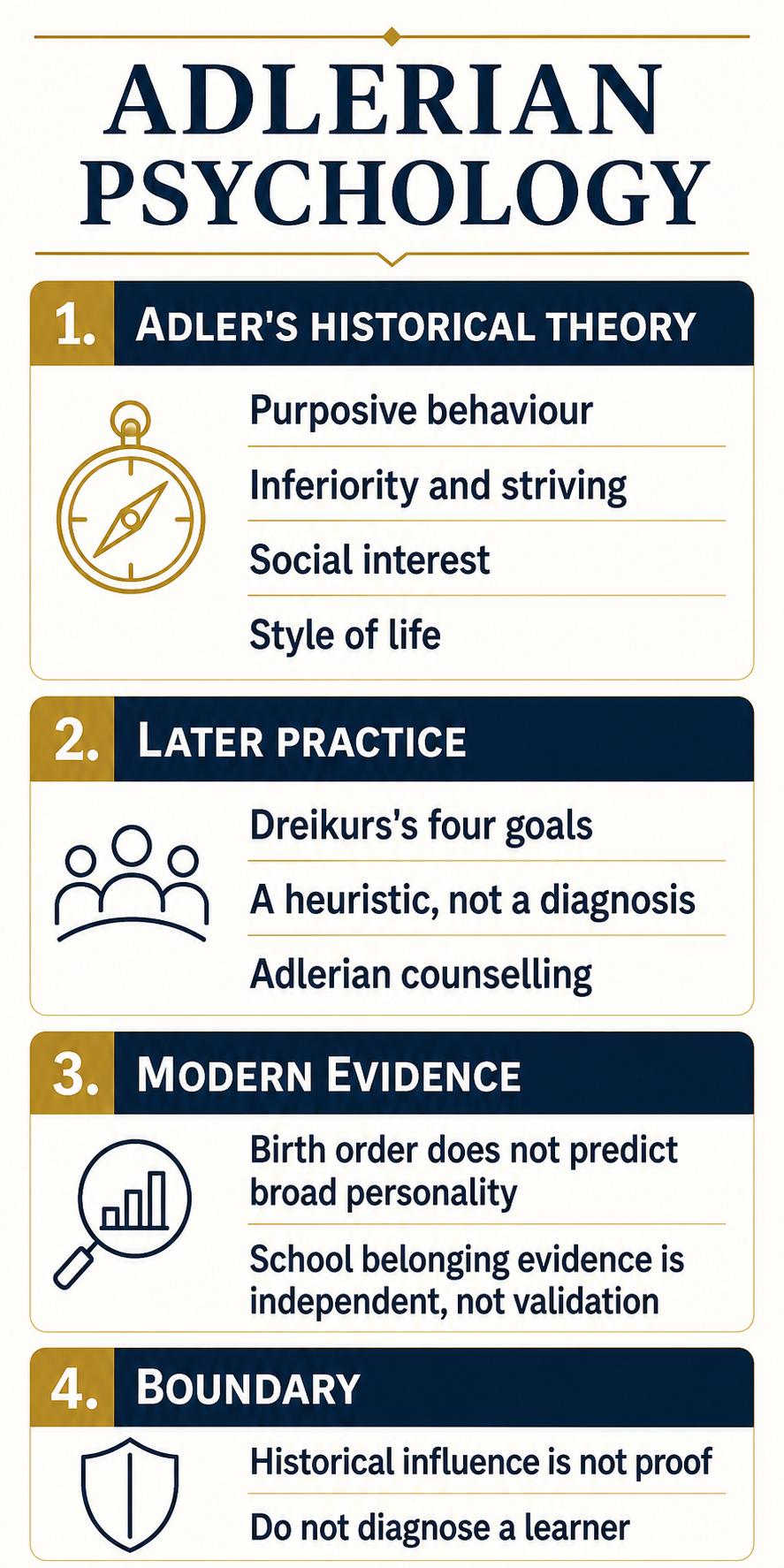
Adlerian Psychology. One, Adler's historical theory: purposive behaviour; inferiority and striving; social interest; style of life.
Two, later practice: Dreikurs's four goals; a heuristic, not a diagnosis; Adlerian counselling.
Three, modern evidence: birth order does not predict broad personality; school belonging evidence is independent, not validation.
Four, boundary: historical influence is not proof; do not diagnose a learner.
The word Adlerian covers several questions, so the evidence has no single verdict. A primary text can show what Adler wrote. It cannot show that his claim is true. A treatment study can test one defined form of therapy.
A belonging study can test links between measured factors. Neither type proves Individual Psychology as a whole.
Swipe horizontally to read the full table.
| Evidence layer | What it supports | What it does not support |
|---|---|---|
| Adler's primary works. | The content, terms and growth of Individual Psychology. | Modern causal claims, effect sizes or comparisons of treatments. |
| Dreikursian practice books. | The history of later Adlerian education and its proposed methods. | A tested four-goal diagnosis or proof that logical consequences work better. |
| Modern birth-order research. | A direct test of broad personality claims tied to family position. | All family relationships or every possible birth-order result. |
| Adlerian play-therapy studies. | Results for a set treatment, group and provider. | Teacher-led therapy, all mental-health conditions or the full theory. |
| School-belonging research. | Links and interventions involving a modern measured concept. | Proof of social interest, fictional finalism or all Individual Psychology. |
A small randomised controlled study tested manualised Adlerian play therapy, which followed a set guide. It involved 58 elementary-aged learners with hard-to-manage classroom behaviour. Teachers and blinded raters reported fewer behaviour problems. The authors reported moderate to large effects (Meany-Walen, Bratton and Kottman, 2014).
This is direct evidence, but it has a narrow scope. The study tested specialist therapy with one sample. It did not test normal teaching or birth-order readings. Nor did it test teacher-led lifestyle assessment or all Adlerian theory.
The study cannot support broad claims about depression or eating disorders. It also cannot support claims about substance misuse or every behaviour concern.
Modern school-belonging research gives education the strongest nearby evidence. Allen and colleagues combined 51 studies with 67,378 people. Teacher support and positive personal characteristics were among the strongest links with adolescent school belonging (Allen et al., 2018).
Another meta-analysis covered 82 correlational studies in secondary education. School belonging had positive links with motivational, social-emotional and behavioural outcomes. Its average link with academic results was small (Korpershoek et al., 2020).
These results give leaders reasons to review school ties and climate. They do not show that Adlerian ideas caused the links.
Individual Psychology has several important limits. Some core ideas are so flexible that they are hard to test. A large modern multi-cohort study did not support familiar birth-order personality types. Much early support came from cases, not controlled trials.
Later Adlerian practice needs its own evidence. Its language can also blame people who face wider barriers.
Testability is a central problem. A loose account can explain opposite acts after they occur. Speech may be read as a search for attention. Silence may be read as fear of failure.
Such claims risk going in a circle unless evidence can prove them wrong.
Some well-known claims have failed strong tests. Birth-order personality types are the clearest case. Large samples found no lasting effect on broad personality traits (Rohrer et al., 2015). This does not make family ties unimportant.
It shows that rank within a family is not a simple cause of personality.
Much of the historical evidence comes from cases. Adler's work helps readers recover his approach to education. The Education of Children is one such source (Adler, 1930/2015). It was not a controlled trial.
Claims that Adler proved gains in attainment, resilience or conduct go beyond that source.
Writers sometimes read later work back into Adler. Dreikurs, Positive Discipline writers and current therapists worked in other settings. Their methods need tests based on their own texts and results. A modern reference work can explain the history and influence of Individual Psychology.
It cannot prove that the approach works (Sabates, 2020).
Clinical claims must stay narrow. Reviews have compared Adlerian ideas with brain science and current social work. A fit between ideas is not proof (Miller and Dillman Taylor, 2016; McCluskey, 2022). The sources in this article do not support Individual Psychology as a full treatment for many diagnoses.
Words can turn an interpretation into blame. Distress may be called a chosen goal or a bid for power. That can hide structural disadvantage, trauma, illness or inaccessible teaching. It can also hide neurodevelopmental difference.
Historical ideas therefore need both ethical and cultural review.
Schools can teach Adlerian psychology as intellectual history. It raises questions about choice, purpose, community and social life. Schools cannot use it to read hidden aims or personality. Support needs direct evidence, fair assessment and proper routes.
Modern belonging evidence is relevant, but it does not prove Adler's theory.
Adler's work forms part of the history of psychology, therapy and education. His writing about children also belongs within child development theories. Historical value does not make a theory a guide to school behaviour.
Schools cannot infer attention, power or revenge from one act. They cannot diagnose an inferiority complex or read an early memory. Nor can they infer a style of life or predict personality from birth order.
These claims lack support and may hide better sources of evidence. Direct talk and study of context must come first. SEND support, safeguarding and skilled clinical care also have their own routes.
For leaders, the key question is not whether a school is Adlerian. The question is whether learners have fair ties, support and a real place in school life. Modern school-belonging research can inform that question. It does not prove social interest or the four mistaken goals.
A separate account of autonomy, competence and relatedness appears in self-determination theory. That evidence also does not confirm Adler's model.
These limits protect both study and practice. A theory can matter in history without becoming a behaviour policy. Nearby evidence can support good relationships without proving an older theory.
Adlerian psychology has no single rule or simple classroom method. Its concepts describe a whole person who moves towards goals in a social world. Freud placed more weight on other forms of conflict. Dreikurs later proposed four mistaken goals.
Evidence varies by claim, so teachers must not use the theory to diagnose learners.
No single principle sums up the theory, which says a person forms a style of life. That person then moves towards goals in a social world. Inferiority feelings, striving and social interest help Adler explain that movement. These are historical concepts, not proven causal laws.
Main concepts include holism and purposeful, or teleological, explanation. They also include inferiority feelings, compensation and striving for superiority. Social interest, fictional finalism and style of life are also central. Family constellation and early recollections became important in Adlerian assessment.
Adler stressed the whole person, social ties, compensation and movement towards goals. Classical Freudian theory focused more on instinct, psychosexual growth and inner conflict. Both accounts changed over time. The contrast should not be treated as absolute.
They are attention, power, revenge and assumed inadequacy. The groups come from Rudolf Dreikurs's later Adlerian account of misbehaviour. They are not four findings proved by Adler. Schools should not use them as a diagnostic list.
Current introductions often list engagement, assessment, insight and reorientation. This is a later way to organise Adlerian therapy. It is not a list of Adler's four main ideas. The four stages also do not prove that the treatment works.
Primary texts show what Adler proposed, but the answer changes with the claim. Strong modern evidence challenges broad birth-order personality claims. Small studies support some manualised forms of Adlerian play therapy. Belonging research supports ties and connection, but not Individual Psychology as a whole.
Teachers may study its history and ethical focus on dignity, contribution and community. They should not infer hidden goals or carry out lifestyle assessments. They should not interpret early memories or provide therapy. Support decisions need direct evidence, school processes and suitable expertise.
The sources include Adler's texts and later work cited here. They cover the history, birth order, early memories, play therapy and school belonging. Each supports only its linked claim. They do not test the same theory, group or type of evidence.
Adler, A. (1927). Understanding human nature. Greenberg. Internet Archive record.
Adler, A. (2015). Original work published 1930. The education of children. Routledge. https://doi.org/10.4324/9781315687933.
Dreikurs, R. (1968). Psychology in the classroom. Harper & Row.
Dreikurs, R., & Soltz, V. (1964). Children: The challenge. Hawthorn Books.
Allen, K., Kern, M. L., Vella-Brodrick, D., Hattie, J., & Waters, L. (2018). What schools need to know about fostering school belonging: A meta-analysis. Educational Psychology Review, 30, 1-34. https://doi.org/10.1007/s10648-016-9389-8.
Holmes, D. S., & Watson, R. I. (1965). Early recollection and vocational choice. Journal of Consulting Psychology, 29(5), 486-488. https://doi.org/10.1037/h0022516.
Korpershoek, H., Canrinus, E. T., Fokkens-Bruinsma, M., & de Boer, H. (2020). The relationships between school belonging and students' motivational, social-emotional, behavioural, and academic outcomes in secondary education: A meta-analytic review. Research Papers in Education, 35(6), 641-680. https://doi.org/10.1080/02671522.2019.1615116.
McCluskey, M. C. (2022). Revitalizing Alfred Adler: An echo for equality. Clinical Social Work Journal, 50(4), 387-399. https://doi.org/10.1007/s10615-021-00793-0.
Meany-Walen, K. K., Bratton, S. C., & Kottman, T. (2014). Effects of Adlerian play therapy on reducing students' disruptive behaviors. Journal of Counseling & Development, 92(1), 47-56. https://doi.org/10.1002/j.1556-6676.2014.00129.x.
Miller, R., & Dillman Taylor, D. (2016). Does Adlerian theory stand the test of time? Examining Individual Psychology from a neuroscience perspective. The Journal of Humanistic Counseling, 55(2), 111-128. https://doi.org/10.1002/johc.12028.
Rohrer, J. M., Egloff, B., & Schmukle, S. C. (2015). Examining the effects of birth order on personality. Proceedings of the National Academy of Sciences, 112(46), 14224-14229. https://doi.org/10.1073/pnas.1506451112.
Sabates, A. M. (2020). Individual Psychology of Alfred Adler. In The Wiley Encyclopedia of Personality and Individual Differences. Wiley. https://doi.org/10.1002/9781119547143.ch20.