Drive Reduction TheorySixth form students aged 17-18 in navy blazers and striped ties engage with Drive Reduction Theory using a model.

Updated on  

January 30, 2026

Drive Reduction Theory

|

July 19, 2023

Understand Drive Reduction Theory's role in shaping habits, motivation, and behavior. Learn how rewards and reinforcement influence our daily actions.

Course Enquiry
Copy citation

Main, P (2023, July 19). Drive Reduction Theory. Retrieved from https://www.structural-learning.com/post/drive-reduction-theory

What is drive reduction theory?

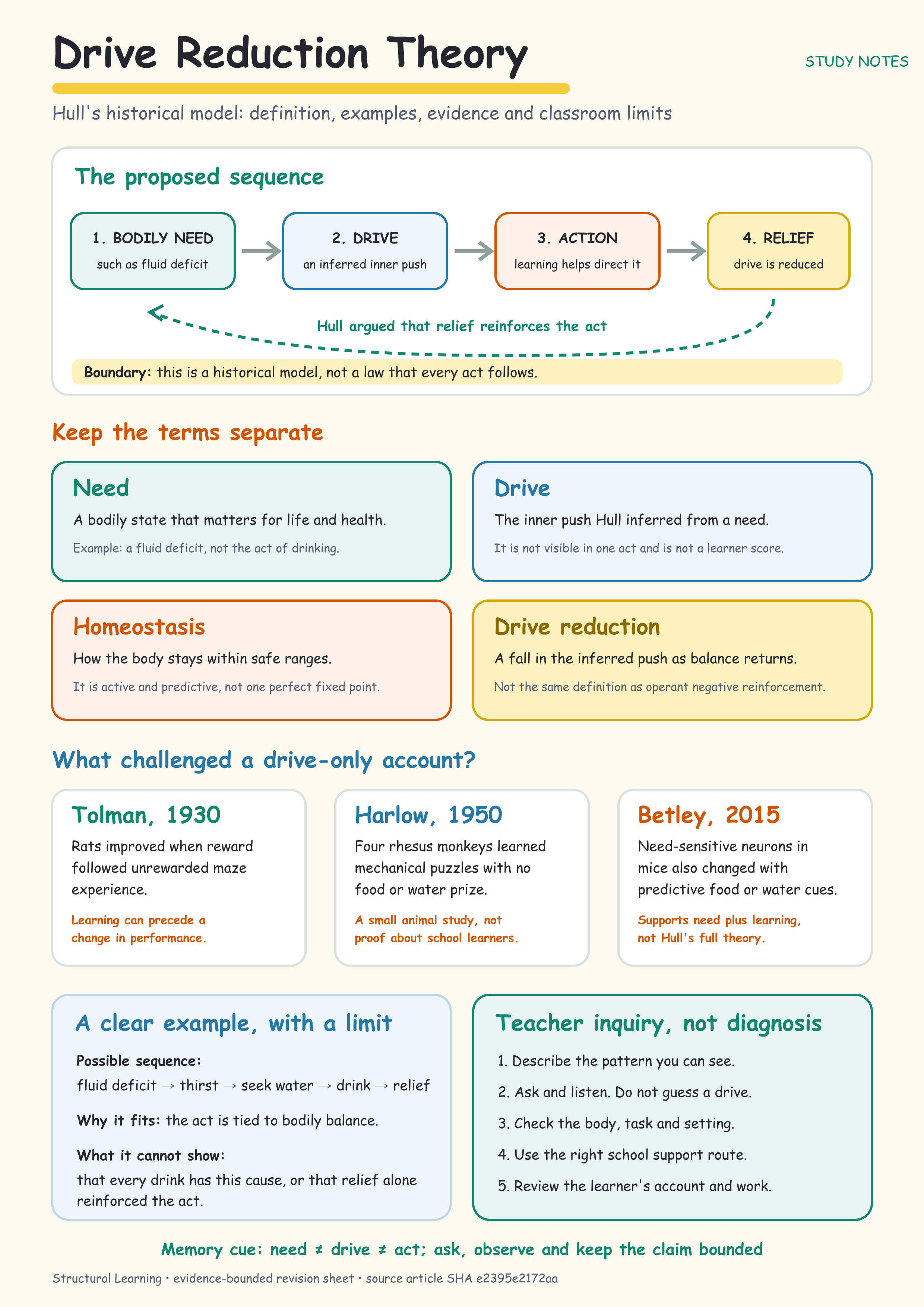
Theories of motivation often grapple with the question of what drives human behaviour. One such theory, the drive reduction theory, posits that our actions are fuelled by the need to alleviate internal tension or arousal levels.

Key Takeaways

  1. The Hidden CurriculumDriver: Why pupils who struggle with routines might be battling unmet physiological needs, and how recognising this transforms your classroom management approach
  2. Beyond Rewards and Sanctions: How drive reduction theory reveals why traditional behaviour systems fail certain pupils and what actually motivates lasting change
  3. The Homeostasis Classroom: Discover the overlooked connection between sensory environments, learning readiness, and why some pupils constantly seek movement or stimulation
  4. Decoding transformative Behaviour: What drive reduction theory tells us about attention-seeking: the surprising physiological needs behind challenging behaviours teachers often misinterpret

This tension, according to the theory, is generated by our physiological needs. When these needs are unmet, they create a state of discomfort, prompting us to engage in motivated behaviours that can satisfy these needs and restore equilibrium.

Five-step process showing how drive reduction theory works from need to satisfaction
How Drive Reduction Theory Works

This process is akin to a thermostat regulating temperature in a room. When the temperature deviates from a set point, the thermostat triggers the heating or cooling system to restore the optimal level. Similarly, when our physiological state deviates from the norm due to hunger, thirst, or sleep deprivation, we are driven to rectify this imbalance.

Circular diagram showing drive reduction theory cycle from physiological needs through behaviours to homeostasis
Cycle diagram with directional arrows: Drive Reduction Theory Feedback Loop

This is where the concept of homeostasis comes into play. Homeostasis is the body's mechanism to maintain a stable internal environment despite external factors.

The drive reduction theory also underscores the role of reinforcement in shaping our behaviours. When a behaviour leads to a desirable outcome, such as the reduction of hunger after eating, it is reinforced. This reinforcement increases the likelihood of the behaviour being repeated in the future. This is where the incentive theory and the theory of learning intersect with the drive reduction theory.

For instance, when we eat when we're hungry, the reduction of hunger and the subsequent feeling of satisfaction act as secondary reinforcers, strengthening the habit strength of eating when hungry. This is a clear example of how the drive reduction theory works.

However, note that this theory doesn't just propose that we're driven by the need to reduce discomfort. It also suggests that the reduction of these internal psychological needs leads to a state of relaxation and satisfaction, which we are inherently driven to achieve.

In a study published in Scientific Reports, researchers found that monkeys were intrinsically motivated to seek out and look at reward-predictive cues, driven by a desire to reduce uncertainty and obtain conditioned reinforcement from positive cues.

This study provides empirical support for the principles of drive reduction theory, demonstrating how it can be applied to understand human behaviour and the behaviour of other intelligent species.

Key insights from the drive reduction theory include:

  • The theory proposes that our behaviours are driven by the need to reduce internal tension or arousal, which is created by unmet physiological needs.
  • Reinforcement plays a crucial role in shaping our behaviours. Behaviours that lead to the reduction of internal tension are reinforced and are thus more likely to be repeated in the future.
  • The theory suggests that we are driven by the need to reduce discomfort and by the desire to achieve a state of relaxation and satisfaction.

As the renowned psychologist Abraham Maslow once said, "A musician must make music, an artist must paint, a poet must write, if he is to be ultimately at peace with himself. What a man can be, he must be." This quote encapsulates the essence of the drive reduction theory, highlighting how our behaviours are driven by our inherent needs and desires.

Who Created Drive Reduction Theory and When?

Drive reduction theory was developed by psychologist Clark Hull in the 1940s as part of his broader behaviourist approach to understanding motivation. Hull proposed that biological needs create drives that motivate organisms to engage in behaviours that reduce these drives and restore homeostasis. His work built upon earlier research by Woodworth and Cannon on drives and homeostasis.

The drive-reduction theory, developed by Clark L. Hull at Yale University, originated from a synthesis of various influential scientists and their theories. Hull was inspired by the groundbreaking work of John B. Watson, Ivan Pavlov, Edward Thorndike, and Charles Darwin.

Hull's theory was influenced by earlier motivation theories such as the behaviourist approach of Watson and Pavlov's classical conditioning. He also drew from Thorndike's law of effect, which stated that behaviours that are followed by positive consequences are more likely to be repeated. Additionally, Darwin's theory of natural selection and the concept of biological drives played a significant role in shaping the drive-reduction theory.

At its core, the drive-reduction theory is grounded in the principle of homeostasis. Homeostasis refers to the body's tendency to maintain a stable equilibrium by adjusting internal conditions.

Hull believed that when individuals experience biological needs, such as hunger or thirst, it creates a state of discomfort or tension. Motivated by the desire to restore homeostasis, individuals engage in behaviours to reduce these drives and achieve a state of relaxation and satisfaction.

Hull's drive-reduction theory originated from his integration of various theories and concepts from prominent scientists. Anchored in the principle of homeostasis, the theory suggests that motivation is driven by the desire to satisfy internal psychological needs and achieve a state of equilibrium.

Drive Reduction Theory of Motivation

How does drive-reduction theory explain human behaviour?

The drive-reduction theory offers an explanation for human behaviour by focusing on the role of internal drives and the motivation to satisfy them. According to this theory, individuals are motivated to engage in behaviours that reduce or satisfy their biological needs to achieve a state of homeostasis.

Primary drives, such as hunger, thirst, and sexual desire, are fundamental physiological needs that directly affect an individual's survival and well-being. These drives create a state of discomfort or tension, motivating individuals to engage in behaviours that will reduce or satisfy these needs.

For example, when experiencing hunger, an individual is motivated to seek food to satisfy this primary drive.

Secondary drives, on the other hand, are learned and acquired through socialization and personal experiences. These drives are not directly related to physiological needs but are still capable of motivating behaviour. Examples of secondary drives include the desire for success, achievement, social acceptance, and recognition.

The concept of homeostasis is crucial in drive-reduction theory. Homeostasis refers to the body's tendency to maintain a stable equilibrium by adjusting internal conditions. When individuals experience an increase in a primary or secondary drive, it disrupts the state of homeostasis, creating a state of discomfort.

Motivated by the desire to restore homeostasis, individuals engage in behaviours that reduce or satisfy these drives. For example, individuals may eat to reduce hunger and restore the body's energy balance.

the drive-reduction theory explains human behaviour by highlighting the motivating role of both primary and secondary drives. It emphasises the importance of achieving homeostatic equilibrium by engaging in behaviours that reduce or satisfy these drives.

By understanding these underlying motivations, we gain insights into why individuals engage in specific behaviours and how they strive for balance and satisfaction in their lives.

How Does Homeostasis Work in Drive Reduction Theory?

Homeostasis in drive reduction theory refers to the body's tendency to maintain stable internal conditions, and when these conditions are disrupted, it creates drives that motivate corrective behaviours. For example, when blood sugar drops, it creates a hunger drive that motivates eating to restore balance. This process works like a biological thermostat, constantly monitoring and adjusting to maintain optimal functioning.

Homeostasis plays a crucial role in Drive Reduction Theory as it functions as a regulatory mechanism to maintain internal equilibrium. It ensures that the body's physiological and psychological processes remain balanced and stable.

When individuals experience an increase in primary or secondary drives, homeostasis is disrupted, resulting in a state of discomfort or tension.

To restore homeostatic balance, individuals are motivated to engage in behaviours that reduce or satisfy these drives. This motivation arises from the discomfort caused by the imbalance. For example, when experiencing hunger, the body's blood sugar levels decrease, disrupting homeostasis. In response, individuals are driven to eat and restore the balance of blood sugar levels.

Homeostasis is achieved through the reduction of drives. By engaging in behaviours that address the unmet needs causing the drive, individuals restore their physiological or psychological balance.

When individuals eat to reduce hunger, for instance, they restore the body's energy balance, thereby reducing the drive. This reduction of the drive helps alleviate the discomfort or tension associated with the unmet need.

The importance of homeostasis in motivating behaviours that seek to satisfy unmet needs is evident in Drive Reduction Theory. By addressing the disrupted internal equilibrium, individuals are driven to alleviate the discomfort caused by the unmet needs. Homeostasis, therefore, acts as a powerful motivating force that directs individuals towards behaviours that restore balance and promote well-being.

Drive reduction theory definition

What Is the Difference Between Primary and Secondary Drives?

Primary drives are innate biological needs like hunger, thirst, and sleep that directly relate to survival and homeostasis. Secondary drives are learned through association with primary drives, such as the drive for money because it can purchase food. While primary drives are universal across humans, secondary drives vary based on individual experiences and cultural conditioning.

There are key distinctions between primary and secondary drives. Primary drives are physiological drives that are essential for survival and instinctually motivated. These drives include the need for food, water, and sleep. They are directly related to our biological needs and the maintenance of homeostasis. The motivation to satisfy these primary drives is strong, as they ensure our survival and well-being.

On the other hand, secondary drives are additional motivations that contribute to primary drives but are not directly related to biological needs.

These drives are learned and acquired through social and environmental factors. They are often based on cultural norms, personal experiences, and individual goals. Examples of secondary drives include the drive for success, achievement, recognition, wealth, and social acceptance.

While primary drives are essential for basic survival, secondary drives play a role in motivating behaviour beyond fulfiling basic physiological needs. These drives are shaped by cognitive processes and social factors.

They serve to fulfil psychological desires and aspirations, as well as to meet social expectations and obtain rewards. Although secondary drives may not be necessary for immediate survival, they can strongly influence our behaviour, choices, and goals.

primary drives are physiological drives that are essential for survival and directly related to biological needs. Secondary drives are additional motivations that contribute to primary drives and are influenced by cognitive and social factors.

Both primary and secondary drives play a significant role in driving behaviour and influencing human motivation.

What Are the Main Criticisms of Drive Reduction Theory?

Critics argue that drive reduction theory cannot explain behaviours that increase rather than decrease arousal, such as thrill-seeking or curiosity-driven exploration. The theory also fails to account for behaviours motivated by external incentives rather than internal drives, and doesn't explain why people engage in activities that don't reduce any apparent physiological need. Additionally, it overlooks cognitive and social factors that influence human motivation beyond basic biological drives.

One key critique of drive reduction theory is its reductionist approach. The theory focuses solely on the biological and physiological aspects of motivation, neglecting the influence of cognitive and social factors.

It fails to consider the role of thoughts, beliefs, and social interactions in motivating behaviour. By oversimplifying motivation as purely driven by the satisfaction of physiological needs, the theory overlooks the complexity and richness of human behaviour.

Another critique is that drive reduction theory assumes universal physiological needs. However, human needs and motivations are not solely determined by biological factors. Cultural, social, and individual differences play a significant role in shaping motivations.

The theory fails to account for the influence of cognitive processes and social factors in shaping behaviour. For instance, the theory cannot explain why individuals engage in risky activities such as participating in adventure sports or indulge in non-essential activities like eating when not hungry.

These critiques highlight the limitations of drive reduction theory in explaining behaviours unrelated to internal needs. The theory's exclusive focus on primary drives and the reduction of physiological tension restricts its explanatory power.

To fully understand human motivation, consider cognitive, social, and cultural factors that influence behaviour beyond the immediate satisfaction of physiological needs.


Exploring Real-Life Applications of Drive Reduction Theory

1. Drive Reduction Theory and Eating Habits

The drive reduction theory is a cornerstone in understanding human behaviour, especially in the context of physiological needs such as eating. When an individual experiences hunger, a physiological drive is activated, creating a state of discomfort.

This discomfort acts as a motivator, driving the individual to seek and consume food to alleviate the hunger. This behaviour is a prime example of the drive reduction theory in action, where the drive (hunger) leads to a behaviour (eating) that reduces the drive, thereby restoring a state of equilibrium.

2. Understanding Hydration through Drive Reduction Theory

Just as with hunger, the drive reduction theory can also explain our drinking behaviour. Dehydration triggers a physiological drive for water, creating a state of discomfort.

This discomfort motivates us to drink, thereby satisfying the drive and restoring our body's equilibrium. This example illustrates how the drive reduction theory can be applied to understand our basic survival behaviours.

3. Drive Reduction Theory in the Classroom

In an educational setting, the drive reduction theory can be used to understand student behaviour. For example, if a student is struggling with a difficult concept, this creates a state of discomfort or tension.

The drive to reduce this discomfort can motivate the student to seek help or study harder to understand the concept, thereby reducing the drive and restoring a state of equilibrium.

Drive reduction theory explains human motivations

4. Drive Reduction Theory and Exercise

Physical exercise can also be understood through the lens of the drive reduction theory. When we exercise, our bodies experience a physiological drive for oxygen and energy.

This drive creates a state of discomfort, which motivates us to breathe more heavily and consume more energy-rich foods. By doing so, we reduce the drive and restore our body's equilibrium.

5. Drive Reduction Theory and Sleep

Sleep is another behaviour that can be explained by the drive reduction theory. When we are tired, our bodies experience a physiological drive for rest. This drive creates a state of discomfort, which motivates us to sleep. By sleeping, we reduce the drive and restore our body's equilibrium.

6. Drive Reduction Theory and Social Interactions

Finally, the drive reduction theory can also be applied to understand our social behaviours. For example, when we feel lonely, this creates a psychological drive for social interaction. This drive motivates us to seek out social interactions to reduce the feeling of loneliness, thereby restoring our psychological equilibrium.

Key Insights:

  • The drive reduction theory provides a framework for understanding a wide range of human behaviours, from basic physiological needs like eating and drinking to more complex behaviours like studying and socializing.
  • Discomfort or tension created by a physiological or psychological drive motivates us to engage in behaviours that reduce the drive and restore a state of equilibrium.
  • The drive reduction theory can be applied in various real-life contexts, including education, exercise, and social interactions, providing valuable insights into human behaviour.

Drive Reduction and Arousal

What Is Drive Reduction Theory in Simple Terms?

Drive reduction theory states that when your body needs something (like food or water), it creates an uncomfortable feeling called a drive that motivates you to take action to meet that need. Once you satisfy the need, the uncomfortable feeling goes away, and your body returns to a balanced state. This cycle of need, drive, action, and satisfaction explains many of our daily behaviours and motivations.

  1. What's the connection between Drive Reduction Theory and habits? Drive Reduction Theory says that we form habits by doing things over and over again that makeus feel better. For example, if you're always hungry and then you eat, you feel better. So, you get into the habit of eating when you're hungry.
  2. What's the deal with rewards in Drive Reduction Theory? Rewards are super important in this theory. They're what motivate us to do things that make us feel better. For example, if you work hard and get a promotion, the higher salary is your reward. This makes you want to work hard again.
  3. What is reinforcement and why does it matter? Reinforcement is when you do something, and something good happens, so you want to do it again. In Drive Reduction Theory, because it helps us learn and form habits. For example, if you study hard and get good grades, you'll want to keep studying hard.
  4. How does Drive Reduction Theory explain why we do what we do? This theory says that we do things to satisfy our needs. For example, if you're thirsty, you drink water. If you're bored, you might read a book or watch TV. We're motivated to do these things because they reduce our 'drives' or needs.
  5. Can you give me an example of Drive Reduction Theory in action? Sure! Let's say you're really thirsty after playing soccer. That's your body's drive telling you it needs water. When you drink water, you're reducing that drive. If you always drink water after playing soccer, you'll form a habit.
  6. What's the role of rewards in this theory? Rewards are what motivate us to reduce our drives. For example, if you're hungry, the reward is feeling satisfied after eating. The more rewarding the action, the more likely we are to do it.
  7. Why is reinforcement important in this theory? Reinforcement is important because it strengthens our habits. If we do something and it reduces our drive, we're likely to do it again. This is how habits are formed.
  8. As for an academic source, check out this study on the subject. It's a bit complex, but it provides a lot of information on the topic.

    Any repeated behaviour that reduces a physiological need will become a learned habit.

    According to research by Wendy Wood and colleagues suggests that a substantial portion of our daily behaviours are habitual, performed automatically in response to environmental cues rather than through conscious decision-making.

    Drive reductiontheory shapes human behaviour" width="auto" height="auto" id="">
    Drive reduction theory shapes human behaviour

    What Are the Key Sources for Understanding Drive Reduction Theory?

    The foundational text is Clark Hull's 'Principles of Behavior' (1943), which first outlined the mathematical approach to drive reduction theory. Important related works include Kenneth Spence's extensions of Hull's theory and Neal Miller's research on learned drives and fear. Modern critiques and applications can be found in contemporary motivation textbooks and educational psychology journals.

    These references have been carefully selected to provide insight into the key concepts and theories related to this topic.

    1. Hull, C. L. (1943). Principles of Behavior: An Introduction to Behavior Theory. This seminal work by Clark L. Hull laid the foundation for Drive Reduction Theory. Hull proposed that behaviour is determined by the interplay of internal physiological drives and external incentives. He emphasised the importance of primary drives, such as hunger and thirst, and secondary drives, which are learned and linked to primary drives.

    2. Maslow, A. H. (1954). Motivation and Personality. Abraham Maslow's theory of motivation, often referred to as the hierarchy of needs, has significant implications for Drive Reduction Theory. Maslow identified five levels of human needs, starting with physiological needs, which align with primary drives. His theory suggests that fulfiling these needs drives behaviour and motivates individuals to reduce physiological tensions.

    Hull's work provides a comprehensive framework for understanding the role of primary and secondary drives, while Maslow's hierarchy of needsoffers a broader perspective on human motivation. We encourage further exploration of these references to deepen your understanding of this intriguing theory of motivation.

    3. Elkin, R. A., & Leippe, M. R. (1986). Physiological arousal, dissonance, and attitude change: evidence for a dissonance-arousal link and a "don't remind me" effect. Journal of Personality and Social Psychology, 51(1), 55-65. 

    Summary: The study explores cognitive dissonance as a drive state, suggesting that drive reduction can be achieved through cognitive changes or forgetting, providing evidence for a link between dissonance and arousal.

    Frequently Asked Questions

    What is drive reduction theory and how does it explain pupil behaviour in the classroom?

    Drive reduction theory explains that pupils' actions are motivated by the need to reduce internal tension created by unmet physiological needs like hunger, thirst, or sensory stimulation. When these basic needs aren't met, pupils experience discomfort that drives them to engage in behaviours to restore balance or homeostasis. Understanding this helps teachers recognise that transformative behaviour may stem from unaddressed physiological needs rather than deliberate defiance.

    How can teachers apply drive reduction theory to improve classroom management?

    Teachers can use drive reduction theory by first ensuring pupils' basic physiological needs are met before expecting optimal learning behaviour. This means considering factors like movement breaks for pupils who need sensory stimulation, ensuring proper ventilation and lighting, and recognising when challenging behaviour might indicate unmet needs. By addressing these underlying drives, teachers can create an environment where pupils are better able to focus and learn.

    Why do traditional reward and sanction systems sometimes fail with certain pupils according to drive reduction theory?

    Traditional behaviour systems often fail because they don't address the underlying physiological drives causing the behaviour in the first place. If a pupil is acting out due to unmet needs for movement or sensory input, rewards and punishments won't resolve the root cause of their discomfort. Drive reduction theory suggests that lasting behavioural change comes from satisfying these fundamental needs rather than simply applying external consequences.

    What practical strategiescan educators use to create a 'homeostasis classroom' environment?

    Educators can create a homeostasis classroom by paying attention to sensory environments, providing regular movement opportunities, and ensuring pupils' basic needs are met before learning begins. This might include flexible seating options, scheduled brain breaks, proper lighting and temperature control, and recognising individual pupils' sensory needs. The goal is to help pupils achieve and maintain their optimal state for learning.

    How does drive reduction theory help teachers understand attention-seeking behaviour differently?

    Drive reduction theory reveals that attention-seeking behaviour often masks unmet physiological needs rather than simple desire for disruption. Pupils may be seeking social connection, sensory stimulation, or trying to communicate discomfort they can't articulate. Teachers can respond more effectively by investigating what underlying need the behaviour might be attempting to satisfy rather than simply addressing the surface behaviour.

    What role does reinforcement play in drive reduction theory for educational settings?

    Reinforcement in drive reduction theory works by strengthening behaviours that successfully reduce internal tension or meet physiological needs. When pupils engage in positive behaviours that help them achieve homeostasis, such as asking for a movement break instead of disrupting class, these actions should be reinforced. This creates stronger neural pathways for appropriate need-meeting behaviours rather than problematic ones.

    How can parents support drive reduction principles at home to improve their child's school readiness?

    Parents can support drive reduction by establishing routines that meet their child's basic physiological needs before school, such as ensuring adequate sleep, proper nutrition, and sensory input. They should also help children recognise and communicate their needs appropriately rather than acting them out. Creating a calm, predictable home environment helps children start each school day in a state closer to homeostasis.

    Further Reading: Key Research Papers

    These peer-reviewed studies provide deeper insights into drive reduction theory and its application in educational settings.

    A model of effective teaching of economics in higher education: the integral role of classroom learning environment, instructional practices, and teacher characteristics 2 citations

    Yidana et al. (2024)

    This paper develops and tests a framework for effective economics teaching in higher education by examining how classroom environments, teaching practices, and instructor characteristics influence student learning. For teachers studying Drive Reduction Theory, this research demonstrates how environmental factors can either satisfy or create drives for learning, showing practical applications of motivational theory in educational settings.

    Research on infographics in flipped ESL classrooms 53 citations (Author, Year) examines student perceptions and academic achievements when visual information design is integrated into reversed learning environments, revealing insights into how multimedia presentations can enhance second language acquisition and learner engagement in technology-enhanced educational settings.

    Bicen et al. (2019)

    This study examines how infographics used in flipped classroom environments affect ESL students' learning perceptions and achievements in second language acquisition. Teachers can connect this to Drive Reduction Theory by understanding how visual learning tools and effective classroom formats can reduce students' anxiety drives while increasing their motivation to engage with challenging language learning tasks.

    Research on flipped classroom approaches for teacher preparation 54 citations (Author, Year) demonstrates how this effective pedagogical model can significantly enhance pre-service teachers' science self-efficacy and attitudes towards scientific learning, providing valuable insights for teacher education programmes seeking to improve confidence and engagement in STEM subjects.

    González-Gómez et al. (2019)

    This research investigates how flipped classroom methodology enhances pre-service teachers' science self-efficacy and attitudes toward science learning. The study is relevant to Drive Reduction Theory because it shows how effective teaching approaches can reduce teachers' anxiety drives about science instruction while building confidence, demonstrating how educational environments can address psychological needs that motivate learning behaviour.

    Development and validation of Online Classroom Learning Environment Inventory (OCLEI): The case of Indonesia during the COVID-19 pandemic 22 citations

    Rahayu et al. (2021)

    This paper describes the development of a tool to measure students' perceptions of online learning environments during the COVID-19 pandemic in Indonesia. For educators studying Drive Reduction Theory, this research illustrates how sudden environmental changes create new drives and needs in learners, and how measuring these psychological responses helps teachers understand what motivates students in digital learning contexts.

    This study examining Maslow's hierarchy theory and academic procrastination 18 citations (Author, Year) explores how addressing students' fundamental psychological needs can effectively reduce procrastination behaviours amongst university students, demonstrating the practical application of motivational theory in higher education settings.

    Muhibbin et al. (2020)

    This study explores how Maslow's hierarchy of needs theory can be applied to reduce academic procrastination among university students. Teachers will find this directly relevant to Drive Reduction Theory as both theories explain how unmet psychological needs create drives that influence behaviour, providing practical insights into addressing the underlying motivational factors behind student procrastination.

Loading audit...

What is drive reduction theory?

Theories of motivation often grapple with the question of what drives human behaviour. One such theory, the drive reduction theory, posits that our actions are fuelled by the need to alleviate internal tension or arousal levels.

Key Takeaways

  1. The Hidden CurriculumDriver: Why pupils who struggle with routines might be battling unmet physiological needs, and how recognising this transforms your classroom management approach
  2. Beyond Rewards and Sanctions: How drive reduction theory reveals why traditional behaviour systems fail certain pupils and what actually motivates lasting change
  3. The Homeostasis Classroom: Discover the overlooked connection between sensory environments, learning readiness, and why some pupils constantly seek movement or stimulation
  4. Decoding transformative Behaviour: What drive reduction theory tells us about attention-seeking: the surprising physiological needs behind challenging behaviours teachers often misinterpret

This tension, according to the theory, is generated by our physiological needs. When these needs are unmet, they create a state of discomfort, prompting us to engage in motivated behaviours that can satisfy these needs and restore equilibrium.

Five-step process showing how drive reduction theory works from need to satisfaction
How Drive Reduction Theory Works

This process is akin to a thermostat regulating temperature in a room. When the temperature deviates from a set point, the thermostat triggers the heating or cooling system to restore the optimal level. Similarly, when our physiological state deviates from the norm due to hunger, thirst, or sleep deprivation, we are driven to rectify this imbalance.

Circular diagram showing drive reduction theory cycle from physiological needs through behaviours to homeostasis
Cycle diagram with directional arrows: Drive Reduction Theory Feedback Loop

This is where the concept of homeostasis comes into play. Homeostasis is the body's mechanism to maintain a stable internal environment despite external factors.

The drive reduction theory also underscores the role of reinforcement in shaping our behaviours. When a behaviour leads to a desirable outcome, such as the reduction of hunger after eating, it is reinforced. This reinforcement increases the likelihood of the behaviour being repeated in the future. This is where the incentive theory and the theory of learning intersect with the drive reduction theory.

For instance, when we eat when we're hungry, the reduction of hunger and the subsequent feeling of satisfaction act as secondary reinforcers, strengthening the habit strength of eating when hungry. This is a clear example of how the drive reduction theory works.

However, note that this theory doesn't just propose that we're driven by the need to reduce discomfort. It also suggests that the reduction of these internal psychological needs leads to a state of relaxation and satisfaction, which we are inherently driven to achieve.

In a study published in Scientific Reports, researchers found that monkeys were intrinsically motivated to seek out and look at reward-predictive cues, driven by a desire to reduce uncertainty and obtain conditioned reinforcement from positive cues.

This study provides empirical support for the principles of drive reduction theory, demonstrating how it can be applied to understand human behaviour and the behaviour of other intelligent species.

Key insights from the drive reduction theory include:

  • The theory proposes that our behaviours are driven by the need to reduce internal tension or arousal, which is created by unmet physiological needs.
  • Reinforcement plays a crucial role in shaping our behaviours. Behaviours that lead to the reduction of internal tension are reinforced and are thus more likely to be repeated in the future.
  • The theory suggests that we are driven by the need to reduce discomfort and by the desire to achieve a state of relaxation and satisfaction.

As the renowned psychologist Abraham Maslow once said, "A musician must make music, an artist must paint, a poet must write, if he is to be ultimately at peace with himself. What a man can be, he must be." This quote encapsulates the essence of the drive reduction theory, highlighting how our behaviours are driven by our inherent needs and desires.

Who Created Drive Reduction Theory and When?

Drive reduction theory was developed by psychologist Clark Hull in the 1940s as part of his broader behaviourist approach to understanding motivation. Hull proposed that biological needs create drives that motivate organisms to engage in behaviours that reduce these drives and restore homeostasis. His work built upon earlier research by Woodworth and Cannon on drives and homeostasis.

The drive-reduction theory, developed by Clark L. Hull at Yale University, originated from a synthesis of various influential scientists and their theories. Hull was inspired by the groundbreaking work of John B. Watson, Ivan Pavlov, Edward Thorndike, and Charles Darwin.

Hull's theory was influenced by earlier motivation theories such as the behaviourist approach of Watson and Pavlov's classical conditioning. He also drew from Thorndike's law of effect, which stated that behaviours that are followed by positive consequences are more likely to be repeated. Additionally, Darwin's theory of natural selection and the concept of biological drives played a significant role in shaping the drive-reduction theory.

At its core, the drive-reduction theory is grounded in the principle of homeostasis. Homeostasis refers to the body's tendency to maintain a stable equilibrium by adjusting internal conditions.

Hull believed that when individuals experience biological needs, such as hunger or thirst, it creates a state of discomfort or tension. Motivated by the desire to restore homeostasis, individuals engage in behaviours to reduce these drives and achieve a state of relaxation and satisfaction.

Hull's drive-reduction theory originated from his integration of various theories and concepts from prominent scientists. Anchored in the principle of homeostasis, the theory suggests that motivation is driven by the desire to satisfy internal psychological needs and achieve a state of equilibrium.

Drive Reduction Theory of Motivation

How does drive-reduction theory explain human behaviour?

The drive-reduction theory offers an explanation for human behaviour by focusing on the role of internal drives and the motivation to satisfy them. According to this theory, individuals are motivated to engage in behaviours that reduce or satisfy their biological needs to achieve a state of homeostasis.

Primary drives, such as hunger, thirst, and sexual desire, are fundamental physiological needs that directly affect an individual's survival and well-being. These drives create a state of discomfort or tension, motivating individuals to engage in behaviours that will reduce or satisfy these needs.

For example, when experiencing hunger, an individual is motivated to seek food to satisfy this primary drive.

Secondary drives, on the other hand, are learned and acquired through socialization and personal experiences. These drives are not directly related to physiological needs but are still capable of motivating behaviour. Examples of secondary drives include the desire for success, achievement, social acceptance, and recognition.

The concept of homeostasis is crucial in drive-reduction theory. Homeostasis refers to the body's tendency to maintain a stable equilibrium by adjusting internal conditions. When individuals experience an increase in a primary or secondary drive, it disrupts the state of homeostasis, creating a state of discomfort.

Motivated by the desire to restore homeostasis, individuals engage in behaviours that reduce or satisfy these drives. For example, individuals may eat to reduce hunger and restore the body's energy balance.

the drive-reduction theory explains human behaviour by highlighting the motivating role of both primary and secondary drives. It emphasises the importance of achieving homeostatic equilibrium by engaging in behaviours that reduce or satisfy these drives.

By understanding these underlying motivations, we gain insights into why individuals engage in specific behaviours and how they strive for balance and satisfaction in their lives.

How Does Homeostasis Work in Drive Reduction Theory?

Homeostasis in drive reduction theory refers to the body's tendency to maintain stable internal conditions, and when these conditions are disrupted, it creates drives that motivate corrective behaviours. For example, when blood sugar drops, it creates a hunger drive that motivates eating to restore balance. This process works like a biological thermostat, constantly monitoring and adjusting to maintain optimal functioning.

Homeostasis plays a crucial role in Drive Reduction Theory as it functions as a regulatory mechanism to maintain internal equilibrium. It ensures that the body's physiological and psychological processes remain balanced and stable.

When individuals experience an increase in primary or secondary drives, homeostasis is disrupted, resulting in a state of discomfort or tension.

To restore homeostatic balance, individuals are motivated to engage in behaviours that reduce or satisfy these drives. This motivation arises from the discomfort caused by the imbalance. For example, when experiencing hunger, the body's blood sugar levels decrease, disrupting homeostasis. In response, individuals are driven to eat and restore the balance of blood sugar levels.

Homeostasis is achieved through the reduction of drives. By engaging in behaviours that address the unmet needs causing the drive, individuals restore their physiological or psychological balance.

When individuals eat to reduce hunger, for instance, they restore the body's energy balance, thereby reducing the drive. This reduction of the drive helps alleviate the discomfort or tension associated with the unmet need.

The importance of homeostasis in motivating behaviours that seek to satisfy unmet needs is evident in Drive Reduction Theory. By addressing the disrupted internal equilibrium, individuals are driven to alleviate the discomfort caused by the unmet needs. Homeostasis, therefore, acts as a powerful motivating force that directs individuals towards behaviours that restore balance and promote well-being.

Drive reduction theory definition

What Is the Difference Between Primary and Secondary Drives?

Primary drives are innate biological needs like hunger, thirst, and sleep that directly relate to survival and homeostasis. Secondary drives are learned through association with primary drives, such as the drive for money because it can purchase food. While primary drives are universal across humans, secondary drives vary based on individual experiences and cultural conditioning.

There are key distinctions between primary and secondary drives. Primary drives are physiological drives that are essential for survival and instinctually motivated. These drives include the need for food, water, and sleep. They are directly related to our biological needs and the maintenance of homeostasis. The motivation to satisfy these primary drives is strong, as they ensure our survival and well-being.

On the other hand, secondary drives are additional motivations that contribute to primary drives but are not directly related to biological needs.

These drives are learned and acquired through social and environmental factors. They are often based on cultural norms, personal experiences, and individual goals. Examples of secondary drives include the drive for success, achievement, recognition, wealth, and social acceptance.

While primary drives are essential for basic survival, secondary drives play a role in motivating behaviour beyond fulfiling basic physiological needs. These drives are shaped by cognitive processes and social factors.

They serve to fulfil psychological desires and aspirations, as well as to meet social expectations and obtain rewards. Although secondary drives may not be necessary for immediate survival, they can strongly influence our behaviour, choices, and goals.

primary drives are physiological drives that are essential for survival and directly related to biological needs. Secondary drives are additional motivations that contribute to primary drives and are influenced by cognitive and social factors.

Both primary and secondary drives play a significant role in driving behaviour and influencing human motivation.

What Are the Main Criticisms of Drive Reduction Theory?

Critics argue that drive reduction theory cannot explain behaviours that increase rather than decrease arousal, such as thrill-seeking or curiosity-driven exploration. The theory also fails to account for behaviours motivated by external incentives rather than internal drives, and doesn't explain why people engage in activities that don't reduce any apparent physiological need. Additionally, it overlooks cognitive and social factors that influence human motivation beyond basic biological drives.

One key critique of drive reduction theory is its reductionist approach. The theory focuses solely on the biological and physiological aspects of motivation, neglecting the influence of cognitive and social factors.

It fails to consider the role of thoughts, beliefs, and social interactions in motivating behaviour. By oversimplifying motivation as purely driven by the satisfaction of physiological needs, the theory overlooks the complexity and richness of human behaviour.

Another critique is that drive reduction theory assumes universal physiological needs. However, human needs and motivations are not solely determined by biological factors. Cultural, social, and individual differences play a significant role in shaping motivations.

The theory fails to account for the influence of cognitive processes and social factors in shaping behaviour. For instance, the theory cannot explain why individuals engage in risky activities such as participating in adventure sports or indulge in non-essential activities like eating when not hungry.

These critiques highlight the limitations of drive reduction theory in explaining behaviours unrelated to internal needs. The theory's exclusive focus on primary drives and the reduction of physiological tension restricts its explanatory power.

To fully understand human motivation, consider cognitive, social, and cultural factors that influence behaviour beyond the immediate satisfaction of physiological needs.


Exploring Real-Life Applications of Drive Reduction Theory

1. Drive Reduction Theory and Eating Habits

The drive reduction theory is a cornerstone in understanding human behaviour, especially in the context of physiological needs such as eating. When an individual experiences hunger, a physiological drive is activated, creating a state of discomfort.

This discomfort acts as a motivator, driving the individual to seek and consume food to alleviate the hunger. This behaviour is a prime example of the drive reduction theory in action, where the drive (hunger) leads to a behaviour (eating) that reduces the drive, thereby restoring a state of equilibrium.

2. Understanding Hydration through Drive Reduction Theory

Just as with hunger, the drive reduction theory can also explain our drinking behaviour. Dehydration triggers a physiological drive for water, creating a state of discomfort.

This discomfort motivates us to drink, thereby satisfying the drive and restoring our body's equilibrium. This example illustrates how the drive reduction theory can be applied to understand our basic survival behaviours.

3. Drive Reduction Theory in the Classroom

In an educational setting, the drive reduction theory can be used to understand student behaviour. For example, if a student is struggling with a difficult concept, this creates a state of discomfort or tension.

The drive to reduce this discomfort can motivate the student to seek help or study harder to understand the concept, thereby reducing the drive and restoring a state of equilibrium.

Drive reduction theory explains human motivations

4. Drive Reduction Theory and Exercise

Physical exercise can also be understood through the lens of the drive reduction theory. When we exercise, our bodies experience a physiological drive for oxygen and energy.

This drive creates a state of discomfort, which motivates us to breathe more heavily and consume more energy-rich foods. By doing so, we reduce the drive and restore our body's equilibrium.

5. Drive Reduction Theory and Sleep

Sleep is another behaviour that can be explained by the drive reduction theory. When we are tired, our bodies experience a physiological drive for rest. This drive creates a state of discomfort, which motivates us to sleep. By sleeping, we reduce the drive and restore our body's equilibrium.

6. Drive Reduction Theory and Social Interactions

Finally, the drive reduction theory can also be applied to understand our social behaviours. For example, when we feel lonely, this creates a psychological drive for social interaction. This drive motivates us to seek out social interactions to reduce the feeling of loneliness, thereby restoring our psychological equilibrium.

Key Insights:

  • The drive reduction theory provides a framework for understanding a wide range of human behaviours, from basic physiological needs like eating and drinking to more complex behaviours like studying and socializing.
  • Discomfort or tension created by a physiological or psychological drive motivates us to engage in behaviours that reduce the drive and restore a state of equilibrium.
  • The drive reduction theory can be applied in various real-life contexts, including education, exercise, and social interactions, providing valuable insights into human behaviour.

Drive Reduction and Arousal

What Is Drive Reduction Theory in Simple Terms?

Drive reduction theory states that when your body needs something (like food or water), it creates an uncomfortable feeling called a drive that motivates you to take action to meet that need. Once you satisfy the need, the uncomfortable feeling goes away, and your body returns to a balanced state. This cycle of need, drive, action, and satisfaction explains many of our daily behaviours and motivations.

  1. What's the connection between Drive Reduction Theory and habits? Drive Reduction Theory says that we form habits by doing things over and over again that makeus feel better. For example, if you're always hungry and then you eat, you feel better. So, you get into the habit of eating when you're hungry.
  2. What's the deal with rewards in Drive Reduction Theory? Rewards are super important in this theory. They're what motivate us to do things that make us feel better. For example, if you work hard and get a promotion, the higher salary is your reward. This makes you want to work hard again.
  3. What is reinforcement and why does it matter? Reinforcement is when you do something, and something good happens, so you want to do it again. In Drive Reduction Theory, because it helps us learn and form habits. For example, if you study hard and get good grades, you'll want to keep studying hard.
  4. How does Drive Reduction Theory explain why we do what we do? This theory says that we do things to satisfy our needs. For example, if you're thirsty, you drink water. If you're bored, you might read a book or watch TV. We're motivated to do these things because they reduce our 'drives' or needs.
  5. Can you give me an example of Drive Reduction Theory in action? Sure! Let's say you're really thirsty after playing soccer. That's your body's drive telling you it needs water. When you drink water, you're reducing that drive. If you always drink water after playing soccer, you'll form a habit.
  6. What's the role of rewards in this theory? Rewards are what motivate us to reduce our drives. For example, if you're hungry, the reward is feeling satisfied after eating. The more rewarding the action, the more likely we are to do it.
  7. Why is reinforcement important in this theory? Reinforcement is important because it strengthens our habits. If we do something and it reduces our drive, we're likely to do it again. This is how habits are formed.
  8. As for an academic source, check out this study on the subject. It's a bit complex, but it provides a lot of information on the topic.

    Any repeated behaviour that reduces a physiological need will become a learned habit.

    According to research by Wendy Wood and colleagues suggests that a substantial portion of our daily behaviours are habitual, performed automatically in response to environmental cues rather than through conscious decision-making.

    Drive reductiontheory shapes human behaviour" width="auto" height="auto" id="">
    Drive reduction theory shapes human behaviour

    What Are the Key Sources for Understanding Drive Reduction Theory?

    The foundational text is Clark Hull's 'Principles of Behavior' (1943), which first outlined the mathematical approach to drive reduction theory. Important related works include Kenneth Spence's extensions of Hull's theory and Neal Miller's research on learned drives and fear. Modern critiques and applications can be found in contemporary motivation textbooks and educational psychology journals.

    These references have been carefully selected to provide insight into the key concepts and theories related to this topic.

    1. Hull, C. L. (1943). Principles of Behavior: An Introduction to Behavior Theory. This seminal work by Clark L. Hull laid the foundation for Drive Reduction Theory. Hull proposed that behaviour is determined by the interplay of internal physiological drives and external incentives. He emphasised the importance of primary drives, such as hunger and thirst, and secondary drives, which are learned and linked to primary drives.

    2. Maslow, A. H. (1954). Motivation and Personality. Abraham Maslow's theory of motivation, often referred to as the hierarchy of needs, has significant implications for Drive Reduction Theory. Maslow identified five levels of human needs, starting with physiological needs, which align with primary drives. His theory suggests that fulfiling these needs drives behaviour and motivates individuals to reduce physiological tensions.

    Hull's work provides a comprehensive framework for understanding the role of primary and secondary drives, while Maslow's hierarchy of needsoffers a broader perspective on human motivation. We encourage further exploration of these references to deepen your understanding of this intriguing theory of motivation.

    3. Elkin, R. A., & Leippe, M. R. (1986). Physiological arousal, dissonance, and attitude change: evidence for a dissonance-arousal link and a "don't remind me" effect. Journal of Personality and Social Psychology, 51(1), 55-65. 

    Summary: The study explores cognitive dissonance as a drive state, suggesting that drive reduction can be achieved through cognitive changes or forgetting, providing evidence for a link between dissonance and arousal.

    Frequently Asked Questions

    What is drive reduction theory and how does it explain pupil behaviour in the classroom?

    Drive reduction theory explains that pupils' actions are motivated by the need to reduce internal tension created by unmet physiological needs like hunger, thirst, or sensory stimulation. When these basic needs aren't met, pupils experience discomfort that drives them to engage in behaviours to restore balance or homeostasis. Understanding this helps teachers recognise that transformative behaviour may stem from unaddressed physiological needs rather than deliberate defiance.

    How can teachers apply drive reduction theory to improve classroom management?

    Teachers can use drive reduction theory by first ensuring pupils' basic physiological needs are met before expecting optimal learning behaviour. This means considering factors like movement breaks for pupils who need sensory stimulation, ensuring proper ventilation and lighting, and recognising when challenging behaviour might indicate unmet needs. By addressing these underlying drives, teachers can create an environment where pupils are better able to focus and learn.

    Why do traditional reward and sanction systems sometimes fail with certain pupils according to drive reduction theory?

    Traditional behaviour systems often fail because they don't address the underlying physiological drives causing the behaviour in the first place. If a pupil is acting out due to unmet needs for movement or sensory input, rewards and punishments won't resolve the root cause of their discomfort. Drive reduction theory suggests that lasting behavioural change comes from satisfying these fundamental needs rather than simply applying external consequences.

    What practical strategiescan educators use to create a 'homeostasis classroom' environment?

    Educators can create a homeostasis classroom by paying attention to sensory environments, providing regular movement opportunities, and ensuring pupils' basic needs are met before learning begins. This might include flexible seating options, scheduled brain breaks, proper lighting and temperature control, and recognising individual pupils' sensory needs. The goal is to help pupils achieve and maintain their optimal state for learning.

    How does drive reduction theory help teachers understand attention-seeking behaviour differently?

    Drive reduction theory reveals that attention-seeking behaviour often masks unmet physiological needs rather than simple desire for disruption. Pupils may be seeking social connection, sensory stimulation, or trying to communicate discomfort they can't articulate. Teachers can respond more effectively by investigating what underlying need the behaviour might be attempting to satisfy rather than simply addressing the surface behaviour.

    What role does reinforcement play in drive reduction theory for educational settings?

    Reinforcement in drive reduction theory works by strengthening behaviours that successfully reduce internal tension or meet physiological needs. When pupils engage in positive behaviours that help them achieve homeostasis, such as asking for a movement break instead of disrupting class, these actions should be reinforced. This creates stronger neural pathways for appropriate need-meeting behaviours rather than problematic ones.

    How can parents support drive reduction principles at home to improve their child's school readiness?

    Parents can support drive reduction by establishing routines that meet their child's basic physiological needs before school, such as ensuring adequate sleep, proper nutrition, and sensory input. They should also help children recognise and communicate their needs appropriately rather than acting them out. Creating a calm, predictable home environment helps children start each school day in a state closer to homeostasis.

    Further Reading: Key Research Papers

    These peer-reviewed studies provide deeper insights into drive reduction theory and its application in educational settings.

    A model of effective teaching of economics in higher education: the integral role of classroom learning environment, instructional practices, and teacher characteristics 2 citations

    Yidana et al. (2024)

    This paper develops and tests a framework for effective economics teaching in higher education by examining how classroom environments, teaching practices, and instructor characteristics influence student learning. For teachers studying Drive Reduction Theory, this research demonstrates how environmental factors can either satisfy or create drives for learning, showing practical applications of motivational theory in educational settings.

    Research on infographics in flipped ESL classrooms 53 citations (Author, Year) examines student perceptions and academic achievements when visual information design is integrated into reversed learning environments, revealing insights into how multimedia presentations can enhance second language acquisition and learner engagement in technology-enhanced educational settings.

    Bicen et al. (2019)

    This study examines how infographics used in flipped classroom environments affect ESL students' learning perceptions and achievements in second language acquisition. Teachers can connect this to Drive Reduction Theory by understanding how visual learning tools and effective classroom formats can reduce students' anxiety drives while increasing their motivation to engage with challenging language learning tasks.

    Research on flipped classroom approaches for teacher preparation 54 citations (Author, Year) demonstrates how this effective pedagogical model can significantly enhance pre-service teachers' science self-efficacy and attitudes towards scientific learning, providing valuable insights for teacher education programmes seeking to improve confidence and engagement in STEM subjects.

    González-Gómez et al. (2019)

    This research investigates how flipped classroom methodology enhances pre-service teachers' science self-efficacy and attitudes toward science learning. The study is relevant to Drive Reduction Theory because it shows how effective teaching approaches can reduce teachers' anxiety drives about science instruction while building confidence, demonstrating how educational environments can address psychological needs that motivate learning behaviour.

    Development and validation of Online Classroom Learning Environment Inventory (OCLEI): The case of Indonesia during the COVID-19 pandemic 22 citations

    Rahayu et al. (2021)

    This paper describes the development of a tool to measure students' perceptions of online learning environments during the COVID-19 pandemic in Indonesia. For educators studying Drive Reduction Theory, this research illustrates how sudden environmental changes create new drives and needs in learners, and how measuring these psychological responses helps teachers understand what motivates students in digital learning contexts.

    This study examining Maslow's hierarchy theory and academic procrastination 18 citations (Author, Year) explores how addressing students' fundamental psychological needs can effectively reduce procrastination behaviours amongst university students, demonstrating the practical application of motivational theory in higher education settings.

    Muhibbin et al. (2020)

    This study explores how Maslow's hierarchy of needs theory can be applied to reduce academic procrastination among university students. Teachers will find this directly relevant to Drive Reduction Theory as both theories explain how unmet psychological needs create drives that influence behaviour, providing practical insights into addressing the underlying motivational factors behind student procrastination.

Big Ideas

Back to Blog

{"@context":"https://schema.org","@graph":[{"@type":"Article","@id":"https://www.structural-learning.com/post/drive-reduction-theory#article","headline":"Drive Reduction Theory","description":"Understand Drive Reduction Theory's role in shaping habits, motivation, and behavior. Learn how rewards and reinforcement influence our daily actions.","datePublished":"2023-07-19T09:28:32.041Z","dateModified":"2026-01-26T10:09:32.212Z","author":{"@type":"Person","name":"Paul Main","url":"https://www.structural-learning.com/team/paulmain","jobTitle":"Founder & Educational Consultant"},"publisher":{"@type":"Organization","name":"Structural Learning","url":"https://www.structural-learning.com","logo":{"@type":"ImageObject","url":"https://cdn.prod.website-files.com/5b69a01ba2e409e5d5e055c6/6040bf0426cb415ba2fc7882_newlogoblue.svg"}},"mainEntityOfPage":{"@type":"WebPage","@id":"https://www.structural-learning.com/post/drive-reduction-theory"},"image":"https://cdn.prod.website-files.com/5b69a01ba2e409501de055d1/69523f67813f8c75d0369028_69523f6543ac9a07f302b804_drive-reduction-theory-infographic.webp","wordCount":3979},{"@type":"BreadcrumbList","@id":"https://www.structural-learning.com/post/drive-reduction-theory#breadcrumb","itemListElement":[{"@type":"ListItem","position":1,"name":"Home","item":"https://www.structural-learning.com/"},{"@type":"ListItem","position":2,"name":"Blog","item":"https://www.structural-learning.com/blog"},{"@type":"ListItem","position":3,"name":"Drive Reduction Theory","item":"https://www.structural-learning.com/post/drive-reduction-theory"}]},{"@type":"FAQPage","@id":"https://www.structural-learning.com/post/drive-reduction-theory#faq","mainEntity":[{"@type":"Question","name":"What is drive reduction theory and how does it explain pupil behaviour in the classroom?","acceptedAnswer":{"@type":"Answer","text":"Drive reduction theory explains that pupils' actions are motivated by the need to reduce internal tension created by unmet physiological needs like hunger, thirst, or sensory stimulation. When these basic needs aren't met, pupils experience discomfort that drives them to engage in behaviours to rest"}},{"@type":"Question","name":"How can teachers apply drive reduction theory to improve classroom management?","acceptedAnswer":{"@type":"Answer","text":"Teachers can use drive reduction theory by first ensuring pupils' basic physiological needs are met before expecting optimal learning behaviour. This means considering factors like movement breaks for pupils who need sensory stimulation, ensuring proper ventilation and lighting, and recognising when"}},{"@type":"Question","name":"Why do traditional reward and sanction systems sometimes fail with certain pupils according to drive reduction theory?","acceptedAnswer":{"@type":"Answer","text":"Traditional behaviour systems often fail because they don't address the underlying physiological drives causing the behaviour in the first place. If a pupil is acting out due to unmet needs for movement or sensory input, rewards and punishments won't resolve the root cause of their discomfort. Drive"}},{"@type":"Question","name":"What practical strategies can educators use to create a 'homeostasis classroom' environment?","acceptedAnswer":{"@type":"Answer","text":"Educators can create a homeostasis classroom by paying attention to sensory environments, providing regular movement opportunities, and ensuring pupils' basic needs are met before learning begins. This might include flexible seating options, scheduled brain breaks, proper lighting and temperature co"}},{"@type":"Question","name":"How does drive reduction theory help teachers understand attention-seeking behaviour differently?","acceptedAnswer":{"@type":"Answer","text":"Drive reduction theory reveals that attention-seeking behaviour often masks unmet physiological needs rather than simple desire for disruption. Pupils may be seeking social connection, sensory stimulation, or trying to communicate discomfort they can't articulate. Teachers can respond more effective"}}]}]}