Herzberg's Two-Factor Theory
Explore Herzberg's Two-Factor Theory of Motivation, differentiating job satisfaction factors and their impact on workplace motivation and efficiency.


Explore Herzberg's Two-Factor Theory of Motivation, differentiating job satisfaction factors and their impact on workplace motivation and efficiency.
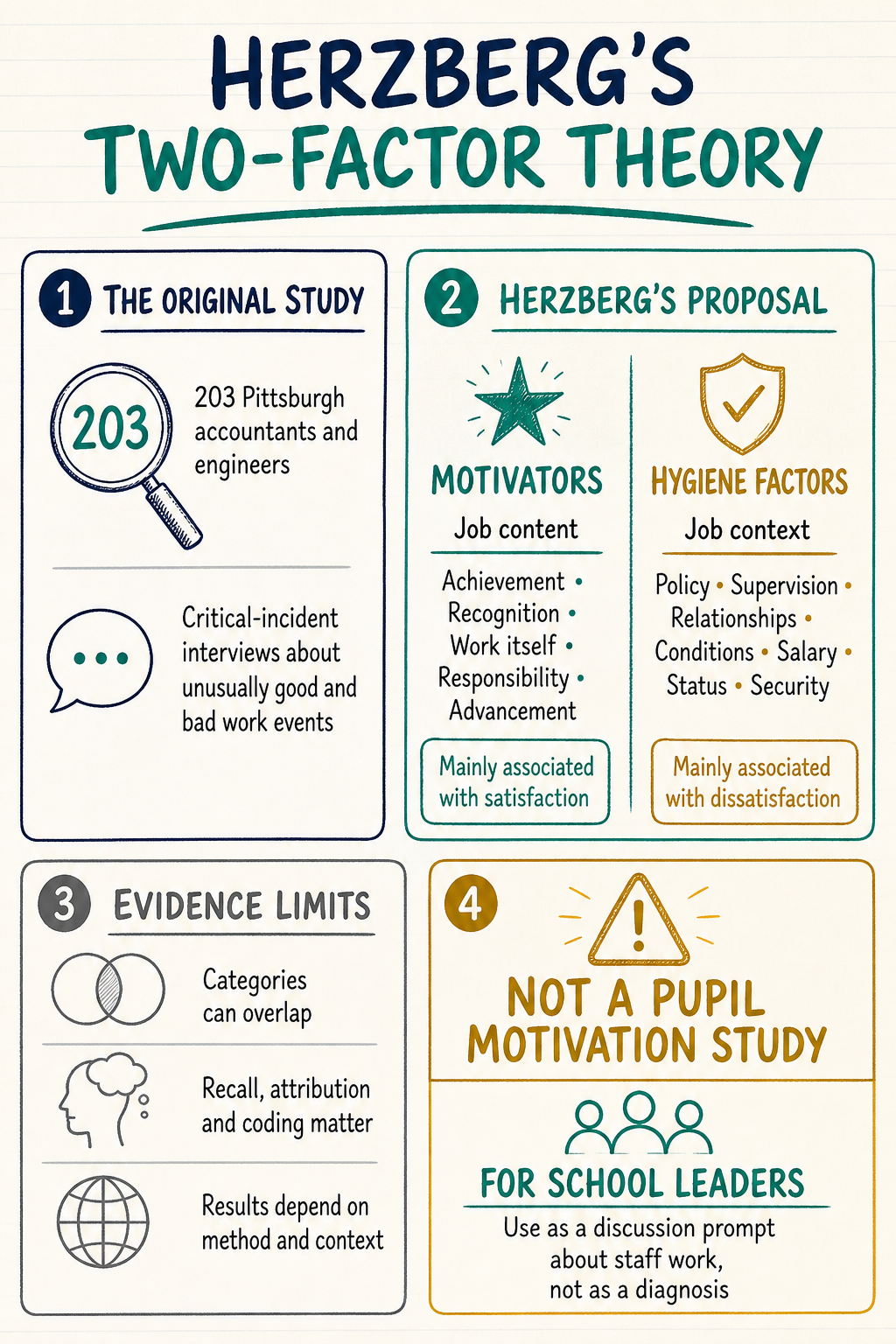
Herzberg's Two-Factor Theory, proposed by American psychologist Frederick Herzberg, is a well-known theory in the field of organisational behaviour. This theory suggests that there are two types of factors that influence job satisfaction: motivators and hygiene factors.
Motivators are the factors that lead to job satisfaction and motivation. These factors are directly related to the job itself and include things such as challenging work, recognition, responsibility, and opportunities for growth and development. When these motivators are present, they have the power to increase job satisfaction and overall motivation levels.

On the other hand, hygiene factors are the factors that are not directly related to the work itself but are necessary for an individual to feel comfortable and content in the workplace. These factors include company policies, interpersonal relations, salary, work conditions, and job security. When these hygiene factors are lacking or unsatisfactory, they can lead to job dissatisfaction.
According to Herzberg, motivators and hygiene factors are independent of each other. An increase in hygiene factors does not necessarily lead to increased motivation, but it can prevent job dissatisfaction. Conversely, an increase in motivators can lead to higher levels of motivation and job satisfaction.

Herzberg's Two-Factor Theory has been widely studied and has had a significant impact on the understanding of employee motivation and job satisfaction. It highlights the importance of not only addressing hygiene factors to prevent dissatisfaction but also focusing on providing motivators to enhance employee satisfaction, motivation, and productivity.
Overall, Herzberg's Two-Factor Theory provides valuable insights into the factors that contribute to employee job satisfaction and has practical implications for organisations seeking to create a positive and motivating work environment.
"It is not money that motivates us, but the love of money, the possibilities of what we can achieve with it.", Frederick Herzberg
Motivators are job-related factors that create satisfaction, including achievement, recognition, challenging work, and growth opportunities. Hygiene factors are environmental elements like salary, policies, and working conditions that prevent dissatisfaction but don't create motivation. These two categories work independently, meaning improving hygiene factors reduces dissatisfaction but doesn't increase motivation.
Motivation and job satisfaction are key factors in understanding employee engagement and productivity. American psychologist Frederick Herzberg's groundbreaking Two-Factor Theory examines into these aspects, shedding light on the intricate dynamics at play within organisations.

According to Herzberg, there are two types of factors that influence job satisfaction: motivators and hygiene factors. Motivators are directly tied to the nature of the work itself and contribute to job satisfaction. They encompass factors such as challenging tasks, recognition, opportunities for growth and development, and increased responsibilities. These motivators have the power to fuel intrinsic motivation and thereby enhance overall job satisfaction.
On the other hand, hygiene factors are not directly related to the work but set the stage for an individual's contentment in the workplace. These factors encompass company policies, interpersonal relations, salary, work conditions, and job security. When hygiene factors are inadequate or unsatisfactory, they can lead to job dissatisfaction and hinder overall motivation.
Herzberg's Two-Factor Theory highlights the following key elements:
Motivators: Fulfillment of motivators leads to increased job satisfaction and motivation.
Hygiene Factors: While their presence alone does not enhance motivation, their absence or inadequacy can lead to job dissatisfaction.
Understanding these factors and their impact on employee engagement is crucial for organisational success. As Herzberg aptly states, "If you want someone to do a good job, you have to give them a good job to do." focus not only on meeting hygiene factors to prevent dissatisfaction but also on providing motivating factors to creates satisfaction, motivation, and productivity.
Herzberg's Theory provides a fresh perspective on employee motivation and job satisfaction, emphasising the need to address both motivators and hygiene factors. Organizations that prioritise creating a positive and motivating work environment while attending to employee wellbeing are bound to reap the benefits in terms of increased engagement and productivity.
For school leaders and teachers, understanding Herzberg's Two-Factor Theory offers valuable insights into creating environments that creates both teacher satisfaction and student achievement. The distinction between motivators and hygiene factors becomes particularly relevant in educational contexts where teacher wellbeing directly impacts learning outcomes.
In practice, addressing hygiene factors might involve ensuring adequate classroom resources, fair administrative policies, competitive salaries, and safe working conditions. However, these alone will not create the motivated, passionate educators that students need. School leaders must also focus on motivators such as providing opportunities for professional development, recognising effective teaching practices, offering meaningful leadership responsibilities, and creating pathways for career advancement.
The theory also applies to student motivation. Just as teachers need both adequate working conditions and meaningful challenges, students require both a supportive learning environment (hygiene factors) and engaging, challenging work that promotes growth (motivators). This dual approach can transform classroom dynamics and improve educational outcomes across the board.
Teachers can apply Herzberg's principles by distinguishing between classroom hygiene factors (clear rules, safe environment, fair grading) and motivators (meaningful challenges, student autonomy, recognition of achievement). This framework helps teachers understand why removing negatives alone won't create engaged learners.
In the classroom context, hygiene factors include clear expectations, consistent routines, comfortable physical environment, and fair assessment practices. When these elements are absent or poorly managed, students experience dissatisfaction that blocks their ability to engage with learning. However, simply perfecting these environmental factors won't spark genuine motivation or love of learning.
True student motivation emerges from classroom motivators such as choice in learning activities, opportunities for creative expression, meaningful feedback on progress, and connections between curriculum and real-world applications. For instance, a Year 8 science teacher might maintain hygiene factors by ensuring lab safety protocols and clear marking criteria, whilst introducing motivators through student-designed experiments and peer teaching opportunities. Research by Hattie (2012) confirms that student autonomy and mastery-oriented feedback rank among the highest-impact strategies for achievement.
The most common mistake is focusing exclusively on hygiene factors whilst neglecting motivators, such as improving staff facilities without addressing professional development or recognition. Schools often invest in surface-level improvements that prevent dissatisfaction but fail to create genuine engagement or excellence.
Many school leaders mistakenly believe that addressing hygiene factors will automatically boost motivation. For example, renovating the staff room or increasing planning time removes sources of frustration but doesn't inherently make teaching more fulfiling. Similarly, raising teacher salaries addresses a hygiene factor but won't compensate for lack of autonomy, recognition, or growth opportunities.
Another frequent error involves treating all staff uniformly without recognising individual motivators. Whilst one teacher might value leadership opportunities, another might find motivation in curriculum innovation or mentoring roles. Effective implementation requires personalised approaches to professional development and recognition. Schools seeing the highest teacher retention rates typically combine strong hygiene factors (reasonable workload, supportive policies) with diverse motivator opportunities tailored to individual strengths and interests.
Research evidence for Herzberg's Two-Factor Theory presents a mixed picture that educational professionals must navigate carefully. While numerous workplace studies have supported the distinction between motivating factors and hygiene factors, replication attempts have yielded inconsistent results. King's analysis of educational settings found that teachers' intrinsic satisfaction often aligned with Herzberg's motivators, yet the rigid separation between motivator and hygiene factors proved less clear-cut in classroom environments than originally proposed.
The most significant criticism centres on Herzberg's methodology and its cultural specificity. Critics argue that his critical incident technique may have been influenced by social desirability bias, where participants attributed positive experiences to internal factors and negative ones to external circumstances. Furthermore, cross-cultural research suggests that the theory's applicability varies considerably across different educational contexts and cultural backgrounds, limiting its universal application in diverse learning environments.
Despite these limitations, educational practitioners can still derive valuable insights by treating Herzberg's framework as a diagnostic tool rather than absolute truth. When addressing student disengagement, consider both environmental factors (classroom conditions, resources) and intrinsic motivators (achievement recognition, meaningful learning opportunities). The theory's enduring value lies in encouraging educators to examine both dimensions of motivation systematically, even whilst acknowledging its empirical constraints.
Consider a secondary school mathematics department where teachers consistently struggle with student engagement despite excellent resources and modern facilities. Following Herzberg's framework, the hygiene factors are clearly met: students have access to quality textbooks, well-equipped classrooms, and fair assessment policies. However, motivation remains low because the motivator factors are absent. Students receive little recognition for progress, feel disconnected from the relevance of mathematical concepts, and perceive no sense of achievement beyond passing examinations.
A practical transformation occurred when the department introduced peer tutoring programmes, real-world problem-solving projects, and individualised progress celebrations. These changes directly addressed Herzberg's motivator factors by providing recognition, developing a sense of responsibility, and creating opportunities for personal growth. Student engagement increased significantly, not because the fundamental teaching conditions improved, but because intrinsic motivational elements were systematically integrated into daily practice.
Similarly, in primary education settings, teachers often focus heavily on maintaining positive classroom behaviour and adequate resources whilst overlooking the motivational impact of student autonomy and meaningful feedback. Effective practitioners recognise that whilst good hygiene factors prevent dissatisfaction, genuine educational engagement emerges when learners experience ownership of their learning journey, receive specific recognition for effort, and understand the personal significance of their academic progress.
While Abraham Maslow's hierarchy of needs suggests that motivation follows a sequential progression from basic physiological needs to self-actualisation, Herzberg's two-factor theory offers a more nuanced understanding of what truly drives performance in educational settings. Unlike Maslow's model, which implies that lower needs must be satisfied before higher ones become motivating, Herzberg demonstrates that hygiene factors and motivators operate independently. This distinction proves particularly valuable for educators, as it explains why improving classroom conditions (hygiene factors) may eliminate dissatisfaction but won't necessarily inspire engagement or achievement.
Edward Deci and Richard Ryan's self-determination theory shares common ground with Herzberg's motivators, particularly in emphasising autonomy, competence, and relatedness as intrinsic drivers. However, Herzberg's framework provides more practical guidance for educational leaders by clearly categorising workplace factors into preventative (hygiene) and promotional (motivator) elements. For instance, whilst self-determination theory identifies the importance of autonomy, Herzberg's model specifically highlights how recognition, responsibility, and opportunities for advancement serve as powerful motivators in teaching practice.
In classroom applications, this comparison suggests that educators should address basic environmental and policy concerns first, then focus on intrinsic motivators like meaningful work and professional growth to truly enhance performance and job satisfaction.
Herzberg's Two-Factor Theory remains a cornerstone of organisational psychology and offers profound insights for educational professionals. By recognising that satisfaction and dissatisfaction operate on separate continuums, educators and school leaders can develop more nuanced approaches to motivation and wellbeing. The theory challenges us to move beyond simply addressing problems (hygiene factors) to actively creating conditions for growth and fulfilment (motivators).
For teachers, this understanding can transform classroom practice, helping to create learning environments where students are not merely content but genuinely engaged and motivated to excel. For school leaders, it provides a framework for building sustainable, positive workplace cultures that retain talented educators and promote continuous improvement.
Ultimately, Herzberg's insights remind us that true motivation comes from within, but the right external conditions can either nurture or inhibit that intrinsic drive. In education, where the stakes are particularly high, applying these principles thoughtfully can make the difference between a thriving learning community and one that merely functions.
For those interested in exploring Herzberg's Two-Factor Theory in greater depth, the following research papers and studies provide valuable insights into its application and development:
1. Herzberg, F., Mausner, B., & Snyderman, B. B. (1959). The Motivation to Work. New York: John Wiley & Sons. The original study that established the Two-Factor Theory, based on extensive interviews with engineers and accountants.
2. Sachau, D. A. (2007). Resurrecting the motivation-hygiene theory: Herzberg and the positive psychology movement. Human Resource Development Review, 6(4), 377-393. A contemporary analysis connecting Herzberg's work to modern positive psychology research.
3. Bassett-Jones, N., & Lloyd, G. C. (2005). Does Herzberg's motivation theory have staying power? Journal of Management Development, 24(10), 929-943. An evaluation of the theory's continued relevance in modern workplace contexts.
4. Teck-Hong, T., & Waheed, A. (2011). Herzberg's motivation-hygiene theory and job satisfaction in the Malaysian retail sector: The mediating effect of love of money. Asian Academy of Management Journal, 16(1), 73-94. A cross-cultural examination of the theory's applications.
5. Madsen, S. R., Miller, D., & John, C. R. (2005). Readiness for organisational change: Do organisational commitment and social relationships in the workplace make a difference? Human Resource Development Quarterly, 16(2), 213-234. Research exploring how Herzberg's factors influence organisational change and development.
Herzberg's Two-Factor Theory, proposed by American psychologist Frederick Herzberg, is a well-known theory in the field of organisational behaviour. This theory suggests that there are two types of factors that influence job satisfaction: motivators and hygiene factors.
Motivators are the factors that lead to job satisfaction and motivation. These factors are directly related to the job itself and include things such as challenging work, recognition, responsibility, and opportunities for growth and development. When these motivators are present, they have the power to increase job satisfaction and overall motivation levels.

On the other hand, hygiene factors are the factors that are not directly related to the work itself but are necessary for an individual to feel comfortable and content in the workplace. These factors include company policies, interpersonal relations, salary, work conditions, and job security. When these hygiene factors are lacking or unsatisfactory, they can lead to job dissatisfaction.
According to Herzberg, motivators and hygiene factors are independent of each other. An increase in hygiene factors does not necessarily lead to increased motivation, but it can prevent job dissatisfaction. Conversely, an increase in motivators can lead to higher levels of motivation and job satisfaction.

Herzberg's Two-Factor Theory has been widely studied and has had a significant impact on the understanding of employee motivation and job satisfaction. It highlights the importance of not only addressing hygiene factors to prevent dissatisfaction but also focusing on providing motivators to enhance employee satisfaction, motivation, and productivity.
Overall, Herzberg's Two-Factor Theory provides valuable insights into the factors that contribute to employee job satisfaction and has practical implications for organisations seeking to create a positive and motivating work environment.
"It is not money that motivates us, but the love of money, the possibilities of what we can achieve with it.", Frederick Herzberg
Motivators are job-related factors that create satisfaction, including achievement, recognition, challenging work, and growth opportunities. Hygiene factors are environmental elements like salary, policies, and working conditions that prevent dissatisfaction but don't create motivation. These two categories work independently, meaning improving hygiene factors reduces dissatisfaction but doesn't increase motivation.
Motivation and job satisfaction are key factors in understanding employee engagement and productivity. American psychologist Frederick Herzberg's groundbreaking Two-Factor Theory examines into these aspects, shedding light on the intricate dynamics at play within organisations.

According to Herzberg, there are two types of factors that influence job satisfaction: motivators and hygiene factors. Motivators are directly tied to the nature of the work itself and contribute to job satisfaction. They encompass factors such as challenging tasks, recognition, opportunities for growth and development, and increased responsibilities. These motivators have the power to fuel intrinsic motivation and thereby enhance overall job satisfaction.
On the other hand, hygiene factors are not directly related to the work but set the stage for an individual's contentment in the workplace. These factors encompass company policies, interpersonal relations, salary, work conditions, and job security. When hygiene factors are inadequate or unsatisfactory, they can lead to job dissatisfaction and hinder overall motivation.
Herzberg's Two-Factor Theory highlights the following key elements:
Motivators: Fulfillment of motivators leads to increased job satisfaction and motivation.
Hygiene Factors: While their presence alone does not enhance motivation, their absence or inadequacy can lead to job dissatisfaction.
Understanding these factors and their impact on employee engagement is crucial for organisational success. As Herzberg aptly states, "If you want someone to do a good job, you have to give them a good job to do." focus not only on meeting hygiene factors to prevent dissatisfaction but also on providing motivating factors to creates satisfaction, motivation, and productivity.
Herzberg's Theory provides a fresh perspective on employee motivation and job satisfaction, emphasising the need to address both motivators and hygiene factors. Organizations that prioritise creating a positive and motivating work environment while attending to employee wellbeing are bound to reap the benefits in terms of increased engagement and productivity.
For school leaders and teachers, understanding Herzberg's Two-Factor Theory offers valuable insights into creating environments that creates both teacher satisfaction and student achievement. The distinction between motivators and hygiene factors becomes particularly relevant in educational contexts where teacher wellbeing directly impacts learning outcomes.
In practice, addressing hygiene factors might involve ensuring adequate classroom resources, fair administrative policies, competitive salaries, and safe working conditions. However, these alone will not create the motivated, passionate educators that students need. School leaders must also focus on motivators such as providing opportunities for professional development, recognising effective teaching practices, offering meaningful leadership responsibilities, and creating pathways for career advancement.
The theory also applies to student motivation. Just as teachers need both adequate working conditions and meaningful challenges, students require both a supportive learning environment (hygiene factors) and engaging, challenging work that promotes growth (motivators). This dual approach can transform classroom dynamics and improve educational outcomes across the board.
Teachers can apply Herzberg's principles by distinguishing between classroom hygiene factors (clear rules, safe environment, fair grading) and motivators (meaningful challenges, student autonomy, recognition of achievement). This framework helps teachers understand why removing negatives alone won't create engaged learners.
In the classroom context, hygiene factors include clear expectations, consistent routines, comfortable physical environment, and fair assessment practices. When these elements are absent or poorly managed, students experience dissatisfaction that blocks their ability to engage with learning. However, simply perfecting these environmental factors won't spark genuine motivation or love of learning.
True student motivation emerges from classroom motivators such as choice in learning activities, opportunities for creative expression, meaningful feedback on progress, and connections between curriculum and real-world applications. For instance, a Year 8 science teacher might maintain hygiene factors by ensuring lab safety protocols and clear marking criteria, whilst introducing motivators through student-designed experiments and peer teaching opportunities. Research by Hattie (2012) confirms that student autonomy and mastery-oriented feedback rank among the highest-impact strategies for achievement.
The most common mistake is focusing exclusively on hygiene factors whilst neglecting motivators, such as improving staff facilities without addressing professional development or recognition. Schools often invest in surface-level improvements that prevent dissatisfaction but fail to create genuine engagement or excellence.
Many school leaders mistakenly believe that addressing hygiene factors will automatically boost motivation. For example, renovating the staff room or increasing planning time removes sources of frustration but doesn't inherently make teaching more fulfiling. Similarly, raising teacher salaries addresses a hygiene factor but won't compensate for lack of autonomy, recognition, or growth opportunities.
Another frequent error involves treating all staff uniformly without recognising individual motivators. Whilst one teacher might value leadership opportunities, another might find motivation in curriculum innovation or mentoring roles. Effective implementation requires personalised approaches to professional development and recognition. Schools seeing the highest teacher retention rates typically combine strong hygiene factors (reasonable workload, supportive policies) with diverse motivator opportunities tailored to individual strengths and interests.
Research evidence for Herzberg's Two-Factor Theory presents a mixed picture that educational professionals must navigate carefully. While numerous workplace studies have supported the distinction between motivating factors and hygiene factors, replication attempts have yielded inconsistent results. King's analysis of educational settings found that teachers' intrinsic satisfaction often aligned with Herzberg's motivators, yet the rigid separation between motivator and hygiene factors proved less clear-cut in classroom environments than originally proposed.
The most significant criticism centres on Herzberg's methodology and its cultural specificity. Critics argue that his critical incident technique may have been influenced by social desirability bias, where participants attributed positive experiences to internal factors and negative ones to external circumstances. Furthermore, cross-cultural research suggests that the theory's applicability varies considerably across different educational contexts and cultural backgrounds, limiting its universal application in diverse learning environments.
Despite these limitations, educational practitioners can still derive valuable insights by treating Herzberg's framework as a diagnostic tool rather than absolute truth. When addressing student disengagement, consider both environmental factors (classroom conditions, resources) and intrinsic motivators (achievement recognition, meaningful learning opportunities). The theory's enduring value lies in encouraging educators to examine both dimensions of motivation systematically, even whilst acknowledging its empirical constraints.
Consider a secondary school mathematics department where teachers consistently struggle with student engagement despite excellent resources and modern facilities. Following Herzberg's framework, the hygiene factors are clearly met: students have access to quality textbooks, well-equipped classrooms, and fair assessment policies. However, motivation remains low because the motivator factors are absent. Students receive little recognition for progress, feel disconnected from the relevance of mathematical concepts, and perceive no sense of achievement beyond passing examinations.
A practical transformation occurred when the department introduced peer tutoring programmes, real-world problem-solving projects, and individualised progress celebrations. These changes directly addressed Herzberg's motivator factors by providing recognition, developing a sense of responsibility, and creating opportunities for personal growth. Student engagement increased significantly, not because the fundamental teaching conditions improved, but because intrinsic motivational elements were systematically integrated into daily practice.
Similarly, in primary education settings, teachers often focus heavily on maintaining positive classroom behaviour and adequate resources whilst overlooking the motivational impact of student autonomy and meaningful feedback. Effective practitioners recognise that whilst good hygiene factors prevent dissatisfaction, genuine educational engagement emerges when learners experience ownership of their learning journey, receive specific recognition for effort, and understand the personal significance of their academic progress.
While Abraham Maslow's hierarchy of needs suggests that motivation follows a sequential progression from basic physiological needs to self-actualisation, Herzberg's two-factor theory offers a more nuanced understanding of what truly drives performance in educational settings. Unlike Maslow's model, which implies that lower needs must be satisfied before higher ones become motivating, Herzberg demonstrates that hygiene factors and motivators operate independently. This distinction proves particularly valuable for educators, as it explains why improving classroom conditions (hygiene factors) may eliminate dissatisfaction but won't necessarily inspire engagement or achievement.
Edward Deci and Richard Ryan's self-determination theory shares common ground with Herzberg's motivators, particularly in emphasising autonomy, competence, and relatedness as intrinsic drivers. However, Herzberg's framework provides more practical guidance for educational leaders by clearly categorising workplace factors into preventative (hygiene) and promotional (motivator) elements. For instance, whilst self-determination theory identifies the importance of autonomy, Herzberg's model specifically highlights how recognition, responsibility, and opportunities for advancement serve as powerful motivators in teaching practice.
In classroom applications, this comparison suggests that educators should address basic environmental and policy concerns first, then focus on intrinsic motivators like meaningful work and professional growth to truly enhance performance and job satisfaction.
Herzberg's Two-Factor Theory remains a cornerstone of organisational psychology and offers profound insights for educational professionals. By recognising that satisfaction and dissatisfaction operate on separate continuums, educators and school leaders can develop more nuanced approaches to motivation and wellbeing. The theory challenges us to move beyond simply addressing problems (hygiene factors) to actively creating conditions for growth and fulfilment (motivators).
For teachers, this understanding can transform classroom practice, helping to create learning environments where students are not merely content but genuinely engaged and motivated to excel. For school leaders, it provides a framework for building sustainable, positive workplace cultures that retain talented educators and promote continuous improvement.
Ultimately, Herzberg's insights remind us that true motivation comes from within, but the right external conditions can either nurture or inhibit that intrinsic drive. In education, where the stakes are particularly high, applying these principles thoughtfully can make the difference between a thriving learning community and one that merely functions.
For those interested in exploring Herzberg's Two-Factor Theory in greater depth, the following research papers and studies provide valuable insights into its application and development:
1. Herzberg, F., Mausner, B., & Snyderman, B. B. (1959). The Motivation to Work. New York: John Wiley & Sons. The original study that established the Two-Factor Theory, based on extensive interviews with engineers and accountants.
2. Sachau, D. A. (2007). Resurrecting the motivation-hygiene theory: Herzberg and the positive psychology movement. Human Resource Development Review, 6(4), 377-393. A contemporary analysis connecting Herzberg's work to modern positive psychology research.
3. Bassett-Jones, N., & Lloyd, G. C. (2005). Does Herzberg's motivation theory have staying power? Journal of Management Development, 24(10), 929-943. An evaluation of the theory's continued relevance in modern workplace contexts.
4. Teck-Hong, T., & Waheed, A. (2011). Herzberg's motivation-hygiene theory and job satisfaction in the Malaysian retail sector: The mediating effect of love of money. Asian Academy of Management Journal, 16(1), 73-94. A cross-cultural examination of the theory's applications.
5. Madsen, S. R., Miller, D., & John, C. R. (2005). Readiness for organisational change: Do organisational commitment and social relationships in the workplace make a difference? Human Resource Development Quarterly, 16(2), 213-234. Research exploring how Herzberg's factors influence organisational change and development.
{"@context":"https://schema.org","@graph":[{"@type":"Article","@id":"https://www.structural-learning.com/post/herzbergs-two-factor-theory#article","headline":"Herzberg's Two-Factor Theory","description":"Explore Herzberg's Two-Factor Theory of Motivation, differentiating job satisfaction factors and their impact on workplace motivation and efficiency.","datePublished":"2023-11-13T16:31:37.523Z","dateModified":"2026-01-26T10:09:32.212Z","author":{"@type":"Person","name":"Paul Main","url":"https://www.structural-learning.com/team/paulmain","jobTitle":"Founder & Educational Consultant"},"publisher":{"@type":"Organization","name":"Structural Learning","url":"https://www.structural-learning.com","logo":{"@type":"ImageObject","url":"https://cdn.prod.website-files.com/5b69a01ba2e409e5d5e055c6/6040bf0426cb415ba2fc7882_newlogoblue.svg"}},"mainEntityOfPage":{"@type":"WebPage","@id":"https://www.structural-learning.com/post/herzbergs-two-factor-theory"},"image":"https://cdn.prod.website-files.com/5b69a01ba2e409501de055d1/69513d030761a66898c90d6a_9afxms.webp","wordCount":4271},{"@type":"BreadcrumbList","@id":"https://www.structural-learning.com/post/herzbergs-two-factor-theory#breadcrumb","itemListElement":[{"@type":"ListItem","position":1,"name":"Home","item":"https://www.structural-learning.com/"},{"@type":"ListItem","position":2,"name":"Blog","item":"https://www.structural-learning.com/blog"},{"@type":"ListItem","position":3,"name":"Herzberg's Two-Factor Theory","item":"https://www.structural-learning.com/post/herzbergs-two-factor-theory"}]},{"@type":"FAQPage","@id":"https://www.structural-learning.com/post/herzbergs-two-factor-theory#faq","mainEntity":[{"@type":"Question","name":"What is the key difference between motivators and hygiene factors in Herzberg's Two-Factor Theory?","acceptedAnswer":{"@type":"Answer","text":"Motivators are job-related factors like challenging work, recognition, and growth opportunities that directly create satisfaction and motivation. Hygiene factors are environmental elements such as salary, policies, and working conditions that prevent dissatisfaction but don't actually increase motiv"}},{"@type":"Question","name":"How can school leaders use Herzberg's theory to improve teacher retention rather than just offering pay rises?","acceptedAnswer":{"@type":"Answer","text":"School leaders should focus on providing motivators such as meaningful responsibilities, professional development opportunities, and recognition for achievements, as these create genuine job satisfaction. Simply improving hygiene factors like salary may prevent dissatisfaction but won't increase mot"}},{"@type":"Question","name":"What are some practical examples of motivators that cost nothing but can transform teaching performance?","acceptedAnswer":{"@type":"Answer","text":"Cost-free motivators include giving teachers challenging projects, providing public recognition for their achievements, offering opportunities for professional growth, and increasing their autonomy in"}},{"@type":"Question","name":"Why might traditional staff wellbeing surveys miss the mark according to Herzberg's theory?","acceptedAnswer":{"@type":"Answer","text":"Traditional wellbeing surveys often focus on hygiene factors like working conditions and policies, which only prevent dissatisfaction rather than create motivation. To truly improve teacher morale, schools need to identify and address motivating factors that relate to the actual work of teaching and"}},{"@type":"Question","name":"How can understanding motivators versus hygiene factors help teachers improve student outcomes in the classroom?","acceptedAnswer":{"@type":"Answer","text":"When teachers experience genuine motivators like meaningful work and growth opportunities, their increased job satisfaction and motivation directly translates to better classroom performance and student engagement. Addressing only hygiene factors keeps teachers comfortable but doesn't inspire the pa"}}]}]}