Updated on
September 24, 2026
CPOMS Safeguarding Guide: Logging, Access and DSL Workflows
CPOMS is safeguarding software for recording concerns, building chronologies and supporting DSL decisions. See what school staff can log, access and review.

Updated on
September 24, 2026
CPOMS is safeguarding software for recording concerns, building chronologies and supporting DSL decisions. See what school staff can log, access and review.
CPOMS Safeguarding Software: What Teachers Should Know describes a secure digital system used by schools to record, review and share safeguarding concerns about learners. In England, teachers must follow Keeping Children Safe in Education when they pass on concerns, and current guidance stresses that all staff should know how to report worries quickly (Department for Education, 2025).
In practice, CPOMS helps a form tutor log that a Year 7 learner has arrived hungry on three Mondays, while a PE teacher records a separate bruise and a lunchtime supervisor notes social withdrawal. The value is not the software alone. It is the clearer timeline it gives the Designated Safeguarding Lead, so small classroom observations can be checked, challenged and acted on before risk is missed.
CPOMS (Child Protection Online Management System) is a digital platform that helps schools record, monitor, and manage safeguarding incidents involving learners. It replaces paper records with a secure online database. The system tracks patterns of concern, supports early intervention, and keeps vital safeguarding information with learners if they change schools. Schools use it to record everything from minor concerns to serious child protection issues in one central, searchable system.
Every child deserves a safe place to learn. They should feel valued, supported and cared for. This means every child should have high-quality education and chances to develop their potential.
CPOMS (Child Protection Online Management System) is a secure system for recording safeguarding and pastoral information. Schools use it to log concerns, incidents, actions and follow-up notes about learners. It should support the school's statutory safeguarding procedures, not replace them.
CPOMS is part of Raptor Technologies, a US school safety software company that bought CPOMS in 2021 (Thoma Bravo, 2021). This ownership matters for headteachers because the school is still the data controller for learners' safeguarding records. Before buying or renewing, leaders should check hosting locations, processor terms, sub-processors, international transfer safeguards and incident notification duties.
Schools can share safeguarding information with parents, social workers, police officers and other agencies when there is a lawful reason to do so. Staff should avoid using CPOMS as a performance dashboard. Its main purpose is to preserve an accurate child protection chronology, support proportionate information sharing and help senior leaders see whether concerns are being followed up.
Schools use CPOMS because it turns scattered incident notes into useful safeguarding information, helping staff identify at-risk learners before situations get worse. The system saves staff time by automating reports and keeping events in date order. This helps schools avoid missed concerns and meet their legal safeguarding duties. Most importantly, it builds a full safeguarding history, which can show patterns that paper systems might miss.
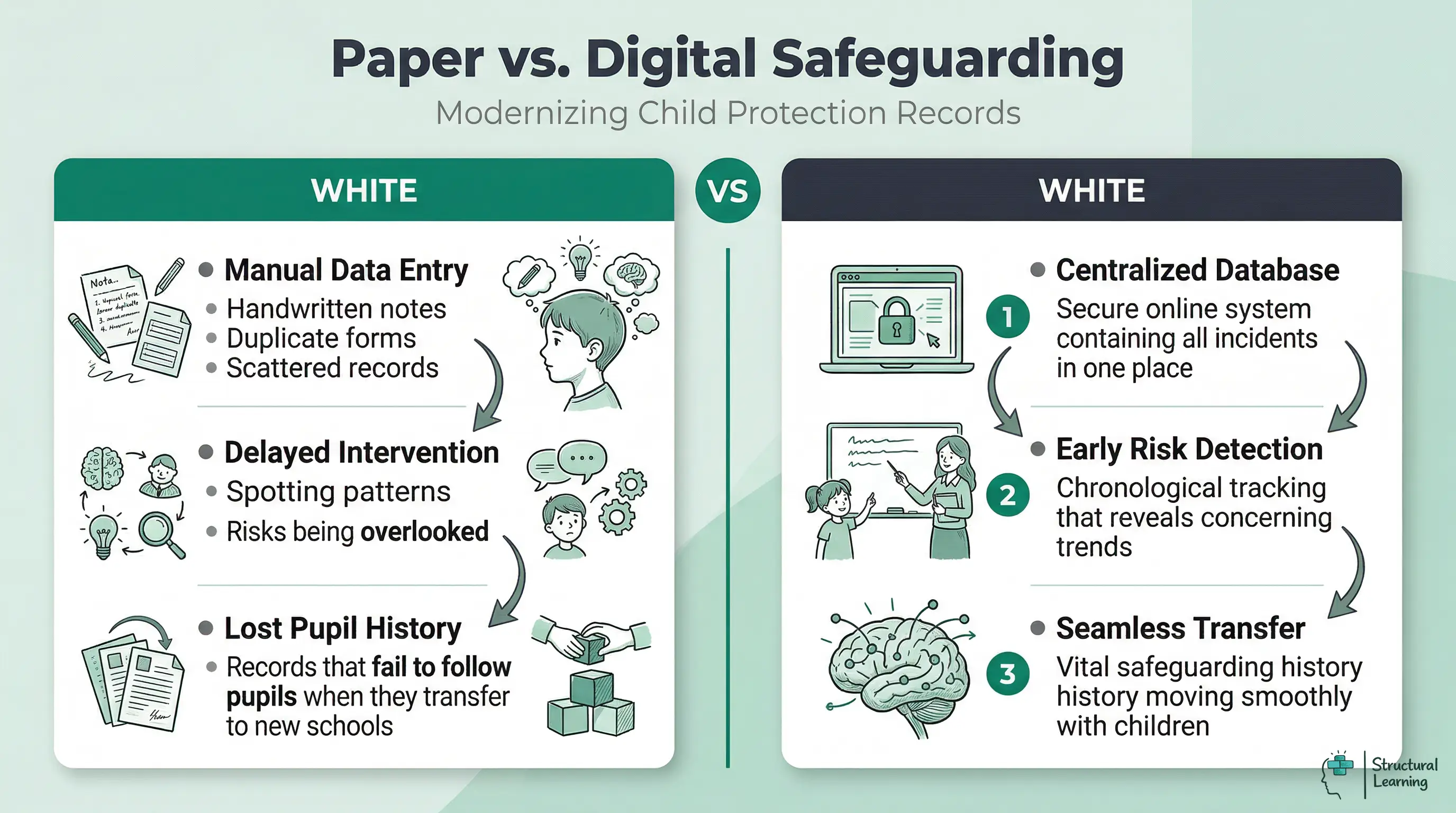
CPOMS is a powerful tool for schools looking to improve safety and security. It allows them to keep track of every aspect of their safeguarding policies and procedures and ensures that they are followed by all staff in school, supporting engagement with proper protocols.
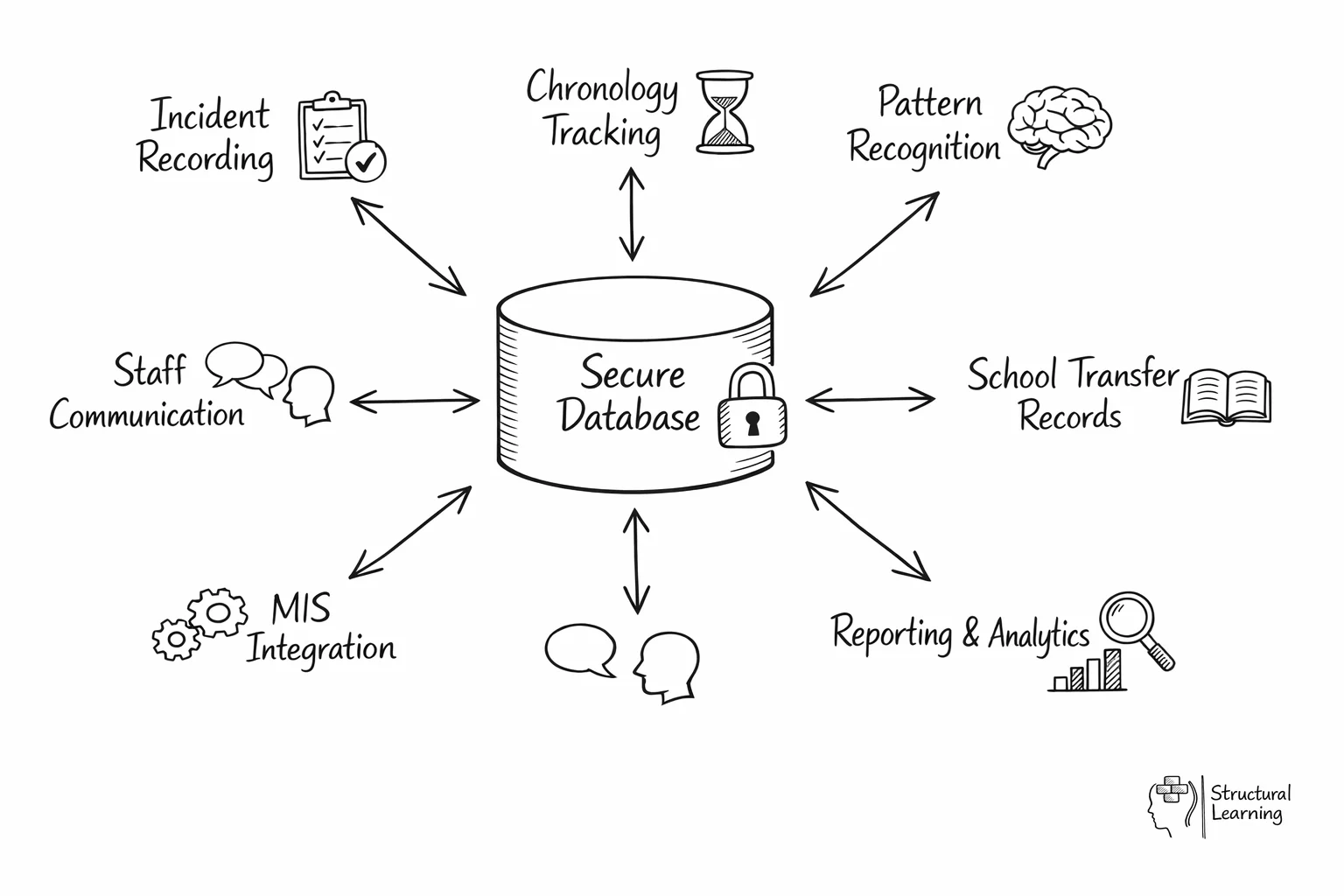
It does this by providing a centralised database where all safeguarding data is stored. This means that no matter where a learner goes to school, their safeguarding records remain safe. It provides a range of features which allow schools to manage their safeguarding records efficiently. These include:
CPOMS can help schools and education organisations strengthen safeguarding practice. It improves management and accountability when staff know what to record, who reviews it and how the record will be used. The software is not a substitute for staff judgement, supervision or the DSL's responsibility to act.
CPOMS helps keep schools safer by storing all safeguarding concerns in one place. It improves staff communication and gives clear, detailed reports (e.g. It also records actions, which supports accountability and helps schools meet requirements.
By digitising safeguarding processes, CPOMS reduces the risk that information is lost or overlooked. Staff can share relevant information with social care, health, police or other partners when this is necessary and lawful. The chronological view helps DSLs build a clearer picture of a learner's experiences and decide what support or referral is needed.
CPOMS can also show patterns across a class, year group or school. Leaders should use this carefully. More entries do not automatically mean safer practice; excessive defensive recording can create a data haystack in which serious signals are harder to spot. Munro warned that child protection systems can drift into compliance work unless professional judgement remains central (Munro, 2011).
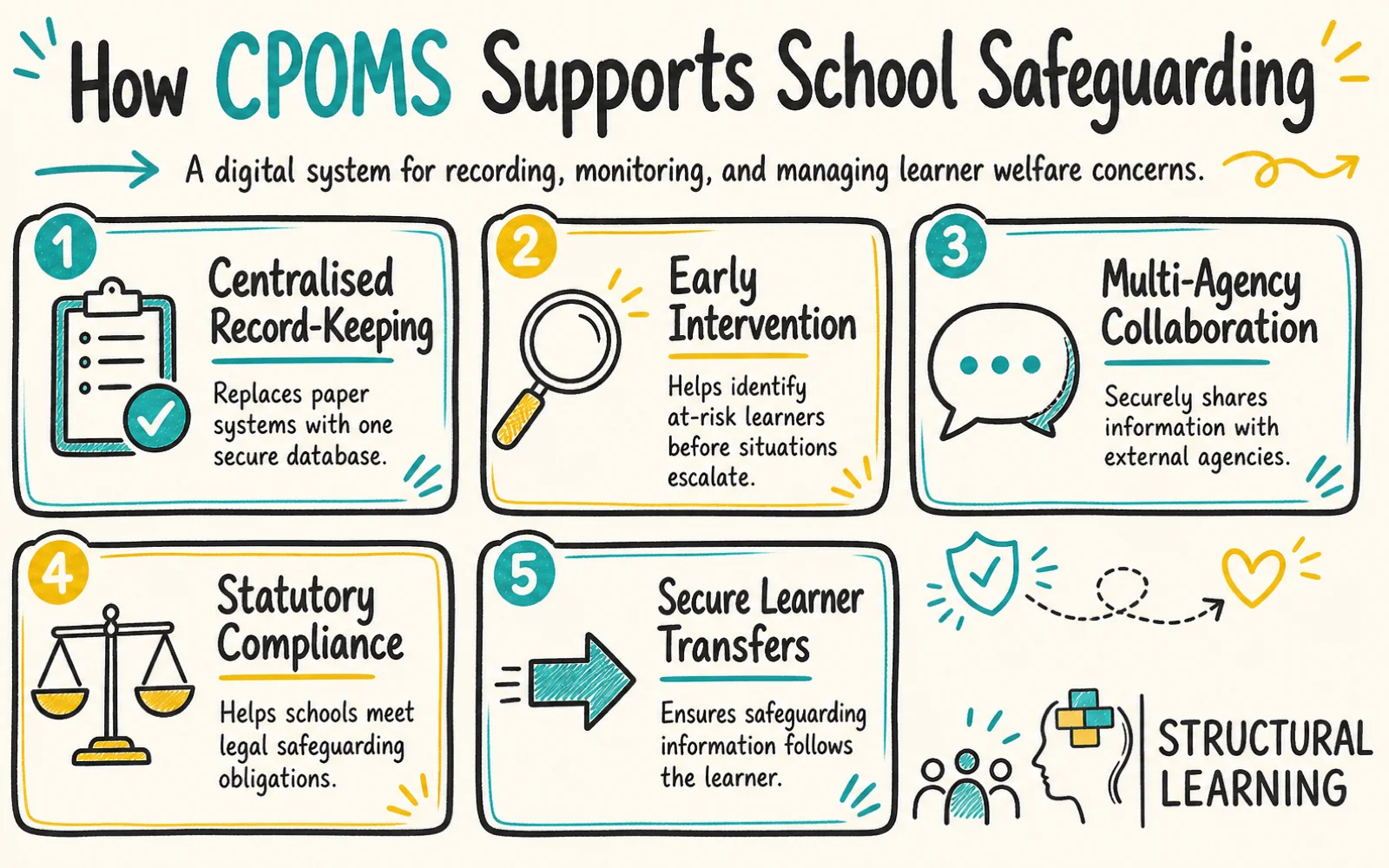
Schools face growing pressure to keep full safeguarding records while managing heavy teaching workloads. CPOMS helps by making the safeguarding process simpler. Teachers can report concerns quickly and accurately. Instead of filling in paper forms during planning time, staff can log incidents in minutes on any device, so nothing gets lost or forgotten.
The real strength of CPOMS lies in its ability to connect dots that might otherwise remain invisible. For example, when Year 3 teacher Mrs Harrison notices that Emma frequently arrives late on Mondays, she can quickly check if other staff have recorded similar observations. The system might reveal that the PE teacher noted bruising last term, whilst the teaching assistant documented behavioural changes. This joined-up approach enables schools to identify vulnerable learners who need support before situations escalate.
CPOMS also helps schools manage safeguarding compliance. The system automatically creates reports for Ofsted inspections, tracks staff training records, and sends instant alerts to designated safeguarding leads about serious concerns. When a learner moves school, their full safeguarding history moves securely with them. This helps stop vulnerable children from slipping through gaps in the system.
Accurate, prompt recording can support earlier review and better information sharing. By reducing avoidable admin and improving chronology, CPOMS can give teachers more time to notice, record and pass on concerns.
CPOMS changes how schools create and maintain safe spaces for learning. It links incidents that may seem separate into a fuller safeguarding picture. Teachers no longer have to rely on memory or scattered paper notes. They can log concerns quickly, knowing each entry adds to a wider view of each learner's wellbeing.
The system is strongest when it shows patterns that one teacher might not see alone. For example, a Year 3 teacher records that Sophie seems withdrawn during morning registration. This then sits alongside the lunchtime supervisor's note that she is sitting alone and the PE teacher's observation of unexplained bruises. Separate small concerns can then form a clear timeline that needs pastoral intervention, helping vulnerable learners receive support earlier and often preventing situations from escalating.
CPOMS also improves staff communication while protecting confidentiality. Teachers see safeguarding information only when they need it, which reduces risky gaps in knowledge. When you cover a colleague's class, you can see which learners need extra emotional support or have specific triggers to avoid. This helps you adapt your teaching, such as pairing a child with a trusted friend or avoiding topics that may cause distress.
The system's impact depends on how staff use it. Teachers may feel more confident when they know their observations will be reviewed, but confidence is not the same as safety. Schools should audit whether CPOMS entries lead to timely DSL decisions, referrals and support plans. They should not claim a fixed reduction in serious incidents unless they can cite their own evaluated data.
CPOMS safeguarding software offers a strong solution for schools seeking to improve their child protection measures. It brings safeguarding information into one place, improves communication, and gives schools clear reporting tools. This helps schools create a safer and more supportive environment for learners. Its user-friendly interface and customisable features make it a useful tool for schools of all sizes and types.
CPOMS (Child Protection Online Management System) is a secure digital platform for managing safeguarding concerns. It works as a central hub. Teachers, pastoral staff, and safeguarding leads can record, track, and respond to worries about learner welfare. These may range from small changes in behaviour to serious child protection issues.
The system lets staff log incidents from any device with internet access. If a Year 7 learner arrives late several times with unexplained bruises, record what you saw, when you saw it and what the learner said. The DSL can then review the entry alongside the learner's previous chronology and decide whether the pattern suggests neglect, abuse, mental health need or another concern.
For classroom teachers, CPOMS streamlines safeguarding responsibilities in three practical ways. First, it eliminates the risk of paper notes getting lost or forgotten in busy staffrooms. Second, it provides instant access to relevant learner information when you need it most, such as discovering a new learner in your form has previous self-harm concerns logged at their previous school. Third, it creates accountability through automatic timestamps and clear audit trails, protecting both learners and staff.
School staff should act on concerns and pass information to the DSL or a deputy without delay. CPOMS supports this by keeping a dated record of observations, actions and follow-up notes. Its alert system can help prioritise urgent cases while preserving an audit trail for multi-agency work.
CPOMS reflects a core safeguarding principle: protecting learners is a shared responsibility across the school workforce. The platform helps staff pass concerns to the DSL, but responsibility remains human. Staff must still notice, listen, record and escalate.
This approach recognises that children may behave differently with different adults during the school day. A teaching assistant might notice withdrawn behaviour at break time. A PE teacher may see unexplained bruising, while a classroom teacher spots falling academic performance. When staff record these separate observations in CPOMS, they can reveal patterns that one staff member might miss alone.
A shared system brings three practical gains. Staff can log low-level concerns in one place, DSLs can compare incidents across settings, and pastoral teams can see whether support is working. For example, one teacher's note about a learner saying they had no breakfast may become more meaningful when combined with lunchtime hoarding or attendance concerns.
Research on child protection reviews shows that harm is often visible only when professionals put fragments of information together (Brandon et al., 2009). CPOMS can help with this synthesis, but it depends on accurate entries and regular DSL review.
Understanding CPOMS' core features changes how teachers support safeguarding in their schools. Teachers spend less time working through complex menus or checking procedures. This helps them focus on protecting learners whilst still meeting their teaching responsibilities.
The 'Add Incident' function serves as your primary tool for recording concerns. Whether you've noticed unexplained bruising during PE or overheard a worrying conversation at breaktime, this feature captures important details quickly. Include specific observations, times, and locations; avoid interpretations or assumptions. For instance, write "Jamie said 'I don't want to go home tonight'" rather than "Jamie seems unhappy at home."
The tagging system helps staff sort concerns and link incidents to wider safeguarding themes. Common tags include 'behaviour changes', 'attendance concerns', or 'peer relationships'. These tags can show patterns that single incidents may hide. For example, several 'hungry at school' tags over a few weeks may show potential neglect more clearly than separate reports.
Alerts keep safeguarding leads updated on serious issues. Teachers should follow the school's safeguarding policy when selecting alert levels. The key distinction is whether the entry is a record for chronology, a concern needing DSL review, or an urgent risk requiring immediate action.
Body maps help staff record physical concerns without adding interpretation. Mark the location of an injury, add the learner's own words where relevant, and avoid guessing the cause. This makes the record more useful in medical, social care or police discussions.
Current statutory guidance expects all school staff to understand safeguarding systems. Staff also need to know how to report concerns. CPOMS can make documentation more consistent, but staff still need training in factual language, confidentiality and escalation.
For Designated Safeguarding Leads (DSLs) and their deputies, CPOMS transforms what was once an overwhelming paper chase into a streamlined digital workflow. The platform creates a clear reporting hierarchy that mirrors your school's safeguarding structure, ensuring concerns reach the right people at the right time.
When staff log a concern, the system alerts DSLs at once. This means key information is less likely to sit unread in a filing cabinet. Deputy DSLs can get set permissions for certain types of incidents, so the workload is shared while DSLs keep oversight. If the DSL is absent, deputies can step in with access to past records and current cases.
CPOMS cuts admin with smart sorting. Teachers log concerns, like unexplained bruising, and DSLs get alerts. The system tags it under 'physical abuse indicators' for quick action. DSLs can spot patterns by comparing events. Colour-coded alerts help DSLs prioritise learners needing urgent help.
The reporting features help during Ofsted inspections and local authority reviews. DSLs can quickly produce chronologies, response records and trend summaries. Schools should avoid unsupported claims about percentage improvements. A stronger test is whether reports show timely decisions, proportionate referrals and recorded outcomes.
CPOMS can reduce duplicate paperwork for DSLs, but the time saved should be used for supervision, professional discussion and direct support for vulnerable learners. Munro's review remains a useful warning here: better systems only improve safeguarding when they strengthen judgement, not when they create paperwork for its own sake (Munro, 2011).
CPOMS setup seems daunting, but good recording habits save time. Consistent practices, capturing concerns accurately, reduce your admin workload. Prioritise these habits from the start for effective safeguarding.
Record incidents as soon as they happen, whilst the details are still fresh. If a Year 3 teacher notices unusual bruising during PE, they should use CPOMS mobile access to log the key details straight away rather than waiting until break time. Write specific observations, such as "purple bruising on upper left arm, approximately 5cm diameter", instead of vague notes like "bruising noticed". This level of detail helps designated safeguarding leads identify patterns and take appropriate action.
Use agreed school terminology rather than private shorthand. Short codes may save seconds, but they can confuse DSLs, supply staff, social workers or parents reading a record later through a Subject Access Request. A better habit is a short factual sentence: "Kai took food from three lunchboxes at 12.20 and said he had not eaten since yesterday."
Record small concerns when they may indicate welfare risk, but do not log every irritation as safeguarding. This matters for Black and neurodivergent boys, whose distress may be misread as defiance if staff record labels rather than observations. Schools should audit CPOMS language for subjective labels, repeated behaviour entries about the same groups and missing evidence of support.
Using safeguarding software like CPOMS signals a commitment to learner and staff welfare, but it also creates long-lived records about vulnerable children. Schools should use it with care: record facts, restrict access, review retention, respond to SARs correctly and delete records securely when the retention period ends.
CPOMS (Child Protection Online Management System) is a secure digital platform that changes how schools record and monitor safeguarding concerns. Instead of using paper forms stored in filing cabinets, teachers can log incidents, behaviour patterns and welfare concerns straight away on any internet-connected device. The system builds a full timeline for each learner, which makes it easier to spot patterns that staff might otherwise miss.
For classroom teachers, CPOMS makes safeguarding easier to manage. If a child is often late, has injuries you cannot explain, or shares a worrying disclosure in circle time, you can record it straight away. The system alerts designated safeguarding leads, so concerns are less likely to be missed. For example, if three teachers log small concerns about the same learner over two weeks, CPOMS flags the pattern and prompts earlier support.
The software's real strength lies in its ability to connect observations across time and staff members. A Year 3 teacher might log that Sarah seems withdrawn after weekends, while the lunchtime supervisor notes she is not eating properly. The PE teacher adds that she is reluctant to change for lessons. Together, these notes may show a pattern that needs DSL review. CPOMS makes these connections visible, supporting the multi-agency approach in Keeping Children Safe in Education guidance.
Teachers also need to understand how software shapes safeguarding judgement. Dropdown menus, risk categories and dashboards are not neutral. They affect what staff notice and how they describe vulnerability. Williamson's work on big data in education warns that digital systems can turn complex educational lives into categories for measurement and intervention (Williamson, 2017).
Good CPOMS practice therefore means writing the human context, not only choosing the nearest tag.
CPOMS can also create reports beyond single learner records. These reports help schools spot wider safeguarding trends. They can guide staff training and provide evidence for inspection, but they also add to the school's data protection duties. Sensitive safeguarding databases need role-based access, multi-factor authentication, secure backups, breach reporting procedures and clear retention rules under UK GDPR and the Data Protection Act 2018 (National Cyber Security Centre, 2024).
Schools should take extra care if they connect old safeguarding data to AI tools or predictive analytics. Models trained on past CPOMS entries may repeat adultification, SEND-related bias or inconsistent staff labelling. ICO guidance on AI fairness says context, discrimination risk and human review matter when automated systems affect people (Information Commissioner's Office, 2023).
Whilst CPOMS may first seem like another admin task, its core features can make safeguarding work clearer and quicker. They can help you protect learners more effectively. Here are the key features that will change how you record and respond to concerns in your classroom.
The incident reporting function works like a digital safeguarding notebook. Recent English school research found wide variation in digital safeguarding incident definitions and reporting, so clear school categories matter (Sullivan et al., 2026).
Instead of writing concerns on post-it notes or in different places, you can log them in CPOMS from any device. For example, you can record unexplained bruising in PE or a child arriving hungry, with the time and context. CPOMS then alerts your designated safeguarding lead, so concerns do not get lost during a busy school day.
The chronology view helps staff spot patterns that paper records can miss. When you open a learner's profile, you see their full safeguarding history in one timeline, including incidents logged by other staff. This wider view can show concern over time, such as Monday absences after weekend contact visits, or behaviour incidents linked to certain lessons. Research by the NSPCC highlights how cumulative harm often goes unnoticed when incidents are viewed in isolation, so this feature can be very useful.
Body maps help staff record physical concerns quickly. Instead of writing long notes, mark the injury on a diagram and add photos.
This visual record helps multi-agency meetings and shows if injuries happen again. Secure messaging lets staff discuss sensitive issues in confidence, instead of relying on corridor chats.
Access to CPOMS is usually limited to designated safeguarding leads, senior leaders, and named staff who need information about particular learners. Teachers can normally view records only for learners they work with directly, or where they have a legitimate safeguarding concern. Your school's data protection policy will explain who can access each level of information.
Teachers without direct CPOMS access should report any safeguarding concerns immediately to their designated safeguarding lead or a member of senior leadership. Many schools have a clear reporting structure where teachers complete incident forms or make verbal reports that are then logged into CPOMS by authorised staff. The key is ensuring concerns are documented promptly and reach the right people.
CPOMS records are typically retained throughout a learner's school career and may be kept for several years after they leave, depending on the severity of incidents and local authority guidance. Serious child protection records are often retained until the learner reaches age 25. Schools must balance safeguarding needs with data protection requirements when determining retention periods.
Parents usually have the right to ask for their child's records under data protection legislation. However, schools may withhold information if sharing it could harm the child or other people. The designated safeguarding lead is normally involved in this decision and may need to consult local authority safeguarding teams. Schools must balance openness with child protection priorities.
Schools train staff to use CPOMS. Staff learn how to log incidents, choose categories, and report concerns. Training also covers signs of abuse, confidentiality, and when to escalate concerns.
These peer-reviewed studies provide the research foundation for the strategies discussed in this article:
AI presents opportunities and challenges for Islamic education now. Digital transformation requires careful consideration (Bahadori & Pillay, 2022). AI tools may aid learners, but educators must guide their use (Holmes et al., 2022). Curriculum changes may be needed to address AI’s influence (Zawacki-Richter et al., 2019).
Rifah Rifah et al. (2024)
AI can change teaching quality and classroom organisation. Misuse can create risks. Teachers can learn to use AI tools to improve their work and cut admin (Holmes et al., 2023). This study by Holmes et al. (2023) offers a balanced view of chances and needed protections.
Is Child Welfare Oppressive?
2 citations
J. Berrick et al. (2025)
This research investigates the delicate balance between protecting children from harm and respecting family autonomy in child welfare systems. Teachers, who often serve as the first line of defence in identifying child protection concerns, will gain deeper understanding of the complex decisions involved in safeguarding cases. The findings help educators navigate the challenging responsibility of reporting concerns while understanding the broader implications for families and children in their care.
Hsiao-Shen Wang et al. (2024)
Interactive digital tools engage learners better than old lessons, say researchers. Fire safety VR software helped elementary learners. Teachers can use this tech to make safety education stick, shows the study. It helps update life skills teaching via fun digital methods, researchers add.
Research and Design of APP for Primary School Learners' Safety Education Based on Embodied Cognitive Theory
5 citations
Yu-Feng Xu & Lianshuan Shi (2020)
This study created a mobile app for primary school children. It taught traffic, food, and electrical safety through hands-on, interactive learning methods based on how children learn through physical experience. Learners who used the app learned and remembered safety knowledge better than learners taught through traditional methods. Teachers can use these findings by adding more interactive, movement-based activities when teaching safety concepts.
A review of machine learning methods used for educational data
34 citations
Zara Ersozlu et al. (2024)
This comprehensive review looked at how machine learning has been used in education over the past decade. It found that these tools can personalise learning, adapt assessments to individual learners, and give clearer insight into how learners learn and progress. The research shows that these technologies can help teachers understand learners' needs and adapt teaching in response. For educators, the study shows how evidence-informed tools can support classroom decisions and improve student outcomes.
AI brings both opportunities and challenges for Islamic education. As digital tools change learning, educators need to adapt, according to researchers (e.g. researchers, date). Learners also need the skills to live and work in this changing world.
Rifah Rifah et al. (2024)
AI tools can improve teaching and school management, but misuse is a risk. The research shows AI helps learning if used carefully. Teachers can gain by knowing the benefits and risks.
AI TOOLS IN EDUCATION: BENEFITS AND CHALLENGES
7 citations
Irina Tzoneva (2023)
ChatGPT's arrival has led to research on how educators use AI. There are concerns about integrity and learner privacy (Holmes et al., 2023). This analysis helps teachers make informed and ethical AI choices. It weighs educational value against key safeguards for learners.
Learners' Digital Photo Stories about School Spaces for Safety and Learning
A. Frelin & J. Grannäs (2021)
Swedish secondary learners used digital photo stories to show teachers and administrators which school spaces felt safe and helped them learn. The research shows important learner views on the physical learning environment that adults might miss. This study gives teachers a creative way to gather honest learner feedback about classroom and school safety. It also shows how digital storytelling can give learners a meaningful voice in shaping their educational experience.
Brandon et al. (2009).
Holmes et al. (2022).
Holmes et al. (2023).
Laming (2003).
Munro (2011).
Ofsted (2023).
Schrum et al. (2021).
Sullivan et al. (2026).
Tschannen-Moran (2004).
Williamson (2017).
Zawacki-Richter et al. (2019).
Zhao (2023).