Updated on
September 7, 2026
Systems Theory in Education: Understanding Complex
A clear guide to systems theory in education, including open systems, feedback loops, school leadership, classroom examples, limitations and a practical mapping tool.


Updated on
September 7, 2026
A clear guide to systems theory in education, including open systems, feedback loops, school leadership, classroom examples, limitations and a practical mapping tool.
What is systems theory in education?
Systems theory in education examines how people, processes, resources, rules and environments interact within a school or classroom. It helps educators define a boundary, map relationships, notice feedback and delays, and anticipate possible effects of change. It is a family of perspectives, not one proven classroom method, and a system map is a testable representation rather than a diagnosis or proof of cause.
Systems theory in education looks at how people, steps, rules, tools and settings work together in a school or class. It helps teachers set a boundary, map links, notice feedback and delays, and think ahead about change. For example, a SENCO can map how a concern moves from class evidence to support and review. It is a family of views, not one proven classroom method. A system map is a model to test, not a diagnosis or proof of cause.
Key takeaways
Systems theory gives teachers a way to study a whole made up of related parts. A school can be described as a system because its learners, staff, curriculum, timetable, data, tools, policies, families and wider setting can affect its work. A class can also be studied as a smaller system within that school. This broad view has roots in general systems theory (Bertalanffy, 1968).
The approach changes the first question. Instead of asking only, "Which person or single factor caused this outcome?", it asks, "What process is producing the pattern we can observe, what else may be contributing, and what would count as evidence?"
That wider question can be valuable. It can reveal a missed handover, a delay between assessment and support, a timetable conflict, a measure that rewards the wrong action or a group whose experience has not been heard. It can also become vague. Saying "everything is connected" is not an analysis.
In one sentence: systems theory can help a school make relationships and assumptions visible, but the map still has to be tested and it does not replace expert assessment, direct teaching or statutory action.
In this guide
The phrase systems theory can sound as though it names one settled model. It is better understood as an umbrella. Different traditions use different definitions, units of analysis and methods.
Ludwig von Bertalanffy's general system theory helped set out a shared language for wholes, links, boundaries and open systems. Later writers built approaches for schools and firms, social talk, human growth and models of change. Shared words do not make their claims the same.
Swipe sideways to compare all columns.
| Tradition | Main question | Useful education example | Important boundary |
|---|---|---|---|
| General systems theory. | How can organised wholes, their parts and their relations be described across disciplines? | Defining a school as an open system with a boundary and environment. | It does not supply a tested classroom intervention. |
| Open-systems organisational theory. | How does an organisation transform inputs into outcomes while exchanging information and resources with its environment? | Examining staffing, curriculum, processes, outcomes and local context in school leadership. | Inputs, processes and outputs are an organising model, not a causal proof. |
| System dynamics. | How do stocks, flows, feedback and delays create patterns over time? | Testing a model of how referrals, staff capacity and waiting time may interact. | A causal-loop diagram contains hypotheses selected by its authors. |
| Ecological systems theory. | How is development situated across immediate settings and wider social structures? | Using Bronfenbrenner's ecological model to consider layers of context. | It is a developmental framework, not another name for system dynamics. |
| Social-systems theory. | How do communication and social subsystems reproduce their own boundaries and inclusion rules? | Studying how institutional communication can include or exclude. | Luhmann's tradition has a distinct theory and vocabulary. |
| Learning organisation. | How can an organisation develop shared learning and adapt? | Building routines in which staff examine evidence and revise practice. | It is a management tradition, not proof that an organisation learns like a person. |
This distinction prevents a common error. A paper on learners drawing stock-flow models cannot show that a headteacher's systems leadership improves results. A theory paper on school inclusion cannot diagnose why one learner is absent. An open-systems diagram cannot prove that a given feedback loop exists.
The family resemblance still matters. Systems approaches direct attention to relationships, boundaries, context, change over time and the possibility that an action has more than one effect. These are useful habits when the problem crosses roles or processes.
Close analysis still matters. A teacher who checks whether a learner can blend a given sound and letter link is right to narrow the question. Good systems work moves between whole and part. It does not reject a precise check.
This page sits within Structural Learning's guide to the main theories of learning. The systems lens asks about linked parts and change over time. Other learning theories give more specific accounts of how learning occurs.
The core ideas are system, purpose, boundary, elements, links, setting, inputs, processes, outputs, feedback, stocks, flows, delays, emergence and adaptation. Teachers do not need to use every term. They need a clear question, a practical boundary and labels that make each claim open to test.
A system is a set of elements whose relationships matter to the pattern being studied. The same school can be framed as a teaching system, an attendance system, an information system or a social system. The frame depends on the question.
Purpose is less clear. A school has stated aims, such as learning, access and safety. Its rules and measures can create other rewards. If a team is judged mainly by the number of support sessions it runs, the system may reward activity more than learning.
This does not reveal a secret aim. It prompts the team to compare its stated goals with what its rules reward.
A boundary says what is inside the map and what is outside it. A class transition map may include instructions, books, movement, noise, time and adult roles. It may treat the school timetable as part of the wider setting.
Every boundary leaves things out. A map that includes only staff choices may miss learner and family knowledge. One that expands to national policy, culture and the economy may be too broad to guide tomorrow's lesson. A good boundary is useful and open to change, not complete.
Elements may be people, groups, resources, rules, information or processes. Relationships describe how they are connected. A relationship should be specific enough to test: "the intervention register is updated after the review meeting" is stronger than "communication affects outcomes".
Arrows on a map need verbs and proof. They may mean supplies, plans, informs, delays, limits or is linked with. An arrow marked "causes" makes a much stronger claim than one marked "may add to".
An open-systems account often sets out inputs, such as staff, learner knowledge and tools; processes, such as teaching, checks and review; and outputs, such as lessons taught or referrals done. Longer-term outcomes may include knowledge, taking part, independence or wellbeing.
The groups are useful only when the labels are clear. A completed support block is an output, not proof that learners learned more. A test score is one outcome measure, not the whole purpose of school.
In system dynamics, a stock is an amount held at one point in time. It may be the number of open referrals or the support time left this term. A flow changes a stock, such as new referrals entering and closed cases leaving a queue.
A delay splits an act from its effect, or data from a choice. Training this week may take months to affect work done alone by learners. A late data cycle may still show results from an old plan. Naming the wait guards against both early praise and endless delay.
Emergence refers to a pattern at the level of the whole that cannot be read from one element alone. School culture is not located in one person or policy. It arises through repeated actions, expectations, relationships and interpretations.
Adaptation means that people or steps change as the setting changes. Staff may work around a new form; learners may alter how they seek help. The response need not be foolish or harmful. It shows that a plan is used in a setting that can change.
Feedback is one of the most misused terms in education systems writing. In system dynamics, feedback occurs when a change travels through a chain of relationships and eventually influences the original variable.
A reinforcing loop amplifies change. If a quantity rises, the loop tends to push it further in the same direction; if it falls, the loop tends to push it further down. A balancing loop counteracts change in relation to a goal or limit.
Polarity boundary: reinforcing does not mean helpful, and balancing does not mean harmful. Positive and negative signs describe the direction of a relationship, not praise, criticism, good or bad teaching.
Consider a simple capacity idea. More open support requests may increase waiting time. Longer waits may reduce the team's power to close reviews because cases grow more complex.
That could add to the open queue. The loop is reinforcing if each link works as proposed.
This is not yet a finding. The team must check whether the queue, wait and case complexity are measured consistently; whether the sequence occurs; and whether staffing, referral thresholds or data entry offer better explanations.
A balancing idea may use a review trigger. As the queue rises above an agreed mark, the team adds review time; this closes more cases and cuts the queue. A delay may still make the queue rise too far and then fall too far.
Feedback about learning has a different meaning. A teacher gives information that helps a learner understand a goal, current performance and a next step. That process may form part of a larger system, but it is not automatically a balancing loop. A behaviour consequence, a survey response and a comment from a colleague are also not system-dynamics loops merely because information was returned.
Richmond's systems-thinking account and later system-dynamics education work use feedback as a structural concept. Fisher's 2023 conceptual paper describes tools including behaviour-over-time graphs, causal loops and stock-flow models. These tools can make a proposed structure explicit. They do not make the proposed structure true.
Before formal systems training, middle-school learners and teachers often gave one-way accounts and found feedback, stocks, flows and delays hard (Sweeney and Sterman, 2007). The study suggests that this form of reasoning needs careful teaching. It does not show that teachers are poor at choice or that each school needs modelling software.
Systems theory is most useful in leadership when an issue crosses roles, routines and school boundaries. A change to assessment may affect the curriculum, staff load, reports, learner effort, support choices and family contact. A leader needs both the local detail and the links.
An open-systems leadership model was built from 12 prior models in the International Successful School Principalship Project (Gurr et al., 2022). It links inputs, school processes and a range of learner and school outcomes. Feedback joins the stages, while economic, political, social, technical and school contexts shape the whole.
The model is descriptive and inductive. It helps organise findings from successful-school research. It does not demonstrate that adopting an inputs-processes-outputs diagram will cause a school to become successful.
A later study drew on 24 school cases from Australia (Goode, Drysdale and Gurr, 2023). It set out links among leadership, skill, culture, networks, context and school results. Case studies can show patterns and plausible links. They cannot split the effect of systems thinking from school choice, leadership, context and other forces.
Leadership checks should take account of varied settings rather than treat schools as machines (Wallace et al., 2001). In another study, interviewed middle- and high-school heads saw systems thinking as useful for the curriculum, staff learning and the use of result data (Shaked and Schechter, 2016). These are useful views, not impact trials.
For a school leader, the practical value lies in disciplined questions:
A school feedback model places clear data flows across support, checks and action at the heart of school skill (Halverson, 2010). The point is not to collect more data. It is to get useful facts to people who can read and act on them.
The UNESCO 2024/5 Global Education Monitoring Report adds a wider leadership boundary. It stresses goals, learning, collaboration and capacity, and shows why context, autonomy and accountability matter. It also warns against reducing education to a narrow set of measurable outcomes. Systems leadership therefore includes deciding what counts as success, not only optimising a process.
This section complements, rather than replaces, Structural Learning's guide to leadership theories. Systems theory is one organisational lens. Transformational, instructional, distributed and other leadership theories ask different questions about influence, practice and responsibility.
A useful system map starts with a choice, not a large chart. The steps below work for a teacher, SENCO, subject team or school leader. They can sit beside the Education Endowment Foundation's school guide, which links staff conduct, context and a clear process (EEF, 2024).
Do not wait for a perfect map. It will never include every influence. The purpose is to make the team's current thinking open to challenge and to improve the next decision. Formative assessment can supply close evidence about what learners know and what teaching should happen next.
Safeguarding and SEND boundary: mapping must not delay immediate action, reasonable adjustments, the graduated approach, health support, specialist assessment or safeguarding procedures. A wider explanation is not a reason to leave a known barrier in place.
Donella Meadows described intervention sites ranging from parameters and delays to information, rules, goals and paradigms (1999). Her essay explicitly presents the list with humility, not as a recipe. In a school, a higher item on that list is not automatically more effective, feasible or ethical. The team still needs evidence and authority for the proposed change.
A secondary school has started a Year 7 reading support scheme. After one term, the mean reading score has changed little. Attendance is uneven, staff report timetable clashes, and some learners say they do not know why they were chosen.
A weak diagnosis would be "the intervention does not work". An equally weak systems slogan would be "the failure is caused by the whole school system". The available evidence supports neither.
Swipe sideways to compare all columns.
| Map field | Current record | What remains uncertain | Next evidence or action |
|---|---|---|---|
| Outcome. | Learners read the taught word patterns with more skill and less help after eight weeks. | Whether the current check is close to the taught content. | Add a brief linked check and keep a broad reading measure. |
| Process. | Assessment, choice, family notice, four weekly sessions, term review. | Whether every learner received the planned time and content. | Record session attendance, content and staff cover. |
| Observed pattern. | Attendance is lowest when sessions replace practical subjects and during cover changes. | Whether timetable clash, learner choice, poor contact or other factors explain absence. | Compare each slot; ask learners and families; check the register and reasons. |
| Hypothesis. | Timetable loss and uncertain purpose may reduce attendance, which reduces access to instruction. | The strength and direction of each relationship. | Move one group to a protected slot, explain the goal, then compare attendance and learning. |
| Alternative. | The support may not match the learners' reading needs, or staff may teach it in varied ways. | Which skills were checked and taught; whether staff used the planned steps. | Review each profile, work sample and delivery record with the SENCO and literacy lead. |
| Decision rule. | Review after eight weeks. | Whether improved attendance is enough. | Continue only if implementation and relevant learning improve without unacceptable curriculum loss or distress. |
The map does not find one root cause. It identifies several testable uncertainties. The first change is small enough to implement and compare. The measures include learning, access and adverse effects.
The example also keeps close expert work in view. If checks show that a learner needs a different reading plan, the school should act on that proof. Systems thinking does not turn a poor match between need and teaching into a puzzle with no clear answer.
A theory of change can then express how the selected activities are expected to lead to short- and longer-term outcomes. The system map describes the current relationships and uncertainties; the theory of change makes the proposed intervention pathway explicit. Neither proves the pathway in advance.
Classroom transition. A class often loses learning time when moving from the teacher's model to work done alone. The teacher maps the instruction, books, seating, help routine and time. A check shows that learners queue for books and then ask what to do.
The teacher places books before the lesson and checks the task with two learners. The team records the time and task starts. This is a small process change based on a clear system boundary, not proof that the class resists rules.
Attendance. A pastoral team sees absence on the same days each week. It maps lesson access, travel, known health needs, family contact, timetable changes and support times. Learner and family accounts are treated as evidence, not notes added to a staff map.
The school follows attendance, SEND, health and safeguarding duties as appropriate. It does not infer anxiety, family motivation or peer influence from the pattern alone. The map helps coordinate information and review actions.
SEND access. A learner completes little written work in several subjects. The SENCO maps task load, current changes, support tech, staff knowledge, lesson shifts and the learner's view. Work shows that spoken answers are sound, but copying and long writing are slow.
The immediate action is an access adjustment and targeted assessment, not a search for a hidden systemic cause. The wider map helps the school apply the adjustment consistently and see whether it improves independence across subjects.
Assessment workload. Leaders introduce frequent data entry to improve intervention decisions. Staff time rises, but review meetings still use incomplete information. A process map shows duplicate entry, unclear ownership and a six-week delay before action.
The school removes a duplicate field, assigns decision responsibility and tests a shorter review cycle. It monitors decision quality and workload. The purpose is not maximum information flow; it is useful information reaching the right decision.
Curriculum rollout. A subject team starts a new sequence but learner work varies between classes. Leaders map training, books, planning time, prior knowledge checks, coaching and tests. They split the quality of the plan from whether staff used it as planned.
The next act follows the rollout data. It may be clearer materials or more rehearsal, not a whole-school change. Systems thinking should cut early claims, not make each response larger.
These examples show when the lens adds value: the issue crosses a handover, process, role or time delay. It is less useful when the next step is already clear and direct, such as replacing a broken hearing device, teaching an untaught prerequisite, correcting an inaccessible document or making an agreed reasonable adjustment.
Teaching systems thinking means helping learners track change, name links, spot feedback and test a model against facts. This is a curriculum goal, not the same as using a map to lead a school. Each task needs a clear subject goal and must teach how to question the model, not just how to draw it.
A concept paper describes K-12 tasks used by systems-thinking teachers (Fisher, 2023). Younger learners used change-over-time graphs and simple stock-flow models. Older learners built models in science, maths, history and work on the natural world. The paper also notes the need for staff training and, for computer models, the right software.
Useful learner tasks include:
The learning goal should be explicit. A string web may illustrate connection, but it does not teach stocks, flows or causal evidence by itself. A complex diagram may look impressive while hiding weak reasoning.
Learners also need leave to test the boundary and the model. Ask who chose the parts and what is missing. Ask which arrow was seen and which is an idea.
Then ask what facts could change their mind. Such questions make systems thinking part of clear thought, not just a word task.
The current school evidence is not a broad impact verdict. One review found just seven studies in its systems-and-control scope (Memarian and Doleck, 2025). Fisher's paper is an account of tasks, not a controlled test. Schools should not claim that systems thinking is a proven route to higher results across the curriculum.
Systems work is limited by the boundary, data and people used to build the model. Maps can hide doubt, weak causal claims, values and missing voices behind a neat chart. Complexity can also delay clear action. Use the lens to test ideas, not to avoid duty or displace a sound, specific response.
A map includes some variables and leaves out others. A neat diagram can create false confidence because uncertainty disappears from view. Record the author, date, purpose, evidence, assumptions and omitted areas. Revise it when the decision or evidence changes.
Two variables may move together because one affects the other, because both respond to something else or because the measures are related. A closed loop drawn on paper does not establish sequence, size or causal direction. Use stronger designs when the decision requires a causal claim.
Someone picks the goal, the parts and the success measure. If a map includes attendance data but not learner views, or staff load but not family access, the gap shapes the choice. A review of school leadership research asks scholars to question claims of neutral systems and to attend to context and missing views (Campbell and Mertkan, 2025).
A distinct social-systems paper studies how school talk can create inclusion and exclusion (Rapp and Corral-Granados, 2021). It reminds us that rules for taking part matter. It is not a tested school intervention.
A team can always add another factor, stakeholder or loop. This can delay an obvious action or make nobody accountable. Set a decision date and assign ownership. If the evidence already supports a reasonable adjustment, safeguarding response or effective teaching step, act while the wider review continues.
Terms such as emergence, key change point and non-linearity may be useful, but they are not proof. Turn each term into a plain school question. "There is a delay" should say what is late, by how long and why that matters.
Much school systems research uses theory, interviews or case studies. It can make ideas clear and form claims to test. It cannot show that a systems approach, as one school change, causes better learner outcomes.
Schools involve choice, rights, links, conflict, history and judgement. Systems-and-control words can strip out the human part if learners and staff are treated as inputs to tune. Use maps with people, not on them. Keep consent, voice, staff duty and routes for challenge. The guide to learner agency covers choice and influence in more depth.
A systems view should not undermine support with a clear reason and evidence base. It can help a school put the plan in place, check access and watch for harm. It cannot replace the teaching method with a broad chart. Adaptive teaching shows how teachers can respond to current learning evidence in the lesson.
Systems theory is therefore best used as a disciplined lens. It helps a team frame a problem, expose assumptions and coordinate evidence. Its value depends on the quality of the map, the evidence used, the voices included and the decisions made afterwards.
These three printable resources turn the article into a careful school process. The study note gives a one-page overview. The two-page map and review record helps a teacher, SENCO or leader test one feasible change. The 12 flashcards support professional learning without presenting a system map as diagnosis or proof.
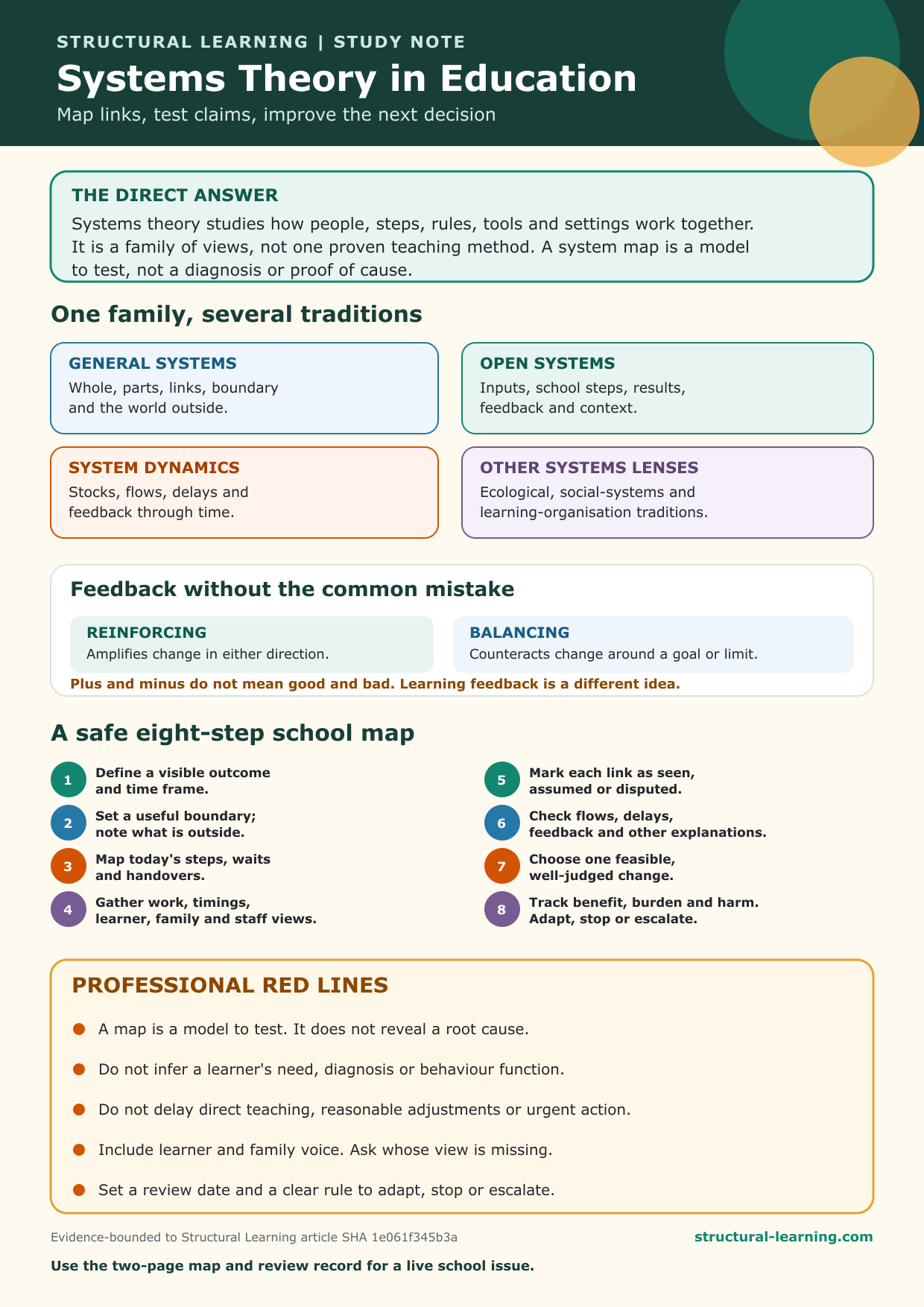
Direct answer: systems theory studies how people, steps, rules, tools and settings work together. It is a family of views, not one proven teaching method. A system map is a model to test, not a diagnosis or proof of cause.
Main traditions: general systems theory studies wholes, parts, links, boundaries and environments. Open-systems models follow inputs, school processes, results, feedback and context. System dynamics focuses on stocks, flows, delays and feedback through time. Ecological, social-systems and learning-organisation approaches ask different questions.
Safe mapping sequence: define a visible outcome and time frame; set a practical boundary; map current steps, waits and handovers; gather work, timings and different voices; label links as seen, assumed or disputed; check flows, delays, feedback and other explanations; choose one feasible change; then track benefit, burden and harm.
Professional red lines: a map does not reveal a root cause. Do not infer a learner's need, diagnosis or behaviour function. Do not delay direct teaching, reasonable adjustments or urgent action. Include learner and family voice, set a review date, and use a clear rule to adapt, stop or escalate.
School System Map and Intervention Review
Use page one to define the issue, boundary, current process, evidence, voices and uncertain links. Use page two to plan one change, check delivery and outcomes, record burden or harm, and decide who owns the next step.
Systems Theory Printable Flashcards
Use the 12 question-and-answer cards for staff development, leadership study or learner revision. Print double-sided, flip on the long edge, then cut on the guides. The answer columns are mirrored for duplex printing.
Teachers most often need to know whether systems theory gives a clear next step, how open systems and feedback loops differ from everyday terms, and what the lens can explain. The short answers below keep the main boundary in view: map links and test claims, but do not diagnose a learner or assume a cause.
A school may map the path from a class check to a support choice. The map records who collects the facts, where they are stored, when they are reviewed, who decides and how the choice reaches the teacher and family. It can reveal delays or missed handovers. It does not prove why a learner needs support.
An open system takes in and sends out people, data, tools and influence. A school receives learners, staff, funds, policy and local knowledge. Its teaching and school steps add to learner and school results. Data on those results can shape later choices. This is a model for thought, not a full account of cause.
It is a school lens that asks leaders to consider links among goals, people, steps, tools, data, results and context. It can help leaders align a rollout and review. Current case and interview evidence does not show that the lens alone improves learner results.
No. In system dynamics, a reinforcing loop amplifies change and a balancing loop counteracts change in relation to a goal or limit. Either can have helpful or harmful consequences. These labels are also different from praise and corrective feedback in teaching.
It can prompt questions about tasks, routines, talk, links and setting. It cannot reveal the role, diagnosis or cause of one learner's conduct from a pattern or chart. Teachers should use direct checks, learner and family voice, school steps and expert tests where needed. The behaviourism guide explains a different learning tradition.
Systems theory is a broad family. Bronfenbrenner's ecological model is a specific developmental framework about the settings and wider structures around a developing person. It should not be used as another name for open-systems organisational theory or system dynamics.
Research describes ways to teach systems concepts and shows that feedback, stocks, flows and delays can be difficult to reason about. That is not the same as strong evidence that systems-thinking instruction generally raises attainment. Judge a specific approach by its design, population, implementation and measured outcomes.
Do not make mapping a condition for immediate safeguarding action, a known reasonable adjustment, urgent health support or clear direct teaching. Do not use it when the boundary is so broad that nobody can act. A map is helpful when it clarifies a real decision.
Further Reading
These sources extend the article's central distinctions between systems concepts, leadership models and evidence about systems thinking in education.