Dewey’s Learning by Doing: 5 Project-Based Lesson Ideas
Dewey's experiential learning explained. Project ideas, critical: when projects backfire (busy work vs real learning), and how reflection closes the gap.

Dewey's experiential learning explained. Project ideas, critical: when projects backfire (busy work vs real learning), and how reflection closes the gap.
What is Dewey’s theory of learning by doing?
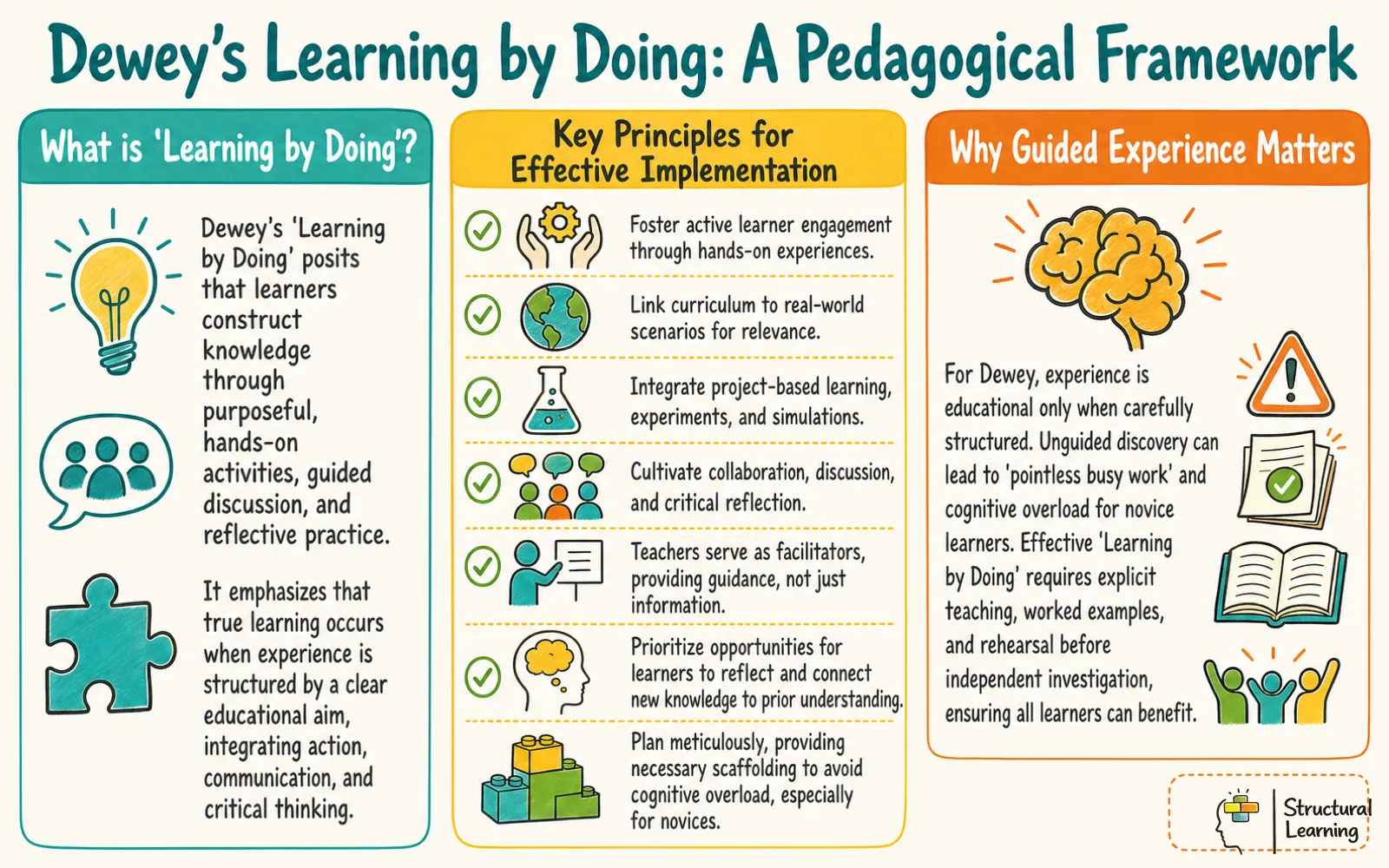
John Dewey's theory of ‘learning by doing’ holds that learners build understanding through active, purposeful experience rather than passive listening. In the classroom this means planned, hands-on projects with clear goals and teacher guidance, where learners test ideas, reflect on what happened, and connect the experience to wider concepts.
Dewey’s Learning by Doing: 5 Project-Based Lesson Ideas describes a clear way to run practical lessons. In this approach, Dewey (1938) argued that learners build knowledge through planned activities, teacher guidance and careful thought. This is important because project work can easily turn into pointless busy work. To prevent this, teachers must clearly frame the question, teach the right methods and include time for reflection.
This connects to the wider context of fundamental theories of learning in modern classroom practice.
For example, in a Year 5 science lesson on insulation, learners may test materials and compare temperature changes. They can then explain which variable made the result reliable. The important caution, noted by Kirschner (2006), is that doing does not mean leaving novices to discover everything alone. Minimally guided inquiry can overload working memory.
Dewey's learning by doing means learners build knowledge through purposeful tasks, guided discussion and reflection. Learning is not just the intake of facts; it happens when action, talk and thought are connected to a clear educational aim.
In the classroom, that means setting up tasks where learners investigate, make decisions, test ideas, and explain what they noticed. A science teacher may let learners run a short enquiry, compare results, and then discuss why one method worked better than another.
Dewey's point was not that activity is enough on its own. Experience becomes educational only when the teacher structures it carefully and helps learners reflect so the lesson leads to better judgement next time.
| Strategy/Type | Description | Example |
|---|---|---|
| Learning by Doing | Learners learn through purposeful experience and reflection. | A science teacher letting learners run an inquiry, compare results, and discuss outcomes. |
| Project-Based Learning | Learners engage in real-world projects to apply knowledge. | Creating a model city to learn about urban planning and geography. |
| Experiments | Hands-on activities to test hypotheses and understand concepts. | Conducting a chemistry experiment to observe reaction rates. |
| Simulations | Virtual or physical simulations to replicate real-world scenarios. | Using a computer simulation to explore economic principles. |
| Collaboration | Working in groups to solve problems and share ideas. | Group projects where learners work together on a presentation. |
| Discussion | Classroom discussions to explore topics and share perspectives. | Learners discussing the implications of historical events in a social studies class. |
| Critical Reflection | Analysing and evaluating experiences to improve understanding. | Journaling about the learning process after a science experiment. |
For Dewey, experience matters because learners need guided activity, not discovery without support. Biesta (2014) reads Dewey as keeping knowledge in the curriculum through pragmatism, rather than replacing teaching with activity. Kirschner, Sweller and Clark (2006) argued that discovery with little guidance can overload novice learners' working memory. In practice, Deweyan project work needs clear teaching, worked examples and rehearsal before learners investigate on their own, so it does not widen gaps between confident learners and those who need more structure.
Evidence on active learning supports Dewey's broad case for purposeful participation when tasks have structure. Freeman et al. (2014) is still useful as a landmark STEM synthesis, but a 2026 review should pair it with post-2020 PBL evidence. Duke et al. (2021) found that well-supported project-based units can improve science and social studies learning when teachers receive curriculum materials and professional development. Lavado-Anguera et al. (2024) also treat PBL as experiential pedagogy, but their account supports clear goals, staged sequencing, defined teamwork roles, feedback and reflection rather than open-ended activity.
Dewey (1938) argued that learners understand by linking knowledge and experience. For example, ask Year 5 learners to measure ingredients before teaching fractions. This concrete task also fits Bruner (1960), who argued that teachers should organise knowledge so learners revisit powerful ideas in more disciplined forms: learners handle quantities first, draw or model them next, then connect the experience to formal fraction notation.
Connecting new topics to learners' existing knowledge is effective. Before teaching fractions, ask learners about times they used fractions. Sharing a pizza or measuring recipes are useful examples, but the concrete to abstract sequence is better attributed to Bruner (1966) than to Ausubel or Piaget (1952) alone. This still fits Vygotsky (1978), who argued that learners build understanding through social interaction and guided activity.
Deweyan progressive education is built around four classroom moves: active engagement, reflection, social collaboration and links between subjects. Learners do something with a clear purpose, discuss what happened, link it to subject knowledge and decide what to try next. Activity matters, but only when the teacher keeps the learning goal visible.
Kolb (1984) and Dewey (1938) both linked active experience with reflection. This means learners should take part, not just listen passively.
Rogers (1969) argued that experiential, self-directed learning supports significant learning. Vygotsky (1978) noted that interaction and discussion support learners. Piaget (1970) found that reflection connects new ideas with past ones.
Active learning can strengthen understanding when it is tied to clear thinking goals (Chi, 2009; Freeman et al., 2014). In science, learners may build small jar habitats, observe interactions between organisms, and explain the cause and effect links they can see.
The connection between school and life is a core Deweyan principle: classroom learning should link to learners' real experiences. When learners see why a topic matters, they are more likely to attend to it, talk about it and use it beyond the lesson.
Research from Bransford et al. (2000) shows learners connect better with real-world examples. This approach helps learners understand concepts and retain knowledge, according to Brown et al. (1989). Offering context helps learners, as suggested by Vygotsky (1978).
Researchers find that real-world examples aid learning. Use case studies and speakers to make lessons relevant. Learners can study letters from factory workers. This helps learners understand industrialisation's effects.
Teachers guide inquiry by moving learners from clear teaching to shared investigation. A simple instruction-to-inquiry sequence is: I do, where the teacher models key words and the method; We do, where the class practises the first step with prompts; You do together, where groups investigate with roles and check-ins; You explain, where each learner gives reasons for the evidence. This keeps Dewey's inquiry active while protecting working memory.
Guided inquiry draws on social constructivist ideas (Vygotsky, 1978; Bruner, 1990). Teachers use questions, prompts and feedback to help learners link new information to what they already know. At the same time, they still leave room for investigation (Wood et al., 1976).
Encourage learners to own their learning. Use questioning, group work and peer feedback. Try the Socratic method (Paul, 1993) for philosophical discussions. This makes learners think critically and share ideas (Vygotsky, 1978).
Project-based learning is an approach in which learners tackle extended tasks that apply knowledge to real-world problems. A strong project has a clear question, taught content, checkpoints for feedback and a final product that shows what learners now understand.
Project-based learning works best when it is treated as a taught sequence, not as a final craft task. Learners need enough subject knowledge to ask a good question, enough procedure to collect reliable evidence, and enough feedback to improve their explanation (Hmelo-Silver, 2004; Barron & Darling-Hammond, 2008).
Learners look at local green issues and make action plans. Field trips help them gather facts and share what they find (Hmelo-Silver, 2004). Science tests and outdoor lessons help this process (Barron & Darling-Hammond, 2008).
Collaboration and discussion are structured social learning processes that help learners share ideas, test thinking, and build communication skills. Learners share ideas and build communication skills through discussion. This helps them learn from peers (Dewey, 1916; Piaget, 1936).
Learners benefit when they work together and use their different skills. In discussion, they can make ideas clearer and question their own thinking (Vygotsky, 1978; Piaget, 1936). Shared tasks also build learners' thinking skills (Bandura, 1977; Bruner, 1966).
Think-pair-share, structured group work and debates can help learners work together. But roles and accountability must be clear. In literature, one learner might track evidence, another tests an interpretation, and another prepares the spoken summary before the group shares with the class (Slavin, 1990). This reduces the free-rider problem, gives quieter learners a clear way into discussion, and makes peer learning easier to assess (Johnson & Johnson, 2009).
Reflection is the process through which learners make sense of experience, connect new knowledge, and identify areas for improvement. Dewey (1933) noted that through reflection, learners connect new knowledge to prior learning and identify areas for growth.
Flavell (1979) says reflection builds learner metacognitive skills. Brown (1987) found learners become more aware of their learning. Zimmerman (1990) stated this helps learners direct their own work. Deci and Ryan (1985) say these skills aid lifelong learning.
Journaling helps learners reflect on their work. Learners can self-assess and get peer feedback (Vygotsky, 1978). After projects, learners should reflect in writing. They discuss learning, challenges, and future plans (Schön, 1983; Dewey, 1933).
Critiques of Dewey's educational approach focus on implementation as much as theory. Experiential learning is hard to run well in large classes, tight schemes of work and resource-poor classrooms (Kolb, 1984; Jarvis, 2006). Leaders should ask a simple quality-assurance question before approving a project: what knowledge will this activity build that a simpler lesson would not build?
Meaningful experiential learning takes time to plan, assess and resource. Kirschner, Sweller and Clark (2006) warn that novices can struggle when guidance is too thin. Some learners with SEND also need predictable routines, smaller steps, or an alternative to forced group work. Assessment should separate the cognitive process from the final product, with visible criteria for planning notes, vocabulary use, individual explanation, peer contribution and final outcome.
Experiential learning can confuse learners when it has too little structure. The Education Endowment Foundation guidance on SEND stresses high-quality teaching first. This includes clear instructions, explicit modelling, scaffolding and feedback before teachers add extra interventions (EEF, 2020).
Wiliam (2011) and Hattie (2012) say feedback matters. Give learners clear goals and structured work. Support them regularly and adapt your teaching. Black & Wiliam (1998) advise careful assessment of learner progress.
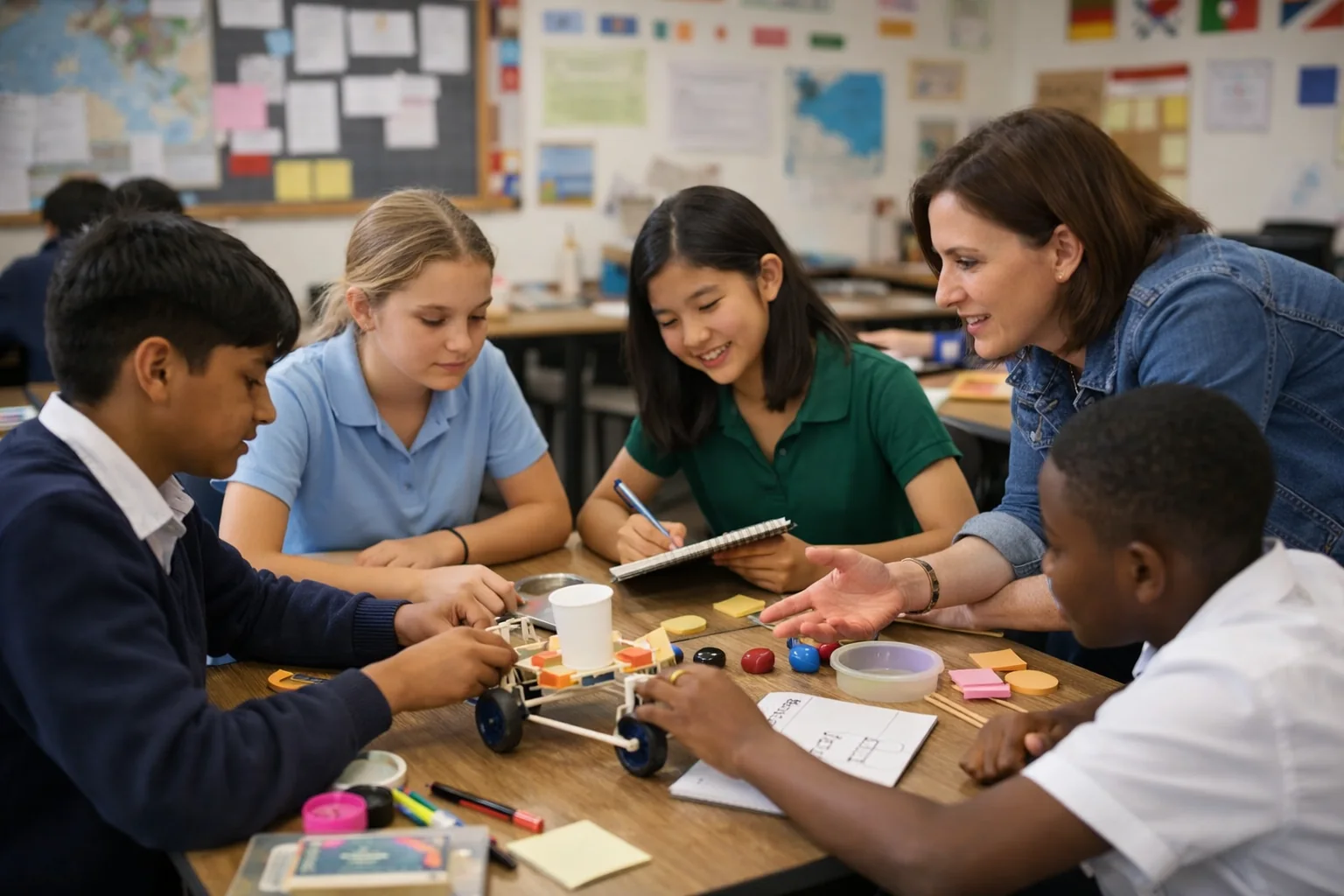
Adaptive teaching means keeping the same ambitious goal while changing the support learners receive. From September 2025, the ITTECF frames this as responsive teaching that protects working memory, especially for learners with SEND. In practical terms, teachers reduce avoidable load, make the steps visible and remove support only when learners can manage the task more independently.
In practice, this means planning the enquiry in layers. Before learners begin, strip out avoidable load: pre-teach two or three key terms, model the first step, show a worked example, and keep instructions visible so learners are not holding everything in their heads at once. This fits cognitive load theory and the EEF’s guidance that high-quality teaching should come first, with targeted scaffolding rather than a pile of different worksheets (Sweller, 2016; EEF, 2020).
In a Year 5 science lesson on insulation, the teacher says, “We are all answering the same question: which material slows heat loss best?” She demonstrates one test, gives every group the same success criteria, then adapts support: one pair gets a step card, another gets a partial results table, and another uses a blank planning grid. Learners still think like scientists, but they are less likely to get lost in the procedure.
This is Dewey with guard rails. Learners still learn by doing, but the teacher manages the load, removes support when it is no longer needed, and builds in reflection afterwards: “Which prompt helped you think clearly, and which one can you now do without?” That is a stronger fit with current adaptive teaching expectations in the ITTECF, and it fits the evidence that novices learn more securely from guided rather than minimally guided inquiry (Kirschner, Sweller and Clark, 2006; Belland, Walker and Kim, 2017).
Democracy in the classroom means taking part in daily learning. It involves talk, shared tasks, and solving problems together. Dewey believed schools should work like small communities, where learners listen, judge facts, take charge, and consider others.
This kind of democracy is not only about voting from time to time. It is the daily habit of joining in, talking things through, and fixing issues as a team.
In teaching terms, this means giving learners a genuine voice within clear academic boundaries. A weekly class meeting can be one simple routine: learners review what is helping learning, identify one barrier, and agree a practical next step together. The teacher still sets expectations and protects the purpose of the lesson, but learners learn that rules, routines, and decisions should be explained and justified, not simply imposed.
Planned talk is another useful teaching tool. In reading, history, or RE, teachers can use talk partners, sentence starters, and set roles. Roles such as summariser, questioner, and fact-checker help every learner join in.
This matches Dewey’s idea that thinking grows through interaction. It also links to newer research on group talk and teamwork, which shows that reasoning improves when learners share and test ideas together.
Democratic practise can also be built into subject tasks. In science, groups may choose which variable to test and defend their method before starting the enquiry; in English, learners can help shape success criteria for persuasive writing and use them in peer review; in PSHE or geography, a class may examine a local issue, compare viewpoints, and propose a response. These approaches help learners see that learning carries civic responsibility, because knowledge is used to make decisions that affect other people.
Dewey's ideas still shape teaching today, but schools need to check the quality of the doing. For a headteacher or MAT curriculum lead, project work is easier to defend under the education inspection framework when plans show prior knowledge, success criteria, formative checks, individual evidence and the final disciplinary standard (Ofsted, 2025). This protects curriculum sequencing: the project should show what learners now know and can do, not interrupt the scheme of work for a display outcome.
This avoids a display-project culture where the product looks impressive but the learning is thin.
You can see Dewey's legacy in project-based learning, enquiry lessons, and structured classroom discussion. Kolb's experiential learning cycle and Vygotsky's work on social learning both echo his view that understanding grows through action and shared meaning. In practice, teachers need a clear lifecycle. They should activate prior knowledge, model the method, let learners investigate, check understanding, and end with reflection that uses precise subject vocabulary.
For example, in science, learners may test which material keeps water warmest, record their results, and then evaluate why the test was or was not fair. In English, a class can hold a short debate before writing, so spoken reasoning strengthens later sentence construction. In primary mathematics, learners can solve a real measurement problem in pairs, then compare methods on the board to make efficient strategies visible.
The modern lesson from Dewey is not that every lesson must be busy or project-led. It is that experience becomes educational when it is organised, discussed, and revisited. Teachers who use quick reflection prompts, success criteria, and well-timed feedback are applying Dewey's insight in a form that fits today's classrooms and the evidence on effective teaching.
Applying Dewey in modern classrooms means using active, practical learning to build understanding, social engagement and reflection. A well-planned Deweyan lesson has a clear lifecycle. The teacher frames a real problem, models the method, lets learners investigate and checks understanding. Finally, learners explain what changed in their thinking.
Active engagement helps learners succeed, even with experiential learning's hurdles. Teachers use Dewey's (n.d.) ideas by planning well and giving support. Reflecting on what you do improves learner outcomes.
References:Dewey (1916) linked democracy with education because classrooms teach more than subject content. When learners discuss evidence, share responsibility and justify choices, they practise active citizenship. Later, Freire (1970) described education as a route to critical consciousness. Illich (1971) also asked schools to consider how far institutions help or limit learner agency.
Dewey, J. (1933). How we think: A restatement of the relation of reflective thinking to the educative process. D. C. Heath and Company.
Dewey, J. (1938). Experience and education. Kappa Delta Pi.
Hattie (2009) reviewed learning research in his book Visible Learning. This large study looked at over 800 reports on learner success. Teachers can learn about effective methods using Hattie's (2009) research.
Kirschner, Sweller and Clark (2006) argued that minimal guidance does not work well for novices. It can overload working memory. This does not rule out experiential methods. It means the teacher must first teach the background knowledge, vocabulary and procedure before learners investigate, collaborate or produce a final artefact.
Thomas, J. W. (2000). A review of research on project-based learning. Autodesk Foundation.
John Dewey's idea of 'learning by doing' links directly to his method called the Theory of Occupations. This theory suggests that learners learn best when they complete tasks with a clear social purpose. These activities should mirror real problems and processes found in the wider world.
Occupations are not just practical tasks. They involve a full cycle: planning, action and reflection, much like useful work in society. This structure gives learners real challenges, so they can form ideas, test solutions and judge results. In this way, they build strong understanding.
A key way to use the Theory of Occupations is through manual training. Dewey supported practical activities such as cooking, woodwork, gardening, or weaving.
He did not view these activities as job training. Instead, he saw them as rich settings for academic learning. They give learners real experiences that bring different school subjects together.
For instance, a cooking project naturally involves chemistry through reactions and ingredients. It also uses mathematics when learners measure amounts and work out ratios. Learners explore history by studying where foods come from and what they mean in different cultures.
They also practise language arts by following recipes and explaining processes. Through this kind of practical work, abstract ideas become real and relevant. This makes learning much easier to remember.
Consider a primary class undertaking a gardening occupation. learners begin by planning what to plant, researching soil types, and designing the garden layout. They then prepare the beds, sow seeds, and care for the plants, observing growth and noting changes.
During this process, learners use maths skills to measure plots and calculate yields. They use scientific understanding to explain plant growth and pest control. They also use historical knowledge when they research farming practices.
Learners record their observations using Graphic Organisers and discuss their findings. This helps strengthen their communication and critical thinking skills.
The teacher guides learners to reflect on problems they face, such as poor plant growth or pest issues. This prompts the class to research solutions and adjust their methods over time. This cycle of action and reflection helps learners build clear internal pictures, or Mental Models. As a result, they better understand natural systems and problem-solving strategies.
Dewey emphasised that experience only becomes educational when it is paired with reflection (Dewey, 1938). The role of the teacher is vital in this process. Teachers must structure the practical tasks and ask clear questions. They should also lead discussions that connect these physical actions to wider academic ideas and real life.
Teachers can use tools like the structured thinking approaches to help learners structure their thinking during these occupations. For example, using a 'Compare and Contrast' skill from the UTF could help learners analyse different soil types, or a 'Sequence' skill could map out the steps of planting and harvesting.
This approach helps manual training within the Theory of Occupations move beyond simple skill acquisition. It builds intellectual habits and a deeper understanding of linked concepts. It also prepares learners to think carefully about complex challenges.
John Dewey's famous 1896 paper, The Reflex Arc Concept in Psychology, challenged how experts viewed the mind and human action. He rejected the old idea that learning is a simple line of stimulus, feeling, and response. Older theories treated these as separate events where an outside stimulus forces an automatic reaction (Dewey, 1896).
Dewey contended this segmented view was artificial and misleading. He argued that sensation and motor response are not independent but interdependent phases within a continuous, coordinated act. The act of seeing a flame, for instance, is already an active motor adjustment of the eyes and attention; it is not a passive reception. The subsequent withdrawal of the hand is an integral part of the ongoing experience, step by step redefining the initial "stimulus" in light of the action.
Dewey argued that the Reflex Arc Concept is better seen as a continuous loop where each part changes the others. This loop shows how people actively explore and reshape the world through their actions. This idea forms the foundation of "learning by doing". It proves that learning is an active process of questioning and testing, rather than just soaking up facts.
Consider a science lesson where learners investigate the properties of different materials. A learner picks up a wooden block (action), feels its texture and weight (sensation), and then decides to test if it floats (further action). This entire sequence is a single, integrated experience, not separate steps. The act of feeling the block informs the decision to test its buoyancy, and the result of the float test refines the learner's understanding of wood's properties.
This shows that learning by doing is an ongoing process of building knowledge. The teacher steps away from simply sharing isolated facts. Instead, they create experiences that connect seeing with doing. When teachers design tasks that ask learners to act, observe, and respond, they help build strong Mental Models through direct practice.
John Dewey played a key role in establishing Functionalism, a school of thought in psychology that emerged in the late 19th century. Charles Darwin's theory of evolution strongly influenced this approach. It moved attention away from the fixed structure of consciousness and towards its changing purpose and function in adapting to the environment. Functionalists saw mental processes, such as thinking, perceiving and remembering, as tools that help an organism survive and thrive.
Dewey, a prominent figure at the University of Chicago, became a leading voice of the Chicago School of Functional Psychology. This group studied how mental processes and behaviour help organisms adjust to their surroundings and thrive. They argued that the mind's main role is to balance an organism's needs with the demands of its environment. In this view, the mind helps organisms seek equilibrium and act effectively (Angell, 1907).
This Functionalist view gives Dewey's "learning by doing" theory its key psychological base. If the mind is meant to adapt and solve problems, then learning cannot mean passively taking in facts. Instead, learners need active work with problems, experimentation and testing hypotheses in real-world contexts.
For Dewey, thinking is a form of action. It is an inner problem-solving process that begins with real-world situations.
When learners face a real problem, their minds start to look for solutions. This shows how our brains adapt to new challenges. When teachers combine this active thinking with practical tasks, learning becomes more meaningful.
Imagine a design and technology lesson about sustainable packaging. A teacher using Dewey's Functionalist ideas would not simply hand out instructions.
Instead, they would present the problem and let learners research their own materials. The class would try different designs and test how strong their models are. Finally, learners would reflect on what worked well and explain their choices.
This approach moves beyond rote memorisation, helping learners develop flexible problem-solving skills and a deeper understanding of concepts through direct experience. The learning process becomes an act of adaptation, mirroring the function of the mind in the Chicago School of Functional Psychology. Learners learn not just what to think, but how to think in response to challenges.
John Dewey strongly challenged the old split between Vocational Education vs. Liberal Education. He saw this dualism, or two-part divide, as harmful to personal growth and democratic society.
In the past, liberal education focused on abstract thinking and was often kept for an elite. Vocational education prepared people for specific trades and manual labour.
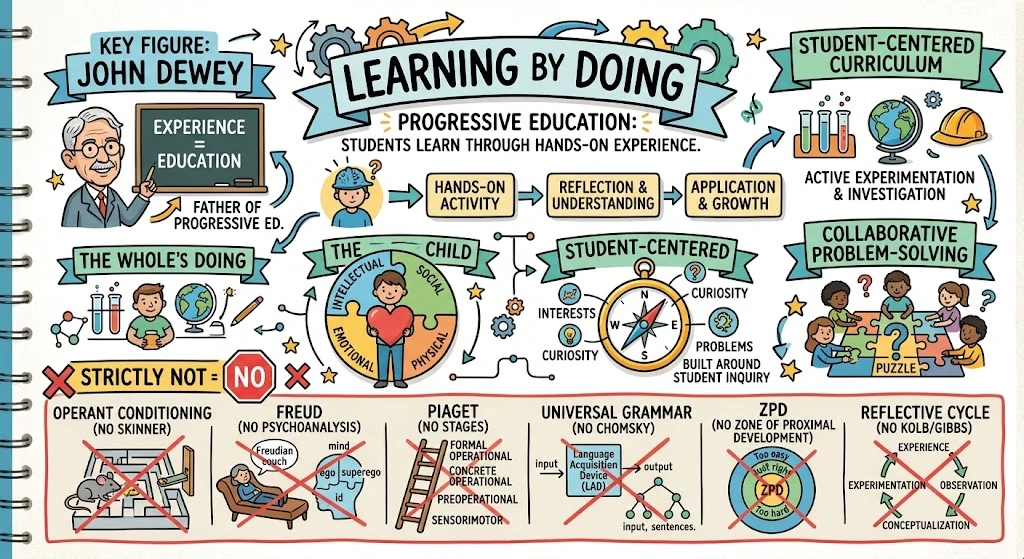
Dewey argued that this strict divide maintained social classes. He felt it limited the intellectual growth of learners on vocational paths, while making academic learning seem irrelevant for others. Separating the two created a false hierarchy. It wrongly suggested that practical work lacked mental challenge and theoretical study lacked practical use (Dewey, 1916).
Dewey also criticised "social efficiency" when it trained people for fixed industrial roles. He argued that education should help learners keep their ability to think critically, grow as people, and take an active part in democratic society.
Instead, Dewey argued for an integrated approach. In this view, practical activities are rich in thinking, and academic study has clear use. He did not see vocational experiences as simple training. He saw them as chances for scientific inquiry, problem-solving and understanding the social and economic contexts of work.
Consider a design and technology lesson where learners build a working wooden chair. The teacher does more than teach joinery skills. They guide learners to research different types of wood and their properties, such as strength and flexibility.
Learners then calculate structural loads and draw accurate technical diagrams using geometry. Finally, they evaluate the ergonomics of their design, which means how well it fits the human body. This project blends practical skills with science, maths, and critical thinking, so the line between vocational and academic learning becomes less fixed.
This whole-school view ensures that all learners develop both practical competence and intellectual capacity, building adaptable individuals rather than narrowly trained workers. Dewey's philosophy encourages teachers to design experiences that connect the 'doing' with deep reflection and conceptual understanding, thereby overcoming the artificial divide.Dewey argued that real learning often starts with an aesthetic experience, or a strong emotional response, to a problematic situation. Here, aesthetic does not only mean beauty. It means a feeling of disruption, curiosity, or challenge that drives investigation (Dewey, 1938). This first spark creates the wish to understand, rather than simply receive facts.
This aesthetic experience is a felt sense that something is incomplete or puzzling. For learners, it may appear as surprise, confusion or curiosity when an observation contradicts what they expected. That emotional pull gives the enquiry a purpose.
Dewey's broader philosophy, known as Instrumentalism, provides the foundation for his "learning by doing" approach. This form of pragmatism treats concepts, theories and ideas as tools for understanding and improving experience. Their value lies in how well they help learners solve problems and guide effective action (Dewey, 1938).
From an instrumentalist viewpoint, knowledge is not a fixed set of facts for learners to absorb. Instead, people build and refine mental tools, or "instruments," to deal with complex situations. These instruments may be scientific hypotheses or mathematical algorithms. They prove their value when they help us predict, explain, and control our environment.
When learners take part in inquiry-based learning, they test and change their conceptual instruments, or thinking tools. In a science experiment, a hypothesis is not a final truth. It is a provisional tool that guides the investigation, and its value depends on how well it leads to visible results and deeper understanding.
Consider a Year 5 mathematics lesson where learners have to design the most efficient layout for a new school garden. They may start by suggesting different geometric shapes for planting beds. Area, perimeter, and spatial reasoning become useful tools as they test layouts, calculate material costs, and weigh up the practical effects of each design. The "best" mathematical concept is the one that helps solve the design problem most effectively.
Teachers guide learners to reflect on the effectiveness of their chosen strategies and concepts. When a learner reflects on why one garden layout proved more practical than another, they are evaluating the utility of their conceptual instruments. This process of testing, refining, and applying ideas strengthens their mental models and prepares them for future challenges.
This ongoing cycle of experience, reflection, and conceptual adjustment means that knowledge is always provisional. It can be refined as learners meet new evidence and ideas. Instrumentalism therefore supports education as an active process, where learners build and improve the tools they use to make sense of the world.
John Dewey's focus on experience and reflection connects closely to David Kolb's Experiential Learning Cycle (Kolb, 1984). Kolb's model gives us a clear way to understand how people learn from what they do. Teachers can use this to plan lessons that guide learners through all four stages of Kolb's cycle. This ensures that practical tasks are always followed by chances to reflect and apply new knowledge.
The cycle begins with Concrete Experience, where learners engage directly with a task, much like Dewey's 'learning by doing'. For example, in a science lesson, learners may conduct an experiment to observe the effects of different soil types on seed germination. This direct engagement provides the raw material for learning.
Next, Reflective Observation asks learners to step back and think about their experience. They ask, "What happened?" and "Why?". A teacher might ask learners to write observations in a journal or discuss surprising results with a partner. This builds critical thinking and moves the task beyond doing into careful thought.
This reflection leads to Abstract Conceptualisation. Here, learners form new ideas or change their current views based on what they have seen. For example, learners may figure out a general rule about the best soil for growing seeds after watching a specific experiment. In this stage, they are building real meaning directly from their own experiences.
Finally, Active Experimentation means using these new concepts in new situations or testing them further. Learners could design a follow-up experiment using their refined understanding of soil types. This shows a practical use of their learning and completes the cycle. It also lets learners test new knowledge in a real-world context and deepen their understanding.
John Dewey's idea of "learning by doing" comes from an American movement called pragmatism. This way of thinking started in the late 1800s and included thinkers like William James and Charles Sanders Peirce. They believed that experience, action, and practical results were the most important parts of learning. Together, they pushed for active learning and challenged the idea that learners should just sit and listen.
William James, a prominent psychologist and philosopher, viewed truth not as a fixed, abstract concept but as something validated by its practical consequences and utility in experience (James, 1907). An idea is "true" if it works in practice, helping us navigate and make sense of the world effectively. This aligns directly with Dewey's "learning by doing", where learners test hypotheses and observe the practical outcomes of their actions. Learning becomes a process of discovering which ideas are useful and effective.
Similarly, Charles Sanders Peirce, the founder of pragmatism, developed a strict experimental method for learning. Peirce argued that doubt pushes us to investigate and make our beliefs more secure.
This means forming clear guesses and designing experiments to test them. We then improve our understanding by looking at visible results. This scientific approach reflects Dewey's call for lessons where learners actively investigate, collect evidence, and draw conclusions.
In a primary science lesson, learners might test which materials keep a cup of water hot for longest. They make guesses, set up simple tests, and measure how the temperature changes. This task shows Peirce's focus on experiments and James's focus on useful results.
Learners learn by doing, as they watch which materials "work" best and think about why. This practical approach gives the lesson a clear purpose. It links their actions to real results and helps them build deeper understanding.
Reflective Thinking helps turn raw experience into meaningful learning. It is more than looking back at what happened. Learners follow a clear process of inquiry and evaluation, so they can link actions to results and improve what they do next.
Dewey (1933) described clear phases of reflective thought. It begins with perplexity, or real doubt about a situation. This leads to the suggestion of possible solutions or explanations, then to elaboration, where learners explore these ideas in their minds. Learners then use testing, either through further action or mental simulation, before reaching a conclusion or revised understanding.
For instance, after a design technology lesson where a prototype failed, a teacher may prompt learners: 'What exactly went wrong with your bridge design?' (perplexity). learners may then suggest: 'Perhaps the joints were too weak' or 'We used the wrong material' (suggestion). The teacher could then guide them to sketch alternative joint designs or research material properties (elaboration), before building a revised prototype (testing) and explaining why the new design is superior (conclusion). This structured approach to reflection ensures learning from mistakes.
John Dewey set up the Laboratory School (University of Chicago) in 1896 to test his ideas in real classrooms. The school moved away from rote learning, where learners repeat and remember facts. Instead, its curriculum asked learners to explore the world around them and learn through direct experience.
For instance, learners explored fractions by measuring ingredients for cooking projects instead of doing abstract exercises. They halved recipes or worked out amounts for a larger batch. This put maths concepts into a practical and meaningful context. In the same way, weaving and carpentry tasks used careful measurement and spatial reasoning, so geometry and arithmetic felt real (Dewey, 1938).
This joined-up approach meant that teachers did not teach subjects in isolation. Instead, learners could clearly see how different areas of knowledge connect together. The school showed how practical activities can build a strong foundation for deeper understanding and problem-solving skills. This perfectly captured Dewey's central vision of learning by doing.
Wider uses of Dewey’s ideas show that learning by doing links to occupations, pragmatism, aesthetic experience, collaboration, cognitive load, neurodiversity and motivation. These points build on his main argument. Experience works best when it has purpose, structure and reflection.
John Dewey's theory of occupations describes useful, practical activities that reflect real-world social processes (Dewey, 1916). These are not just physical tasks, but complete experiences that require both deep thinking and active doing. An occupation asks learners to spot a problem, plan a solution, carry it out, and reflect on the results. This active process clearly links thought with action.
For example, a science class may take on an "urban farming" project. Learners research sustainable growing methods and design a small hydroponic system. They then grow plants, measure growth data, and analyse their crop yield.
This activity brings together biology, engineering, data analysis, and team problem-solving. It moves learners far beyond abstract, theoretical study.
Dewey looked closely at the traditional split between vocational and liberal education. He argued that schools created a false and harmful dichotomy when they separated practical work skills from abstract knowledge. True education should bring these parts together. It should prepare people to take part actively and thoughtfully in a democratic society.
Occupations act as an important bridge between these apparent divides. They provide practical skills for future work (the vocational aspect) while also building critical thinking, problem-solving and ethical reasoning (the liberal aspect). This approach makes learning useful now and enriching over time. It helps build well-rounded people who can adapt to complex challenges.
| Aspect | Traditional Dichotomy | Dewey's Integrated View (Occupations) |
|---|---|---|
| Purpose of Vocational Education | To train specific manual skills for employment. | To develop practical competencies alongside intellectual habits and social understanding. |
| Purpose of Liberal Education | To cultivate intellect through abstract knowledge, often detached from practical application. | To connect abstract knowledge to real-world problems, building critical thought and judgement. |
| Learning Approach | Passive reception of information; separate theoretical and practical instruction. | Active engagement in purposeful activities; integration of doing, thinking, and reflecting. |
Dewey's specific philosophy is known as Instrumentalism, which is his unique take on pragmatism. It suggests that ideas, concepts, and theories act as tools or "instruments". We use these mental tools to solve practical problems and adapt to new experiences (Dewey, 1938). Therefore, human thought is an active process of inquiry that aims to turn uncertain situations into clear ones.
These intellectual instruments, or thinking tools, are judged by how well they guide action and help learners overcome difficulties. They are not judged mainly by whether they match a fixed reality. Learning means testing these conceptual tools in real-world contexts, then refining and validating them.
For example, in a science class, learners may use the concept of "fair testing" as an instrument to design an experiment investigating plant growth. They may use a graphic organisers to plan their variables, testing how well the "fair testing" framework helps them produce reliable results and draw valid conclusions.
Dewey suggested that learning often starts with an "aesthetic experience". This is an emotional spark that grabs a learner's focus before they even start thinking (Dewey, 1934). At first, they do not fully understand the idea.
Instead, they feel an immediate connection to the situation or problem. This feeling creates wonder, curiosity, or slight confusion, which makes them want to learn more.
This emotional engagement gives inquiry a strong starting point. Before learners choose to learn, an aesthetic experience can draw them in and make the task feel relevant. Teachers can design activities that prompt these responses and prepare learners for deeper thinking.
For instance, a science teacher may begin a lesson on buoyancy by having learners observe a seemingly impossible demonstration, such as a heavy object floating or a light object sinking, without immediate explanation. learners may exclaim, "How does that work?" or "That's weird!", demonstrating an immediate emotional and curious response. This pre-cognitive trigger motivates them to investigate the underlying principles.
Traditional education often relied on a psychological model called the "reflex arc". This model treated learning as a mechanical process of stimulus and response. In it, an external event led to a predictable reaction (Dewey, 1896). This view suggested that learners could receive knowledge passively and then show it through separate, measurable behaviours.
John Dewey rejected this mechanistic view of human experience and learning. He argued that the "reflex arc" made thought and action seem too simple and separate. Instead, Dewey proposed an "organic" model, where a person's experience is continuous and purposeful, not a set of disconnected reactions.
In the classroom, this difference matters. A teacher using the reflex arc model might give a fact, such as "water boils at 100°C", and ask learners to recall it in a test. By contrast, a teacher using Dewey's organic view would ask learners to investigate boiling water, measure changes in temperature, and discuss energy transfer. This helps learners build linked understanding instead of just memorising one separate fact.
| Feature | "Reflex Arc" Model | Dewey's "Organic" View |
|---|---|---|
| Learning View | Mechanical, stimulus-response | Integrated, purposeful experience |
| learner Role | Passive receiver | Active investigator, meaning-maker |
| Educational Goal | Rote recall, isolated facts | Connected understanding, judgement |
Dewey's emphasis on active experience and thoughtful reflection aligns closely with David Kolb's Experiential Learning Cycle (Kolb, 1984). Both theories present learning as an ongoing process. Learners make sense of direct encounters, then use that meaning again. This structured approach moves them from concrete action to thoughtful understanding and back to informed application.
Kolb's four stages give teachers a clear way to use Dewey's 'learning by doing' in class. Teachers can plan activities that take learners through each phase. This helps learners build sound knowledge, so practical activity leads to real educational growth.
| Kolb's Stage | Dewey's Principle | Classroom Application |
|---|---|---|
| 1. Concrete Experience | Active engagement, hands-on tasks | learners conduct a science experiment, building a circuit. |
| 2. Reflective Observation | Reflection, discussion, making sense of experience | learners discuss why some circuits worked and others did not, using a Graphic Organiser to record observations. |
| 3. Abstract Conceptualisation | Forming generalisations, theories, linking to prior knowledge | The teacher guides learners to form rules about series and parallel circuits. |
| 4. Active Experimentation | Testing new ideas, applying learning, planning future actions | learners design and build a new circuit to solve a specific problem, applying their new understanding. |
Computer-Supported Collaborative Learning (CSCL) can support John Dewey's focus on active, social learning. In the AI era, however, teachers need stronger evidence of process. Digital simulations work well when learners can test variables that would be unsafe, slow or expensive in class. Assessment should include planning notes, observed decisions, oral explanation and a record of revisions, because generative AI can produce polished written summaries without proving understanding (Xia et al., 2024).
Teachers can design tasks where learners use online platforms to co-create artefacts or carry out shared investigations. For example, a science class can use a virtual lab simulation to gather data. They can then repeat one measurement with real equipment, photograph the set-up, annotate errors and defend the method orally. This makes the final report less gameable by a large language model, because assessment includes embodied action, process evidence and teacher questioning, not only a polished product (Shapiro and Stolz, 2019; Kickbusch et al., 2025).
This digital teamwork allows learners to test their ideas and improve their arguments. They can also think about how they worked together as a group. This builds on Dewey's idea that experiences should be structured and followed by reflection. Teachers can use digital tools to help learners organise their work and talk to each other more clearly.
| CSCL Tool | Deweyan Principle Supported |
|---|---|
| Shared Document (e.g., Google Docs) | Collaborative knowledge construction, co-creation |
| Online Discussion Forum | Reflective dialogue, debate, peer feedback |
| Virtual Whiteboard | Visualisation of shared thinking, problem-solving |
John Dewey's emphasis on active, experiential learning should not be treated as minimally guided discovery. The sharper reading is that genuine learning by doing requires more explicit teaching, not less. Kirschner, Sweller and Clark (2006) warned that novice learners can be overwhelmed when complex tasks place too much load on working memory, while Hmelo-Silver, Duncan and Chinn (2007) argued that inquiry can work when it is scaffolded. In classroom terms, model the method, check prior knowledge, guide practice, then fade support as learners become more fluent.
Teachers need to structure "learning by doing" so learners do not face cognitive overload, which means too much to think about at once. They can keep discovery alive by breaking complex tasks into steps, giving clear guidance at key points, and helping learners organise their ideas and work.
Before learners start an experiential task, teachers can help them build initial mental models and plan their approach. This reduces extraneous cognitive load during the activity by providing a clear framework. Learners can activate prior knowledge and anticipate steps, rather than hold too many new elements in working memory at once.
For instance, a Year 7 science teacher planning a plant growth investigation might ask learners to use a Multi-Flow Map. They can use it to predict causes and effects before they design their experiment. This helps them picture the scientific process, spot variables, and think ahead about likely outcomes in a clear structure (Sweller, 1988).
During the "doing" phase, learners often require support in applying specific cognitive processes to their task. Teachers can direct learners to use specific colour-coded thinking skills as they navigate their inquiry.
Consider a Year 9 history class studying primary sources about the Industrial Revolution. Instead of simply "analysing," learners can use UTF skills at set stages, such as 'Identify Key Information' (blue), 'Compare and Contrast' (yellow), or 'Evaluate Evidence' (red). This gives targeted scaffolding, so learners use the right cognitive strategies without being overwhelmed by the size of the task (Rosenshine, 2012).
The reflection and articulation stages of "learning by doing" help learners consolidate knowledge, or make it stick. Yet these stages can also place high cognitive demands on learners. Learners need support to organise their findings and express their understanding clearly. Writing frames and graphic organisers provide this structure.
Following the plant growth experiment, learners can use a writing frame to structure their lab report, with sentence starters for 'Our hypothesis was...', 'We observed...', and 'This suggests...'. After analysing historical sources, learners can complete a Venn diagram to compare perspectives or a concept map to link key ideas. These tools reduce the cognitive burden of organising thoughts, allowing learners to focus on the content of their learning.
John Dewey believed that learning through experience helps children build knowledge. However, typical learning-by-doing tasks can carry a neurodivergent penalty. This happens when they rely on noisy rooms, rapid switching, unclear instructions and compulsory group talk. Teachers need to design access before the lesson starts, with predictable routines, quiet options, clear roles and individual ways to show understanding.
Neurodivergent learners, including those with Autism Spectrum Condition or ADHD, may face sensory overload or executive dysfunction in open-ended group tasks (Dawson & Guare, 2010). This is the neurodivergent penalty of poorly planned PBL. Unstructured exploration, forced group talk and multi-sensory input can punish learners who need predictability. Teachers can reduce cognitive load and support self-regulation with clear roles, visual timelines, sensory choices, opt-in speaking routes and explicit check-ins.
A structured thinking approach gives learners clear, colour-coded thinking skills to support open-ended enquiries. For example, in a Key Stage 2 science investigation on plant growth, learners may use the 'Observing' skill to record changes in a systematic way. They can then use 'Analysing' to interpret data. This clear structure helps neurodiverse learners manage a complex investigation by breaking it into manageable steps.
Strong mental models help learners understand ideas in depth. However, some neurodiverse learners may find complex ideas hard to grasp. Graphic Organisers and Thinking Maps give visual support, so learners can show and arrange their thoughts.
This reduces the mental effort needed to process information in their heads (Sweller, 1988). For example, a Key Stage 3 history class could use a Flow Map to place historical events in order. This helps learners see how one event caused another.
This matrix shows how to adapt Dewey's hands-on activities for neurodiverse learners using normal classroom resources. It provides a clear and helpful framework for SENCOs and teachers.
|
The Neuroscience of Dewey's "Itch": Interoception and the Drive to LearnDewey said experience starts with a felt problem, tension or uncertainty. It does not start with learners simply taking in information. Teachers can link this Deweyan idea with modern work on interoception, which studies how people sense internal bodily states (Craig, 2002). However, they should not treat these two bodies of work as the same source. Interoceptive signals are body signals, such as a feeling of confusion, curiosity, or unease. They can form the physiological basis for Dewey's "itch." When learners meet a problem that does not fit their current mental models, they feel this internal signal. This feeling pushes them to engage with the material and resolve the cognitive dissonance. Teachers can explicitly draw attention to these internal states, helping learners recognise when they feel confused or curious. For instance, in a Year 5 science lesson on circuits, a learner may connect wires incorrectly and feel a subtle frustration when the bulb fails to light. The teacher can prompt, "What does that feeling tell you about what's happening?" This encourages the learner to use the structured thinking approaches's 'Analyse' skill (red colour) to break down the problem. By reflecting on this internal signal, learners start to build more accurate Mental Models of electrical flow. This approach uses interoceptive awareness, or awareness of body signals, to deepen understanding and support purposeful learning. Research Evidence Check Evidence SynthesisDoes Dewey's learning by doing support structured activity? Can it include reflection and teacher-guided inquiry? Use it as a starting point for professional discussion: identify the learner's current need, record evidence from more than one lesson, and agree the next classroom adjustment with the SENCO or family. Promising support: Consensus-sourced records support Dewey's core idea: experience works best when teachers set a clear task, guide inquiry and build in reflection. The evidence does not support open-ended activity on its own. 60% Yes from 5 studiesmoderate evidence
Teacher takeaway Set a real problem, model the inquiry route, ask learners to work together and finish with reflection. The aim is purposeful learning, not busy work. View the evidence behind this answer5 studies1Experience and Educationpeer-reviewed studyyes20189262 citations Dewey explains why experience can teach well or badly. The book says teachers must plan tasks, connect them over time and help learners reflect. View journal sourceconsensus.app 2Experiential Learning Theory as a Guide for Experiential Educators in Higher Educationpeer-reviewed studyyes2022446 citations Kolb and Kolb explain the learning cycle built from Dewey's ideas. The paper helps teachers plan action, reflection, ideas and new trials. View journal sourceconsensus.app 3John Dewey and Teacher Educationpeer-reviewed studyyes201918 citations This entry explains how Dewey shaped teacher education. It stresses planned environments, reflection and learning experiences set out in a clear order. View journal sourceconsensus.app 4JOHN DEWEY'S HIGH HOPES FOR PLAY: Democracy and Education and Progressive Era Controversiespeer-reviewed studypossibly201711 citations This historical paper looks at Dewey's views on play and democracy. It is useful for early years and primary settings, but it is not direct trial evidence. View journal sourceconsensus.app 5Experience is Not the Whole Story: The Integral Role of the Situation in Dewey's Democracy and Educationpeer-reviewed studypossibly20189 citations This paper argues that experience only makes sense inside a clear situation. Teachers must consider learner interest, aims and moral choices before they plan inquiry. View journal sourceconsensus.app ReferencesDewey, J. (1938). Experience and education. Froebel, F. (1826). The education of man. Kirschner, P. (2006). Why minimal guidance during instruction does not work. Kolb, D. (1984). Experiential learning. Vygotsky, L. (1978). Mind in society: The development of higher psychological processes. Further Reading: Key Papers on John Deweys TheoryThese peer-reviewed sources underpin the evidence base for this article. Consensus.app links aggregate the paper with its journal DOI. Experience and Education
John Dewey (2018), Free Press (reprint edition) Dewey's most concise statement on his philosophy of experience as the foundation for education. Critiques both traditional and progressive education, arguing each is miseducative when divorced from a developed philosophy of experience. The starting point for understanding Dewey a Experiential Learning Theory as a Guide for Experiential Educators in Higher Education
A. Kolb (2022), Experiential Learning and Teaching in Higher Education Authoritative synthesis of Experiential Learning Theory (the learning cycle, learning style, learning space) by Kolb and Kolb, who built directly on Dewey. Connects Dewey's foundational ideas to current classroom practice with worked applications across disciplines. John Dewey and Teacher Education
Wendy Rowley (2019), Oxford Research Encyclopedia of Education Comprehensive Oxford encyclopedia entry on Dewey's implications for teacher preparation. Covers his philosophy of experience, the role of reflection, and the duty of teacher educators to design environments that promote sequential learning experiences. JOHN DEWEY'S HIGH HOPES FOR PLAY: Democracy and Education and Progressive Era Controversies
Barbara Beatty (2017), The Journal of the Gilded Age and Progressive Era Historical analysis of Dewey's writings on play in early years and kindergarten settings. Useful for primary teachers wanting to understand the pedagogical lineage from Froebel through Dewey to modern play-based curricula. Experience is Not the Whole Story: The Integral Role of the Situation in Dewey's Democracy and Education L. Hildebrand (2018), Journal of Philosophy of Education Argues that 'situation' is inseparable from 'experience' in Dewey's pedagogy and explains why both must shape teacher decisions about learner interest, problem-solving aims, and moral education. Helps teachers translate Dewey beyond the much-quoted 'learning by doing'. |
|---|