Updated on
October 8, 2026
Emotion Coaching: A Complete Guide for Teachers
Explore John Gottman's five-step Emotion Coaching approach to effectively support children's emotional development and turn challenges into learning moments.


Updated on
October 8, 2026
Explore John Gottman's five-step Emotion Coaching approach to effectively support children's emotional development and turn challenges into learning moments.
Emotion Coaching helps learners understand feelings through empathy, clear limits and problem-solving. It draws on Gottman, Katz and Hooven's meta-emotion research and on UK school adaptation work recorded by Bath Spa University.
Emotion Coaching is an evidence-informed, relationship-based approach for helping learners notice, name and manage feelings while adults still hold clear behaviour boundaries. Gottman, Katz and Hooven's family research shaped the original model, and Bath Spa University records how Rose, Gus and Gilbert adapted it for UK educational settings.
Emotion coaching helps learners connect and learn during emotional moments. John Gottman and colleagues developed the original family-based model, and Bath Spa University describes the UK school adaptation through the work of Janet Rose, Licette Gus and Louise Gilbert. That is a school-implementation lineage, not a single combined author citation.
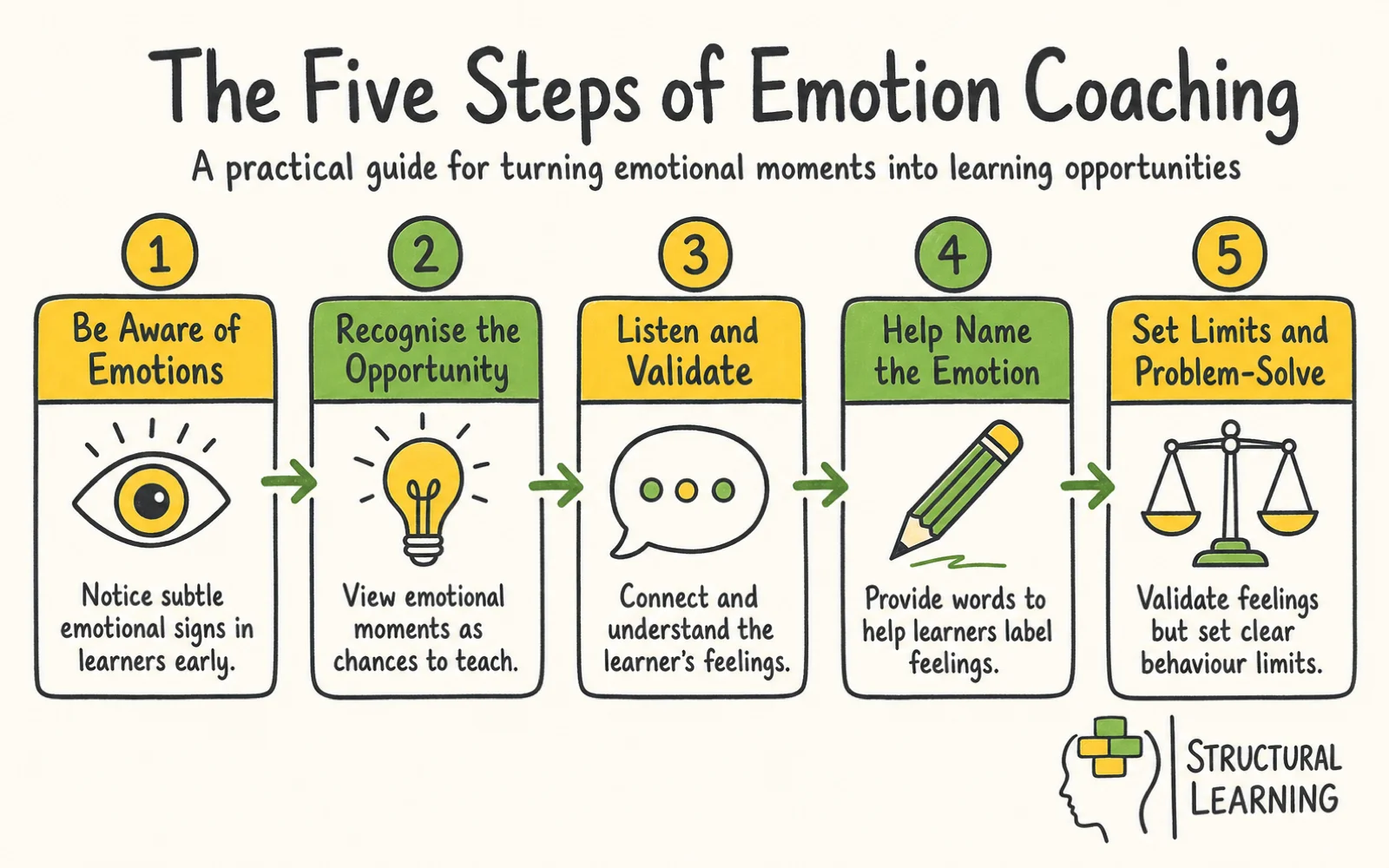
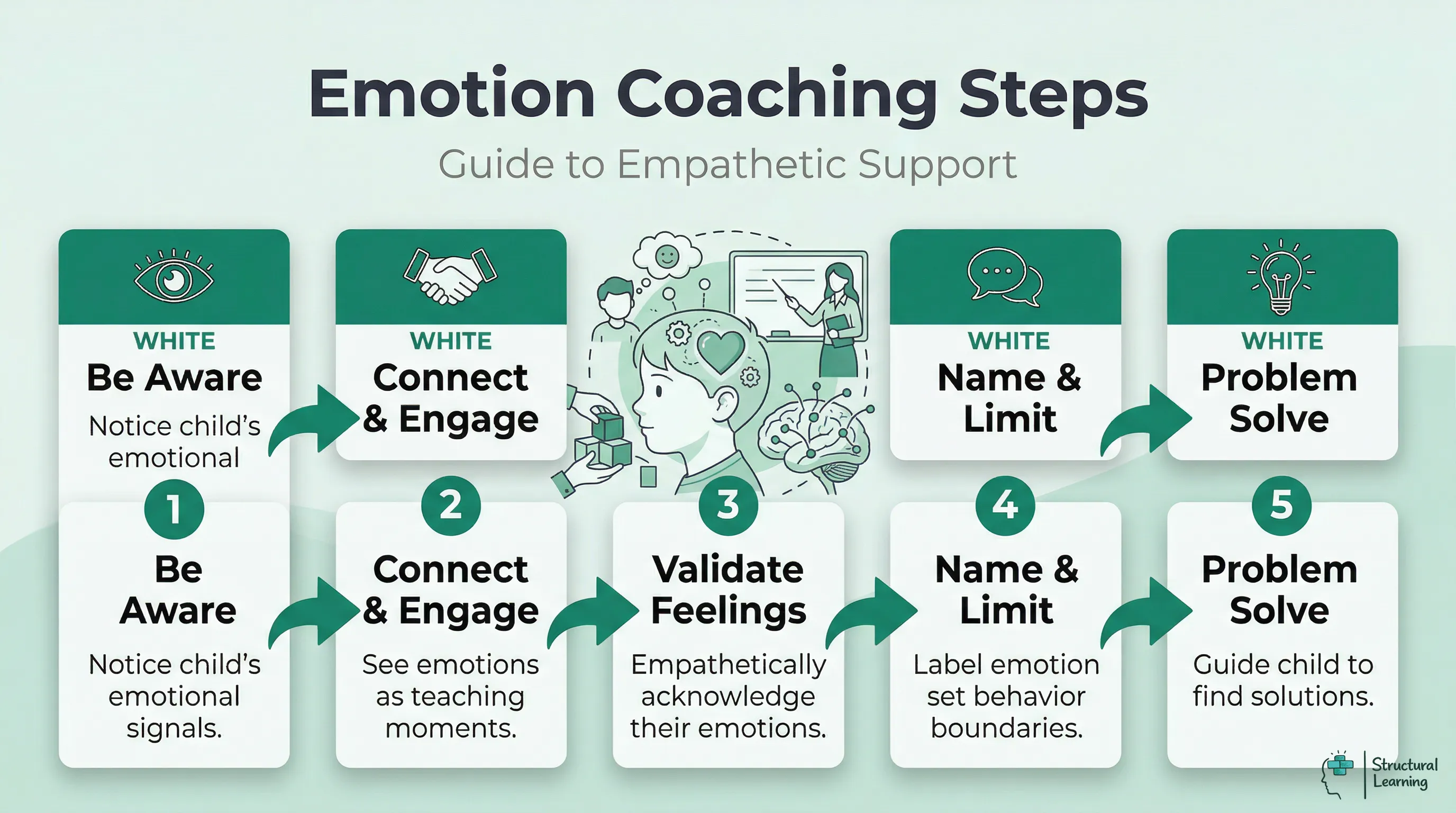
At its core, Emotion Coaching involves five key steps:
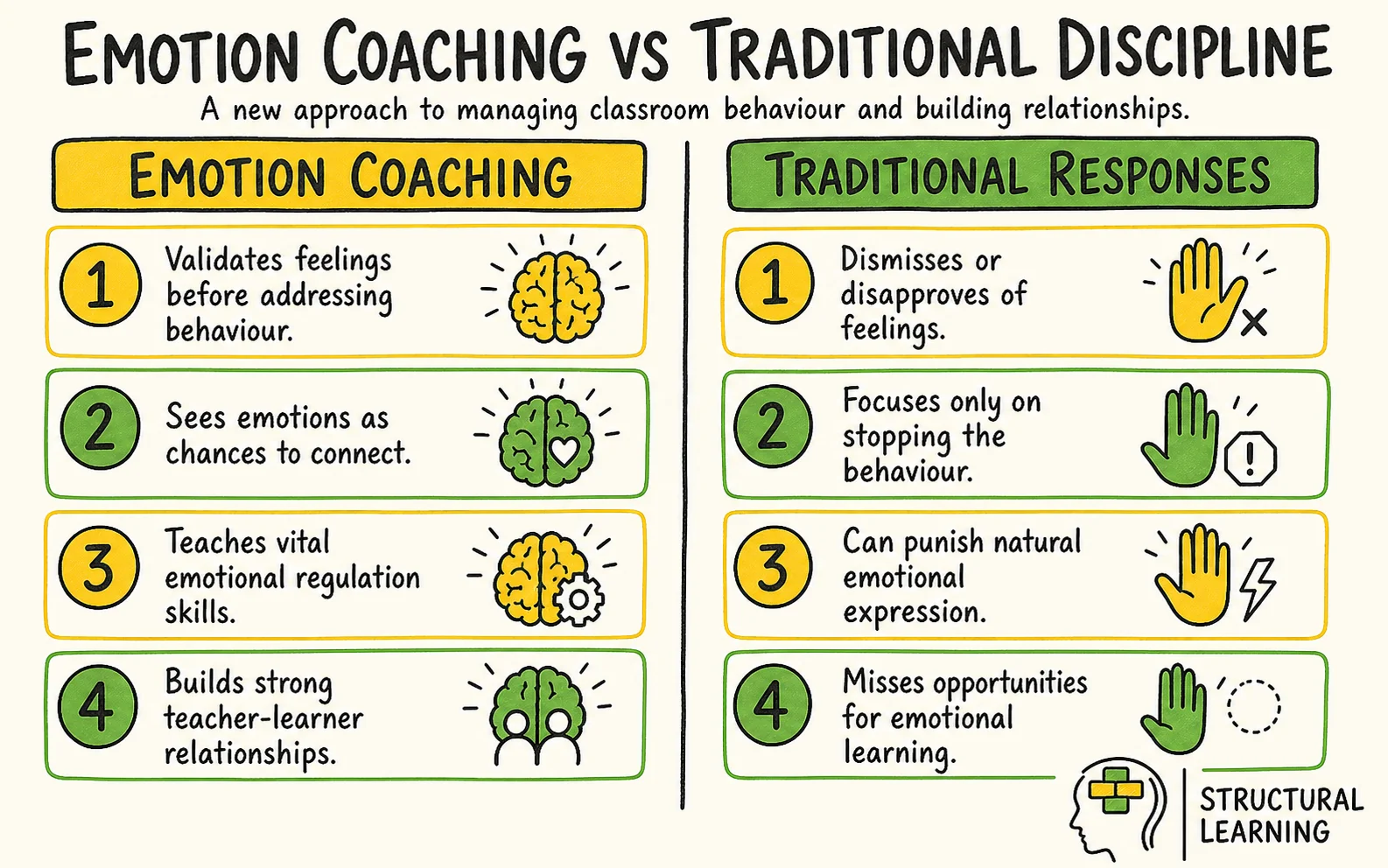
These responses contrast sharply with helpful methods. "Emotion dismissing" ignores learners' feelings ("Don't cry"). "Emotion disapproving" punishes expression (Morris et al., 2007). These responses do not help emotional development (Gottman et al., 1997).
Emotion Coaching sees feelings as valid signals, but some behaviours are unacceptable. A learner can feel furious but shouldn't hit (Gottman et al., 1997). Adults help learners understand and express emotions well (Shapiro, 1997; Rose et al., 2017).
When children experience intense emotions, their amygdala (the brain's alarm system) becomes highly activated, triggering fight, flight, or freeze responses. In this state, the prefrontal cortex (responsible for reasoning, language, and impulse control) goes partially offline. This is why telling an upset child to "calm down and Think about it" rarely works: the thinking parts of their brain are not fully available.
Emotion Coaching uses neuroscience to help learners. Empathetic responses calm the amygdala, restoring prefrontal cortex function. This lowers learner stress hormones and heart rate, allowing rational thought. Problem-solving and behaviour management then become effective (Gottman, 1997).
Schore (1994) states co-regulation helps learners manage feelings with support. Calm adults give learners structure when emotions are strong (Siegel, 1999). Cozolino (2014) says learner nervous systems mirror this calm. Mikolajczak (2018) finds co-regulation slowly builds learner self-regulation.
Emotion Coaching strengthens attachment relationships by demonstrating that the adult is a safe person who can handle the child's big feelings. Children learn they donot have to suppress or hide emotions to maintain connection. This secure base supports all other learning and development.
Gottman, Katz and Hooven (1996) introduced parental meta-emotion philosophy and linked emotion-coaching responses with children's emotion regulation, physiology and later adjustment. The safest classroom claim is that the school approach draws from this family research; it should not be presented as direct proof that every classroom will see rapid academic or behaviour gains.
UK school evidence is more cautious. Rose, Gilbert and McGuire-Snieckus (2015) reported a mixed-method pilot with 127 practitioners, and Gilbert's Bath Spa doctoral study explored practitioner adoption across primary, secondary and early-years settings. These sources support careful implementation, staff training and relational practice; they do not justify unsourced percentage claims.
Emotion Coaching starts with noticing. Adults aware of emotions see signs early (Gottman, 1997). They spot jaw tightening, withdrawal, or rising voices. This awareness allows for early intervention before emotions overwhelm the learner.
Teachers must spot learners' subtle emotions that are often missed. Children feel frustration, sadness, and anxiety daily, (Brackett, Rivers & Salovey, 2011). These less obvious moments are key times for support (Gottman, Katz & Hooven, 1997).
Developing awareness:
When a child is emotional, adults face a choice: see this as a problem to solve quickly or an opportunity to connect and teach. Emotion Coaching requires consciously choosing the second option, which may feel counterintuitive when behaviour is challenging.
This impacts learning (Siegel, 2010). Treat emotional moments as learning chances, not problems. Then, responses involve curiosity and empathy (Cozolino, 2014; Immordino-Yang, 2015).
Reframing emotional moments:
Empathy connects you after you see the emotional chance. Focus on understanding the learner's experience. Forget your agenda, such as lesson plans (Elias et al., 1997). Stop the disruption later (Jennings, 2019).
Empathetic listening involves your whole body: getting down to the child's level, making gentle eye contact, and using a calm, warm voice. Your non-verbal communication often matters more than your words. Children quickly sense whether an adult is genuinely interested in their feelings or just trying to Manage their behaviour.
Validation phrases that work:
Avoid immediately jumping to solutions or trying to talk children out of their feelings. Validation comes first, problem-solving comes later.
Researchers Gottman, Katz, and Hooven (1996) found young learners need more words for feelings. They struggle to name the difference between frustration and anger. Emotion Coaching helps learners label and understand what they feel, say Gottman, Katz, and Hooven (1996).
Labelling emotions helps learners manage feelings, (Lieberman et al., 2007). This restarts the prefrontal cortex, so learners create coping strategies. Research shows labelling emotions reduces how intense they feel.
Age-appropriate emotion words:
Sometimes children will reject your suggestions: "I'm not angry!" This is fine. Your job is not to be right about the specific emotion but to demonstrate that feelings can be named and discussed.
Emotional validation, clear limits, and teamwork are key. Teachers should recognise feelings, stating unacceptable actions (Siegel, 2010). Adults and learners can then work together to find better answers (Greenspan, 1997; Shanker, 2016).
This step often sounds like: "I understand you felt angry when Jake took your pen, and it's normal to feel angry about that. But we can't hit people when we're angry. What else could you do when someone takes something that belongs to you?"
Effective limit-setting:
Teachers often say Emotion Coaching takes too much time. Managing busy classrooms makes stopping feel hard. However, research (Gottman, 1997; Katz, 2016) shows coaching saves time later. It prevents bigger issues and builds learners' self-regulation skills.
For brief emotional moments, Emotion Coaching can take just 30-60 seconds. A quick acknowledgment ("That's disappointing"), validation ("I can see you're frustrated"), and gentle redirect ("Let's try a different approach") often suffices.
Some children, particularly those who have experienced trauma or repeated emotional dismissal, may initially reject emotional support. They might say "I'm fine" while clearly struggling, or become more upset when you try to help.
Show learners you care by staying nearby and available. Say, "I'm here if you change your mind." This helps build trust. Your consistent presence aids co-regulation (Schore, 2003), even if learners reject you.
Emotion Coaching requires adults to remain regulated when children are dysregulated. This is easier said than done, especially when behaviours are challenging or significant. If you find yourself becoming frustrated or overwhelmed, it's better to pause and seek support than to continue when you cannot offer genuine empathy.
Emotion Coaching needs teachers to understand and manage emotions. Reflect regularly, use peer support and do CPD. This helps you maintain your emotional resources (Gottman et al., 1997).
Emotion coaching helps young learners manage feelings. Learners often find self-regulation and talking about emotions hard. Early years coaching provides co-regulation and builds vocabulary. This creates a base for later emotional growth (Gottman, 1997).
Focus on simple language, physical comfort, and helping children connect emotions to situations: "You're crying because Mama left. You're sad when Mama goes. Mama always comes back after snack time."
Primary-aged children can engage in more sophisticated emotional discussions and begin to recognise patterns in their emotions. Use Growth mindset language to help them understand that emotional regulation is a skill they can develo p: "You're getting better at noticing when you start to feel frustrated. What did you notice in your body?"
Research by Gottman, Katz, and Hooven (1997) shows teens need support. Brain development and social pressure affect learners. Support their independence by setting clear limits, as detailed by Gottman, Katz, and Hooven (1997).
Focus on collaborative problem-solving and helping them understand the connection between emotions, thoughts, and behaviours: "It sounds like you felt humiliated when that happened in front of your friends. That's a horrible feeling. What would help you handle a similar situation differently?"
Emotion coaching helps learners build a strong feelings vocabulary. It lets them recognise emotions in themselves and others. This emotional literacy is key for social and emotional learning, (Gottman et al., 1997).
Use books, role-play, and real-life situations to help children identify emotions in facial expressions, body language, and vocal tones. Point out emotional cues throughout the day: "I notice Tom's shoulders are hunched up and he's frowning. What do you think he might be feeling?"
Emotion wheels, feeling thermometers, and emotion cards are visual aids supporting learner recognition and talk. Keep these tools handy, and use them often, not only during crises (Barrett, 2017; Feldman Barrett, 2017).
Learners can link emotions to body sensations. Anger may feel like heat (Feldman Barrett, 2017), anxiety like butterflies (Pennebaker, 1982). Recognising these physical signals, like tension (Critchley, 2002), helps learners manage emotions before they escalate (Gross, 2015).
Practise body scans and mindful check-ins: "Let's pause and notice what's happening in our bodies right now. What do you notice? Where do you feel it?"
Emotion Coaching changes how we see learners' feelings. We now know emotions are key information, not learning barriers. This offers growth and connection chances (Gottman, 1997). It needs effort, but improves behaviour and relationships (Shapiro & Gottman, 2005).
Children who experience consistent Emotion Coaching can build a richer emotional vocabulary and more practised routes back to problem-solving. The claim should stay modest: the approach is best read as a teachable routine for co-regulation and emotional literacy, not a guaranteed intervention effect.
These verified sources replace the previous short resource list and separate direct Emotion Coaching evidence from broader social and emotional learning evidence.
Bath Spa University Emotion Coaching project page
Rose, Gilbert and McGuire-Snieckus (2015) UK pilot study record
Lieberman et al. (2007) affect-labelling study record
Durlak et al. (2011) SEL meta-analysis record
Emotion Coaching supports learners to understand and manage their feelings with adult help. This relationship-based method values all emotions (Gottman, 1997). Instead of dismissing feelings, it offers learning moments (Gottman et al., 1997; Katz et al., 2012).
Emotion coaching has four core principles. Emotions give information, not good or bad labels. These moments are key for teaching learners (Gottman, 1997). Validate feelings before behaviour to build trust (Gottman et al., 1996). Set limits while accepting emotions to aid boundaries (Gottman et al., 1997).
In practice, this might look like Mrs Thompson kneeling beside a tearful Year 2 learner who's upset about losing a game. Instead of saying "You're fine, it's just a game," she responds with "I can see you're really disappointed about losing. That feels horrible, doesn't it?" Only after the child feels heard does she guide them towards appropriate responses.
Gottman's research is best used for the family meta-emotion model. In schools, describe Emotion Coaching as a structured way to recognise feelings, validate the learner's experience, set limits and problem-solve. Broader SEL studies support the value of emotional literacy, but they should not be treated as direct proof for every Emotion Coaching claim.
For teachers, Emotion Coaching transforms challenging moments from battles into bridges. When Year 5 student Marcus throws his pencil in maths, his teacher Mr Patel sees beyond the behaviour to the struggle underneath. This shift from controlling emotions to coaching through them creates classrooms where children feel safe to learn, make mistakes, and grow.

When eight-year-old Marcus kicks his desk after losing a maths game, your response in that moment shapes his Emotional development. The Emotion Coaching framework provides five clear steps that transform such challenging moments into opportunities for growth.
Step 2: Understand triggers. Find what starts challenging feelings (Ekman, 2003). Knowing triggers means you can act proactively (Cole et al., 2004). Support learners to manage tough emotions effectively (Gross, 2015).
Step 2: See emotions as teaching moments. Instead of viewing outbursts as disruptions, reframe them as chances to build emotional skills. When Sophie tears up her artwork in frustration, resist the urge to immediately discuss wasted resources; focus first on the learning opportunity.
Step 3: Listen with empathy and validate. Get down to the child's eye level and acknowledge their experience: "You're really disappointed your tower fell down." This validation helps children feel understood, activating the thinking brain rather than the survival brain.
Step 4: Label emotions. Help children develop emotional vocabulary by naming what they feel: "It sounds like you're feeling frustrated and maybe a bit embarrassed too." Lieberman et al. (2007) found that affect labelling was associated with reduced amygdala activity and increased right ventrolateral prefrontal activity in adults. That supports the principle of naming feelings, but it does not support a precise classroom behaviour statistic.
Step 5: Set limits whilst problem-solving. Once calm returns, address behaviour boundaries and explore solutions together: "It's okay to feel angry, but we can't throw books. What could we do differently next time you feel this way?" This collaborative approach builds self-regulation skills whilst maintaining classroom expectations.
Teachers build emotionally intelligent classrooms by consistently practicing these steps. Learners then manage feelings well, which reduces disruptions and builds resilience (Jennings, 2019). This helps prepare learners for future challenges (Brackett, Rivers, & Salovey, 2011; Durlak et al., 2011).
Emotion Coaching helps learners understand feelings before adults move into problem-solving. Broader SEL evidence, including Durlak et al. (2011), links well-implemented social and emotional learning programmes with improved social skills, behaviour and academic outcomes. This supports emotional literacy as part of classroom practice, but not a precise short-term attainment guarantee.
Teachers may experience calmer routines when adults respond consistently, but this article should not attribute a Manchester anecdote to Gottman's 1997 parenting book. Use school-based implementation evidence, such as Bath Spa's pilot and practitioner research, to frame likely benefits cautiously.
The approach strengthens teacher-student relationships significantly. When children feel understood rather than judged, they're more likely to seek help, share concerns, and engage in learning. This creates a positive cycle: calmer classrooms lead to more teaching time, which improves outcomes and reduces Teacher burnout.
Coaching reduces behaviour issues and exclusions, boosting peer relationships. Learners coach each other, using phrases like "I see you're frustrated". This support system changes the classroom, making it safe to express feelings. Studies show lasting benefits, with better mental health (Gottman, 1997; Katz et al., 2012; Rivers et al., 2015; Shapiro, 2016).
Gottman's work informs the approach, but classroom guidance is usually framed as a practical sequence: notice the emotion, listen and validate, help the learner name it, set the behavioural limit and problem-solve. Avoid treating these steps as a fixed research scale.
| Stage | What the Teacher Says | What This Achieves |
|---|---|---|
| Stage 1: What happened? (Become aware of the emotion) |
"I can see something has upset you. Can you tell me what happened?" "I noticed you pushed your book away. Something seems to be bothering you." |
Shows the child their emotions have been noticed. Demonstrates attunement. Opens the conversation without judgement or assumptions about what caused the upset. |
| Stage 2: What are you thinking and feeling? (Recognise it as a teaching opportunity) |
"What are you feeling right now? Is it anger, frustration, or something else?" "It sounds like you might be feeling worried. Is that right?" |
Helps the child label and identify their emotions. Builds emotional vocabulary. Validates that all feelings are acceptable, even if certain behaviours are not. |
| Stage 3: Who is involved? (Listen and validate feelings) |
"Tell me more about that. Who else was there when this happened?" "I understand. That sounds really difficult. I would feel upset too if that happened to me." |
Validates the child's experience through active listening. Demonstrates empathy. Helps the child feel heard and understood before moving towards solutions. |
| Stage 4: How are you thinking and feeling now? (Help label the emotion) |
"Now that you have told me about it, how are you feeling? Has talking about it helped?" "On a scale of 1 to 5, where is your feeling now compared to before?" |
Encourages metacognitive reflection on emotional states. Helps the child notice that emotions can change over time. Develops self-awareness and emotional regulation skills. |
| Stage 5: How can we make it better? (Set limits and problem-solve) |
"What do you think we could do to make this better?" "Pushing is not okay because it hurts others. But let us think about what you could do instead when you feel that way." |
Sets clear boundaries while empowering the child to problem-solve. Teaches that all emotions are valid but not all behaviours are acceptable. Develops agency and responsibility. |
| Stage 6: Next time... (Agree on next steps) |
"So next time you feel frustrated, what could you try instead?" "Let us agree on a plan. When you feel that way again, you could use your calm-down card or come and talk to me." |
Creates a forward-looking plan the child has ownership of. Builds coping strategies for future situations. Reinforces the child's capacity to manage emotions independently over time. |
There is no reliable source for a universal 2-3 week change window. Staff should expect implementation to be gradual: the routine needs consistent adult modelling, shared language and reflection over time, with extra support for learners whose needs are more complex.
If learners don't respond to emotion coaching, consider extra support. Sensory breaks or SENCO involvement might help them. Some learners need more time to trust adults before accepting support. Ensure basic needs are met, as unmet needs hinder emotional regulation. (Gottman, 1997) (Bowlby, 1969)
Focus on brief, consistent responses rather than lengthy conversations during busy periods. Use whole-class emotion check-ins that take just 2-3 minutes and train teaching assistants in the same approaches. Create visual emotion coaching prompts around the classroom so children can self-regulate, and address individual needs during natural transition times or whilst other children are engaged in Independent work.
Adapt learning for each learner's needs. Visual aids (Volkmar et al., 2014) help learners with autism. Learners with ADHD benefit from regular, brief check-ins (Chronis et al., 2007). Sensory issues affect emotional control; adjust your methods (Bogdashina, 2003). Occupational therapy input can help (Ayres, 1972).
Emotion Coaching does not excuse harmful behaviour. It separates feelings from actions: the adult validates the emotion, keeps the boundary clear, and then helps the learner choose a safer response. That distinction is consistent with the Bath Spa description of validating emotions, setting limits and problem-solving with the child.
When talking with parents, avoid promising rapid behaviour drops or attainment gains. Explain that the approach gives adults a shared script for moments of dysregulation: notice the emotion, name it, validate it, state the limit and problem-solve once the learner is calmer.
For learners with SEND, trauma histories, autism, ADHD or persistent anxiety, Emotion Coaching may need to sit alongside individual plans, sensory adjustments, specialist advice and safeguarding procedures. If the behaviour signals unmet need or risk, the response should escalate through the school's normal pastoral and SEND systems rather than relying on a script alone.
Use the evidence carefully. Gottman, Katz and Hooven provide the family meta-emotion foundation; Bath Spa records the UK school adaptation and practitioner studies; Lieberman et al. support the affect-labelling mechanism; Durlak et al. and RULER studies support broader SEL. None of these sources supports the removed numerical classroom-impact claims.
Parental Meta-Emotion Philosophy and the Emotional Life of Families
Gottman, Katz and Hooven (1996) provide the foundational meta-emotion model behind Emotion Coaching. Use it for the family-origin theory, not for unsupported classroom percentage claims.
Bath Spa University Emotion Coaching project page
Bath Spa explains how Emotion Coaching was introduced to UK education settings and lists the university reports and research publications behind the approach.
Emotion Coaching as a strategy for behavioural self-regulation in schools
Rose, Gilbert and McGuire-Snieckus (2015) report a UK mixed-method pilot with practitioners in schools, early-years settings and youth centres. It supports careful implementation claims, not universal effect sizes.
Emotion Coaching as a universal strategy
Rose, Gus and Gilbert (2015) position Emotion Coaching as a universal communication strategy for sustainable emotional and behavioural wellbeing.
Introducing Emotion Coaching into educational settings
Gilbert's doctoral study gives practitioner evidence on adoption, adaptation and the conditions needed to sustain Emotion Coaching in primary, secondary and early-years settings.
Emotion Coaching with Children and Young People in Schools
Gilbert, Gus and Rose's 2021 book is a practitioner guide for schools, with a foreword by John Gottman. It is useful as professional guidance, not as an RCT.
Lieberman et al. (2007) support the affect-labelling mechanism often summarised as naming feelings. It should not be converted into classroom behaviour percentages.
The impact of enhancing students' social and emotional learning
It is adjacent evidence, not direct proof for every Emotion Coaching claim.
Improving the social and emotional climate of classrooms with RULER
Rivers, Brackett, Reyes, Elbertson and Salovey (2013) support emotional-literacy work at classroom level. RULER is a related SEL programme, not the same as Emotion Coaching.
Jennings and Greenberg (2009) support claims about teacher social-emotional competence and classroom climate.
Gottman's work supports the original emotion-coaching model, while Rivers and colleagues' RULER studies support broader emotional-literacy programmes. Together, they justify teaching learners to recognise and name feelings, but they should not be collapsed into a single claim that every behaviour issue becomes a self-regulation opportunity.
Teachers spot small emotions as chances to connect. They listen well and help the learner name feelings (Lieberman et al., 2007). Teachers set behaviour limits and find solutions together. This calms the learner before problem-solving (Schore, 1994; Siegel & Bryson, 2011).
This approach aims to strengthen relationships by helping learners feel heard before adults address behaviour. Jennings and Greenberg (2009) describe how teacher social and emotional competence can shape classroom climate.
Gottman's research does not directly prove that classroom learners achieve more after Emotion Coaching. A more accurate summary is that Bath Spa's school work positions Emotion Coaching as an implementation approach for supporting emotional self-regulation, while broader SEL research addresses achievement and behaviour at programme level.
When a child experiences intense emotional distress, the reasoning parts of their brain temporarily shut down. Telling them to calm down works against their biology because they cannot process logical instructions in that heightened state. Acknowledging their feelings first helps to reduce stress hormones, which must happen before they can manage their behaviour.
This approach values all learner emotions, but sets firm limits on actions. It contrasts with methods that punish actions or ignore feelings. Instead of demanding compliance, it builds learner emotional competence (Siegel & Bryson, 2011).