Updated on
October 8, 2026
Assimilation vs Accommodation: Piaget's Theory and Examples
What is the difference between assimilation and accommodation? Compare Piaget's concepts through everyday and classroom examples, with common misconceptions.

Updated on
October 8, 2026
What is the difference between assimilation and accommodation? Compare Piaget's concepts through everyday and classroom examples, with common misconceptions.
What is the difference between assimilation and accommodation?
In Piaget's theory, assimilation uses an existing scheme to interpret a new experience. Accommodation changes an existing scheme, or creates a new one, when the experience does not fit. They work together as part of adaptation: assimilation preserves continuity, while accommodation makes the scheme more suited to the experience.
A learner’s first answer helps you choose the next teaching move. Ask which rule they used, show a case that challenges it, then teach a clearer rule. Check that rule on a fresh case to see what the learner kept and changed.
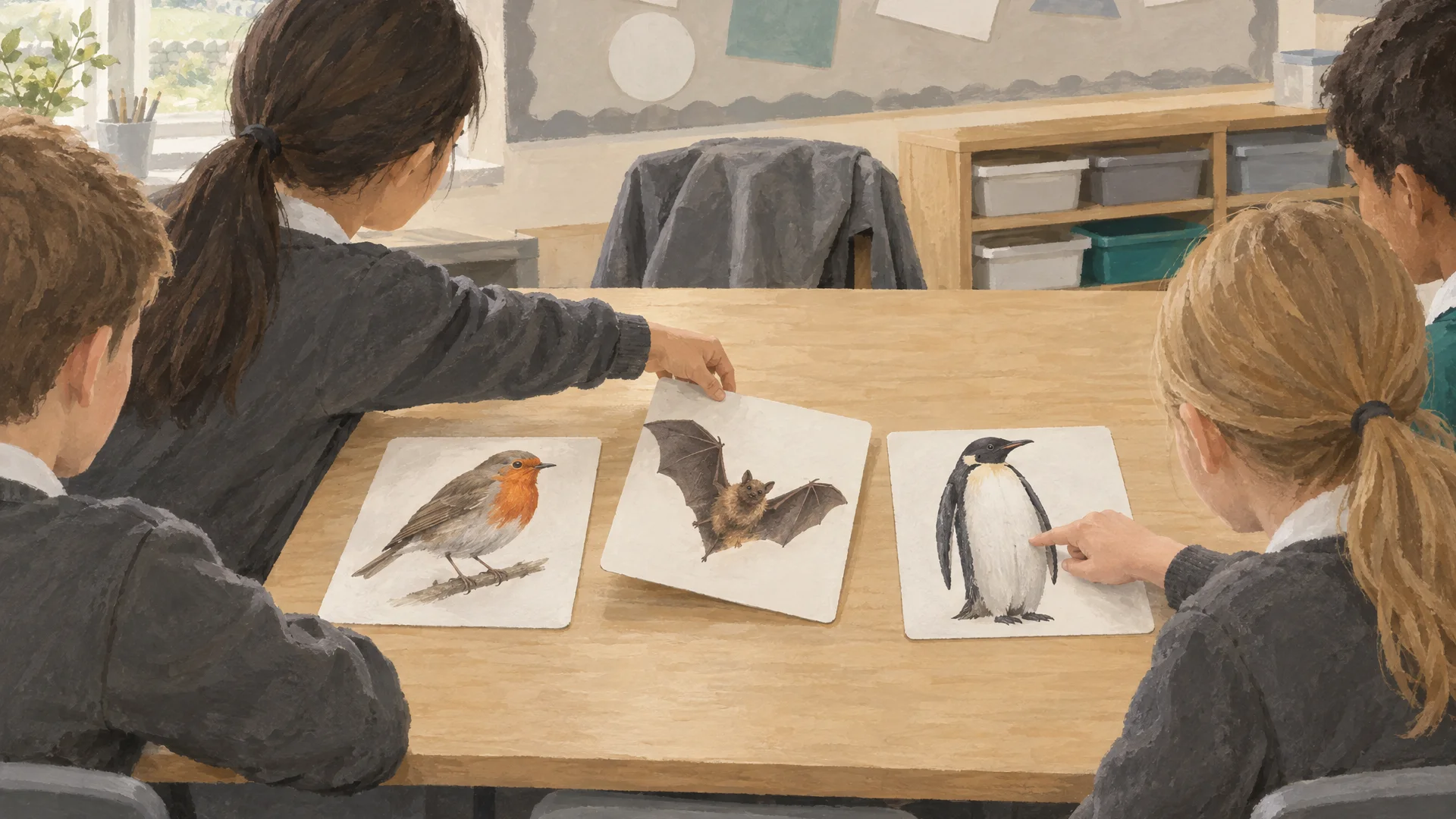
Year 5 science, animal sorting. Ask pairs to sort a robin, bat and penguin and write their rule. Teach feathers as the bird feature, then ask them to test their rule again.
Look for: learners use feathers to explain why the penguin is a bird and the bat is a mammal.
Year 12 psychology, scenario sorting. Use the quiz below and ask pairs to underline what stays the same or changes in each scheme.
Look for: learners justify a choice through the scheme, then explain why effort alone gives too little information.
Use the comparison to plan a question, rather than label a learner. Their explanation and a later task give you more useful evidence than one right or wrong answer.
Piaget often used the word scheme for an organised pattern of action or thought (Piaget, 1952). Education texts often use schema as a convenient term. This guide places the pair within the wider family of learning theories while keeping Piaget's account separate from modern work on memory and classroom schema building.
The useful classroom question is what the learner kept and what they changed. A penguin example shows both processes within one encounter. Ask learners which features support their answer and which part of their old rule needs revision.
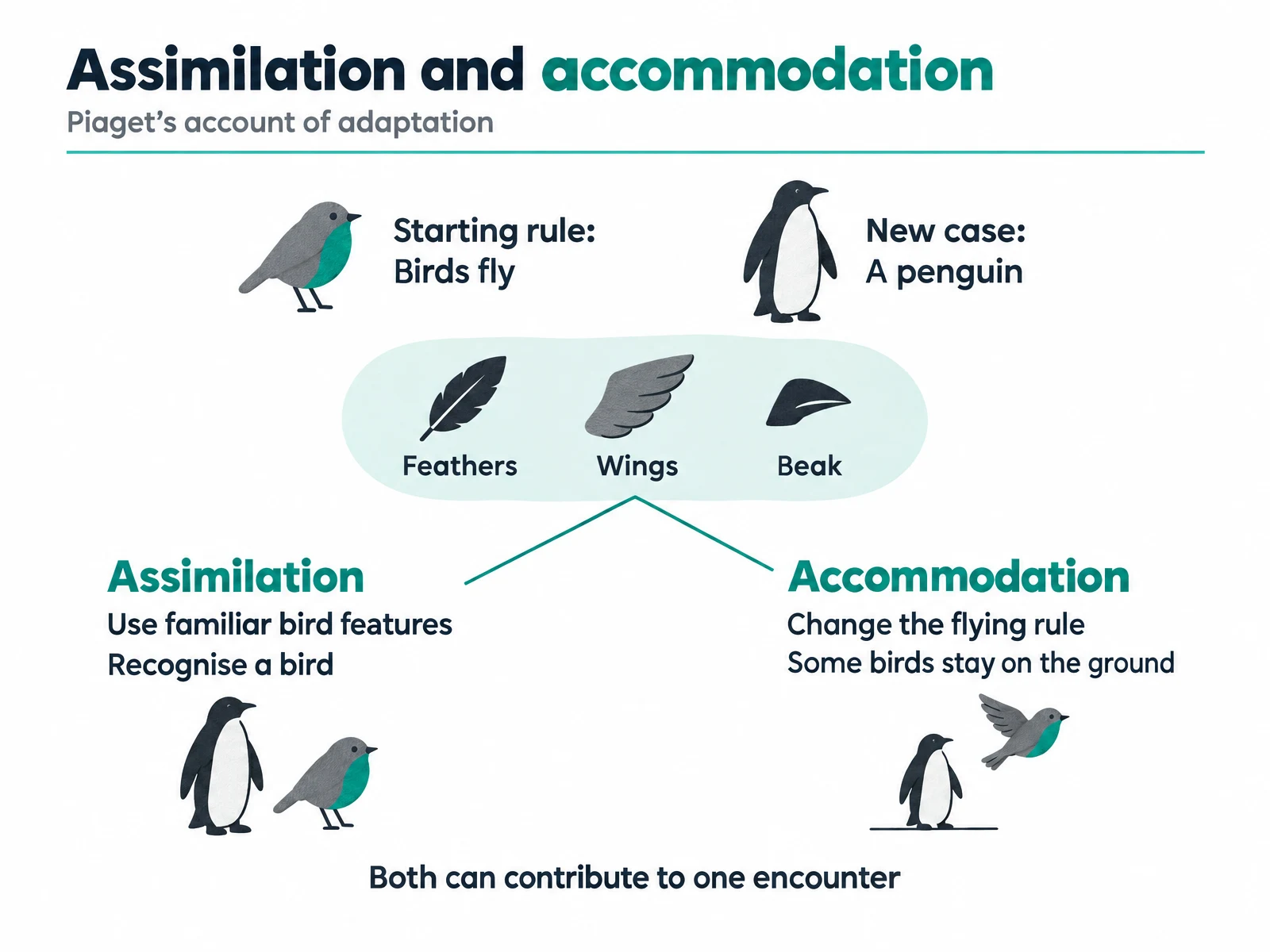
Starting rule: “Birds fly.” New case: a penguin has feathers, wings and a beak, but stays on the ground.
Both can contribute to one encounter. Ask what stayed useful and what changed.
Study note: what the scheme explains and what must change. Open the full-size study note.
A learner who knows that mammals breathe air may assimilate a dolphin into the mammal category. A learner who assumes that all mammals live on land must also change that part of the scheme. The same experience can therefore involve both the use and revision of prior thought.
Judge the quality of the explanation, rather than its speed or effort. A learner may keep an error, ignore a conflict or change only a small detail. Ask them to test their rule on a new case.
Read each row as two possible responses to the same experience. In one, the learner uses the scheme they already have. In the other, the learner changes its rules or categories. Use their explanation to judge which response the example shows.
| Question | Assimilation | Accommodation |
|---|---|---|
| What stays relatively stable? | The existing scheme gives the main reading of the experience. | The scheme is revised, split or made more exact. |
| What prompts the response? | The experience can be read through an organisation already in use. | Some feature resists the current reading and calls for a better one. |
| Zebra example | The child calls the animal a horse because it fits a four-legged animal scheme. | The child forms a distinct zebra category after noticing stable differences. |
| Shape example | The learner treats a rhombus as another four-sided shape. | The learner builds an inclusive hierarchy: a square is both a rectangle and a rhombus, and all three are quadrilaterals. |
Piaget described assimilation and accommodation as linked. A scheme adjusts to the details of each case even when its main form stays intact (Piaget, 1936). The columns show two emphases within the same process of adaptation.
Assimilation is the use of an existing scheme to organise a new object, event or idea. The learner draws on a pattern they already use. David Ausubel's meaningful learning theory later made prior knowledge the starting point for teaching too. The scheme adjusts to the details of the case while keeping its main form.
A baby who has a grasping scheme may apply it to objects of different sizes and textures. An older learner may use an existing “mammal” scheme to classify a new animal. In each case, prior organisation shapes which features matter and what response seems sensible.
Assimilation can be useful and efficient, but it can also preserve an error. A learner who believes that heavier objects fall faster may interpret a demonstration in a way that protects that belief. Check how well the scheme explains the evidence.
For a fuller account of schemas and schema building in current classroom practice, use the specialist guide. This page keeps its focus on Piaget's scheme, adaptation and comparison terms.
Each example below is assimilation because an existing pattern does the interpreting. Some readings are right and some carry an old error forward.
Adults assimilate all the time, which is how routine tasks stay quick. The same habit explains why a first reading of a new idea often sounds like the old one.
Accommodation changes a scheme to account for an experience more fully. The learner may refine a category, split it into several, link ideas or form a new scheme. Test the revised account on another case to judge how well it works.
A child may first treat every four-legged animal as a dog. Repeated contact with cats, foxes and horses may lead to more exact schemes. In science, a learner may revise a “force keeps things moving” idea after they can explain the separate roles of force, motion and friction.
Learners can respond to surprise in several ways. They may dismiss a result, change the question or hold two accounts at once (Vosniadou and Brewer, 1992). Studies of anomalous data, evidence that challenges an expected result, show a range of responses (Chinn and Brewer, 1993).
Useful parts of prior knowledge can remain while one link or category changes. The aim is an account that explains more of the evidence. Ask what the learner kept as well as what they changed.
A schema, or scheme, is a pattern the learner uses to make sense of experience, which assimilation uses and accommodation changes as thought adapts to new cases. Equilibration is the ongoing work of bringing thought and experience into a more coherent relation (Piaget, 1977).
Disequilibrium means a mismatch between the learner’s scheme and their experience. A prediction fails or two ideas clash. The learner may revise the scheme, protect it or miss the clash. Ask which part of their rule the new case challenges.
Later work on conceptual change, how learners revise their explanations, gives teachers a way to plan instruction. Teach a new model that is clear, fits the evidence and works across cases (Posner et al., 1982). This is a later teaching framework alongside Piaget’s theory.
For modern work on prior knowledge, memory and cognitive load, use the specialist guides. They help you plan the amount of new material a task asks learners to handle.
A learner often starts with an existing scheme, then changes it as a new case reveals a gap, but Piaget treated assimilation and accommodation as linked parts of adaptation. This gives teachers a useful example rather than a fixed sequence for every encounter.
Assimilation and accommodation occur as learners make sense of experience through their existing schemes and adjust those schemes to account for the details, gaps or conflicts they encounter. Adjustments range from a small change in action to a new rule or category.
The diagram follows a Year 5 class meeting a bat after deciding that birds are the animals that fly. Use it to plan your questions. Treat the steps as possible responses you infer from what learners say and do.
The two branches at step 3 show linked emphases. Even the bird-shaped reading at 3a adjusts a little, and the rebuilt rule at step 4 keeps most of what the learner already knew about birds.
Assimilation and accommodation work in all four stages of Piaget’s theory, as learners use and change their schemes: sensorimotor, preoperational, concrete operational and formal operational. A stage names a broad form of thought.
| Stage | What the processes can involve |
|---|---|
| Sensorimotor | An infant uses a grasping scheme, then adjusts the grip for a larger object. |
| Preoperational | A child calls a fox a dog, then forms a distinct fox category. |
| Concrete operational | A learner groups four-sided shapes, then revises the links between squares, rectangles and rhombuses. |
| Formal operational | A learner uses a theory to predict a hypothetical result, then revises it in light of evidence. |
The same kind of change can show up in many tasks. A child may change a rule while sorting animals. An older learner may do the same while testing an idea. Use the task to check the rule.
These are illustrations of the terms within Piaget’s account. Use the Piaget stages guide for the stage claims and their limits. Choose classroom tasks from learners’ current explanations and knowledge.
Paired examples are useful because they hold the experience steady and change the learner's response. Each example below names the starting scheme, the new case, an assimilation reading and a possible accommodation. The labels remain interpretations; a teacher would need talk, work and later transfer evidence before drawing a firm conclusion.
In language learning, assimilation uses a known pattern to interpret or produce new language, while accommodation revises that pattern when new examples challenge the rule the learner first used. A learner who changes “goed” to “went” is revising an overgeneralised past-tense rule.
Year 3 English: start with “walked” and “jumped”, then compare “went” and “saw”. Ask learners to keep the regular rule and record the exceptions. Check “played” and “ate” later. Look for a reason that explains both patterns.
Adults use familiar schemes when they meet new tools, roles or ideas, and revise those schemes when experience calls for a change in how they make sense of the new situation. A colleague may expect a new phone app’s menu to work like the old one, then learn a different layout.
The old menu pattern guides the first tap. Learning where this app keeps its options changes that pattern. Use this everyday example to discuss what stayed useful and what changed. It keeps the focus on learning in adult life.
Use matched examples, predictions and revision to make prior thought visible. Teach a sounder account, then check how learners use it in a new case. The lessons below show this approach at two ages. Adapt the activities to your subject.
Start with the rule the class already uses. Show a robin, bat and penguin. Ask pairs to sort them into birds and other animals, then write their rule. If a pair uses “birds fly”, ask where that rule puts the bat.
Now give the case that does not fit. Show a short clip of a bat feeding its young, then a penguin swimming. Ask three questions: "Which part of your rule still works? What has to change? Say the new rule and test it." A strong revised answer sounds like this: "Birds have feathers and lay eggs. Most fly, but not all. Bats fly, but they are mammals."
Check the change a week later rather than on the spot. Ask the class to sort an ostrich and a flying fish without a reminder. If a learner still sorts by flying, return to the feathers-and-fur comparison and ask them to explain the rule.
If learners equate assimilation with easy learning and accommodation with hard learning, start with the quiz above. Ask pairs to sort the scenarios and explain what stays useful or changes in each scheme. Add a learner who drops “all metals are magnetic” after testing copper.
Then show a learner who struggles with a surprising result and still explains it away. Ask what happened to the scheme. Learners rewrite both definitions without easy, hard or effort, then justify one fresh scenario using the word scheme.
Give groups a starting scheme and several new cases. Sort possible responses into “main scheme stays useful” and “scheme must change”. Each choice needs a reason. Include a case where both are involved to show how the processes work together.
A final solo card checks each learner's explanation. This keeps the task focused on the concept rather than group agreement.
Ask learners to predict an outcome and state the rule behind it. Test the prediction with a suitable example, then teach the stronger account. Learners rewrite the rule and apply it to a case that differs from the first.
This resembles good formative assessment: ask for the rule, respond to the evidence and check its next use. Follow a surprising result with clear teaching and a chance to test the stronger explanation.
Learners draw a small concept map before the explanation, then revise it in another colour. Label which link stayed useful, which changed and why. Use the marked changes as a prompt for talk about how their explanation developed.
Use the wider guide to pedagogy for teaching to plan your response. A wrong answer gives you a question to investigate. Ask for the reason, then compare it with another piece of work.
Every activity above runs on the same three questions: what still works, what has to change, and how the new idea explains the case. Choose a topic in the planner, or type your own idea and the case that breaks it, and print the card for your lesson plan.
The planner's topics are starting points. The strongest case that does not fit usually comes from your own class, so note the rules learners write in the first activity and build the next lesson's misfit from them.
Listen for the rule behind an answer, then choose one next move. The signals below suggest what to check; use another case to see whether the learner’s explanation holds up.
| Learner signal | Next teaching move | What to check next |
|---|---|---|
| “A bat is a bird because it flies.” | Compare feathers and fur on a robin, bat and penguin. Ask the learner to rewrite the sorting rule. | Can they sort an ostrich and flying fish by the same rule? |
| “A bat is a bird with fur.” | Ask what makes it a bird. Compare its features with the robin, then teach the mammal category. | Can they explain which features count for a new animal? |
| “The whale is a mammal because it breathes air and feeds its young milk.” | Ask them to compare a whale and a shark using the same features. | Does the reason hold for a dolphin as well? |
| “The penguin is a bird because it has feathers.” | Ask which part of the old flying rule changed and which bird features stayed useful. | Can they explain a flightless bird a week later? |
For Advanced Placement (AP) Psychology or Medical College Admission Test (MCAT) practice, track the scheme: assimilation uses it and accommodation changes it. Explain the choice from the scenario before checking the answers. The questions below are original practice examples.
Read each case, pick one answer and say why. Keep your first choice so you can see which part of your rule needs work.
The best example of assimilation is a learner using an existing scheme to interpret a new case while keeping its main form, rather than revising its rules or categories. In question 1, look for the response that keeps the dog category.
Teaching that sets up a case that does not fit is usually called cognitive conflict. It is the most studied classroom version of Piaget's idea. A meta-analysis of 218 studies with 18,051 learners found a large average effect of conceptual change teaching in science (g = 1.10), with cognitive conflict close to the other strategies (Pacaci et al., 2024). The spread between studies was very wide, so the average says little about any single lesson.
Reviews help to explain that spread. Conflict has to feel meaningful to the learner, and motivation, beliefs and prior knowledge all shape the response (Limón, 2001). On its own a surprising result is rather inefficient; it works better when a clearer alternative is available and learners have time to use it (Potvin, 2023). In a study of 96 ninth-grade learners watching a counterintuitive demonstration, superficial change was the most common response (Lee and Byun, 2012).
Timing matters less than many guides suggest. In a study of 558 learners aged about 10 to 12, presenting the scientific idea before the conflicting demonstration worked at least as well as opening with the conflict (Potvin et al., 2015). For planning, treat the case that does not fit as one step between clear teaching and later practice.
Most of these studies come from science lessons with older primary and secondary learners. They test forms of teaching, not assimilation or accommodation themselves, which stay inferences from what learners say and do.
The same two words turn up across psychology with different meanings, which is why search results for them can look confusing. A systematic review of 473 psychology articles found the terms used in ten research areas, almost all tracing back to Piaget or to James Mark Baldwin (Hanfstingl et al., 2022).
In sociology and migration studies, assimilation usually means a person or group taking on the culture around them. In the study of vision, accommodation is the eye changing its focus. Some talking therapies for trauma use both words for how a person fits a painful event into their existing beliefs. In schools, "accommodations" can also mean adjustments made for a learner. This guide uses Piaget's meaning throughout.
A learner may work hard and still keep an old rule. Ask what changed in the rule, then check it on a fresh case. The examples below help you spot when a neat label gives too little information.
Read the terms through what happens to a scheme. They describe adaptation, while rote practice and discovery learning describe teaching choices. The wider debate between behaviourism and constructivism concerns how teaching should work. Jerome Bruner's theory explains discovery learning.
Piaget built assimilation and accommodation into a broad biological and epistemological theory of how knowledge develops. They were not designed as a brain model, a SEND diagnosis or a complete teaching method. This makes them useful for interpretation, but limited as direct measures of classroom learning.
Teachers cannot infer a learner's stage or capacity to accommodate from one task. Language, sensory access, motor demands, anxiety, attention, the wording of the question and past teaching can all shape what the learner shows. Reasonable adjustments may be long-term access needs and should not be removed merely because performance improves.
Critics also argue that Piaget underweighted social, cultural and teaching influences. That criticism should not be turned into the claim that he ignored them entirely. Later reviews defend the theory against simple caricatures while also recognising changes in developmental research (Flavell, 1996). A detailed defence tests ten common criticisms against Piaget's own claims (Lourenço and Machado, 1996).
Some school staff make a sharper version of that point on social media: that the stages reach classrooms as settled fact.
Three short posts from educators on social media. They object to Piaget's stages being passed on as settled fact, which is a different claim from the adaptation terms on this page.
We need to stop teaching Piaget’s stages in school as though they are objectively true.
many educators learned erroneous info in college & then carried that wrong info into their clasrooms. Ex: Piaget's theory of 4 stages of child devel is incorrect.
Piaget was wrong about much.
Their objection is aimed at the stage sequence and its age bands. Assimilation and accommodation describe how a scheme changes at any age, so a teacher can set the age bands aside and still use the two terms to describe what a learner says.
The concepts do not have their own classroom effect size. Studies of conceptual change, worked examples or peer talk test distinct forms of teaching. Their findings cannot prove that assimilation or accommodation adds a fixed amount of progress.
The broader Piaget theory guide covers his stages, classic tasks, biography and wider criticisms. To see how his account sits beside behaviourist and social accounts, use the overview of the main learning theories.
Plan one keep, change, explain task for your next lesson. Pick an idea your class is likely to bring and find one case it cannot explain, write the three questions before you teach, then test the revised idea on a fresh case a week later.
Jean Piaget developed assimilation and accommodation as central parts of his theory of how knowledge grows, explaining how learners use existing schemes and adjust them through experience. The terms also have an earlier history in James Mark Baldwin’s work (Hanfstingl et al., 2022).
A child who already has a scheme for dogs may call a fox a dog because it fits the existing category. The child uses prior organisation to read the new animal. The label may later change as stable differences become clear.
The child revises the broad dog category after learning how foxes differ. They may split one category into two or add features to the old scheme. Useful prior knowledge remains while the animal categories become more exact.
Accommodation is the usual contrast to assimilation because it changes the learner’s scheme, while assimilation uses a scheme the learner already has to read a new case. Both are parts of adaptation. A learner can use and change the same rule in one task. Look for what stays useful and what changes as they make sense of the case.
Both are ways a learner adapts to experience, both work on the same schemes, and both usually happen in the same encounter. They differ in direction. Assimilation fits the case to the scheme, while accommodation fits the scheme to the case.
In Piaget's terms, that is accommodation. Taking in information that fits what you already know, without changing the scheme much, is assimilation. Exam questions often use these two definitions, so check which way the change runs.
Equilibration is Piaget’s account of how thought adjusts when experience reveals gaps or conflicting ideas. A learner revises how their schemes work together. In the bat example, the bird and mammal categories become more coherent as flying gives way to clearer features.
This page covers Piaget’s account of schemes and how they change. The Vygotsky theory guide sets out his account of learning through talk and work with others. Keep the terms of each theory clear when you compare them. The comparison of Piaget and Vygotsky shows how the two accounts differ.
The sources below support the definitions, relationship between the two processes, equilibration, later conceptual-change comparison and limits used in this guide.