Memorable TeachingGCSE students in maroon sweatshirts attentively watching a science demonstration in a secondary school classroom.

Updated on  

February 4, 2026

Memorable Teaching

|

August 25, 2022

Memorable Teaching: A summary of Peps Mccrea’s book exploring how to engage students, enhance learning retention and create an impactful classroom experience.


Course Enquiry
Copy citation

Benjamin, Z (2022, August 25). Memorable Teaching. Retrieved from https://www.structural-learning.com/post/memorable-teaching

Key Takeaways

  1. Memory Is the Residue of Thought: Students remember what they think about. Designing lessons that ensure students think about the right content is the key to durable learning, whether through dialogic teaching or other methods.
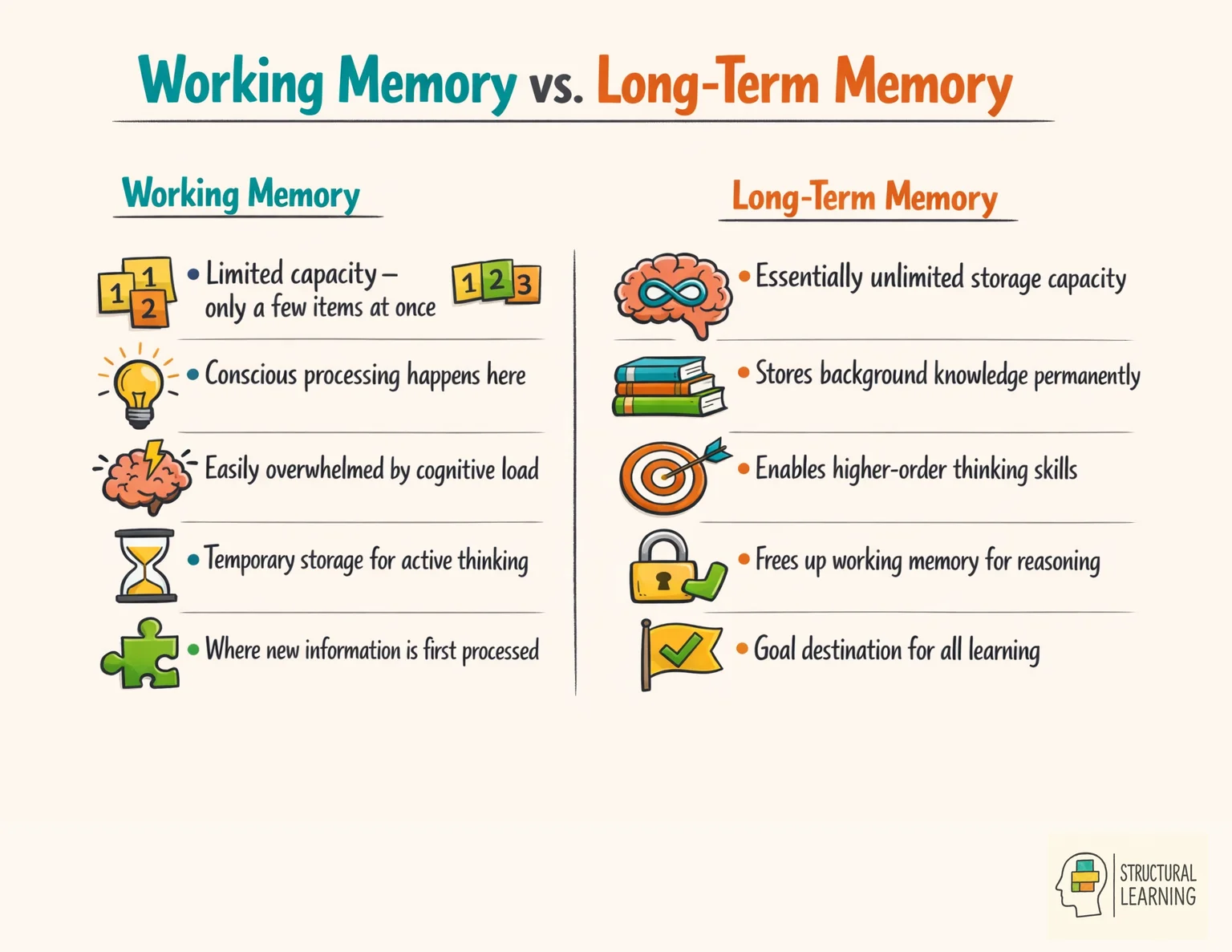
  2. Working MemoryIs Limited: We can only process a few items at once. Effective teaching manages cognitive load to avoid overwhelming students and supports transfer to long-term memory.
  3. Knowledge Enables Thinking: Background knowledgestored in long-term memory enables higher-order thinking by freeing up working memory for reasoning rather than basic recall.
  4. Deliberate Practice Matters: Spaced retrieval practice strengthens memory far more effectively than re-reading or passive review. Testing is a teaching strategy, not just an assessment tool.

What Is Memorable Teaching by Peps McCrea?

Memorable Teaching is a book that translates cognitive scienceresearch into practical principles for classroom teaching, part of the High Impact Teaching series. The book helps teachers understand how memory works and provides evidence-based strategies to improve learning, without prescribing specific methods but offering flexible principles applicable across subjects.

Comparison infographic showing differences between <a href=working memory and long-term memory in learning" loading="lazy">
Working Memory vs. Long-Term Memory

Memorable Teaching is a book by Peps McCrea that distils cognitive science research into practical principles for classroom teaching. Part of the High Impact Teaching series, it bridges the gap between academic research on learning and the daily realities of teaching. The book is aimed at teachers and school leaders who want to understand how memory works and improve their teaching accordingly.

McCrea, who has worked in teaching, teacher education, and educational research, writes accessibly about complex cognitive processes. The book does not prescribe specific methods but provides principles that teachers can apply across subjects and contexts, incorporating observational learning and various pedagogical approaches.

Core Principles

Memory as the Goal of Teaching

The book opens with a clear statement: the purpose of teaching is to create durable change in long-term memory. If students do not remember what they learned, teaching has not achieved its goal. This framing clarifies what teachers are trying to achieve and provides a clear framework for evaluating progress.

The Architecture of Memory

McCrea explains the relationship between working memory (limited capacity, conscious processing) and long-term memory (essentially unlimited capacity, stored knowledge). Effective teaching helps information transfer from working memory to long-term memory through a systems approach, where it can be retrieved and used.

The Role of Attention

Students remember what they attend to and think about. This makes directing attentionthe crucial first step. Lessons where students think about engaging but irrelevant aspects (the game format, the decoration, the competitive element) may be enjoyable but ineffective for learning the intended content.

How Do Teachers Apply Memory Principles in Practice?

Teachers apply memory principles by designing lessons that manage cognitive load, using techniques like breaking complex tasks into smaller steps and providing worked examples. They also incorporate regular retrieval practice through low-stakes quizzing and structure lessons to ensure students think deeply about the key content rather than superficial features.

PrincipleClassroom Application
Limit new informationIntroduce concepts one at a time, check understanding before adding complexity
Direct attention to contentAsk "What will students be thinking about?" when designing activities
Connect to prior knowledgeActivate relevant schemas before introducing new material
Use concrete examplesMake abstract concepts tangible with specific, memorable examples
Space practice over timeReturn to material repeatedly rather than massing practice in one session
Test rather than re-readUse retrieval practice (low-stakes quizzes, recall activities) for revision
Make retrieval effortfulAllow some forgetting before retrieval to strengthen memory traces

How Can Teachers Manage Student Cognitive Load?

Teachers manage cognitive load by presenting information in small chunks, using visual aids to reduce processing demands, and removing unnecessary distractions from learning materials. They also scaffold complex tasks by providing partial solutions initially and gradually removing support as students develop expertise.

A substantial portion of the book addresses cognitive load: the demands placed on working memory. When cognitive load exceeds capacity, learning fails. Sources of unnecessary load include unclear instructions, split attention (looking between diagram and text), redundant information, and overly complex presentations.
Teachers can manage cognitive load by presenting information clearly, integrating text with diagrams, removing unnecessary content, and building up complexity gradually. Worked examples reduce load for novices by showing the solution process rather than requiring students to discover it.

What Is Schema Building in Teaching?

Schema building is the process of helping students organise new information into meaningful mental frameworks that connect to their existing knowledge. Teachers build schema by explicitly showing relationships between concepts, using analogies to familiar ideas, and regularly revisiting key concepts to strengthen connections.

McCrea explains how knowledge is organised in schema: interconnected networks of concepts. Well-developed schema allow experts to process information efficiently because they can chunk multiple elements into single units. Teaching should explicitly help students build schema by connecting new learning to existing knowledge and making relationships between concepts clear.

Applying the Principles

Lesson Planning

When planning lessons, ask: What do I want students to remember from this lesson? What will students actually be thinking about? Have I managed cognitive load appropriately? How will I connect to prior knowledge? How will I return to this material to strengthen memory?

Activity Design

Evaluate activities against memory principles. Engaging activities that do not require thinking about the intended content will not produce learning. Prefer activities where engaging with content is unavoidable.

Curriculum Design

The principles apply at curriculum level too. Spacing topics across the year, building from simple to complex, and systematically returning to earlier learning applies memory science to curriculum structure.

How Can Teachers Use Worked Examples Effectively?

Worked examples reduce cognitive load by showing studentsthe step-by-step process of solving problems before asking them to work independently. They are particularly powerful for novices learning new procedures or concepts. The key is to gradually fade support as students develop expertise.

McCrea emphasises that worked examples are most effective when students actively process them rather than passively reading through. Teachers should encourage students to explain each step to themselves, identify the underlying principles, and compare different worked examples to spot patterns. For instance, in mathematics, rather than simply showing the solution to an equation, teachers might present two similar problems side by side and ask students to identify what changes between them and how this affects the solution method.

The transition from worked examples to independent practice should be gradual. Teachers can use partially completed examples where students fill in missing steps, or paired problem-solving where students alternate between studying worked examples and attempting similar problems. This scaffolded approach prevents the cognitive overload that occurs when students jump directly from watching demonstrations to solving complex problems independently.

What Role Does Feedback Play in Building Memory?

Effective feedback directs attention to what matters and helps students correct misconceptions before they become embedded in long-term memory. The timing, specificity, and focus of feedback all influence whether it strengthens accurate memories or inadvertently reinforces errors.

According to memory principles, immediate feedback is crucial when students are first learning new content, as it prevents incorrect information from being encoded into long-term memory. However, McCrea notes that slightly delayed feedback can be beneficial during practice phases, as the effort required to recall information before receiving feedback strengthens memory traces. Teachers might provide immediate feedback during initial instruction but build in short delays during revision activities.

The content of feedback matters as much as its timing. Feedback should direct students' attention to the key features of successful performance rather than peripheral details. For example, when marking essays, highlighting specific ways students have used evidence effectively teaches more than generic comments like "good point". Teachers should also ensure feedback is manageable, too much information overwhelms working memory and reduces the likelihood that students will process and remember the guidance.

How Should Teachers Approach Common Misconceptions?

Addressing misconceptions requires more than simply presenting correct information. Teachers must help students actively reconstruct their understanding, as existing schema strongly influence how new information is interpreted and remembered.

McCrea's framework suggests that teachers should first make misconceptions visible through diagnostic questioning or tasks that reveal student thinking. Once identified, misconceptions need explicit attention, simply teaching the correct concept often fails because students interpret new information through their existing, flawed schema. For instance, if students believe heavier objects fall faster, simply stating the correct principle is insufficient. Teachers need activities that create cognitive conflict, such as dropping objects of different weights simultaneously.

The process of overcoming misconceptions requires repeated exposure and practice with correct concepts. Teachers should return to previously addressed misconceptions in different contexts, helping students recognise when their old thinking patterns resurface. Spaced practice is particularly important here, a single lesson rarely overwrites deeply held miscon ceptions. Regular, brief reviews that require students to distinguish between their previous misconceptions and correct understanding help establish more accurate schema in long-term memory.

Frequently Asked Questions

Does this mean lessons should not be engaging?

No. The book does not oppose engagement but argues that engagement should come from thinking about content, not from irrelevant features. Students can be deeply engaged in challenging, meaningful work. The warning is against engagement that distracts from learning.

How does this relate to understanding versus memorisation?

McCrea does not advocate rote memorisation of meaningless content. Understanding involves building connected schema in memory. Meaningful learning is memorable; disconnected facts are not. The book argues for teaching in ways that create rich, connected memory, not for drilling isolated facts.

Is this just about teacher-led instruction?

The principles apply regardless of teaching method. Active learning, discussion, and student-led activities can align with memory principles if they require students to think deeply about content. The question is always: What are students thinking about and will this thinking produce durable memory?

Where can I get the book?

Memorable Teaching by Peps McCrea is available from booksellers including Amazon. It is part of the High Impact Teaching series, which includes other titles on related topics. The book is relatively short and accessible, designed for busy practitioners.

Further Reading: Key Research Papers

These peer-reviewed studies provide deeper insights into memorable teaching and its application in educational settings.

Differential information transfer and loss between working memory and long-term memory across serial positions. 3 citations

This paper examines how information transfers between working memory (temporary mental storage) and long-term memory, focusing on how the position of information affects what gets remembered or lost. For teachers, this research helps explain why certain lesson content sticks with students while other parts are forgotten, informing how to structure and sequence educational material for better retention.

Relationship Between Cognitive Load Theory, Intrinsic Motivation and Emotions in Healthcare Professions Education: A Perspective on the Missing Link View study ↗15 citations

Patel et al. (2024)

This study explores how CognitiveLoad Theory relates to student motivation and emotions in healthcare education, particularly in high-fidelity simulation training. Teachers can use these insights to better understand how mental workload affects student engagement and emotional responses, helping them design lessons that balance cognitive challenge with student motivation.

Spaced Retrieval Practice Imposes Desirable Difficulty in Calculus Learning 14 citations

Lyle et al. (2022)

This research demonstrates that spacing calculus practice problems across multiple assignments (rather than clustering them together) creates beneficial learning difficulty that improves student performance. Teachers can apply this finding by distributing similar problems across different homework sets and quizzes, leading to stronger mathematical understanding and retention.

Retrieval practice and spaced learning: preventing loss of knowledge in Dutch medical sciences students in an ecologically valid setting 18 citations

Donker et al. (2022)

This study shows that including questions about previously learned material in current exams helps medical students retain knowledge over time through retrieval practice and spaced learning. Teachers can prevent knowledge decay by regularly incorporating review questions from earlier units into current assessments, helping students maintain and strengthen their long-term learning.

Pre-Service Teachers’ Perceptions of Barriers to Promoting Critical Thinking Skillsin the Classroom View study ↗26 citations

Khalid et al. (2021)

This research identifies barriers that prevent pre-service teachers from effectively promoting critical thinking skills in their classrooms and explores potential solutions. The findings help current teachers understand common obstacles to developing student critical thinking and provides strategies for overcoming these challenges in their own teaching practice.

Loading audit...

Key Takeaways

  1. Memory Is the Residue of Thought: Students remember what they think about. Designing lessons that ensure students think about the right content is the key to durable learning, whether through dialogic teaching or other methods.
  2. Working MemoryIs Limited: We can only process a few items at once. Effective teaching manages cognitive load to avoid overwhelming students and supports transfer to long-term memory.
  3. Knowledge Enables Thinking: Background knowledgestored in long-term memory enables higher-order thinking by freeing up working memory for reasoning rather than basic recall.
  4. Deliberate Practice Matters: Spaced retrieval practice strengthens memory far more effectively than re-reading or passive review. Testing is a teaching strategy, not just an assessment tool.

What Is Memorable Teaching by Peps McCrea?

Memorable Teaching is a book that translates cognitive scienceresearch into practical principles for classroom teaching, part of the High Impact Teaching series. The book helps teachers understand how memory works and provides evidence-based strategies to improve learning, without prescribing specific methods but offering flexible principles applicable across subjects.

Comparison infographic showing differences between <a href=working memory and long-term memory in learning" loading="lazy">
Working Memory vs. Long-Term Memory

Memorable Teaching is a book by Peps McCrea that distils cognitive science research into practical principles for classroom teaching. Part of the High Impact Teaching series, it bridges the gap between academic research on learning and the daily realities of teaching. The book is aimed at teachers and school leaders who want to understand how memory works and improve their teaching accordingly.

McCrea, who has worked in teaching, teacher education, and educational research, writes accessibly about complex cognitive processes. The book does not prescribe specific methods but provides principles that teachers can apply across subjects and contexts, incorporating observational learning and various pedagogical approaches.

Core Principles

Memory as the Goal of Teaching

The book opens with a clear statement: the purpose of teaching is to create durable change in long-term memory. If students do not remember what they learned, teaching has not achieved its goal. This framing clarifies what teachers are trying to achieve and provides a clear framework for evaluating progress.

The Architecture of Memory

McCrea explains the relationship between working memory (limited capacity, conscious processing) and long-term memory (essentially unlimited capacity, stored knowledge). Effective teaching helps information transfer from working memory to long-term memory through a systems approach, where it can be retrieved and used.

The Role of Attention

Students remember what they attend to and think about. This makes directing attentionthe crucial first step. Lessons where students think about engaging but irrelevant aspects (the game format, the decoration, the competitive element) may be enjoyable but ineffective for learning the intended content.

How Do Teachers Apply Memory Principles in Practice?

Teachers apply memory principles by designing lessons that manage cognitive load, using techniques like breaking complex tasks into smaller steps and providing worked examples. They also incorporate regular retrieval practice through low-stakes quizzing and structure lessons to ensure students think deeply about the key content rather than superficial features.

PrincipleClassroom Application
Limit new informationIntroduce concepts one at a time, check understanding before adding complexity
Direct attention to contentAsk "What will students be thinking about?" when designing activities
Connect to prior knowledgeActivate relevant schemas before introducing new material
Use concrete examplesMake abstract concepts tangible with specific, memorable examples
Space practice over timeReturn to material repeatedly rather than massing practice in one session
Test rather than re-readUse retrieval practice (low-stakes quizzes, recall activities) for revision
Make retrieval effortfulAllow some forgetting before retrieval to strengthen memory traces

How Can Teachers Manage Student Cognitive Load?

Teachers manage cognitive load by presenting information in small chunks, using visual aids to reduce processing demands, and removing unnecessary distractions from learning materials. They also scaffold complex tasks by providing partial solutions initially and gradually removing support as students develop expertise.

A substantial portion of the book addresses cognitive load: the demands placed on working memory. When cognitive load exceeds capacity, learning fails. Sources of unnecessary load include unclear instructions, split attention (looking between diagram and text), redundant information, and overly complex presentations.

Teachers can manage cognitive load by presenting information clearly, integrating text with diagrams, removing unnecessary content, and building up complexity gradually. Worked examples reduce load for novices by showing the solution process rather than requiring students to discover it.

What Is Schema Building in Teaching?

Schema building is the process of helping students organise new information into meaningful mental frameworks that connect to their existing knowledge. Teachers build schema by explicitly showing relationships between concepts, using analogies to familiar ideas, and regularly revisiting key concepts to strengthen connections.

McCrea explains how knowledge is organised in schema: interconnected networks of concepts. Well-developed schema allow experts to process information efficiently because they can chunk multiple elements into single units. Teaching should explicitly help students build schema by connecting new learning to existing knowledge and making relationships between concepts clear.

Applying the Principles

Lesson Planning

When planning lessons, ask: What do I want students to remember from this lesson? What will students actually be thinking about? Have I managed cognitive load appropriately? How will I connect to prior knowledge? How will I return to this material to strengthen memory?

Activity Design

Evaluate activities against memory principles. Engaging activities that do not require thinking about the intended content will not produce learning. Prefer activities where engaging with content is unavoidable.

Curriculum Design

The principles apply at curriculum level too. Spacing topics across the year, building from simple to complex, and systematically returning to earlier learning applies memory science to curriculum structure.

How Can Teachers Use Worked Examples Effectively?

Worked examples reduce cognitive load by showing studentsthe step-by-step process of solving problems before asking them to work independently. They are particularly powerful for novices learning new procedures or concepts. The key is to gradually fade support as students develop expertise.

McCrea emphasises that worked examples are most effective when students actively process them rather than passively reading through. Teachers should encourage students to explain each step to themselves, identify the underlying principles, and compare different worked examples to spot patterns. For instance, in mathematics, rather than simply showing the solution to an equation, teachers might present two similar problems side by side and ask students to identify what changes between them and how this affects the solution method.

The transition from worked examples to independent practice should be gradual. Teachers can use partially completed examples where students fill in missing steps, or paired problem-solving where students alternate between studying worked examples and attempting similar problems. This scaffolded approach prevents the cognitive overload that occurs when students jump directly from watching demonstrations to solving complex problems independently.

What Role Does Feedback Play in Building Memory?

Effective feedback directs attention to what matters and helps students correct misconceptions before they become embedded in long-term memory. The timing, specificity, and focus of feedback all influence whether it strengthens accurate memories or inadvertently reinforces errors.

According to memory principles, immediate feedback is crucial when students are first learning new content, as it prevents incorrect information from being encoded into long-term memory. However, McCrea notes that slightly delayed feedback can be beneficial during practice phases, as the effort required to recall information before receiving feedback strengthens memory traces. Teachers might provide immediate feedback during initial instruction but build in short delays during revision activities.

The content of feedback matters as much as its timing. Feedback should direct students' attention to the key features of successful performance rather than peripheral details. For example, when marking essays, highlighting specific ways students have used evidence effectively teaches more than generic comments like "good point". Teachers should also ensure feedback is manageable, too much information overwhelms working memory and reduces the likelihood that students will process and remember the guidance.

How Should Teachers Approach Common Misconceptions?

Addressing misconceptions requires more than simply presenting correct information. Teachers must help students actively reconstruct their understanding, as existing schema strongly influence how new information is interpreted and remembered.

McCrea's framework suggests that teachers should first make misconceptions visible through diagnostic questioning or tasks that reveal student thinking. Once identified, misconceptions need explicit attention, simply teaching the correct concept often fails because students interpret new information through their existing, flawed schema. For instance, if students believe heavier objects fall faster, simply stating the correct principle is insufficient. Teachers need activities that create cognitive conflict, such as dropping objects of different weights simultaneously.

The process of overcoming misconceptions requires repeated exposure and practice with correct concepts. Teachers should return to previously addressed misconceptions in different contexts, helping students recognise when their old thinking patterns resurface. Spaced practice is particularly important here, a single lesson rarely overwrites deeply held miscon ceptions. Regular, brief reviews that require students to distinguish between their previous misconceptions and correct understanding help establish more accurate schema in long-term memory.

Frequently Asked Questions

Does this mean lessons should not be engaging?

No. The book does not oppose engagement but argues that engagement should come from thinking about content, not from irrelevant features. Students can be deeply engaged in challenging, meaningful work. The warning is against engagement that distracts from learning.

How does this relate to understanding versus memorisation?

McCrea does not advocate rote memorisation of meaningless content. Understanding involves building connected schema in memory. Meaningful learning is memorable; disconnected facts are not. The book argues for teaching in ways that create rich, connected memory, not for drilling isolated facts.

Is this just about teacher-led instruction?

The principles apply regardless of teaching method. Active learning, discussion, and student-led activities can align with memory principles if they require students to think deeply about content. The question is always: What are students thinking about and will this thinking produce durable memory?

Where can I get the book?

Memorable Teaching by Peps McCrea is available from booksellers including Amazon. It is part of the High Impact Teaching series, which includes other titles on related topics. The book is relatively short and accessible, designed for busy practitioners.

Further Reading: Key Research Papers

These peer-reviewed studies provide deeper insights into memorable teaching and its application in educational settings.

Differential information transfer and loss between working memory and long-term memory across serial positions. 3 citations

This paper examines how information transfers between working memory (temporary mental storage) and long-term memory, focusing on how the position of information affects what gets remembered or lost. For teachers, this research helps explain why certain lesson content sticks with students while other parts are forgotten, informing how to structure and sequence educational material for better retention.

Relationship Between Cognitive Load Theory, Intrinsic Motivation and Emotions in Healthcare Professions Education: A Perspective on the Missing Link View study ↗15 citations

Patel et al. (2024)

This study explores how CognitiveLoad Theory relates to student motivation and emotions in healthcare education, particularly in high-fidelity simulation training. Teachers can use these insights to better understand how mental workload affects student engagement and emotional responses, helping them design lessons that balance cognitive challenge with student motivation.

Spaced Retrieval Practice Imposes Desirable Difficulty in Calculus Learning 14 citations

Lyle et al. (2022)

This research demonstrates that spacing calculus practice problems across multiple assignments (rather than clustering them together) creates beneficial learning difficulty that improves student performance. Teachers can apply this finding by distributing similar problems across different homework sets and quizzes, leading to stronger mathematical understanding and retention.

Retrieval practice and spaced learning: preventing loss of knowledge in Dutch medical sciences students in an ecologically valid setting 18 citations

Donker et al. (2022)

This study shows that including questions about previously learned material in current exams helps medical students retain knowledge over time through retrieval practice and spaced learning. Teachers can prevent knowledge decay by regularly incorporating review questions from earlier units into current assessments, helping students maintain and strengthen their long-term learning.

Pre-Service Teachers’ Perceptions of Barriers to Promoting Critical Thinking Skillsin the Classroom View study ↗26 citations

Khalid et al. (2021)

This research identifies barriers that prevent pre-service teachers from effectively promoting critical thinking skills in their classrooms and explores potential solutions. The findings help current teachers understand common obstacles to developing student critical thinking and provides strategies for overcoming these challenges in their own teaching practice.

Classroom Practice

Back to Blog

{"@context":"https://schema.org","@graph":[{"@type":"Article","@id":"https://www.structural-learning.com/post/memorable-teaching#article","headline":" Memorable Teaching","description":"Memorable Teaching: A summary of Peps Mccrea’s book exploring how to engage students, enhance learning retention and create an impactful classroom experience.","datePublished":"2022-08-25T13:32:49.505Z","dateModified":"2026-01-26T10:09:32.212Z","author":{"@type":"Person","name":"Paul Main","url":"https://www.structural-learning.com/team/paulmain","jobTitle":"Founder & Educational Consultant"},"publisher":{"@type":"Organization","name":"Structural Learning","url":"https://www.structural-learning.com","logo":{"@type":"ImageObject","url":"https://cdn.prod.website-files.com/5b69a01ba2e409e5d5e055c6/6040bf0426cb415ba2fc7882_newlogoblue.svg"}},"mainEntityOfPage":{"@type":"WebPage","@id":"https://www.structural-learning.com/post/memorable-teaching"},"image":"https://cdn.prod.website-files.com/5b69a01ba2e409501de055d1/69661bd287ae543766a37857_69661bd1c1e21fdccb47d22e_memorable-teaching-infographic.webp","wordCount":1677},{"@type":"BreadcrumbList","@id":"https://www.structural-learning.com/post/memorable-teaching#breadcrumb","itemListElement":[{"@type":"ListItem","position":1,"name":"Home","item":"https://www.structural-learning.com/"},{"@type":"ListItem","position":2,"name":"Blog","item":"https://www.structural-learning.com/blog"},{"@type":"ListItem","position":3,"name":" Memorable Teaching","item":"https://www.structural-learning.com/post/memorable-teaching"}]},{"@type":"FAQPage","@id":"https://www.structural-learning.com/post/memorable-teaching#faq","mainEntity":[{"@type":"Question","name":"Does this mean lessons should not be engaging?","acceptedAnswer":{"@type":"Answer","text":"No. The book does not oppose engagement but argues that engagement should come from thinking about content, not from irrelevant features. Students can be deeply engaged in challenging, meaningful work. The warning is against engagement that distracts from learning."}},{"@type":"Question","name":"How does this relate to understanding versus memorisation?","acceptedAnswer":{"@type":"Answer","text":"McCrea does not advocate rote memorisation of meaningless content. Understanding involves building connected schema in memory. Meaningful learning is memorable; disconnected facts are not. The book argues for teaching in ways that create rich, connected memory, not for drilling isolated facts."}},{"@type":"Question","name":"Is this just about teacher-led instruction?","acceptedAnswer":{"@type":"Answer","text":"The principles apply regardless of teaching method."}},{"@type":"Question","name":"Where can I get the book?","acceptedAnswer":{"@type":"Answer","text":"Memorable Teaching by Peps McCrea is available from booksellers including Amazon. It is part of the High Impact Teaching series, which includes other titles on related topics. The book is relatively short and accessible, designed for busy practitioners."}}]}]}