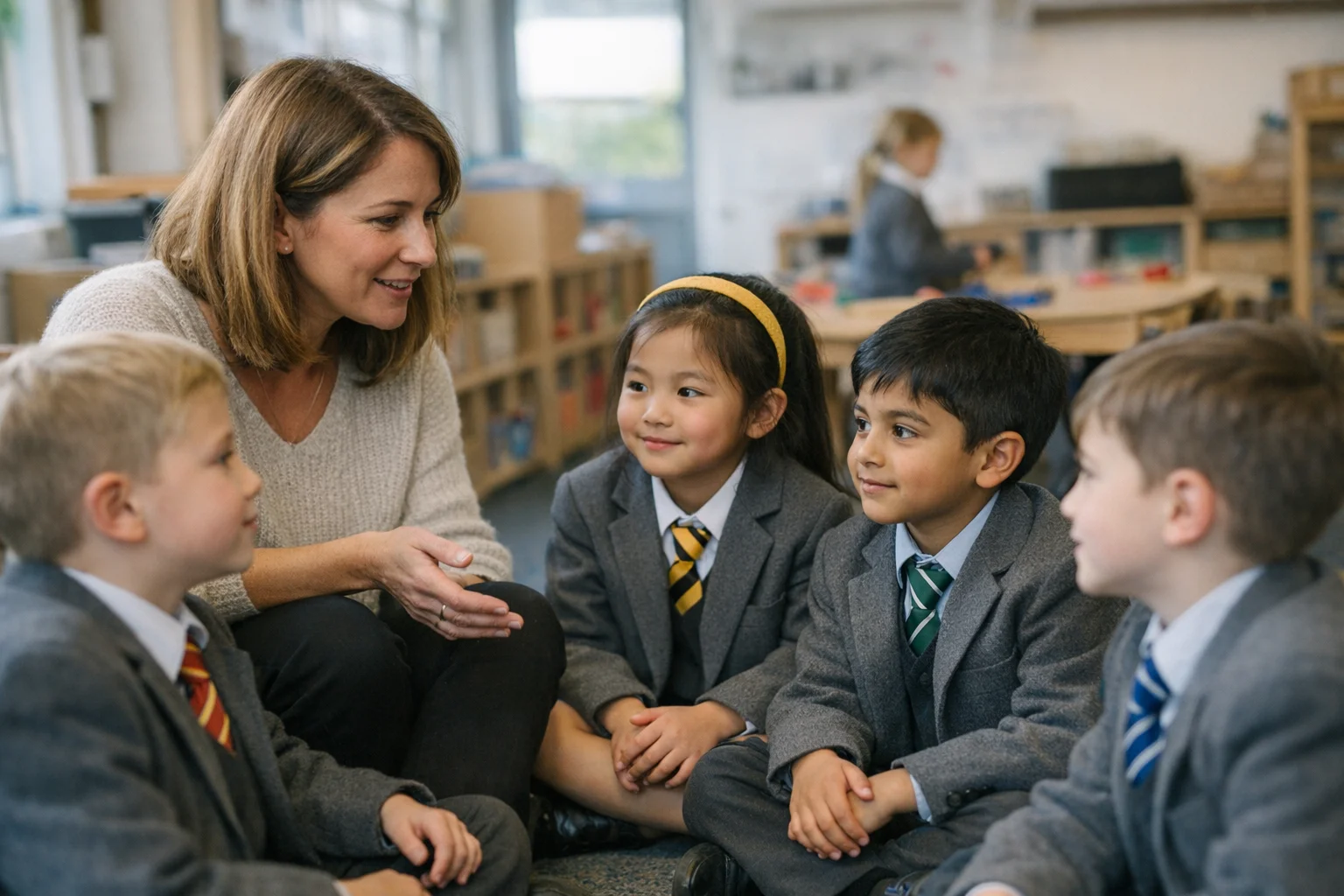
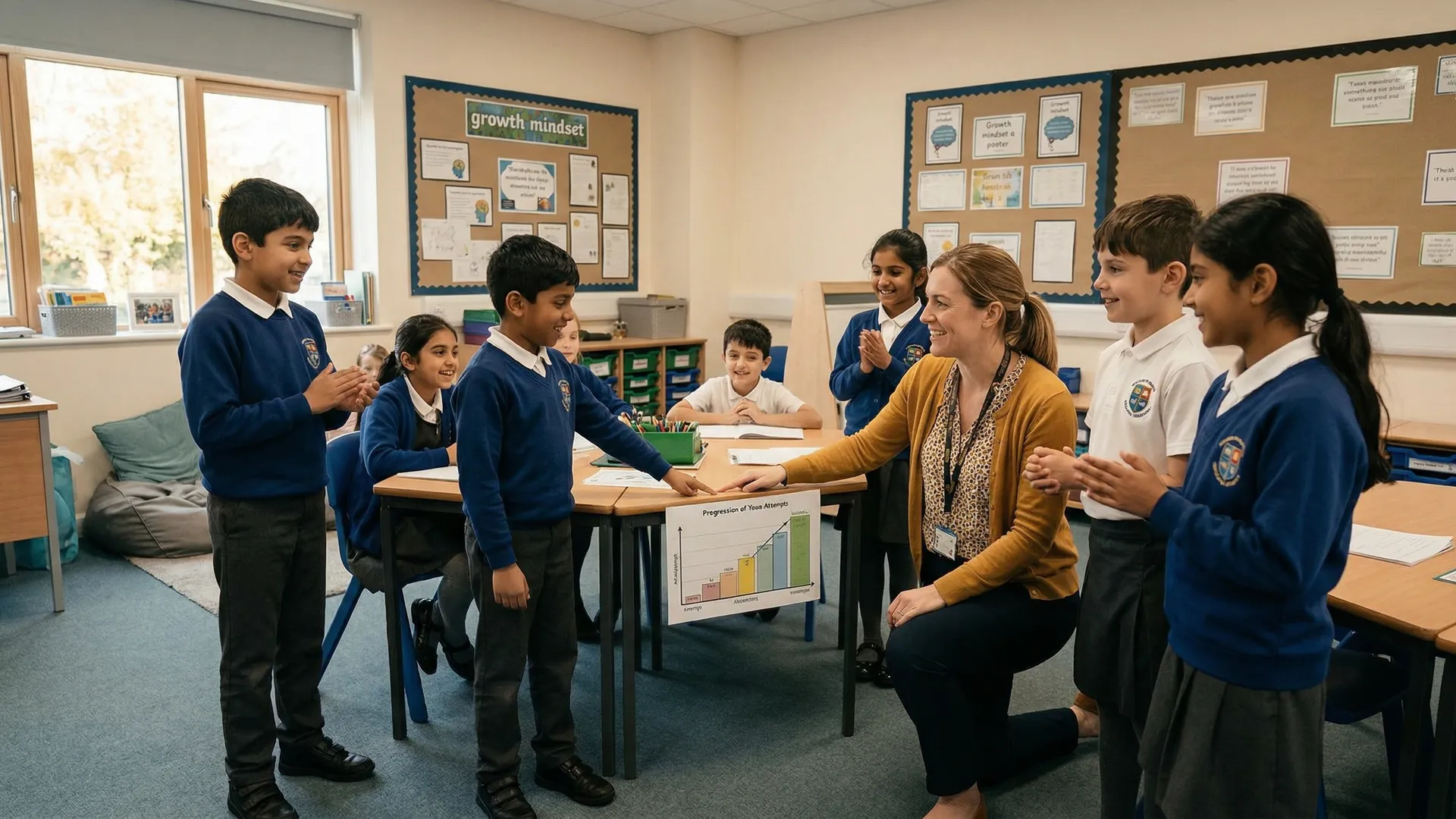
Gibbs' Reflective Cycle: The Six Stages of Reflection ExplainedEarly years students in grey blazers with house ties reflect on activities guided by their teacher, exploring learning stations.

Updated on  

January 30, 2026

Gibbs' Reflective Cycle: The Six Stages of Reflection Explained

|

May 9, 2023

Master Gibbs' Reflective Cycle with this complete guide. Learn the six stages of reflection with examples for education and nursing practice.

Course Enquiry
Copy citation

Main, P (2023, May 09). Gibbs' Reflective Cycle. Retrieved from https://www.structural-learning.com/post/gibbs-reflective-cycle

What is Gibbs' Reflective Cycle?

Gibbs' Reflective Cycle is a popular model for reflection, acting as a structured methodto enable individuals to think systematically about the experiences they had during a specific situation.

Key Takeaways

  1. Beyond Simple Diary Entries: Transform your teaching reflections from surface-level descriptions into powerful tools for professional growth using Gibbs' six-stage framework.
  2. The Missing Analysis Stage: Discover why most teachers stop at 'what went wrong' and miss the critical fourth stage that reveals underlying patterns in classroom challenges.
  3. From Reflection to Action: Learn how the final stage turns your reflective insights into concrete classroom improvements that actually stick.
  4. Structure Your Professional Development: Use Gibbs' cycle to transform mandatory CPD reflections into meaningful growth opportunities that directly improve your teaching practice.

Gibbs’ Reflective Cycle is a widely used and accepted model of reflection. Developed by Graham Gibbs in 1988 at Oxford Polytechnic, now Oxford Brookes University, this reflective cycle framework is widely used within various fields such as healthcare, education, and management to enhance professional and personal development. It has since become an integral part of reflective practice, allowing individuals to reflect on their experiences in a structured way.

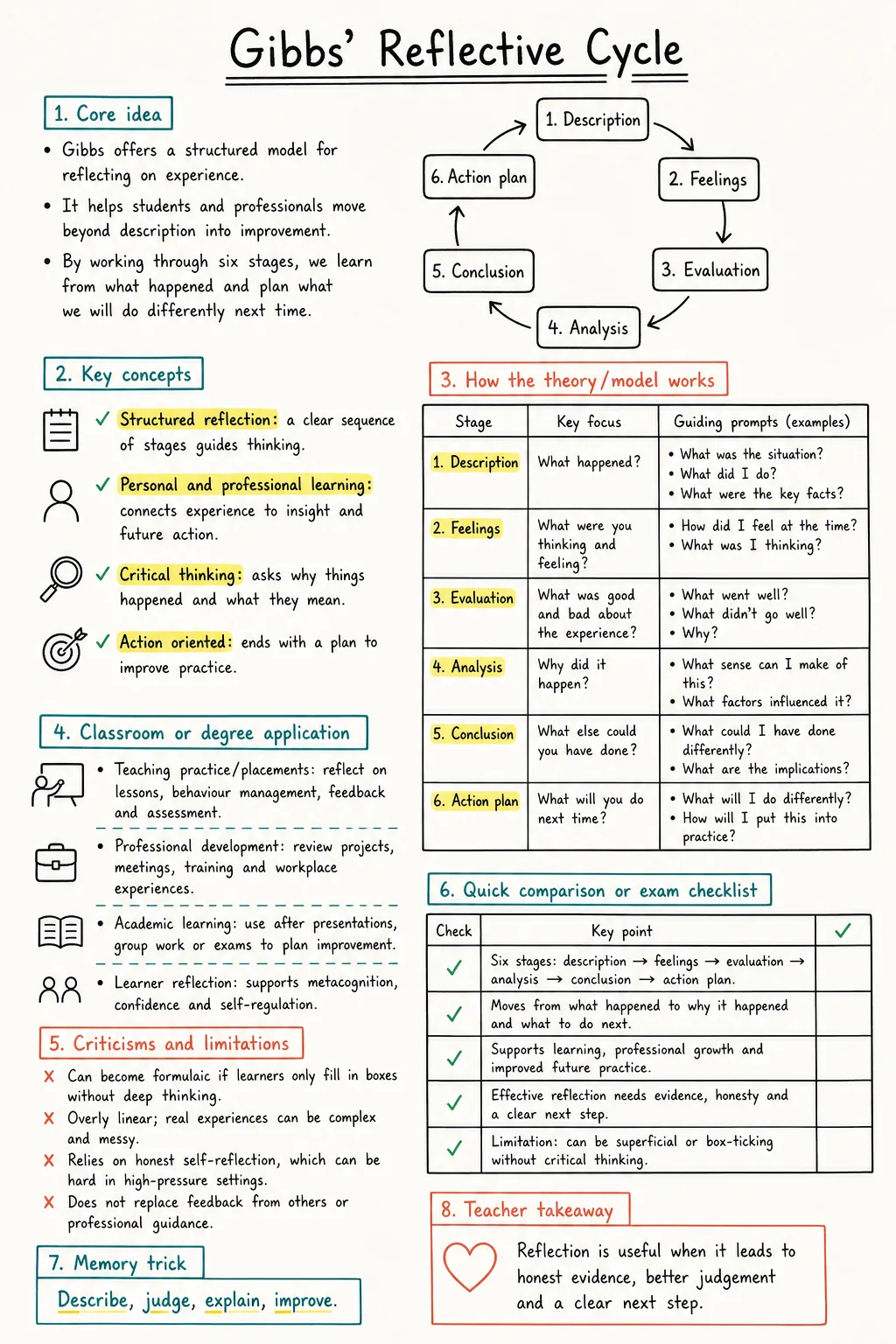
Gibbs Reflective Cycle infographic showing 6 stages from description to action plan for structured learning
Gibbs' Reflective Cycle: The 6 Stages

The cycle consists of six stageswhich must be completed in order for the reflection to have a defined purpose. The first stage is to describe the experience. This is followed by reflecting on the feelings felt during the experience, identifying what knowledge was gained from it, analysing any decisions made in relation to it and considering how this could have been done differently.

The final stage of the cycle is to come up with a plan for how to approach similar experiences in future.

Gibbs' Reflective Cycle encourages individuals to consider their own experiences in a more in-depth and analytical way, helping them to identify how they can improve their practice in the future.

A survey from the British Journal of Midwifery found that 63% of healthcare professionals regularly used Gibbs' Reflective Cycle as a tool for reflection.

"Reflection is a critical component of professional nursing practice and a strategy for learning through practice. This integrative review synthesizes the literature on nursing students’ reflection on their clinical experiences.", Beverly J. Bowers, RN, PhD

The Six Stages of Gibbs' Cycle

The six stages are: Description (what happened), Feelings (what were you thinking and feeling), Evaluation (what was good and bad), Analysis (what sense can you make of it), Conclusion (what else could you have done), and Action Plan (what will you do next time). Each stage builds on the previous one to create a comprehensive reflection process that moves from observation to concrete improvement strategies.

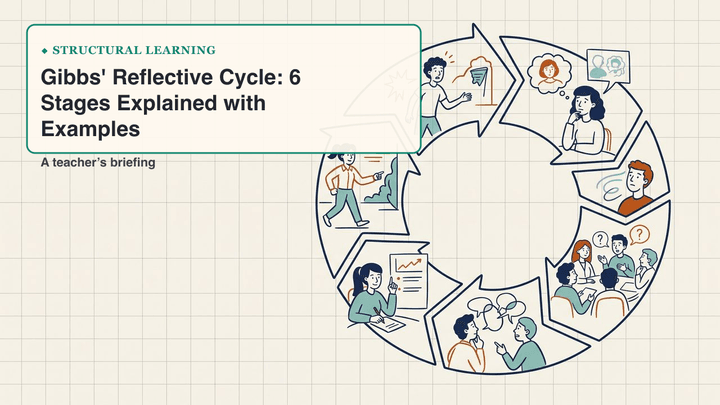
Circular diagram showing Gibbs' six reflective stages connected by arrows in a continuous cycle
Cycle diagram with directional arrows: Gibbs' Six-Stage Reflective Cycle

The Gibbs reflective cycle consists of six distinct stages: Description, Feelings, Evaluation, Analysis, Conclusion, and Action Plan. Each stage prompts the individual to examine their experiences through questions designed to incite deep and critical reflection. For instance, in the 'Description' stage, one might ask: "What happened?". This questioning method encourages a thorough understandingof both the event and the individual's responses to it.

To illustrate, let's consider a student nurse reflecting on an interaction with a patient. In the 'Description' stage, the student might describe the patient's condition, their communication with the patient, and the outcome of their interaction. Following this, they would move on to the 'Feelings' stage, where they might express how they felt during the interaction, perhaps feeling confident, anxious, or uncertain.

The 'Evaluation' stage would involve the student reflecting on their interaction with the patient, considering how they could have done things differently and what went well. In the 'Analysis' stage, the student might consider the wider implications of their actions and how this impacted on the patient's experience.

Finally, in the 'Conclusion' stage, the student would summarise their reflections by noting what they have learned from the experience. They would then set an 'Action Plan' for how they will apply this newfound knowledge in their future practice.

Gibbs' Reflective Cycle is a useful tool for nurses to utilise in order to reflect on their past experiences and improve their practice. By using reflective questions, nurses can actively engage in reflection and identify areas for improvement. 

  1. Description: Start by objectively recounting the experience. Helpful questions to ask include: What happened? Who was involved? When and where did this occur?
  2. Feelings: Capture your emotional response to the experience. Acknowledge both positive and negative emotions, as they significantly affect our interpretation of the event.
  3. Evaluation: Assess the good and bad aspects of the experience. What worked well, and what didn't? What were the positive impacts and negative consequences?
  4. Analysis: Dig deeper into understanding why things unfolded as they did. This analysis stage is where you draw on relevant literature and professional knowledge to interpret the experience.
  5. Conclusion: Determine what you could have done differently and what you've learned from the experience.
  6. Action Plan: Develop a plan detailing what you'll do if a similar situation arises in the future.

Gibbs Reflective Cycle

Using Gibbs' Cycle in Teaching Practice

Teachers commonly use Gibbs' cycle to reflect on challenging lessons, student behaviour incidents, or new teaching strategies they've tried. For example, after a difficult class, a teacher might describe what happened, identify their frustration, evaluate what worked and didn't work, analyse why students were disengaged, conclude what alternative approaches could help, and create an action plan for the next lesson. This systematic approach transforms negative experiences into learning opportunities.

The Gibbs Reflective Cycle, a model of reflection, can be a powerful tool for learning and personal development across various vocations. Here are five fictional examples:

  1. Nursing: A nurse named Jane had a challenging interaction with a patient. Using the Gibbs Reflective Cycle, she first described the situation and her initial reactions. She then reflected on her feelings, identifying negative emotions that arose. During the analysis stage, she realised that her communication skills needed improvement. She concluded that better communication could have led to a more positive outcome. Finally, she developed a personal development plan to improve her communication skills, demonstrating the positive impacts of deep level reflection.
  2. Teaching: A teacher, Mr. Smith, had difficulty managing his classroom. He used the Gibbs Reflective Cycle to reflect on a particularly chaotic day. He identified negative aspects of his classroom management strategy and, through critical thinking, realised that he needed to set clearer expectations for his students. He then developed a plan to implement these changes, showing how the approach to reflection can lead to actionable improvements.
  3. Customer Service: Sarah, a customer service representative, received constructive feedback from a customer who was dissatisfied with the service. She used the Gibbs Reflective Cycle to reflect on the interaction, identifying her feelings of disappointment and analysing what went wrong. She concluded that she needed to improve her problem-solving skills and developed a plan to do so.
  4. Management: A manager, Tom, struggled with delegating tasks to his team. He used the Gibbs Reflective Cycle to reflect on a project that was delayed due to his reluctance to delegate. He identified his fear of losing control as a negative emotion and realised during the analysis stage that trust in his team was crucial. He then developed a plan to practice delegation in future projects.
  5. Counseling: A counselor, Dr. Lee, felt that her recent sessions with a client were not productive. She used the Gibbs Reflective Cycle to reflect on these sessions. She identified feelings of frustration and, upon analysis, realised that she needed to adjust her counseling techniques to better suit her client's needs. She then developed a plan to implement these changes.

These examples illustrate how the Gibbs Reflective Cycle can facilitate learning and reflection across different vocations, leading to personal and professional growth.

Why Gibbs' Cycle Works for CPD

Gibbs' cycle is effective because it provides a clear structure that prevents superficial reflection and ensures practitioners examine experiences from multiple angles. The model's strength lies in its progression from description to action, forcing users to move beyond simply recounting events to understanding why things happened and planning concrete improvements. This systematic approach makes it particularly valuable for mandatory CPD requirements and performance reviews.

Gibbs' Reflective Cycle offers a structured approach to reflection, making it a helpful tool for educators and learners alike. The model encourages critical reflection, stimulating the ability to analyse experiences through questions and transform them into valuable learning opportunities.

Experiential Learning, a concept closely tied with reflection, suggests that we learn from our experiences, particularly when we engage in reflection and active experimentation. Gibbs' model bridges the gap between theory and practice, offering a framework to capture and analyse experiences in a meaningful way.

By using Gibbs' model, educators can guide students through their reflective process, helping them extract valuable lessons from their positive and negative experiences.

When Should Teachers Use Gibbs' Reflective Cycle?

Teachers should use Gibbs' cycle after significant classroom events, challenging situations, or when trying new teaching methods. It's particularly valuable for weekly lesson reflections, after parent conferences, following student assessments, or when dealing with classroom management issues. Regular use helps develop reflective habits that improve teaching practice over time.

The flexibility and simplicity of Gibbs' Reflective Cycle make it widely applicable in various real-world scenarios, from personal situations to professional practice.

For instance, Diana Eastcott, a nursing educator, utilised Gibbs' model to facilitate her students' reflection on their clinical practice experience. The students were encouraged to reflect on their clinical experiences, analyse their reactions and feelings, and construct an action plan for future patient interactions. This process not only enhanced their professional knowledge but also developed personal growth and emotional resilience.

In another example, Bob Farmer, a team leader in a tech company, used Gibbs' Cycle to reflect on a project that didn't meet expectations. He guided his team through the reflective process, helping them identify areas for improvement and develop strategies for better future outcomes.

These scenarios underline the versatility of Gibbs' model, demonstrating its value in both educational and professional settings.

  1. (Gibbs Reflective Cycle, University of Northampton, https://www.northampton.ac.uk)
  2. (Gibbs' Reflective Cycle, Oxford Brookes University, https://www.brookes.ac.uk)
  3. (Reflective Practice, San Francisco State University, https://www.sfsu.edu)

How Gibbs' Cycle Supports Teacher Growth

Gibbs' cycle supports professional growth by providing a framework that transforms everyday teaching experiences into learning opportunities. The structured approach helps teachers identify patterns in their practice, recognise areas for improvement, and develop evidence-based strategies for enhancement. This systematic reflectiondirectly feeds into professional development plans and helps teachers demonstrate continuous improvement.

The use of Gibbs' Reflective Cycle can have profound effects on personal and professional development. It aids in recognising strengths, weaknesses, and areas for improvement, providing an avenue for constructive feedback and self-improvement.

In the context of professional development, Gibbs' model promotes continuous learning and adaptability. By transforming bad experiences into learning opportunities, individuals can enhance their competencies and skills, preparing them for similar future situations.

Moreover, the reflective cycle promotes emotional intelligence by encouraging individuals to explore their feelings and reactions to different experiences. Acknowledging and understanding negative emotions can lead to increased resilience, better stress management, and improved interpersonal relationships.

Gibbs' Cycle vs Simple Reflection

Unlike simple diary entries or casual reflection, Gibbs' cycle requires systematic analysis through six distinct stages that build toward actionable improvements. The model's Analysis stage specifically pushes practitioners to examine underlying causes and patterns rather than stopping at surface-level observations. This depth ensures that reflection leads to genuine professional learningand concrete changes in practice.

Gibbs' Reflective Cycle is a practical tool that transforms experiences into learning. It incorporates principles of Experiential Learning and emphasises the importance of abstract conceptualization and active experimentation in the learning process.

In the field of education, Gibbs' model can significantly influence teaching methods. It encourages educators to incorporate reflective practices in their teaching methods, promoting a deeper understanding of course material and facilitating the application of theoretical knowledge in practical scenarios.

Moreover, the model can be used to encourage students to reflect on their experiences, both within and outside the classroom, and learn from them. This process creates critical thinking, problem-solving skills, and personal growth, equipping students with the skills they need for lifelong learning.

Implementing Gibbs' Cycle in Schools

Schools can implement Gibbs' cycle by incorporating it into professional development programs, peer observation frameworks, and performance management processes. Start by training staff in the six stages, providing templates and examples, then integrate the cycle into regular meeting structures and CPD activities. Successful implementation requires leadership support and clear expectations about when and how staff should use the framework.

Here's a list of guidance tips for organisations interested in embracing Gibbs' Reflective Cycle as their professional development model.

  1. Understanding the Gibbs Reflective Cycle: Before implementing, ensure that everyone in the organisation understands the Gibbs Reflective Cycle model. This model consists of six stages: Description, Feelings, Evaluation, Analysis, Conclusion, and Action Plan. The goal is to encourage deep level reflection on experiences to creates learning and improve future actions.
  2. Promote a Culture of Reflection: Encourage everyone in the organisation to incorporate reflection into their daily routine. Reflection should not be seen as an added task, but rather as an integral part of the professional development process.
  3. Use Real-Life Situations: For the methods in education to be effective, use real-life situations when applying the Gibbs Reflective Cycle. This way, employees can relate to the experiences, making the reflection process more relevant and meaningful.
  4. Encourage Sharing of Reflections: Create a safe space for individuals to share their reflections. This could be through team meetings, one-on-one sessions with managers, or through online platforms. Sharing allows for collective learning and may provide different perspectives on the same situation.
  5. Integrate Reflective Practice in Training Programs: Use the Gibbs Reflective Cycle in training programs. After each training session, encourage participants to go through the reflective cycle. This can help them understand the training content better and apply it in their work.
  6. Link Reflection to Personal Development: Connect the outcome of the reflection to personal development plans. The Action Plan stage of the cycle should feed into the individual's personal development plan, helping them identify areas of strength and areas needing improvement.
  7. Provide Guidance and Support: Provide guidance and support in the early stages of implementing the Gibbs Reflective Cycle. This could include providing templates or guides, or offering training on how to use the model effectively.
  8. Continuous Review and Feedback: Regularly review the use of the Gibbs Reflective Cycle in your organisation and provide feedback. This will help ensure that the model is being used effectively and is helping individuals in their professional development.
  9. Model Reflective Practice: Leaders and managers should model reflective practice themselves. This shows that the organisation values reflective practice and can motivate employees to engage in it themselves.
  10. Celebrate Success: Recognize and celebrate when reflective practice leads to positive changes or improvements. This can motivate employees to continue using the Gibbs Reflective Cycle in their professional development.

Kolb's vs Gibbs' Reflective Cycles

Both Kolb's Experiential Learning Theory and Gibbs' Reflective Cycle are influential learning methods used extensively in education and professional development. While they share similarities, such as promoting a cyclical learning process and developing a deeper understanding of experiences, there are key differences.

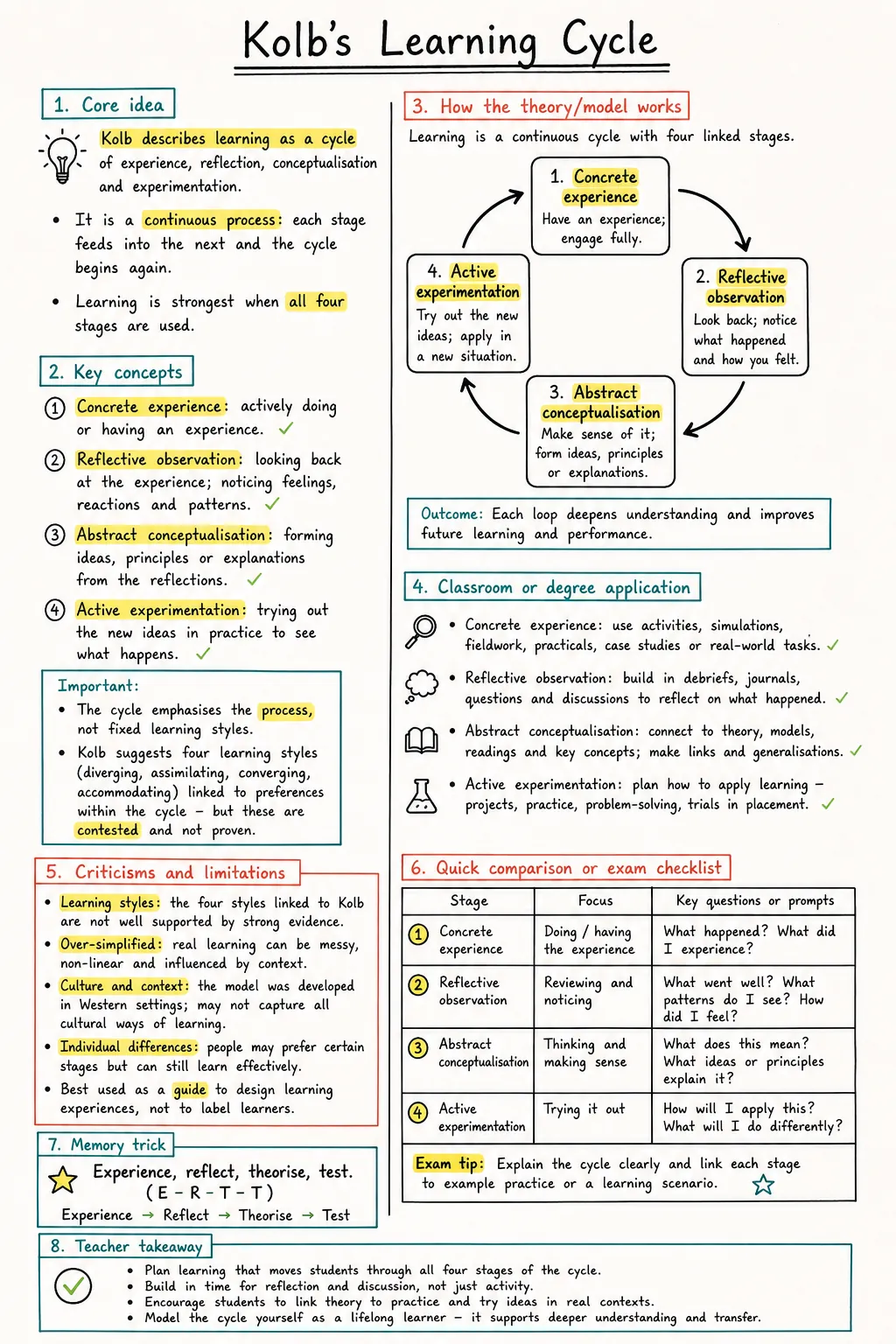
Kolb's cycle consists of four stages: Concrete Experience, Reflective Observation, Abstract Conceptualization, and Active Experimentation. It focuses more on the transformation of direct experience into knowledge, emphasising the role of experience in learning.

On the other hand, Gibbs' cycle, with its six stages, places a greater emphasis on emotions and their impact on learning. For example, a team leader might use Kolb's cycle to improve operational skills after a failed project, focusing on what happened and how to improve. However, using Gibbs' cycle, the same leader would also reflect on how the failure made them feel, and how those feelings might have influenced their decision-making.


Other notable Learning Methods and Cycles


Learning Cycle TheoryOriginApplication
Experiential Learning Theory (ELT)Developed by David Kolb in the 1980s. It's based on the work of John Dewey, Kurt Lewin, and Jean Piaget.It's widely used in professional development and higher education settings. It helps learners gain knowledge from their experiences by going through four stages: Concrete Experience, Reflective Observation, Abstract Conceptualization, and Active Experimentation.
5E Instructional ModelDeveloped by the Biological Sciences Curriculum Study (BSCS) in the 1980s.This model is popular in science education. It includes five phases: Engagement, Exploration, Explanation, Elabouration, and Evaluation. It promotes inquiry-based learning and active engagement.
ADDIE ModelThe origins can be traced back to the US Military in the 1970s.It's widely used in instructional design and training development. The five phases are Analysis, Design, Development, Implementation, and Evaluation.
Kemp Design ModelDeveloped by Jerold Kemp in the late 1970s.This model is used in instructional design. It emphasises continuous revision and flexibility throughout the learning cycle, including nine components that are considered simultaneously and iteratively.
Gagne's Nine Events of InstructionDeveloped by Robert Gagne in the 1960s.This is commonly used in instructional design and teaching. It includes nine steps: Gain attention, Inform learners of objectives, Stimulate recall of prior learning, Present the content, Provide learner guidance, Elicit performance, Provide feedback, Assess performance, and Enhance retention and transfer.
ARCS Model of Motivational DesignDeveloped by John Keller in the 1980s.This model is used to improve learners' motivation. The four components are Attention, Relevance, Confidence, and Satisfaction. It is widely used in e-learning and instructional design.
Bloom's TaxonomyDeveloped by Benjamin Bloom in the 1950s.It is used to classify educational learning objectives into levels of complexity and specificity. The taxonomy consists of six levels: Remembering, Understanding, Applying, Analyzing, Evaluating, and Creating. It is widely used in education to design lesson plans and assessments.

Please note that each of these theories or models has been developed and refined over time, and they each have their own strengths and weaknesses depending on the specific learning context or goals.

Benefits of Gibbs' Cycle in Education

The main benefits include improved classroom practice through systematic reflection, better professional development outcomes, and enhanced ability to handle challenging classroom situations. Teachers who regularly use Gibbs' cycle report increased confidence in trying new strategies and better understanding of student needs. The framework also provides clear documentation for performance reviews and professional portfolios.

Gibbs' Reflective Cycle is an invaluable tool for nurturing professional skills and developing personal growth. By systematically integrating this reflective model into educational practices, institutions can significantly enhance their students' professional development.

Here are seven effective ways educational institutions can harness the power of Gibbs' Reflective Cycle to boost skill acquisition, operational proficiency, leadership capabilities, and personal skills mastery.

  1. Incorporate Reflective Practice in Curriculum: Educational institutions can incorporate Gibbs' Reflective Cycle into their curriculum, making it a regular part of learning. This can encourage students to develop professional skills by continually reflecting on their experiences and learning from them.
  2. Real-World Scenarios: By using real-world situations or case studies, educational institutions can provide practical instances for students to apply the reflective cycle. This will help them understand the type of situation they might encounter in their professional life and how to handle it.
  3. Promote Skill Acquisition: Gibbs' cycle can be used as a tool for skill acquisition. By reflecting on their performance in various tasks and projects, students can identify their strengths and areas that need improvement. This can aid in the development of operational skills, leadership skills, and personal skills.
  4. Professional Development Workshops: Educational institutions can organise workshops that focus on the application of Gibbs' Reflective Cycle for professional development. These workshops could provide hands-on training on how to use the cycle effectively.
  5. Reflective Journals: Encourage students to keep a reflective journal. This practice can help students regularly apply Gibbs' cycle, promoting introspection, and the development of key leadership skills.
  6. Mentorship Programs: Implement mentorship programs where experienced professionals guide students in applying Gibbs' Reflective Cycle. This can provide students with valuable insights into how reflective practice can enhance their professional skills.
  7. Assessments Based on Reflection: Design assessments that value reflective practice. Instead of solely focusing on theoretical knowledge, consider students' ability to reflect on their experiences and learn from them. This approach can make learning more engaging and relevant to real-world situations.


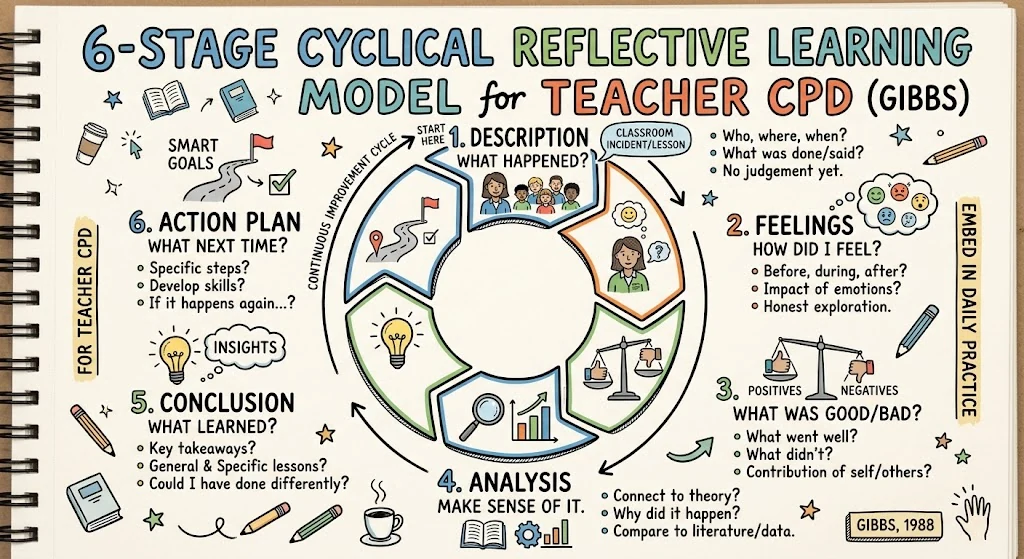
Gibbs Reflective Cycle concept map showing six stages of structured reflection for professional development in education
Gibbs' Reflective Cycle: The Six Stages of Reflection Explained - Visual Overview

Getting Started with Gibbs' Cycle

Teachers can start by selecting one significant classroom event per week and working through all six stages using a template or journal. Begin with shorter reflections of 15-20 minutes, focusing on completing each stage rather than perfection. As the process becomes familiar, extend to more complex situations and use the cycle for collabourative reflection with colleagues.

In the journey of life and work, we continuously encounter new situations, face challenges, and make decisions that shape our personal and professional trajectory. It's in these moments that Gibbs' Reflective Cycleemerges as a guiding compass, providing a structured framework to analyse experiences, draw insights, and plan our future course of action.

Underlying the model is the philosophy of lifelong learning. By encouraging critical reflection, it helps us to passively experience life and to actively engage with it, to question, and to learn. It's through this reflection that we move from the field of 'doing' to 'understanding', transforming experiences into knowledge.

Moreover, the model emphasises the importance of an action-oriented approach. It propels us to use our reflections to plan future actions, promoting adaptability and growth. Whether you're an educator using the model to enhance your teaching methods, a student exploring the depths of your learning process, or a professional striving for excellence in your field, Gibbs' Reflective Cycle can be a powerful tool.

In an ever-changing world, where the pace of change is accelerating, the ability to learn, adapt, and evolve is paramount. Reflective practices, guided by models such as Gibbs', provide us with the skills and mindset to navigate this change effectively. They helps us to learn from our past, be it positive experiences or negative experiences, and use these lessons to shape our future.

From developing personal growth and emotional resilience to enhancing professional practice and shapingfuture outcomes, the benefits of Gibbs' Reflective Cycle are manifold. As we continue our journey of growth and learning, this model serves as a beacon, illuminating our path and guiding us towards a future of continuous learning and development.

Gibbs model of reflection in clinical settings

Resources for Mastering Gibbs' Cycle

Key resources include Gibbs' original 1988 text 'Learning by Doing', practical guides from teaching colleges, and online templates specifically designed for educational contexts. Many universities provide free downloadable worksheets and video tutorials that demonstrate each stage of the cycle. Professional development courses often include modules on reflective practice using Gibbs' framework.

Here is a list of five key studies examining the effectiveness of Gibbs' Reflective Cycle in promoting critical reflection across different domains. These studies explore the cycle's structured approach in enhancing reflective practice, its role as a helpful and practical tool, and how it informs future actions.

  1. Reflective Writing in Public Health Education
    Ezezika and Johnston (2022) investigated the use of Gibbs' Reflective Cyclein a structured reflective writing assignment within an undergraduate public health course. They found that it enhanced students' ability to evaluate their learning and apply discipline-specific knowledge to real-world health issues. The evaluation stage of the cycle clarified student expectations and improved grading consistency. This study highlights how Gibbs' model serves as a practical tool for enhancing critical reflection in academic settings.
  2. Gibbs’ Cycle in Nursing Education
    Wilding (2008) explored how student nurses utilised Gibbs' Reflective Cycle to critically assess gender issues and professional conduct in clinical practice. The study demonstrated that the cycle is a structured approach to developing critical thinking skills, allowing students to make meaningful evaluations of their experiences and refine future actions in their practice. The research supports the cycle as a helpful tool in professional training.
  3. Impact on Nursing Residency Programs
    Waltz (2019) examined the implementation of Gibbs' Reflective Cycle in team meetings within nursing residency programs to reduce stress and increase job satisfaction. Facilitated discussions using the model helped new nurses critically analyse their experiences, leading to improved retention rates and reduced burnout. The study underscores the cycle's value in supporting novice professionals' transition into demanding roles.
  4. Enhancing Critical Reflection in Professional Practice
    Paterson and Chapman (2013) analysed how Gibbs’ and Kolb’s reflective cycles helped professionals across various fields improve their reflective practice. They concluded that Gibbs' model provides a structured approach to evaluating experiences, ensuring continuous professional development. This research demonstrates how the cycle aids the evaluation stage of learning, developing deeper critical reflection.
  5. Honesty in Student Reflections
    Maloney et al. (2013) investigated physiotherapy students' use of Gibbs' Reflective Cycle in summative reflective essays. While students recognised its benefits, some struggled with honest self-evaluation, affecting the depth of their reflections. The study emphasises the need for well-designed assessment criteria to encourage genuine critical engagement, ensuring that the cycle remains an effective framework for structured reflection.

These studies collectively illustrate the broad applicability of Gibbs’ Reflective Cycle across academic, professional, and healthcare settings, reinforcing its role as a structured and practical tool for developing reflective practice.

Frequently Asked Questions

Gibbs' Cycle vs Simple Diary Entries

Gibbs' Reflective Cycle is a structured six-stage framework developed by Graham Gibbs in 1988 that transforms surface-level descriptions into powerful tools for professional growth. Unlike simple diary entries that merely record what happened, this model systematically guides educators through description, feelings, evaluation, analysis, conclusion, and action planning to create meaningful development opportunities.

Why Complete Gibbs' Six Stages Sequentially?

The six stages are Description (what happened), Feelings (thoughts and emotions), Evaluation (what was good and bad), Analysis (making sense of the experience), Conclusion (what else could have been done), and Action Plan (future approach). Each stage builds on the previous one to create a comprehensive reflection process that moves systematically from observation to concrete improvement strategies.

Practical Classroom Applications of Gibbs' Cycle

Teachers commonly use the cycle to reflect on challenging lessons, student behaviour incidents, or new teaching strategies. For example, after a difficult class, they would describe what happened, identify their emotions, evaluate successes and failures, analyse why students were disengaged, conclude alternative approaches, and create an action plan for future lessons.

Why Teachers Skip Critical Analysis Stage

Most teachers stop at identifying 'what went wrong' in the evaluation stage and miss the analysis phase where they draw on professional knowledge and literature to understand why things unfolded as they did. This analysis stage is crucial because it reveals underlying patterns in classroom challenges and transforms observations into deeper professional insights.

Transforming Mandatory CPD with Gibbs' Cycle

Instead of treating CPD reflections as a tick-box exercise, teachers can use the six-stage framework to structure their professional development systematically. This approach ensures they move beyond surface-level reporting to genuine analysis and concrete action planning that directly improves their instructional approach.

Common Challenges Implementing Gibbs' Cycle

The main challenge is moving beyond the comfortable description and evaluation stages to engage in deeper analysis that requires drawing on professional knowledge and research. Teachers may also struggle with being honest about their emotions in the feelings stage or creating specific, actionable plans rather than vague intentions for improvement.

Action Planning for Classroom Improvements

The action planning stage transforms reflective insights into concrete, implementable strategies by requiring teachers to specify exactly what they will do differently in similar future situations. This final stage prevents reflection from becoming merely an intellectual exercise and ensures it leads to tangible changes in pedagogical methods that 'actually stick'.

Stage 2: Feelings and Emotional Responses

The feelings stage of Gibbs' Reflective Cycle serves as more than a simple emotional inventory. Recent research by Saraçoğlu et al. (2025) highlights how emotional experiences in educational settings occur within complex sociocultural contexts, where interactions can be emotionally intense. For teachers, this stage requires honest examination of both their own emotions and their students' emotional responses during the teaching experience. Rather than dismissing feelings as irrelevant to professional practice, this stage recognises emotions as valuable data that inform teaching effectiveness.

When engaging with this stage, teachers should explore emotions chronologically: initial feelings before the lesson, emotional shifts during teaching moments, and residual feelings afterwards. Chaudhri et al. (2023) found that emotions tend to have a significant impact on students' learning outcomes, making it crucial for teachers to understand the emotional climate of their classroom. Consider recording specific triggers for emotional responses, such as a student's unexpected question that caused anxiety or the satisfaction felt when a struggling pupil grasped a difficult concept. This detailed emotional mapping reveals patterns that might otherwise remain hidden.

Personal vs Professional Emotional Responses

A critical skill in this stage involves separating personal emotional responses from professional ones. For instance, frustration with a transformative student might stem from personal tiredness rather than the student's behaviour itself. Teachers should ask themselves: "Would I have felt differently if this happened at a different time or under different circumstances?" This distinction prevents misattribution and leads to more accurate analysis in later stages. Research by Mokhele-Ramulumo et al. (2025) demonstrates how understanding emotional responses shapes attitudes and behaviours, suggesting that teachers who accurately identify their emotional triggers can better manage classroom dynamics.

The feelings stage also requires acknowledging uncomfortable emotions without judgement. Many teachers feel pressured to maintain perpetual positivity, yet recognising feelings of disappointment, inadequacy, or even anger provides crucial insights for professional development. Document these emotions using specific language rather than general terms: instead of writing "felt bad," specify whether you felt overwhelmed, underprepared, or dismissed. This precision creates a richer foundation for the evaluation stage that follows, where you'll assess what went well and what didn't. Remember, the goal isn't to eliminate negative emotions but to understand their sources and impacts on your teaching practice.

Stage 3: Evaluation and Analysis

The evaluation stage marks a critical turning point in Gibbs' Reflective Cycle where teachers move beyond emotional responses to make objective judgements about their classroom experiences. Unlike the feelings stage, evaluation requires you to step back and assess both the positive and negative aspects of a situation without letting emotions cloud your judgement. This balanced approach prevents the common teaching trap of focusing solely on what went wrong, which research by MacNeil et al. (2023) suggests can limit professional growth when stakeholders engage in one-sided evaluations of their experiences.

Effective evaluation in teaching contexts requires a structured approach that goes beyond simple 'good' or 'bad' categorisations. Start by identifying specific elements that worked well, such as a particular questioning technique that sparked student engagement or a classroom management strategy that maintained focus during transitions. Then examine what didn't work, but frame these observations constructively. For instance, rather than noting "the group work failed," evaluate specific aspects: "Students in mixed-ability groups completed tasks at different speeds, leaving some disengaged." This granular approach to evaluation provides clearer direction for the analysis stage that follows.

Two-Column Evaluation Method

To ensure balanced evaluation, create two columns labelled "Effective Elements" and "Areas for Development." Under each, list specific observations with brief evidence. For example, under "Effective Elements," you might write: "Visual timer on board, 95% of students transitioned within 2 minutes." This technique prevents the natural tendency to dwell on negatives whilst ensuring you capture successful strategies that might otherwise be forgotten. The evaluation stage differs from peer-based faculty evaluation discussed by Akins and Murphy (2019), as it focuses on self-assessment rather than external judgement, making it less threatening and more conducive to honest reflection.

A crucial but often overlooked aspect of evaluation is considering unintended outcomes. Perhaps your carefully planned differentiated worksheet inadvertently highlighted ability gaps, affecting student confidence. Or maybe your attempt to incorporate technology enhanced engagement but reduced meaningful peer interaction. These unexpected results often provide the richest material for professional development. By evaluating both intended and unintended outcomes, you create a comprehensive picture that feeds directly into the analysis stage, where you'll explore why these outcomes occurred and identify patterns across multiple teaching experiences.

Key Questions for Each Stage of Reflection

While many teachers understand the six stages of Gibbs' Reflective Cycle, they often struggle with knowing exactly what to ask themselves at each stage. Simply knowing the stages isn't enough; you need targeted questions that probe deeper into your teaching practice. Research by Roberts et al. (2025) on critical design strategies demonstrates that structured questioning methods significantly enhance reflective thinking, a principle that applies directly to classroom reflection.

The quality of your reflection depends entirely on the questions you ask. Generic prompts like "What happened?" produce surface-level responses that rarely lead to meaningful change. Instead, each stage requires specific questions that challenge assumptions and uncover hidden patterns in your teaching practice. For the Description stage, rather than simply recounting events, ask: "What specific student behaviours indicated engagement or confusion?" and "Which transitions between activities created momentum or disruption?" These targeted questions transform basic observation into actionable data.

Progressive Questioning Techniques

As you move through the cycle, your questions should build upon previous insights. In the Feelings stage, avoid stopping at "I felt frustrated." Instead, probe with: "What specific moment triggered this emotion?" and "How did my emotional state influence my teaching decisions?" The Analysis stage, often the most neglected, requires questions that connect theory to practice: "Which pedagogical principles were at play when the lesson succeeded/failed?" and "What patterns emerge when I compare this experience to similar situations?"

The final stages demand forward-thinking questions. For the Conclusion stage, ask: "What would I need to change about my planning, not just my delivery?" and "Which of my teaching assumptions has this experience challenged?" The Action Plan stage moves beyond vague intentions with questions like: "What specific resources or support do I need to implement this change?" and "How will I measure whether my new approach works?" This progression mirrors the taxonomy development process described by Finelli and Borrego (2014), where systematic questioning leads to clearer categorisation and understanding of complex educational phenomena.

Transform these questions into a personal reflection toolkit by adapting them to your subject area and teaching context. A science teacher might focus questions on labouratory management and practical demonstrations, whilst a primary teacher could emphasise questions about differentiation across ability levels. The key is maintaining the progressive depth whilst making each question relevant to your specific classroom challenges.

Key Research Papers on Gibbs

These peer-reviewed studies provide the research foundation for the strategies discussed in this article:

Teachers talking about teaching and school: collabouration and reflective practice via Critical Friends Groups
43 citations

L. Kuh (2016)

This paper examines how teachers can use Critical Friends Groups to engage in collabourative reflection about their teaching practice. These structured peer discussion groups provide teachers with a supportive space to share challenges, receive constructive feedback, and improve their professional practice through collective problem-solving, which directly supports the collabourative reflection emphasised in Gibbs' cycle.

AI in the Classroom: A Systematic Review of Barriers to Educator Acceptance
2 citations

Ellaine Joy G. Eusebio et al. (2025)

This systematic review identifies the key obstacles teachers face when deciding whether to adopt AI technologies in their classrooms. Understanding these barriers, from lack of training to concerns about job security and student data privacy, helps teachers and administrators address resistance thoughtfully and implement AI tools more effectively through informed reflection on their concerns and needs.

AI in Higher Education: Initial Teacher Training in the Critical and Didactic Use of Artificial Intelligence
2 citations

Sebastián Martín-Gómez & C. J. González Ruiz (2025)

This study demonstrates how teacher training programs can integrate AI tools like ChatGPT and Gemini into coursework through a structured six-phase approach emphasising critical thinking and verification. Teachers can learn from this model to thoughtfully incorporate AI into their own practice, using reflection to question outputs, compare sources, and verify information rather than accepting AI-generated content uncritically.

Emotional labour as teaching expertise: reflective practices for teacher professional development workshops
1 citations

Mandie Bevels Dunn et al. (2025)

This research highlights the often-overlooked emotional demands of teaching, from managing difficult parent conversations to supporting struggling students, and argues that reflective practice should address these challenges explicitly. Teachers can benefit from professional development that includes reflection on emotional labour, helping them develop strategies for managing stress and building relationships while maintaining their wellbeing and effectiveness in the classroom.

Further Reading: Key Research Papers

These peer-reviewed studies provide deeper insights into gibbs' reflective cycle: the six stages of reflection explained and its application in educational settings.

Experiential learning. 2613 citations

Wooding et al. (2019)

This chapter explores experiential learning, which is the process of learning through direct experience combined with reflection on that experience. It is highly relevant to teachers using Gibbs' Reflective Cycle as it emphasises how reflection transforms raw experience into meaningful learning, which aligns perfectly with the structured reflection stages that Gibbs provides.

REFLECTIVE TEACHING TOWARD EFL TEACHERS’ PROFESSIONAL AUTONOMY: REVISITING ITS DEVELOPMENT IN INDONESIA 16 citations

Lubis et al. (2018)

This paper examines the development of reflective teaching practices among English as a Foreign Language teachers in Indonesia over 25 years, focusing on how reflection promotes teacher autonomy and continuous professional development. It is valuable for teachers learning about Gibbs' Reflective Cycle as it demonstrates the real-world application and long-term benefits of structured reflection in teaching practice, particularly in developing critical thinking skills and lifelong learning habits.

Revitalising reflective practice in pre-service teacher education: developing and practicing an effective framework 17 citations

Roberts et al. (2021)

This research develops and tests a framework to help pre-service teachers understand and practice reflective thinking effectively, addressing common difficulties students face in grasping the importance of reflection. It is particularly relevant for teachers exploring Gibbs' Reflective Cycle as it provides evidence-based strategies for implementing structured reflection frameworks and demonstrates how systematic approaches to reflection can be taught and developed in educational settings.

Promoting pre-service teachers' professional vision of classroom management during practical school training: Effects of a structured online- and video-based self-reflection and feedback intervention 141 citations

Weber et al. (2018)

This study investigates how structured online and video-based reflection and feedback interventions can improve pre-service teachers' ability to analyse and understand classroom management during practical training. It is relevant to teachers using Gibbs' Reflective Cycle as it demonstrates how technology-enhanced structured reflection can be applied to specific teaching challenges, showing practical ways to implement systematic reflection processes in teacher development.

Loading audit...

What is Gibbs' Reflective Cycle?

Gibbs' Reflective Cycle is a popular model for reflection, acting as a structured methodto enable individuals to think systematically about the experiences they had during a specific situation.

Key Takeaways

  1. Beyond Simple Diary Entries: Transform your teaching reflections from surface-level descriptions into powerful tools for professional growth using Gibbs' six-stage framework.
  2. The Missing Analysis Stage: Discover why most teachers stop at 'what went wrong' and miss the critical fourth stage that reveals underlying patterns in classroom challenges.
  3. From Reflection to Action: Learn how the final stage turns your reflective insights into concrete classroom improvements that actually stick.
  4. Structure Your Professional Development: Use Gibbs' cycle to transform mandatory CPD reflections into meaningful growth opportunities that directly improve your teaching practice.

Gibbs’ Reflective Cycle is a widely used and accepted model of reflection. Developed by Graham Gibbs in 1988 at Oxford Polytechnic, now Oxford Brookes University, this reflective cycle framework is widely used within various fields such as healthcare, education, and management to enhance professional and personal development. It has since become an integral part of reflective practice, allowing individuals to reflect on their experiences in a structured way.

Gibbs Reflective Cycle infographic showing 6 stages from description to action plan for structured learning
Gibbs' Reflective Cycle: The 6 Stages

The cycle consists of six stageswhich must be completed in order for the reflection to have a defined purpose. The first stage is to describe the experience. This is followed by reflecting on the feelings felt during the experience, identifying what knowledge was gained from it, analysing any decisions made in relation to it and considering how this could have been done differently.

The final stage of the cycle is to come up with a plan for how to approach similar experiences in future.

Gibbs' Reflective Cycle encourages individuals to consider their own experiences in a more in-depth and analytical way, helping them to identify how they can improve their practice in the future.

A survey from the British Journal of Midwifery found that 63% of healthcare professionals regularly used Gibbs' Reflective Cycle as a tool for reflection.

"Reflection is a critical component of professional nursing practice and a strategy for learning through practice. This integrative review synthesizes the literature on nursing students’ reflection on their clinical experiences.", Beverly J. Bowers, RN, PhD

The Six Stages of Gibbs' Cycle

The six stages are: Description (what happened), Feelings (what were you thinking and feeling), Evaluation (what was good and bad), Analysis (what sense can you make of it), Conclusion (what else could you have done), and Action Plan (what will you do next time). Each stage builds on the previous one to create a comprehensive reflection process that moves from observation to concrete improvement strategies.

Circular diagram showing Gibbs' six reflective stages connected by arrows in a continuous cycle
Cycle diagram with directional arrows: Gibbs' Six-Stage Reflective Cycle

The Gibbs reflective cycle consists of six distinct stages: Description, Feelings, Evaluation, Analysis, Conclusion, and Action Plan. Each stage prompts the individual to examine their experiences through questions designed to incite deep and critical reflection. For instance, in the 'Description' stage, one might ask: "What happened?". This questioning method encourages a thorough understandingof both the event and the individual's responses to it.

To illustrate, let's consider a student nurse reflecting on an interaction with a patient. In the 'Description' stage, the student might describe the patient's condition, their communication with the patient, and the outcome of their interaction. Following this, they would move on to the 'Feelings' stage, where they might express how they felt during the interaction, perhaps feeling confident, anxious, or uncertain.

The 'Evaluation' stage would involve the student reflecting on their interaction with the patient, considering how they could have done things differently and what went well. In the 'Analysis' stage, the student might consider the wider implications of their actions and how this impacted on the patient's experience.

Finally, in the 'Conclusion' stage, the student would summarise their reflections by noting what they have learned from the experience. They would then set an 'Action Plan' for how they will apply this newfound knowledge in their future practice.

Gibbs' Reflective Cycle is a useful tool for nurses to utilise in order to reflect on their past experiences and improve their practice. By using reflective questions, nurses can actively engage in reflection and identify areas for improvement. 

  1. Description: Start by objectively recounting the experience. Helpful questions to ask include: What happened? Who was involved? When and where did this occur?
  2. Feelings: Capture your emotional response to the experience. Acknowledge both positive and negative emotions, as they significantly affect our interpretation of the event.
  3. Evaluation: Assess the good and bad aspects of the experience. What worked well, and what didn't? What were the positive impacts and negative consequences?
  4. Analysis: Dig deeper into understanding why things unfolded as they did. This analysis stage is where you draw on relevant literature and professional knowledge to interpret the experience.
  5. Conclusion: Determine what you could have done differently and what you've learned from the experience.
  6. Action Plan: Develop a plan detailing what you'll do if a similar situation arises in the future.

Gibbs Reflective Cycle

Using Gibbs' Cycle in Teaching Practice

Teachers commonly use Gibbs' cycle to reflect on challenging lessons, student behaviour incidents, or new teaching strategies they've tried. For example, after a difficult class, a teacher might describe what happened, identify their frustration, evaluate what worked and didn't work, analyse why students were disengaged, conclude what alternative approaches could help, and create an action plan for the next lesson. This systematic approach transforms negative experiences into learning opportunities.

The Gibbs Reflective Cycle, a model of reflection, can be a powerful tool for learning and personal development across various vocations. Here are five fictional examples:

  1. Nursing: A nurse named Jane had a challenging interaction with a patient. Using the Gibbs Reflective Cycle, she first described the situation and her initial reactions. She then reflected on her feelings, identifying negative emotions that arose. During the analysis stage, she realised that her communication skills needed improvement. She concluded that better communication could have led to a more positive outcome. Finally, she developed a personal development plan to improve her communication skills, demonstrating the positive impacts of deep level reflection.
  2. Teaching: A teacher, Mr. Smith, had difficulty managing his classroom. He used the Gibbs Reflective Cycle to reflect on a particularly chaotic day. He identified negative aspects of his classroom management strategy and, through critical thinking, realised that he needed to set clearer expectations for his students. He then developed a plan to implement these changes, showing how the approach to reflection can lead to actionable improvements.
  3. Customer Service: Sarah, a customer service representative, received constructive feedback from a customer who was dissatisfied with the service. She used the Gibbs Reflective Cycle to reflect on the interaction, identifying her feelings of disappointment and analysing what went wrong. She concluded that she needed to improve her problem-solving skills and developed a plan to do so.
  4. Management: A manager, Tom, struggled with delegating tasks to his team. He used the Gibbs Reflective Cycle to reflect on a project that was delayed due to his reluctance to delegate. He identified his fear of losing control as a negative emotion and realised during the analysis stage that trust in his team was crucial. He then developed a plan to practice delegation in future projects.
  5. Counseling: A counselor, Dr. Lee, felt that her recent sessions with a client were not productive. She used the Gibbs Reflective Cycle to reflect on these sessions. She identified feelings of frustration and, upon analysis, realised that she needed to adjust her counseling techniques to better suit her client's needs. She then developed a plan to implement these changes.

These examples illustrate how the Gibbs Reflective Cycle can facilitate learning and reflection across different vocations, leading to personal and professional growth.

Why Gibbs' Cycle Works for CPD

Gibbs' cycle is effective because it provides a clear structure that prevents superficial reflection and ensures practitioners examine experiences from multiple angles. The model's strength lies in its progression from description to action, forcing users to move beyond simply recounting events to understanding why things happened and planning concrete improvements. This systematic approach makes it particularly valuable for mandatory CPD requirements and performance reviews.

Gibbs' Reflective Cycle offers a structured approach to reflection, making it a helpful tool for educators and learners alike. The model encourages critical reflection, stimulating the ability to analyse experiences through questions and transform them into valuable learning opportunities.

Experiential Learning, a concept closely tied with reflection, suggests that we learn from our experiences, particularly when we engage in reflection and active experimentation. Gibbs' model bridges the gap between theory and practice, offering a framework to capture and analyse experiences in a meaningful way.

By using Gibbs' model, educators can guide students through their reflective process, helping them extract valuable lessons from their positive and negative experiences.

When Should Teachers Use Gibbs' Reflective Cycle?

Teachers should use Gibbs' cycle after significant classroom events, challenging situations, or when trying new teaching methods. It's particularly valuable for weekly lesson reflections, after parent conferences, following student assessments, or when dealing with classroom management issues. Regular use helps develop reflective habits that improve teaching practice over time.

The flexibility and simplicity of Gibbs' Reflective Cycle make it widely applicable in various real-world scenarios, from personal situations to professional practice.

For instance, Diana Eastcott, a nursing educator, utilised Gibbs' model to facilitate her students' reflection on their clinical practice experience. The students were encouraged to reflect on their clinical experiences, analyse their reactions and feelings, and construct an action plan for future patient interactions. This process not only enhanced their professional knowledge but also developed personal growth and emotional resilience.

In another example, Bob Farmer, a team leader in a tech company, used Gibbs' Cycle to reflect on a project that didn't meet expectations. He guided his team through the reflective process, helping them identify areas for improvement and develop strategies for better future outcomes.

These scenarios underline the versatility of Gibbs' model, demonstrating its value in both educational and professional settings.

  1. (Gibbs Reflective Cycle, University of Northampton, https://www.northampton.ac.uk)
  2. (Gibbs' Reflective Cycle, Oxford Brookes University, https://www.brookes.ac.uk)
  3. (Reflective Practice, San Francisco State University, https://www.sfsu.edu)

How Gibbs' Cycle Supports Teacher Growth

Gibbs' cycle supports professional growth by providing a framework that transforms everyday teaching experiences into learning opportunities. The structured approach helps teachers identify patterns in their practice, recognise areas for improvement, and develop evidence-based strategies for enhancement. This systematic reflectiondirectly feeds into professional development plans and helps teachers demonstrate continuous improvement.

The use of Gibbs' Reflective Cycle can have profound effects on personal and professional development. It aids in recognising strengths, weaknesses, and areas for improvement, providing an avenue for constructive feedback and self-improvement.

In the context of professional development, Gibbs' model promotes continuous learning and adaptability. By transforming bad experiences into learning opportunities, individuals can enhance their competencies and skills, preparing them for similar future situations.

Moreover, the reflective cycle promotes emotional intelligence by encouraging individuals to explore their feelings and reactions to different experiences. Acknowledging and understanding negative emotions can lead to increased resilience, better stress management, and improved interpersonal relationships.

Gibbs' Cycle vs Simple Reflection

Unlike simple diary entries or casual reflection, Gibbs' cycle requires systematic analysis through six distinct stages that build toward actionable improvements. The model's Analysis stage specifically pushes practitioners to examine underlying causes and patterns rather than stopping at surface-level observations. This depth ensures that reflection leads to genuine professional learningand concrete changes in practice.

Gibbs' Reflective Cycle is a practical tool that transforms experiences into learning. It incorporates principles of Experiential Learning and emphasises the importance of abstract conceptualization and active experimentation in the learning process.

In the field of education, Gibbs' model can significantly influence teaching methods. It encourages educators to incorporate reflective practices in their teaching methods, promoting a deeper understanding of course material and facilitating the application of theoretical knowledge in practical scenarios.

Moreover, the model can be used to encourage students to reflect on their experiences, both within and outside the classroom, and learn from them. This process creates critical thinking, problem-solving skills, and personal growth, equipping students with the skills they need for lifelong learning.

Implementing Gibbs' Cycle in Schools

Schools can implement Gibbs' cycle by incorporating it into professional development programs, peer observation frameworks, and performance management processes. Start by training staff in the six stages, providing templates and examples, then integrate the cycle into regular meeting structures and CPD activities. Successful implementation requires leadership support and clear expectations about when and how staff should use the framework.

Here's a list of guidance tips for organisations interested in embracing Gibbs' Reflective Cycle as their professional development model.

  1. Understanding the Gibbs Reflective Cycle: Before implementing, ensure that everyone in the organisation understands the Gibbs Reflective Cycle model. This model consists of six stages: Description, Feelings, Evaluation, Analysis, Conclusion, and Action Plan. The goal is to encourage deep level reflection on experiences to creates learning and improve future actions.
  2. Promote a Culture of Reflection: Encourage everyone in the organisation to incorporate reflection into their daily routine. Reflection should not be seen as an added task, but rather as an integral part of the professional development process.
  3. Use Real-Life Situations: For the methods in education to be effective, use real-life situations when applying the Gibbs Reflective Cycle. This way, employees can relate to the experiences, making the reflection process more relevant and meaningful.
  4. Encourage Sharing of Reflections: Create a safe space for individuals to share their reflections. This could be through team meetings, one-on-one sessions with managers, or through online platforms. Sharing allows for collective learning and may provide different perspectives on the same situation.
  5. Integrate Reflective Practice in Training Programs: Use the Gibbs Reflective Cycle in training programs. After each training session, encourage participants to go through the reflective cycle. This can help them understand the training content better and apply it in their work.
  6. Link Reflection to Personal Development: Connect the outcome of the reflection to personal development plans. The Action Plan stage of the cycle should feed into the individual's personal development plan, helping them identify areas of strength and areas needing improvement.
  7. Provide Guidance and Support: Provide guidance and support in the early stages of implementing the Gibbs Reflective Cycle. This could include providing templates or guides, or offering training on how to use the model effectively.
  8. Continuous Review and Feedback: Regularly review the use of the Gibbs Reflective Cycle in your organisation and provide feedback. This will help ensure that the model is being used effectively and is helping individuals in their professional development.
  9. Model Reflective Practice: Leaders and managers should model reflective practice themselves. This shows that the organisation values reflective practice and can motivate employees to engage in it themselves.
  10. Celebrate Success: Recognize and celebrate when reflective practice leads to positive changes or improvements. This can motivate employees to continue using the Gibbs Reflective Cycle in their professional development.

Kolb's vs Gibbs' Reflective Cycles

Both Kolb's Experiential Learning Theory and Gibbs' Reflective Cycle are influential learning methods used extensively in education and professional development. While they share similarities, such as promoting a cyclical learning process and developing a deeper understanding of experiences, there are key differences.

Kolb's cycle consists of four stages: Concrete Experience, Reflective Observation, Abstract Conceptualization, and Active Experimentation. It focuses more on the transformation of direct experience into knowledge, emphasising the role of experience in learning.

On the other hand, Gibbs' cycle, with its six stages, places a greater emphasis on emotions and their impact on learning. For example, a team leader might use Kolb's cycle to improve operational skills after a failed project, focusing on what happened and how to improve. However, using Gibbs' cycle, the same leader would also reflect on how the failure made them feel, and how those feelings might have influenced their decision-making.


Other notable Learning Methods and Cycles


Learning Cycle TheoryOriginApplication
Experiential Learning Theory (ELT)Developed by David Kolb in the 1980s. It's based on the work of John Dewey, Kurt Lewin, and Jean Piaget.It's widely used in professional development and higher education settings. It helps learners gain knowledge from their experiences by going through four stages: Concrete Experience, Reflective Observation, Abstract Conceptualization, and Active Experimentation.
5E Instructional ModelDeveloped by the Biological Sciences Curriculum Study (BSCS) in the 1980s.This model is popular in science education. It includes five phases: Engagement, Exploration, Explanation, Elabouration, and Evaluation. It promotes inquiry-based learning and active engagement.
ADDIE ModelThe origins can be traced back to the US Military in the 1970s.It's widely used in instructional design and training development. The five phases are Analysis, Design, Development, Implementation, and Evaluation.
Kemp Design ModelDeveloped by Jerold Kemp in the late 1970s.This model is used in instructional design. It emphasises continuous revision and flexibility throughout the learning cycle, including nine components that are considered simultaneously and iteratively.
Gagne's Nine Events of InstructionDeveloped by Robert Gagne in the 1960s.This is commonly used in instructional design and teaching. It includes nine steps: Gain attention, Inform learners of objectives, Stimulate recall of prior learning, Present the content, Provide learner guidance, Elicit performance, Provide feedback, Assess performance, and Enhance retention and transfer.
ARCS Model of Motivational DesignDeveloped by John Keller in the 1980s.This model is used to improve learners' motivation. The four components are Attention, Relevance, Confidence, and Satisfaction. It is widely used in e-learning and instructional design.
Bloom's TaxonomyDeveloped by Benjamin Bloom in the 1950s.It is used to classify educational learning objectives into levels of complexity and specificity. The taxonomy consists of six levels: Remembering, Understanding, Applying, Analyzing, Evaluating, and Creating. It is widely used in education to design lesson plans and assessments.

Please note that each of these theories or models has been developed and refined over time, and they each have their own strengths and weaknesses depending on the specific learning context or goals.

Benefits of Gibbs' Cycle in Education

The main benefits include improved classroom practice through systematic reflection, better professional development outcomes, and enhanced ability to handle challenging classroom situations. Teachers who regularly use Gibbs' cycle report increased confidence in trying new strategies and better understanding of student needs. The framework also provides clear documentation for performance reviews and professional portfolios.

Gibbs' Reflective Cycle is an invaluable tool for nurturing professional skills and developing personal growth. By systematically integrating this reflective model into educational practices, institutions can significantly enhance their students' professional development.

Here are seven effective ways educational institutions can harness the power of Gibbs' Reflective Cycle to boost skill acquisition, operational proficiency, leadership capabilities, and personal skills mastery.

  1. Incorporate Reflective Practice in Curriculum: Educational institutions can incorporate Gibbs' Reflective Cycle into their curriculum, making it a regular part of learning. This can encourage students to develop professional skills by continually reflecting on their experiences and learning from them.
  2. Real-World Scenarios: By using real-world situations or case studies, educational institutions can provide practical instances for students to apply the reflective cycle. This will help them understand the type of situation they might encounter in their professional life and how to handle it.
  3. Promote Skill Acquisition: Gibbs' cycle can be used as a tool for skill acquisition. By reflecting on their performance in various tasks and projects, students can identify their strengths and areas that need improvement. This can aid in the development of operational skills, leadership skills, and personal skills.
  4. Professional Development Workshops: Educational institutions can organise workshops that focus on the application of Gibbs' Reflective Cycle for professional development. These workshops could provide hands-on training on how to use the cycle effectively.
  5. Reflective Journals: Encourage students to keep a reflective journal. This practice can help students regularly apply Gibbs' cycle, promoting introspection, and the development of key leadership skills.
  6. Mentorship Programs: Implement mentorship programs where experienced professionals guide students in applying Gibbs' Reflective Cycle. This can provide students with valuable insights into how reflective practice can enhance their professional skills.
  7. Assessments Based on Reflection: Design assessments that value reflective practice. Instead of solely focusing on theoretical knowledge, consider students' ability to reflect on their experiences and learn from them. This approach can make learning more engaging and relevant to real-world situations.


Gibbs Reflective Cycle concept map showing six stages of structured reflection for professional development in education
Gibbs' Reflective Cycle: The Six Stages of Reflection Explained - Visual Overview

Getting Started with Gibbs' Cycle

Teachers can start by selecting one significant classroom event per week and working through all six stages using a template or journal. Begin with shorter reflections of 15-20 minutes, focusing on completing each stage rather than perfection. As the process becomes familiar, extend to more complex situations and use the cycle for collabourative reflection with colleagues.

In the journey of life and work, we continuously encounter new situations, face challenges, and make decisions that shape our personal and professional trajectory. It's in these moments that Gibbs' Reflective Cycleemerges as a guiding compass, providing a structured framework to analyse experiences, draw insights, and plan our future course of action.

Underlying the model is the philosophy of lifelong learning. By encouraging critical reflection, it helps us to passively experience life and to actively engage with it, to question, and to learn. It's through this reflection that we move from the field of 'doing' to 'understanding', transforming experiences into knowledge.

Moreover, the model emphasises the importance of an action-oriented approach. It propels us to use our reflections to plan future actions, promoting adaptability and growth. Whether you're an educator using the model to enhance your teaching methods, a student exploring the depths of your learning process, or a professional striving for excellence in your field, Gibbs' Reflective Cycle can be a powerful tool.

In an ever-changing world, where the pace of change is accelerating, the ability to learn, adapt, and evolve is paramount. Reflective practices, guided by models such as Gibbs', provide us with the skills and mindset to navigate this change effectively. They helps us to learn from our past, be it positive experiences or negative experiences, and use these lessons to shape our future.

From developing personal growth and emotional resilience to enhancing professional practice and shapingfuture outcomes, the benefits of Gibbs' Reflective Cycle are manifold. As we continue our journey of growth and learning, this model serves as a beacon, illuminating our path and guiding us towards a future of continuous learning and development.

Gibbs model of reflection in clinical settings

Resources for Mastering Gibbs' Cycle

Key resources include Gibbs' original 1988 text 'Learning by Doing', practical guides from teaching colleges, and online templates specifically designed for educational contexts. Many universities provide free downloadable worksheets and video tutorials that demonstrate each stage of the cycle. Professional development courses often include modules on reflective practice using Gibbs' framework.

Here is a list of five key studies examining the effectiveness of Gibbs' Reflective Cycle in promoting critical reflection across different domains. These studies explore the cycle's structured approach in enhancing reflective practice, its role as a helpful and practical tool, and how it informs future actions.

  1. Reflective Writing in Public Health Education
    Ezezika and Johnston (2022) investigated the use of Gibbs' Reflective Cyclein a structured reflective writing assignment within an undergraduate public health course. They found that it enhanced students' ability to evaluate their learning and apply discipline-specific knowledge to real-world health issues. The evaluation stage of the cycle clarified student expectations and improved grading consistency. This study highlights how Gibbs' model serves as a practical tool for enhancing critical reflection in academic settings.
  2. Gibbs’ Cycle in Nursing Education
    Wilding (2008) explored how student nurses utilised Gibbs' Reflective Cycle to critically assess gender issues and professional conduct in clinical practice. The study demonstrated that the cycle is a structured approach to developing critical thinking skills, allowing students to make meaningful evaluations of their experiences and refine future actions in their practice. The research supports the cycle as a helpful tool in professional training.
  3. Impact on Nursing Residency Programs
    Waltz (2019) examined the implementation of Gibbs' Reflective Cycle in team meetings within nursing residency programs to reduce stress and increase job satisfaction. Facilitated discussions using the model helped new nurses critically analyse their experiences, leading to improved retention rates and reduced burnout. The study underscores the cycle's value in supporting novice professionals' transition into demanding roles.
  4. Enhancing Critical Reflection in Professional Practice
    Paterson and Chapman (2013) analysed how Gibbs’ and Kolb’s reflective cycles helped professionals across various fields improve their reflective practice. They concluded that Gibbs' model provides a structured approach to evaluating experiences, ensuring continuous professional development. This research demonstrates how the cycle aids the evaluation stage of learning, developing deeper critical reflection.
  5. Honesty in Student Reflections
    Maloney et al. (2013) investigated physiotherapy students' use of Gibbs' Reflective Cycle in summative reflective essays. While students recognised its benefits, some struggled with honest self-evaluation, affecting the depth of their reflections. The study emphasises the need for well-designed assessment criteria to encourage genuine critical engagement, ensuring that the cycle remains an effective framework for structured reflection.

These studies collectively illustrate the broad applicability of Gibbs’ Reflective Cycle across academic, professional, and healthcare settings, reinforcing its role as a structured and practical tool for developing reflective practice.

Frequently Asked Questions

Gibbs' Cycle vs Simple Diary Entries

Gibbs' Reflective Cycle is a structured six-stage framework developed by Graham Gibbs in 1988 that transforms surface-level descriptions into powerful tools for professional growth. Unlike simple diary entries that merely record what happened, this model systematically guides educators through description, feelings, evaluation, analysis, conclusion, and action planning to create meaningful development opportunities.

Why Complete Gibbs' Six Stages Sequentially?

The six stages are Description (what happened), Feelings (thoughts and emotions), Evaluation (what was good and bad), Analysis (making sense of the experience), Conclusion (what else could have been done), and Action Plan (future approach). Each stage builds on the previous one to create a comprehensive reflection process that moves systematically from observation to concrete improvement strategies.

Practical Classroom Applications of Gibbs' Cycle

Teachers commonly use the cycle to reflect on challenging lessons, student behaviour incidents, or new teaching strategies. For example, after a difficult class, they would describe what happened, identify their emotions, evaluate successes and failures, analyse why students were disengaged, conclude alternative approaches, and create an action plan for future lessons.

Why Teachers Skip Critical Analysis Stage

Most teachers stop at identifying 'what went wrong' in the evaluation stage and miss the analysis phase where they draw on professional knowledge and literature to understand why things unfolded as they did. This analysis stage is crucial because it reveals underlying patterns in classroom challenges and transforms observations into deeper professional insights.

Transforming Mandatory CPD with Gibbs' Cycle

Instead of treating CPD reflections as a tick-box exercise, teachers can use the six-stage framework to structure their professional development systematically. This approach ensures they move beyond surface-level reporting to genuine analysis and concrete action planning that directly improves their instructional approach.

Common Challenges Implementing Gibbs' Cycle

The main challenge is moving beyond the comfortable description and evaluation stages to engage in deeper analysis that requires drawing on professional knowledge and research. Teachers may also struggle with being honest about their emotions in the feelings stage or creating specific, actionable plans rather than vague intentions for improvement.

Action Planning for Classroom Improvements

The action planning stage transforms reflective insights into concrete, implementable strategies by requiring teachers to specify exactly what they will do differently in similar future situations. This final stage prevents reflection from becoming merely an intellectual exercise and ensures it leads to tangible changes in pedagogical methods that 'actually stick'.

Stage 2: Feelings and Emotional Responses

The feelings stage of Gibbs' Reflective Cycle serves as more than a simple emotional inventory. Recent research by Saraçoğlu et al. (2025) highlights how emotional experiences in educational settings occur within complex sociocultural contexts, where interactions can be emotionally intense. For teachers, this stage requires honest examination of both their own emotions and their students' emotional responses during the teaching experience. Rather than dismissing feelings as irrelevant to professional practice, this stage recognises emotions as valuable data that inform teaching effectiveness.

When engaging with this stage, teachers should explore emotions chronologically: initial feelings before the lesson, emotional shifts during teaching moments, and residual feelings afterwards. Chaudhri et al. (2023) found that emotions tend to have a significant impact on students' learning outcomes, making it crucial for teachers to understand the emotional climate of their classroom. Consider recording specific triggers for emotional responses, such as a student's unexpected question that caused anxiety or the satisfaction felt when a struggling pupil grasped a difficult concept. This detailed emotional mapping reveals patterns that might otherwise remain hidden.

Personal vs Professional Emotional Responses

A critical skill in this stage involves separating personal emotional responses from professional ones. For instance, frustration with a transformative student might stem from personal tiredness rather than the student's behaviour itself. Teachers should ask themselves: "Would I have felt differently if this happened at a different time or under different circumstances?" This distinction prevents misattribution and leads to more accurate analysis in later stages. Research by Mokhele-Ramulumo et al. (2025) demonstrates how understanding emotional responses shapes attitudes and behaviours, suggesting that teachers who accurately identify their emotional triggers can better manage classroom dynamics.

The feelings stage also requires acknowledging uncomfortable emotions without judgement. Many teachers feel pressured to maintain perpetual positivity, yet recognising feelings of disappointment, inadequacy, or even anger provides crucial insights for professional development. Document these emotions using specific language rather than general terms: instead of writing "felt bad," specify whether you felt overwhelmed, underprepared, or dismissed. This precision creates a richer foundation for the evaluation stage that follows, where you'll assess what went well and what didn't. Remember, the goal isn't to eliminate negative emotions but to understand their sources and impacts on your teaching practice.

Stage 3: Evaluation and Analysis

The evaluation stage marks a critical turning point in Gibbs' Reflective Cycle where teachers move beyond emotional responses to make objective judgements about their classroom experiences. Unlike the feelings stage, evaluation requires you to step back and assess both the positive and negative aspects of a situation without letting emotions cloud your judgement. This balanced approach prevents the common teaching trap of focusing solely on what went wrong, which research by MacNeil et al. (2023) suggests can limit professional growth when stakeholders engage in one-sided evaluations of their experiences.

Effective evaluation in teaching contexts requires a structured approach that goes beyond simple 'good' or 'bad' categorisations. Start by identifying specific elements that worked well, such as a particular questioning technique that sparked student engagement or a classroom management strategy that maintained focus during transitions. Then examine what didn't work, but frame these observations constructively. For instance, rather than noting "the group work failed," evaluate specific aspects: "Students in mixed-ability groups completed tasks at different speeds, leaving some disengaged." This granular approach to evaluation provides clearer direction for the analysis stage that follows.

Two-Column Evaluation Method

To ensure balanced evaluation, create two columns labelled "Effective Elements" and "Areas for Development." Under each, list specific observations with brief evidence. For example, under "Effective Elements," you might write: "Visual timer on board, 95% of students transitioned within 2 minutes." This technique prevents the natural tendency to dwell on negatives whilst ensuring you capture successful strategies that might otherwise be forgotten. The evaluation stage differs from peer-based faculty evaluation discussed by Akins and Murphy (2019), as it focuses on self-assessment rather than external judgement, making it less threatening and more conducive to honest reflection.

A crucial but often overlooked aspect of evaluation is considering unintended outcomes. Perhaps your carefully planned differentiated worksheet inadvertently highlighted ability gaps, affecting student confidence. Or maybe your attempt to incorporate technology enhanced engagement but reduced meaningful peer interaction. These unexpected results often provide the richest material for professional development. By evaluating both intended and unintended outcomes, you create a comprehensive picture that feeds directly into the analysis stage, where you'll explore why these outcomes occurred and identify patterns across multiple teaching experiences.

Key Questions for Each Stage of Reflection

While many teachers understand the six stages of Gibbs' Reflective Cycle, they often struggle with knowing exactly what to ask themselves at each stage. Simply knowing the stages isn't enough; you need targeted questions that probe deeper into your teaching practice. Research by Roberts et al. (2025) on critical design strategies demonstrates that structured questioning methods significantly enhance reflective thinking, a principle that applies directly to classroom reflection.

The quality of your reflection depends entirely on the questions you ask. Generic prompts like "What happened?" produce surface-level responses that rarely lead to meaningful change. Instead, each stage requires specific questions that challenge assumptions and uncover hidden patterns in your teaching practice. For the Description stage, rather than simply recounting events, ask: "What specific student behaviours indicated engagement or confusion?" and "Which transitions between activities created momentum or disruption?" These targeted questions transform basic observation into actionable data.

Progressive Questioning Techniques

As you move through the cycle, your questions should build upon previous insights. In the Feelings stage, avoid stopping at "I felt frustrated." Instead, probe with: "What specific moment triggered this emotion?" and "How did my emotional state influence my teaching decisions?" The Analysis stage, often the most neglected, requires questions that connect theory to practice: "Which pedagogical principles were at play when the lesson succeeded/failed?" and "What patterns emerge when I compare this experience to similar situations?"

The final stages demand forward-thinking questions. For the Conclusion stage, ask: "What would I need to change about my planning, not just my delivery?" and "Which of my teaching assumptions has this experience challenged?" The Action Plan stage moves beyond vague intentions with questions like: "What specific resources or support do I need to implement this change?" and "How will I measure whether my new approach works?" This progression mirrors the taxonomy development process described by Finelli and Borrego (2014), where systematic questioning leads to clearer categorisation and understanding of complex educational phenomena.

Transform these questions into a personal reflection toolkit by adapting them to your subject area and teaching context. A science teacher might focus questions on labouratory management and practical demonstrations, whilst a primary teacher could emphasise questions about differentiation across ability levels. The key is maintaining the progressive depth whilst making each question relevant to your specific classroom challenges.

Key Research Papers on Gibbs

These peer-reviewed studies provide the research foundation for the strategies discussed in this article:

Teachers talking about teaching and school: collabouration and reflective practice via Critical Friends Groups
43 citations

L. Kuh (2016)

This paper examines how teachers can use Critical Friends Groups to engage in collabourative reflection about their teaching practice. These structured peer discussion groups provide teachers with a supportive space to share challenges, receive constructive feedback, and improve their professional practice through collective problem-solving, which directly supports the collabourative reflection emphasised in Gibbs' cycle.

AI in the Classroom: A Systematic Review of Barriers to Educator Acceptance
2 citations

Ellaine Joy G. Eusebio et al. (2025)

This systematic review identifies the key obstacles teachers face when deciding whether to adopt AI technologies in their classrooms. Understanding these barriers, from lack of training to concerns about job security and student data privacy, helps teachers and administrators address resistance thoughtfully and implement AI tools more effectively through informed reflection on their concerns and needs.

AI in Higher Education: Initial Teacher Training in the Critical and Didactic Use of Artificial Intelligence
2 citations

Sebastián Martín-Gómez & C. J. González Ruiz (2025)

This study demonstrates how teacher training programs can integrate AI tools like ChatGPT and Gemini into coursework through a structured six-phase approach emphasising critical thinking and verification. Teachers can learn from this model to thoughtfully incorporate AI into their own practice, using reflection to question outputs, compare sources, and verify information rather than accepting AI-generated content uncritically.

Emotional labour as teaching expertise: reflective practices for teacher professional development workshops
1 citations

Mandie Bevels Dunn et al. (2025)

This research highlights the often-overlooked emotional demands of teaching, from managing difficult parent conversations to supporting struggling students, and argues that reflective practice should address these challenges explicitly. Teachers can benefit from professional development that includes reflection on emotional labour, helping them develop strategies for managing stress and building relationships while maintaining their wellbeing and effectiveness in the classroom.

Further Reading: Key Research Papers

These peer-reviewed studies provide deeper insights into gibbs' reflective cycle: the six stages of reflection explained and its application in educational settings.

Experiential learning. 2613 citations

Wooding et al. (2019)

This chapter explores experiential learning, which is the process of learning through direct experience combined with reflection on that experience. It is highly relevant to teachers using Gibbs' Reflective Cycle as it emphasises how reflection transforms raw experience into meaningful learning, which aligns perfectly with the structured reflection stages that Gibbs provides.

REFLECTIVE TEACHING TOWARD EFL TEACHERS’ PROFESSIONAL AUTONOMY: REVISITING ITS DEVELOPMENT IN INDONESIA 16 citations

Lubis et al. (2018)

This paper examines the development of reflective teaching practices among English as a Foreign Language teachers in Indonesia over 25 years, focusing on how reflection promotes teacher autonomy and continuous professional development. It is valuable for teachers learning about Gibbs' Reflective Cycle as it demonstrates the real-world application and long-term benefits of structured reflection in teaching practice, particularly in developing critical thinking skills and lifelong learning habits.

Revitalising reflective practice in pre-service teacher education: developing and practicing an effective framework 17 citations

Roberts et al. (2021)

This research develops and tests a framework to help pre-service teachers understand and practice reflective thinking effectively, addressing common difficulties students face in grasping the importance of reflection. It is particularly relevant for teachers exploring Gibbs' Reflective Cycle as it provides evidence-based strategies for implementing structured reflection frameworks and demonstrates how systematic approaches to reflection can be taught and developed in educational settings.

Promoting pre-service teachers' professional vision of classroom management during practical school training: Effects of a structured online- and video-based self-reflection and feedback intervention 141 citations

Weber et al. (2018)

This study investigates how structured online and video-based reflection and feedback interventions can improve pre-service teachers' ability to analyse and understand classroom management during practical training. It is relevant to teachers using Gibbs' Reflective Cycle as it demonstrates how technology-enhanced structured reflection can be applied to specific teaching challenges, showing practical ways to implement systematic reflection processes in teacher development.

Big Ideas

Back to Blog

{"@context":"https://schema.org","@graph":[{"@type":"Article","@id":"https://www.structural-learning.com/post/gibbs-reflective-cycle#article","headline":"Gibbs' Reflective Cycle: The Six Stages of Reflection Explained","description":"Master Gibbs' Reflective Cycle with this complete guide. Learn the six stages of reflection, see examples, and discover how to use the model in education...","datePublished":"2023-05-09T15:55:42.319Z","dateModified":"2026-01-26T10:09:32.212Z","author":{"@type":"Person","name":"Paul Main","url":"https://www.structural-learning.com/team/paulmain","jobTitle":"Founder & Educational Consultant"},"publisher":{"@type":"Organization","name":"Structural Learning","url":"https://www.structural-learning.com","logo":{"@type":"ImageObject","url":"https://cdn.prod.website-files.com/5b69a01ba2e409e5d5e055c6/6040bf0426cb415ba2fc7882_newlogoblue.svg"}},"mainEntityOfPage":{"@type":"WebPage","@id":"https://www.structural-learning.com/post/gibbs-reflective-cycle"},"image":"https://cdn.prod.website-files.com/5b69a01ba2e409501de055d1/6952545235622d3f9ed4b684_69525450f0d57128c385b8f2_gibbs-reflective-cycle-infographic.webp","wordCount":6178},{"@type":"BreadcrumbList","@id":"https://www.structural-learning.com/post/gibbs-reflective-cycle#breadcrumb","itemListElement":[{"@type":"ListItem","position":1,"name":"Home","item":"https://www.structural-learning.com/"},{"@type":"ListItem","position":2,"name":"Blog","item":"https://www.structural-learning.com/blog"},{"@type":"ListItem","position":3,"name":"Gibbs' Reflective Cycle: The Six Stages of Reflection Explained","item":"https://www.structural-learning.com/post/gibbs-reflective-cycle"}]}]}