Metacognition in Science Education: A Teacher's GuideMetacognition in Science Education: A Teacher's Guide - educational concept illustration

Updated on  

January 23, 2026

Metacognition in Science Education: A Teacher's Guide

|

January 20, 2026

Explore how to integrate metacognition in science education through the POE strategy, inquiry-based learning, and hands-on lab techniques for student engagement.

Course Enquiry
Copy citation

<p>Main, P. (2026, January 20). Metacognition in Science Education: A Teacher's Guide. Retrieved from <a href="https://www.structural-learning.com/post/metacognition-science-education-teachers">https://www.structural-learning.com/post/metacognition-science-education-teachers</a></p>

Metacognition, thinking about thinking, is particularly crucial in science education where students must question their observations, challenge their assumptions, and continuously refine their understanding. When students become aware of their own thought processes during scientific inquiry, they develop deeper conceptual understanding and stronger problem-solving abilities that extend far beyond the classroom.

Key Takeaways

  1. Wrong Predictions Drive Learning: The POE strategy transforms student mistakes into powerful learning moments by making their thinking visible and productive.
  2. Science Demands Cognitive Restructuring: Students must actively override intuitive beliefs, like heavier objects falling faster, requiring explicit metacognitive awareness to succeed.
  3. Lab Reports Need Reflection: Adding simple reflection questions to traditional lab reports creates metacognitive learning experiences that deepen scientific understanding.
  4. Concept Maps Reveal Gaps: Visual knowledge structures help students identify missing connections in their understanding that passive review completely misses.

This guide explores how teachers can embed metacognitive strategies into science teaching, from laboratory experiments to theoretical discussions, helping students become independent scientific thinkers.

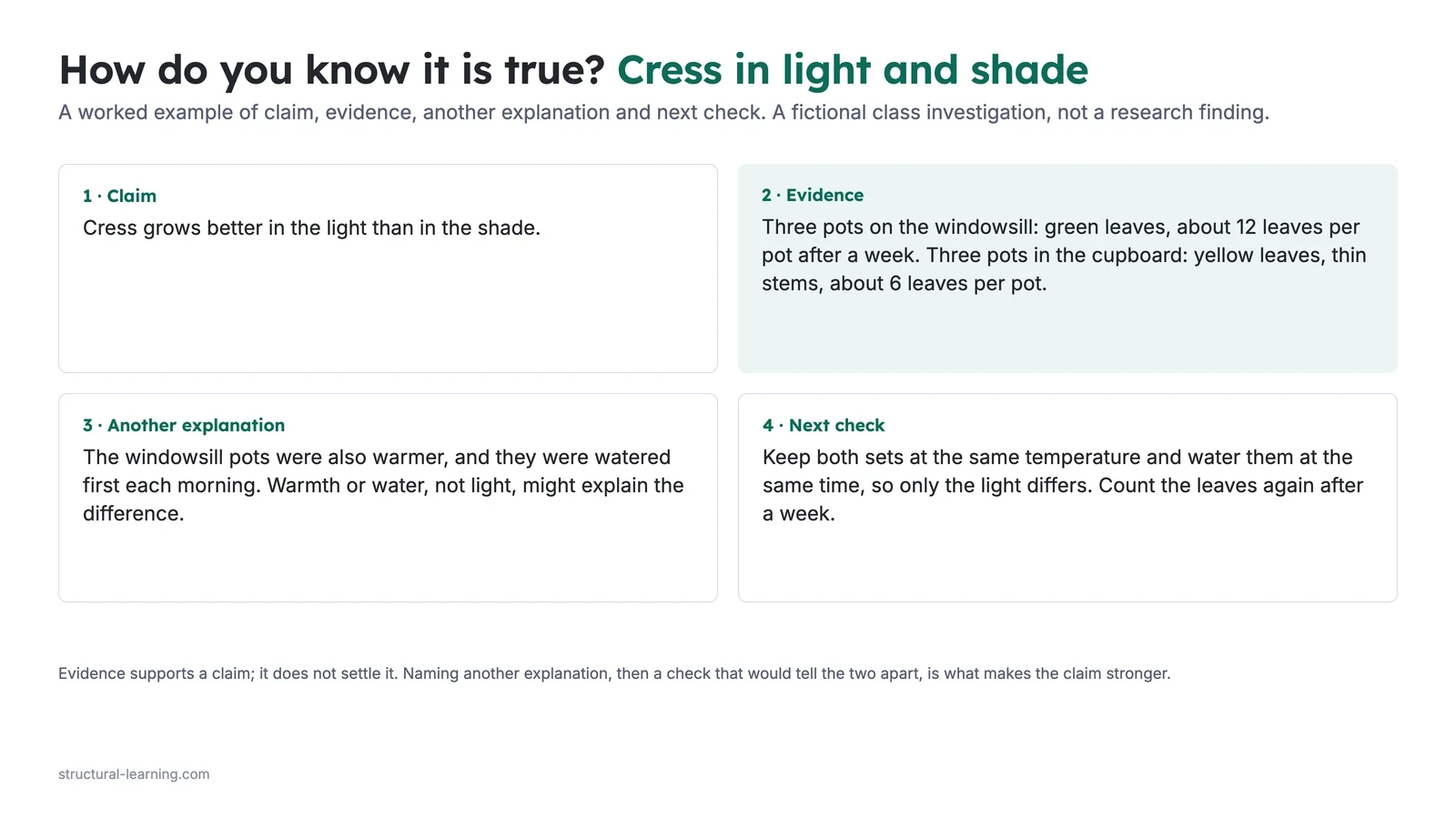
Everyday Thinking vs Scientific Thinking infographic for teachers
Everyday Thinking vs Scientific Thinking

What is Metacognition in Science Education?

Science education uniquely demands metacognitive awareness because students must constantly navigate between everyday intuitions and scientific explanations. Research shows that many science misconceptions persist precisely because students fail to recognise when their existing mental models conflict with new evidence.

Three-step POE strategy process for developing metacognitive thinking in science education
POE Strategy

Unlike other subjects where knowledge accumulates more linearly, science requires students to actively restructure their thinking. When learning about forces, for example, students must consciously override their intuitive belief that heavier objects fall faster. This cognitive restructuring only occurs when students become aware of their own thinking patterns.

Metacognition helps students develop what researchers call "epistemic cognition", understanding how scientific knowledge is constructed and validated. Students who monitor their thinking learn to distinguish between observation and inference, recognise the limits of their current understanding, and actively seek evidence that might challenge their assumptions.

Predict-Observe-Explain (POE) Strategy

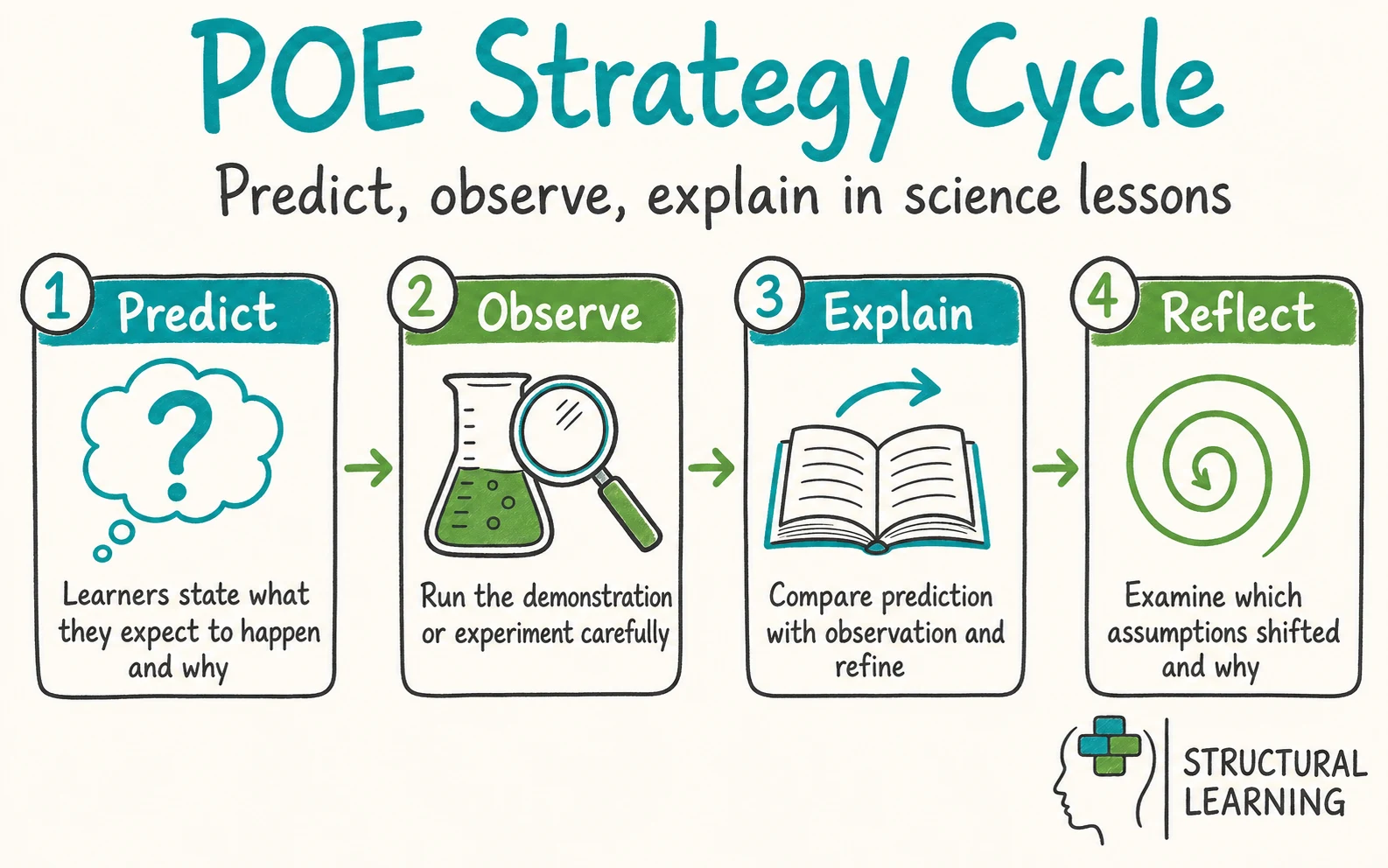
The Predict-Observe-Explain strategy is a powerful metacognitive tool that makes students' thinking visible. Before conducting an experiment or demonstration, students predict what will happen and explain their reasoning. This prediction phase forces students to articulate their current mental model.

During the observation phase, students watch carefully for discrepancies between their predictions and reality. This creates cognitive conflict that drives learning. The explanation phase then requires students to reconcile any differences, explicitly addressing why their prediction was correct or incorrect.

For example, when studying density, students might predict whether a can of diet cola will float or sink in water. Most predict both will sink because they are both heavy cans. When the diet cola floats and the regular sinks, students must explain this surprising result, leading to deeper understanding of density and dissolved substances.

The metacognitive power of POE lies in making prediction errors productive rather than embarrassing. Students learn that wrong predictions are valuable opportunities to identify gaps in their understanding.

How Scientific Inquiry Develops Metacognition

Scientific inquiry itself is fundamentally metacognitive. The scientific method requires constant self-monitoring: Have I controlled all variables? Is my sample size adequate? Could observer bias have affected my results? What alternative explanations might account for these findings?

Teachers can make this metacognitive dimension explicit by discussing the thinking processes behind each step of inquiry. When designing experiments, ask students: "How do you know this is a fair test?" or "What assumptions are we making here?" These questions shift attention from merely following procedures to understanding the reasoning behind them.

During data collection, encourage students to keep dual records, not just observations but also notes about their thinking process. "Why did I decide to measure temperature every 30 seconds rather than every minute?" This practise helps students recognise that scientific decisions require justification.

Analysis becomes more sophisticated when students question their interpretations. "Am I seeing a pattern because it is really there, or because I expected to find it?" This healthy scepticism, directed at one's own thinking, is the hallmark of scientific metacognition.

Using Concept Maps for Self-Reflection

Concept maps serve as external representations of internal knowledge structures, making them excellent metacognitive tools for science learning. When students create concept maps, they must explicitly identify relationships between concepts and evaluate the strength of those connections.

The process of constructing a concept map requires students to retrieve information from memory, organise it hierarchically, and identify linking relationships. This metacognitive activity often reveals gaps in understanding that passive review would miss.

For example, a concept map about photosynthesis might reveal that a student knows the inputs and outputs but cannot explain the actual mechanism. The visual structure makes this gap immediately apparent, prompting targeted learning.

Comparing concept maps over time provides powerful feedback about conceptual development. Students can literally see how their understanding has become more sophisticated, with more connections and more nuanced relationships between concepts.

Lab Report Reflection Sections

Traditional lab reports focus entirely on procedures and results, missing a crucial metacognitive opportunity. Adding a dedicated reflection section transforms lab work into a metacognitive learning experience.

Reflection prompts might include:

  • "What surprised me about these results?"
  • "What would I do differently if I repeated this experiment?"
  • "What questions does this experiment raise that we didn't answer?"
  • "How confident am I in these conclusions and why?"

These questions require students to step back from the technical details and evaluate their own learning process. The reflection becomes a conversation with oneself about understanding rather than merely reporting what happened.

Some teachers use a "hypothesis evolution" section where students explain how their thinking changed during the experiment. This explicitly values conceptual change and helps students recognise that revising ideas in light of evidence is scientific thinking at its best.

Building Student Self-Questioning Skills

Metacognitive students constantly ask themselves: "Do I really understand this, or am I just familiar with the words? " Teachers can model this self-questioning by thinking aloud during demonstrations.

When explaining a concept, occasionally pause and say: "Actually, I'm not sure I explained that clearly. Let me think about a better way to describe it." This shows students that even experts monitor their explanations and make adjustments.

Teach specific comprehension monitoring strategies:

  • Self-explanation: After reading a paragraph about a scientific concept, students explain it in their own words without looking
  • Prediction testing: Students predict what the next paragraph will discuss, then check if they were right
  • Question generation: Students create exam questions about the material, which requires deep understanding

The "Can you explain it to someone else?" test is particularly powerful. If students cannot explain a concept clearly to a peer, they probably haven't understood it themselves. This realisation, recognising incomplete understanding, is metacognitive awareness in action.

The POE Strategy in Action infographic for teachers
The POE Strategy in Action

Metacognition in Experimental Design

Designing experiments is inherently metacognitive because it requires students to anticipate problems and think through logical sequences. When students plan investigations, explicitly ask them to justify their choices.

"Why did you decide to measure mass rather than volume here?" This question forces students to articulate their reasoning, making implicit thinking explicit. Students begin to recognise that good experimental design requires conscious decision-making at every step.

Use "debugging" exercises where students evaluate flawed experimental designs. Finding errors in others' thinking helps students develop the critical lens they need to evaluate their own plans. "What did this student forget to control?" becomes "What have I forgotten to control?"

After completing experiments, conduct "post-mortem" discussions where students identify what worked well and what they would improve. This reflection on the entire process, not just the results, builds metacognitive awareness about experimental thinking.

Turning Failed Experiments into Learning

In real science, failed experiments are common and valuable. Yet school science often creates the impression that every experiment should produce expected results. This misrepresentation undermines metacognitive development.

When experiments "fail," resist the urge to immediately fix them or explain what went wrong. Instead, use failure as a metacognitive learning opportunity. Ask students:

  • "What does this unexpected result tell us?"
  • "What assumptions might we need to reconsider?"
  • "How could we modify our hypothesis based on this evidence?"

Reframe failure as information. An experiment that doesn't work as expected hasn't failed, it has provided data about how the system actually behaves. This perspective shift helps students become more resilient and flexible thinkers.

Share stories of real scientific discoveries that emerged from unexpected results. Alexander Fleming's discovery of penicillin, for example, resulted from noticing when something went "wrong", contamination in his bacterial cultures. Students need to understand that scientific breakthroughs often require recognising and investigating surprises rather than dismissing them as mistakes.

Science Notebooks as Metacognitive Tools

Science notebooks, used effectively, become thinking journals rather than mere record-keeping books. Encourage students to use notebooks for exploratory thinking, not just polished final answers.

Include different sections:

  • Observations: What I noticed
  • Wonderings: Questions this raises
  • Connections: How this relates to other concepts
  • Confidence ratings: How sure am I about these ideas?

The "confidence rating" element is particularly metacognitive. After writing an explanation, students rate their certainty from 1-5. Low ratings identify topics needing further study, while high ratings can be tested through peer teaching.

POE strategy flow diagram showing predict-observe-explain process for metacognitive science learning
Flow diagram: Predict-Observe-Explain (POE) Strategy Process

Periodically ask students to review old notebook entries and add comments in a different colour: "I understand this better now because..." This reflection makes learning visible and helps students appreciate their own progress.

Some teachers use "marginal thinking" where students write their polished answers in the main column but use margins for informal thinking, questions, and metacognitive comments. This dual format legitimises exploratory thinking as part of the scientific process.

Metacognition Across Science Subjects

Biology: Cell Division Metacognition

When learning about mitosis, students often memorise stages without understanding the underlying logic. Metacognitive approaches make the thinking visible.

After studying mitosis, ask: "If you were designing a system to copy cells, what problems would you need to solve?" Students identify challenges like ensuring equal DNA distribution and coordinating timing. Then they recognise that mitosis stages solve these specific problems.

This reversal, starting with the problem rather than the solution, requires metacognitive thinking about why biological systems work as they do.

Chemistry: Balancing Equations with Metacognition

Balancing chemical equations is procedural knowledge that students often struggle to connect to conceptual understanding. Metacognitive strategies bridge this gap.

Before teaching the procedure, discuss: "What does it mean for an equation to be balanced?" Students articulate the principle that atoms cannot be created or destroyed. This metacognitive awareness of the underlying concept makes the procedure meaningful rather than mechanical.

As students practise, ask them to verbalise their thinking: "I'm adding a coefficient of 2 here because I need two more oxygen atoms on this side." This self-explanation strengthens both procedural skill and conceptual understanding.

Physics: Force Diagrams and Mental Models

Force diagrams make students' mental models visible, revealing common misconceptions. A student who draws forces incorrectly is making their flawed thinking explicit, a metacognitive breakthrough.

When reviewing force diagrams, ask students: "How did you decide which forces to include?" This metacognitive question reveals their reasoning process. Many students discover they were adding forces they "thought should be there" rather than forces actually acting on the object.

Compare diagrams with partners and discuss differences. "Why did you include air resistance when I didn't?" These conversations develop metacognitive awareness about the choices involved in scientific modelling.

Age-Appropriate Metacognitive Strategies

Metacognitive development differs between primary and secondary science, requiring different pedagogical approaches.

Primary Science (Ages 5-11)

Young children are developing basic metacognitive awareness. Strategies need to be concrete and supported:

  • Use simple think-aloud routines: "I'm thinking that..."
  • Create "I wonder" boards where children post questions
  • Use partner talk extensively: "Turn and explain to your partner why this happened"
  • Model uncertainty: "I'm not quite sure, so let's find out together"

Primary metacognition focuses on building awareness that thinking about thinking is valuable. Simple questions like "What helped you understand that?" begin developing metacognitive vocabulary.

Secondary Science (Ages 11-16)

Secondary students can engage in more sophisticated metacognitive reflection:

  • Analyse their own learning strategies: "Which revision method helped you most and why?"
  • Evaluate evidence critically: "How reliable is this data source?"
  • Plan investigations independently: "What will you do if you get unexpected results?"
  • Reflect on conceptual change: "How has your understanding of energy changed this year?"

Secondary metacognition aims for independent self-regulation where students automatically monitor and adjust their thinking during scientific work.

The transition from primary to secondary involves moving from teacher-prompted metacognition to self-initiated metacognitive monitoring. This progression requires sustained practise and explicit instruction at both levels.

Building Epistemic Cognition in Students infographic for teachers
Building Epistemic Cognition in Students

Implementing Metacognitive Science Teaching

Metacognition transforms science education from passive knowledge absorption to active knowledge construction. When students learn to monitor their thinking, question their assumptions, and deliberately evaluate their understanding, they develop the self-directed learning skills that characterise true scientific thinking.

The strategies explored here, from POE to science notebooks to reflection sections, share a common feature: they make thinking visible. By externalising internal thought processes, students can examine, evaluate, and improve their own scientific reasoning.

Ultimately, teaching metacognition in science is teaching students to become their own best teachers, capable of identifying what they don't understand and taking deliberate steps to deepen their knowledge. These are the habits of mind that will serve them far beyond any particular science curriculum.

Further Reading: Key Research Papers

These peer-reviewed studies provide the research foundation for the strategies discussed in this article:

THE JIGSAW TECHNIQUE IN LOWER SECONDARY PHYSICS EDUCATION: STUDENTS' ACHIEVEMENT, METACOGNITION AND MOTIVATION View study ↗
20 citations

Branislava K. Blajvaz et al. (2022)

This study found that using the jigsaw cooperative learning technique in physics classes significantly improved students' understanding of the subject while also boosting their ability to think about their own learning and increasing their motivation. The research demonstrates that when students work together in structured groups where each member becomes an expert on one piece of a larger topic, they not only learn physics better but also develop stronger self-awareness about how they learn. For physics teachers looking to move beyond traditional lecture methods, this approach offers a proven way to simultaneously address content mastery, metacognitive development, and student engagement.

Critical Thinking and Epistemic Sophistication in Science Education View study ↗
3 citations

O. E. Tamayo Alzate (2025)

This research argues that the most effective approach to developing critical thinking in science classrooms is to focus on subject-specific thinking skills rather than generic critical thinking strategies. The study emphasizes that students need to learn how to think critically within the particular context of scientific inquiry, understanding how knowledge is constructed and validated in science specifically. Science teachers can use this insight to design lessons that explicitly teach students how scientists evaluate evidence, form hypotheses, and build knowledge, rather than assuming that general critical thinking skills will automatically transfer to scientific contexts.

Changing Teachers' Epistemic Cognition: A New Conceptual Framework for Epistemic Reflexivity View study ↗
136 citations

J. Lunn Brownlee et al. (2017)

This influential research reveals that teachers' beliefs about knowledge and learning directly shape how they teach, making it crucial for educators to examine and refine their own thinking about these fundamental questions. The study shows that when teachers engage in explicit reflection about how knowledge is created and validated, they become more effective at helping students develop sophisticated thinking skills. The framework provides practical guidance for professional development programmes and individual teachers who want to better understand how their own beliefs about knowledge influence their classroom practices and student outcomes.

The Improvement of students' metacognition skills on natural science education using guided inquiry models View study ↗
2 citations

K. Huda et al. (2021)

This study demonstrates that guided inquiry teaching methods effectively help middle school students develop stronger metacognitive skills in science, meaning students become better at monitoring and directing their own learning processes. The research found that when teachers structure lessons to guide students through scientific investigations rather than simply presenting information, students improve their ability to plan their learning, monitor their understanding, and evaluate their progress. For science teachers, this suggests that shifting from direct instruction to guided inquiry approaches can simultaneously teach science content while building students' capacity for independent learning.

Prospective Primary School Teachers' Conception Change on States of Matter and Their Changes through Predict-Observe-Explain Strategy View study ↗
29 citations

A. Banawi et al. (2019)

This research found that the Predict-Observe-Explain strategy successfully helped future elementary teachers overcome common misconceptions about states of matter and develop more accurate scientific understanding. The study shows that when teacher candidates first make predictions, then observe actual phenomena, and finally explain what they saw, they are more likely to recognise and correct their own misunderstandings about fundamental science concepts. This finding is particularly important because teachers who hold misconceptions often inadvertently pass them on to their students, making it essential that teacher preparation programmes address these issues before educators enter the classroom.

Loading audit...

Metacognition, thinking about thinking, is particularly crucial in science education where students must question their observations, challenge their assumptions, and continuously refine their understanding. When students become aware of their own thought processes during scientific inquiry, they develop deeper conceptual understanding and stronger problem-solving abilities that extend far beyond the classroom.

Key Takeaways

  1. Wrong Predictions Drive Learning: The POE strategy transforms student mistakes into powerful learning moments by making their thinking visible and productive.
  2. Science Demands Cognitive Restructuring: Students must actively override intuitive beliefs, like heavier objects falling faster, requiring explicit metacognitive awareness to succeed.
  3. Lab Reports Need Reflection: Adding simple reflection questions to traditional lab reports creates metacognitive learning experiences that deepen scientific understanding.
  4. Concept Maps Reveal Gaps: Visual knowledge structures help students identify missing connections in their understanding that passive review completely misses.

This guide explores how teachers can embed metacognitive strategies into science teaching, from laboratory experiments to theoretical discussions, helping students become independent scientific thinkers.

Everyday Thinking vs Scientific Thinking infographic for teachers
Everyday Thinking vs Scientific Thinking

What is Metacognition in Science Education?

Science education uniquely demands metacognitive awareness because students must constantly navigate between everyday intuitions and scientific explanations. Research shows that many science misconceptions persist precisely because students fail to recognise when their existing mental models conflict with new evidence.

Three-step POE strategy process for developing metacognitive thinking in science education
POE Strategy

Unlike other subjects where knowledge accumulates more linearly, science requires students to actively restructure their thinking. When learning about forces, for example, students must consciously override their intuitive belief that heavier objects fall faster. This cognitive restructuring only occurs when students become aware of their own thinking patterns.

Metacognition helps students develop what researchers call "epistemic cognition", understanding how scientific knowledge is constructed and validated. Students who monitor their thinking learn to distinguish between observation and inference, recognise the limits of their current understanding, and actively seek evidence that might challenge their assumptions.

Predict-Observe-Explain (POE) Strategy

The Predict-Observe-Explain strategy is a powerful metacognitive tool that makes students' thinking visible. Before conducting an experiment or demonstration, students predict what will happen and explain their reasoning. This prediction phase forces students to articulate their current mental model.

During the observation phase, students watch carefully for discrepancies between their predictions and reality. This creates cognitive conflict that drives learning. The explanation phase then requires students to reconcile any differences, explicitly addressing why their prediction was correct or incorrect.

For example, when studying density, students might predict whether a can of diet cola will float or sink in water. Most predict both will sink because they are both heavy cans. When the diet cola floats and the regular sinks, students must explain this surprising result, leading to deeper understanding of density and dissolved substances.

The metacognitive power of POE lies in making prediction errors productive rather than embarrassing. Students learn that wrong predictions are valuable opportunities to identify gaps in their understanding.

How Scientific Inquiry Develops Metacognition

Scientific inquiry itself is fundamentally metacognitive. The scientific method requires constant self-monitoring: Have I controlled all variables? Is my sample size adequate? Could observer bias have affected my results? What alternative explanations might account for these findings?

Teachers can make this metacognitive dimension explicit by discussing the thinking processes behind each step of inquiry. When designing experiments, ask students: "How do you know this is a fair test?" or "What assumptions are we making here?" These questions shift attention from merely following procedures to understanding the reasoning behind them.

During data collection, encourage students to keep dual records, not just observations but also notes about their thinking process. "Why did I decide to measure temperature every 30 seconds rather than every minute?" This practise helps students recognise that scientific decisions require justification.

Analysis becomes more sophisticated when students question their interpretations. "Am I seeing a pattern because it is really there, or because I expected to find it?" This healthy scepticism, directed at one's own thinking, is the hallmark of scientific metacognition.

Using Concept Maps for Self-Reflection

Concept maps serve as external representations of internal knowledge structures, making them excellent metacognitive tools for science learning. When students create concept maps, they must explicitly identify relationships between concepts and evaluate the strength of those connections.

The process of constructing a concept map requires students to retrieve information from memory, organise it hierarchically, and identify linking relationships. This metacognitive activity often reveals gaps in understanding that passive review would miss.

For example, a concept map about photosynthesis might reveal that a student knows the inputs and outputs but cannot explain the actual mechanism. The visual structure makes this gap immediately apparent, prompting targeted learning.

Comparing concept maps over time provides powerful feedback about conceptual development. Students can literally see how their understanding has become more sophisticated, with more connections and more nuanced relationships between concepts.

Lab Report Reflection Sections

Traditional lab reports focus entirely on procedures and results, missing a crucial metacognitive opportunity. Adding a dedicated reflection section transforms lab work into a metacognitive learning experience.

Reflection prompts might include:

  • "What surprised me about these results?"
  • "What would I do differently if I repeated this experiment?"
  • "What questions does this experiment raise that we didn't answer?"
  • "How confident am I in these conclusions and why?"

These questions require students to step back from the technical details and evaluate their own learning process. The reflection becomes a conversation with oneself about understanding rather than merely reporting what happened.

Some teachers use a "hypothesis evolution" section where students explain how their thinking changed during the experiment. This explicitly values conceptual change and helps students recognise that revising ideas in light of evidence is scientific thinking at its best.

Building Student Self-Questioning Skills

Metacognitive students constantly ask themselves: "Do I really understand this, or am I just familiar with the words? " Teachers can model this self-questioning by thinking aloud during demonstrations.

When explaining a concept, occasionally pause and say: "Actually, I'm not sure I explained that clearly. Let me think about a better way to describe it." This shows students that even experts monitor their explanations and make adjustments.

Teach specific comprehension monitoring strategies:

  • Self-explanation: After reading a paragraph about a scientific concept, students explain it in their own words without looking
  • Prediction testing: Students predict what the next paragraph will discuss, then check if they were right
  • Question generation: Students create exam questions about the material, which requires deep understanding

The "Can you explain it to someone else?" test is particularly powerful. If students cannot explain a concept clearly to a peer, they probably haven't understood it themselves. This realisation, recognising incomplete understanding, is metacognitive awareness in action.

The POE Strategy in Action infographic for teachers
The POE Strategy in Action

Metacognition in Experimental Design

Designing experiments is inherently metacognitive because it requires students to anticipate problems and think through logical sequences. When students plan investigations, explicitly ask them to justify their choices.

"Why did you decide to measure mass rather than volume here?" This question forces students to articulate their reasoning, making implicit thinking explicit. Students begin to recognise that good experimental design requires conscious decision-making at every step.

Use "debugging" exercises where students evaluate flawed experimental designs. Finding errors in others' thinking helps students develop the critical lens they need to evaluate their own plans. "What did this student forget to control?" becomes "What have I forgotten to control?"

After completing experiments, conduct "post-mortem" discussions where students identify what worked well and what they would improve. This reflection on the entire process, not just the results, builds metacognitive awareness about experimental thinking.

Turning Failed Experiments into Learning

In real science, failed experiments are common and valuable. Yet school science often creates the impression that every experiment should produce expected results. This misrepresentation undermines metacognitive development.

When experiments "fail," resist the urge to immediately fix them or explain what went wrong. Instead, use failure as a metacognitive learning opportunity. Ask students:

  • "What does this unexpected result tell us?"
  • "What assumptions might we need to reconsider?"
  • "How could we modify our hypothesis based on this evidence?"

Reframe failure as information. An experiment that doesn't work as expected hasn't failed, it has provided data about how the system actually behaves. This perspective shift helps students become more resilient and flexible thinkers.

Share stories of real scientific discoveries that emerged from unexpected results. Alexander Fleming's discovery of penicillin, for example, resulted from noticing when something went "wrong", contamination in his bacterial cultures. Students need to understand that scientific breakthroughs often require recognising and investigating surprises rather than dismissing them as mistakes.

Science Notebooks as Metacognitive Tools

Science notebooks, used effectively, become thinking journals rather than mere record-keeping books. Encourage students to use notebooks for exploratory thinking, not just polished final answers.

Include different sections:

  • Observations: What I noticed
  • Wonderings: Questions this raises
  • Connections: How this relates to other concepts
  • Confidence ratings: How sure am I about these ideas?

The "confidence rating" element is particularly metacognitive. After writing an explanation, students rate their certainty from 1-5. Low ratings identify topics needing further study, while high ratings can be tested through peer teaching.

POE strategy flow diagram showing predict-observe-explain process for metacognitive science learning
Flow diagram: Predict-Observe-Explain (POE) Strategy Process

Periodically ask students to review old notebook entries and add comments in a different colour: "I understand this better now because..." This reflection makes learning visible and helps students appreciate their own progress.

Some teachers use "marginal thinking" where students write their polished answers in the main column but use margins for informal thinking, questions, and metacognitive comments. This dual format legitimises exploratory thinking as part of the scientific process.

Metacognition Across Science Subjects

Biology: Cell Division Metacognition

When learning about mitosis, students often memorise stages without understanding the underlying logic. Metacognitive approaches make the thinking visible.

After studying mitosis, ask: "If you were designing a system to copy cells, what problems would you need to solve?" Students identify challenges like ensuring equal DNA distribution and coordinating timing. Then they recognise that mitosis stages solve these specific problems.

This reversal, starting with the problem rather than the solution, requires metacognitive thinking about why biological systems work as they do.

Chemistry: Balancing Equations with Metacognition

Balancing chemical equations is procedural knowledge that students often struggle to connect to conceptual understanding. Metacognitive strategies bridge this gap.

Before teaching the procedure, discuss: "What does it mean for an equation to be balanced?" Students articulate the principle that atoms cannot be created or destroyed. This metacognitive awareness of the underlying concept makes the procedure meaningful rather than mechanical.

As students practise, ask them to verbalise their thinking: "I'm adding a coefficient of 2 here because I need two more oxygen atoms on this side." This self-explanation strengthens both procedural skill and conceptual understanding.

Physics: Force Diagrams and Mental Models

Force diagrams make students' mental models visible, revealing common misconceptions. A student who draws forces incorrectly is making their flawed thinking explicit, a metacognitive breakthrough.

When reviewing force diagrams, ask students: "How did you decide which forces to include?" This metacognitive question reveals their reasoning process. Many students discover they were adding forces they "thought should be there" rather than forces actually acting on the object.

Compare diagrams with partners and discuss differences. "Why did you include air resistance when I didn't?" These conversations develop metacognitive awareness about the choices involved in scientific modelling.

Age-Appropriate Metacognitive Strategies

Metacognitive development differs between primary and secondary science, requiring different pedagogical approaches.

Primary Science (Ages 5-11)

Young children are developing basic metacognitive awareness. Strategies need to be concrete and supported:

  • Use simple think-aloud routines: "I'm thinking that..."
  • Create "I wonder" boards where children post questions
  • Use partner talk extensively: "Turn and explain to your partner why this happened"
  • Model uncertainty: "I'm not quite sure, so let's find out together"

Primary metacognition focuses on building awareness that thinking about thinking is valuable. Simple questions like "What helped you understand that?" begin developing metacognitive vocabulary.

Secondary Science (Ages 11-16)

Secondary students can engage in more sophisticated metacognitive reflection:

  • Analyse their own learning strategies: "Which revision method helped you most and why?"
  • Evaluate evidence critically: "How reliable is this data source?"
  • Plan investigations independently: "What will you do if you get unexpected results?"
  • Reflect on conceptual change: "How has your understanding of energy changed this year?"

Secondary metacognition aims for independent self-regulation where students automatically monitor and adjust their thinking during scientific work.

The transition from primary to secondary involves moving from teacher-prompted metacognition to self-initiated metacognitive monitoring. This progression requires sustained practise and explicit instruction at both levels.

Building Epistemic Cognition in Students infographic for teachers
Building Epistemic Cognition in Students

Implementing Metacognitive Science Teaching

Metacognition transforms science education from passive knowledge absorption to active knowledge construction. When students learn to monitor their thinking, question their assumptions, and deliberately evaluate their understanding, they develop the self-directed learning skills that characterise true scientific thinking.

The strategies explored here, from POE to science notebooks to reflection sections, share a common feature: they make thinking visible. By externalising internal thought processes, students can examine, evaluate, and improve their own scientific reasoning.

Ultimately, teaching metacognition in science is teaching students to become their own best teachers, capable of identifying what they don't understand and taking deliberate steps to deepen their knowledge. These are the habits of mind that will serve them far beyond any particular science curriculum.

Further Reading: Key Research Papers

These peer-reviewed studies provide the research foundation for the strategies discussed in this article:

THE JIGSAW TECHNIQUE IN LOWER SECONDARY PHYSICS EDUCATION: STUDENTS' ACHIEVEMENT, METACOGNITION AND MOTIVATION View study ↗
20 citations

Branislava K. Blajvaz et al. (2022)

This study found that using the jigsaw cooperative learning technique in physics classes significantly improved students' understanding of the subject while also boosting their ability to think about their own learning and increasing their motivation. The research demonstrates that when students work together in structured groups where each member becomes an expert on one piece of a larger topic, they not only learn physics better but also develop stronger self-awareness about how they learn. For physics teachers looking to move beyond traditional lecture methods, this approach offers a proven way to simultaneously address content mastery, metacognitive development, and student engagement.

Critical Thinking and Epistemic Sophistication in Science Education View study ↗
3 citations

O. E. Tamayo Alzate (2025)

This research argues that the most effective approach to developing critical thinking in science classrooms is to focus on subject-specific thinking skills rather than generic critical thinking strategies. The study emphasizes that students need to learn how to think critically within the particular context of scientific inquiry, understanding how knowledge is constructed and validated in science specifically. Science teachers can use this insight to design lessons that explicitly teach students how scientists evaluate evidence, form hypotheses, and build knowledge, rather than assuming that general critical thinking skills will automatically transfer to scientific contexts.

Changing Teachers' Epistemic Cognition: A New Conceptual Framework for Epistemic Reflexivity View study ↗
136 citations

J. Lunn Brownlee et al. (2017)

This influential research reveals that teachers' beliefs about knowledge and learning directly shape how they teach, making it crucial for educators to examine and refine their own thinking about these fundamental questions. The study shows that when teachers engage in explicit reflection about how knowledge is created and validated, they become more effective at helping students develop sophisticated thinking skills. The framework provides practical guidance for professional development programmes and individual teachers who want to better understand how their own beliefs about knowledge influence their classroom practices and student outcomes.

The Improvement of students' metacognition skills on natural science education using guided inquiry models View study ↗
2 citations

K. Huda et al. (2021)

This study demonstrates that guided inquiry teaching methods effectively help middle school students develop stronger metacognitive skills in science, meaning students become better at monitoring and directing their own learning processes. The research found that when teachers structure lessons to guide students through scientific investigations rather than simply presenting information, students improve their ability to plan their learning, monitor their understanding, and evaluate their progress. For science teachers, this suggests that shifting from direct instruction to guided inquiry approaches can simultaneously teach science content while building students' capacity for independent learning.

Prospective Primary School Teachers' Conception Change on States of Matter and Their Changes through Predict-Observe-Explain Strategy View study ↗
29 citations

A. Banawi et al. (2019)

This research found that the Predict-Observe-Explain strategy successfully helped future elementary teachers overcome common misconceptions about states of matter and develop more accurate scientific understanding. The study shows that when teacher candidates first make predictions, then observe actual phenomena, and finally explain what they saw, they are more likely to recognise and correct their own misunderstandings about fundamental science concepts. This finding is particularly important because teachers who hold misconceptions often inadvertently pass them on to their students, making it essential that teacher preparation programmes address these issues before educators enter the classroom.

Educational Technology

Back to Blog