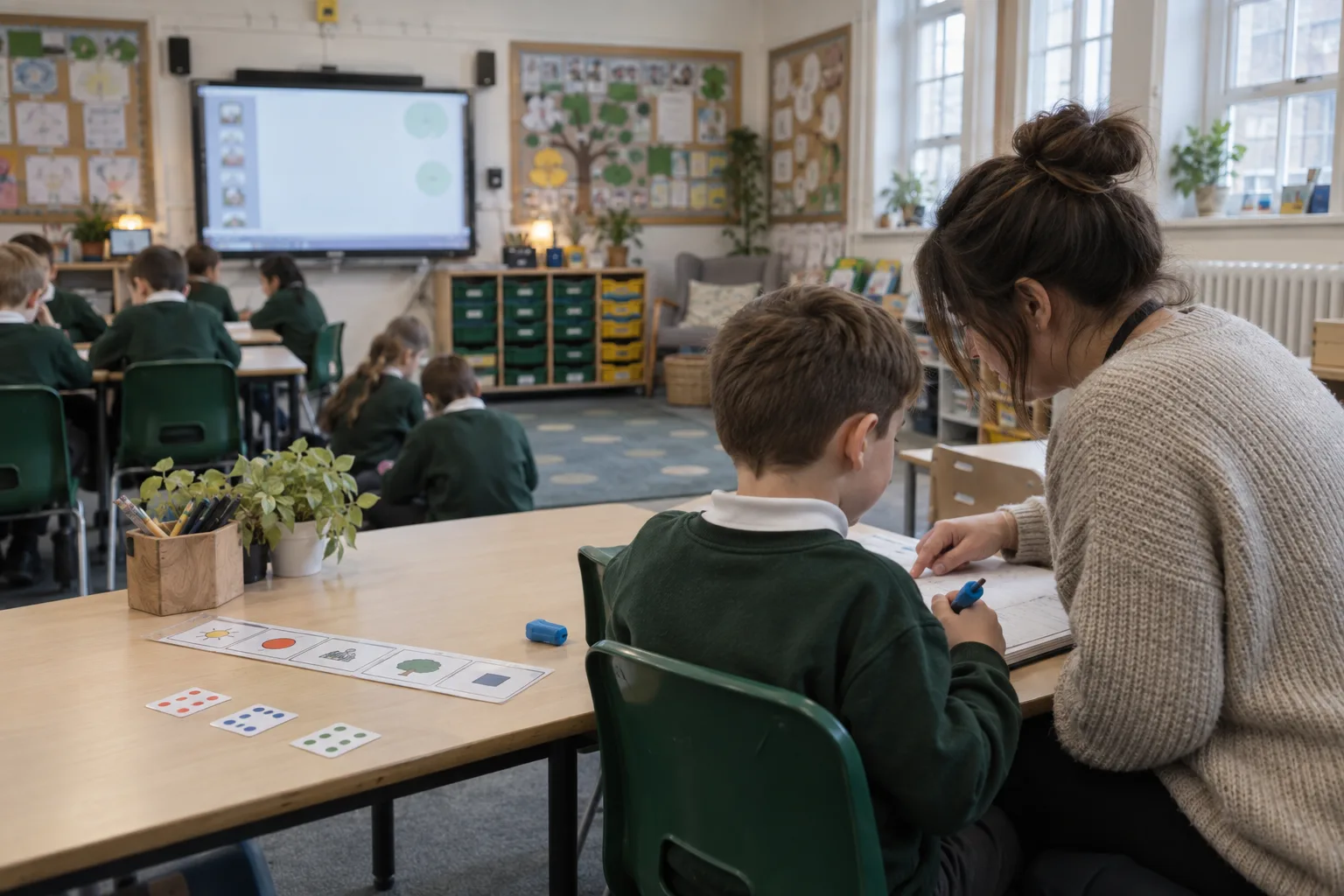
TEACCH Workstations: The Complete Guide to Independent Work Systems for AutismTEACCH Workstations: The Complete Guide to Independent Work Systems for Autism - educational concept illustration

Updated on  

February 12, 2026

TEACCH Workstations: The Complete Guide to Independent Work Systems for Autism

|

January 16, 2026

Set up effective TEACCH workstations with this complete guide. Learn the Four Questions framework, task box ideas, and build independence in autistic learners.

Course Enquiry
Copy citation

Main, P. (2026, January 20). TEACCH Workstations: The Complete Guide to Structured Teaching for Autism. Retrieved from https://www.structural-learning.com/post/teacch-workstations-complete-guide

TEACCH workstations are structured independent work areas that help children with autism complete tasks without constant adult supervision. Developed by the TEACCH Autism Programme at the University of North Carolina, this approach uses visual organisation and clear expectations to answer four essential questions every student needs answered: What work? How much? When finished? What next?

Key Takeaways

  1. The Four Questions Framework: Every workstation must visually answer what work, how much, when finished, and what next to build true independence.
  2. Mastered Skills Only Rule: Workstations should contain previously learned tasks, not new concepts. Save teaching for direct instruction time instead.
  3. Left to Right Workflow: This simple visual pattern reduces confusion and builds transferable organisational skills students can use anywhere.
  4. Individual Customisation Matters: Match visual complexity, task quantity, and schedule type to each student's current abilities for maximum success.

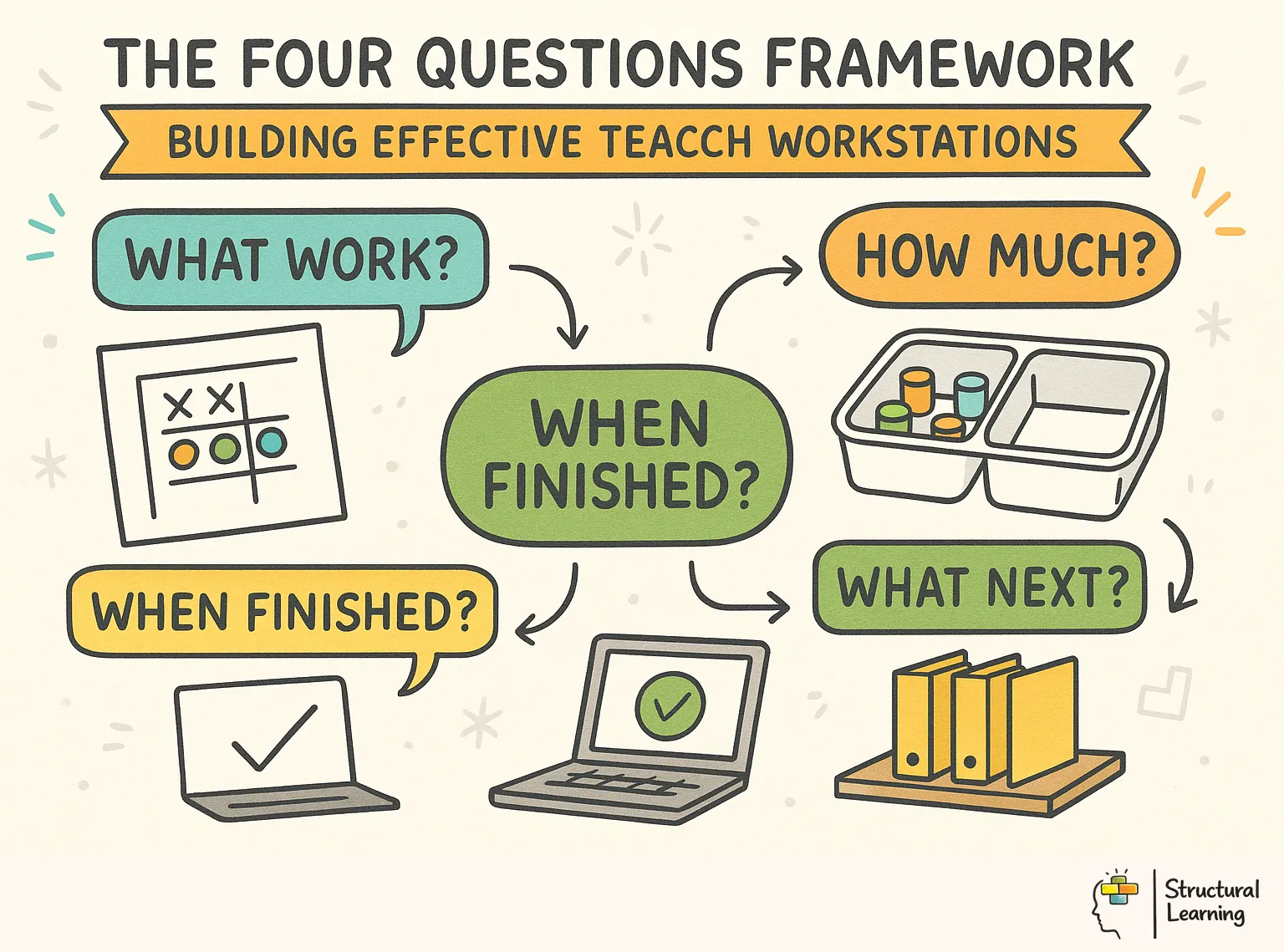
The Four Questions Framework: Building Effective TEACCH Workstations infographic for teachers


The Four Questions Framework: Building Effective TEACCH Workstations

  • The Four Questions Framework: Every TEACCH workstation must visually answer: What work do I need to do? How much work? How do I know when I am finished? What happens next? If your system does not answer all four, students will struggle
  • Mastered Skills Only: Workstations contain tasks students have already learned. The purpose is building independence, not teaching new skills. Save new learning for direct instruction time.
  • Left-to-Right Organisation: Tasks flow from left (to do) to right (finished). This consistent visual pattern reduces confusion and builds transferable organisational skills
  • Individual Customisation: No two students need identical systems. Match the visual complexity, number of tasks, and type of schedule to each student's current abilities
  • What is the TEACCH Method?

    TEACCH is a structured teaching approach developed at the University of North Carolina for individuals with autism. The method adapts environments to match visual processing strengths rather than changing the individual. TEACCH creates predictable, organised learning spaces that support natural learning spaces.

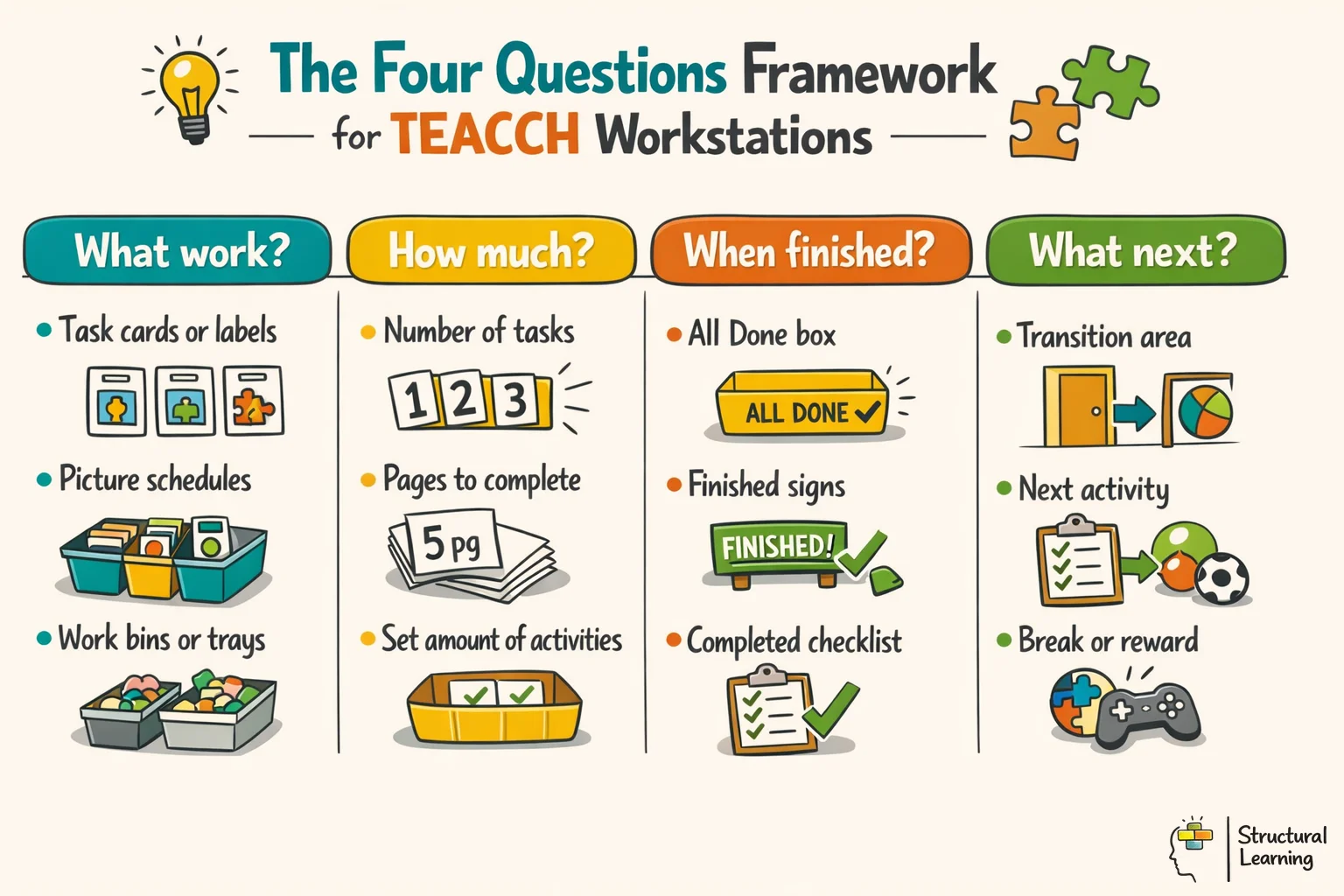
    TEACCH workstation framework showing four essential questions for autism independent work systems
    The Four Questions Framework for TEACCH Workstations

    TEACCH stands for Treatment and Education of Autistic and Communication related handicapped CHildren. Developed at the University of North Carolina at Chapel Hill, it is one of the oldest and most widely-used structured teaching approaches for autism.

    The TEACCH philosophy recognises that autistic individuals often have strengths in visual processing and benefit from predictable, organised environments. Rather than trying to change the individual to fit typical environments, TEACCH adapts the environment to match how autistic people learn best within inclusive settings.

    Structured Teaching, the core methodology of TEACCH, has four main components:

    Workstations are where work systems come to life in the classroom.

    Essential TEACCH Workstation Questions Explained

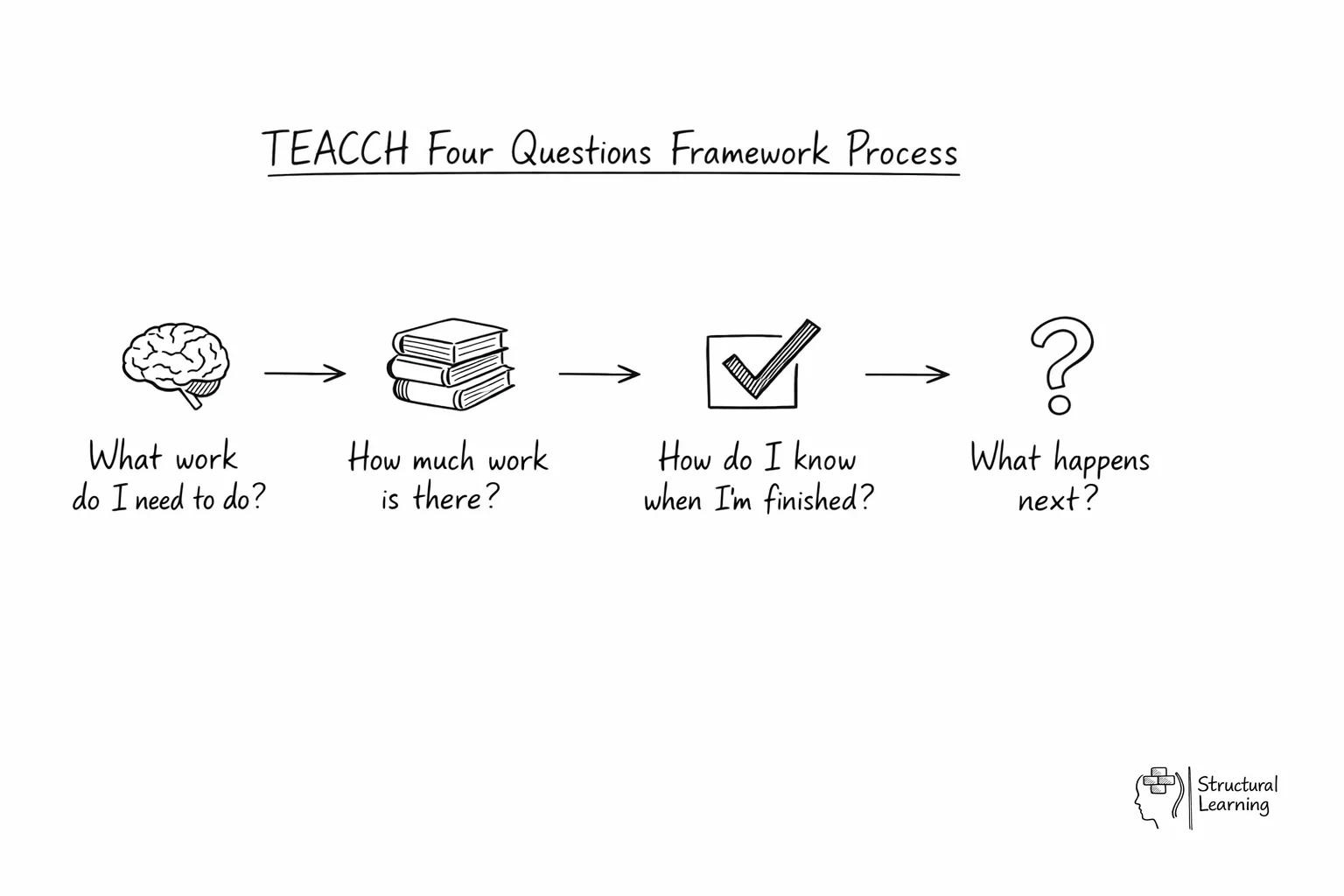
    TEACCH work systems must visually answer four essential questions: What work do I need to do? How much work is there? How do I know when finished? What happens next? These questions provide the structure students need for independent task completion.

    The foundation of effective TEACCH workstations is ensuring students can independently answer four questions just by looking at their workspace:

    What Work Do I Do?

    Students must clearly see which tasks they need to complete. This might be communicated through:

    How Much Work Must I Do?

    Students need to know the quantity of work expected. Visual communication methods include:

    How Do I Know I'm Finished?

    Completion must be obvious. This clarity supports executive function skills by reducing uncertainty and anxiety. Strategies include:

    What Happens When I Finish?

    Students need to know what follows independent work time. This predictability helps maintain engagement and reduces anxiety. Options include:

    TEACCH Workstation Setup and Organisation

    Creating an effective TEACCH workstation requires careful attention to physical organisation and visual clarity. The setup process involves establishing clear boundaries, consistent workflows, and accessible materials that support independent task completion.

    Left-to-Right Workflow Setup

    The most effective TEACCH workstations follow a consistent left-to-right organisation pattern that mirrors natural reading direction and creates predictable routines:

    This consistent pattern reduces cognitive load and helps students develop transferable organisational skills they can apply across different environments.

    Visual Schedule Selection for TEACCH

    Visual schedules must match each student's developmental level and visual processing abilities. The hierarchy progresses from concrete to abstract representations:

    The key is selecting the format that allows maximum independence whilst avoiding frustration or confusion.

    Task Selection and Organisation

    Successful TEACCH workstations contain only previously mastered skills. This principle ensures students can focus on building independence rather than struggling with new concepts. Consider these guidelines:

    Troubleshooting TEACCH Workstation Problems

    Even well-designed TEACCH workstations can face implementation hurdles. Understanding common challenges helps teachers troubleshoot and refine their systems for maximum effectiveness.

    TEACCH workstation flow diagram showing four sequential questions for autism independence
    Flow diagram: TEACCH Four Questions Framework Process

    Student Resistance or Avoidance

    When students resist using workstations, the system may be too complex or contain unfamiliar tasks. Solutions include:

    Difficulty with Task Completion

    If students struggle to finish tasks independently, consider whether the "finished" criteria are sufficiently clear. Adjustments might include:

    Generalisation Across Settings

    Students may succeed with workstations in one environment but struggle in others. Building transferable skills requires:

    Evaluating TEACCH Workstation Effectiveness

    Effective TEACCH workstations require ongoing evaluation and refinement. Success indicators include increased independent task completion, reduced need for adult prompts, and improved student confidence during work periods. Teachers should regularly assess whether students can navigate their systems independently and adjust complexity levels accordingly.

    Data collection might focus on completion rates, time spent on task, and the level of adult support required. This information guides decisions about advancing to more complex visual schedules, increasing task quantities, or introducing new types of activities.

    Remember that TEACCH workstations are not static systems but dynamic tools that evolve with student growth and changing needs. Regular review ensures continued effectiveness and supports ongoing development of independence skills that benefit students across all areas of learning.

    The Four Essential Questions Framework

    At the heart of every successful TEACCH workstation lies a simple yet powerful framework: four questions that guide students through independent work. These questions, developed through decades of research at the University of North Carolina's TEACCH programme, transform abstract expectations into concrete visual information that students with autism can readily understand.

    The first question, 'What work?', requires clear visual organisation. Place task boxes or folders in a designated 'to do' area, numbered or colour-coded to match the student's schedule. For example, a student might see three numbered boxes on their left shelf, instantly understanding these are today's tasks.

    The second question, 'How much?', addresses the common anxiety many students experience about workload. Visual clarity here prevents overwhelming situations; a student can see exactly three task boxes rather than wondering if more work will appear. Some teachers use visual completion strips where students move a marker after each task, providing additional reassurance about progress.

    Questions three and four, 'When finished?' and 'What next?', complete the independence cycle. A clearly marked 'finished' basket on the right provides immediate feedback that work is complete. The 'what next' component might be a visual schedule showing break time, a choice board for preferred activities, or a transition card indicating the next classroom activity. Without these final elements, students often remain at their workstation, uncertain whether they've truly completed their responsibilities.

    This framework succeeds because it externalises executive function skills that many students with autism find challenging. Rather than requiring students to remember multi-step processes or interpret verbal instructions, the visual system provides permanent, predictable answers to their natural questions about work expectations.

    TEACCH Workstation Resources and Training

    TEACCH programme outcomes

    Structured teaching for autism

    For educators seeking to deepen their understanding of TEACCH methodology and independent work systems, these research papers provide valuable insights:

    Frequently Asked Questions

    How long should children spend at TEACCH workstations each day?

    Most children benefit from 15-30 minute sessions at TEACCH workstations, depending on their attention span and developmental level. Start with shorter periods and gradually increase duration as students build stamina and independence. The key is consistency rather than lengthy sessions, with many teachers scheduling workstation time 2-3 times daily.

    What materials do I need to set up a TEACCH workstation in my classroom?

    Essential materials include containers or trays for organising tasks, visual schedules (photos, symbols, or written words), a clearly defined workspace, and a 'finished' basket or area. You'll also need familiar activities like sorting tasks, matching games, or simple puzzles that students have already mastered. A divider or designated area helps minimise distractions.

    How do I know if my TEACCH workstation is working effectively?

    Look for students completing tasks independently without seeking adult help or becoming distressed. Successful workstations result in calm, focused behaviour and students naturally moving through their sequence of activities. If you notice frequent confusion, task avoidance, or requests for help, the system may need simplifying or the tasks may be too challenging.

    Can TEACCH workstations be used for children without autism?

    Yes, TEACCH workstations benefit many children who thrive with structure and visual organisation, including those with ADHD, learning difficulties, or anxiety. The clear expectations and predictable routines support any child who struggles with transitions or needs help developing independent work skills. However, some neurotypical children may find the structure too rigid for their learning style.

    What should I do if a student refuses to use their TEACCH workstation?

    First, check that all tasks are genuinely mastered skills and the visual level matches the student's abilities. Reduce the number of tasks or simplify the schedule format if needed. Consider whether the student needs a motivating activity at the end of their sequence, and ensure the workspace feels calm and predictable rather than overwhelming.

    Further Reading: Key Research Papers

    These peer-reviewed studies provide the research foundation for the strategies discussed in this article:

    EDUCATIONAL SUPPORT FOR STUDENTS WITH AUTISM SPECTRUM DISORDERS: A PEDAGOGICAL MODEL FOR INCLUSIVE LEARNING ENVIRONMENTS View study ↗

    Hristina Fidosieva (2025)

    This groundbreaking study challenges traditional deficit-based approaches to supporting students with autism and instead proposes a strength-based model that focuses on building independence, communication skills, and cognitive growth. The research reveals that when educators shift from trying to 'fix' autistic behaviours to building on students' natural abilities and interests, learning outcomes improve dramatically. This work provides teachers with a fresh perspective on inclusive education that emphasizes participation and autonomy, offering practical strategies that benefit not just students with autism but create more engaging learning environments for all students.

    A CONCEPTUAL ANALYSIS OF TECHNOLOGY INTEGRATION IN CLASSROOM INSTRUCTION TOWARDS ENHANCING STUDENT ENGAGEMENT AND LEARNING OUTCOMES View study ↗
    10 citations

    Sabiroh Md Sabri et al. (2024)

    This comprehensive analysis reveals that successful technology integration goes far beyond simply adding digital devices to the classroom, requiring thoughtful planning and strategic implementation to truly enhance learning. The researchers found that when technology is purposefully woven into instruction rather than used as an add-on, students show deeper engagement and improved academic outcomes. For teachers navigating the complex world of educational technology, this study provides clear guidance on how to select and implement digital tools that genuinely support learning objectives rather than serve as distractions.

    Instructional Modifications in Inclusive Early Childhood Education: A Case Study of Teaching Strategies for Children with Autism in Yogyakarta View study ↗
    1 citations

    Winda Syafaatin Maulidah & Kurnia Mufalakhah (2024)

    Through an in-depth case study of a child with autism in an inclusive classroom, this research identifies specific teaching modifications that successfully promoted both academic learning and social development. The study demonstrates how simple adjustments to instruction, such as visual supports, structured routines, and individualized pacing, can make dramatic differences in a child's ability to participate meaningfully in classroom activities. Early childhood educators will find practical, immediately applicable strategies that not only support children with autism but enhance the learning environment for all students in inclusive settings.

    Artificial intelligence and medical education: application in classroom instruction and student assessment using a pharmacology & therapeutics case study View study ↗
    43 citations

    K. Sridharan & Reginald P Sequeira (2024)

    This innovative study explores how artificial intelligence tools can transform both teaching and assessment in educational settings, using medical education as a testing ground for broader applications. The researchers found that AI can effectively generate learning objectives, create personalised content, and provide immediate feedback to students, fundamentally changing the traditional roles of teachers and learners. While focused on medical training, the findings offer valuable insights for educators in any field who are curious about how AI might enhance their teaching practise and provide more individualized learning experiences for their students.

    Loading audit...

    TEACCH workstations are structured independent work areas that help children with autism complete tasks without constant adult supervision. Developed by the TEACCH Autism Programme at the University of North Carolina, this approach uses visual organisation and clear expectations to answer four essential questions every student needs answered: What work? How much? When finished? What next?

    Key Takeaways

    1. The Four Questions Framework: Every workstation must visually answer what work, how much, when finished, and what next to build true independence.
    2. Mastered Skills Only Rule: Workstations should contain previously learned tasks, not new concepts. Save teaching for direct instruction time instead.
    3. Left to Right Workflow: This simple visual pattern reduces confusion and builds transferable organisational skills students can use anywhere.
    4. Individual Customisation Matters: Match visual complexity, task quantity, and schedule type to each student's current abilities for maximum success.

    The Four Questions Framework: Building Effective TEACCH Workstations infographic for teachers


    The Four Questions Framework: Building Effective TEACCH Workstations

  • The Four Questions Framework: Every TEACCH workstation must visually answer: What work do I need to do? How much work? How do I know when I am finished? What happens next? If your system does not answer all four, students will struggle
  • Mastered Skills Only: Workstations contain tasks students have already learned. The purpose is building independence, not teaching new skills. Save new learning for direct instruction time.
  • Left-to-Right Organisation: Tasks flow from left (to do) to right (finished). This consistent visual pattern reduces confusion and builds transferable organisational skills
  • Individual Customisation: No two students need identical systems. Match the visual complexity, number of tasks, and type of schedule to each student's current abilities
  • What is the TEACCH Method?

    TEACCH is a structured teaching approach developed at the University of North Carolina for individuals with autism. The method adapts environments to match visual processing strengths rather than changing the individual. TEACCH creates predictable, organised learning spaces that support natural learning spaces.

    TEACCH workstation framework showing four essential questions for autism independent work systems
    The Four Questions Framework for TEACCH Workstations

    TEACCH stands for Treatment and Education of Autistic and Communication related handicapped CHildren. Developed at the University of North Carolina at Chapel Hill, it is one of the oldest and most widely-used structured teaching approaches for autism.

    The TEACCH philosophy recognises that autistic individuals often have strengths in visual processing and benefit from predictable, organised environments. Rather than trying to change the individual to fit typical environments, TEACCH adapts the environment to match how autistic people learn best within inclusive settings.

    Structured Teaching, the core methodology of TEACCH, has four main components:

    Workstations are where work systems come to life in the classroom.

    Essential TEACCH Workstation Questions Explained

    TEACCH work systems must visually answer four essential questions: What work do I need to do? How much work is there? How do I know when finished? What happens next? These questions provide the structure students need for independent task completion.

    The foundation of effective TEACCH workstations is ensuring students can independently answer four questions just by looking at their workspace:

    What Work Do I Do?

    Students must clearly see which tasks they need to complete. This might be communicated through:

    How Much Work Must I Do?

    Students need to know the quantity of work expected. Visual communication methods include:

    How Do I Know I'm Finished?

    Completion must be obvious. This clarity supports executive function skills by reducing uncertainty and anxiety. Strategies include:

    What Happens When I Finish?

    Students need to know what follows independent work time. This predictability helps maintain engagement and reduces anxiety. Options include:

    TEACCH Workstation Setup and Organisation

    Creating an effective TEACCH workstation requires careful attention to physical organisation and visual clarity. The setup process involves establishing clear boundaries, consistent workflows, and accessible materials that support independent task completion.

    Left-to-Right Workflow Setup

    The most effective TEACCH workstations follow a consistent left-to-right organisation pattern that mirrors natural reading direction and creates predictable routines:

    This consistent pattern reduces cognitive load and helps students develop transferable organisational skills they can apply across different environments.

    Visual Schedule Selection for TEACCH

    Visual schedules must match each student's developmental level and visual processing abilities. The hierarchy progresses from concrete to abstract representations:

    The key is selecting the format that allows maximum independence whilst avoiding frustration or confusion.

    Task Selection and Organisation

    Successful TEACCH workstations contain only previously mastered skills. This principle ensures students can focus on building independence rather than struggling with new concepts. Consider these guidelines:

    Troubleshooting TEACCH Workstation Problems

    Even well-designed TEACCH workstations can face implementation hurdles. Understanding common challenges helps teachers troubleshoot and refine their systems for maximum effectiveness.

    TEACCH workstation flow diagram showing four sequential questions for autism independence
    Flow diagram: TEACCH Four Questions Framework Process

    Student Resistance or Avoidance

    When students resist using workstations, the system may be too complex or contain unfamiliar tasks. Solutions include:

    Difficulty with Task Completion

    If students struggle to finish tasks independently, consider whether the "finished" criteria are sufficiently clear. Adjustments might include:

    Generalisation Across Settings

    Students may succeed with workstations in one environment but struggle in others. Building transferable skills requires:

    Evaluating TEACCH Workstation Effectiveness

    Effective TEACCH workstations require ongoing evaluation and refinement. Success indicators include increased independent task completion, reduced need for adult prompts, and improved student confidence during work periods. Teachers should regularly assess whether students can navigate their systems independently and adjust complexity levels accordingly.

    Data collection might focus on completion rates, time spent on task, and the level of adult support required. This information guides decisions about advancing to more complex visual schedules, increasing task quantities, or introducing new types of activities.

    Remember that TEACCH workstations are not static systems but dynamic tools that evolve with student growth and changing needs. Regular review ensures continued effectiveness and supports ongoing development of independence skills that benefit students across all areas of learning.

    The Four Essential Questions Framework

    At the heart of every successful TEACCH workstation lies a simple yet powerful framework: four questions that guide students through independent work. These questions, developed through decades of research at the University of North Carolina's TEACCH programme, transform abstract expectations into concrete visual information that students with autism can readily understand.

    The first question, 'What work?', requires clear visual organisation. Place task boxes or folders in a designated 'to do' area, numbered or colour-coded to match the student's schedule. For example, a student might see three numbered boxes on their left shelf, instantly understanding these are today's tasks.

    The second question, 'How much?', addresses the common anxiety many students experience about workload. Visual clarity here prevents overwhelming situations; a student can see exactly three task boxes rather than wondering if more work will appear. Some teachers use visual completion strips where students move a marker after each task, providing additional reassurance about progress.

    Questions three and four, 'When finished?' and 'What next?', complete the independence cycle. A clearly marked 'finished' basket on the right provides immediate feedback that work is complete. The 'what next' component might be a visual schedule showing break time, a choice board for preferred activities, or a transition card indicating the next classroom activity. Without these final elements, students often remain at their workstation, uncertain whether they've truly completed their responsibilities.

    This framework succeeds because it externalises executive function skills that many students with autism find challenging. Rather than requiring students to remember multi-step processes or interpret verbal instructions, the visual system provides permanent, predictable answers to their natural questions about work expectations.

    TEACCH Workstation Resources and Training

    TEACCH programme outcomes

    Structured teaching for autism

    For educators seeking to deepen their understanding of TEACCH methodology and independent work systems, these research papers provide valuable insights:

    Frequently Asked Questions

    How long should children spend at TEACCH workstations each day?

    Most children benefit from 15-30 minute sessions at TEACCH workstations, depending on their attention span and developmental level. Start with shorter periods and gradually increase duration as students build stamina and independence. The key is consistency rather than lengthy sessions, with many teachers scheduling workstation time 2-3 times daily.

    What materials do I need to set up a TEACCH workstation in my classroom?

    Essential materials include containers or trays for organising tasks, visual schedules (photos, symbols, or written words), a clearly defined workspace, and a 'finished' basket or area. You'll also need familiar activities like sorting tasks, matching games, or simple puzzles that students have already mastered. A divider or designated area helps minimise distractions.

    How do I know if my TEACCH workstation is working effectively?

    Look for students completing tasks independently without seeking adult help or becoming distressed. Successful workstations result in calm, focused behaviour and students naturally moving through their sequence of activities. If you notice frequent confusion, task avoidance, or requests for help, the system may need simplifying or the tasks may be too challenging.

    Can TEACCH workstations be used for children without autism?

    Yes, TEACCH workstations benefit many children who thrive with structure and visual organisation, including those with ADHD, learning difficulties, or anxiety. The clear expectations and predictable routines support any child who struggles with transitions or needs help developing independent work skills. However, some neurotypical children may find the structure too rigid for their learning style.

    What should I do if a student refuses to use their TEACCH workstation?

    First, check that all tasks are genuinely mastered skills and the visual level matches the student's abilities. Reduce the number of tasks or simplify the schedule format if needed. Consider whether the student needs a motivating activity at the end of their sequence, and ensure the workspace feels calm and predictable rather than overwhelming.

    Further Reading: Key Research Papers

    These peer-reviewed studies provide the research foundation for the strategies discussed in this article:

    EDUCATIONAL SUPPORT FOR STUDENTS WITH AUTISM SPECTRUM DISORDERS: A PEDAGOGICAL MODEL FOR INCLUSIVE LEARNING ENVIRONMENTS View study ↗

    Hristina Fidosieva (2025)

    This groundbreaking study challenges traditional deficit-based approaches to supporting students with autism and instead proposes a strength-based model that focuses on building independence, communication skills, and cognitive growth. The research reveals that when educators shift from trying to 'fix' autistic behaviours to building on students' natural abilities and interests, learning outcomes improve dramatically. This work provides teachers with a fresh perspective on inclusive education that emphasizes participation and autonomy, offering practical strategies that benefit not just students with autism but create more engaging learning environments for all students.

    A CONCEPTUAL ANALYSIS OF TECHNOLOGY INTEGRATION IN CLASSROOM INSTRUCTION TOWARDS ENHANCING STUDENT ENGAGEMENT AND LEARNING OUTCOMES View study ↗
    10 citations

    Sabiroh Md Sabri et al. (2024)

    This comprehensive analysis reveals that successful technology integration goes far beyond simply adding digital devices to the classroom, requiring thoughtful planning and strategic implementation to truly enhance learning. The researchers found that when technology is purposefully woven into instruction rather than used as an add-on, students show deeper engagement and improved academic outcomes. For teachers navigating the complex world of educational technology, this study provides clear guidance on how to select and implement digital tools that genuinely support learning objectives rather than serve as distractions.

    Instructional Modifications in Inclusive Early Childhood Education: A Case Study of Teaching Strategies for Children with Autism in Yogyakarta View study ↗
    1 citations

    Winda Syafaatin Maulidah & Kurnia Mufalakhah (2024)

    Through an in-depth case study of a child with autism in an inclusive classroom, this research identifies specific teaching modifications that successfully promoted both academic learning and social development. The study demonstrates how simple adjustments to instruction, such as visual supports, structured routines, and individualized pacing, can make dramatic differences in a child's ability to participate meaningfully in classroom activities. Early childhood educators will find practical, immediately applicable strategies that not only support children with autism but enhance the learning environment for all students in inclusive settings.

    Artificial intelligence and medical education: application in classroom instruction and student assessment using a pharmacology & therapeutics case study View study ↗
    43 citations

    K. Sridharan & Reginald P Sequeira (2024)

    This innovative study explores how artificial intelligence tools can transform both teaching and assessment in educational settings, using medical education as a testing ground for broader applications. The researchers found that AI can effectively generate learning objectives, create personalised content, and provide immediate feedback to students, fundamentally changing the traditional roles of teachers and learners. While focused on medical training, the findings offer valuable insights for educators in any field who are curious about how AI might enhance their teaching practise and provide more individualized learning experiences for their students.

    Educational Technology

    Back to Blog

    {"@context":"https://schema.org","@graph":[{"@type":"Article","@id":"https://www.structural-learning.com/post/teacch-workstations-complete-guide#article","headline":"TEACCH Workstations: The Complete Guide to Independent Work Systems for Autism","description":"Set up effective TEACCH workstations with this complete guide. Learn the Four Questions framework, task box ideas, and build independence in autistic learners.","datePublished":"2026-01-16T13:34:07.934Z","dateModified":"2026-02-11T15:27:49.705Z","author":{"@type":"Person","name":"Paul Main","url":"https://www.structural-learning.com/team/paulmain","jobTitle":"Founder & Educational Consultant"},"publisher":{"@type":"Organization","name":"Structural Learning","url":"https://www.structural-learning.com","logo":{"@type":"ImageObject","url":"https://cdn.prod.website-files.com/5b69a01ba2e409e5d5e055c6/6040bf0426cb415ba2fc7882_newlogoblue.svg"}},"mainEntityOfPage":{"@type":"WebPage","@id":"https://www.structural-learning.com/post/teacch-workstations-complete-guide"},"image":"https://cdn.prod.website-files.com/5b69a01ba2e409501de055d1/6982281b6373df2bfba9dd6a_696a3e4f71051747a4674930_696a3db2da21037210b43d48_teacch-workstations-the-comple-framework-1768570289699.webp","wordCount":2070},{"@type":"BreadcrumbList","@id":"https://www.structural-learning.com/post/teacch-workstations-complete-guide#breadcrumb","itemListElement":[{"@type":"ListItem","position":1,"name":"Home","item":"https://www.structural-learning.com/"},{"@type":"ListItem","position":2,"name":"Blog","item":"https://www.structural-learning.com/blog"},{"@type":"ListItem","position":3,"name":"TEACCH Workstations: The Complete Guide to Independent Work Systems for Autism","item":"https://www.structural-learning.com/post/teacch-workstations-complete-guide"}]}]}