


Updated on
September 9, 2026
Curriculum Reform Post COVID-19: An optimistic vision
Explore essential post-COVID curriculum reforms that help teachers balance knowledge with practical skills whilst preparing students for an uncertain future.

Updated on
September 9, 2026
Explore essential post-COVID curriculum reforms that help teachers balance knowledge with practical skills whilst preparing students for an uncertain future.
Curriculum Reform Post COVID-19: An optimistic vision explains how schools can rethink curriculum aims, sequencing, assessment, and support after the pandemic. The aim is to address lasting gaps in knowledge, wellbeing, digital access, and teacher capacity. The Curriculum and Assessment Review Panel (2025) argues that recovery now needs structural changes, including routes that help learners rebuild foundational knowledge instead of repeating failed pathways.
For teachers, this means planning from what learners can securely do, not from the age-linked scheme that says where they should be. In a Year 8 maths class, for example, a learner who missed key fraction work may need stage-based tasks, visual models and low-stakes checks before moving into ratio, while another learner is ready to apply the same idea in science data handling.
Post-COVID curriculum reform now needs to move beyond short-term recovery plans. Schools must map knowledge, action and self across year groups, check where learners actually are, and design assessment that helps them move on without repeating failure. Digital literacy is no longer an add-on; by 2026 it includes AI literacy, critical media judgement and fair access to devices and feedback (Lodge et al., 2023).
When the World Health Organisation (WHO) declared COVID-19 a pandemic in March 2020, schools had to redesign routines quickly. By 2026, the issue is no longer emergency remote learning. It is the long-term work of rebuilding secure knowledge, attendance, social confidence and assessment practices for learners whose schooling was disrupted.
Online platforms, learning software and blended tasks are now normal parts of school life. The curriculum question is how to use them well. A Year 6 teacher might use a short diagnostic quiz to find gaps in fractions, teach with manipulatives, then set an online retrieval task that checks whether learners can explain the idea in words. The aim is not more technology; it is clearer evidence of learning.
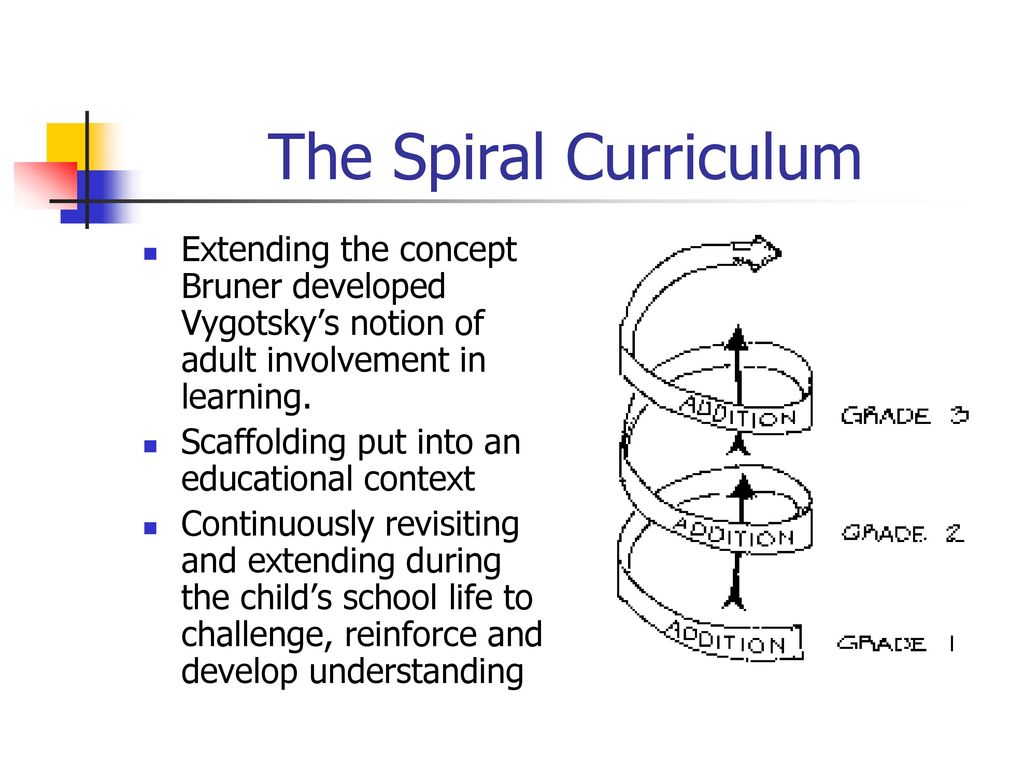
Effective curriculum development uses constructivist theories such as Bruner's (1960) spiral curriculum. This means learners return to key ideas over time, with each step becoming more demanding. Modern frameworks balance three areas: knowledge (what learners know), action (what they can do), and self (who they become as people and learners). These foundations help schools build curricula that are academically strong and personally meaningful.
A well-designed curriculum gives teachers, learners, school leaders and policy makers a clear plan for strong education. It sets out the learning outcomes and core competencies learners need before they move to the next stage. It should also support differentiation, practise key skills again and give fair access to the curriculum.
Bruner saw the curriculum as learners meeting core ideas again and again. Each return should deepen their concepts, skills, attitudes and values. This still helps teachers plan progression, but only when earlier knowledge is secure. If a spiral returns to fractions, algebra or historical causation too soon, it can add cognitive load instead of building mastery, especially for disrupted cohorts (Sweller, 1988; Ashman, 2021).
A stronger post-pandemic model combines Bruner's spiral with stage-based competency mapping. Teachers identify the next secure step, design group or pair work only where it serves the learning aim, and avoid treating all learners in an age cohort as if they share the same starting point. Barnett, Parry, and Coate (2001) proposed a curriculum model involving three domains:
1) Knowledge means the subject matter that belongs to a specific discipline;
2) Action, a component which includes the necessary skills of the discipline, and
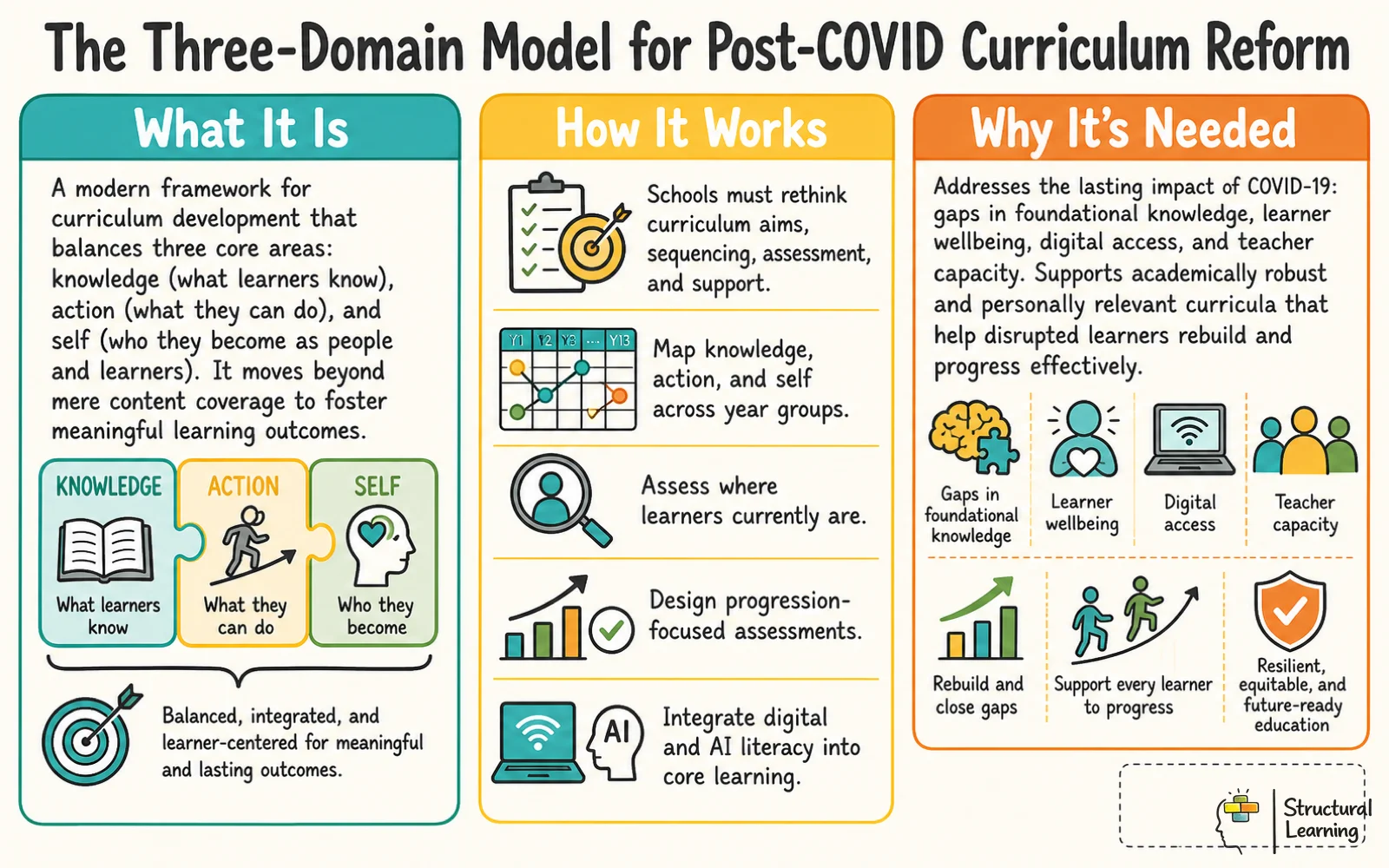
3) Self.
Parker (2003) argues for the benefits of a transformational curriculum. This does not mean adding personal development onto a knowledge curriculum as an extra task. Instead, teachers design tasks where knowledge, action and self interact. In history, learners might study the causes of migration, analyse local census evidence, then reflect on how historical narratives shape current civic debate.
This approach has limits. If the self domain becomes a test of confidence, resilience, or preferred classroom behaviour, it can reward middle-class norms. It can also overlook working-class, EAL, neurodivergent, and traumatised learners (Reay, 2017). Curriculum leaders should therefore define self-direction through visible learning behaviours, such as planning, checking, and explaining, rather than personality traits.
A curriculum philosophy does not dictate a single teaching model. It sets out what knowledge matters, what kinds of action learners should practise, and what forms of independence they should develop. Pedagogy is the classroom method that helps those aims become visible.
These choices must fit the school's context and the National Curriculum. Sequencing matters because curriculum decisions have effects across years, not just within one topic. Teachers need enough detail to plan progression, but not so much prescription that every lesson becomes unmanageable.
Schools bridge the implementation gap when leaders make curriculum change teachable for staff. That means protected planning time, clear examples of expected work, subject-specific training and feedback loops that show what is working. In the 2026 recruitment and retention crisis, a reform that increases teacher workload is unlikely to last.
Curriculum reform is needed because schools face problems that existed before COVID-19, but became sharper after it. These include uneven attendance, gaps in core knowledge, digital inequality, anxiety, weaker transitions and pressure on teachers. Bradbury et al. (2021) warn that simple 'catch-up' discourse can define learners by what they lack, rather than by the next knowledge they are ready to secure.
A more useful response is stage-based progression. The Curriculum and Assessment Review Panel (2025) argues that learners with lower prior attainment need routes that help them rebuild foundations and bank progress. This is better than repeated failure through premature resits. For school leaders, it means using formative assessment, trauma-informed routines, digital access checks and manageable curriculum maps before adding new content.
Curriculum reform has six main steps: identify the problem, set goals, design the curriculum, pilot it, put it into practice, then evaluate and refine it. Each step needs careful planning, shared examples and regular assessment. The aim is to improve learning without adding workload that teachers could avoid.
There are several steps that need to be considered in the process of curriculum reform. These are:
These stages matter, but they also create pressure. Change takes time, so leaders should narrow the focus, agree what will stop, and give teachers shared planning materials before expecting new practice. Goals should be specific enough to evaluate through learner work, not just policy documents.
Schools should also be ready to adapt the curriculum when evidence shows that learners need a different route. In English and maths, this may mean securing Level 1 stepping stones before moving to Level 2 expectations. In wider subjects, it may mean revisiting prerequisite vocabulary, diagrams or practical routines first. Learners can then move into abstract work with a stronger base.
Curriculum reform after COVID-19 is no longer an emergency response. It is now a long-term task that brings knowledge, assessment, wellbeing, digital access and teacher capacity into line. Schools should keep Bruner's idea of revisiting key ideas. But each return should be checked against learner evidence and cognitive load.
The strongest reforms will move beyond age-based catch-up and towards stage-based progression. They will teach learners how to question AI-generated answers. They will also use formative assessment before high-stakes judgements and protect teacher time. This is a realistic optimistic vision: high expectations, clearer sequencing, and humane implementation.
Bruner's spiral curriculum is still useful, but it does not fully explain curriculum recovery. Critics of discovery learning argue that beginners need clear teaching and worked examples before they explore ideas more freely. Kirschner, Sweller and Clark (2006) warn that too little guidance can overload working memory. Sweller's (1988) cognitive load theory helps explain why revisiting ideas may confuse learners if they have not yet built stable schemas.
Second, the post-COVID language of 'catch-up' can narrow curriculum reform into a deficit story. Bradbury et al. (2021) argue that this framing can label children by loss rather than by the knowledge they are ready to build. This matters culturally because pandemic disruption did not fall evenly across class, SEND, language background or digital access.
Third, learner-centred curriculum claims can play down the public purpose of education. Biesta (2021) argues that education should help learners meet the world, not just follow personal preference. A curriculum built around the self domain can also reward middle-class confidence and penalise quieter, neurodivergent, or traumatised learners. This concern fits with Reay's (2017) critique of classed educational expectations.
Much curriculum theory is based on ideas, small studies, or higher education settings. Because of this, schools should test these principles with classroom evidence before using them across the whole school. Even so, Bruner's main point still matters: learners often grasp big ideas when teachers revisit them with clearer language, stronger examples, and better signs that learners are ready.
The implementation gap is the gap between high-level education policies and what really happens in classrooms. To close it, schools need to give teachers training, resources and time. Teachers also need time to adapt new ideas to their local context. Reform works best when everyone in the school organisation communicates clearly, so changes feel manageable and effective.
Teachers use this approach by revisiting core concepts at planned points in a learner's education, with each return increasing in complexity. It works best when teachers check that prior knowledge is secure before adding a harder representation. Without that check, revisiting can confuse novices and add unnecessary cognitive load.
This framework proposes that a balanced curriculum should include three areas: knowledge, action and self. It asks schools to teach important content, give learners chances to use it, and help them develop independence. In practice, leaders should keep the model manageable so it does not become another layer of staff workload.
The pandemic showed the need for curriculum structures that respond to disrupted knowledge, wellbeing, attendance and digital access. In 2026, digital literacy is a basic expectation, not a novelty. Reform now needs to include AI literacy, critical media judgement, fair access to online tasks and assessment that helps learners take the next secure step.
Research suggests that curricula focused on self-direction and learner agency can support motivation when they are grounded in strong subject knowledge. Learners need chances to plan, test, explain and revise their thinking through their learning process. This keeps constructivist principles tied to classroom evidence rather than vague aspiration.
A common mistake is trying to cover too much content. This leaves too little time for learners to practise and master specific skills. Schools also struggle when they make changes too quickly, without the support and professional development staff need. Effective updates should use evidence, follow a clear sequence and focus on a small number of high-impact goals.
Bruner, J. (1960). The process of education.
External References: Teachers' Standards (DfE) | EEF: Evidence-Based Guidance Reports

![Restorative Justice in Schools: A Complete Guide [2026]](https://cdn.prod.website-files.com/5b69a01ba2e409501de055d1/69d10d1b8439e584054873c1_69d10d186a5477665840c608_restorative-justice-in-schools-classroom-teaching.webp)