Updated on
September 24, 2026
Metacognition for Neurodivergent Learners
Teach metacognition to SEND and neurodivergent learners. Adapted scaffolding, visual supports, and evidence-based strategies for ADHD, dyslexia, autism.


Updated on
September 24, 2026
Teach metacognition to SEND and neurodivergent learners. Adapted scaffolding, visual supports, and evidence-based strategies for ADHD, dyslexia, autism.
Metacognition for SEND and neurodivergent learners works best when teachers make planning, monitoring and evaluation easy to see. Many learners with ADHD, autism, dyslexia, dyscalculia, DCD/dyspraxia, DLD/SLCN, anxiety or SEMH needs can explain a useful strategy. But they may not use it reliably when working memory, language processing, sensory load or emotional regulation is under pressure. The term describes a structured process for turning evidence into a classroom decision, not a label on its own.
This difference matters. Metacognitive knowledge means knowing what helps you learn. Metacognitive regulation means using that knowledge to plan, notice difficulty, adjust, and check the outcome (Flavell, 1979; Brown, 1987; Zimmerman, 2002). For SEND learners, this regulation often needs external scaffolds, such as visual steps, goal reminders, worked examples, sentence frames, timers, accuracy feedback, and adult co-regulation.
A teacher can say, "Before we start, point to the step you will use first. When the timer sounds, tick whether the strategy is helping. If it is not, choose one change from the card." The learner is not being asked to reflect in the abstract. They are being taught conditional knowledge: when this problem appears, which support should I use next?
Different SEND profiles can create different metacognitive barriers. The aim is not to attach a fixed strategy to a diagnosis. It is to notice what blocks planning, monitoring or evaluation, then choose a visible scaffold that reduces the load on the learner.
Flavell (1979) defined metacognition as learners "thinking about thinking." Neurodivergent learners can benefit from metacognitive strategies. These strategies give structure to the thinking skills they need for learning. This matters because neurotypical learners may develop these skills without direct teaching.
Whitebread and Pino-Pasternak (2010) found that metacognitive instruction helps learners with difficulties. Neurodivergent learners may not pick up these skills on their own. Without clear teaching, they may struggle to check their understanding or choose useful strategies.
The EEF Toolkit currently reports that metacognition and self-regulation add, on average, eight months' additional progress over a year. Higgins et al. (2018) and Quigley et al. (2018) stress that this gain depends on explicit strategy teaching, modelling and guided practice. SEND learners benefit most when visual scaffolds sit alongside worked examples.
Neurodivergent learners benefit more because metacognitive strategies provide:
Neurodivergent learners often need teachers to teach metacognitive strategies in clear steps. Sweller (1988) argued that teachers should reduce extra demands on working memory. This lets learners focus on the strategy itself, instead of trying to hold too many instructions in mind.
Scaffolding, as described by Vygotsky (1978), gives learners temporary support while they practise a new way of thinking. For learners with ADHD, goal setting and self-monitoring can make attention, effort and next steps more visible (Tuckman, 2009; Zimmerman, 2000).
Explicit instruction in metacognition involves:
Modelling thinking processes aloud: Teachers verbalise their own thinking, making invisible cognitive processes visible. For example, when approaching a maths problem, a teacher can say: "I'm going to read this problem twice before I start.
First, I'll identify the key information. What am I being asked to find? What information do I already have? What operation do I need to use?"
Naming strategies explicitly: Teachers should not assume that learners will spot and name strategies by themselves. Instead, they should give clear labels. Terms like "self-questioning", "planning", "monitoring", and "evaluating" give learners shared words for talking about thinking processes.
Providing worked examples: Show learners how to use metacognitive strategies step by step. This reduces cognitive load, or the amount of information learners must hold in mind. It also gives them a clear model. Worked examples should explain the thinking process, not just show the solution.
Researchers like Flavell (1979) show that metacognition matters. Schools should use the same metacognitive language across subjects. This supports all learners, especially those with SEND (Higgins et al., 2018). It also helps learners spot and use helpful strategies (EEF, 2021).
Breaking down strategies into steps: Complex metacognitive processes should be decomposed into manageable sub-steps. For instance, "planning an essay" can involve. Identify the question type, underline keywords, brainstorm ideas, select main points, decide on order, create outline.
Swanson (1990) found explicit strategy instruction improves academic performance for learners with learning disabilities. Practise and feedback are also vital. Make strategies clear. Do not expect learners to infer them from general teaching.
These profiles affect academic and social skills. Research explores cognitive differences, which are differences in how learners think and process information (Baron-Cohen, 2009; Frith, 2003; Mottron, 2011).
Teachers must understand these profiles. Teachers can tailor instruction for learners with autism. This equips learners for success (Grandin, 1995; Attwood, 2006).
Research by Grainger et al. (2016) found that autistic learners often find metacognitive monitoring difficult. This means checking whether they understand something, or whether their approach is working. As a result, they may keep using strategies that do not work, or find it hard to see when they need extra support.
Specific challenges for autistic learners:
Effective approaches for autistic learners:
Visual supports are especially useful for autistic learners. Strategy checklists with images, flowcharts for decision-making, and visual timetables for planning can all reduce cognitive load. They also make abstract processes easier to see and understand.
Researchers suggest that explicit strategy instruction is vital for learners. Teachers should show learners when and where each strategy works. Teach strategy use across different subjects, and point out the similarities and differences (Weinstein & Mayer, 1986).
Social metacognition means thinking about how we, and other people, read a social situation. This needs careful attention. Many metacognitive discussions assume learners share the same social cues and context. For autistic learners, teachers can teach perspective-taking, including how others may think about a problem, while still respecting neurodivergent thinking rather than simply teaching "neurotypical" approaches.
(Flavell, 1979) showed routines help learners develop metacognition. Predictable lessons mean learners use brainpower on thinking, not worries. (Bjorklund & Thompson, 2011) state less anxiety allows better learning.
ADHD impacts learner metacognition: planning, self-monitoring, and impulse control. Reid et al. (2005) show direct teaching of strategies helps learners with ADHD. It develops skills for academic progress.
Key metacognitive challenges with ADHD:
Effective metacognitive strategies for ADHD:
External working memory supports are not optional extras for many learners with ADHD. Checklists, graphic organisers, written strategy prompts and stage-specific digital prompts move the routine out of working memory, so learners do not have to hold the goal, monitor attention and choose a next step at the same time. Brann and Sidi (2024) found that prompts before, during and after digital reading helped adults with ADHD compensate for mind-wandering by cueing them back to the task.
Self-monitoring tools help ADHD learners develop awareness of their attention and understanding. Simple strategies like the "5-minute check" (stop every 5 minutes and ask "Am I understanding this? Do I need to re-read?") can be significant when explicitly taught and practised.
Physical movement breaks support metacognitive regulation. Brief movement between thinking steps can help ADHD learners reset and refocus. For example, "plan at your desk, walk to get materials, work at the table, return to desk to check".
Timers and visual time supports make abstract time concepts concrete. ADHD learners often struggle with time estimation, a key component of metacognitive planning. Visual timers that show time passing help develop more accurate metacognitive awareness of pacing.
Breaking tasks into smaller chunks with frequent check-ins prevents the overwhelm that occurs when ADHD learners face lengthy assignments. Metacognitive prompts at each check-in ("What have I accomplished? What's next? Do I need help?") build self-regulation skills.
Dyslexia affects around 10% of people, impacting reading and spelling. It goes beyond literacy skills to affect how learners think about their learning. Researchers such as Swanson (1992) and Borkowski (1996) found that metacognition is important. Flavell (1979) explored thinking during reading and written tasks.
Burden (2005) showed that learners with dyslexia can develop negative beliefs about themselves as learners (see "Dyslexia and Self-Concept", Whurr). This can affect how they engage with metacognitive thinking. For this reason, it is key to address both literacy needs and metacognitive awareness.
Metacognitive challenges specific to dyslexia:
Supporting metacognitive development with dyslexia:
Dual coding approaches that combine
Teach comprehension monitoring strategies clearly and directly. A method such as "click or clunk" helps dyslexic learners notice what makes sense and what does not. This gives them a practical tool for metacognitive monitoring while they read.
Text-to-speech, speech-to-text, planning apps and carefully governed generative AI tools can act as an external executive function scaffold, or "exocortex". They offload sequencing, retrieval and monitoring so the learner can ask: What is my goal? Which step is next? Does this paragraph match the task? Brann and Sidi (2024) show why stage-specific prompts matter for ADHD: prompts before, during and after a digital task cue attention checks and help learners return to the text. Teachers still need to teach the strategy, because AI should support thinking rather than replace it.
Structured writing frameworks help learners plan their thinking. They also support organisation. Templates, paragraph frames and visual organisers provide scaffolding, which means step-by-step support for the task.
This lets dyslexic learners focus on writing's metacognitive aspects. Consider audience, purpose, and structure. Learners avoid being overwhelmed by the physical act of writing.

Research by Nicholson and Fawcett (2008) shows that dyslexic learners often have strong visual-spatial skills. Teachers can recognise these metacognitive strengths, including problem-solving and visual-spatial reasoning (West, 1997). This can build learner confidence and give them a starting point for using strategies by themselves.
Sweller's (1988) cognitive load theory helps explain metacognition's impact on neurodivergent learners. The theory says working memory is limited. Good teaching reduces extra cognitive load, aiding learning for all learners.
Cognitive load is not only inside the learner. Classroom environments can add avoidable load through unclear instructions, noise, unpredictable transitions or inaccessible text. A social model of disability asks teachers to remove these barriers first, so ADHD, autistic and dyslexic learners can use working memory for the learning task rather than for decoding the classroom.
Applying cognitive load theory to metacognitive instruction:
Overly complex presentations undermine effective learning. Simple formats help learners manage thinking skills (Bjork (Bjork, 1994), 1994). Kirschner, Sweller and Clark (2006) argued that novice learners need clear guidance when they meet complex new material, especially when tasks are unfamiliar or high in working memory demand.
Manage intrinsic load by breaking complex metacognitive skills into smaller steps. Instead of teaching "planning" as one skill, break it down. Include understanding the task, identifying needed resources, sequencing steps, estimating time, and checking feasibility.
Improve germane load by using worked examples and partly completed templates. These help learners build schema without overloading working memory.
Dual coding reduces cognitive load
This approach also builds learners' self-regulation. Wood, Bruner, and Ross (1976) showed that scaffolding helps learners master tasks. As support is slowly removed, learners develop metacognitive skills and improve working memory. This frees space for more complex activities.
CAST's updated UDL Guidelines 3.0 frame Universal Design for Learning as a way to design learning environments that reduce barriers and support learner agency (CAST, 2024). For metacognitive teaching, this means offering more than one route for learners to plan, monitor and explain their thinking.
UDL is built on three principles: multiple means of representation, multiple means of action and expression, and multiple means of engagement. Each principle has direct implications for metacognitive instruction.
Multiple means of representation:
Teach metacognitive strategies in several ways: spoken explanations, visual diagrams, videos, worked examples, and interactive models. This helps learners use the format that best fits how they process information.
Offer choices in language and symbols. Use the metacognitive term, then add plain classroom words. For example, "self-monitoring" can also be described as "checking your understanding".
Offer alternatives for visual and auditory information. Strategy checklists should be available in visual formats with minimal text for learners who struggle with reading, whilst also being available as text for those who prefer reading or who use screen readers.
Multiple means of action and expression:
Metacognition can be shown in several ways. Learners can explain a process verbally, reflect in writing, draw a concept map, record audio, point to a prompt card, or demonstrate the strategy in the work itself. This matters for SEND: asking a learner to use a strategy and explain it aloud at the same time can create a dual task, which cognitive load theory predicts will overload working memory for novices (Sweller, 1988). Assess the metacognitive action first, then invite articulation when it supports learning.
Provide varied tools for construction and composition. Some learners may express metacognitive thinking best through drawing or diagramming, others through writing or speaking.
Build fluencies with graduated levels of support. Initial metacognitive tasks can be highly scaffolded with sentence starters and templates, with support gradually reduced as competence develops.
Multiple means of engagement:
Learners can choose metacognitive strategies, or ways to plan, check, and improve their learning (Bjork, 1994). This helps them feel more in charge of tasks. It can also improve engagement and autonomy. Giving learners choice supports better learning outcomes (Flavell, 1979; Nelson, 1992).
Learners benefit from predictable metacognitive structures because they reduce threat and distraction. (Hattie, 2012). Short, regular metacognitive check-ins cause less anxiety (Yeager & Dweck, 2012). In contrast, long and unpredictable reflections can be worrying. (Boekaerts, 1997).
Metacognitive partner discussions help learners work together and feel part of a learning community. Neurodivergent learners can build metacognitive awareness by hearing how peers think through a task (Veenman, 1990; Flavell, 1979). This approach also helps learners reflect more clearly (Hattie, 2012).
This enhanced understanding allows learners to monitor and regulate their own learning (Hattie, 2012). Researchers such as Clark (2016) and Paivio (1991) found visual aids cut down on thinking effort. Visuals help learners remember and grasp tricky ideas about their own thinking (Sousa, 2017).
Types of visual supports for metacognition:
Strategy checklists transform sequential metacognitive processes into visible, manageable steps. For example, a problem-solving checklist can include. Read the problem, identify what you know, identify what you need to find, select a strategy, work through the solution, check your answer.
Thinking routines, such as those developed by Project Zero at Harvard, give learners visual structures for metacognitive reflection. They help learners stop and think about their thinking. "See-Think-Wonder", "Connect-Extend-Challenge", and "I used to think... Now I think..." give learners clear frameworks for metacognitive analysis.
Graphic organisers, such as mind maps, Venn diagrams, and flowcharts, help learners show their thinking visually. For neurodivergent learners, these tools reduce the language demands of metacognition. They also support clearer organisation of thought.
Visual timers and schedules make time management and planning visible. For ADHD learners in particular, seeing time pass supports metacognitive awareness of pacing and progress.
Colour coding can show different metacognitive processes. For example, use blue for planning steps, yellow for monitoring steps, and green for evaluation steps. This helps learners tell the parts of metacognitive regulation apart.
Ann Brown (1987) separated metacognitive regulation from metacognitive knowledge. Her work showed that even young children can learn to plan, monitor, and evaluate their own thinking when adults give structured support.
Implementing visual supports effectively:
Introduce visual supports clearly. Model how to use them several times before you expect learners to use them independently.
Keep visuals consistent across lessons and subjects. This helps learners recognise a strategy and use it in new places. Using the same strategy checklist format across subjects helps neurodivergent learners see where the strategy applies.
Avoid visual clutter. Whilst visuals are powerful, overloading displays with too many visual supports can increase rather than reduce cognitive load.
Adapt visual supports to each learner's needs. Some learners benefit from detailed visuals. Others need simple versions with only the key information.
Research shows neurodivergent learners often find task decomposition hard. Explicit teaching helps learners break down tasks into steps. This reduces stress and improves planning. Learners can then self-monitor better.
Why task breakdown is important for neurodivergent learners:
Executive function challenges common in ADHD and autism impair the ability to spontaneously break down tasks. What seems like procrastination or task avoidance is often difficulty knowing where to start.
These guides reduce cognitive load, assisting learners (Alloway & Passolunghi, 2011). Neurodivergent learners often struggle to remember all task parts at once (Cowan, 2014). Step-by-step guides help these learners work around this memory issue (Dehn, 2008).
Perfectionism and anxiety are common in neurodivergent populations. They can make learners feel stuck when a task is complex. Smaller steps reduce anxiety and give clear starting points.
Teaching task breakdown explicitly:
Model task analysis repeatedly using think-aloud protocols. Show learners how you break down various tasks, from writing an essay to conducting a science experiment.
Use consistent questioning frameworks. Questions like "What's the first thing I need to do? What comes next? What's the final step?" provide a replicable structure learners can internalise.
| Learner profile | Metacognitive barrier to notice | Teacher scaffold | Classroom practice example |
|---|---|---|---|
| ADHD | The learner may lose the plan during the task or miss the point where attention has drifted. | Use a short goal card, visible timer and self-monitoring tick at fixed intervals. | During independent writing, the teacher says, "At five minutes, tick whether you are still using your first sentence plan." |
| Autism | Uncertainty, sensory load or unclear task rules may block monitoring and flexible adjustment. | Preview the task, make success criteria literal and add accuracy feedback after each attempt. | In maths, the teacher shows one completed example, then asks, "Which part of your answer matches the model?" |
| Dyslexia | Reading, spelling or transcription load may use the working memory needed for comprehension monitoring. | Use reading bookmarks, oral rehearsal, dual coding and graphic organisers. | After each paragraph, the learner points to a bookmark prompt: "main idea, confusing word, fix-up strategy." |
| Dyscalculia | Number sense, estimation and multi-step procedures can make it hard to judge whether an answer is reasonable. | Use worked examples, estimation prompts and a fixed check routine: predict, solve, compare, explain. | Before calculation, the teacher asks, "Will the answer be bigger or smaller than 100? How will you check?" |
| DCD/dyspraxia | Motor planning, handwriting and fatigue may hide what the learner understands. | Separate thinking from recording through oral planning, drag-and-drop organisers or scribed key words. | The learner orders idea cards first, then dictates the plan before writing only the final response. |
| DLD/SLCN | Language processing demands may make instructions, strategy names and reflective questions hard to retain. | Use visual vocabulary, sentence frames, rehearsal time and one metacognitive prompt at a time. | The teacher models, "I chose this strategy because..." and the learner completes the same sentence orally. |
| PDA/anxiety/EBSA | Perceived demand, threat or uncertainty may block reflection before the learning task begins. | Offer low-arousal choices, preview changes and co-create the monitoring method. | The teacher says, "You can check your plan with the card or with me. Which feels easier today?" |
| SEMH/trauma | Emotional arousal can reduce working memory and make public self-evaluation feel unsafe. | Use predictable routines, private check-ins, repair conversations and regulation before evaluation. | After a difficult task, the teacher asks privately, "Which part felt hard first: starting, staying with it or checking?" |
Create task breakdown templates for common assignment types. An essay breakdown template can include. Analyse question, brainstorm ideas, research, create outline, write introduction, write body paragraphs, write conclusion, edit and proofread.
Practise with tasks that slowly become more complex. Start with simple, familiar tasks. Then add more challenge as learners become more confident and skilled.
Teach time estimation alongside task breakdown. Give each step an estimated time. This helps learners build metacognitive awareness of pacing, so they can judge how long work may take.
Supporting independence:
Initially, provide completed task breakdowns for learners to follow. Gradually shift to co-creating breakdowns with learners. Eventually, learners create their own breakdowns with teacher feedback.
Use visual task boards where learners can see each step and tick off completed items. This visible progress is particularly motivating for neurodivergent learners.
Teachers can build positive metacognitive beliefs by celebrating when learners complete tasks. Many neurodivergent learners have a history of unfinished tasks. Break tasks into clear steps, then link each step to small, repeated wins. Over time, this helps learners build confidence and self-efficacy.
A neurodiversity-affirming approach values how neurodivergent learners think. Early metacognition models mostly used neurotypical groups, so a school rubric for "good self-regulation" can wrongly mark autistic focus, ADHD non-linear problem-solving or visual dyslexic planning as deficits. Milton (2012) argued that misunderstanding can sit between the learner and the school, not only inside the learner. In metacognitive teaching, the aim is flexible self-regulation, without expecting every learner to use neurotypical strategies.
Principles of neurodiversity-affirming metacognition:
Cognitive diversity matters because learners take in and use information in different ways (Rose & Strangman, 2007). Metacognitive teaching helps learners see their strengths, the strategies they prefer and the support they need (Flavell, 1979; Nelson, 1996). The aim is flexible self-regulation, not making every learner follow the same routine.
Do not focus on learners' struggles. Instead, find and use their metacognitive strengths. Autistic individuals often excel in systematic thinking (Grandin, 2011).
Those with ADHD often show creative problem solving (Brown, 2005). Dyslexic individuals often show good visual-spatial skills (West, 1997).
Give learners real choice when they pick a strategy. Not every strategy works for every learner. Let neurodivergent learners try different metacognitive approaches and choose what fits their own cognitive profile.
Sensory needs matter. Learners need mental space for metacognition (Ashburner et al., 2021). Overload reduces this space. Sensory support helps learners take part in metacognitive reflection, where they think about their own learning (Hughes & Doherty, 2016).
Respect different ways of communicating. Some neurodivergent learners may find it hard to talk about their thinking. They may show their thinking more clearly in writing or through visuals.
Avoiding harmful practices:
Do not use metacognitive strategies as behaviour management tools that teach masking. The aim is not to make neurodivergent learners "act neurotypical". It is to support their learning and wellbeing.
Tailor metacognitive strategies to each learner. Start with their strengths, challenges and preferences. Research by Brown et al. (1983) and Flavell (1979) supports personalised approaches. The key point is to make sure the strategy fits the individual learner.
Don't assume that neurotypical metacognitive approaches are always better. Some neurodivergent ways of thinking may work better for certain tasks.
Research by Tanner (2012) shows awareness is key for teachers. We must avoid harming learner metacognition, despite good intentions. Training helps teachers prevent these common problems (Costa & Kallick, 2009). Work by Flavell (1979) and Vygotsky (1978) highlights scaffolding's role.
Pitfall 1: Assuming transfer will occur automatically
Neurodivergent learners often don't recognise that a strategy learned in maths can also apply to English or science. Teachers need to teach transfer explicitly. This means showing similarities across contexts and practising application in varied settings.
Pitfall 2: Introducing too many strategies at once
This helps learners manage the volume of new information (Sweller, 1988). Teach metacognitive strategies one at a time, instead of all at once. Check learners understand each strategy well before introducing another (Clark, Nguyen & Sweller, 2006).
Pitfall 3: Insufficient modelling and practise
Neurodivergent learners usually need more modelling and guided practice before they work alone. One demo is often not enough. Plan several sessions across different situations (Brown & Gilman, 2024). This supports application (Lee & Patel, 2023).
Pitfall 4: Using abstract language without concrete examples
Terms like "reflect on your learning" or "monitor your understanding" may not mean much without concrete examples. Pair each metacognitive term with a clear action that learners can see, hear, or do.
Pitfall 5: Forgetting to teach when strategies are useful
Learners may learn a metacognitive strategy but still not know when to use it. Teach conditional knowledge clearly. For example: "Use this strategy when you encounter [specific situation]."
Pitfall 6: Neglecting working memory limitations
(Sweller, 1988) showed working memory is limited, especially for complex tasks. Checklists and visual aids help learners bypass these limits. Use them as memory supports during lessons. (Clark & Mayer, 2016; Kirschner, Sweller & Clark, 2006).
Pitfall 7: Inconsistent implementation across staff
Researchers like Flavell (1979) show that metacognition helps learners. Neurodivergent learners benefit when staff use the same language across the school (Proust, 2013). Hacker et al (1998) state that consistent strategies help learners transfer strategies from one task to another.
Pitfall 8: Focusing only on academic metacognition
Research shows metacognitive skills boost learners' social skills and emotional control (Veenman et al., 2006). Apply metacognitive teaching beyond the classroom to improve life skills. Consider research from Flavell (1979) and Dunlosky and Rawson (2012).
Case Study 1: Tom, Year 8 learner with ADHD
Tom found essay writing hard. His answers were often muddled and unfinished. His teacher introduced a visual essay plan with clear metacognitive prompts, such as: "What type of question is this?
What do I already know about the topic? What's my main argument? What evidence supports each point?"
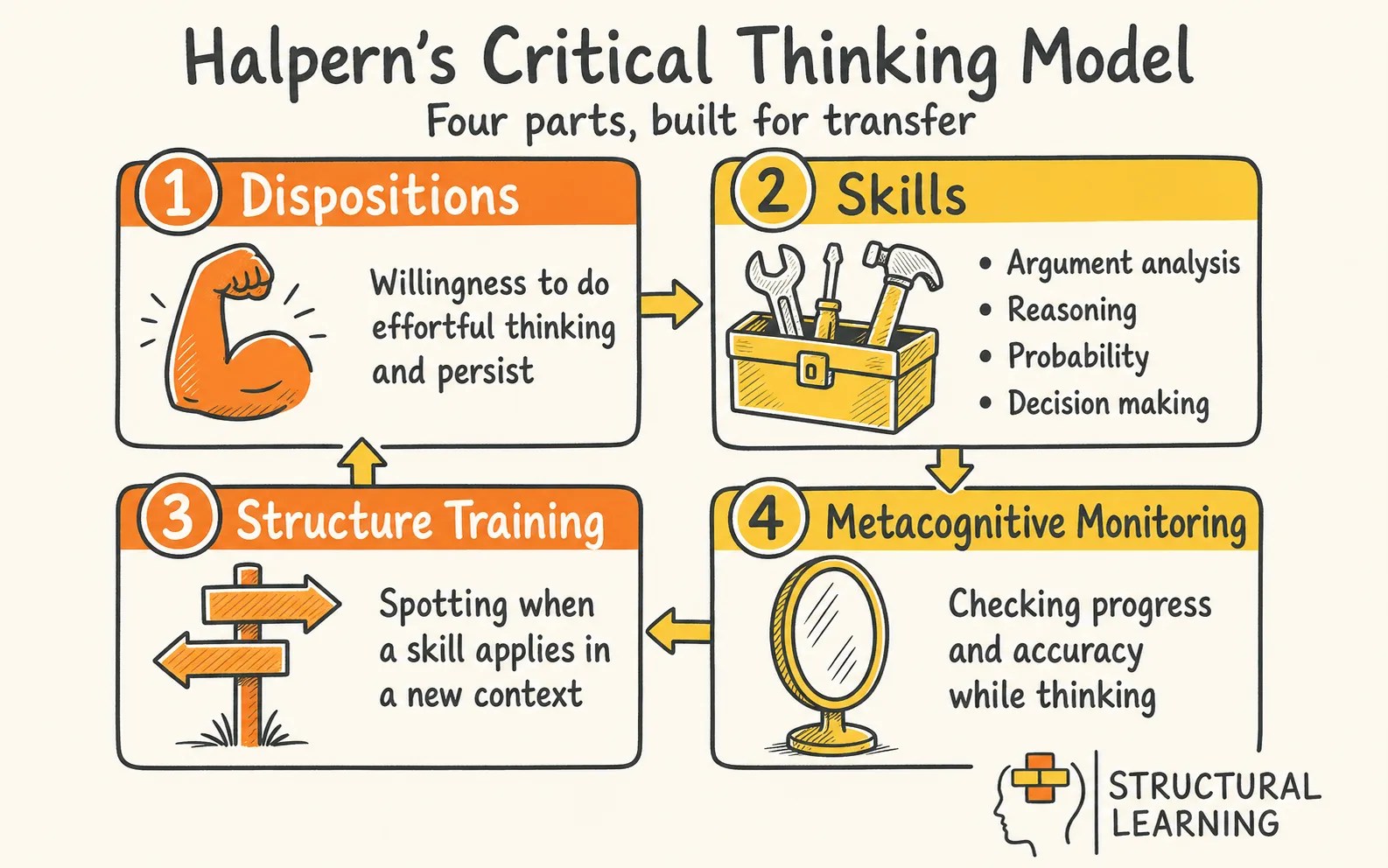
This connects closely with research on critical thinking skills, which provides further classroom strategies for teachers.
At first, the teacher completed the framework with Tom and thought aloud at each step. Over several weeks, the teacher gave less support. Tom began using the framework on his own, and his essay quality improved dramatically. Most importantly, Tom used the approach in other subjects without prompting, showing that explicit instruction had built real metacognitive understanding rather than mere compliance.
Case Study 2: Aisha, Year 5 learner with autism
Aisha excelled at decoding but struggled with reading comprehension. Her teacher introduced the "click or clunk" metacognitive monitoring strategy. After each paragraph, Aisha used a visual checklist to identify sentences that "clicked" (made sense) and "clunked" (were confusing). For "clunks", she had a flowchart of fix-up strategies: re-read, look at pictures, read ahead for context, ask for help.
The visual, step-by-step approach suited Aisha's cognitive profile. Within a term, her comprehension improved significantly. The strategy also reduced her anxiety about reading because she now had a clear process for managing confusion, rather than becoming overwhelmed.
Case Study 3: Jordan, Year 10 learner with dyslexia
Jordan avoided writing tasks due to spelling and handwriting difficulties, which had led to negative metacognitive beliefs ("I'm not a good writer"). His teacher implemented a dual coding approach: Jordan could plan essays using mind maps with drawings and minimal text, then dictate his writing using speech-to-text software.

This removed barriers that had stopped Jordan engaging with higher-level metacognitive processes. Because spelling and handwriting no longer used up his thinking effort, Jordan could focus on audience, argument structure, and evidence quality. His metacognitive awareness of what makes effective writing grew a great deal, and his self-belief improved.
Case Study 4: Whole School Implementation
A primary school used the same metacognitive language and visual supports across the whole school. It did this because the SEND register had grown faster than the one-to-one teaching assistant time available. Every classroom showed the same planning, monitoring and evaluation prompts. Subject leaders added these prompts to lesson slides, writing frames and intervention folders, rather than leaving them to individual adults.
SEND learners benefited because the support travelled with them. Teaching assistants introduced the strategies during targeted work, but mainstream teachers kept using the same prompts in class. This reduced reliance on adult prompting, made the school less vulnerable to staffing gaps and gave parents a shared language for homework. End-of-year evidence showed stronger independence and self-regulation for SEND learners.
Generate an 8-week metacognition roadmap tailored to your key stage, subject, and current practise level.
Metacognition and Special Educational Needs is by David Whitebread and Marisol Pasternak (2010). Metacognition means thinking about learning.
This seminal paper looks at how metacognitive instruction helps learners with learning difficulties. It finds stronger benefits for them than for mainstream groups. The authors review experimental studies showing effect sizes up to twice as large for SEND learners when teachers explicitly teach metacognitive strategies and then gradually remove scaffolding. View study, 234 citations
Executive Function and Metacognition is by Philip David Zelazo and Sophie Jacques (2012). Executive function means the mental skills learners use to plan, focus, and manage tasks.
Zelazo and Jacques (2012) link executive function to learner metacognition. Executive function means the mental skills used to plan, focus, remember steps, and manage actions. Their work helps us see why learners with executive function issues gain from explicit metacognitive teaching. This paper gives a framework for how metacognitive help offsets executive function problems.
Teaching Metacognitive Skills to Children with Learning Disabilities by H. Lee Swanson (1990)
Swanson's research highlights the role of metacognition for learners with learning difficulties. Teachers can support this through clear strategy teaching, modelling, and feedback (Swanson, 1990). Studies show that systematic instruction helps address metacognitive deficits, or gaps in how learners plan, monitor, and reflect (View study, 543 citations).
Metacognition in Autism Spectrum Disorders is by Catherine Grainger and colleagues (2016). It focuses on metacognition, which means thinking about thinking, in autistic learners.
Grainger's research team compared metacognition in autistic learners and neurotypical peers. Autistic learners struggle to assess their understanding. They also have difficulty knowing when to ask for help.
The study points to clear lessons for teaching practice. Teachers need to teach self-monitoring strategies directly. Visual supports can also help learners. (View study, 167 citations)
Burden's research on dyslexic learners' self-concept (Burden, 2005) fits with wider EEF guidance. This guidance says that explicit metacognitive strategy teaching helps learners notice their own thinking. It also supports academic progress (Higgins et al., 2018).
Burden (2005) says dyslexia can affect reading and writing, thinking skills, and self-regulation. Dyslexic learners may start to believe they cannot do well, which can slow their progress. Burden argues that literacy support works best when teachers also build thinking skills, as this can help learners over time.
Additional UK guidance on EBSA and autism: Lincolnshire County Council EBSA guidance.
Metacognition means being aware of your own thinking and learning how to manage it. For SEND learners, teachers need to provide clear, structured frameworks. These help learners plan, monitor, and evaluate their work. Neurotypical learners may develop these skills naturally, but neurodivergent learners often need direct instruction to build self-awareness and independence.
Teachers must make their own thinking visible by regularly thinking aloud and modelling tasks. It is essential to break complex activities into smaller, manageable steps using visual checklists and clear prompts. Educators should also establish consistent language across all subjects so that learners can easily recognise and apply these strategies in different contexts.
Neurotypical learners often pick up learning strategies from watching others. Neurodivergent learners usually need clear, direct teaching to handle their thinking and focus, in line with the EEF guidance on explicit strategy instruction (Higgins et al., 2018). Naming strategies and showing examples helps learners avoid overload and build good habits.
The Education Endowment Foundation identifies metacognition as a low-cost approach with strong impact. It adds, on average, eight months' additional progress over a year. Research shows that learners with learning difficulties can make even greater gains than their peers when teachers teach these skills directly. These methods work especially well for special educational needs when teachers combine them with visual supports and clear routines.
A frequent mistake is assuming that a verbal reminder such as "check your work" will create self-regulation. For many SEND learners, the barrier is not willingness; it is holding the goal, the strategy and the next step in working memory at the same time. Teach one specific technique, place the prompt on the desk or screen, and give immediate, precise feedback on how the learner uses it.
Alloway and Passolunghi (2011). The relationship between working memory, IQ, and mathematical skills in children. Learning and Individual Differences, 21(1), 133-137.
Ashburner et al. (2021).
Attwood (2006).
Baron-Cohen (2009).
Bjork (1994).
Bjorklund and Thompson (2011).
Boekaerts (1997).
Borkowski (1996). Metacognition: Theory or chapter heading?. Learning and Individual Differences, 8(4), 391-402.
Brann and Sidi (2024). Metacognitive scaffolding for digital reading and mind-wandering in adults with and without ADHD. Learning and Instruction, 95, 102051.
Brown et al. (1983).
Brown (1987).
Brown (2005).
Brown and Gilman (2024).
Burden (2005).
CAST (2024).
Clark, Nguyen and Sweller (2006).
Clark (2016).
Clark and Mayer (2016).
Costa and Kallick (2009).
Cowan (2014).
Dawson and Guare (2009).
Dehn (2008).
Dunlosky and Rawson (2012).
EEF (2021).
Flavell (1979).
Frith (2003).
Grainger et al. (2016). Metacognitive monitoring and control processes in children with autism spectrum disorder: Diminished judgement of confidence accuracy. Consciousness and Cognition, 42, 65-74.
Grandin (1995). How People with Autism Think. Learning and Cognition in Autism, 137-156.
Grandin (2011).
Hacker et al. (1998).
Hattie (2012).
Higgins et al. (2018).
Hughes and Doherty (2016).
Kirschner, Sweller and Clark (2006). Why Minimal Guidance During Instruction Does Not Work: An Analysis of the Failure of Constructivist, Discovery, Problem-Based, Experiential, and Inquiry-Based Teaching. Educational Psychologist, 41(2), 75-86.
Lee and Patel (2023).
Milton (2012). On the ontological status of autism: the ‘double empathy problem’. Disability & Society, 27(6), 883-887.
Mottron (2011). The power of autism. Nature, 479(7371), 33-35.
Nelson (1992).
Nelson (1996). Consciousness and metacognition.. American Psychologist, 51(2), 102-116.
Nicholson and Fawcett (2008).
Paivio (1991).
Proust (2013).
Quigley et al. (2018). Metacognition and Self-regulated Learning. Education Endowment Foundation.
Reid et al. (2005).
Rose and Meyer (2002).
Rose and Strangman (2007). Universal Design for Learning: meeting the challenge of individual learning differences through a neurocognitive perspective. Universal Access in the Information Society, 5(4), 381-391.
Shanker (2013).
Sousa (2017).
Swanson (1990).
Swanson (1992). Learning Disabled Readers' Comprehension of Computer Mediated Text: The Influence of Working Memory, Metacognition and Attribution. Learning Disabilities Research & Practice, 7(2), 74-86.
Sweller (1988).
Tanner (2012). Promoting Student Metacognition. CBE—Life Sciences Education, 11(2), 113-120.
Tuckman (2009).
Veenman (1990).
Veenman et al. (2006).
Vygotsky (1978).
Weinstein and Mayer (1986).
West (1997).
Whitebread and Pino-Pasternak (2010).
Wood, Bruner and Ross (1976). THE ROLE OF TUTORING IN PROBLEM SOLVING. Journal of Child Psychology and Psychiatry, 17(2), 89-100.
Yeager and Dweck (2012). Mindsets That Promote Resilience: When Students Believe That Personal Characteristics Can Be Developed. Educational Psychologist, 47(4), 302-314.
Zelazo and Jacques (2012).
Zimmerman (2000). Attaining Self-Regulation. Handbook of Self-Regulation, 13-39.
Zimmerman (2002).
These peer-reviewed studies provide the evidence base for the strategies discussed above.
Compassionate pedagogy for neurodiversity in higher education
Hamilton et al. (2023)
This paper advocates for teaching approaches that are empathetic and responsive to neurodiverse learners in higher education. It encourages educators to implement flexible and inclusive practices, developing a supportive environment that accommodates varied learning styles for all students.
Strategies to Improve Logical Thinking in Students with ASD and ADHD
Herrerías (2025)
This research focuses on techniques to improve logical thinking in students with ASD and ADHD. It offers teachers practical strategies to develop critical reasoning skills, helping neurodivergent students enhance their understanding and problem-solving abilities in the classroom.
Maras et al. (2019)
This study explores methods to support autistic young people in monitoring their mathematics learning processes. It provides teachers with guidance to assist autistic learners in developing self-awareness and self-regulation during mathematical tasks, improving accuracy and independence.
Goodall et al. (2022)
This paper presents a framework for inclusive classrooms, linking interoception, self-regulation, emotional intelligence, and metacognition for dysregulated students. It helps teachers understand that 'naughty' behaviours often stem from self-regulation deficits, outlining strategies to build capacity.
Noureddine et al. (2024)
This review analyses metacognition in students with learning disabilities, highlighting a profile of surface strategies and poor self-regulation. It informs teachers about common challenges and effective cognitive-metacognitive interventions to enhance self-regulatory learning strategies in the classroom.