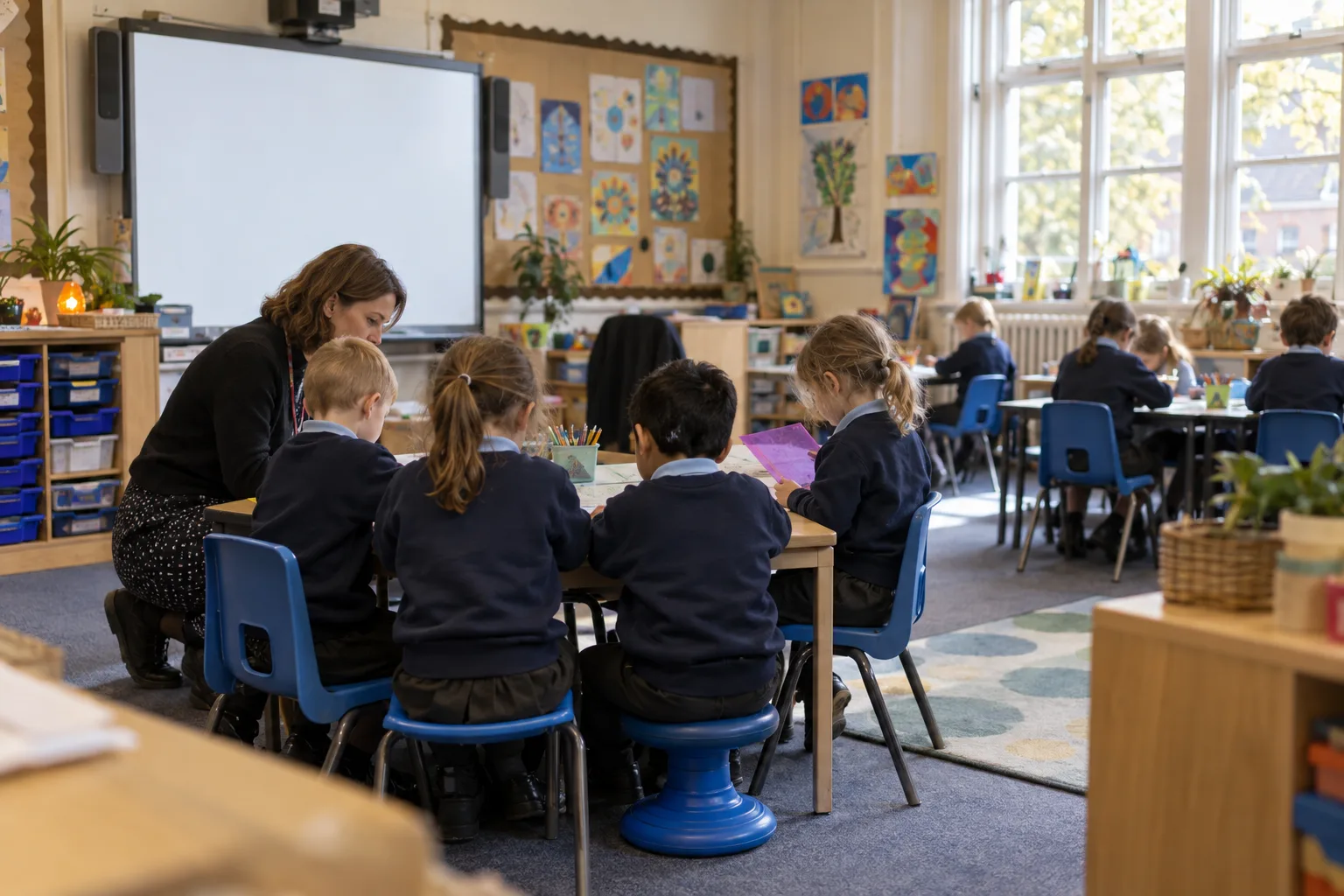
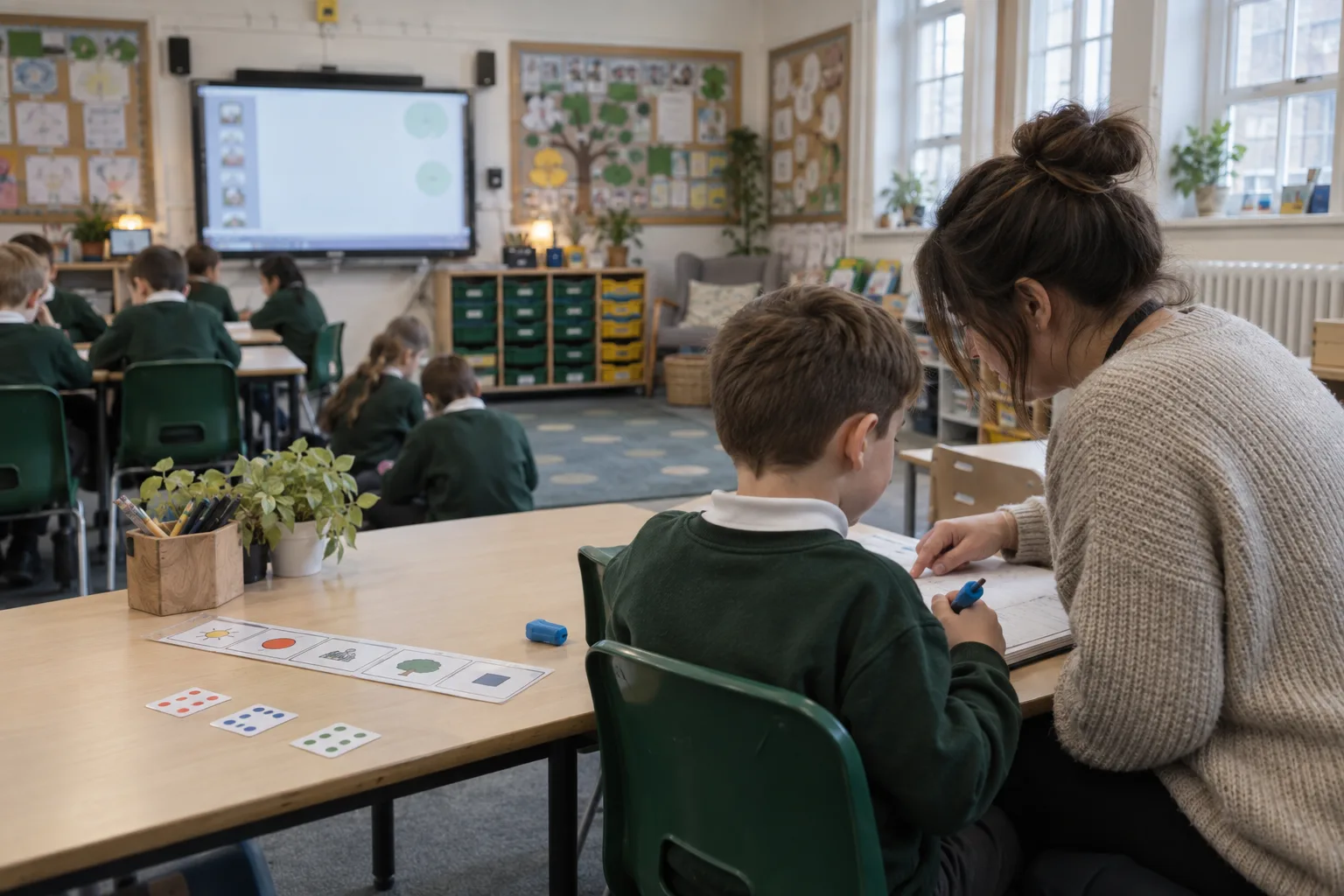
The resource room is one of the most cognitively demanding environments in a school. Students transition mid-period from general education classrooms, carrying the cognitive residue of whatever they were just doing. They arrive with working memory capacities that are, by definition, below average. They receive compressed instruction in reading, maths, or writing. Then they return to general education to pick up where they left off. Every transition, every context switch, every instructional demand competes for a cognitive resource that is already in short supply.
Most discussions of cognitive load theory apply it to curriculum design in mainstream classrooms. Kennedy and Romig (2024) is the only peer-reviewed paper connecting it directly to special education, and it is paywalled. This guide fills that gap. It applies Sweller's theory to the specific conditions of resource room instruction, where the combination of limited working memory, frequent transitions, and multiple daily interventions creates a perfect storm for cognitive overload.
Key Takeaways
The overload threshold is lower in the resource room: Students receiving special education services typically have working memory capacities 1–2 standard deviations below the mean (Alloway, 2009). Instructional design that works for typically developing learners will regularly overwhelm students with learning disabilities if applied without adjustment.
Extraneous load is the variable you control: Intrinsic load is set by the content itself. Extraneous load is created by how you present that content. In the resource room, poor materials layout, split-attention tasks, and redundant verbal explanation are the primary sources of avoidable overload.
The first five minutes of a resource room session are cognitively the most costly: Context switching from general education carries a working memory penalty. A structured arrival routine and a brief retrieval warm-up tied to previous resource room content, not the student's current general education lesson, resets the cognitive workspace before instruction begins.
Multiple daily interventions create cumulative cognitive fatigue: A student receiving reading, maths, speech, and OT support across a single school day draws repeatedly from the same working memory pool. Scheduling the most demanding cognitive session first and building recovery time between sessions is not a scheduling preference. It is an evidence-based decision with direct effects on learning outcomes.
Why Cognitive Load Theory Matters More in Special Education
John Sweller introduced cognitive load theory in 1988 to explain why some instructional designs produce better learning than others. The core claim is that working memory is severely limited in both capacity and duration. When instructional demands exceed that capacity, learning breaks down. The theory has since accumulated one of the strongest evidence bases in educational psychology, with Sweller (2011) reviewing decades of experimental research confirming its core predictions.
For typically developing learners, working memory can hold approximately four chunks of information simultaneously, with individual differences around that mean (Cowan, 2001). For students with learning disabilities, the picture is markedly different. Alloway (2009) tracked 3,189 school-age children over a decade and found that working memory deficits were the strongest predictor of academic underachievement, outperforming IQ, behaviour ratings, and socioeconomic status. Swanson and Siegel (2001) reviewed the literature on working memory in children with reading disabilities specifically and found consistent deficits in both the phonological loop and the central executive components of working memory, the two components most critical for reading acquisition.
What this means in practice is that the margin between manageable instruction and cognitive overload is narrower in the resource room than anywhere else in a school. A typically developing Year 5 student might absorb a four-step problem with a complex worked example and retain the structure. A student with a learning disability in the same lesson may lose the thread at step two and spend the remaining time managing confusion rather than learning. The instructional design is not wrong, but it was not built for this student's cognitive architecture.
The resource room teacher who understands cognitive load theory is not simply applying a mainstream framework in a new setting. They are working with a theory that explains, with precision, why some of their students shut down, make increasing errors across a session, or seem to lose at the end what they understood at the beginning. Every strategy in this guide follows directly from that explanation.
The Three Types of Cognitive Load and What They Mean in Your Classroom
Sweller distinguishes three types of cognitive load, each with different sources and different implications for instructional design.
Intrinsic load is the inherent complexity of the material being learned. Decoding a consonant-vowel-consonant word is lower intrinsic load than comprehending a multi-clause sentence. Solving a one-step equation is lower intrinsic load than a multi-step word problem. Intrinsic load is determined by the content itself and by the number of interacting elements the learner must process simultaneously. You cannot reduce intrinsic load without changing the task. What you can do is sequence content so students encounter fewer interacting elements at once, mastering components before combining them.
Extraneous load is the cognitive demand created by how content is presented, rather than by the content itself. It is load imposed by poor instructional design. Instructions that are harder to parse than necessary, materials that require students to look in two places simultaneously, explanations that repeat what the student can already read, visual layouts that scatter related information across a page: all of these create extraneous load that consumes working memory without contributing to learning. Extraneous load is the primary target for resource room teachers because it is entirely within your control.
Germane load is the cognitive effort devoted to learning itself, specifically to building and integrating new knowledge with existing schemas. Sweller and colleagues have refined this concept over time; the current consensus is that germane load is not a separate type but rather the productive use of remaining working memory capacity after intrinsic and extraneous loads have been accounted for. The practical implication is straightforward: every reduction in extraneous load creates more capacity for the actual learning work.
To make this concrete, consider a resource room reading lesson on main idea identification. The intrinsic load is moderate: students must understand what a paragraph says, identify what most of it is about, and abstract a general statement from specific details. These are interacting elements that require simultaneous processing. The extraneous load, however, can vary enormously based on your instructional choices. If you provide a graphic organiser with a clearly labelled 'main idea' box adjacent to the paragraph, you reduce the need for students to hold the graphic organiser structure and the paragraph content in working memory simultaneously. If you instead ask students to use the graphic organiser displayed on the whiteboard while reading a separate printed paragraph, you split their attention across two locations and add extraneous load that has nothing to do with identifying main ideas. The content did not change. The cognitive cost did.
The Context-Switching Problem: What Happens When Students Walk Through Your Door
Most resource room students do not start their sessions from cognitive rest. They arrive from a general education classroom mid-lesson, or at the transition between subjects, carrying what cognitive scientists call task-switching costs.
Monsell (2003) established that switching between tasks imposes a measurable performance penalty, even when the previous task has technically ended. The working memory system does not wipe cleanly between contexts. Residual activation from the previous task competes with the demands of the new one, producing slower response times, higher error rates, and reduced capacity for the first minutes of the new task. In a typical population, this cost is real but manageable. In students with working memory deficits, the same switching cost lands on a system that already had less headroom.
For a resource room student, the transition sequence might look like this: they were in a maths lesson, working on fractions, trying to keep pace with the class. They were called to pack up and walk to the resource room. During that walk, they are managing the social aspects of leaving the room, navigating the corridor, and whatever is occupying their attention in the moment. They arrive at your door and you begin reading instruction. Their working memory is still partially occupied with fractions, with the social dynamics of leaving, and with the effort of the transition itself.
The first three to five minutes of a resource room session are regularly lost to this context-switching penalty. Students appear inattentive, make errors on tasks that were manageable in the previous session, or need repeated re-explanation of instructions they absorbed easily yesterday. This is not lack of motivation. It is the predictable effect of context switching on an already-taxed working memory system.
Three strategies reduce this cost directly. First, establish an identical arrival routine for every session. When the physical and procedural environment is predictable, students use less working memory navigating it and can begin re-orienting to the instructional context sooner. A named seat, materials already laid out, and the same brief settling activity each day are sufficient. Second, display a simple visual agenda at the start of every session, not a detailed lesson plan but three or four items that tell students what the session will contain. The visual offloads prospective memory demands from working memory, freeing capacity for instruction. Third, begin every session with a two-minute retrieval warm-up tied to the previous resource room lesson, not to the student's current general education content. This warm-up does not introduce new material. It retrieves something already partially learned in this specific context, which reactivates resource room schemas and signals to the working memory system that this context, not the maths lesson context, is now the operating environment.
The retrieval warm-up also produces a direct learning benefit. Karpicke and Roediger (2008) showed that retrieval practice produced larger learning gains than repeated study, even when the retrieval attempt was imperfect. A two-minute warm-up that asks students to recall the three-step decoding strategy from yesterday's session is both a context-reset tool and a retrieval practice event. It serves two functions simultaneously without adding time to the session.
Designing Resource Room Instruction for Limited Working Memory
The most practically useful applications of cognitive load theory for resource room teachers come from the specific instructional design effects that Sweller and colleagues have identified through experimental research. Each effect has a direct translation to resource room practice.
The Worked Example Effect
Renkl (2014) reviewed decades of worked example research and found that novice learners, those without strong prior knowledge in a domain, learn more efficiently from studying worked examples than from attempting to solve equivalent problems independently. The reason is cognitive load: problem-solving by novices requires simultaneous search through a problem space, retrieval of relevant procedures, and monitoring of progress toward a goal. This multi-component process overwhelms working memory. A worked example externalises the solution, removing the search component and allowing the student to focus on understanding the procedure itself.
For students with learning disabilities, who are effectively novices in most academic domains they receive resource room support for, this effect is amplified. The practical application is to show the complete solution first, narrate each step explicitly, and only then move to guided practice with progressively less scaffolding. Do not begin with independent problem-solving and use worked examples as remediation for students who struggled. Use worked examples as the starting point for everyone and fade the scaffolding as competence develops.
In a reading comprehension lesson, this means modelling the entire main idea identification process aloud before asking students to attempt a paragraph themselves. In a writing lesson, it means showing a complete constructed-response answer before asking students to build their own. In a maths lesson, it means working through a complete problem with explicit annotation of each step, then providing a partially completed version for the student to complete.
The Split-Attention Effect
When learners must integrate information from two separate sources, they incur extraneous load from the physical act of holding information from one source while visually searching for the matching information in the other. Sweller and colleagues call this the split-attention effect, and it is one of the most reliable sources of avoidable extraneous load in resource room materials.
Common split-attention situations in resource room instruction include: a reading passage on one page and comprehension questions on a separate page or on a whiteboard; a diagram on a worksheet with explanatory text in a separate paragraph; a multi-step instruction displayed on screen while students work on a different surface; and vocabulary definitions listed in one column with example sentences in a column across the page. In each case, the student must mentally integrate the two sources, holding one in working memory while scanning for the other.
The fix is physically integrating related information. Place comprehension questions directly adjacent to the relevant passage text. Embed labels and explanations directly into diagrams rather than below them. Use callout boxes to connect vocabulary words to their examples within the same visual unit. Print the full worked example on the same surface the student will use for guided practice, so they can see both simultaneously without holding one in memory. The content does not change. The working memory cost of navigating it does.
The Redundancy Effect
Sweller identified a counterintuitive finding: explaining to students what they can already read for themselves actually impairs learning for some learners. When a teacher reads aloud the same text that students are simultaneously reading, both the auditory and visual versions of the same information compete in working memory, consuming capacity that could be used for processing. This redundancy effect is strongest when the student has sufficient prior knowledge to read the text independently.
For resource room students with reading difficulties, this requires careful calibration. A student who cannot yet decode the text independently should hear it read aloud because the auditory channel provides access to content they cannot yet obtain through the visual channel. A student who can decode but struggles with comprehension should not have the text read aloud word-for-word during comprehension instruction, because the auditory channel is redundant with the visual channel and adds load. Instead, you might read aloud while the student reads silently for a shared decoding task, then shift to student-led silent reading with targeted auditory prompts for comprehension checkpoints.
The practical rule: provide auditory information when it adds content the student cannot access visually. Remove it when it duplicates what the student can already see. This applies to verbal instructions, too. If your instruction steps are displayed on a card the student can read, narrating the same steps adds redundancy. Give the card and pause, or narrate without the card. Choose one channel when the information is identical in both.
The Goal-Free Effect and Completion Problems
Sweller demonstrated that replacing specific goals with open-ended exploration tasks reduces the cognitive load imposed by means-end analysis. When a student knows the specific answer they must reach, they engage in backwards problem-solving, holding the goal in working memory, comparing their current state to that goal, and selecting operations to reduce the gap. This process consumes working memory that could be devoted to understanding the procedure.
In the resource room, a goal-free instruction for a maths task might be: "Calculate as many values as you can from this diagram." Rather than "Find the value of x." The student is no longer managing the distance between their current state and a specific required answer. They explore the problem space and notice relationships. For writing tasks, a goal-free instruction might be: "Write down everything you know about the character in this paragraph," rather than "Write three sentences about the character using evidence from the text." The latter requires simultaneously managing the quantity requirement, the content requirement, and the evidence requirement, all in working memory.
Completion problems are a related strategy. Rather than providing a blank problem or a fully worked example, provide a partially completed problem and ask students to finish it. A partially completed graphic organiser with the main idea already identified asks students to find supporting details, reducing the cognitive load of managing the entire task at once. A partially written constructed response with the topic sentence provided asks students to add evidence and elaboration. Scaffolding in education is, at its core, a cognitive load management strategy: you provide the structure that would otherwise consume working memory, freeing capacity for the target skill.
The Modality Principle in Small-Group Instruction
Baddeley's (2000) working memory model identifies two largely separate input channels: the phonological loop processes verbal information, and the visuospatial sketchpad processes visual and spatial information. These channels can operate simultaneously without competing directly, because they use different cognitive resources. The modality principle, established through multiple experiments by Sweller and colleagues, states that learning is enhanced when information is presented through both channels simultaneously rather than through either channel alone.
This principle has direct practical value in the resource room's small-group format. When you narrate a strategy aloud while the student simultaneously looks at a visual representation of that strategy, you are using both channels without competition. The student's phonological loop processes your verbal explanation while their visuospatial sketchpad processes the graphic. The effective working memory capacity available is doubled relative to using either channel alone.
For a reading lesson, this means narrating the inference strategy aloud while the student follows the same steps on a graphic organiser. You say: "First, I find the clue words in the text." The student simultaneously reads the 'clue words' step on the organiser and scans the passage for examples. Your verbal narration and their visual tracking reinforce each other without competing. The student is not splitting attention between two sources of the same information. They are receiving complementary information through complementary channels.
For maths instruction, the modality principle suggests narrating the steps of a procedure while the student manipulates concrete materials or follows a visual representation. Your verbal description of adding fractions with unlike denominators ("First I find the least common multiple of the two denominators") is received through the phonological loop while the student watches or handles fraction strips through the visuospatial channel. Dual coding theory, developed independently by Paivio, reaches a compatible conclusion through a different mechanism: verbal and visual representations, when linked, create more retrieval routes and more durable memory traces.
For writing instruction in a resource room small group, you might narrate the sentence structure aloud while the student sees the sentence template on their desk. "The topic sentence names your topic and tells your opinion. Your template shows you where each part goes." The verbal description and the visual template are complementary, not redundant. The student hears the function while they see the structure.
The practical rule: in a small group, always accompany verbal explanation with a simultaneous visual. The visual should represent the same information through a different channel, not repeat the same information in written form. An annotated diagram, a graphic organiser, a colour-coded sentence template, a number line, a timeline: these are visuospatial representations that complement verbal instruction rather than duplicating it.
Intervention Overload: The Scheduling Problem Nobody Talks About
Students who receive resource room instruction frequently receive multiple interventions across the school day. A student with a complex profile might receive reading instruction in the resource room, supplementary maths support, speech and language therapy, occupational therapy, and counselling or social skills support, sometimes all within the same day. The assumption embedded in this scheduling is that each intervention draws from a separate pool of resources. It does not.
Working memory is a unitary system with a central executive that coordinates processing across domains. Every cognitive demand across every intervention session draws from the same system. A student who has completed 45 minutes of intensive decoding instruction before arriving at your resource room session for writing is not a student with a fresh working memory. They are a student whose central executive has already been taxed.
Baumeister (2002) introduced the concept of ego depletion to describe how self-regulatory resources deplete with use, with consequences for subsequent performance even on unrelated tasks. While the ego depletion literature has been subject to replication debates, the more robust finding from cognitive science is simpler: cognitive fatigue is real, is measureable, and affects performance on subsequent cognitive tasks (Van der Linden, Frese, and Meijman, 2003). Sweller (2010) explicitly noted that the effectiveness of instructional design principles is moderated by the cognitive load history of the learner. The same instruction that works at 9 a.m. may produce worse outcomes at 2 p.m. for the same student if they have been in demanding instructional situations throughout the day.
This has specific scheduling implications for resource room teachers and IEP teams. The most cognitively demanding resource room session should be scheduled first in the day when possible, particularly for students with multiple intervention blocks. Speech and language therapy, which primarily taxes the phonological loop, can often follow reading intervention without severe resource competition. Occupational therapy, which taxes the visuospatial sketchpad and motor systems, has a different resource profile and may be more compatible with adjacent scheduling. However, two sessions that both require sustained attention and working memory manipulation should not be scheduled back to back without a recovery period. A 10-minute unstructured break, a physical movement activity, or a low-demand routine task between intensive interventions allows the central executive to recover before the next demand.
When you are writing an IEP or advising on scheduling, use IEP goal bank resources and scheduling discussions as opportunities to flag the intervention-overload problem explicitly. An IEP that lists five intervention services without addressing their sequencing across the day is an IEP that has not accounted for the cumulative cognitive cost of those services.
Measuring Cognitive Load in Real Time During Your Sessions
Cognitive load cannot be measured directly by a teacher during instruction, but its consequences are observable. Resource room teachers who know what to look for can identify overload as it develops and adjust before it produces disengagement or error cascades.
Rising error rates across a session. A student who performs a task correctly at the beginning of a session but begins making increasing errors as the session progresses is not losing knowledge. They are losing working memory capacity. Track not just whether students get answers right but the pattern of errors across time. An upward error trajectory in a session is a reliable signal of mounting extraneous load or sustained intrinsic load beyond the student's current capacity.
Slower response times. As working memory approaches capacity, retrieval and processing slow down. A student who answered fluently in the first ten minutes and is now taking noticeably longer to respond is showing the processing-speed signature of high cognitive load. This is particularly observable in fluency tasks where you have a baseline from the same session.
Increasing off-task behaviour. When a task exceeds cognitive capacity, avoidance is an adaptive response. The student who begins looking around the room, seeking social interactions, or engaging in low-demand repetitive behaviour is often not choosing distraction over work. They are managing an impossible cognitive demand by reducing it. Before responding with a redirecting prompt, consider whether the task itself has created overload. Reducing the task complexity, providing a completion scaffold, or breaking for a brief low-demand activity is often more productive than a behavioural redirect.
Emotional responses and shutdown. For some students with learning disabilities, reaching the working memory ceiling produces an emotional response: frustration, tears, refusal, or withdrawal. This is particularly common in students who have a strong awareness of their own academic difficulties. The emotional response is real, but its proximate cause is often cognitive overload rather than an independent emotional trigger. Executive function in the classroom research makes clear that the same prefrontal systems that manage working memory also regulate emotional responses, which means that a student who is cognitively overloaded is also more vulnerable to emotional dysregulation in the same moment.
The practical monitoring system is simple. Before each session, note the task and your estimate of its intrinsic load. Track two variables across the session: student error rate and response latency. At the midpoint of the session, if either is rising, adjust the task design before continuing. This is not a formal assessment system. It is a real-time sensitivity to the cognitive consequences of your instructional choices.
Progress monitoring through curriculum-based measurement gives you the cross-session picture. Within-session monitoring of error patterns gives you the real-time signal. Both are necessary for CLT-informed resource room instruction.
A CLT-Informed Resource Room Session Schedule
The following model schedule applies cognitive load principles to a standard 45-minute resource room session. It is designed for a reading or writing intervention context, but the structure transfers to maths with minor adjustments.
Minutes 1–3: Arrival routine and cognitive reset. Students arrive, find their named seats, and find materials already laid out on the desk. The visual agenda for the session is displayed. No new information is presented during this period. The routine is identical to every other session.
Minutes 3–8: Retrieval warm-up. Students complete a brief retrieval task tied to the previous resource room session, not their current general education content. This might be: "Write down the three steps of the RACE strategy we used yesterday," or "Read this short passage and find the main idea using the strategy from Tuesday." The warm-up is low-stakes, the content is familiar, and it deliberately reactivates the resource room context. It also provides a baseline measure of retention from the previous session.
Minutes 8–23: Explicit instruction with worked examples. This is the highest-intrinsic-load portion of the session and should therefore occur when working memory resources are freshest, after the warm-up reset. Introduce one new skill or one new application of a previously taught skill. Begin with a complete worked example, narrating each step aloud while the student follows a matching visual representation on their desk. Ensure all materials are integrated, not split across locations. Provide two to three worked examples before moving to guided practice.
Minutes 23–38: Guided practice with completion scaffolds. Students work on partially completed problems or tasks. The scaffold reduces intrinsic load by removing elements of the task the student does not yet need to manage independently, freeing working memory for the target skill. Gradually reduce scaffold support across the practice set. Monitor error rates in real time. If error rates begin to rise, reduce the task complexity or return to a partially worked example rather than continuing to independent tasks.
Minutes 38–43: Review and session preview. Students retrieve the key learning from today's session in their own words. This is brief and not corrected heavily. Its purpose is to begin consolidation and provide the raw material for next session's retrieval warm-up. Then preview one or two things that will appear in the next session, which reduces the context-switching cost at the start of the following session by giving students a prospective retrieval cue.
Minutes 43–45: Transition preparation. Students are reminded of where they are returning to and what they will need to engage with immediately on arrival. This two-minute preparation reduces the cognitive cost of transitioning back into the general education context by partially pre-loading that context before they leave.
This schedule produces approximately 15 minutes of intensive instruction and 15 minutes of supported practice, with the remaining time devoted to the context-management work that is not optional for this population. Teachers who feel that this leaves insufficient time for content should note that 15 minutes of CLT-informed instruction, well sequenced, produces more durable learning than 30 minutes of instruction that regularly pushes students past their cognitive threshold.
High Extraneous Load vs Low Extraneous Load: Resource Room Design Decisions
The following table contrasts common resource room instructional approaches with CLT-informed alternatives. In each row, the cognitive cost difference is significant even when the apparent task is identical.
Instructional Element
High Extraneous Load (Common Practice)
Low Extraneous Load (CLT-Informed)
Lesson instructions
Four-step verbal instructions delivered at session start. Student holds all steps in working memory while completing step one.
One-step instruction cards displayed at each task transition. Student reads the current step only; next step revealed when previous is complete.
Materials layout
Reading passage on one page, comprehension questions on a separate sheet. Student alternates between both while holding question meaning in working memory.
Questions printed adjacent to the relevant passage section. Graphic organiser template on the same sheet as the passage.
Transition between activities
Teacher announces the next activity verbally. Student must decode the instruction, locate required materials, and shift mental set simultaneously.
Visual agenda on display. Materials for the next activity already on the desk before the transition. Student can shift attention without managing logistics.
Multi-step problems
Student given a full problem with the specific answer required. Must simultaneously manage all steps and track distance to the goal.
Completion problem with first two steps already completed. Student finishes the remaining steps. Alternatively, goal-free: "Calculate as many values as you can."
Vocabulary instruction
Vocabulary list on one side of a card, definitions on the other. Student must mentally connect the two while holding both in working memory.
Word, definition, and example sentence on the same card face, with a visual or iconic cue adjacent to the word. Retrieval practice from memory once initial encoding is secure.
Reading comprehension tasks
Teacher reads the passage aloud while the student follows along in print. Both phonological and visual channels carry identical information, creating redundancy.
For decoding support: teacher reads, student follows. For comprehension instruction: student reads independently, teacher provides targeted verbal prompts at comprehension checkpoints rather than full text narration.
Writing tasks
Open writing prompt requiring simultaneous management of content ideas, sentence structure, vocabulary selection, spelling, and transcription.
Sentence template with slots for key components: "[Topic] is important because [reason 1] and [reason 2]." Student focuses on generating content; sentence structure is scaffolded.
Small-group discussion format
Open question posed to the group. Students must simultaneously monitor who is speaking, retain the question, formulate a response, and manage turn-taking. Multiple interacting elements.
Written question displayed on the table. Students given 60 seconds to write or draw a response before discussion begins. The write-first step externalises the response and reduces the simultaneous load of formulation and participation.
Communicating CLT to Your IEP Team and General Education Colleagues
The resource room teacher who understands cognitive load theory has knowledge that most general education colleagues, and many IEP team members, do not. Translating that knowledge into IEP language and collaborative practice is itself a practical skill.
When writing IEP accommodations, CLT provides precise rationale for specific supports. Rather than writing "extended time on assessments," you might write: "Assessments broken into sections of no more than five questions, with a five-minute break between sections, to accommodate the impact of limited working memory capacity on sustained task performance." Rather than "preferential seating," you might write: "Student seated to minimise visual distractions, as extraneous visual input reduces available working memory for academic tasks." The accommodation is the same but the rationale is explicit, evidence-based, and defensible.
When collaborating with general education teachers about a shared student, CLT gives you a vocabulary for explaining why certain classroom conditions produce difficulty. A student who appears to lose previously mastered material when the classroom is noisy is not forgetting. The extraneous load of managing the noise environment is competing with retrieval. A student who performs better on tests than on classwork is not gaming assessment accommodations. The reduced extraneous load of a quiet testing environment is producing more accurate measurement of what they actually know. The 504 plan vs IEP distinction matters here: both frameworks can specify environmental accommodations, but only the IEP specifies the specially designed instruction in which CLT-informed resource room teaching sits.
For direct instruction sessions, the worked example sequence, the completion problem scaffold, and the explicit modelling of strategy steps are all CLT-consistent practices with their own independent evidence bases. Rosenshine's principles of instruction (Rosenshine, 2012), which overlap substantially with CLT recommendations, provide another framework that general education colleagues may already know. Framing CLT applications in terms of Rosenshine's principles can bridge from the resource room to the general education classroom without requiring colleagues to engage with an unfamiliar theoretical framework.
Connecting CLT to IEP Goals and Progress Monitoring
Cognitive load theory is not just an instructional design framework. It predicts specific patterns in student performance data that should inform how you write and evaluate IEP goals.
A student whose progress monitoring data shows high variability across sessions, performing well one day and poorly the next on similar material, may be experiencing sensitivity to extraneous load or to the intervention-scheduling factors described above. This pattern is different from a student whose data shows a flat trendline with low variability, which suggests an instructional match problem. CLT helps you interpret the shape of progress data, not just the slope.
When writing IEP goals for students with working memory deficits, the specification of task conditions matters as much as the target skill. "Student will identify the main idea of a grade-level paragraph with 80% accuracy in four of five trials" is a measurable goal. "Student will identify the main idea of a grade-level paragraph presented with an adjacent graphic organiser scaffold, with 80% accuracy in four of five trials, fading the scaffold to an independent task over the course of the academic year" is a CLT-informed goal that specifies both the starting scaffold and the direction of travel. The fade is important: the purpose of the scaffold is to reduce working memory load while schema for main idea identification is being built. As that schema consolidates, the scaffold can be reduced because the student now has internal resources where they previously had none.
Differentiation strategies in the resource room should be understood partly through a CLT lens. Differentiation by task complexity, by scaffold level, and by the amount of extraneous load in the instructional materials are all forms of differentiation with a direct cognitive load rationale. Differentiation by interest or learning style, without attention to cognitive load, may address motivation but leave the core instructional problem unaddressed.
The practise of working memory as an explicit topic of instruction with students is also worth considering for older resource room students. Gathercole and Alloway (2008) found that children who understand their own working memory limitations, and who are taught explicit compensatory strategies such as writing down information to externalise it, requesting repetition of instructions without social stigma, and using visual aids proactively, develop greater academic independence than those who receive only compensatory instruction without metacognitive awareness. This is, in effect, CLT-informed metacognitive training.
One Action for Your Next Session
Before your next resource room session, audit the materials you plan to use for a single split-attention instance: one place where students must look at two locations to integrate related information. Bring those two pieces of information together onto the same surface. You will not change the content of the lesson. You will change the cognitive cost of accessing it.
Further Reading: Key Research Papers
The following papers form the core evidence base for applying cognitive load theory to special education instruction. Each is directly relevant to resource room practice.
Working Memory and LearningView study ↗ 1,400+ citations
Alloway, T. P. (2009)
This longitudinal study of over 3,000 children established working memory as the strongest predictor of academic achievement across primary school years, outperforming IQ. For resource room teachers, the study clarifies that students with learning disabilities are not underperforming despite adequate resources; their working memory architecture imposes a ceiling that instructional design must account for rather than work against.
Cognitive Load Theory and Its ApplicationsView study ↗ 2,800+ citations
Sweller, J. (2011)
Sweller's comprehensive review of cognitive load theory's development across two decades covers all major effects relevant to instructional design, including the worked example, split-attention, redundancy, and modality effects. This is the primary theoretical source for the strategies described in this guide and the essential starting point for any teacher seeking to apply CLT systematically.
Working Memory Deficits in Children with Reading DisabilitiesView study ↗ 900+ citations
Swanson, H. L. and Siegel, L. (2001)
This comprehensive review examined working memory function in children with reading disabilities across multiple studies and confirmed consistent deficits in both phonological loop and central executive components. The finding that both components are affected, rather than just phonological storage, has significant implications for resource room instruction: these students struggle not just with holding verbal information but with managing the cognitive processes that direct working memory use.
The Worked Example Effect in Instructional DesignView study ↗ 800+ citations
Renkl, A. (2014)
Renkl's review synthesises three decades of worked example research and examines conditions under which the effect is strongest. The finding that worked examples produce their greatest advantage with novice learners, and that the advantage diminishes as expertise grows, has direct implications for how resource room teachers should fade scaffolding across an intervention programme. The paper also addresses self-explanation effects, showing that prompting students to explain worked example steps increases learning beyond passive study alone.
Task Switching and Working MemoryView study ↗ 3,100+ citations
Monsell, S. (2003)
Monsell's foundational paper on task switching established the cognitive cost of transitioning between different task sets, demonstrating that residual activation from the previous task competes with the incoming task demands for working memory resources. This research underpins the transition management strategies described in this guide: the context-switching penalty is a documented cognitive phenomenon, not a motivational problem, and it requires structural solutions rather than behavioural ones.
References
Alloway, T. P. (2009). Working memory, but not IQ, predicts subsequent learning in children with learning difficulties. European Journal of Psychological Assessment, 25(2), 92–98.
Baddeley, A. D. (2000). The episodic buffer: A new component of working memory? Trends in Cognitive Sciences, 4(11), 417–423.
Baumeister, R. F., Muraven, M., and Tice, D. M. (2002). Ego depletion: A resource model of volition, self-regulation, and controlled processing. Social Cognition, 18(2), 130–150.
Cowan, N. (2001). The magical number 4 in short-term memory: A reconsideration of mental storage capacity. Behavioural and Brain Sciences, 24(1), 87–114.
Gathercole, S. E. and Alloway, T. P. (2008). Working memory and learning: A practical guide for teachers. SAGE Publications.
Karpicke, J. D. and Roediger, H. L. (2008). The critical importance of retrieval for learning. Science, 319(5865), 966–968.
Kennedy, M. J. and Romig, J. E. (2024). Applying cognitive load theory in special education. Learning Disability Quarterly, advance online publication.
Monsell, S. (2003). Task switching. Trends in Cognitive Sciences, 7(3), 134–140.
Renkl, A. (2014). The worked examples principle in multimedia learning. In R. E. Mayer (Ed.), The Cambridge handbook of multimedia learning (2nd ed., pp. 391–412). Cambridge University Press.
Rosenshine, B. (2012). Principles of instruction: Research-based strategies that all teachers should know. American Educator, 36(1), 12–19.
Swanson, H. L. and Siegel, L. (2001). Learning disabilities as a working memory deficit. Issues in Education, 7(1), 1–48.
Sweller, J. (1988). Cognitive load during problem solving: Effects on learning. Cognitive Science, 12(2), 257–285.
Sweller, J. (2010). Element interactivity and intrinsic, extraneous, and germane cognitive load. Educational Psychology Review, 22(2), 123–138.
Sweller, J. (2011). Cognitive load theory. Psychology of Learning and Motivation, 55, 37–76.
Van der Linden, D., Frese, M., and Meijman, T. F. (2003). Mental fatigue and the control of cognitive processes. Acta Psychologica, 113(1), 45–65.
The resource room is one of the most cognitively demanding environments in a school. Students transition mid-period from general education classrooms, carrying the cognitive residue of whatever they were just doing. They arrive with working memory capacities that are, by definition, below average. They receive compressed instruction in reading, maths, or writing. Then they return to general education to pick up where they left off. Every transition, every context switch, every instructional demand competes for a cognitive resource that is already in short supply.
Most discussions of cognitive load theory apply it to curriculum design in mainstream classrooms. Kennedy and Romig (2024) is the only peer-reviewed paper connecting it directly to special education, and it is paywalled. This guide fills that gap. It applies Sweller's theory to the specific conditions of resource room instruction, where the combination of limited working memory, frequent transitions, and multiple daily interventions creates a perfect storm for cognitive overload.
Key Takeaways
The overload threshold is lower in the resource room: Students receiving special education services typically have working memory capacities 1–2 standard deviations below the mean (Alloway, 2009). Instructional design that works for typically developing learners will regularly overwhelm students with learning disabilities if applied without adjustment.
Extraneous load is the variable you control: Intrinsic load is set by the content itself. Extraneous load is created by how you present that content. In the resource room, poor materials layout, split-attention tasks, and redundant verbal explanation are the primary sources of avoidable overload.
The first five minutes of a resource room session are cognitively the most costly: Context switching from general education carries a working memory penalty. A structured arrival routine and a brief retrieval warm-up tied to previous resource room content, not the student's current general education lesson, resets the cognitive workspace before instruction begins.
Multiple daily interventions create cumulative cognitive fatigue: A student receiving reading, maths, speech, and OT support across a single school day draws repeatedly from the same working memory pool. Scheduling the most demanding cognitive session first and building recovery time between sessions is not a scheduling preference. It is an evidence-based decision with direct effects on learning outcomes.
Why Cognitive Load Theory Matters More in Special Education
John Sweller introduced cognitive load theory in 1988 to explain why some instructional designs produce better learning than others. The core claim is that working memory is severely limited in both capacity and duration. When instructional demands exceed that capacity, learning breaks down. The theory has since accumulated one of the strongest evidence bases in educational psychology, with Sweller (2011) reviewing decades of experimental research confirming its core predictions.
For typically developing learners, working memory can hold approximately four chunks of information simultaneously, with individual differences around that mean (Cowan, 2001). For students with learning disabilities, the picture is markedly different. Alloway (2009) tracked 3,189 school-age children over a decade and found that working memory deficits were the strongest predictor of academic underachievement, outperforming IQ, behaviour ratings, and socioeconomic status. Swanson and Siegel (2001) reviewed the literature on working memory in children with reading disabilities specifically and found consistent deficits in both the phonological loop and the central executive components of working memory, the two components most critical for reading acquisition.
What this means in practice is that the margin between manageable instruction and cognitive overload is narrower in the resource room than anywhere else in a school. A typically developing Year 5 student might absorb a four-step problem with a complex worked example and retain the structure. A student with a learning disability in the same lesson may lose the thread at step two and spend the remaining time managing confusion rather than learning. The instructional design is not wrong, but it was not built for this student's cognitive architecture.
The resource room teacher who understands cognitive load theory is not simply applying a mainstream framework in a new setting. They are working with a theory that explains, with precision, why some of their students shut down, make increasing errors across a session, or seem to lose at the end what they understood at the beginning. Every strategy in this guide follows directly from that explanation.
The Three Types of Cognitive Load and What They Mean in Your Classroom
Sweller distinguishes three types of cognitive load, each with different sources and different implications for instructional design.
Intrinsic load is the inherent complexity of the material being learned. Decoding a consonant-vowel-consonant word is lower intrinsic load than comprehending a multi-clause sentence. Solving a one-step equation is lower intrinsic load than a multi-step word problem. Intrinsic load is determined by the content itself and by the number of interacting elements the learner must process simultaneously. You cannot reduce intrinsic load without changing the task. What you can do is sequence content so students encounter fewer interacting elements at once, mastering components before combining them.
Extraneous load is the cognitive demand created by how content is presented, rather than by the content itself. It is load imposed by poor instructional design. Instructions that are harder to parse than necessary, materials that require students to look in two places simultaneously, explanations that repeat what the student can already read, visual layouts that scatter related information across a page: all of these create extraneous load that consumes working memory without contributing to learning. Extraneous load is the primary target for resource room teachers because it is entirely within your control.
Germane load is the cognitive effort devoted to learning itself, specifically to building and integrating new knowledge with existing schemas. Sweller and colleagues have refined this concept over time; the current consensus is that germane load is not a separate type but rather the productive use of remaining working memory capacity after intrinsic and extraneous loads have been accounted for. The practical implication is straightforward: every reduction in extraneous load creates more capacity for the actual learning work.
To make this concrete, consider a resource room reading lesson on main idea identification. The intrinsic load is moderate: students must understand what a paragraph says, identify what most of it is about, and abstract a general statement from specific details. These are interacting elements that require simultaneous processing. The extraneous load, however, can vary enormously based on your instructional choices. If you provide a graphic organiser with a clearly labelled 'main idea' box adjacent to the paragraph, you reduce the need for students to hold the graphic organiser structure and the paragraph content in working memory simultaneously. If you instead ask students to use the graphic organiser displayed on the whiteboard while reading a separate printed paragraph, you split their attention across two locations and add extraneous load that has nothing to do with identifying main ideas. The content did not change. The cognitive cost did.
The Context-Switching Problem: What Happens When Students Walk Through Your Door
Most resource room students do not start their sessions from cognitive rest. They arrive from a general education classroom mid-lesson, or at the transition between subjects, carrying what cognitive scientists call task-switching costs.
Monsell (2003) established that switching between tasks imposes a measurable performance penalty, even when the previous task has technically ended. The working memory system does not wipe cleanly between contexts. Residual activation from the previous task competes with the demands of the new one, producing slower response times, higher error rates, and reduced capacity for the first minutes of the new task. In a typical population, this cost is real but manageable. In students with working memory deficits, the same switching cost lands on a system that already had less headroom.
For a resource room student, the transition sequence might look like this: they were in a maths lesson, working on fractions, trying to keep pace with the class. They were called to pack up and walk to the resource room. During that walk, they are managing the social aspects of leaving the room, navigating the corridor, and whatever is occupying their attention in the moment. They arrive at your door and you begin reading instruction. Their working memory is still partially occupied with fractions, with the social dynamics of leaving, and with the effort of the transition itself.
The first three to five minutes of a resource room session are regularly lost to this context-switching penalty. Students appear inattentive, make errors on tasks that were manageable in the previous session, or need repeated re-explanation of instructions they absorbed easily yesterday. This is not lack of motivation. It is the predictable effect of context switching on an already-taxed working memory system.
Three strategies reduce this cost directly. First, establish an identical arrival routine for every session. When the physical and procedural environment is predictable, students use less working memory navigating it and can begin re-orienting to the instructional context sooner. A named seat, materials already laid out, and the same brief settling activity each day are sufficient. Second, display a simple visual agenda at the start of every session, not a detailed lesson plan but three or four items that tell students what the session will contain. The visual offloads prospective memory demands from working memory, freeing capacity for instruction. Third, begin every session with a two-minute retrieval warm-up tied to the previous resource room lesson, not to the student's current general education content. This warm-up does not introduce new material. It retrieves something already partially learned in this specific context, which reactivates resource room schemas and signals to the working memory system that this context, not the maths lesson context, is now the operating environment.
The retrieval warm-up also produces a direct learning benefit. Karpicke and Roediger (2008) showed that retrieval practice produced larger learning gains than repeated study, even when the retrieval attempt was imperfect. A two-minute warm-up that asks students to recall the three-step decoding strategy from yesterday's session is both a context-reset tool and a retrieval practice event. It serves two functions simultaneously without adding time to the session.
Designing Resource Room Instruction for Limited Working Memory
The most practically useful applications of cognitive load theory for resource room teachers come from the specific instructional design effects that Sweller and colleagues have identified through experimental research. Each effect has a direct translation to resource room practice.
The Worked Example Effect
Renkl (2014) reviewed decades of worked example research and found that novice learners, those without strong prior knowledge in a domain, learn more efficiently from studying worked examples than from attempting to solve equivalent problems independently. The reason is cognitive load: problem-solving by novices requires simultaneous search through a problem space, retrieval of relevant procedures, and monitoring of progress toward a goal. This multi-component process overwhelms working memory. A worked example externalises the solution, removing the search component and allowing the student to focus on understanding the procedure itself.
For students with learning disabilities, who are effectively novices in most academic domains they receive resource room support for, this effect is amplified. The practical application is to show the complete solution first, narrate each step explicitly, and only then move to guided practice with progressively less scaffolding. Do not begin with independent problem-solving and use worked examples as remediation for students who struggled. Use worked examples as the starting point for everyone and fade the scaffolding as competence develops.
In a reading comprehension lesson, this means modelling the entire main idea identification process aloud before asking students to attempt a paragraph themselves. In a writing lesson, it means showing a complete constructed-response answer before asking students to build their own. In a maths lesson, it means working through a complete problem with explicit annotation of each step, then providing a partially completed version for the student to complete.
The Split-Attention Effect
When learners must integrate information from two separate sources, they incur extraneous load from the physical act of holding information from one source while visually searching for the matching information in the other. Sweller and colleagues call this the split-attention effect, and it is one of the most reliable sources of avoidable extraneous load in resource room materials.
Common split-attention situations in resource room instruction include: a reading passage on one page and comprehension questions on a separate page or on a whiteboard; a diagram on a worksheet with explanatory text in a separate paragraph; a multi-step instruction displayed on screen while students work on a different surface; and vocabulary definitions listed in one column with example sentences in a column across the page. In each case, the student must mentally integrate the two sources, holding one in working memory while scanning for the other.
The fix is physically integrating related information. Place comprehension questions directly adjacent to the relevant passage text. Embed labels and explanations directly into diagrams rather than below them. Use callout boxes to connect vocabulary words to their examples within the same visual unit. Print the full worked example on the same surface the student will use for guided practice, so they can see both simultaneously without holding one in memory. The content does not change. The working memory cost of navigating it does.
The Redundancy Effect
Sweller identified a counterintuitive finding: explaining to students what they can already read for themselves actually impairs learning for some learners. When a teacher reads aloud the same text that students are simultaneously reading, both the auditory and visual versions of the same information compete in working memory, consuming capacity that could be used for processing. This redundancy effect is strongest when the student has sufficient prior knowledge to read the text independently.
For resource room students with reading difficulties, this requires careful calibration. A student who cannot yet decode the text independently should hear it read aloud because the auditory channel provides access to content they cannot yet obtain through the visual channel. A student who can decode but struggles with comprehension should not have the text read aloud word-for-word during comprehension instruction, because the auditory channel is redundant with the visual channel and adds load. Instead, you might read aloud while the student reads silently for a shared decoding task, then shift to student-led silent reading with targeted auditory prompts for comprehension checkpoints.
The practical rule: provide auditory information when it adds content the student cannot access visually. Remove it when it duplicates what the student can already see. This applies to verbal instructions, too. If your instruction steps are displayed on a card the student can read, narrating the same steps adds redundancy. Give the card and pause, or narrate without the card. Choose one channel when the information is identical in both.
The Goal-Free Effect and Completion Problems
Sweller demonstrated that replacing specific goals with open-ended exploration tasks reduces the cognitive load imposed by means-end analysis. When a student knows the specific answer they must reach, they engage in backwards problem-solving, holding the goal in working memory, comparing their current state to that goal, and selecting operations to reduce the gap. This process consumes working memory that could be devoted to understanding the procedure.
In the resource room, a goal-free instruction for a maths task might be: "Calculate as many values as you can from this diagram." Rather than "Find the value of x." The student is no longer managing the distance between their current state and a specific required answer. They explore the problem space and notice relationships. For writing tasks, a goal-free instruction might be: "Write down everything you know about the character in this paragraph," rather than "Write three sentences about the character using evidence from the text." The latter requires simultaneously managing the quantity requirement, the content requirement, and the evidence requirement, all in working memory.
Completion problems are a related strategy. Rather than providing a blank problem or a fully worked example, provide a partially completed problem and ask students to finish it. A partially completed graphic organiser with the main idea already identified asks students to find supporting details, reducing the cognitive load of managing the entire task at once. A partially written constructed response with the topic sentence provided asks students to add evidence and elaboration. Scaffolding in education is, at its core, a cognitive load management strategy: you provide the structure that would otherwise consume working memory, freeing capacity for the target skill.
The Modality Principle in Small-Group Instruction
Baddeley's (2000) working memory model identifies two largely separate input channels: the phonological loop processes verbal information, and the visuospatial sketchpad processes visual and spatial information. These channels can operate simultaneously without competing directly, because they use different cognitive resources. The modality principle, established through multiple experiments by Sweller and colleagues, states that learning is enhanced when information is presented through both channels simultaneously rather than through either channel alone.
This principle has direct practical value in the resource room's small-group format. When you narrate a strategy aloud while the student simultaneously looks at a visual representation of that strategy, you are using both channels without competition. The student's phonological loop processes your verbal explanation while their visuospatial sketchpad processes the graphic. The effective working memory capacity available is doubled relative to using either channel alone.
For a reading lesson, this means narrating the inference strategy aloud while the student follows the same steps on a graphic organiser. You say: "First, I find the clue words in the text." The student simultaneously reads the 'clue words' step on the organiser and scans the passage for examples. Your verbal narration and their visual tracking reinforce each other without competing. The student is not splitting attention between two sources of the same information. They are receiving complementary information through complementary channels.
For maths instruction, the modality principle suggests narrating the steps of a procedure while the student manipulates concrete materials or follows a visual representation. Your verbal description of adding fractions with unlike denominators ("First I find the least common multiple of the two denominators") is received through the phonological loop while the student watches or handles fraction strips through the visuospatial channel. Dual coding theory, developed independently by Paivio, reaches a compatible conclusion through a different mechanism: verbal and visual representations, when linked, create more retrieval routes and more durable memory traces.
For writing instruction in a resource room small group, you might narrate the sentence structure aloud while the student sees the sentence template on their desk. "The topic sentence names your topic and tells your opinion. Your template shows you where each part goes." The verbal description and the visual template are complementary, not redundant. The student hears the function while they see the structure.
The practical rule: in a small group, always accompany verbal explanation with a simultaneous visual. The visual should represent the same information through a different channel, not repeat the same information in written form. An annotated diagram, a graphic organiser, a colour-coded sentence template, a number line, a timeline: these are visuospatial representations that complement verbal instruction rather than duplicating it.
Intervention Overload: The Scheduling Problem Nobody Talks About
Students who receive resource room instruction frequently receive multiple interventions across the school day. A student with a complex profile might receive reading instruction in the resource room, supplementary maths support, speech and language therapy, occupational therapy, and counselling or social skills support, sometimes all within the same day. The assumption embedded in this scheduling is that each intervention draws from a separate pool of resources. It does not.
Working memory is a unitary system with a central executive that coordinates processing across domains. Every cognitive demand across every intervention session draws from the same system. A student who has completed 45 minutes of intensive decoding instruction before arriving at your resource room session for writing is not a student with a fresh working memory. They are a student whose central executive has already been taxed.
Baumeister (2002) introduced the concept of ego depletion to describe how self-regulatory resources deplete with use, with consequences for subsequent performance even on unrelated tasks. While the ego depletion literature has been subject to replication debates, the more robust finding from cognitive science is simpler: cognitive fatigue is real, is measureable, and affects performance on subsequent cognitive tasks (Van der Linden, Frese, and Meijman, 2003). Sweller (2010) explicitly noted that the effectiveness of instructional design principles is moderated by the cognitive load history of the learner. The same instruction that works at 9 a.m. may produce worse outcomes at 2 p.m. for the same student if they have been in demanding instructional situations throughout the day.
This has specific scheduling implications for resource room teachers and IEP teams. The most cognitively demanding resource room session should be scheduled first in the day when possible, particularly for students with multiple intervention blocks. Speech and language therapy, which primarily taxes the phonological loop, can often follow reading intervention without severe resource competition. Occupational therapy, which taxes the visuospatial sketchpad and motor systems, has a different resource profile and may be more compatible with adjacent scheduling. However, two sessions that both require sustained attention and working memory manipulation should not be scheduled back to back without a recovery period. A 10-minute unstructured break, a physical movement activity, or a low-demand routine task between intensive interventions allows the central executive to recover before the next demand.
When you are writing an IEP or advising on scheduling, use IEP goal bank resources and scheduling discussions as opportunities to flag the intervention-overload problem explicitly. An IEP that lists five intervention services without addressing their sequencing across the day is an IEP that has not accounted for the cumulative cognitive cost of those services.
Measuring Cognitive Load in Real Time During Your Sessions
Cognitive load cannot be measured directly by a teacher during instruction, but its consequences are observable. Resource room teachers who know what to look for can identify overload as it develops and adjust before it produces disengagement or error cascades.
Rising error rates across a session. A student who performs a task correctly at the beginning of a session but begins making increasing errors as the session progresses is not losing knowledge. They are losing working memory capacity. Track not just whether students get answers right but the pattern of errors across time. An upward error trajectory in a session is a reliable signal of mounting extraneous load or sustained intrinsic load beyond the student's current capacity.
Slower response times. As working memory approaches capacity, retrieval and processing slow down. A student who answered fluently in the first ten minutes and is now taking noticeably longer to respond is showing the processing-speed signature of high cognitive load. This is particularly observable in fluency tasks where you have a baseline from the same session.
Increasing off-task behaviour. When a task exceeds cognitive capacity, avoidance is an adaptive response. The student who begins looking around the room, seeking social interactions, or engaging in low-demand repetitive behaviour is often not choosing distraction over work. They are managing an impossible cognitive demand by reducing it. Before responding with a redirecting prompt, consider whether the task itself has created overload. Reducing the task complexity, providing a completion scaffold, or breaking for a brief low-demand activity is often more productive than a behavioural redirect.
Emotional responses and shutdown. For some students with learning disabilities, reaching the working memory ceiling produces an emotional response: frustration, tears, refusal, or withdrawal. This is particularly common in students who have a strong awareness of their own academic difficulties. The emotional response is real, but its proximate cause is often cognitive overload rather than an independent emotional trigger. Executive function in the classroom research makes clear that the same prefrontal systems that manage working memory also regulate emotional responses, which means that a student who is cognitively overloaded is also more vulnerable to emotional dysregulation in the same moment.
The practical monitoring system is simple. Before each session, note the task and your estimate of its intrinsic load. Track two variables across the session: student error rate and response latency. At the midpoint of the session, if either is rising, adjust the task design before continuing. This is not a formal assessment system. It is a real-time sensitivity to the cognitive consequences of your instructional choices.
Progress monitoring through curriculum-based measurement gives you the cross-session picture. Within-session monitoring of error patterns gives you the real-time signal. Both are necessary for CLT-informed resource room instruction.
A CLT-Informed Resource Room Session Schedule
The following model schedule applies cognitive load principles to a standard 45-minute resource room session. It is designed for a reading or writing intervention context, but the structure transfers to maths with minor adjustments.
Minutes 1–3: Arrival routine and cognitive reset. Students arrive, find their named seats, and find materials already laid out on the desk. The visual agenda for the session is displayed. No new information is presented during this period. The routine is identical to every other session.
Minutes 3–8: Retrieval warm-up. Students complete a brief retrieval task tied to the previous resource room session, not their current general education content. This might be: "Write down the three steps of the RACE strategy we used yesterday," or "Read this short passage and find the main idea using the strategy from Tuesday." The warm-up is low-stakes, the content is familiar, and it deliberately reactivates the resource room context. It also provides a baseline measure of retention from the previous session.
Minutes 8–23: Explicit instruction with worked examples. This is the highest-intrinsic-load portion of the session and should therefore occur when working memory resources are freshest, after the warm-up reset. Introduce one new skill or one new application of a previously taught skill. Begin with a complete worked example, narrating each step aloud while the student follows a matching visual representation on their desk. Ensure all materials are integrated, not split across locations. Provide two to three worked examples before moving to guided practice.
Minutes 23–38: Guided practice with completion scaffolds. Students work on partially completed problems or tasks. The scaffold reduces intrinsic load by removing elements of the task the student does not yet need to manage independently, freeing working memory for the target skill. Gradually reduce scaffold support across the practice set. Monitor error rates in real time. If error rates begin to rise, reduce the task complexity or return to a partially worked example rather than continuing to independent tasks.
Minutes 38–43: Review and session preview. Students retrieve the key learning from today's session in their own words. This is brief and not corrected heavily. Its purpose is to begin consolidation and provide the raw material for next session's retrieval warm-up. Then preview one or two things that will appear in the next session, which reduces the context-switching cost at the start of the following session by giving students a prospective retrieval cue.
Minutes 43–45: Transition preparation. Students are reminded of where they are returning to and what they will need to engage with immediately on arrival. This two-minute preparation reduces the cognitive cost of transitioning back into the general education context by partially pre-loading that context before they leave.
This schedule produces approximately 15 minutes of intensive instruction and 15 minutes of supported practice, with the remaining time devoted to the context-management work that is not optional for this population. Teachers who feel that this leaves insufficient time for content should note that 15 minutes of CLT-informed instruction, well sequenced, produces more durable learning than 30 minutes of instruction that regularly pushes students past their cognitive threshold.
High Extraneous Load vs Low Extraneous Load: Resource Room Design Decisions
The following table contrasts common resource room instructional approaches with CLT-informed alternatives. In each row, the cognitive cost difference is significant even when the apparent task is identical.
Instructional Element
High Extraneous Load (Common Practice)
Low Extraneous Load (CLT-Informed)
Lesson instructions
Four-step verbal instructions delivered at session start. Student holds all steps in working memory while completing step one.
One-step instruction cards displayed at each task transition. Student reads the current step only; next step revealed when previous is complete.
Materials layout
Reading passage on one page, comprehension questions on a separate sheet. Student alternates between both while holding question meaning in working memory.
Questions printed adjacent to the relevant passage section. Graphic organiser template on the same sheet as the passage.
Transition between activities
Teacher announces the next activity verbally. Student must decode the instruction, locate required materials, and shift mental set simultaneously.
Visual agenda on display. Materials for the next activity already on the desk before the transition. Student can shift attention without managing logistics.
Multi-step problems
Student given a full problem with the specific answer required. Must simultaneously manage all steps and track distance to the goal.
Completion problem with first two steps already completed. Student finishes the remaining steps. Alternatively, goal-free: "Calculate as many values as you can."
Vocabulary instruction
Vocabulary list on one side of a card, definitions on the other. Student must mentally connect the two while holding both in working memory.
Word, definition, and example sentence on the same card face, with a visual or iconic cue adjacent to the word. Retrieval practice from memory once initial encoding is secure.
Reading comprehension tasks
Teacher reads the passage aloud while the student follows along in print. Both phonological and visual channels carry identical information, creating redundancy.
For decoding support: teacher reads, student follows. For comprehension instruction: student reads independently, teacher provides targeted verbal prompts at comprehension checkpoints rather than full text narration.
Writing tasks
Open writing prompt requiring simultaneous management of content ideas, sentence structure, vocabulary selection, spelling, and transcription.
Sentence template with slots for key components: "[Topic] is important because [reason 1] and [reason 2]." Student focuses on generating content; sentence structure is scaffolded.
Small-group discussion format
Open question posed to the group. Students must simultaneously monitor who is speaking, retain the question, formulate a response, and manage turn-taking. Multiple interacting elements.
Written question displayed on the table. Students given 60 seconds to write or draw a response before discussion begins. The write-first step externalises the response and reduces the simultaneous load of formulation and participation.
Communicating CLT to Your IEP Team and General Education Colleagues
The resource room teacher who understands cognitive load theory has knowledge that most general education colleagues, and many IEP team members, do not. Translating that knowledge into IEP language and collaborative practice is itself a practical skill.
When writing IEP accommodations, CLT provides precise rationale for specific supports. Rather than writing "extended time on assessments," you might write: "Assessments broken into sections of no more than five questions, with a five-minute break between sections, to accommodate the impact of limited working memory capacity on sustained task performance." Rather than "preferential seating," you might write: "Student seated to minimise visual distractions, as extraneous visual input reduces available working memory for academic tasks." The accommodation is the same but the rationale is explicit, evidence-based, and defensible.
When collaborating with general education teachers about a shared student, CLT gives you a vocabulary for explaining why certain classroom conditions produce difficulty. A student who appears to lose previously mastered material when the classroom is noisy is not forgetting. The extraneous load of managing the noise environment is competing with retrieval. A student who performs better on tests than on classwork is not gaming assessment accommodations. The reduced extraneous load of a quiet testing environment is producing more accurate measurement of what they actually know. The 504 plan vs IEP distinction matters here: both frameworks can specify environmental accommodations, but only the IEP specifies the specially designed instruction in which CLT-informed resource room teaching sits.
For direct instruction sessions, the worked example sequence, the completion problem scaffold, and the explicit modelling of strategy steps are all CLT-consistent practices with their own independent evidence bases. Rosenshine's principles of instruction (Rosenshine, 2012), which overlap substantially with CLT recommendations, provide another framework that general education colleagues may already know. Framing CLT applications in terms of Rosenshine's principles can bridge from the resource room to the general education classroom without requiring colleagues to engage with an unfamiliar theoretical framework.
Connecting CLT to IEP Goals and Progress Monitoring
Cognitive load theory is not just an instructional design framework. It predicts specific patterns in student performance data that should inform how you write and evaluate IEP goals.
A student whose progress monitoring data shows high variability across sessions, performing well one day and poorly the next on similar material, may be experiencing sensitivity to extraneous load or to the intervention-scheduling factors described above. This pattern is different from a student whose data shows a flat trendline with low variability, which suggests an instructional match problem. CLT helps you interpret the shape of progress data, not just the slope.
When writing IEP goals for students with working memory deficits, the specification of task conditions matters as much as the target skill. "Student will identify the main idea of a grade-level paragraph with 80% accuracy in four of five trials" is a measurable goal. "Student will identify the main idea of a grade-level paragraph presented with an adjacent graphic organiser scaffold, with 80% accuracy in four of five trials, fading the scaffold to an independent task over the course of the academic year" is a CLT-informed goal that specifies both the starting scaffold and the direction of travel. The fade is important: the purpose of the scaffold is to reduce working memory load while schema for main idea identification is being built. As that schema consolidates, the scaffold can be reduced because the student now has internal resources where they previously had none.
Differentiation strategies in the resource room should be understood partly through a CLT lens. Differentiation by task complexity, by scaffold level, and by the amount of extraneous load in the instructional materials are all forms of differentiation with a direct cognitive load rationale. Differentiation by interest or learning style, without attention to cognitive load, may address motivation but leave the core instructional problem unaddressed.
The practise of working memory as an explicit topic of instruction with students is also worth considering for older resource room students. Gathercole and Alloway (2008) found that children who understand their own working memory limitations, and who are taught explicit compensatory strategies such as writing down information to externalise it, requesting repetition of instructions without social stigma, and using visual aids proactively, develop greater academic independence than those who receive only compensatory instruction without metacognitive awareness. This is, in effect, CLT-informed metacognitive training.
One Action for Your Next Session
Before your next resource room session, audit the materials you plan to use for a single split-attention instance: one place where students must look at two locations to integrate related information. Bring those two pieces of information together onto the same surface. You will not change the content of the lesson. You will change the cognitive cost of accessing it.
Further Reading: Key Research Papers
The following papers form the core evidence base for applying cognitive load theory to special education instruction. Each is directly relevant to resource room practice.
Working Memory and LearningView study ↗ 1,400+ citations
Alloway, T. P. (2009)
This longitudinal study of over 3,000 children established working memory as the strongest predictor of academic achievement across primary school years, outperforming IQ. For resource room teachers, the study clarifies that students with learning disabilities are not underperforming despite adequate resources; their working memory architecture imposes a ceiling that instructional design must account for rather than work against.
Cognitive Load Theory and Its ApplicationsView study ↗ 2,800+ citations
Sweller, J. (2011)
Sweller's comprehensive review of cognitive load theory's development across two decades covers all major effects relevant to instructional design, including the worked example, split-attention, redundancy, and modality effects. This is the primary theoretical source for the strategies described in this guide and the essential starting point for any teacher seeking to apply CLT systematically.
Working Memory Deficits in Children with Reading DisabilitiesView study ↗ 900+ citations
Swanson, H. L. and Siegel, L. (2001)
This comprehensive review examined working memory function in children with reading disabilities across multiple studies and confirmed consistent deficits in both phonological loop and central executive components. The finding that both components are affected, rather than just phonological storage, has significant implications for resource room instruction: these students struggle not just with holding verbal information but with managing the cognitive processes that direct working memory use.
The Worked Example Effect in Instructional DesignView study ↗ 800+ citations
Renkl, A. (2014)
Renkl's review synthesises three decades of worked example research and examines conditions under which the effect is strongest. The finding that worked examples produce their greatest advantage with novice learners, and that the advantage diminishes as expertise grows, has direct implications for how resource room teachers should fade scaffolding across an intervention programme. The paper also addresses self-explanation effects, showing that prompting students to explain worked example steps increases learning beyond passive study alone.
Task Switching and Working MemoryView study ↗ 3,100+ citations
Monsell, S. (2003)
Monsell's foundational paper on task switching established the cognitive cost of transitioning between different task sets, demonstrating that residual activation from the previous task competes with the incoming task demands for working memory resources. This research underpins the transition management strategies described in this guide: the context-switching penalty is a documented cognitive phenomenon, not a motivational problem, and it requires structural solutions rather than behavioural ones.
References
Alloway, T. P. (2009). Working memory, but not IQ, predicts subsequent learning in children with learning difficulties. European Journal of Psychological Assessment, 25(2), 92–98.
Baddeley, A. D. (2000). The episodic buffer: A new component of working memory? Trends in Cognitive Sciences, 4(11), 417–423.
Baumeister, R. F., Muraven, M., and Tice, D. M. (2002). Ego depletion: A resource model of volition, self-regulation, and controlled processing. Social Cognition, 18(2), 130–150.
Cowan, N. (2001). The magical number 4 in short-term memory: A reconsideration of mental storage capacity. Behavioural and Brain Sciences, 24(1), 87–114.
Gathercole, S. E. and Alloway, T. P. (2008). Working memory and learning: A practical guide for teachers. SAGE Publications.
Karpicke, J. D. and Roediger, H. L. (2008). The critical importance of retrieval for learning. Science, 319(5865), 966–968.
Kennedy, M. J. and Romig, J. E. (2024). Applying cognitive load theory in special education. Learning Disability Quarterly, advance online publication.
Monsell, S. (2003). Task switching. Trends in Cognitive Sciences, 7(3), 134–140.
Renkl, A. (2014). The worked examples principle in multimedia learning. In R. E. Mayer (Ed.), The Cambridge handbook of multimedia learning (2nd ed., pp. 391–412). Cambridge University Press.
Rosenshine, B. (2012). Principles of instruction: Research-based strategies that all teachers should know. American Educator, 36(1), 12–19.
Swanson, H. L. and Siegel, L. (2001). Learning disabilities as a working memory deficit. Issues in Education, 7(1), 1–48.
Sweller, J. (1988). Cognitive load during problem solving: Effects on learning. Cognitive Science, 12(2), 257–285.
Sweller, J. (2010). Element interactivity and intrinsic, extraneous, and germane cognitive load. Educational Psychology Review, 22(2), 123–138.
Sweller, J. (2011). Cognitive load theory. Psychology of Learning and Motivation, 55, 37–76.
Van der Linden, D., Frese, M., and Meijman, T. F. (2003). Mental fatigue and the control of cognitive processes. Acta Psychologica, 113(1), 45–65.