Attention and Learning: A Cognitive Science ApproachAttention and Learning: A Cognitive Science Approach - students learning in classroom

Attention and Learning: A Cognitive Science Approach

|

December 29, 2025

Explore how attention shapes learning in the classroom, with evidence-based strategies to support student focus and reduce distraction in an increasingly demanding cognitive environment.

Every teacher knows the feeling: you're explaining something important, and half the class is staring out the window. Or perhaps they're looking at you, but their minds are clearly elsewhere. Attention problems are among the most common challenges teachers face, and they're not getting easier.

Attention is the gateway to learning. Information that doesn't receive attention cannot be encoded, consolidated, or retrieved. No matter how brilliantly you teach, students who aren't attending won't learn. Yet attention is finite, effortful, and increasingly competed for by devices, distractions, and demanding schedules.

Understanding how attention works gives teachers practical strategies for capturing and maintaining student focus. Cognitive science has revealed that attention isn't a single system but a set of interconnected processes that can be supported, trained, and optimised through instructional design—skills that are fundamental to self-regulated learning.

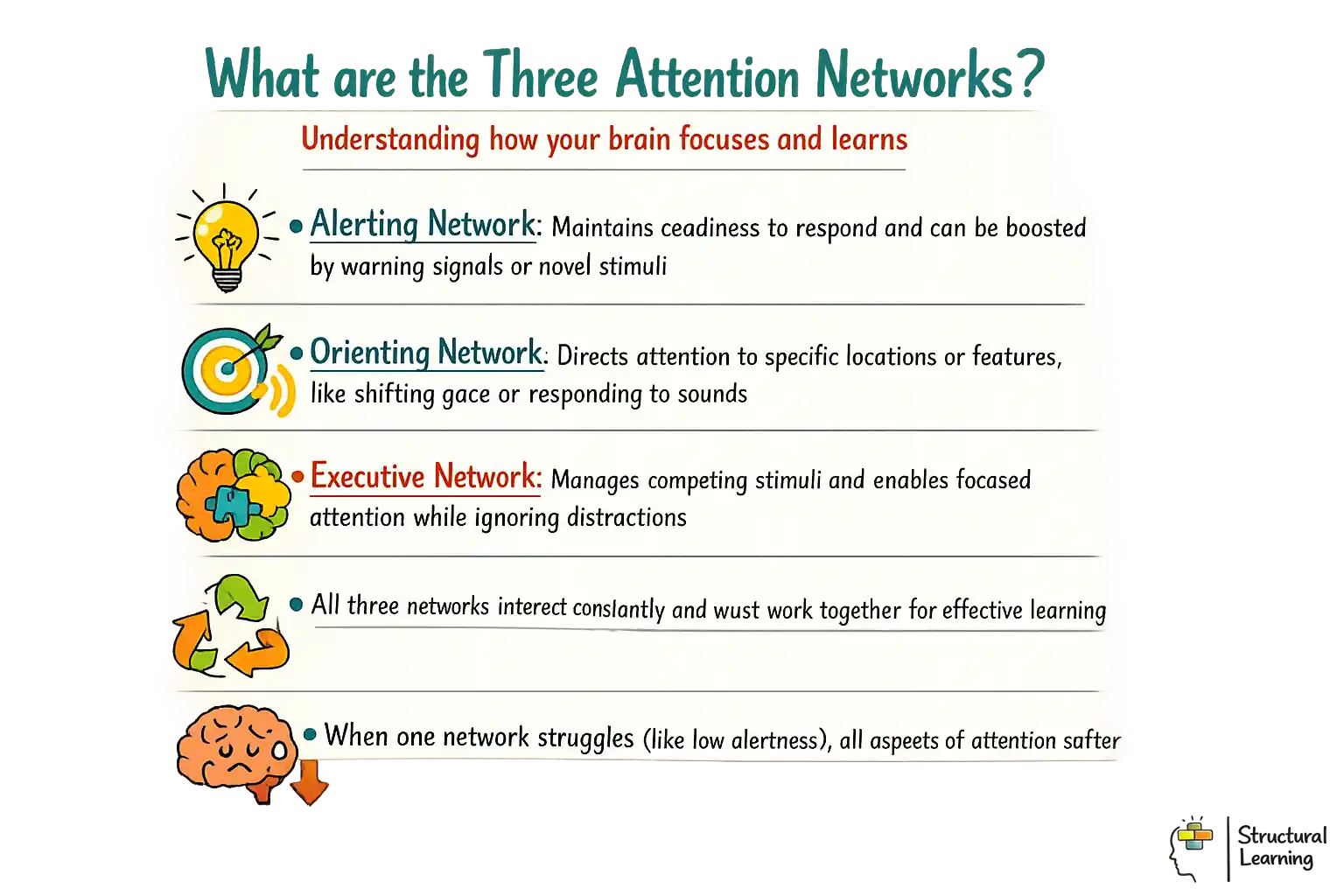
The Three Systems of Attention: Your Brain's Focus Network infographic for teachers
The Three Systems of Attention: Your Brain's Focus Network

Key Takeaways

  • Attention is the prerequisite for all learning; unattended information cannot be encoded
  • Three attention systems work together: alerting, orienting, and executive control
  • Teacher strategies can support attention, but cannot create unlimited focus in students

What Is Attention?

Attention refers to the cognitive processes that select information for further processing while filtering out irrelevant stimuli. Your brain is constantly bombarded with far more sensory information than it can handle. Attention determines what gets through.

Think of attention as a spotlight in a dark theatre. The spotlight illuminates only a small portion of the stage at any moment. What falls within the beam is visible; what falls outside remains in darkness. Attention works similarly, selecting certain information for conscious processing while the rest fades into the background.

But attention is more complex than a simple spotlight. Modern cognitive science describes attention as comprising multiple systems that work together.

The Three Attention Networks

Michael Posner and colleagues identified three interconnected attention networks that serve different functions.

The alerting network maintains a state of readiness to respond. Alertness fluctuates throughout the day and can be temporarily boosted by warning signals or novel stimuli. When alertness is low, all aspects of attention suffer.

The orienting network directs attention to specific locations or features. When you shift your gaze to look at something, or when a loud sound captures your attention, the orienting network is at work.

The executive network manages conflicts between competing stimuli and enables focused attention on task-relevant information. This system is critical for ignoring distractions and maintaining concentration on demanding tasks.

These networks interact constantly. A well-rested student with appropriate alertness can orient to the teacher and use executive control to maintain focus despite distractions. A tired student may struggle with all three.

Attention and Working Memory

Attention is intimately connected to working memory. Working memory holds information in mind while we think about it, and attention determines what enters working memory in the first place.

Selective Attention Gates Encoding

Information must be attended to before it can be encoded into memory. This makes attention the critical first stage of learning. If students aren't attending during instruction, they can't be learning, regardless of how well the material is presented.

Teachers sometimes assume that if information is presented, students will absorb it. But presentation without attention produces no learning. The challenge isn't just making information available; it's ensuring it receives attention.

Attention and Cognitive Load

Cognitive load theory explains how attention limits constrain learning. When instructional demands exceed attention capacity, learning suffers. Well-designed instruction manages attention demands to ensure essential information receives adequate processing.

High cognitive load consumes attention resources, leaving less available for the learning itself. Reducing extraneous load frees attention for productive engagement with content.

The Three Types of Attention

Understanding different aspects of attention helps teachers address specific attention challenges.

Selective Attention

Selective attention enables focusing on relevant information while ignoring distractions. In a noisy classroom, selective attention allows a student to focus on the teacher's voice while filtering out surrounding conversations.

Selective attention develops throughout childhood and continues into adolescence. Younger students and those with attention difficulties may struggle more with filtering distractions.

Teachers can support selective attention by:

  • Reducing environmental distractions
  • Making target information salient
  • Using signals to capture attention
  • Providing clear guidance about what to focus on

Sustained Attention

Sustained attention is the ability to maintain focus over time. Also called vigilance, sustained attention is required for tasks that demand continued concentration.

Sustained attention naturally declines over time. Most students can maintain focused attention for 10-20 minutes before concentration begins to flag. Younger students and those with attention difficulties may have shorter optimal attention spans.

Teachers can support sustained attention by:

  • Breaking long tasks into shorter segments
  • Building in movement or activity changes
  • Varying instructional approaches within lessons
  • Strategically timing key content

Divided Attention

Divided attention involves attending to multiple streams of information simultaneously. True multitasking is largely a myth; the brain rapidly switches between tasks rather than processing them in parallel.

When attention is divided, performance on all tasks suffers. Students who check phones during instruction aren't learning while they look at the device, but they also disrupt the learning that was happening before and after. The switching cost extends beyond the moment of distraction.

Teachers can support focused rather than divided attention by:

  • Establishing clear expectations about devices
  • Making learning engaging enough to compete with distractions
  • Designing activities that require continuous engagement
  • Teaching students about the costs of divided attention

How Attention Shapes Learning

The relationship between attention and learning is fundamental. Every stage of memory formation depends on adequate attention.

Attention and Encoding

Information must be attended to be encoded. Attention determines which aspects of experience enter memory. When students half-attend to instruction, they encode partial, fragmented representations that are difficult to retrieve.

The quality of encoding depends on the quality of attention. Deep, focused attention produces rich encoding. Shallow, divided attention produces weak encoding. This is why retrieval practice works better when conducted with full attention.

Attention and Comprehension

Understanding requires sustained attention. Complex ideas need to be held in mind while connections are made and implications are drawn. When attention lapses, the thread of comprehension breaks.

Reading comprehension particularly suffers when attention wavers. Students may read words without comprehending sentences because attention drifted mid-paragraph. Reading comprehension strategies must account for attention limitations.

Attention and Retrieval

Even retrieval requires attention. When students take tests while distracted, they retrieve less than when fully focused. The effort of searching memory and selecting responses demands attention resources.

This explains why test conditions matter. Distracting environments impair retrieval regardless of how well information was initially learned.

Technology and Attention in the Classroom

Digital devices present unprecedented attention challenges. Smartphones, tablets, and laptops offer constant opportunities for attention diversion, and young people may be particularly susceptible.

The Costs of Device Distraction

Research consistently shows that device presence impairs learning, even when devices aren't being actively used. The mere presence of a smartphone on a desk diverts some attention to wondering what might be happening on it.

When students do check devices during instruction, the costs are substantial. Not only is attention diverted during device use, but task-switching costs impair performance before and after the interruption.

Attention Fragmentation

Modern technology may be training brains toward fragmented attention. Students accustomed to rapidly switching between apps, notifications, and feeds may find sustained attention more difficult than previous generations did.

Whether technology is changing attention capacity, or simply revealing underlying limitations, the practical challenge remains: how do we design instruction that works with rather than against attention constraints?

Classroom Policies and Practices

Schools and teachers approach device management differently. Some ban devices entirely; others attempt to leverage them for learning. Neither approach eliminates attention challenges.

What matters is creating conditions where learning tasks receive sustained attention. This may involve:

  • Clear expectations about device use
  • Physical distance between students and devices during key instruction
  • Task designs that require continuous engagement
  • Open discussion about attention and its importance
From Distraction to Learning: The Attention-Memory Pipeline infographic for teachers
From Distraction to Learning: The Attention-Memory Pipeline

Strategies to Support Student Attention

Teachers cannot create unlimited attention in students, but they can support the attention available.

Managing the Learning Environment

The physical environment affects attention. Reduce visual clutter, control noise, and arrange seating to minimise distractions. Temperature, lighting, and comfort also influence alertness.

Consider what students see when they look up from their work. A wall of interesting posters may capture attention that should be directed elsewhere. Sometimes less stimulating environments support better focus.

Signalling What Matters

Help students allocate attention effectively by clearly signalling what's important. Don't leave students guessing about where to focus. Use verbal and visual cues to direct attention to key information.

Phrases like "This is crucial" or "I'll be asking about this" prime students to attend closely. Writing key points on the board provides visual anchors for attention. Consistent structures help students know when to concentrate most intensely.

Building in Variation

Attention declines with monotony. Varying instructional approaches, activities, and demands refreshes attention resources. The change itself provides a kind of reset.

This doesn't mean constantly switching activities. Fragmented instruction can be as problematic as monotonous instruction. The goal is strategic variation that maintains engagement without creating chaos.

Timing Key Content

If attention peaks early and declines over time, position crucial content strategically. Don't save the most important point for the end of a long explanation when attention has faded.

Consider front-loading essential information, providing breaks before attention depletes completely, and using retrieval activities to reactivate attention for important content.

Making Learning Active

Active engagement supports attention better than passive reception. When students must do something with information rather than just receive it, attention is more likely to be maintained.

Active learning strategies serve double duty: they produce better encoding and they support the attention necessary for that encoding to occur.

Using Movement

Physical movement can refresh attention. Brief movement breaks, activities that require standing or changing position, or even allowing some movement during sedentary tasks can help students maintain focus.

This is particularly important for younger students and those who struggle with sustained stillness. Movement isn't opposed to attention; strategically deployed, it supports attention.

Attention and Lesson Design

Understanding attention constraints should inform how lessons are designed.

Chunking and Pacing

Break content into chunks that fit within attention spans. Present a chunk, allow processing, then move to the next. This respects attention limitations while ensuring coverage.

Pacing matters too. Moving too quickly doesn't allow adequate processing; moving too slowly leads to attention drift. The optimal pace provides enough time for deep processing without allowing disengagement.

Attention-Check Points

Build in moments that require active attention demonstration. Questions, quick writes, or paired discussions force attention back to the task if it has wandered.

These check points serve dual purposes: they support attention in the moment, and they provide formative assessment information about engagement levels.

Intrinsic Interest

Learning that is genuinely interesting captures attention more easily than learning that feels pointless. While teachers can't make all content fascinating, they can connect learning to student interests, purposes, and prior knowledge.

Relevance supports attention. Students who understand why something matters attend more readily than those who see no purpose in the learning.

Attention Difficulties and Learning

Some students face particular attention challenges that require additional support.

ADHD and Attention

Students with ADHD experience difficulties with attention regulation as a core feature of their condition. These students may struggle with sustained attention, impulse control, and filtering distractions despite good intentions.

Understanding ADHD helps teachers provide appropriate support rather than assuming attention difficulties reflect lack of effort. Strategies that help all students attend often need to be intensified for students with ADHD.

Anxiety and Attention

Anxiety consumes attention resources. Worried students are attending to their worries rather than to instruction. The cognitive burden of anxiety leaves less capacity for learning.

Reducing unnecessary stress and creating psychologically safe learning environments indirectly support attention by freeing cognitive resources currently devoted to worry.

Sleep and Attention

Sleep-deprived students have impaired attention across all three attention networks. Alertness is low, orienting is sluggish, and executive control is diminished.

Teachers can't solve student sleep problems, but understanding the connection helps explain some attention difficulties. Supporting students in understanding sleep's importance for learning may influence behaviour.

Developing Attention Skills

While attention capacity has limits, attention skills can be developed with practice.

Metacognitive Awareness

Teaching students about attention helps them recognise when attention has wandered and redirect it. Metacognitive awareness of attention state is the first step toward self-regulation.

Ask students to notice when their attention drifts. What were they thinking about? What helped them refocus? This reflection develops attention monitoring skills.

Strategies for Refocusing

Teach specific strategies for recapturing wandering attention. Taking a deep breath, deliberately looking at the teacher, asking oneself a question about the content, or writing a brief note can all help redirect focus.

Students who have specific strategies to deploy are better able to manage attention than those who simply hope to concentrate.

Building Focus Tolerance

Like physical stamina, attention stamina can be built through practice. Gradually increasing the duration of focused work, with appropriate support, helps students develop greater sustained attention capacity.

Start where students are. If current attention spans are short, work with that limitation while gradually extending expectations.

From Understanding to Practice

Attention is the foundation of learning. Without attention, encoding fails, comprehension breaks down, and retrieval becomes impossible. Teachers who understand attention can design instruction that works with cognitive constraints rather than against them.

Practical applications include:

  • Structuring lessons to respect attention limitations
  • Reducing unnecessary distractions
  • Using signals and variation to maintain engagement
  • Building in active processing that requires attention
  • Teaching students about their own attention

Attention challenges aren't going away. If anything, they're intensifying as digital distraction competes ever more effectively for students' limited focus. But understanding attention gives teachers strategies for creating conditions where learning can occur.

Further Reading: Key Papers on Attention and Learning

The following papers provide deeper exploration of attention and its role in education.

  • Attention and Effort (Kahneman, 1973)
  • Daniel Kahneman's classic work established the resource model of attention, arguing that attention is a limited resource that must be allocated among competing demands. The book explains why divided attention impairs performance and how effort relates to attention deployment.

  • Brain Mechanisms of Selective Attention (Posner & Petersen, 1990)
  • This paper describes the three attention networks (alerting, orienting, executive) that remain central to attention research. Understanding these distinct but interacting systems helps explain why attention difficulties can take different forms.

  • The Attentional Cost of Receiving a Cell Phone Notification (Stothart, Mitchum & Yehnert, 2015)
  • This study demonstrates that phone notifications impair attention on current tasks even when notifications aren't checked. The mere awareness that a notification has arrived diverts attention and reduces performance.

  • Media Multitasking and Cognitive Control Across the Lifespan (Uncapher & Wagner, 2018)
  • This review examines how media multitasking relates to attention and cognitive control. The authors find that heavy media multitaskers show reduced cognitive control, though the direction of causation remains debated.

  • Why Don't Students Like School? (Willingham, 2009)
  • Daniel Willingham explains cognitive science principles for teachers, including the role of attention in learning. The book provides practical guidance for capturing and maintaining student attention through instructional design.

    7 Science-Based Strategies to Capture Student Attention infographic for teachers
    7 Science-Based Strategies to Capture Student Attention

    Read More

    Loading audit...

    Every teacher knows the feeling: you're explaining something important, and half the class is staring out the window. Or perhaps they're looking at you, but their minds are clearly elsewhere. Attention problems are among the most common challenges teachers face, and they're not getting easier.

    Attention is the gateway to learning. Information that doesn't receive attention cannot be encoded, consolidated, or retrieved. No matter how brilliantly you teach, students who aren't attending won't learn. Yet attention is finite, effortful, and increasingly competed for by devices, distractions, and demanding schedules.

    Understanding how attention works gives teachers practical strategies for capturing and maintaining student focus. Cognitive science has revealed that attention isn't a single system but a set of interconnected processes that can be supported, trained, and optimised through instructional design—skills that are fundamental to self-regulated learning.

    The Three Systems of Attention: Your Brain's Focus Network infographic for teachers
    The Three Systems of Attention: Your Brain's Focus Network

    Key Takeaways

    • Attention is the prerequisite for all learning; unattended information cannot be encoded
    • Three attention systems work together: alerting, orienting, and executive control
    • Teacher strategies can support attention, but cannot create unlimited focus in students

    What Is Attention?

    Attention refers to the cognitive processes that select information for further processing while filtering out irrelevant stimuli. Your brain is constantly bombarded with far more sensory information than it can handle. Attention determines what gets through.

    Think of attention as a spotlight in a dark theatre. The spotlight illuminates only a small portion of the stage at any moment. What falls within the beam is visible; what falls outside remains in darkness. Attention works similarly, selecting certain information for conscious processing while the rest fades into the background.

    But attention is more complex than a simple spotlight. Modern cognitive science describes attention as comprising multiple systems that work together.

    The Three Attention Networks

    Michael Posner and colleagues identified three interconnected attention networks that serve different functions.

    The alerting network maintains a state of readiness to respond. Alertness fluctuates throughout the day and can be temporarily boosted by warning signals or novel stimuli. When alertness is low, all aspects of attention suffer.

    The orienting network directs attention to specific locations or features. When you shift your gaze to look at something, or when a loud sound captures your attention, the orienting network is at work.

    The executive network manages conflicts between competing stimuli and enables focused attention on task-relevant information. This system is critical for ignoring distractions and maintaining concentration on demanding tasks.

    These networks interact constantly. A well-rested student with appropriate alertness can orient to the teacher and use executive control to maintain focus despite distractions. A tired student may struggle with all three.

    Attention and Working Memory

    Attention is intimately connected to working memory. Working memory holds information in mind while we think about it, and attention determines what enters working memory in the first place.

    Selective Attention Gates Encoding

    Information must be attended to before it can be encoded into memory. This makes attention the critical first stage of learning. If students aren't attending during instruction, they can't be learning, regardless of how well the material is presented.

    Teachers sometimes assume that if information is presented, students will absorb it. But presentation without attention produces no learning. The challenge isn't just making information available; it's ensuring it receives attention.

    Attention and Cognitive Load

    Cognitive load theory explains how attention limits constrain learning. When instructional demands exceed attention capacity, learning suffers. Well-designed instruction manages attention demands to ensure essential information receives adequate processing.

    High cognitive load consumes attention resources, leaving less available for the learning itself. Reducing extraneous load frees attention for productive engagement with content.

    The Three Types of Attention

    Understanding different aspects of attention helps teachers address specific attention challenges.

    Selective Attention

    Selective attention enables focusing on relevant information while ignoring distractions. In a noisy classroom, selective attention allows a student to focus on the teacher's voice while filtering out surrounding conversations.

    Selective attention develops throughout childhood and continues into adolescence. Younger students and those with attention difficulties may struggle more with filtering distractions.

    Teachers can support selective attention by:

    • Reducing environmental distractions
    • Making target information salient
    • Using signals to capture attention
    • Providing clear guidance about what to focus on

    Sustained Attention

    Sustained attention is the ability to maintain focus over time. Also called vigilance, sustained attention is required for tasks that demand continued concentration.

    Sustained attention naturally declines over time. Most students can maintain focused attention for 10-20 minutes before concentration begins to flag. Younger students and those with attention difficulties may have shorter optimal attention spans.

    Teachers can support sustained attention by:

    • Breaking long tasks into shorter segments
    • Building in movement or activity changes
    • Varying instructional approaches within lessons
    • Strategically timing key content

    Divided Attention

    Divided attention involves attending to multiple streams of information simultaneously. True multitasking is largely a myth; the brain rapidly switches between tasks rather than processing them in parallel.

    When attention is divided, performance on all tasks suffers. Students who check phones during instruction aren't learning while they look at the device, but they also disrupt the learning that was happening before and after. The switching cost extends beyond the moment of distraction.

    Teachers can support focused rather than divided attention by:

    • Establishing clear expectations about devices
    • Making learning engaging enough to compete with distractions
    • Designing activities that require continuous engagement
    • Teaching students about the costs of divided attention

    How Attention Shapes Learning

    The relationship between attention and learning is fundamental. Every stage of memory formation depends on adequate attention.

    Attention and Encoding

    Information must be attended to be encoded. Attention determines which aspects of experience enter memory. When students half-attend to instruction, they encode partial, fragmented representations that are difficult to retrieve.

    The quality of encoding depends on the quality of attention. Deep, focused attention produces rich encoding. Shallow, divided attention produces weak encoding. This is why retrieval practice works better when conducted with full attention.

    Attention and Comprehension

    Understanding requires sustained attention. Complex ideas need to be held in mind while connections are made and implications are drawn. When attention lapses, the thread of comprehension breaks.

    Reading comprehension particularly suffers when attention wavers. Students may read words without comprehending sentences because attention drifted mid-paragraph. Reading comprehension strategies must account for attention limitations.

    Attention and Retrieval

    Even retrieval requires attention. When students take tests while distracted, they retrieve less than when fully focused. The effort of searching memory and selecting responses demands attention resources.

    This explains why test conditions matter. Distracting environments impair retrieval regardless of how well information was initially learned.

    Technology and Attention in the Classroom

    Digital devices present unprecedented attention challenges. Smartphones, tablets, and laptops offer constant opportunities for attention diversion, and young people may be particularly susceptible.

    The Costs of Device Distraction

    Research consistently shows that device presence impairs learning, even when devices aren't being actively used. The mere presence of a smartphone on a desk diverts some attention to wondering what might be happening on it.

    When students do check devices during instruction, the costs are substantial. Not only is attention diverted during device use, but task-switching costs impair performance before and after the interruption.

    Attention Fragmentation

    Modern technology may be training brains toward fragmented attention. Students accustomed to rapidly switching between apps, notifications, and feeds may find sustained attention more difficult than previous generations did.

    Whether technology is changing attention capacity, or simply revealing underlying limitations, the practical challenge remains: how do we design instruction that works with rather than against attention constraints?

    Classroom Policies and Practices

    Schools and teachers approach device management differently. Some ban devices entirely; others attempt to leverage them for learning. Neither approach eliminates attention challenges.

    What matters is creating conditions where learning tasks receive sustained attention. This may involve:

    • Clear expectations about device use
    • Physical distance between students and devices during key instruction
    • Task designs that require continuous engagement
    • Open discussion about attention and its importance
    From Distraction to Learning: The Attention-Memory Pipeline infographic for teachers
    From Distraction to Learning: The Attention-Memory Pipeline

    Strategies to Support Student Attention

    Teachers cannot create unlimited attention in students, but they can support the attention available.

    Managing the Learning Environment

    The physical environment affects attention. Reduce visual clutter, control noise, and arrange seating to minimise distractions. Temperature, lighting, and comfort also influence alertness.

    Consider what students see when they look up from their work. A wall of interesting posters may capture attention that should be directed elsewhere. Sometimes less stimulating environments support better focus.

    Signalling What Matters

    Help students allocate attention effectively by clearly signalling what's important. Don't leave students guessing about where to focus. Use verbal and visual cues to direct attention to key information.

    Phrases like "This is crucial" or "I'll be asking about this" prime students to attend closely. Writing key points on the board provides visual anchors for attention. Consistent structures help students know when to concentrate most intensely.

    Building in Variation

    Attention declines with monotony. Varying instructional approaches, activities, and demands refreshes attention resources. The change itself provides a kind of reset.

    This doesn't mean constantly switching activities. Fragmented instruction can be as problematic as monotonous instruction. The goal is strategic variation that maintains engagement without creating chaos.

    Timing Key Content

    If attention peaks early and declines over time, position crucial content strategically. Don't save the most important point for the end of a long explanation when attention has faded.

    Consider front-loading essential information, providing breaks before attention depletes completely, and using retrieval activities to reactivate attention for important content.

    Making Learning Active

    Active engagement supports attention better than passive reception. When students must do something with information rather than just receive it, attention is more likely to be maintained.

    Active learning strategies serve double duty: they produce better encoding and they support the attention necessary for that encoding to occur.

    Using Movement

    Physical movement can refresh attention. Brief movement breaks, activities that require standing or changing position, or even allowing some movement during sedentary tasks can help students maintain focus.

    This is particularly important for younger students and those who struggle with sustained stillness. Movement isn't opposed to attention; strategically deployed, it supports attention.

    Attention and Lesson Design

    Understanding attention constraints should inform how lessons are designed.

    Chunking and Pacing

    Break content into chunks that fit within attention spans. Present a chunk, allow processing, then move to the next. This respects attention limitations while ensuring coverage.

    Pacing matters too. Moving too quickly doesn't allow adequate processing; moving too slowly leads to attention drift. The optimal pace provides enough time for deep processing without allowing disengagement.

    Attention-Check Points

    Build in moments that require active attention demonstration. Questions, quick writes, or paired discussions force attention back to the task if it has wandered.

    These check points serve dual purposes: they support attention in the moment, and they provide formative assessment information about engagement levels.

    Intrinsic Interest

    Learning that is genuinely interesting captures attention more easily than learning that feels pointless. While teachers can't make all content fascinating, they can connect learning to student interests, purposes, and prior knowledge.

    Relevance supports attention. Students who understand why something matters attend more readily than those who see no purpose in the learning.

    Attention Difficulties and Learning

    Some students face particular attention challenges that require additional support.

    ADHD and Attention

    Students with ADHD experience difficulties with attention regulation as a core feature of their condition. These students may struggle with sustained attention, impulse control, and filtering distractions despite good intentions.

    Understanding ADHD helps teachers provide appropriate support rather than assuming attention difficulties reflect lack of effort. Strategies that help all students attend often need to be intensified for students with ADHD.

    Anxiety and Attention

    Anxiety consumes attention resources. Worried students are attending to their worries rather than to instruction. The cognitive burden of anxiety leaves less capacity for learning.

    Reducing unnecessary stress and creating psychologically safe learning environments indirectly support attention by freeing cognitive resources currently devoted to worry.

    Sleep and Attention

    Sleep-deprived students have impaired attention across all three attention networks. Alertness is low, orienting is sluggish, and executive control is diminished.

    Teachers can't solve student sleep problems, but understanding the connection helps explain some attention difficulties. Supporting students in understanding sleep's importance for learning may influence behaviour.

    Developing Attention Skills

    While attention capacity has limits, attention skills can be developed with practice.

    Metacognitive Awareness

    Teaching students about attention helps them recognise when attention has wandered and redirect it. Metacognitive awareness of attention state is the first step toward self-regulation.

    Ask students to notice when their attention drifts. What were they thinking about? What helped them refocus? This reflection develops attention monitoring skills.

    Strategies for Refocusing

    Teach specific strategies for recapturing wandering attention. Taking a deep breath, deliberately looking at the teacher, asking oneself a question about the content, or writing a brief note can all help redirect focus.

    Students who have specific strategies to deploy are better able to manage attention than those who simply hope to concentrate.

    Building Focus Tolerance

    Like physical stamina, attention stamina can be built through practice. Gradually increasing the duration of focused work, with appropriate support, helps students develop greater sustained attention capacity.

    Start where students are. If current attention spans are short, work with that limitation while gradually extending expectations.

    From Understanding to Practice

    Attention is the foundation of learning. Without attention, encoding fails, comprehension breaks down, and retrieval becomes impossible. Teachers who understand attention can design instruction that works with cognitive constraints rather than against them.

    Practical applications include:

    • Structuring lessons to respect attention limitations
    • Reducing unnecessary distractions
    • Using signals and variation to maintain engagement
    • Building in active processing that requires attention
    • Teaching students about their own attention

    Attention challenges aren't going away. If anything, they're intensifying as digital distraction competes ever more effectively for students' limited focus. But understanding attention gives teachers strategies for creating conditions where learning can occur.

    Further Reading: Key Papers on Attention and Learning

    The following papers provide deeper exploration of attention and its role in education.

  • Attention and Effort (Kahneman, 1973)
  • Daniel Kahneman's classic work established the resource model of attention, arguing that attention is a limited resource that must be allocated among competing demands. The book explains why divided attention impairs performance and how effort relates to attention deployment.

  • Brain Mechanisms of Selective Attention (Posner & Petersen, 1990)
  • This paper describes the three attention networks (alerting, orienting, executive) that remain central to attention research. Understanding these distinct but interacting systems helps explain why attention difficulties can take different forms.

  • The Attentional Cost of Receiving a Cell Phone Notification (Stothart, Mitchum & Yehnert, 2015)
  • This study demonstrates that phone notifications impair attention on current tasks even when notifications aren't checked. The mere awareness that a notification has arrived diverts attention and reduces performance.

  • Media Multitasking and Cognitive Control Across the Lifespan (Uncapher & Wagner, 2018)
  • This review examines how media multitasking relates to attention and cognitive control. The authors find that heavy media multitaskers show reduced cognitive control, though the direction of causation remains debated.

  • Why Don't Students Like School? (Willingham, 2009)
  • Daniel Willingham explains cognitive science principles for teachers, including the role of attention in learning. The book provides practical guidance for capturing and maintaining student attention through instructional design.

    7 Science-Based Strategies to Capture Student Attention infographic for teachers
    7 Science-Based Strategies to Capture Student Attention

    Read More

    Educational Technology

    Back to Blog