Attention Autism: The Complete Teacher's Guide to Bucket Time
|
January 16, 2026
Explore Attention Autism (Bucket Time) with this teacher's guide. Understand the four stages and access 50+ engaging activities for children with autism.
Main, P. (2026, January 20). Attention Autism: The Complete Teacher's Guide to the Bucket Approach. Retrieved from https://www.structural-learning.com/post/attention-autism-complete-teachers-guide
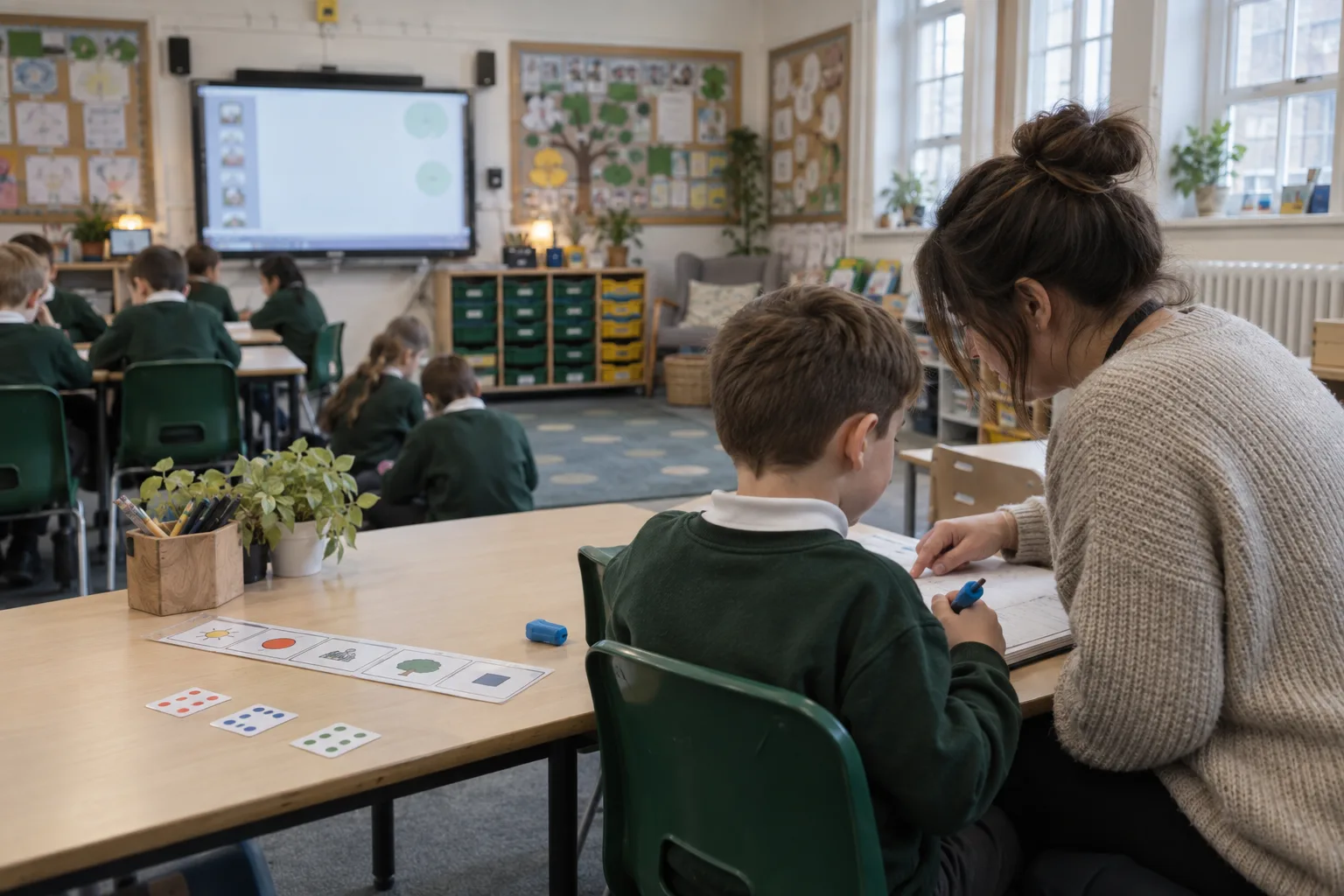
Attention Autism, also known as Bucket Time, is a powerful intervention that you can implement in your classroom to develop joint attention, communication, and social skills in children with autism. This comprehensive teacher's guide will walk you through Gina Davies' four-stage programme step by step, showing you exactly how to create those "irresistible invitations to learn" using visually engaging, sensory-rich activities. From setting up your first bucket session to adapting activities for different ability levels, you'll discover practical strategies that transform how children with autism engage with learning. Ready to see the magic of Bucket Time unfold in your classroom?
Key Takeaways
Adults Only Handle Materials: Children watch without touching for stages 1-3, building joint attention and sustained focus before any participation is expected.
Visual Spectacle Over Instructions: Minimise language and maximise visual impact with sensory-rich bucket activities that create irresistible learning invitations for autistic children.
Joy Beats Behaviour Management: Focus on creating shared excitement and curiosity rather than compliance, making activities so engaging that children naturally want to attend.
Four Stage Systematic Progression: Move from passive observation to independent task completion, building attention skills step by step through structured bucket time sessions.
Core Benefits for Students
The Four-Stage Progression: Attention Autism moves from passive observation (Stage 1) to independent task completion (Stage 4), building attention skills systematically over time
Adults Lead, Children Watch: In Stages 1-3, only adults handle the materials while children observe. This develops joint attention and sustained focus before participation is expected
Minimal Language, Maximum Impact: Use simple key words during activities rather than complex instructions. The visual spectacle does the teaching while language reinforces key concepts
Joy Over Compliance: The approach is built on creating shared excitement and curiosity, not rewards or behaviour management. If activities are not engaging enough, children will not attend
The 4 Pillars of Attention Autism Success
Benefits of Attention Autism for Students
The Four-Stage Progression: Attention Autism moves from passive observation (Stage 1) to independent task completion (Stage 4), building attention skills systematically over time
Adults Lead, Children Watch: In Stages 1-3, only adults handle the materials while children observe. This develops joint attention and sustained focus before participation is expected
Minimal Language, Maximum Impact: Use simple key words during activities rather than complex instructions. The visual spectacle does the teaching while language reinforces key concepts
Joy Over Compliance: The approach is built on creating shared excitement and curiosity, not rewards or behaviour management. If activities are not engaging enough, children will not attend
Understanding the Attention Autism Method
Attention Autism is a four-stage intervention programme that uses visually engaging activities to develop joint attention skills in children with autism. The method, also called Bucket Time, was created by speech therapist Gina Davies to build communication and social skills through irresistible sensory experiences.
The 4 Stages of Attention Autism
Attention Autism is a structured intervention designed to capture and sustain the attention of children with autism spectrum disorder (ASD). Should specify the actual years of experience with a source or remove the specific number, the approach uses highly motivating visual activities to teach fundamental communication skills.
The programme addresses a core challenge for many autistic children: developing joint attention. Joint attention is the ability to share focus with another person on an object or activity. This skill forms the foundation for language development, social interaction, and learning.
Traditional approaches often struggle because they rely on verbal instructions and social motivation that autistic children may find difficult to access. Attention Autism works differently. It creates such visually compelling, sensory-rich experiences that children want to watch. The adult becomes interesting because they control access to these fascinating activities.
The Four Stages of Attention Autism
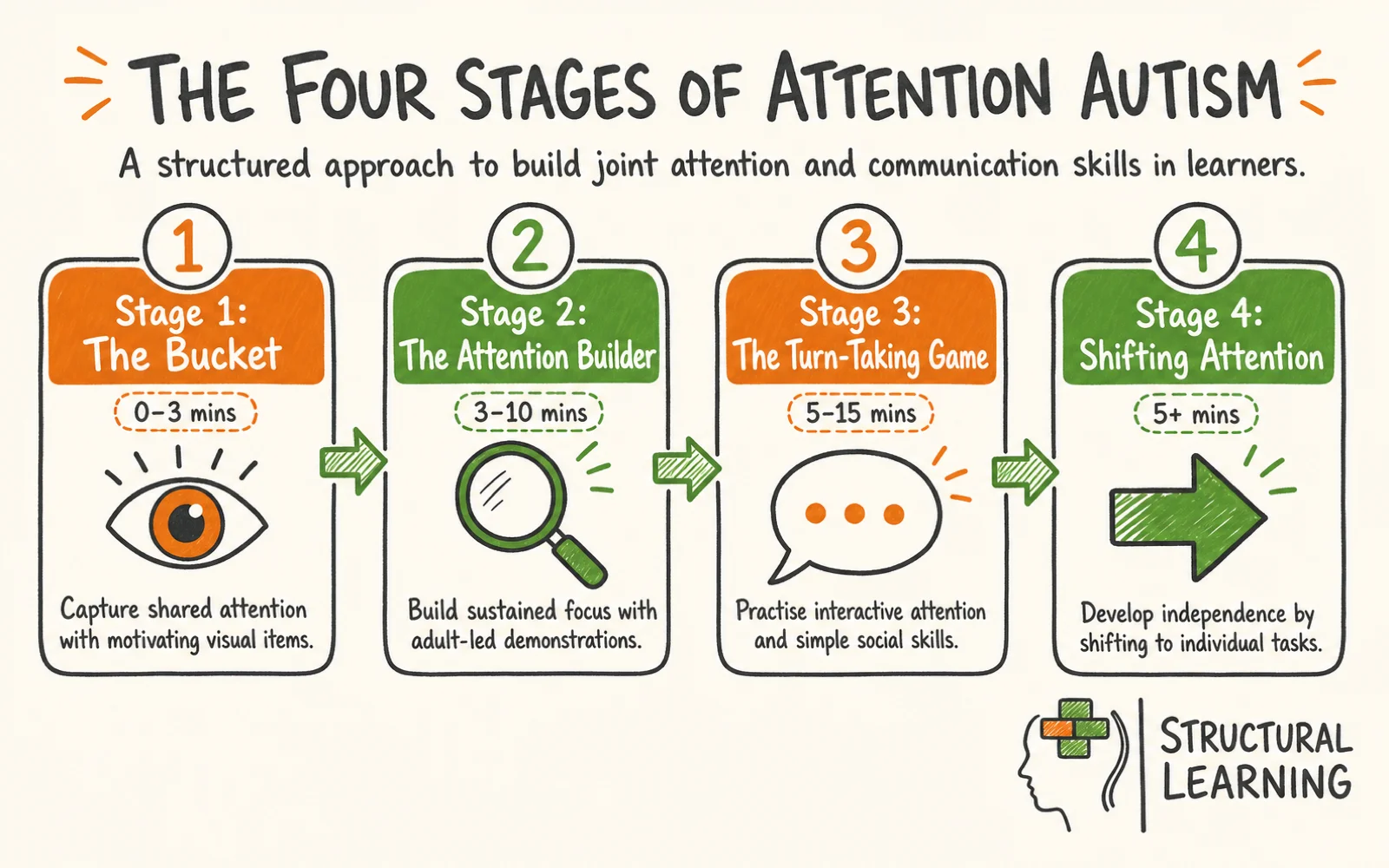
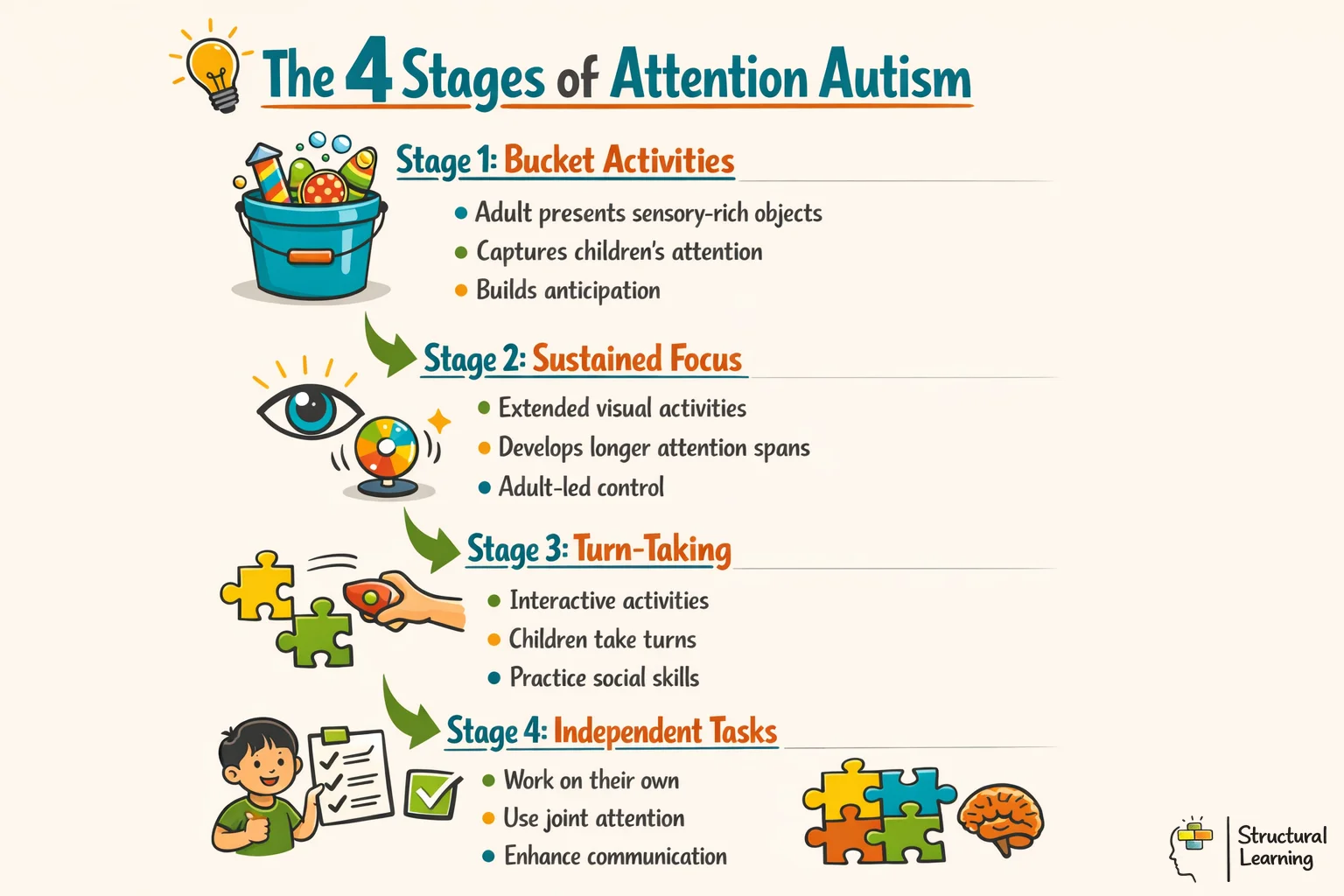
The Four Stages of Attention Autism progress from passive observation to independent participation. Stage 1 focuses on capturing attention, Stage 2 develops sustained focus, Stage 3 introduces turn-taking, and Stage 4 promotes independent task completion using the skills developed in earlier stages.
Stage 1: Focus-Building Bucket Activities
Stage 1 is where every Attention Autism process begins. A decorated bucket filled with surprising, sensory-rich objects becomes the focus of the session. The adult presents items one at a time, creating anticipation and wonder.
Once children can focus during Stage 1 bucket activities, Stage 2 extends their attention span. The Attention Builder is a single, visually spectacular activity performed by the adult that takes longer to complete and builds anticipation.
| Volcano Eruption | Build a volcano, add bicarbonate and vinegar for eruption | Bicarbonate, vinegar, container, food colouring |
| Mentos Explosion | Drop Mentos into diet cola for a dramatic fountain | Diet cola, Mentos, outdoor space |
| Paint Splat | Drop paint-filled balloons onto paper from a height | Paint, balloons, paper, height |
| Ice Excavation | Freeze toys in ice blocks, pour warm water to reveal them | Ice, small toys, warm water |
| Slime Making | Mix glue and activator with dramatic stirring | PVA glue, borax/contact lens solution, food colouring |
| Popcorn Popping | Use a clear popper so children can watch kernels pop | Popcorn maker, corn kernels |
| Colour Mixing | Pour coloured water between containers, mix to create new colours | Food colouring, water, clear containers |
| Balloon Rocket | Thread balloon on string, release to zoom across room | Balloon, string, tape, straw |
Stage 3: Interactive Turn-Taking Activities
Stage 3 introduces participation. Children are invited (never forced) to take turns in structured activities. This develops turn-taking, waiting, and emotional regulation when it is not their turn.
Purpose of Stage 3:
Introduce turn-taking with peers
Develop waiting and patience
Build tolerance for not always having a turn
Encourage verbal or non-verbal requesting
Model peer interaction
How to Run a Stage 3 Session:
Demonstrate the activity with another adult first
Invite one child to participate (use their name)
Complete the turn together, celebrating success
Return the child to their seat
Invite another child
Not every child will get a turn each session
Important Stage 3 Principles:
Children must want to participate (never force)
Model with an adult before inviting children
Keep individual turns short
Some children will watch multiple sessions before joining
Celebrate any participation, however small
Stage 3 Activity Ideas: 15 Turn-Taking Games
| Activity | What Happens | Skills Developed |
|----------|--------------|------------------|
| Pompom Splat | Child dips pompom in paint, drops it onto paper | Motor planning, cause-effect |
| Bowling | Child rolls ball to knock down pins | Turn-taking, waiting |
| Posting Box | Child posts objects through shaped holes | Matching, fine motor |
| Marble Run | Child places marble at top, watches it travel | Anticipation, tracking |
| Balloon Stomp | Child stomps on balloon to pop it | Sensory regulation, confidence |
| Fishing Game | Child uses magnetic rod to catch fish | Concentration, patience |
| Stacking Tower | Child adds block to tower, next child adds | Cooperation, waiting |
| Spray Bottle Art | Child sprays coloured water onto coffee filters | Creativity, motor skills |
| Bubble Wrap Pop | Child jumps on bubble wrap | Sensory input, excitement |
| Parachute Games | Children hold edges, bounce balls in centre | Group cooperation |
Stage 4: Developing Independent Attention Skills
Stage 4 is the final stage. Children watch a demonstration, then complete an individual version of the task independently before returning to the group to share their work.
Attention Autism sessions require a decorated bucket, visually engaging materials, and children seated in a semicircle facing the adult. Sessions begin with a signal song, proceed through structured stages, and maintain adult control of all materials until Stage 4.
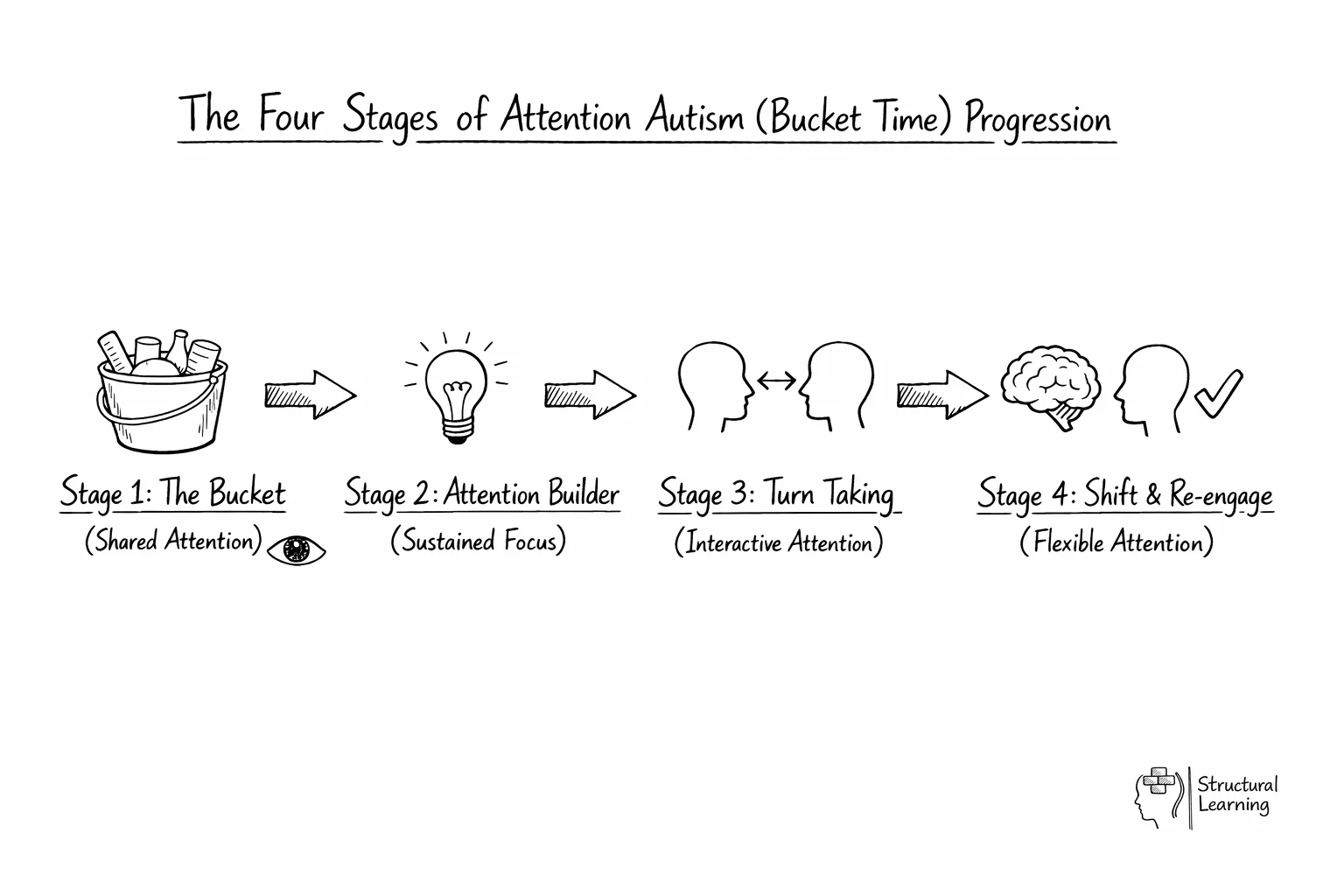
Flow diagram: The Four Stages of Attention Autism Progression
Creating the Ideal Bucket Time Environment
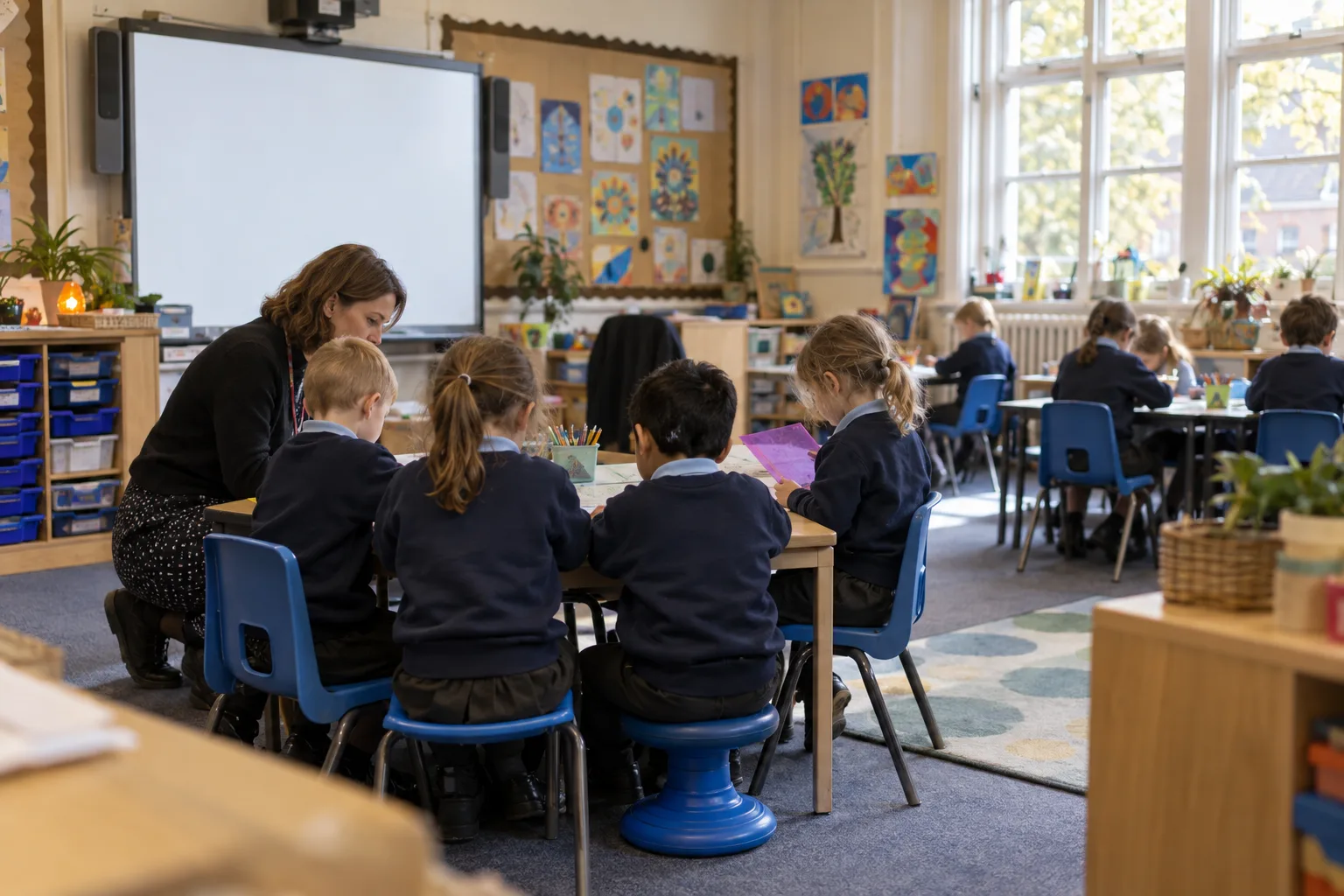
Create a calm, distraction-reduced space:
Semicircle seating arrangement
Adults positioned behind children (supporting) and in front (leading)
Minimal visual clutter
Good lighting so activities are clearly visible
Materials hidden until needed
Whiteboard visible for visual cues
Teacher and Support Staff Roles
Lead Adult:
Runs the session from the front
Controls all materials
Models enthusiasm and engagement
Uses key words and simple language
Makes eye contact with children watching
Supporting Adults:
Sit behind/beside children
Model watching and engagement
Redirect children who lose focus
Echo key words
Prevent children from grabbing materials
Celebrate alongside children
Optimal Bucket Time Session Frequency
| Stage | Session Length | Recommended Frequency |
|-------|---------------|----------------------|
| Stage 1 | 2-5 minutes | Daily |
| Stage 2 | 5-10 minutes | 3-5 times weekly |
| Stage 3 | 10-15 minutes | 2-3 times weekly |
| Stage 4 | 15-20 minutes | As readiness allows |
Children should demonstrate consistent engagement at one stage before progressing to the next. This may take weeks or months.
Communication Techniques During Bucket Time
Use minimal, consistent language throughout sessions:
Key Phrases:
"Look!" (directing attention)
"Wow!" (expressing excitement)
"Ready, steady, go!" (building anticipation)
"Your turn" / "My turn" (Stage 3)
"Finished" (closure)
Simple labels: "Ball!", "Bubbles!", "Pop!"
What to Avoid:
Complex instructions
Too many words
Questions during activities
Corrective language
Demands or commands
From Bucket to Independence: The 4-Stage Process
Troubleshooting Bucket Time Challenges
Common Attention Autism challenges include children leaving the group, lack of engagement, and difficulty progressing between stages. Solutions involve increasing visual appeal of activities, reducing session length, and ensuring materials match individual children's interests and developmental levels.
When Children Grab Bucket Time Materials
Solution: Calmly return items to the bucket, close the lid, and redirect the child to their seat. Do not make a big deal of it. The natural consequence is the activity pauses.
Managing Children Who Leave the Group
Solution: Have a supporting adult gently guide them back. If they consistently leave, ensure activities are engaging enough. Some children need more time before they are ready for group activities.
What If Children Won't Watch Activities?
Solution: Are the items motivating enough for this specific child? Observe what captures their attention outside sessions and incorporate those interests. Some children watch peripherally rather than directly.
Stuck Between Stages: Progression Solutions
Solution: There is no rush. Children may stay at Stage 1 for months. Progression happens when they are ready, not on a schedule. Pushing too fast undermines the approach.
Attention Autism Research and Evidence
Should provide accurate timeframe with sources or use less specific language working with autistic children. While large-scale randomised controlled trials are limited, the approach is widely used in UK schools and is recommended by many speech and language therapy services.
Gina Davies Autism Centre offers face-to-face and online training courses. Training is recommended before implementing the approach to ensure fidelity to the model.
Facebook group: "Attention Autism Sharing Group" (activity ideas from practitioners)
Pinterest boards with activity collections
Essential Attention Autism Books for Teachers
Gina Davies has published resources through the Gina Davies Autism Centre. Check their website for current availability.
Integrating Bucket Time Across School Curriculum
Bucket Time integrates across school curriculum by embedding target vocabulary and concepts into sensory activities. Teachers incorporate maths, science, and literacy objectives through carefully selected materials whilst maintaining the programme's focus on joint attention and communication development.
While Attention Autism began as a communication intervention, schools increasingly use it as a teaching approach across subjects:
Literacy: Use Stage 2 to demonstrate story events, Stage 4 for related mark-making
Numeracy: Counting objects in the bucket, sorting in Stage 4
Science: Experiments as Attention Builders (volcanoes, colour mixing)
Art: Creative Stage 4 tasks linked to topics
PSHE: Turn-taking and emotional regulation through Stage 3
Frequently Asked Questions
How long before we see progress?
This varies enormously. Some children engage immediately; others need weeks of consistent sessions before sustained attention develops. Progress often comes in small steps.
Can we use this with non-autistic children?
Yes. While designed for autism, the approach benefits any child who struggles with attention, communication, or social skills. Many early years settings use it universally.
What age range is suitable?
Typically used with children aged 3-11, but adaptable for older children with significant learning difficulties. Teen and adult versions exist for specialist settings.
Do we need special equipment?
No. While commercial bucket sets exist, you can source items from pound shops, charity shops, and household objects. Novelty and surprise matter more than expense.
Attention Autism vs Intensive Interaction Methods
Attention Autism is adult-led and uses props and activities. Intensive Interaction is child-led and uses the child's own behaviours as the starting point. Both develop communication but through different routes. They complement each other well.
5 Secrets to Irresistible Stage 1 Bucket Sessions
Gina Davies' Attention Autism Framework
Attention Autism is a specialist intervention approach designed to develop natural and spontaneous communication skills in children with autism. Created by speech and language therapist Gina Davies, this framework transforms traditional teaching methods by focusing on building joint attention through highly motivating, visually spectacular activities.
At its core, Attention Autism recognises that many children with autism struggle with conventional learning approaches that rely heavily on verbal instruction and social compliance. Instead of expecting children to conform to typical classroom expectations, Davies' framework works with their natural interests and sensory preferences. The approach uses what Davies calls "irresistible invitations to learn", activities so engaging that children naturally want to watch and eventually participate.
The framework operates on four key principles that distinguish it from other interventions. First, it prioritises engagement over compliance; if children aren't genuinely interested, the activity needs changing rather than forcing participation. Second, it builds skills progressively, starting with simple observation before moving to active involvement. Third, it uses minimal language, allowing visual spectacle to carry the teaching load. Finally, it celebrates process over product, focusing on the shared experience rather than perfect outcomes.
In practise, this might look like using a bubble machine with added glitter during Stage 1 to capture whole-group attention, or creating "magic" colour-changing water experiments during Stage 2 activities. Teachers report that children who previously struggled to engage for even seconds can sustain attention for 10-15 minutes when activities align with Attention Autism principles. Research by Davies (2013) demonstrated significant improvements in joint attention skills, with participating children showing increased eye contact, shared enjoyment, and spontaneous communication attempts after regular Bucket Time sessions.
Preparing Your Bucket Time Environment
Creating an effective Bucket Time environment requires thoughtful preparation and strategic positioning. Your physical setup directly impacts children's ability to engage with the visual spectacle, so careful planning is essential for success.
Begin by selecting a consistent space where children can sit in a semicircle facing you. Position yourself against a plain background, ideally a blank wall, to minimise visual distractions. Place your bucket of materials within easy reach but hidden from view; a tablecloth over the bucket works brilliantly for building anticipation. Ensure all children have clear sightlines to your demonstration area, which should be at their eye level when seated.
Timing is crucial for maintaining engagement. Start with 5-minute sessions for beginners, gradually extending to 10-15 minutes as attention skills develop. Schedule Bucket Time at consistent points in your routine, such as after morning registration or before snack time. This predictability helps children prepare mentally for the focused attention required.
Essential materials include a decorated bucket (bright colours and textures work well), a selection of visually striking items that create movement or surprise, and a simple visual schedule showing the Bucket Time symbol. For Stage 1, collect items like spinning tops, bubble machines, wind-up toys, or colourful scarves. Stage 2 requires materials for simple cause-and-effect demonstrations: shaving foam and food colouring, water beads in clear containers, or musical instruments that create unexpected sounds.
Remember to prepare your materials in advance and test each activity beforehand. Having a colleague observe your first few sessions can provide valuable feedback about positioning and pacing. Most importantly, your own enthusiasm sets the tone; if you're genuinely excited about revealing each item, children will mirror that engagement naturally.
Detailed Guide to Four Attention Stages
Understanding the four-stage structure of Attention Autism is essential for successful implementation. Each stage builds upon the previous one, creating a scaffolded approach that gradually increases expectations whilst maintaining high engagement.
Stage 1: The Bucket focuses on gaining and maintaining attention through highly motivating visual activities. The adult produces surprising items from a bucket, such as wind-up toys, light spinners, or bubble machines. Children watch but do not touch. This stage typically lasts 5-10 minutes and establishes the foundation of shared attention. For example, pulling out a singing puppet or a glowing sensory ball creates immediate visual interest that draws the whole group together.
Stage 2: The Attention Builder extends focusing time through visually spectacular activities. The adult demonstrates activities like flour and glitter mixing, shaving foam spreading, or paint pouring onto large surfaces. Children continue watching without participating. This stage develops sustained joint attention for 3-5 minutes per activity. Teachers might roll marbles through paint on paper or create 'magic' colour-changing experiments using simple kitchen ingredients.
Stage 3: Turn Taking and Re-engagement introduces participation within a structured format. Children take individual turns to complete a simple action modelled by the adult, such as shaking a sensory bottle or pressing a switch toy. The key is maintaining brief, successful turns that keep the group engaged. Activities might include posting items into containers, activating cause-and-effect toys, or simple mark-making with unusual tools.
Stage 4: Individual Work transitions children to independent table-top activities. Students work simultaneously on parallel tasks based on skills practised in earlier stages. This might involve individual art activities, simple construction tasks, or sensory exploration trays. The shift from group observation to individual participation demonstrates genuine skill development and generalisation.
Davies (2013) emphasises that progression through stages should be flexible, with most sessions focusing on Stages 1-2 until children consistently demonstrate readiness for more active participation.
Attention Autism Implementation Best Practices
Attention Autism offers a structured, joyful approach to developing attention and communication skills in autistic children. By creating visually spectacular, sensory-rich experiences that children genuinely want to watch, practitioners can build the joint attention skills that form the foundation for all learning.
The four-stage progression from passive observation to independent task completion provides a clear pathway for development. Success depends on making activities so engaging that children cannot help but attend, then gradually introducing participation and independence as skills develop.
Remember Gina Davies' guiding principle: offer an irresistible invitation to learn through creating curiosity and joy in shared good times.
Further Reading: Key Research Papers
These peer-reviewed studies provide the research foundation for the strategies discussed in this article:
INSTRUCTORS' USAGE OF MOBILE LEARNING APPLICATIONS IN CLASSROOM AND ITS IMPACT ON THE LEARNERS'PERFORMANCEView study ↗ 1 citations
Liu Min (2024)
This research examined how university instructors use mobile learning apps in their classrooms and found that strategic integration of these tools significantly boosts student motivation and academic performance. The study emphasizes that success depends on aligning mobile app activities with clear learning goals and incorporating hands-on, multi-sensory experiences. For teachers considering digital tools in their practise, this research provides valuable evidence that thoughtful technology integration can enhance student engagement and learning outcomes.
The Effectiveness of Interactive Teaching Strategies in Teaching English LanguageView study ↗ 5 citations
Israa Eibead Ajaj (2023)
This study demonstrates that interactive teaching methods significantly improve students' development of core English language skills including listening, speaking, reading, and writing. The research shows that when teachers move beyond traditional lecture-based approaches to incorporate collaborative and engaging activities, students develop stronger language competencies. This finding is particularly valuable for educators working with English language learners, as it provides evidence-based support for adopting more dynamic, student-centred teaching approaches.
The development of student feedback literacy: the influences of teacher feedback on peer feedbackView study ↗ 172 citations
Ye Han & Yueting Xu (2019)
This research reveals that when teachers provide thoughtful follow-up feedback on student peer assessments, it dramatically improves students' ability to give and receive meaningful feedback from classmates. The study found that teacher guidance helps students develop critical evaluation skills and become more effective collaborators in their own learning process. This has important implications for classroom practise, suggesting that peer feedback activities are most successful when teachers actively scaffold and support the process rather than simply assigning peer review tasks.
Technology-enhanced multisensory music education for children with autism: Effects on sensory integration and learning behavioursView study ↗
Liza Lee & Han-Ju Ho (2025)
This groundbreaking study found that combining colour-coded music notation with interactive, multisensory music technology significantly improved sensory processing and learning behaviours in preschool children with autism spectrum disorder. The research demonstrates that structured, multisensory musical activities can help children with autism better integrate sensory information and develop stronger learning skills. For educators working with students on the autism spectrum, this research highlights the powerful potential of combining music, visual supports, and interactive technology to create more accessible and effective learning experiences.
Teacher Candidates' Views On Self And Peer Assessment As A Tool For Student DevelopmentView study ↗ 28 citations
F. Bozkurt (2020)
This research explored future teachers' perspectives on self and peer assessment and found that these strategies function as powerful learning tools rather than just evaluation methods. The study reveals that when students assess their own work and provide feedback to classmates, they develop deeper understanding, critical thinking skills, and greater ownership of their learning. For practising teachers, this research reinforces the value of incorporating regular self-reflection and peer feedback opportunities as integral parts of the learning process, not just end-of-unit activities.
Attention Autism, also known as Bucket Time, is a powerful intervention that you can implement in your classroom to develop joint attention, communication, and social skills in children with autism. This comprehensive teacher's guide will walk you through Gina Davies' four-stage programme step by step, showing you exactly how to create those "irresistible invitations to learn" using visually engaging, sensory-rich activities. From setting up your first bucket session to adapting activities for different ability levels, you'll discover practical strategies that transform how children with autism engage with learning. Ready to see the magic of Bucket Time unfold in your classroom?
Key Takeaways
Adults Only Handle Materials: Children watch without touching for stages 1-3, building joint attention and sustained focus before any participation is expected.
Visual Spectacle Over Instructions: Minimise language and maximise visual impact with sensory-rich bucket activities that create irresistible learning invitations for autistic children.
Joy Beats Behaviour Management: Focus on creating shared excitement and curiosity rather than compliance, making activities so engaging that children naturally want to attend.
Four Stage Systematic Progression: Move from passive observation to independent task completion, building attention skills step by step through structured bucket time sessions.
Core Benefits for Students
The Four-Stage Progression: Attention Autism moves from passive observation (Stage 1) to independent task completion (Stage 4), building attention skills systematically over time
Adults Lead, Children Watch: In Stages 1-3, only adults handle the materials while children observe. This develops joint attention and sustained focus before participation is expected
Minimal Language, Maximum Impact: Use simple key words during activities rather than complex instructions. The visual spectacle does the teaching while language reinforces key concepts
Joy Over Compliance: The approach is built on creating shared excitement and curiosity, not rewards or behaviour management. If activities are not engaging enough, children will not attend
The 4 Pillars of Attention Autism Success
Benefits of Attention Autism for Students
The Four-Stage Progression: Attention Autism moves from passive observation (Stage 1) to independent task completion (Stage 4), building attention skills systematically over time
Adults Lead, Children Watch: In Stages 1-3, only adults handle the materials while children observe. This develops joint attention and sustained focus before participation is expected
Minimal Language, Maximum Impact: Use simple key words during activities rather than complex instructions. The visual spectacle does the teaching while language reinforces key concepts
Joy Over Compliance: The approach is built on creating shared excitement and curiosity, not rewards or behaviour management. If activities are not engaging enough, children will not attend
Understanding the Attention Autism Method
Attention Autism is a four-stage intervention programme that uses visually engaging activities to develop joint attention skills in children with autism. The method, also called Bucket Time, was created by speech therapist Gina Davies to build communication and social skills through irresistible sensory experiences.
The 4 Stages of Attention Autism
Attention Autism is a structured intervention designed to capture and sustain the attention of children with autism spectrum disorder (ASD). Should specify the actual years of experience with a source or remove the specific number, the approach uses highly motivating visual activities to teach fundamental communication skills.
The programme addresses a core challenge for many autistic children: developing joint attention. Joint attention is the ability to share focus with another person on an object or activity. This skill forms the foundation for language development, social interaction, and learning.
Traditional approaches often struggle because they rely on verbal instructions and social motivation that autistic children may find difficult to access. Attention Autism works differently. It creates such visually compelling, sensory-rich experiences that children want to watch. The adult becomes interesting because they control access to these fascinating activities.
The Four Stages of Attention Autism
The Four Stages of Attention Autism progress from passive observation to independent participation. Stage 1 focuses on capturing attention, Stage 2 develops sustained focus, Stage 3 introduces turn-taking, and Stage 4 promotes independent task completion using the skills developed in earlier stages.
Stage 1: Focus-Building Bucket Activities
Stage 1 is where every Attention Autism process begins. A decorated bucket filled with surprising, sensory-rich objects becomes the focus of the session. The adult presents items one at a time, creating anticipation and wonder.
Once children can focus during Stage 1 bucket activities, Stage 2 extends their attention span. The Attention Builder is a single, visually spectacular activity performed by the adult that takes longer to complete and builds anticipation.
| Volcano Eruption | Build a volcano, add bicarbonate and vinegar for eruption | Bicarbonate, vinegar, container, food colouring |
| Mentos Explosion | Drop Mentos into diet cola for a dramatic fountain | Diet cola, Mentos, outdoor space |
| Paint Splat | Drop paint-filled balloons onto paper from a height | Paint, balloons, paper, height |
| Ice Excavation | Freeze toys in ice blocks, pour warm water to reveal them | Ice, small toys, warm water |
| Slime Making | Mix glue and activator with dramatic stirring | PVA glue, borax/contact lens solution, food colouring |
| Popcorn Popping | Use a clear popper so children can watch kernels pop | Popcorn maker, corn kernels |
| Colour Mixing | Pour coloured water between containers, mix to create new colours | Food colouring, water, clear containers |
| Balloon Rocket | Thread balloon on string, release to zoom across room | Balloon, string, tape, straw |
Stage 3: Interactive Turn-Taking Activities
Stage 3 introduces participation. Children are invited (never forced) to take turns in structured activities. This develops turn-taking, waiting, and emotional regulation when it is not their turn.
Purpose of Stage 3:
Introduce turn-taking with peers
Develop waiting and patience
Build tolerance for not always having a turn
Encourage verbal or non-verbal requesting
Model peer interaction
How to Run a Stage 3 Session:
Demonstrate the activity with another adult first
Invite one child to participate (use their name)
Complete the turn together, celebrating success
Return the child to their seat
Invite another child
Not every child will get a turn each session
Important Stage 3 Principles:
Children must want to participate (never force)
Model with an adult before inviting children
Keep individual turns short
Some children will watch multiple sessions before joining
Celebrate any participation, however small
Stage 3 Activity Ideas: 15 Turn-Taking Games
| Activity | What Happens | Skills Developed |
|----------|--------------|------------------|
| Pompom Splat | Child dips pompom in paint, drops it onto paper | Motor planning, cause-effect |
| Bowling | Child rolls ball to knock down pins | Turn-taking, waiting |
| Posting Box | Child posts objects through shaped holes | Matching, fine motor |
| Marble Run | Child places marble at top, watches it travel | Anticipation, tracking |
| Balloon Stomp | Child stomps on balloon to pop it | Sensory regulation, confidence |
| Fishing Game | Child uses magnetic rod to catch fish | Concentration, patience |
| Stacking Tower | Child adds block to tower, next child adds | Cooperation, waiting |
| Spray Bottle Art | Child sprays coloured water onto coffee filters | Creativity, motor skills |
| Bubble Wrap Pop | Child jumps on bubble wrap | Sensory input, excitement |
| Parachute Games | Children hold edges, bounce balls in centre | Group cooperation |
Stage 4: Developing Independent Attention Skills
Stage 4 is the final stage. Children watch a demonstration, then complete an individual version of the task independently before returning to the group to share their work.
Attention Autism sessions require a decorated bucket, visually engaging materials, and children seated in a semicircle facing the adult. Sessions begin with a signal song, proceed through structured stages, and maintain adult control of all materials until Stage 4.
Flow diagram: The Four Stages of Attention Autism Progression
Creating the Ideal Bucket Time Environment
Create a calm, distraction-reduced space:
Semicircle seating arrangement
Adults positioned behind children (supporting) and in front (leading)
Minimal visual clutter
Good lighting so activities are clearly visible
Materials hidden until needed
Whiteboard visible for visual cues
Teacher and Support Staff Roles
Lead Adult:
Runs the session from the front
Controls all materials
Models enthusiasm and engagement
Uses key words and simple language
Makes eye contact with children watching
Supporting Adults:
Sit behind/beside children
Model watching and engagement
Redirect children who lose focus
Echo key words
Prevent children from grabbing materials
Celebrate alongside children
Optimal Bucket Time Session Frequency
| Stage | Session Length | Recommended Frequency |
|-------|---------------|----------------------|
| Stage 1 | 2-5 minutes | Daily |
| Stage 2 | 5-10 minutes | 3-5 times weekly |
| Stage 3 | 10-15 minutes | 2-3 times weekly |
| Stage 4 | 15-20 minutes | As readiness allows |
Children should demonstrate consistent engagement at one stage before progressing to the next. This may take weeks or months.
Communication Techniques During Bucket Time
Use minimal, consistent language throughout sessions:
Key Phrases:
"Look!" (directing attention)
"Wow!" (expressing excitement)
"Ready, steady, go!" (building anticipation)
"Your turn" / "My turn" (Stage 3)
"Finished" (closure)
Simple labels: "Ball!", "Bubbles!", "Pop!"
What to Avoid:
Complex instructions
Too many words
Questions during activities
Corrective language
Demands or commands
From Bucket to Independence: The 4-Stage Process
Troubleshooting Bucket Time Challenges
Common Attention Autism challenges include children leaving the group, lack of engagement, and difficulty progressing between stages. Solutions involve increasing visual appeal of activities, reducing session length, and ensuring materials match individual children's interests and developmental levels.
When Children Grab Bucket Time Materials
Solution: Calmly return items to the bucket, close the lid, and redirect the child to their seat. Do not make a big deal of it. The natural consequence is the activity pauses.
Managing Children Who Leave the Group
Solution: Have a supporting adult gently guide them back. If they consistently leave, ensure activities are engaging enough. Some children need more time before they are ready for group activities.
What If Children Won't Watch Activities?
Solution: Are the items motivating enough for this specific child? Observe what captures their attention outside sessions and incorporate those interests. Some children watch peripherally rather than directly.
Stuck Between Stages: Progression Solutions
Solution: There is no rush. Children may stay at Stage 1 for months. Progression happens when they are ready, not on a schedule. Pushing too fast undermines the approach.
Attention Autism Research and Evidence
Should provide accurate timeframe with sources or use less specific language working with autistic children. While large-scale randomised controlled trials are limited, the approach is widely used in UK schools and is recommended by many speech and language therapy services.
Gina Davies Autism Centre offers face-to-face and online training courses. Training is recommended before implementing the approach to ensure fidelity to the model.
Facebook group: "Attention Autism Sharing Group" (activity ideas from practitioners)
Pinterest boards with activity collections
Essential Attention Autism Books for Teachers
Gina Davies has published resources through the Gina Davies Autism Centre. Check their website for current availability.
Integrating Bucket Time Across School Curriculum
Bucket Time integrates across school curriculum by embedding target vocabulary and concepts into sensory activities. Teachers incorporate maths, science, and literacy objectives through carefully selected materials whilst maintaining the programme's focus on joint attention and communication development.
While Attention Autism began as a communication intervention, schools increasingly use it as a teaching approach across subjects:
Literacy: Use Stage 2 to demonstrate story events, Stage 4 for related mark-making
Numeracy: Counting objects in the bucket, sorting in Stage 4
Science: Experiments as Attention Builders (volcanoes, colour mixing)
Art: Creative Stage 4 tasks linked to topics
PSHE: Turn-taking and emotional regulation through Stage 3
Frequently Asked Questions
How long before we see progress?
This varies enormously. Some children engage immediately; others need weeks of consistent sessions before sustained attention develops. Progress often comes in small steps.
Can we use this with non-autistic children?
Yes. While designed for autism, the approach benefits any child who struggles with attention, communication, or social skills. Many early years settings use it universally.
What age range is suitable?
Typically used with children aged 3-11, but adaptable for older children with significant learning difficulties. Teen and adult versions exist for specialist settings.
Do we need special equipment?
No. While commercial bucket sets exist, you can source items from pound shops, charity shops, and household objects. Novelty and surprise matter more than expense.
Attention Autism vs Intensive Interaction Methods
Attention Autism is adult-led and uses props and activities. Intensive Interaction is child-led and uses the child's own behaviours as the starting point. Both develop communication but through different routes. They complement each other well.
5 Secrets to Irresistible Stage 1 Bucket Sessions
Gina Davies' Attention Autism Framework
Attention Autism is a specialist intervention approach designed to develop natural and spontaneous communication skills in children with autism. Created by speech and language therapist Gina Davies, this framework transforms traditional teaching methods by focusing on building joint attention through highly motivating, visually spectacular activities.
At its core, Attention Autism recognises that many children with autism struggle with conventional learning approaches that rely heavily on verbal instruction and social compliance. Instead of expecting children to conform to typical classroom expectations, Davies' framework works with their natural interests and sensory preferences. The approach uses what Davies calls "irresistible invitations to learn", activities so engaging that children naturally want to watch and eventually participate.
The framework operates on four key principles that distinguish it from other interventions. First, it prioritises engagement over compliance; if children aren't genuinely interested, the activity needs changing rather than forcing participation. Second, it builds skills progressively, starting with simple observation before moving to active involvement. Third, it uses minimal language, allowing visual spectacle to carry the teaching load. Finally, it celebrates process over product, focusing on the shared experience rather than perfect outcomes.
In practise, this might look like using a bubble machine with added glitter during Stage 1 to capture whole-group attention, or creating "magic" colour-changing water experiments during Stage 2 activities. Teachers report that children who previously struggled to engage for even seconds can sustain attention for 10-15 minutes when activities align with Attention Autism principles. Research by Davies (2013) demonstrated significant improvements in joint attention skills, with participating children showing increased eye contact, shared enjoyment, and spontaneous communication attempts after regular Bucket Time sessions.
Preparing Your Bucket Time Environment
Creating an effective Bucket Time environment requires thoughtful preparation and strategic positioning. Your physical setup directly impacts children's ability to engage with the visual spectacle, so careful planning is essential for success.
Begin by selecting a consistent space where children can sit in a semicircle facing you. Position yourself against a plain background, ideally a blank wall, to minimise visual distractions. Place your bucket of materials within easy reach but hidden from view; a tablecloth over the bucket works brilliantly for building anticipation. Ensure all children have clear sightlines to your demonstration area, which should be at their eye level when seated.
Timing is crucial for maintaining engagement. Start with 5-minute sessions for beginners, gradually extending to 10-15 minutes as attention skills develop. Schedule Bucket Time at consistent points in your routine, such as after morning registration or before snack time. This predictability helps children prepare mentally for the focused attention required.
Essential materials include a decorated bucket (bright colours and textures work well), a selection of visually striking items that create movement or surprise, and a simple visual schedule showing the Bucket Time symbol. For Stage 1, collect items like spinning tops, bubble machines, wind-up toys, or colourful scarves. Stage 2 requires materials for simple cause-and-effect demonstrations: shaving foam and food colouring, water beads in clear containers, or musical instruments that create unexpected sounds.
Remember to prepare your materials in advance and test each activity beforehand. Having a colleague observe your first few sessions can provide valuable feedback about positioning and pacing. Most importantly, your own enthusiasm sets the tone; if you're genuinely excited about revealing each item, children will mirror that engagement naturally.
Detailed Guide to Four Attention Stages
Understanding the four-stage structure of Attention Autism is essential for successful implementation. Each stage builds upon the previous one, creating a scaffolded approach that gradually increases expectations whilst maintaining high engagement.
Stage 1: The Bucket focuses on gaining and maintaining attention through highly motivating visual activities. The adult produces surprising items from a bucket, such as wind-up toys, light spinners, or bubble machines. Children watch but do not touch. This stage typically lasts 5-10 minutes and establishes the foundation of shared attention. For example, pulling out a singing puppet or a glowing sensory ball creates immediate visual interest that draws the whole group together.
Stage 2: The Attention Builder extends focusing time through visually spectacular activities. The adult demonstrates activities like flour and glitter mixing, shaving foam spreading, or paint pouring onto large surfaces. Children continue watching without participating. This stage develops sustained joint attention for 3-5 minutes per activity. Teachers might roll marbles through paint on paper or create 'magic' colour-changing experiments using simple kitchen ingredients.
Stage 3: Turn Taking and Re-engagement introduces participation within a structured format. Children take individual turns to complete a simple action modelled by the adult, such as shaking a sensory bottle or pressing a switch toy. The key is maintaining brief, successful turns that keep the group engaged. Activities might include posting items into containers, activating cause-and-effect toys, or simple mark-making with unusual tools.
Stage 4: Individual Work transitions children to independent table-top activities. Students work simultaneously on parallel tasks based on skills practised in earlier stages. This might involve individual art activities, simple construction tasks, or sensory exploration trays. The shift from group observation to individual participation demonstrates genuine skill development and generalisation.
Davies (2013) emphasises that progression through stages should be flexible, with most sessions focusing on Stages 1-2 until children consistently demonstrate readiness for more active participation.
Attention Autism Implementation Best Practices
Attention Autism offers a structured, joyful approach to developing attention and communication skills in autistic children. By creating visually spectacular, sensory-rich experiences that children genuinely want to watch, practitioners can build the joint attention skills that form the foundation for all learning.
The four-stage progression from passive observation to independent task completion provides a clear pathway for development. Success depends on making activities so engaging that children cannot help but attend, then gradually introducing participation and independence as skills develop.
Remember Gina Davies' guiding principle: offer an irresistible invitation to learn through creating curiosity and joy in shared good times.
Further Reading: Key Research Papers
These peer-reviewed studies provide the research foundation for the strategies discussed in this article:
INSTRUCTORS' USAGE OF MOBILE LEARNING APPLICATIONS IN CLASSROOM AND ITS IMPACT ON THE LEARNERS'PERFORMANCEView study ↗ 1 citations
Liu Min (2024)
This research examined how university instructors use mobile learning apps in their classrooms and found that strategic integration of these tools significantly boosts student motivation and academic performance. The study emphasizes that success depends on aligning mobile app activities with clear learning goals and incorporating hands-on, multi-sensory experiences. For teachers considering digital tools in their practise, this research provides valuable evidence that thoughtful technology integration can enhance student engagement and learning outcomes.
The Effectiveness of Interactive Teaching Strategies in Teaching English LanguageView study ↗ 5 citations
Israa Eibead Ajaj (2023)
This study demonstrates that interactive teaching methods significantly improve students' development of core English language skills including listening, speaking, reading, and writing. The research shows that when teachers move beyond traditional lecture-based approaches to incorporate collaborative and engaging activities, students develop stronger language competencies. This finding is particularly valuable for educators working with English language learners, as it provides evidence-based support for adopting more dynamic, student-centred teaching approaches.
The development of student feedback literacy: the influences of teacher feedback on peer feedbackView study ↗ 172 citations
Ye Han & Yueting Xu (2019)
This research reveals that when teachers provide thoughtful follow-up feedback on student peer assessments, it dramatically improves students' ability to give and receive meaningful feedback from classmates. The study found that teacher guidance helps students develop critical evaluation skills and become more effective collaborators in their own learning process. This has important implications for classroom practise, suggesting that peer feedback activities are most successful when teachers actively scaffold and support the process rather than simply assigning peer review tasks.
Technology-enhanced multisensory music education for children with autism: Effects on sensory integration and learning behavioursView study ↗
Liza Lee & Han-Ju Ho (2025)
This groundbreaking study found that combining colour-coded music notation with interactive, multisensory music technology significantly improved sensory processing and learning behaviours in preschool children with autism spectrum disorder. The research demonstrates that structured, multisensory musical activities can help children with autism better integrate sensory information and develop stronger learning skills. For educators working with students on the autism spectrum, this research highlights the powerful potential of combining music, visual supports, and interactive technology to create more accessible and effective learning experiences.
Teacher Candidates' Views On Self And Peer Assessment As A Tool For Student DevelopmentView study ↗ 28 citations
F. Bozkurt (2020)
This research explored future teachers' perspectives on self and peer assessment and found that these strategies function as powerful learning tools rather than just evaluation methods. The study reveals that when students assess their own work and provide feedback to classmates, they develop deeper understanding, critical thinking skills, and greater ownership of their learning. For practising teachers, this research reinforces the value of incorporating regular self-reflection and peer feedback opportunities as integral parts of the learning process, not just end-of-unit activities.