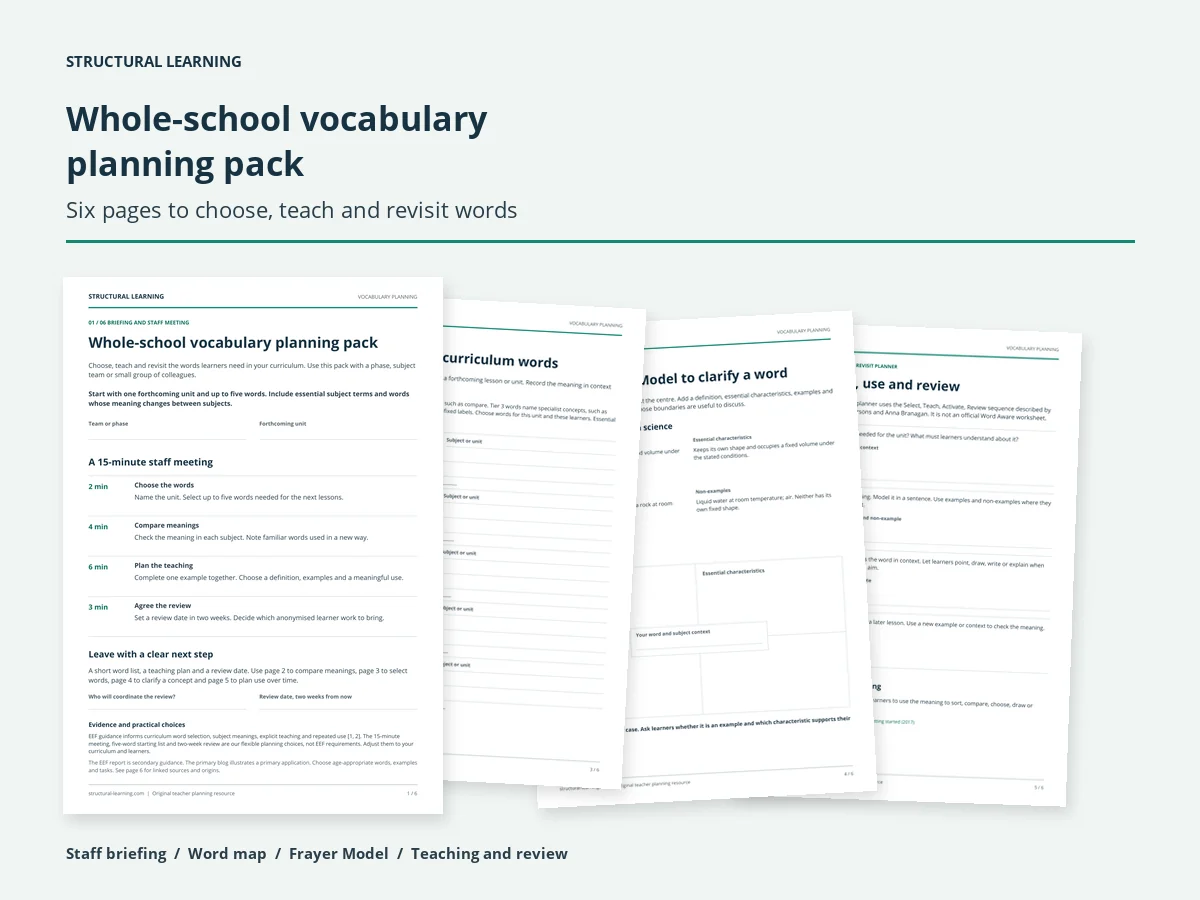
Word Aware: The Complete Guide to the STAR Approach for Vocabulary DevelopmentWord Aware: The Complete Guide to the STAR Approach for Vocabulary Development - educational concept illustration

Updated on  

January 21, 2026

Word Aware: The Complete Guide to the STAR Approach for Vocabulary Development

|

January 20, 2026

Implement the Word Aware STAR approach for effective vocabulary teaching. Covers word selection, Goldilocks words, whole-school implementation, and strategies for SEND and EAL learners.

Course Enquiry
Copy citation

Main, P. (2026, January 20). Word Aware: The Complete Guide to the STAR Approach for Vocabulary Development. Retrieved from https://www.structural-learning.com/post/word-aware-complete-guide-star-approach

Word Aware is an evidence-based vocabulary intervention developed by speech and language therapists Anna Branagan and Stephen Parsons. The approach transforms how schools teach vocabulary by moving beyond simple definitions to deep, lasting word knowledge. Through the STAR framework (Select, Teach, Activate, Review), children encounter target words in meaningful contexts across the school day, building the rich vocabulary knowledge that underpins reading comprehension, academic success, and communication skills.

Research shows that vocabulary knowledge at school entry is one of the strongest predictors of later academic achievement. Children from disadvantaged backgrounds often enter school with significantly smaller vocabularies than their peers, creating a gap that widens without explicit intervention. Word Aware provides schools with a structured, whole-school approach to vocabulary teaching that closes this gap while benefiting all learners.

Traditional Vocabulary Teaching vs Word Aware Approach infographic for teachers
Traditional Vocabulary Teaching vs Word Aware Approach

Key Takeaways

  • Vocabulary needs explicit teaching: Incidental exposure to new words is insufficient for building deep word knowledge. The STAR approach provides a systematic framework ensuring children encounter words repeatedly in varied, meaningful contexts
  • Not all words deserve equal attention: Word Aware distinguishes between Anchor words (basic, high-frequency), Goldilocks words (curriculum-relevant, teachable), and Step-on words (specialist, domain-specific), helping teachers prioritise effectively
  • Twelve meaningful encounters builds retention: Research suggests children need approximately twelve meaningful encounters with a word before it becomes part of their productive vocabulary, not just recognised but actively used
  • Whole-school consistency multiplies impact: When every teacher uses the STAR approach and common vocabulary displays, children encounter target words across subjects and contexts, dramatically increasing exposure and reinforcing learning

What Is Word Aware?

Word Aware is a whole-school vocabulary programme based on research into how children learn new words effectively. The approach was developed by Anna Branagan and Stephen Parsons, experienced speech and language therapists who recognised that traditional vocabulary teaching, typically involving definitions and single exposures, fails to create lasting word knowledge.

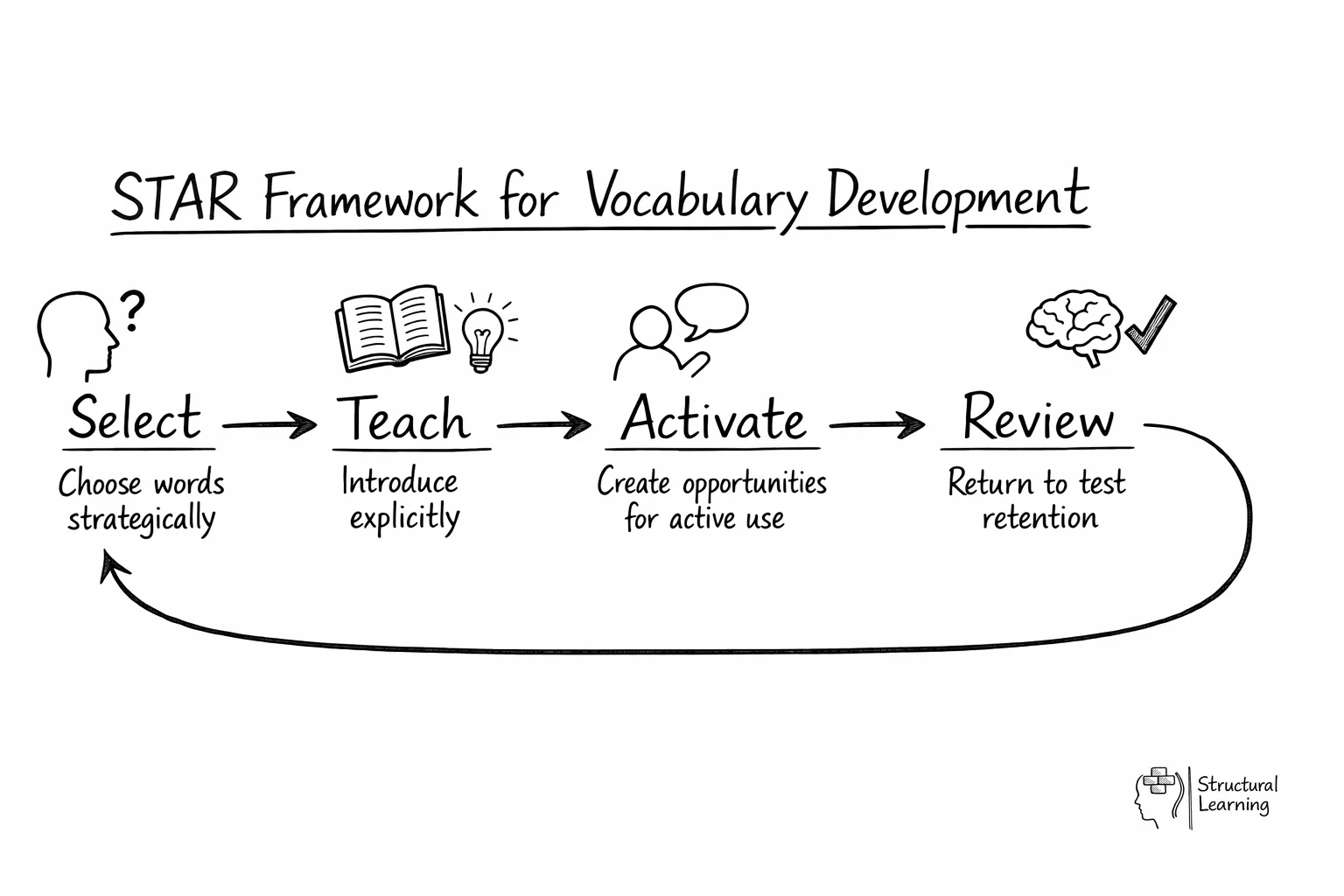
The programme centres on the STAR framework, a four-step process for teaching vocabulary:

Select - Choose words strategically, prioritising words that children will encounter across subjects and contexts, and that are within reach of current understanding.

Teach - Introduce words explicitly using child-friendly definitions, examples, images, and connections to known concepts.

Activate - Create multiple opportunities for children to use target words actively in speaking and writing across the curriculum.

Review - Return to words regularly, testing retention and deepening understanding over time.

Word Aware differs from traditional vocabulary instruction in several crucial ways. Rather than teaching words in isolation, it embeds vocabulary development across the curriculum. Rather than relying on dictionary definitions, it uses child-friendly explanations with concrete examples. Rather than assuming one exposure is sufficient, it plans for twelve or more meaningful encounters with each word.

The Evidence Base for Word Aware

Word Aware draws on decades of vocabulary research, particularly the work of Blachowicz and Fisher (2010) on effective vocabulary instruction. Understanding this evidence helps teachers appreciate why the approach works and implement it with fidelity.

The vocabulary gap is real and consequential: Hart and Risley's seminal research found that children from low-income families hear approximately 30 million fewer words by age three than children from higher-income families. While subsequent research has debated exact figures, the fundamental finding holds: children enter school with vastly different vocabulary sizes, and this gap predicts later reading comprehension and academic achievement.

Incidental learning is insufficient: Children do learn some words through incidental exposure during reading and conversation. However, this learning is unreliable and varies dramatically between children. Research shows that children with larger vocabularies actually learn more words incidentally than children with smaller vocabularies, meaning incidental exposure widens rather than closes the gap.

Explicit instruction accelerates learning: Stahl and Fairbanks' meta-analysis found that explicit vocabulary instruction produces significant gains in word knowledge and reading comprehension. Effect sizes are larger when instruction goes beyond definitions to include multiple contexts, meaningful use, and connections to prior knowledge.

Multiple exposures are essential: Research consistently shows that single exposures to new words produce little lasting learning. Beck and McKeown suggest children need approximately twelve meaningful encounters with a word before it moves from recognition to productive use. Word Aware operationalises this finding through the STAR framework.

Context matters: Words learned in rich, meaningful contexts are retained better than words learned through rote memorisation. The approach's emphasis on activation across contexts reflects this principle.

Understanding Word Types: Anchor, Goldilocks, and Step-on

One of Word Aware's most practical contributions is its classification of words into three tiers, helping teachers prioritise which words deserve intensive teaching.

Anchor Words are basic, high-frequency words that most children acquire through everyday language exposure. Examples include "big", "happy", "run", and "house". These words rarely need explicit teaching for typically developing children, though they may require attention for children with language difficulties or English as an additional language. Anchor words form the foundation upon which other vocabulary builds.

Goldilocks Words are the priority targets for vocabulary instruction. These are words that are:

  • Useful across multiple contexts (not restricted to one subject)
  • Sophisticated but not obscure
  • Within reach of children's conceptual understanding
  • Likely to appear in academic texts and formal language

Examples include "fortunate", "merchant", "absurd", "coincidence", and "analyse". These words are just right for explicit teaching because children are unlikely to learn them through incidental exposure but can understand them when taught explicitly. Goldilocks words significantly expand children's expressive range and reading comprehension.

Step-on Words are specialist, technical vocabulary tied to specific subjects or domains. Examples include "photosynthesis", "denominator", "peninsula", and "alliteration". These words are best taught within their subject context when the relevant concepts are being studied. While important for curriculum access, they are lower priority for whole-school vocabulary programmes because they have limited cross-curricular application.

The practical implication is clear: schools should focus systematic vocabulary teaching primarily on Goldilocks words, while ensuring subject teachers handle Step-on words within their domains.

The STAR Framework in Detail

Select: Choosing Words to Teach

Effective word selection is the foundation of the STAR approach. Poor selection wastes teaching time on words children will rarely encounter or already know.

Selection criteria for Goldilocks words:

  • The word appears in texts children will read across multiple subjects
  • The word has general utility beyond one specific context
  • The concept behind the word is within children's understanding
  • The word is sophisticated enough to merit teaching time
  • The word connects to other words and concepts already known

Sources for word selection:

  • Upcoming texts in English and across the curriculum
  • Academic vocabulary lists (such as the Academic Word List)
  • Words children encountered but did not understand
  • Words that connect thematically to current topics
  • Words from previous instruction that need reinforcement

Practical selection process:

  • Review upcoming curriculum content for potential vocabulary
  • Identify words meeting Goldilocks criteria
  • Prioritise words with cross-curricular relevance
  • Select 6-10 words per week for intensive focus
  • Add words to the school's cumulative vocabulary list
  • Avoid the trap of selecting too many words. Deep knowledge of fewer words outweighs superficial exposure to many words. Quality of instruction matters more than quantity of vocabulary.

    Teach: Introducing Words Effectively

    The Teach phase goes far beyond reading a definition. Effective word introduction creates multiple entry points for understanding.

    Child-friendly definitions: Traditional dictionary definitions are often circular or use unfamiliar words. Child-friendly definitions explain the word using simple language children already understand. For "fortunate": "If you are fortunate, something good has happened to you, usually because of luck rather than because you did something to make it happen."

    Examples in context: Provide multiple sentence examples showing the word in use: "She was fortunate to find her lost keys before she left the house." "We were fortunate that it didn't rain on our sports day." Examples should vary context while maintaining core meaning.

    Non-examples: Clarify meaning by showing what the word does not mean: "If you win a race because you practiced every day, you're not fortunate - you earned it through hard work."

    Word associations: Connect to related words and concepts: "Fortunate is related to fortune, which can mean luck. If someone is fortunate, you could also say they are lucky or that fortune smiled on them."

    Visual representations: Where possible, provide images or drawings that capture the word's meaning. Visual supports are particularly important for concrete nouns but can also support abstract concepts through symbolic representation.

    Etymology and word parts: For appropriate words, explore roots, prefixes, and suffixes: "Mis-fortunate uses the prefix mis- meaning 'bad', so misfortune means bad luck, the opposite of being fortunate."

    Activate: Creating Meaningful Use Opportunities

    Teaching words explicitly is necessary but not sufficient. Children must actively use words in speaking and writing to consolidate learning. The Activate phase creates these opportunities.

    Oral rehearsal: Children practise saying the word correctly and using it in sentences. Partner activities where children explain word meanings to each other reinforce understanding through articulation.

    Written application: Writing tasks incorporate target vocabulary: "Write a sentence using 'fortunate' about a character in our story." Quality feedback on vocabulary use reinforces attention to word choice.

    Cross-curricular activation: When target words appear naturally in other subjects, teachers highlight the connection: "We learned 'fortunate' in English. Can you think of a historical figure who was fortunate?" This multiplies exposure without additional teaching time.

    Word wall activities: Interactive word walls where children add examples, illustrations, or connections keep vocabulary visible and create opportunities for revisiting.

    Games and puzzles: Word games, crosswords, vocabulary bingo, and word association activities provide engaging practice. Games work best when they require using words meaningfully, not just recognising them.

    Discussion prompts: Structured discussion using target vocabulary: "With your partner, discuss a time when someone was fortunate. Use the word 'fortunate' in your explanation."

    Review: Consolidating Long-term Retention

    The Review phase ensures words move into long-term memory rather than fading after initial teaching. Without systematic review, vocabulary instruction produces temporary gains that disappear over time.

    Spaced retrieval: Review words at increasing intervals: immediately after teaching, the next day, after a week, after a month. Spaced practice produces stronger retention than massed practice.

    Quick recall activities: Brief daily activities testing whether children remember previously taught words: "Can anyone remember what 'reluctant' means?" "Give me a thumbs up if you remember what 'abundant' means."

    Cumulative assessment: Regular low-stakes quizzes covering words taught over previous weeks. Focus on using words correctly in context rather than reciting definitions.

    Word of the Day/Week revisiting: Returning to words taught in previous weeks as the Word of the Day reinforces the message that vocabulary learning is cumulative.

    Application monitoring: Note when children use target vocabulary spontaneously in speaking or writing. This is the ultimate evidence that words have been truly learned.

    Re-teaching when needed: Review identifies words that have not been retained. These words need re-teaching, potentially using different strategies or examples.

    The STAR Framework: Your 4-Step Vocabulary Teaching System infographic for teachers
    The STAR Framework: Your 4-Step Vocabulary Teaching System

    Implementing Word Aware Whole-School

    Word Aware achieves maximum impact as a whole-school approach rather than isolated classroom practice. Consistency across classes and subjects multiplies children's exposure to target words.

    Vocabulary coordinator: Designate a staff member to lead vocabulary development, coordinating word selection, maintaining the school vocabulary list, and supporting consistent implementation.

    Shared vocabulary lists: The school maintains a cumulative list of Goldilocks words taught across year groups. This prevents repetition and ensures progression, with earlier words available for review and activation.

    Consistent displays: Every classroom displays current target vocabulary using a consistent format. Children moving between rooms or subjects encounter the same visual supports.

    Cross-curricular activation expectations: All subject teachers look for opportunities to activate target vocabulary from the school list, not just words from their own teaching.

    Vocabulary in planning: Long-term plans identify key vocabulary for each unit, with Goldilocks words selected for intensive teaching and Step-on words identified for subject-specific instruction.

    Parent communication: Share target vocabulary with families through newsletters or apps. Parents can reinforce words at home without needing specialist knowledge.

    Assessment and tracking: Monitor vocabulary development through standardised assessments and classroom-based measures. Track impact on reading comprehension and writing quality.

    Word Aware for SEND and EAL Learners

    While Word Aware benefits all children, it is particularly powerful for children with special educational needs and those learning English as an additional language.

    Children with developmental language disorder: These children have particular difficulty learning new vocabulary through incidental exposure. The explicit, systematic approach of STAR provides the structured teaching they need. Additional repetition and visual support may be required.

    Children with autism spectrum condition: Explicit teaching with clear examples suits the learning style of many autistic children. Visual supports and predictable routines (such as consistent word introduction formats) support understanding. Be aware that abstract words may need concrete anchoring.

    Children with learning difficulties: The multi-sensory approach (visual, verbal, written) provides multiple entry points. Reduce the number of target words and increase repetition cycles. Ensure words selected are genuinely useful and comprehensible.

    Children with ADHD: Keep activation activities varied and engaging. Use games and movement-based activities. Provide visual reminders of target vocabulary. The structured approach helps maintain focus on key words.

    Children learning English as an additional language: EAL learners may need Anchor words that native speakers know instinctively. Visual supports are essential. Connect new English words to first language equivalents where possible. Oral rehearsal is particularly important for pronunciation.

    Universal adaptations: Pre-teaching vocabulary before whole-class instruction helps vulnerable learners access content. Sentence stems ("___ is fortunate because ___") support activation for children who struggle to generate sentences independently.

    Example Words and Teaching Approaches

    Examining specific word examples illustrates how the STAR approach works in practice.

    Example 1: Reluctant (Goldilocks Word)

    Select: "Reluctant" appears frequently in narratives and non-fiction. It is sophisticated but accessible, and useful across contexts.

    Teach:

    • Definition: "If you are reluctant to do something, you don't really want to do it, even though you might have to."
    • Examples: "She was reluctant to jump in the cold water." "The reluctant hero didn't want to fight, but knew he had to help."
    • Non-example: "If you're excited to go to a party, you're not reluctant."
    • Related words: unwilling, hesitant, unenthusiastic

    Activate:

    • "Tell your partner about a time you were reluctant to do something."
    • "Write a sentence about a character who was reluctant."
    • In PSHE: "Why might someone be reluctant to ask for help?"
    • In History: "Why were some people reluctant to support the war?"

    Review: Include in weekly vocabulary quiz. Revisit when reading texts featuring reluctant characters.

    Example 2: Abundant (Goldilocks Word)

    Select: "Abundant" is useful in science, geography, history, and narrative writing. It describes something common in everyday communication in sophisticated way.

    Teach:

    • Definition: "If something is abundant, there is a lot of it, more than enough."
    • Examples: "The rainforest has abundant rainfall." "Food was abundant at the feast."
    • Non-example: "During the famine, food was not abundant - it was scarce."
    • Related words: plentiful, ample, lots of

    Activate:

    • Geography: "Where is water abundant and where is it scarce?"
    • Science: "What resources are abundant in our local area?"
    • Writing: Improve sentences by replacing "lots of" with "abundant"

    Review: Compare with "scarce" (opposite). Use in discussions of resource distribution.

    Assessment of Vocabulary Learning

    Measuring vocabulary development is essential for evaluating Word Aware implementation and identifying children needing additional support.

    Standardised assessments: Tests such as the British Picture Vocabulary Scale (BPVS) or vocabulary components of broader language assessments provide normative comparisons. Administer at the start and end of the year to measure growth.

    Expressive vocabulary checks: Ask children to explain word meanings in their own words. This reveals depth of understanding better than recognition tasks.

    Use in context: The gold standard is children using taught words appropriately in their own speaking and writing. Track instances of target vocabulary appearing in independent work.

    Quick class checks: "Can you give me a sentence using 'abundant'?" reveals whether words have moved into productive vocabulary.

    Word knowledge scales: Children rate their knowledge of words (e.g., "never heard it", "heard it but don't know what it means", "know it and can use it"). Comparing ratings before and after instruction measures perceived growth.

    Cumulative quizzes: Regular short quizzes covering words taught in previous weeks identify retention patterns and words needing re-teaching.

    Common Implementation Challenges

    Understanding typical difficulties helps schools implement Word Aware effectively.

    Too many words, too shallow: Schools sometimes select too many words, sacrificing depth for breadth. Resist pressure to cover more vocabulary. Twelve meaningful encounters with six words beats one exposure to twenty words.

    Goldilocks words are too easy or too hard: Proper word selection requires knowing children's current vocabulary. Words that seem appropriately challenging to adults may be too easy or too hard for particular year groups. Monitor comprehension and adjust selection.

    Activation opportunities missed: Teachers teach words explicitly but forget to activate across the day. Build activation prompts into planning. Use the shared vocabulary list as a reminder of words to look for.

    Review falls away: Initial teaching is implemented well, but review becomes inconsistent. Build review into timetabled routines. Quick vocabulary starters take only minutes but prevent forgetting.

    Inconsistent across staff: Some teachers implement fully while others engage minimally. Senior leadership must prioritise vocabulary and monitor consistency. Share success stories and impact data.

    SEND children excluded: In efforts to simplify, schools sometimes reduce vocabulary expectations for SEND children rather than adapting the approach. These children often benefit most from explicit vocabulary instruction and should be included with appropriate support.

    Anchor, Goldilocks & Step-on Words: Know Your Vocabulary Types infographic for teachers
    Anchor, Goldilocks & Step-on Words: Know Your Vocabulary Types

    Further Reading: Key Research Papers

    Bringing Words to Life: Robust Vocabulary Instruction View study ↗ by Beck, McKeown, and Kucan (2002) is the foundational text on tiered vocabulary instruction. The authors introduce the three-tier vocabulary framework that Word Aware adapts (Anchor, Goldilocks, and Step-on words) and provide detailed guidance on selecting words for instruction. The book demonstrates how to create rich, meaningful instruction that goes beyond definitions to build deep word knowledge. Teachers will find extensive examples of child-friendly definitions and teaching activities.

    Vocabulary Assessment and Instruction for School-Age Children View study ↗ by Blachowicz and Fisher (2010) reviews research on vocabulary development and translates findings into practical classroom strategies. The authors establish the principle that children need multiple meaningful exposures to words, suggesting approximately twelve encounters before words become part of productive vocabulary. The text provides assessment approaches and instructional frameworks that directly inform Word Aware methodology.

    Closing the Vocabulary Gap View study ↗ by Alex Quigley (2018) contextualises vocabulary instruction within UK schools, drawing on research while providing practical implementation guidance. Quigley emphasises the role of vocabulary in academic success and social mobility, making the case for whole-school vocabulary programmes. The book provides strategies for different subjects and addresses common implementation challenges in British educational contexts.

    The Vocabulary Gap in the Early Years View study ↗ from Oxford University Press (2017) summarises research on vocabulary differences at school entry and their consequences for later achievement. The report quantifies the vocabulary gap and reviews intervention effectiveness, providing evidence that explicit vocabulary instruction can significantly narrow the gap when implemented systematically. The findings underscore why programmes like Word Aware are essential, particularly in schools serving disadvantaged communities.

    Teaching Vocabulary to English Language Learners View study ↗ by Graves, August, and Mancilla-Martinez (2012) examines vocabulary instruction specifically for EAL learners, who face the dual challenge of learning English while developing academic vocabulary. The authors provide modified approaches that maintain Word Aware's core principles while addressing EAL-specific needs, including the role of first language knowledge and the importance of explicit instruction for words native speakers acquire naturally.

    Loading audit...

    Word Aware is an evidence-based vocabulary intervention developed by speech and language therapists Anna Branagan and Stephen Parsons. The approach transforms how schools teach vocabulary by moving beyond simple definitions to deep, lasting word knowledge. Through the STAR framework (Select, Teach, Activate, Review), children encounter target words in meaningful contexts across the school day, building the rich vocabulary knowledge that underpins reading comprehension, academic success, and communication skills.

    Research shows that vocabulary knowledge at school entry is one of the strongest predictors of later academic achievement. Children from disadvantaged backgrounds often enter school with significantly smaller vocabularies than their peers, creating a gap that widens without explicit intervention. Word Aware provides schools with a structured, whole-school approach to vocabulary teaching that closes this gap while benefiting all learners.

    Traditional Vocabulary Teaching vs Word Aware Approach infographic for teachers
    Traditional Vocabulary Teaching vs Word Aware Approach

    Key Takeaways

    • Vocabulary needs explicit teaching: Incidental exposure to new words is insufficient for building deep word knowledge. The STAR approach provides a systematic framework ensuring children encounter words repeatedly in varied, meaningful contexts
    • Not all words deserve equal attention: Word Aware distinguishes between Anchor words (basic, high-frequency), Goldilocks words (curriculum-relevant, teachable), and Step-on words (specialist, domain-specific), helping teachers prioritise effectively
    • Twelve meaningful encounters builds retention: Research suggests children need approximately twelve meaningful encounters with a word before it becomes part of their productive vocabulary, not just recognised but actively used
    • Whole-school consistency multiplies impact: When every teacher uses the STAR approach and common vocabulary displays, children encounter target words across subjects and contexts, dramatically increasing exposure and reinforcing learning

    What Is Word Aware?

    Word Aware is a whole-school vocabulary programme based on research into how children learn new words effectively. The approach was developed by Anna Branagan and Stephen Parsons, experienced speech and language therapists who recognised that traditional vocabulary teaching, typically involving definitions and single exposures, fails to create lasting word knowledge.

    The programme centres on the STAR framework, a four-step process for teaching vocabulary:

    Select - Choose words strategically, prioritising words that children will encounter across subjects and contexts, and that are within reach of current understanding.

    Teach - Introduce words explicitly using child-friendly definitions, examples, images, and connections to known concepts.

    Activate - Create multiple opportunities for children to use target words actively in speaking and writing across the curriculum.

    Review - Return to words regularly, testing retention and deepening understanding over time.

    Word Aware differs from traditional vocabulary instruction in several crucial ways. Rather than teaching words in isolation, it embeds vocabulary development across the curriculum. Rather than relying on dictionary definitions, it uses child-friendly explanations with concrete examples. Rather than assuming one exposure is sufficient, it plans for twelve or more meaningful encounters with each word.

    The Evidence Base for Word Aware

    Word Aware draws on decades of vocabulary research, particularly the work of Blachowicz and Fisher (2010) on effective vocabulary instruction. Understanding this evidence helps teachers appreciate why the approach works and implement it with fidelity.

    The vocabulary gap is real and consequential: Hart and Risley's seminal research found that children from low-income families hear approximately 30 million fewer words by age three than children from higher-income families. While subsequent research has debated exact figures, the fundamental finding holds: children enter school with vastly different vocabulary sizes, and this gap predicts later reading comprehension and academic achievement.

    Incidental learning is insufficient: Children do learn some words through incidental exposure during reading and conversation. However, this learning is unreliable and varies dramatically between children. Research shows that children with larger vocabularies actually learn more words incidentally than children with smaller vocabularies, meaning incidental exposure widens rather than closes the gap.

    Explicit instruction accelerates learning: Stahl and Fairbanks' meta-analysis found that explicit vocabulary instruction produces significant gains in word knowledge and reading comprehension. Effect sizes are larger when instruction goes beyond definitions to include multiple contexts, meaningful use, and connections to prior knowledge.

    Multiple exposures are essential: Research consistently shows that single exposures to new words produce little lasting learning. Beck and McKeown suggest children need approximately twelve meaningful encounters with a word before it moves from recognition to productive use. Word Aware operationalises this finding through the STAR framework.

    Context matters: Words learned in rich, meaningful contexts are retained better than words learned through rote memorisation. The approach's emphasis on activation across contexts reflects this principle.

    Understanding Word Types: Anchor, Goldilocks, and Step-on

    One of Word Aware's most practical contributions is its classification of words into three tiers, helping teachers prioritise which words deserve intensive teaching.

    Anchor Words are basic, high-frequency words that most children acquire through everyday language exposure. Examples include "big", "happy", "run", and "house". These words rarely need explicit teaching for typically developing children, though they may require attention for children with language difficulties or English as an additional language. Anchor words form the foundation upon which other vocabulary builds.

    Goldilocks Words are the priority targets for vocabulary instruction. These are words that are:

    • Useful across multiple contexts (not restricted to one subject)
    • Sophisticated but not obscure
    • Within reach of children's conceptual understanding
    • Likely to appear in academic texts and formal language

    Examples include "fortunate", "merchant", "absurd", "coincidence", and "analyse". These words are just right for explicit teaching because children are unlikely to learn them through incidental exposure but can understand them when taught explicitly. Goldilocks words significantly expand children's expressive range and reading comprehension.

    Step-on Words are specialist, technical vocabulary tied to specific subjects or domains. Examples include "photosynthesis", "denominator", "peninsula", and "alliteration". These words are best taught within their subject context when the relevant concepts are being studied. While important for curriculum access, they are lower priority for whole-school vocabulary programmes because they have limited cross-curricular application.

    The practical implication is clear: schools should focus systematic vocabulary teaching primarily on Goldilocks words, while ensuring subject teachers handle Step-on words within their domains.

    The STAR Framework in Detail

    Select: Choosing Words to Teach

    Effective word selection is the foundation of the STAR approach. Poor selection wastes teaching time on words children will rarely encounter or already know.

    Selection criteria for Goldilocks words:

    • The word appears in texts children will read across multiple subjects
    • The word has general utility beyond one specific context
    • The concept behind the word is within children's understanding
    • The word is sophisticated enough to merit teaching time
    • The word connects to other words and concepts already known

    Sources for word selection:

    • Upcoming texts in English and across the curriculum
    • Academic vocabulary lists (such as the Academic Word List)
    • Words children encountered but did not understand
    • Words that connect thematically to current topics
    • Words from previous instruction that need reinforcement

    Practical selection process:

  • Review upcoming curriculum content for potential vocabulary
  • Identify words meeting Goldilocks criteria
  • Prioritise words with cross-curricular relevance
  • Select 6-10 words per week for intensive focus
  • Add words to the school's cumulative vocabulary list
  • Avoid the trap of selecting too many words. Deep knowledge of fewer words outweighs superficial exposure to many words. Quality of instruction matters more than quantity of vocabulary.

    Teach: Introducing Words Effectively

    The Teach phase goes far beyond reading a definition. Effective word introduction creates multiple entry points for understanding.

    Child-friendly definitions: Traditional dictionary definitions are often circular or use unfamiliar words. Child-friendly definitions explain the word using simple language children already understand. For "fortunate": "If you are fortunate, something good has happened to you, usually because of luck rather than because you did something to make it happen."

    Examples in context: Provide multiple sentence examples showing the word in use: "She was fortunate to find her lost keys before she left the house." "We were fortunate that it didn't rain on our sports day." Examples should vary context while maintaining core meaning.

    Non-examples: Clarify meaning by showing what the word does not mean: "If you win a race because you practiced every day, you're not fortunate - you earned it through hard work."

    Word associations: Connect to related words and concepts: "Fortunate is related to fortune, which can mean luck. If someone is fortunate, you could also say they are lucky or that fortune smiled on them."

    Visual representations: Where possible, provide images or drawings that capture the word's meaning. Visual supports are particularly important for concrete nouns but can also support abstract concepts through symbolic representation.

    Etymology and word parts: For appropriate words, explore roots, prefixes, and suffixes: "Mis-fortunate uses the prefix mis- meaning 'bad', so misfortune means bad luck, the opposite of being fortunate."

    Activate: Creating Meaningful Use Opportunities

    Teaching words explicitly is necessary but not sufficient. Children must actively use words in speaking and writing to consolidate learning. The Activate phase creates these opportunities.

    Oral rehearsal: Children practise saying the word correctly and using it in sentences. Partner activities where children explain word meanings to each other reinforce understanding through articulation.

    Written application: Writing tasks incorporate target vocabulary: "Write a sentence using 'fortunate' about a character in our story." Quality feedback on vocabulary use reinforces attention to word choice.

    Cross-curricular activation: When target words appear naturally in other subjects, teachers highlight the connection: "We learned 'fortunate' in English. Can you think of a historical figure who was fortunate?" This multiplies exposure without additional teaching time.

    Word wall activities: Interactive word walls where children add examples, illustrations, or connections keep vocabulary visible and create opportunities for revisiting.

    Games and puzzles: Word games, crosswords, vocabulary bingo, and word association activities provide engaging practice. Games work best when they require using words meaningfully, not just recognising them.

    Discussion prompts: Structured discussion using target vocabulary: "With your partner, discuss a time when someone was fortunate. Use the word 'fortunate' in your explanation."

    Review: Consolidating Long-term Retention

    The Review phase ensures words move into long-term memory rather than fading after initial teaching. Without systematic review, vocabulary instruction produces temporary gains that disappear over time.

    Spaced retrieval: Review words at increasing intervals: immediately after teaching, the next day, after a week, after a month. Spaced practice produces stronger retention than massed practice.

    Quick recall activities: Brief daily activities testing whether children remember previously taught words: "Can anyone remember what 'reluctant' means?" "Give me a thumbs up if you remember what 'abundant' means."

    Cumulative assessment: Regular low-stakes quizzes covering words taught over previous weeks. Focus on using words correctly in context rather than reciting definitions.

    Word of the Day/Week revisiting: Returning to words taught in previous weeks as the Word of the Day reinforces the message that vocabulary learning is cumulative.

    Application monitoring: Note when children use target vocabulary spontaneously in speaking or writing. This is the ultimate evidence that words have been truly learned.

    Re-teaching when needed: Review identifies words that have not been retained. These words need re-teaching, potentially using different strategies or examples.

    The STAR Framework: Your 4-Step Vocabulary Teaching System infographic for teachers
    The STAR Framework: Your 4-Step Vocabulary Teaching System

    Implementing Word Aware Whole-School

    Word Aware achieves maximum impact as a whole-school approach rather than isolated classroom practice. Consistency across classes and subjects multiplies children's exposure to target words.

    Vocabulary coordinator: Designate a staff member to lead vocabulary development, coordinating word selection, maintaining the school vocabulary list, and supporting consistent implementation.

    Shared vocabulary lists: The school maintains a cumulative list of Goldilocks words taught across year groups. This prevents repetition and ensures progression, with earlier words available for review and activation.

    Consistent displays: Every classroom displays current target vocabulary using a consistent format. Children moving between rooms or subjects encounter the same visual supports.

    Cross-curricular activation expectations: All subject teachers look for opportunities to activate target vocabulary from the school list, not just words from their own teaching.

    Vocabulary in planning: Long-term plans identify key vocabulary for each unit, with Goldilocks words selected for intensive teaching and Step-on words identified for subject-specific instruction.

    Parent communication: Share target vocabulary with families through newsletters or apps. Parents can reinforce words at home without needing specialist knowledge.

    Assessment and tracking: Monitor vocabulary development through standardised assessments and classroom-based measures. Track impact on reading comprehension and writing quality.

    Word Aware for SEND and EAL Learners

    While Word Aware benefits all children, it is particularly powerful for children with special educational needs and those learning English as an additional language.

    Children with developmental language disorder: These children have particular difficulty learning new vocabulary through incidental exposure. The explicit, systematic approach of STAR provides the structured teaching they need. Additional repetition and visual support may be required.

    Children with autism spectrum condition: Explicit teaching with clear examples suits the learning style of many autistic children. Visual supports and predictable routines (such as consistent word introduction formats) support understanding. Be aware that abstract words may need concrete anchoring.

    Children with learning difficulties: The multi-sensory approach (visual, verbal, written) provides multiple entry points. Reduce the number of target words and increase repetition cycles. Ensure words selected are genuinely useful and comprehensible.

    Children with ADHD: Keep activation activities varied and engaging. Use games and movement-based activities. Provide visual reminders of target vocabulary. The structured approach helps maintain focus on key words.

    Children learning English as an additional language: EAL learners may need Anchor words that native speakers know instinctively. Visual supports are essential. Connect new English words to first language equivalents where possible. Oral rehearsal is particularly important for pronunciation.

    Universal adaptations: Pre-teaching vocabulary before whole-class instruction helps vulnerable learners access content. Sentence stems ("___ is fortunate because ___") support activation for children who struggle to generate sentences independently.

    Example Words and Teaching Approaches

    Examining specific word examples illustrates how the STAR approach works in practice.

    Example 1: Reluctant (Goldilocks Word)

    Select: "Reluctant" appears frequently in narratives and non-fiction. It is sophisticated but accessible, and useful across contexts.

    Teach:

    • Definition: "If you are reluctant to do something, you don't really want to do it, even though you might have to."
    • Examples: "She was reluctant to jump in the cold water." "The reluctant hero didn't want to fight, but knew he had to help."
    • Non-example: "If you're excited to go to a party, you're not reluctant."
    • Related words: unwilling, hesitant, unenthusiastic

    Activate:

    • "Tell your partner about a time you were reluctant to do something."
    • "Write a sentence about a character who was reluctant."
    • In PSHE: "Why might someone be reluctant to ask for help?"
    • In History: "Why were some people reluctant to support the war?"

    Review: Include in weekly vocabulary quiz. Revisit when reading texts featuring reluctant characters.

    Example 2: Abundant (Goldilocks Word)

    Select: "Abundant" is useful in science, geography, history, and narrative writing. It describes something common in everyday communication in sophisticated way.

    Teach:

    • Definition: "If something is abundant, there is a lot of it, more than enough."
    • Examples: "The rainforest has abundant rainfall." "Food was abundant at the feast."
    • Non-example: "During the famine, food was not abundant - it was scarce."
    • Related words: plentiful, ample, lots of

    Activate:

    • Geography: "Where is water abundant and where is it scarce?"
    • Science: "What resources are abundant in our local area?"
    • Writing: Improve sentences by replacing "lots of" with "abundant"

    Review: Compare with "scarce" (opposite). Use in discussions of resource distribution.

    Assessment of Vocabulary Learning

    Measuring vocabulary development is essential for evaluating Word Aware implementation and identifying children needing additional support.

    Standardised assessments: Tests such as the British Picture Vocabulary Scale (BPVS) or vocabulary components of broader language assessments provide normative comparisons. Administer at the start and end of the year to measure growth.

    Expressive vocabulary checks: Ask children to explain word meanings in their own words. This reveals depth of understanding better than recognition tasks.

    Use in context: The gold standard is children using taught words appropriately in their own speaking and writing. Track instances of target vocabulary appearing in independent work.

    Quick class checks: "Can you give me a sentence using 'abundant'?" reveals whether words have moved into productive vocabulary.

    Word knowledge scales: Children rate their knowledge of words (e.g., "never heard it", "heard it but don't know what it means", "know it and can use it"). Comparing ratings before and after instruction measures perceived growth.

    Cumulative quizzes: Regular short quizzes covering words taught in previous weeks identify retention patterns and words needing re-teaching.

    Common Implementation Challenges

    Understanding typical difficulties helps schools implement Word Aware effectively.

    Too many words, too shallow: Schools sometimes select too many words, sacrificing depth for breadth. Resist pressure to cover more vocabulary. Twelve meaningful encounters with six words beats one exposure to twenty words.

    Goldilocks words are too easy or too hard: Proper word selection requires knowing children's current vocabulary. Words that seem appropriately challenging to adults may be too easy or too hard for particular year groups. Monitor comprehension and adjust selection.

    Activation opportunities missed: Teachers teach words explicitly but forget to activate across the day. Build activation prompts into planning. Use the shared vocabulary list as a reminder of words to look for.

    Review falls away: Initial teaching is implemented well, but review becomes inconsistent. Build review into timetabled routines. Quick vocabulary starters take only minutes but prevent forgetting.

    Inconsistent across staff: Some teachers implement fully while others engage minimally. Senior leadership must prioritise vocabulary and monitor consistency. Share success stories and impact data.

    SEND children excluded: In efforts to simplify, schools sometimes reduce vocabulary expectations for SEND children rather than adapting the approach. These children often benefit most from explicit vocabulary instruction and should be included with appropriate support.

    Anchor, Goldilocks & Step-on Words: Know Your Vocabulary Types infographic for teachers
    Anchor, Goldilocks & Step-on Words: Know Your Vocabulary Types

    Further Reading: Key Research Papers

    Bringing Words to Life: Robust Vocabulary Instruction View study ↗ by Beck, McKeown, and Kucan (2002) is the foundational text on tiered vocabulary instruction. The authors introduce the three-tier vocabulary framework that Word Aware adapts (Anchor, Goldilocks, and Step-on words) and provide detailed guidance on selecting words for instruction. The book demonstrates how to create rich, meaningful instruction that goes beyond definitions to build deep word knowledge. Teachers will find extensive examples of child-friendly definitions and teaching activities.

    Vocabulary Assessment and Instruction for School-Age Children View study ↗ by Blachowicz and Fisher (2010) reviews research on vocabulary development and translates findings into practical classroom strategies. The authors establish the principle that children need multiple meaningful exposures to words, suggesting approximately twelve encounters before words become part of productive vocabulary. The text provides assessment approaches and instructional frameworks that directly inform Word Aware methodology.

    Closing the Vocabulary Gap View study ↗ by Alex Quigley (2018) contextualises vocabulary instruction within UK schools, drawing on research while providing practical implementation guidance. Quigley emphasises the role of vocabulary in academic success and social mobility, making the case for whole-school vocabulary programmes. The book provides strategies for different subjects and addresses common implementation challenges in British educational contexts.

    The Vocabulary Gap in the Early Years View study ↗ from Oxford University Press (2017) summarises research on vocabulary differences at school entry and their consequences for later achievement. The report quantifies the vocabulary gap and reviews intervention effectiveness, providing evidence that explicit vocabulary instruction can significantly narrow the gap when implemented systematically. The findings underscore why programmes like Word Aware are essential, particularly in schools serving disadvantaged communities.

    Teaching Vocabulary to English Language Learners View study ↗ by Graves, August, and Mancilla-Martinez (2012) examines vocabulary instruction specifically for EAL learners, who face the dual challenge of learning English while developing academic vocabulary. The authors provide modified approaches that maintain Word Aware's core principles while addressing EAL-specific needs, including the role of first language knowledge and the importance of explicit instruction for words native speakers acquire naturally.

    Educational Technology

    Back to Blog