Updated on
September 25, 2026
Colourful Semantics vs Shape Coding
Compare Colourful Semantics and Shape Coding for learners who find language hard. One teaches meaning roles, the other grammatical structure.

Updated on
September 25, 2026
Compare Colourful Semantics and Shape Coding for learners who find language hard. One teaches meaning roles, the other grammatical structure.
Colourful Semantics and Shape Coding are both visual approaches for teaching sentences to children who find language hard, but they target different things. Colourful Semantics colour-codes the meaning roles in a sentence (who, what doing, what, where). Shape Coding, created by speech and language therapist Susan Ebbels, uses shapes, colours and arrows to teach grammatical structure such as word class, tense and agreement. The short version: start with Colourful Semantics for meaning-based sentence building, move towards Shape Coding for explicit, more complex grammar.
This guide compares the two so you can choose for a particular child. For how to run each one, see our complete guide to Colourful Semantics and the complete Shape Coding guide; this page is the decision, not the how-to.
Pick a topic and a level, then generate a colour-coded sentence to read aloud and build. Orange = who, yellow = what doing, green = what, blue = where, pink = when.
1. Choose a topic
2. Choose a level
Tip: say the sentence aloud together before writing it, then fade the colours as learners gain confidence.
The table below summarises the difference. Use it as a quick decision aid, then read on for the detail.
Colourful Semantics asks a child to think about meaning first: who is in the sentence, what they are doing, what to, and where. The colour carries the role, so the child builds and says a sentence without needing grammatical labels.
It suits younger learners and those at the stage of producing simple, complete sentences. A Reception child who says "dog run" can use orange and yellow to reach "The dog is running."
The evidence is small-scale but real: school-delivered groups improved sentence structure and mean length of utterance (Atwell, 2024), and a Colourful Semantics protocol rapidly increased full-sentence production in a single child (Papakyritsis et al., 2024).
Shape Coding teaches the grammar itself. Shapes mark word classes, colours and arrows mark how words relate, and the system can represent complex structures such as tense, agreement and clause type. It was designed by an SLT for children with developmental language disorder.
It suits older or more able learners who already produce sentences but make grammatical errors, such as missing past tense or subject-verb agreement. A Year 5 child who writes "yesterday he walk to school" is working on something Shape Coding is built for.
There is encouraging evidence for specific targets: a randomised trial improved past tense marking in 5- and 6-year-olds (Calder et al., 2020), and individualised intervention improved morphosyntax in 8- to 10-year-olds (Ebbels et al., 2024).
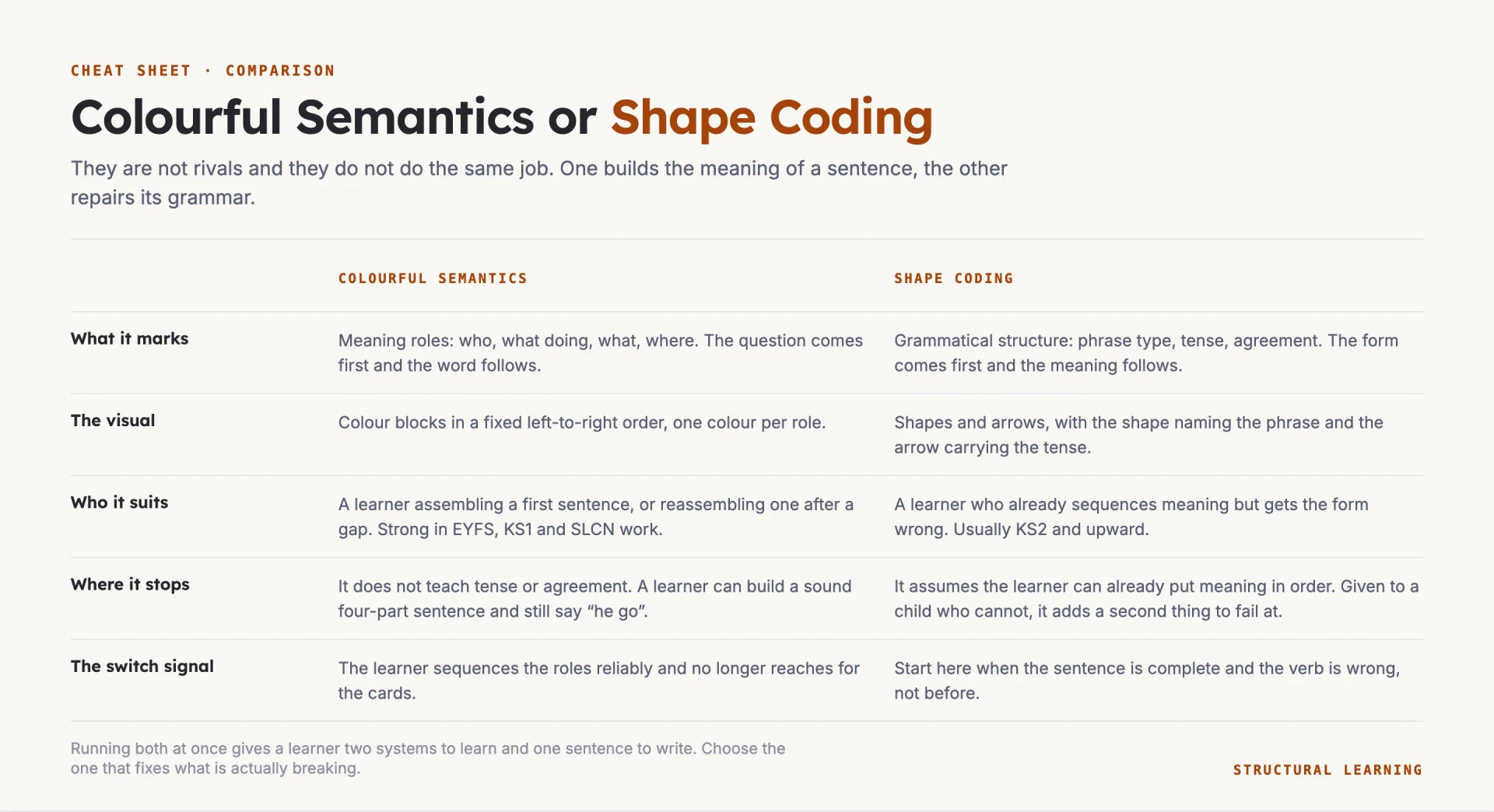
The cleanest way to hold the difference is meaning versus form. Colourful Semantics organises a sentence by what each part means; Shape Coding organises it by what each part is grammatically.
| Feature | Colourful Semantics | Shape Coding |
|---|---|---|
| Created by | Alison Bryan (1997) | Susan Ebbels (2007) |
| Teaches | Meaning roles in a sentence | Grammatical structure and word class |
| Visual system | Colours for who, what doing, what, where | Shapes, colours and arrows for grammar |
| Best-suited stage | Early years and primary, emerging sentences | Older or more able learners, complex grammar |
| Grammar coverage | Sentence content and word order | Tense, agreement, morphology, clause types |
| Who delivers it | Teachers and support staff | Often a speech and language therapist |
| Evidence | Small-scale school and clinical studies | Promising individualised trials, limited overall base |
That is why Colourful Semantics is a strong starting point and Shape Coding a strong next step. A child usually needs to build a meaningful sentence before they can refine its grammar.
In practice, Colourful Semantics gets a child to "The girl is eating an apple." Shape Coding then helps with "The girls were eating apples," where tense and number have to be correct.
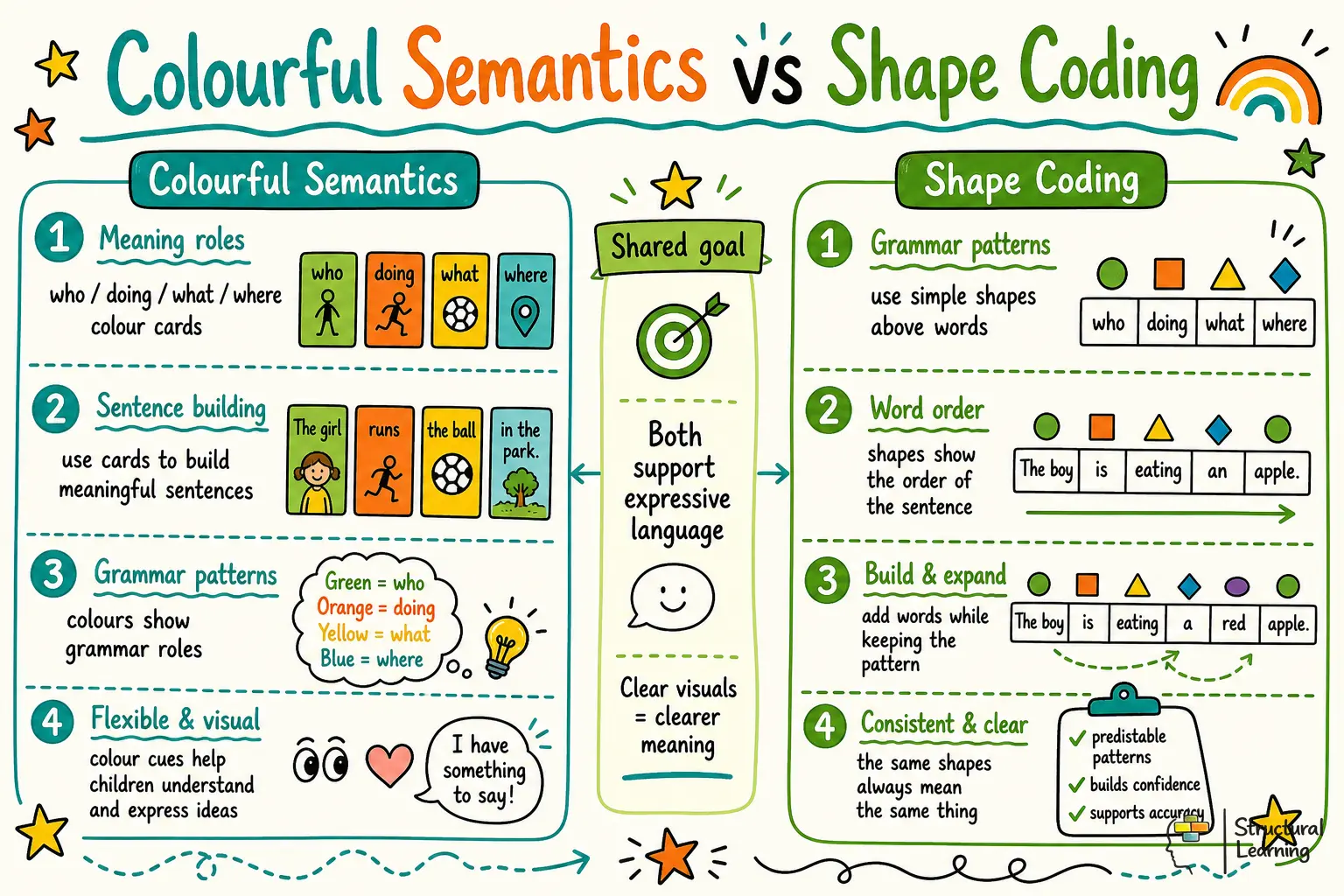
Colourful Semantics uses colour alone, mapped to wh-questions: orange answers "who?", yellow answers "what doing?", green answers "what?", blue answers "where?". The colours are consistent and easy for young children to learn.
Shape Coding layers more information. Shapes show word class, colours add grammatical detail, and arrows show relationships such as which word a tense marker applies to. This richness is what lets it teach complex grammar, but it also makes it harder to learn and usually needs trained delivery.
The visual load is part of the choice: more information means more power and more complexity.
Choose by the child's need. If a learner is not yet producing complete, meaningful sentences, start with Colourful Semantics. If a learner produces sentences but makes specific grammatical errors, Shape Coding targets exactly that.
Consider who will deliver it. Colourful Semantics is feasible for teachers and support staff to run with groups (Atwell, 2024), whereas Shape Coding is often delivered individually by a speech and language therapist and is intensive (Ebbels et al., 2024).
Be honest about the evidence when you decide. A 2025 systematic review found only five Shape Coding studies and could not confirm its general effectiveness, suggesting it may be most appropriate in specialist SLT-led settings (Brown et al., 2025). Colourful Semantics has its own small evidence base. Neither is a guaranteed fix.
The two approaches are a progression, not rivals. Once a child reliably builds meaningful sentences with Colourful Semantics, they are ready to refine grammar with Shape Coding.
Bridge it explicitly. Take a sentence the child built with colour roles, then use Shape Coding to fix the grammar, for example turning "he walk" into "he walks". The child keeps the meaning structure they know and adds grammatical precision.
Foundational colour-coded sentence practice supports this move, so a child secure in building better sentences by meaning has the base for explicit grammar work.
Yes, and many practitioners do. You can run Colourful Semantics as the meaning-first routine and bring in Shape Coding when a specific grammatical target needs attention.
Keep the roles separate so the child is not overwhelmed. Use colour to settle who-doing-what-where, then switch to shapes only for the grammatical feature you are teaching that week.
For a child working with an SLT, ask which targets they are addressing with Shape Coding so your classroom Colourful Semantics work reinforces rather than competes.
The honest picture is asymmetric. Colourful Semantics has small-scale school and clinical evidence for sentence structure and mean length of utterance (Atwell, 2024; Papakyritsis et al., 2024), but no large trials.
Shape Coding has stronger single designs for specific targets, including a randomised trial on past tense (Calder et al., 2020) and individualised gains in morphosyntax (Ebbels et al., 2024). It sits within a recognised family of explicit grammar approaches (Balthazar et al., 2020). However, a systematic review concluded the overall base is too limited and varied to confirm effectiveness (Brown et al., 2025).
For a teacher, that means treating both as evidence-informed rather than proven, and measuring each child's progress yourself.
For more in this series, see the Colourful Semantics activity bank and how to start the approach in EYFS and KS1.
Colourful Semantics colour-codes the meaning roles in a sentence (who, what doing, what, where), while Shape Coding uses shapes, colours and arrows to teach grammatical structure such as tense and agreement. Colourful Semantics builds meaningful sentences; Shape Coding refines their grammar.
Use Colourful Semantics if the learner is not yet producing complete, meaningful sentences, and Shape Coding if they produce sentences but make specific grammatical errors. Younger learners usually start with Colourful Semantics.
Yes. Use Colourful Semantics to settle the meaning and word order, then bring in Shape Coding for a specific grammatical target. Keep the two visual systems separate so the learner is not overloaded.
Not exactly. They share a visual, explicit approach, but Colourful Semantics organises sentences by meaning and Shape Coding by grammatical form. Shape Coding can represent more complex grammar, which is why it often follows Colourful Semantics.
It depends on the target. Shape Coding has randomised and individualised evidence for specific grammatical features in children with DLD (Calder et al., 2020; Ebbels et al., 2024), though a systematic review judged its overall evidence base limited (Brown et al., 2025). Colourful Semantics suits earlier, meaning-based sentence building.
Decide for one current learner: if they are not yet making full sentences, plan a Colourful Semantics routine; if they make specific grammar errors, note the target and discuss Shape Coding with your speech and language therapist.
These peer-reviewed studies provide the evidence base for the strategies discussed above.
How effective is shape coding at improving understanding and use of grammar in school-aged children with Developmental Language Disorder?
Brown, S., et al. (2025)
This review highlights varied evidence for Shape Coding in supporting grammar. For teachers, it suggests using visual coding systems flexibly and combining them with regular classroom-based assessment to monitor effectiveness for learners with language difficulties.
The Efficacy of an Explicit Intervention Approach to Improve Past Tense Marking for Early School-Age Children With Developmental Language Disorder
17 citations
Calder, S., et al. (2020)
This study demonstrates that explicit past-tense instruction using Shape Coding significantly improves grammar. Teachers can adopt these structured visual cues in weekly sessions to help primary school learners grasp tense markings and build sentence confidence.
Using colourful semantic approaches as a group intervention within primary schools to improve language development
Atwell, K. (2024)
This evaluation shows Colourful Semantics is highly effective as a small-group classroom intervention. Teachers can easily implement this colour-coded framework to help primary learners structure sentences, increase speech length, and develop expressive language skills.
The Effectiveness of Individualised Morphosyntactic Target Identification and Explicit Intervention Using the SHAPE CODING System for Children With Developmental Language Disorder
Ebbels, S. E., et al. (2024)
This research shows that personalised grammar targets using Shape Coding boost language acquisition. Teachers should collaborate with specialists to deliver frequent, highly focused visual coding support tailored to a learner's specific grammatical needs.
Explicit Grammatical Intervention for Developmental Language Disorder: Three Approaches
36 citations
Balthazar, C. H., Ebbels, S., & Zwitserlood, R. (2020)
This paper compares three visual, multimodal grammar approaches. It provides teachers with practical frameworks to break down complex grammatical patterns systematically, reducing cognitive load for learners with language difficulties through varied visual stimuli.