Updated on
June 13, 2026
Beyond Phonics: How the Toe by Toe Manual Transforms Reading Ability
An evidence-informed guide for SENCOs and teachers on when to use Toe by Toe, how it works, and its place in a whole-school literacy strategy.


Updated on
June 13, 2026
An evidence-informed guide for SENCOs and teachers on when to use Toe by Toe, how it works, and its place in a whole-school literacy strategy.
Toe by Toe is a highly structured, cumulative reading intervention programme contained in a single red manual. Developed by Keda Cowling, it was designed specifically to support learners who struggle with reading, including those diagnosed with dyslexia. For over two decades, it has become a staple resource in many UK schools, used by SENCOs, teachers, and teaching assistants to provide targeted support.

The manual is essentially a self-contained toolkit. It requires no specialist training to deliver, only a literate 'coach' and a willing learner. Its core principle is to break reading down into its smallest component parts, individual phonetic sounds, and build them back up, step-by-step. This systematic approach aims to move a learner from struggling to decode single letters to reading fluently with confidence.
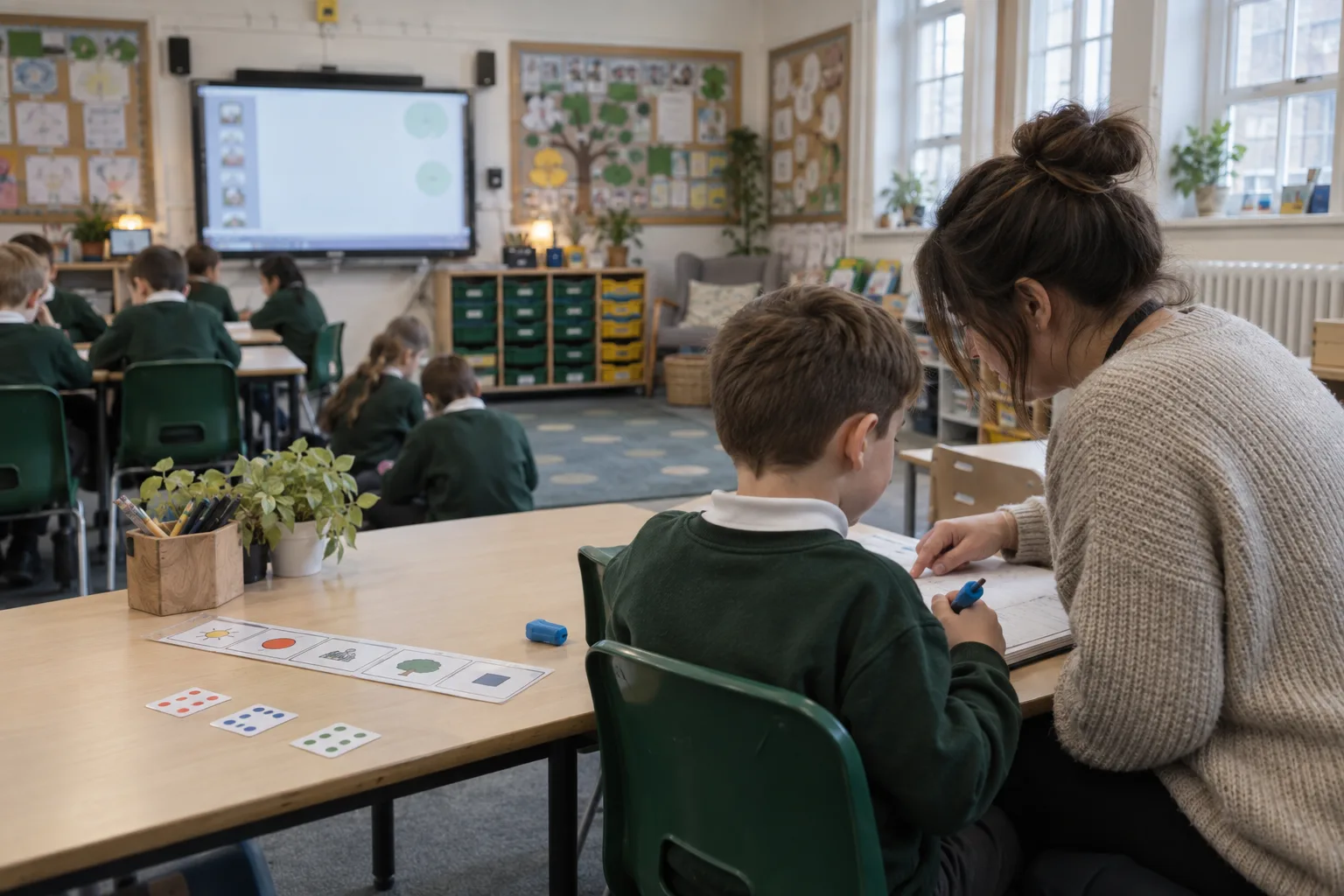
Unlike many other resources, Toe by Toe is explicitly designed for a one-to-one coaching relationship. The format consists of carefully sequenced exercises, from single sounds and non-words to full sentences, that the coach and learner work through together.
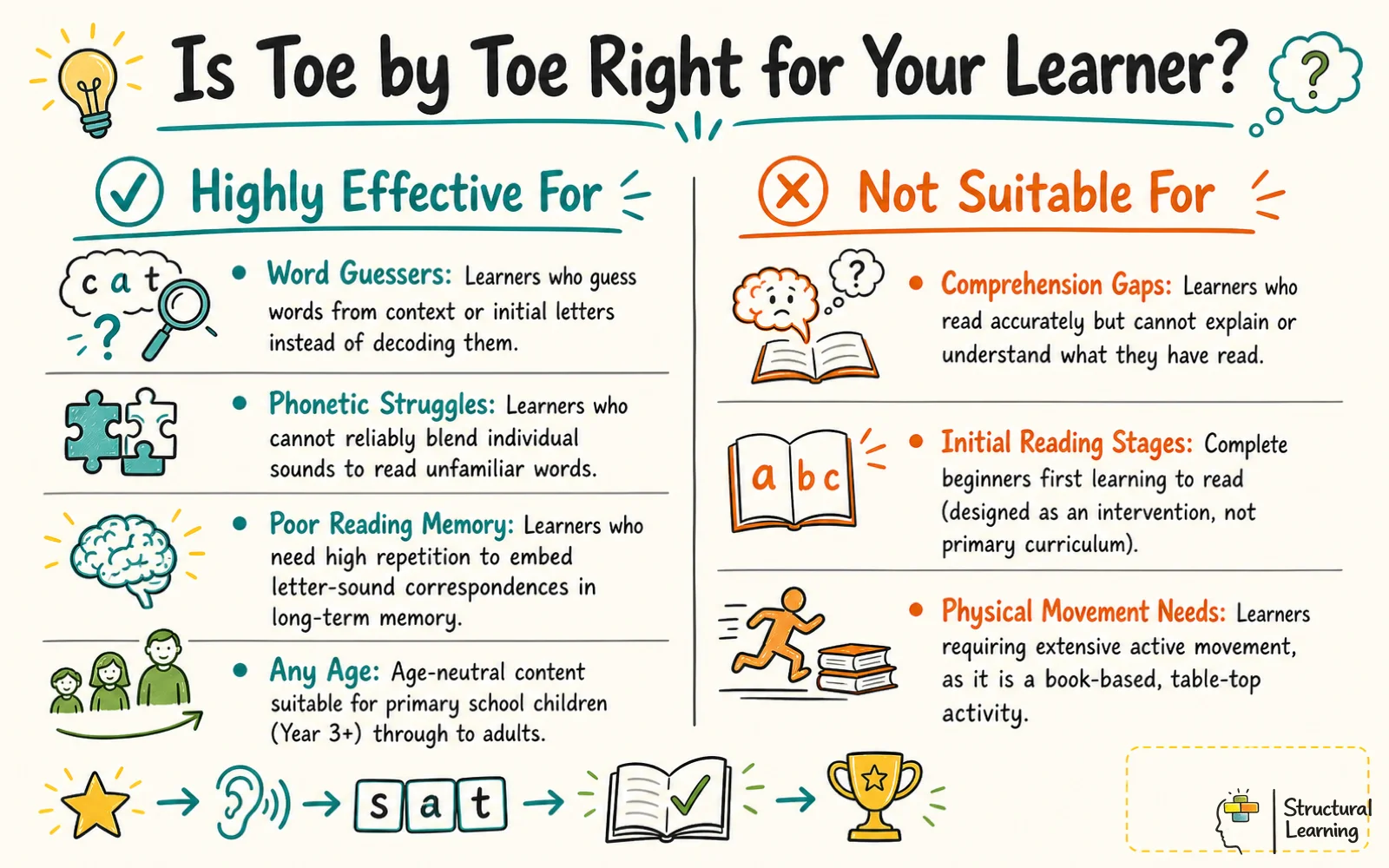
A common misconception is that Toe by Toe is exclusively for learners with dyslexia. While it is highly effective for this group, its application is much broader. Deciding if it's the right fit requires understanding the specific nature of a learner's reading difficulty.
Toe by Toe is most effective for learners who:
Toe by Toe is NOT the right intervention for learners who:
The success of Toe by Toe lies in its simple but rigid structure. It is designed to remove cognitive overload and build automaticity through a series of carefully controlled exercises.
The manual is designed for short, frequent sessions, ideally 20 minutes every day. This consistency is more important than the length of any single session. This daily reinforcement is crucial for learners with poor working memories, as it prevents the "forgetting curve" that can occur between less frequent sessions.
A key feature of the manual is its extensive use of nonsense words (e.g., 'tok', 'mip', 'bim'). This is a deliberate and critical design choice. Real words allow learners to draw on their vocabulary and guess from context. Non-words remove this crutch entirely. To read a nonsense word correctly, the learner has no choice but to apply their phonetic knowledge, sound out the letters, and blend them. This isolates the skill of decoding and makes it impossible to "cheat."
When learners progress to multi-syllable words, Toe by Toe provides a unique visual scaffold. Words are printed with dots or dashes to guide the learner in breaking them down into manageable chunks (e.g., 'con-tent'). This technique, known as syllable division, reduces the cognitive load of tackling a long, intimidating word and teaches the learner a strategy they can apply to any word they encounter.
Progress is tracked directly on the page. When a learner reads a word or sound correctly, the coach marks a tick next to it. To be considered 'mastered', a sound or word must be read correctly on three separate, consecutive occasions. A dot is used to mark an incorrect attempt. This simple system provides immediate visual feedback, building a sense of achievement as the page fills with ticks. It also ensures that a skill is truly secure before the learner moves on.
The methodology of Toe by Toe is grounded in established principles of cognitive science, which explains why it can be so effective for struggling readers.
The core challenge for many struggling readers is a bottleneck in working memory. They expend so much cognitive effort trying to decode individual words that they have no mental capacity left to comprehend the meaning of the sentence. The goal of any effective reading intervention is to make decoding automatic.
Toe by Toe achieves this through systematic overlearning. By repeatedly practising the same sound-symbol relationships in a structured way, the knowledge is transferred from the effortful working memory to the vast long-term memory. This process of automatisation is fundamental to skilled reading (Sweller, 1988).

Download a one-page study note for Toe by Toe, with the key ideas, limitations and classroom links in one place.
Research on structured literacy interventions consistently shows positive effects for struggling readers (Nilvius et al., 2020; Bakken et al., 2021). The structured, explicit, and cumulative nature of these programmes reduces the cognitive burden on the learner. By controlling the introduction of new information and ensuring mastery before progression, the manual keeps the learning within the learner's cognitive capacity.
UK-specific reviews have found that one-to-one delivery of programmes like Toe by Toe can have a "useful" impact, producing measurable gains in both reading accuracy and comprehension (Lavan & Talcott, 2020). However, the largest gains are seen in word identification and fluency, with less impact on comprehension when the intervention is used in isolation (O’Rourke et al., 2021). This underscores the need to see it as one part of a broader literacy strategy.
Successful implementation requires careful planning and a commitment to the programme's methodology. The biggest barrier is often logistical, not pedagogical.
Use simple diagnostic assessments to identify learners whose primary difficulty is with phonetic decoding. Look for a significant gap between their listening comprehension (what they understand when read to) and their independent reading level. These are the learners most likely to benefit.
This is the most challenging aspect. Finding a daily 20-minute one-to-one slot for multiple learners is a significant resource commitment.
A Year 7 learner, Leo, sits with his TA in a quiet corner of the library.
This is a critical, non-negotiable step. Using Toe by Toe alone risks creating learners who can decode words but do not read for meaning, a phenomenon sometimes called "barking at print".
Immediately after the 20-minute Toe by Toe session, the coach should spend 5-10 minutes in a guided oral reading activity.
This practice explicitly connects the decoding skills from the manual to the ultimate purpose of reading: making meaning from text.
The evidence base for structured, systematic phonics interventions is robust. However, it's important to look at the specific evidence for Toe by Toe and understand its limitations.
A major UK review of literacy interventions found that when delivered meticulously one-to-one, Toe by Toe can yield a "useful" impact. The study reported an average reading accuracy ratio gain of 2.5 (meaning the learner made 2.5 months of progress for every month of intervention) and a reading comprehension ratio gain of 2.0 (Lavan & Talcott, 2020).
More recent research from Ireland, which evaluated the programme being delivered by parents at home, found even more substantial gains in word identification (a ratio gain of 3.61) and reading fluency (2.40) (O’Rourke, Olsthoorn, and O’Halloran, 2021). This highlights that the intervention can be delivered effectively by non-professionals when the structure is followed.
The same Irish study found a minimal impact on reading comprehension (a ratio gain of just 0.9) when Toe by Toe was used without a paired reading component (O’Rourke, Olsthoorn, and O’Halloran, 2021). This is the strongest evidence for the critique that the manual, on its own, does not sufficiently develop comprehension skills. It is a decoding tool, and must be treated as such.
The other major limitation is practical. The requirement for daily, one-to-one delivery is resource-intensive. Research in UK schools has noted that this can lead to "exhaustion and stress for the teacher" and is often compromised by a "lack of resources, time, and money" (Jeffes, 2015). In reality, many schools struggle to deliver more than two or three sessions a week, which can dilute the programme's effectiveness.
For a SENCO or literacy lead considering implementing Toe by Toe:
| Phase | Action | Done? |
|---|---|---|
| 1. Selection | Identify learners: Use reading assessments to find learners whose primary barrier is decoding, not comprehension. | ☐ |
| Gain staff buy-in: Explain the methodology and, crucially, the time commitment to SLT and TAs. | ☐ | |
| Purchase manuals: Ensure one manual per learner-coach pair. | ☐ | |
| 2. Logistics | Assign coaches: Pair each learner with a consistent coach (TA, volunteer, mentor). | ☐ |
| Create a timetable: Ring-fence a daily 20-minute slot for each pair. This is the hardest part. Be realistic. | ☐ | |
| Find a quiet space: The intervention needs a distraction-free environment. | ☐ | |
| 3. Training | Brief the coaches: Hold a short session to walk through the manual's instructions. Emphasise the 'three tick' system and the importance of not skipping pages. | ☐ |
| Explain the "why": Ensure coaches understand the purpose of non-words and daily repetition. | ☐ | |
| Mandate paired reading: Train coaches to follow every Toe by Toe session with 5-10 minutes of guided oral reading from a separate, level-appropriate book. | ☐ | |
| 4. Monitoring | Initial assessment: Record the learner's reading age or decoding score before starting. | ☐ |
| Regular check-ins: Briefly meet with coaches weekly to discuss progress and challenges. | ☐ | |
| Re-assess: Measure progress against the baseline every 10-12 weeks. Look for gains in decoding, fluency, and reading age. | ☐ | |
| Review and adapt: If progress is slow, check the fidelity of implementation (is it happening daily? is the coach following the script?). If decoding is secure, plan for graduation from the programme. | ☐ |
Research Evidence Check
What is the evidence for structured decoding and cumulative reading interventions for struggling readers?
Promising support: The Consensus search found relevant papers, but the evidence should be treated as emerging and checked carefully against the article claims.
Use the approach as an explicit routine: model the target skill, give guided practice, build in repetition, and check whether pupils can use it beyond the intervention session.
Students with disorders of intellectual development (ID) experience challenges in reading and writing, indicating the need for research-based interventions. This systematic review and meta-analysis investigated the effects of reading and writing interventions for students aged 4–19 with disorders of ID using randomized controlled trials (RCTs) and quasi-experimental designs (QEDs). We conducted electronic searches of relevant databases, backward and forward searches, and contacted experts in the field. Based on predefined criteria, nine studies were included in the systematic review, and seven were included in the meta-analysis. The reading interventions included decoding strategies, often combined with sight-word and supplemental instructions appropriate to the participants’ adaptive and cognitive skills. None of the studies aimed to increase writing skills. The overall mean effect size from the reading interventions for trained reading was large (g = 0.95, 95% CI = [0.51, 1.38]), for transfer reading small-to-moderate (g = 0.49, 95% CI = [0.20, 0.78]) and for transfer writing small (g = 0.04, 95% CI = [−0.36, 0.44]). Students with disorders of ID can benefit from reading interventions combining decoding strategies and sight word reading. There is a need for RCT and QED studies investigating writing interventions for students with disorders of ID only.
Classroom implication: Translate the finding into explicit modelling, guided practice and progress monitoring rather than relying on one-off exposure.
Abstract: This pre-registered systematic review and meta-analysis aimed to answer if K-2 students at risk (Population) for reading impairment benefited from a response to tier 2 reading intervention (Intervention) compared to teaching as usual, (Comparator), on word decoding outcomes (Outcome), based on randomized controlled trials (Study type). Eligibility criteria were adequately sized (N > 30 per group) randomized controlled trials of tier 2 reading interventions within response to intervention targeting K-2 at risk students (percentile 40) compared with teaching as usual (TAU). Reading interventions had to be at least 20 sessions and conducted in a school setting with at least 30 students in each group and containing reading activities. Comparator could not be another intervention. Only decoding tests from Woodcock Reading Mastery Test-Revised (WRMT) and Test of Word Reading Efficiency (TOWRE) were included.Information sources: Database search was conducted 2019–05-20 in ERIC, PsycINFO, LLBA, WOS, and additionally in Google Scholar as well as a hand search in previous reviews and meta-analyses. The searches were updated on 2021–03-21. Risk of bias: Studies were assessed with Cochrane’s Risk of Bias 2, R-index and funnel plots. A random-effects model was used to analyze the effect sizes (Hedges’ g). Seven studies met the eligibility criteria but only four had sufficient data to extract for the meta-analysis. The weighted mean effect size across the four included studies was Hedges’ g = 0.31, 95% CI [0.12, 0.50] which means that the intervention group improved their decoding ability more than students receiving TAU. A Leave-one-out analysis showed that the weighted effect did not depend on a single study. Students at risk of reading difficulties benefit from tier 2 reading intervention conducted within response to intervention regarding a small effect on the students decoding ability. Only four studies met inclusion criteria and all studies had at least some risk of bias. tier 2 reading interventions, conducted in small groups within RtI, can to some extent support decoding development as a part of reading factors.
Classroom implication: Translate the finding into explicit modelling, guided practice and progress monitoring rather than relying on one-off exposure.
Abstract This systematic review and meta-analysis investigated the efficacy of spelling interventions for the remediation of dyslexia and spelling deficits. Theoretically important moderators, such as the treatment approach as well as orthographic and sample characteristics, were also considered. Thirty-four controlled trials that evaluated spelling interventions in children, adolescents, and adults with dyslexia and spelling deficits were included. Results show that treatment approaches using phonics, orthographic (graphotactic or orthographic phonological spelling rules), and morphological instruction had a moderate to high impact on spelling performance. A significant influence of interventions that teach memorization strategies to improve spelling could not be confirmed. This work shows that understanding the principles of an orthography is beneficial for learners with dyslexia or spelling deficits and presents key components for effective spelling intervention.
Classroom implication: Translate the finding into explicit modelling, guided practice and progress monitoring rather than relying on one-off exposure.
This systematic review examines the effects of summarizing and main idea interventions on the reading comprehension outcomes of struggling readers in Grades 3 through 12. A comprehensive search identified 30 studies published in peer-reviewed journals between 1978 and 2016. Studies included struggling reader participants in Grades 3 through 12; targeted summarizing or main idea instruction; used an experimental, quasi-experimental, or single-case design; and included a reading comprehension outcome. A meta-analysis of 23 group design studies resulted in a statistically significant mean effect of 0.97. Group size, number of sessions, grade level, and publication year did not moderate treatment effect. Visual analysis of six single-case designs yielded strong evidence for retell measures and a range of evidence for short-answer comprehension measures. Findings suggest that main idea and summarizing instruction may improve struggling readers’ main idea identification and reading comprehension. Limitations include the lack of standardized measures and the unreported, changing description of the counterfactual.
Classroom implication: Translate the finding into explicit modelling, guided practice and progress monitoring rather than relying on one-off exposure.
More than fifteen million native Chinese-speaking children are at risk for reading difficulties (RD), making effective Chinese reading interventions crucial for enhancing individual and societal well-being. A total of 51 studies from 2,015 children aged 6 to 13 years were included in the current meta-analysis to examine what works for reading interventions among Chinese children at risk for RD. For decoding outcomes, results indicated positive effects of interventions targeting decoding skills, g = 1.18, meta-linguistic skills, g = 0.57, and cognitive skills, g = 0.52. Interventions targeting decoding skills showed a stronger effect than those targeting cognitive skills. Interventions solely targeting decoding skills were as effective as multi-component interventions (e.g., combining decoding and meta-linguistic skills). For reading comprehension outcomes, results indicated positive effects of interventions targeting decoding skills, g = 0.64, and meta-linguistic skills, g = 0.79, but not of those targeting cognitive skills, g = − 0.08. Interventions targeting decoding skills were more effective than those targeting cognitive skills. These findings, taken together, suggest that compared to cognitive skills, interventions targeting decoding or meta-linguistic skills are consistently effective for improving decoding and reading comprehension. Decoding seems to be the active ingredient for successful reading interventions. Implications for future research were also discussed.
Classroom implication: Translate the finding into explicit modelling, guided practice and progress monitoring rather than relying on one-off exposure.
Developmental dyslexia presents significant cognitive challenges in reading and language processing across various age groups. Effective interventions play a crucial role in ameliorating these challenges. This meta-analysis is aimed to comprehensively review and synthesize the existing literature on interventions for developmental dyslexia spanning children, adolescents, and adults from 1990 to 2023 through the use of cognitive techniques as well as technological tools. A systematic search was conducted across multiple electronic databases, including PubMed, Google Scholar, and PsycINFO. Inclusion criteria encompassed peer-reviewed studies focusing on interventions specifically designed for developmental dyslexia across different age groups. Meta-analyses, systematic reviews, and randomized controlled trials were prioritized. A total of [50] studies met the inclusion criteria, comprising interventions targeting developmental dyslexia. The synthesized findings revealed a diverse range of intervention approaches, including phonological training, multisensory techniques, assistive technologies, and cognitive remediation. Additionally, analyses highlighted variations in intervention effectiveness across age groups. This meta-analysis underscores the importance of tailored interventions for developmental dyslexia across the lifespan. While certain interventions demonstrate promise, variations in efficacy across age groups necessitate further investigation and the development of personalized approaches to address the multifaceted nature of dyslexia.
Classroom implication: Translate the finding into explicit modelling, guided practice and progress monitoring rather than relying on one-off exposure.
This meta-analysis synthesizes 49 standardized mean-change differences between control and treatment groups as effect sizes from 28 independent studies, investigating the efficacy of existing reading interventions on literacy skills for Chinese children. Six potentially important moderators were considered in this study. These moderators included intervention outcome, intervention method, intervention timing, participant type, intervention form, and intervention implementer. Overall, the existing reading intervention significantly impacted Chinese children’s literacy achievement (g = 0.68). Different intervention methods showed somehow different effects on literacy outcomes. Specifically, fluency training (g = 1.78) appeared as the most effective intervention method with a large effect. Working memory training (g = 0.80), phonological training (g = 0.69), orthographic training (g = 0.70), and morphological training (g = 0.66) had significant and medium effects on improving literacy skills of Chinese children. In addition, reading intervention improved literacy skills of older children (g = 0.90) and younger children (g = 0.63) comparably. However, children with dyslexia (g = 0.87) seemed to benefit more than typically developing children (g = 0.49) from reading interventions. Reading interventions seemed to have a better effect on word spelling (g = 0.93) than word reading (g = 0.63). Interventions delivered in group (g = 0.78) seemed to be more effective than interventions delivered individually (g = 0.45). Children gained more from interventions administered by researchers (g = 0.85) or combined implementers (g = 1.11) than by parents (g = 0.27). These findings suggest that appropriate reading interventions are effective and essential for improving the literacy outcomes of Chinese children, but the efficacy might be different depending on the intervention methods, children’s literacy status, outcome measures, and intervention settings.
Classroom implication: Translate the finding into explicit modelling, guided practice and progress monitoring rather than relying on one-off exposure.
Learning disabilities (LD) may affect a range of academic skills but are most often observed in reading. Researchers and policymakers increasingly recommend addressing reading difficulties encountered by students with LD using evidence-based practices, or interventions validated through multiple, high-quality research studies. A valuable tool in identifying evidence-based practices is the meta-analysis, which entails statistically aggregating the results obtained through primary studies. Specific methods used in meta-analyses have the potential to influence their findings, with ramifications for research and practice. This review assessed the methodological features of the systematic reviews and analytic procedures featured in meta-analyses of reading intervention studies that included students with LD written between 2000 and 2020. Identified articles (= 23) suggest that meta-analyses have become more prevalent and transparent over time, notwithstanding issues related to publication bias and the opacity of coding procedures. A discussion of implications follows a description of results.
Classroom implication: Translate the finding into explicit modelling, guided practice and progress monitoring rather than relying on one-off exposure.
What age range is the Toe by Toe manual suitable for? The manual is suitable for learners from around age 7 up to adulthood. The content is age-neutral, focusing purely on the mechanics of reading, so it can be used without embarrassment by older learners who have gaps in their early reading education.
Do teachers or parents need specialist training to deliver it? No. This is one of the most common misconceptions. The manual is explicitly designed to be used by any literate person. All the instructions for the coach are contained in 'coaching boxes' on each page. The key to success is following the highly-structured programme meticulously, not having a prior qualification in teaching reading.
How quickly can you expect to see a measurable improvement in reading age? This varies significantly depending on the learner's starting point and the fidelity of the implementation. With daily 20-minute sessions, many learners show a noticeable increase in confidence and decoding ability within a few weeks. The authors suggest that completing the entire manual, which can take between six and nine months, can often result in a significant jump in reading age. Progress should be monitored regularly to ensure the intervention is working.
This week, identify one learner in your class or group who consistently guesses words from pictures or initial letters. In a quiet moment, ask them to read a short list of five simple, phonetically regular non-words (e.g., bim, lup, zot, fev, hic). Their ability to tackle this task will tell you a great deal about whether their difficulty lies with decoding, and if a structured intervention like Toe by Toe might be the right next step.