Updated on
September 24, 2026
One-Page Profile: Free Template, Examples and Guide
What a one-page profile is, the three sections it needs, worked examples and a free editable template for teachers and learners to complete together.


Updated on
September 24, 2026
What a one-page profile is, the three sections it needs, worked examples and a free editable template for teachers and learners to complete together.
A one-page profile is a short, person-centred summary. It helps teachers quickly see what matters to a learner, what others value about them, and what support works. Helen Sanderson Associates and NDTi call one-page profiles practical, person-centred tools. This approach matters in schools because long plans are rarely useful during a lesson.
The profile should tell a supply teacher what to do in the first five minutes. It should explain where the learner sits best and how they show stress. It must also list safe routines and steps to prevent behaviour escalating.
Co-write the profile with your learner using the editable version, or print the PDF for review meetings and transition briefings.
A one-page profile is a one-sheet, person-centred guide that helps staff know a learner quickly. Helen Sanderson Associates calls one-page profiles a foundation for personalisation. Meanwhile, NDTi focuses on what matters, what people are good at, and how to support them. In school, this means teachers can see the learner before the label and make useful changes before the lesson starts.
The page strips away clinical jargon and focuses on useful, daily realities. It moves away from describing deficits and instead highlights strengths and useful environmental changes. This approach helps school staff know exactly what makes a learner feel safe and ready to learn. When a teacher reads a well-crafted profile, they receive a direct blueprint for how that learner interacts with the world, processes details, and handles stress.
For a busy class teacher, the profile serves as a quick guide. It translates broad needs labels into concrete classroom actions. The teacher learns more than just knowing a child has dyslexia. They learn this child needs instructions written on a pale yellow background. They also learn the child needs a glossary before starting a new science topic. This level of specificity is what makes the tool so powerful for educational professionals.
Classroom Example: A Year 4 teacher receives a new learner mid-term. Before the child arrives, the teacher reads their one-page profile. The page clearly states the child becomes highly anxious when asked to read aloud without warning. During the first English lesson, the teacher uses these details to privately ask if the child wants to read the third paragraph. This gives the child ten minutes to prepare. This quick use prevents a potential behavioural crisis on the first day.
Classroom Action Plan:
Start with one learner rather than a whole cohort. This keeps the page short and lets staff test if the support steps work. It also helps the learner trust the process before using the template more widely.
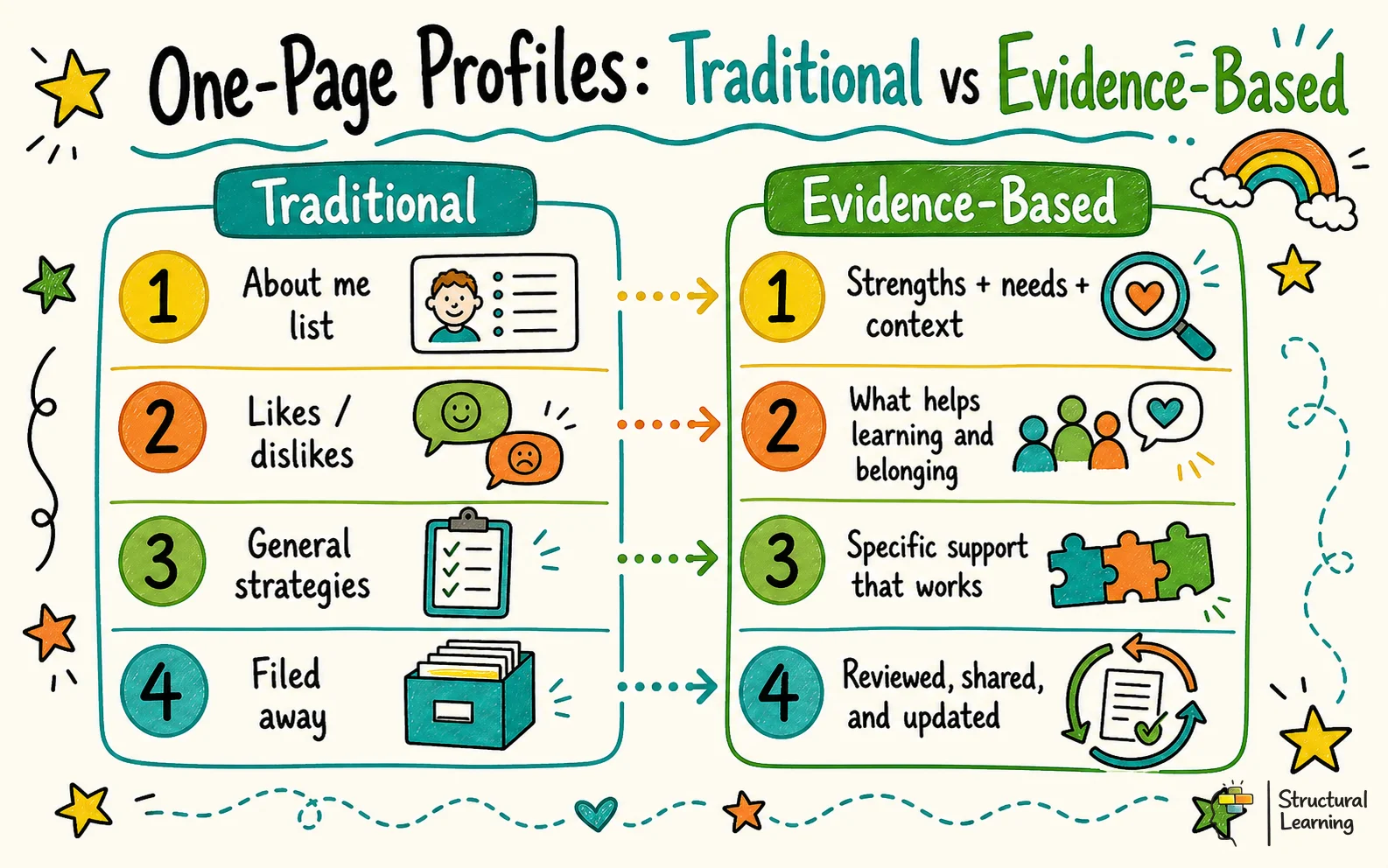
Every child, young person and adult with additional needs benefits from having a clear guide of their preferences and requirements. However, in a school setting, these profiles are mainly vital for learners on the SEND register. For a child, young person or teenager with autism, ADHD, or sensory processing ways, the profile acts as a talk passport. It explains their internal world to adults who can otherwise misinterpret their behaviour as defiant or disengaged (Neill & Sanderson, 2012).
You do not need to wait for an EHCP to create one. Many schools use these profiles as the very first step in their graduated response. When a teacher notices a child, young person or adolescent facing a barrier to learning, writing a profile helps. It clarifies what support is working. This page then travels with the learner, giving a baseline of evidence if a formal EHCP needs check is eventually required by the local council.
Local councils across the UK increasingly expect schools to use person-centred tools. Plans must include the views of the child and family. This shows the school follows the SEND Code of Practice. The profile ensures that the learner remains at the centre of all decision-making processes, rather than becoming a passive recipient of support steps.
Classroom Example: A SENCO is preparing evidence for an EHCP use for a Year 2 learner. Rather than just submitting school data, the SENCO includes the child's one-page profile. This shows the local council exactly what reasonable changes the school has already attempted. A Year 2 teacher can use this profile to brief a new teaching assistant. This keeps support consistent while waiting for official funding.
Classroom Action Plan:
The structure of a standard one-page profile is deliberately simple. It typically consists of three core sections that provide a thorough view of the learner. The first section is 'What people appreciate about me'. This section deliberately starts the chat on a good note. It lists character strengths, talents, and good traits. This is important for building teacher-learner relationships and boosting the self-esteem of learners who often face constant correction (Hattie, 2009).
The second section is 'What is important to me'. This covers the things that keep the learner grounded and happy. It can include special likes, rigid routines, preferred seating arrangements, or key friendships. Understanding this is vital. When learners lack what matters to them, anxiety rises and working memory drops, making learning impossible.
The third section is 'How best to support me'. This is the teaching core of the page. It lists exact, clear steps for teachers and support staff. The way people support a learner must be steady across all subjects to build a predictable setting. This section should detail talk preferences, sensory changes, and cognitive scaffolding techniques. It must be precise, replacing vague lines with clear steps.
To ensure this section delivers actual classroom value, we must move away from generalised descriptions and write precise steps. The table below compares vague, weak lines with clear, useful alternatives.
| Clear Lines ✓ | Weak Lines ✗ |
|---|---|
| "Provide a printed glossary of five key key words terms with dual-coded symbols before beginning a reading task." This gives the learner a direct tool to decode text independently. |
"Needs help with reading." Too vague; does not explain how the teacher should support the reading. |
| "Use a structured five-minute timer with a visual countdown on the board before transitioning to English." Gives the child time to process the shift in activities. |
"He gets anxious during transitions." Shows the issue but fails to provide a step. |
| "If overwhelmed, allow him to use the designated quiet corner and ear defenders for up to five minutes without verbal questioning." Defines the exact self-control protocol. |
"Needs a break when upset." Leaves the nature and duration of the break open to interpretation. |
| "Use first-person prompts like 'Could you show me...' to encourage independent task entry instead of direct commands." Prevents demand avoidance by changing the phrasing. |
"Resists teacher steps." Frames the learner's coping mechanism as voluntary defiance. |
Classroom Example: A Key Stage 2 learner with autism participates in a termly review session with their teaching assistant. Instead of the adults writing the page, the learner takes ownership of updating their own 'How best to support me' section. They decide to add a note that they need to wear ear defenders during school assemblies. This shifts the process from teacher-directed management to learner-led self-advocacy, building vital independence for the future.
Classroom Action Plan:
Choose who it is for. You get the printable profile, the question to ask out loud for each box, and the wording trap to avoid.
Add a name and say who it is for, then build the profile.
Before it goes in the file
A profile is only worth writing if the person recognises themselves in it. Read it back to them, in their words, and change anything they do not agree with. If you cannot read it back, it is a record, not a profile.
The profile says how to support them. Turning that into next Tuesday's lesson is the slow part. The Structural Learning app builds the scaffolded version of a lesson for your topic and year group. Try it on a free account, no card needed.
One-page profiles sit inside a wider person-centred planning tradition. Guidance from Helen Sanderson Associates and NDTi is clear. The page should focus on what matters to the person, what others value about them, and the support that works. Cognitive load research explains this value. When teachers remove unnecessary barriers, learners have more working memory available for the task (Sweller, 1988; Paas et al., 2003).
If a learner is overwhelmed by sensory input or confusing steps, their working memory is consumed by extra load. The "How best to support me" section gives teachers the exact steps needed to reduce that load. The result is not extra paperwork; it is a faster route to participation, regulation and access to the lesson content.
Local council guidance also supports this useful use. Lancashire County Council describes a one-page profile as a way to record and share details. This helps others get to know and support a child or young person. That keeps the page close to classroom practice rather than turning it into another compliance file.
In addition, the process of co-producing and reviewing the profile serves as a powerful metacognitive intervention. Do not treat the profile as just a checklist to complete. Actively involving the learner helps them develop self-regulated learning steps. These steps are proven to highly improve school outcomes (Flavell, 1979; Dignath et al., 2008).
Classroom Example: A Year 9 science teacher uses a child's profile to adapt a useful chemistry demonstration. The profile notes that the learner struggles with multistep verbal steps due to working memory deficits. Applying cognitive load principles, the teacher provides the learner with a physical, step-by-step visual checklist for the experiment. This targeted support prevents cognitive strain and allows the learner to safely and successfully complete the useful task alongside their peers.
Classroom Action Plan:
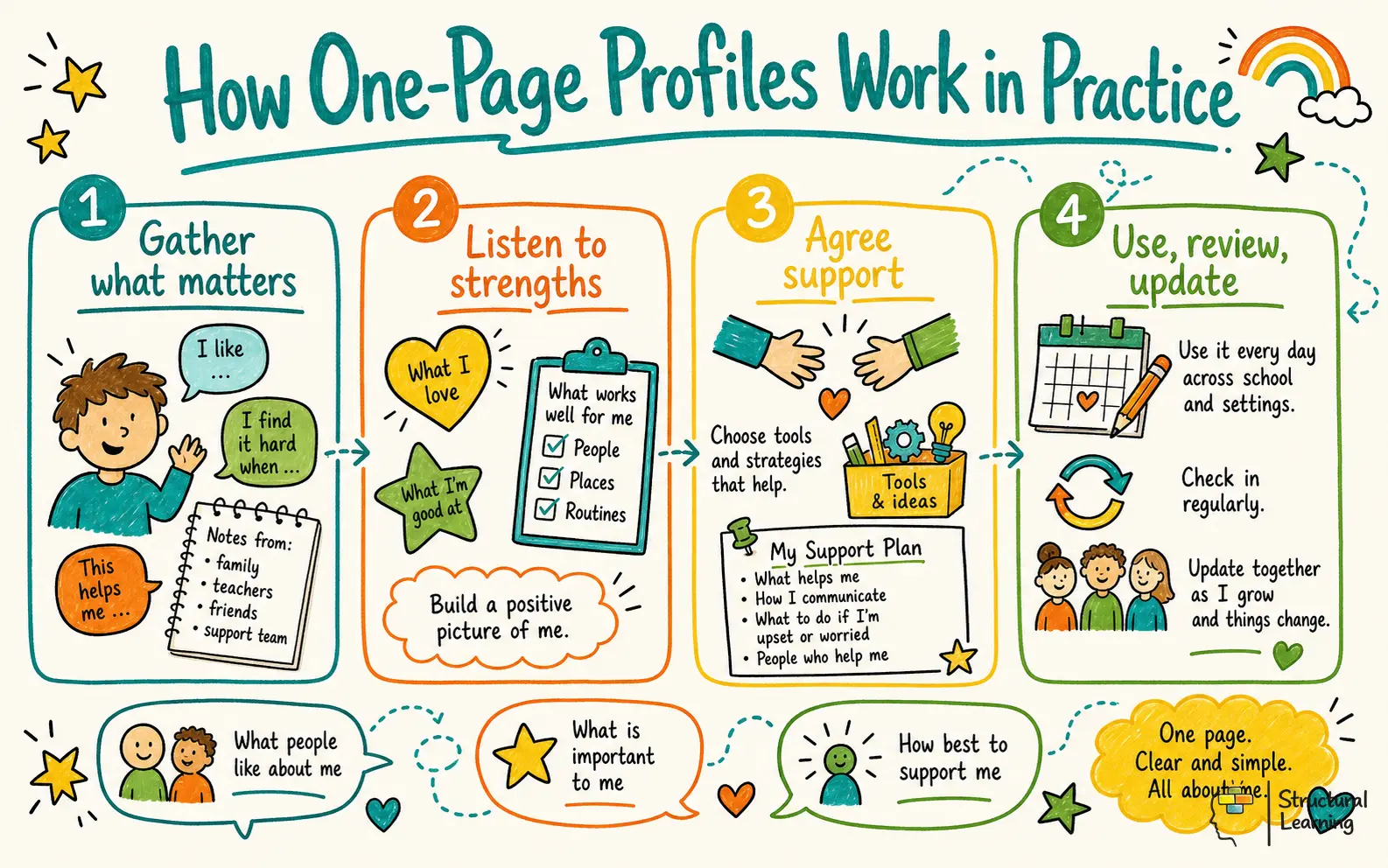
Rolling out one-page profiles across a whole school requires careful planning by the SENCO. The first step is giving staff training on the purpose of the page. Teachers need to know that these are not just admin files to be stored in a cabinet. They are active lesson planning tools. SENCOs must model how to extract details from the profile and embed it into a daily teaching sequence.
joint work is the most key element of implementation. A profile written solely by a teacher in an empty classroom is rarely useful. The process must involve the child, young person and their parents. Parents possess deep, historical knowledge of what works for their child at home, which can often be translated into classroom steps. When parents feel heard and valued in this process, the relationship between home and school strengthens significantly.
Many local councils, with Lancashire County Council, provide templates and examples for schools. Schools should align their internal template with local expectations, especially if the profile will be used alongside EHCP evidence. A secure shared system also means supply teachers, specialists and midday supervisors can find the current version quickly.
These profiles are also key safeguards during transitions, mainly when an autistic child moves from a small primary school to a large, bustling secondary school (Humphrey & Symes, 2013; Lillvist & Wilder, 2017).
Classroom Example: An autistic learner is transitioning from a small primary school to a large, bustling secondary school. The secondary SENCO uses the learner's one-page profile to brief seven different subject teachers before September. The profile explicitly states: "I need a 2-minute warning before the bell rings, otherwise the sudden noise causes severe distress." Because all seven teachers read this single sheet, they collectively use the step, ensuring a smooth and trauma-free transition for the learner.
Classroom Action Plan:
Schools use a variety of plans to track and support learners with SEND. It is important for SENCOs and teachers to know how the one-page profile fits into this wider system of paperwork. The table below outlines the primary ways between common support plans, with individual support plans, used in UK schools.
| Page Type | Primary Purpose | Length & Format | Who Writes It? | Update Frequency |
|---|---|---|---|---|
| One-Page Profile | Quick, clear guide of strengths, likes, and key daily support steps. | Single sheet, highly visual, bullet points. | Co-written by the learner, parents, and school staff. | Termly, or when significant changes occur. |
| School Support Passport | Similar to a profile, but often includes clear short-term school or behavioural targets. | One to two pages, structured around goals. | Often led by the SENCO or class teacher with learner input. | Termly, alongside the assess-plan-do-review cycle. |
| Individual Education Plan (IEP) | Detailed tracking of clear, measurable SEND targets, support steps, and outcomes. | Multi-page page, formal structure. | SENCO and class teacher. | Termly review of data and support steps. |
| EHCP | Legally binding page detailing education, health, and social care needs and provision. | Highly detailed, extensive, formal legal page. | Local Council, based on multi-agency professional advice. | Annual formal review. |
Understanding this hierarchy helps schools avoid duplication of effort. The profile is the top-level guide. It is the page a cover teacher reads in the five minutes before a lesson begins. The IEP or EHCP provides the deep, granular data behind the steps listed on the profile.
Classroom Example: An Early Career Teacher (ECT) feels overwhelmed by reading a twenty-page EHCP for a new learner. The SENCO guides the ECT to look at the one-page profile first. The SENCO explains that the profile page acts as an executive guide of the EHCP. By mastering the three simple steps on the profile, the ECT can quickly create a safe setting. This happens before diving into the complex long-term targets of the full legal plan.
Classroom Action Plan:
To ensure one-page profiles actually impact classroom practice, SENCOs must guide teachers to write high-quality, clear lines. Vague advice is entirely useless in the middle of a busy lesson. The goal is to provide steps that any adult can instantly know and apply.
Writing useful page profiles is a skill that requires practice. When writing these plans, you are distilling complex psychological and educational needs into simple steps. This is an exercise in profound clarity.
Classroom Example: A teacher uses the 'What people appreciate about me' section to strategically manage group work. The profile notes that a highly anxious learner has an intense special interest in Minecraft and is very creative. The teacher deliberately groups this learner with peers who share this interest for a joint history project about Roman towns. This uses the learner's strengths, reduces social anxiety, and results in highly engaged learning.
Classroom Action Plan:

A one-page profile is a short, person-centred guide that helps teachers know a learner quickly. It records what people like about the learner and what matters to them. It also lists clear support steps to help them learn and feel safe.
An EHCP is a statutory plan and a school support passport is often a school support guide. A one-page profile is lighter and more learner-led. It does not replace legal duties or expert plans; it helps staff translate those plans into day-to-day classroom actions.
The profile should be co-written with the learner wherever possible, with input from parents, carers, class teachers, teaching assistants and the SENCO. The SENCO can quality check the final version, but the content should sound like the learner and reflect what works in real lessons.
Review the profile at least termly and after any major transition, change in support, new diagnosis, placement move or change in family circumstances. A five-minute learner chat can be enough to check whether the support steps are still accurate.
Next lesson, choose one learner with complex needs, read their profile, and deliberately use one step from the "How best to support me" section during the main teaching input.