Year 1 Phonics ScreeningSixth form students aged 17-18 in green cardigans, collaborating around phonics tasks in a modern study space

Updated on  

January 30, 2026

Year 1 Phonics Screening

Boost Year 1 phonics skills with engaging activities, expert tips, and practice tests. Empower pupils to excel in phonics screening & literacy.

Course Enquiry
Copy citation

Hammond, S (2023, May 03). Year 1 Phonics Screening. Retrieved from https://www.structural-learning.com/post/year-1-phonics-screening

What is the Year 1 Phonics Screening?

The Year 1 PhonicsScreening Check is a key checkpoint in a child's early reading process. It's designed to assess how well pupils can decode words using phonics, the foundational skill of breaking down and blending sounds to read. Taken by children across England towards the end of Year 1, the check offers a snapshot of each child's progress and highlights who might need extra support as they move forwards in their literacy learning.

Key Takeaways

  1. Beyond Pass or Fail: Discover how to use screening results as a diagnostic tool that reveals specific decoding patterns, not just a number
  2. The Alien Word Trap: Why advanced readers fail the test and how to prepare confident Phase 5 pupils without limiting their progress
  3. Escape Operation Phonics Panic: Transform your Summer Term 1 from flashcard frenzy into meaningful phonics practise that builds genuine decoding skills
  4. The 75% Question: What the national drop from 82% really tells us about post-pandemic phonics gaps and targeted intervention strategies

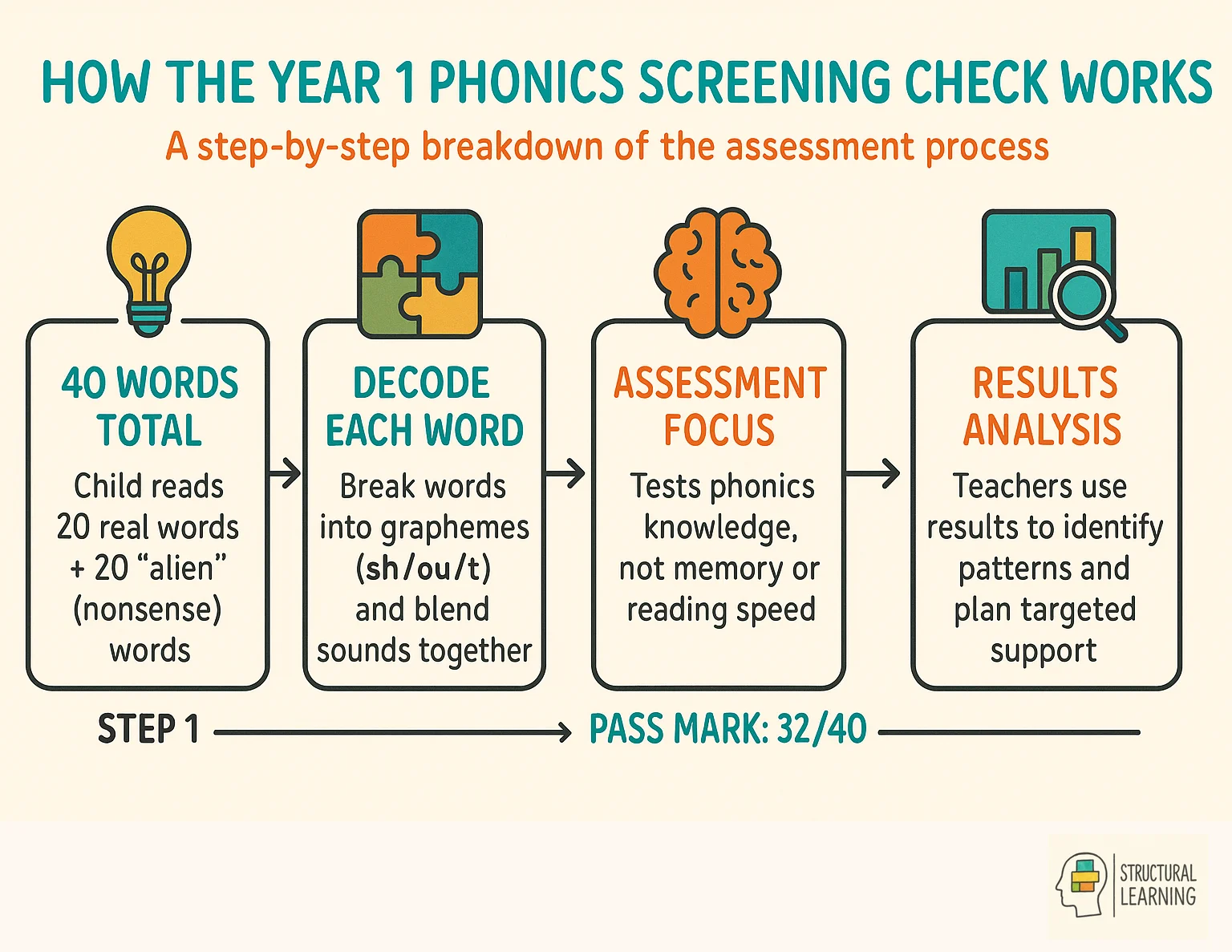
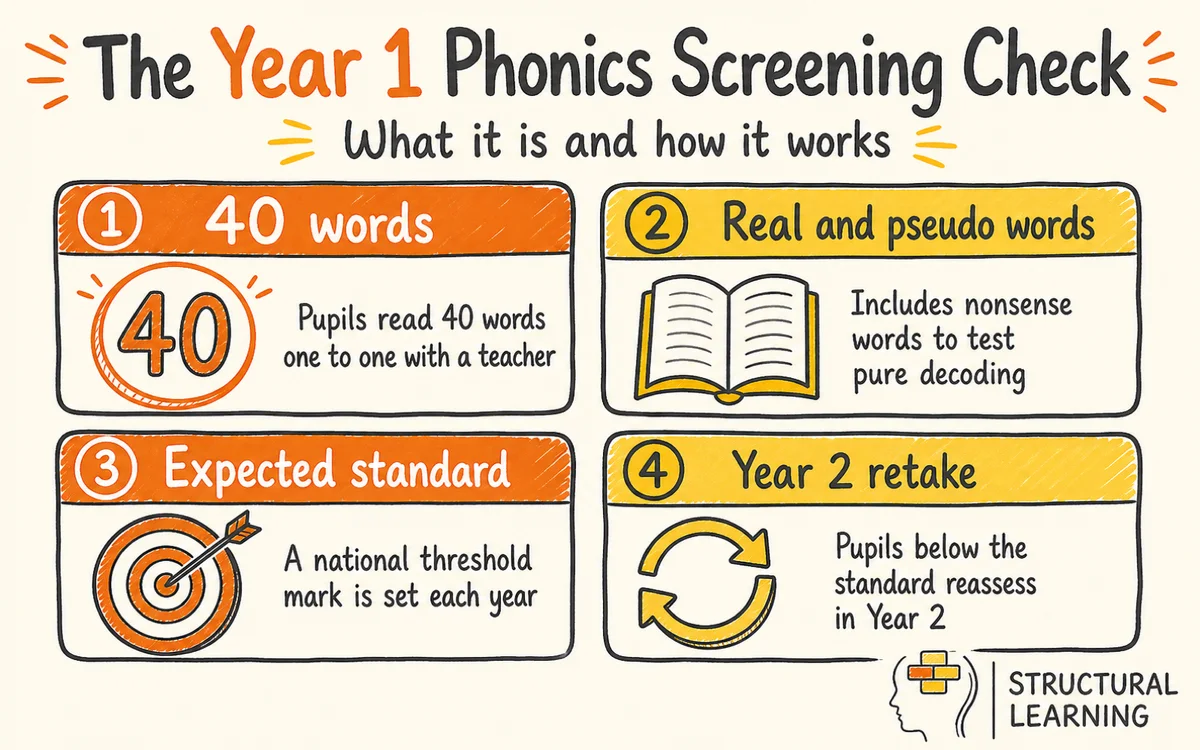
The assessment itself is straightforward: children read a list of 40 words, some real and some pseudo (sometimes called "alien words"). The idea behind the nonsense words is to check decoding skills without relying on memory or sight-reading. It's not about comprehension, it's about whether children can apply phonics rules to unfamiliar combinations of letters.

Step-by-step process showing how the Year 1 Phonics Screening Check assessment works
How the Year 1 Phonics Screening Check Works

There's a pass mark each year, but the focus shouldn't just be on meeting that number. For teachers, what really matters is understanding how far each child has come in their ability to hear, break down, and rebuild words. It's also about spotting patterns, where they're getting stuck, and where they're flying.

This article takes a practical look at how the screening works, what the results mean, and how teachers and support staff can prepare pupils in a way that's engaging, confidence-building, and not purely test-driven. Whether you're an ECT in your first phonics term, a seasoned Year 1 teacher, or a parent wanting to understand what your child is working towards, we'll cover the useful, the frustrating, and everything in between.

Three things to know:
  • The screening checks decoding skills, not reading comprehension.
  • It includes real and pseudo words to test phonics, not memory.
  • It's a tool, not a verdict, and should be used to inform support, not define a child.
  • When Does Phonics Screening Happen?

    Let's start at the very beginning, the Phonics Screening Check is an annual statutory data assessment for Year 1 children. The purpose is to check how well children can decode words to ensure Year 1 children are on track to become fluent readers.

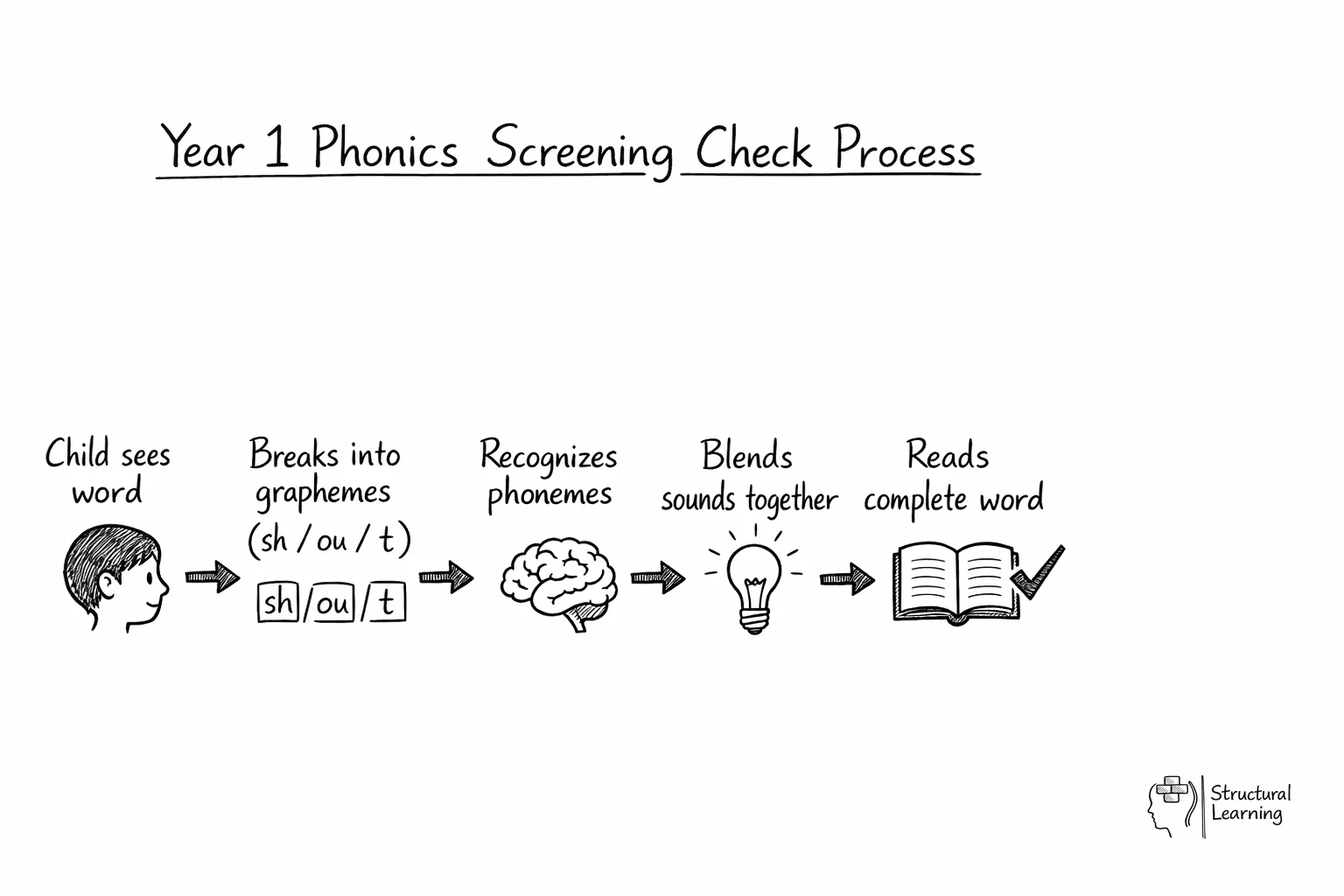
    Decoding is the process of breaking a word into its graphemes, the written/printed, smallest unit of sound in a word, and then blending them together for example shout is broken into sh/ou/t. Within the PSC children are asked to decode 40 words, 20 real words and 20 alien/nonsense or pseudo words.

    Flow diagram showing 5-step phonics decoding process from seeing word to reading aloud
    Flow diagram: Year 1 Phonics Screening Check Process and Decoding Steps

    The purpose of the Phonics Screening is to check children's grapheme phoneme correspondence, can they spot the graphemes and recognise the sound or phoneme that they make then blend them together?

    The threshold has been 32 since the PSC started in 2012, those children that do not reach 32 in June will be provided with extra support through an intervention programme and repeat the screening in June the following year.

    It is useful to note that the Phonics screening is checking for letter and sound correspondence not the speed of reading or how easily they can decode unfamiliar words, which are all skills required to be a confident reader.

    Why are children being asked to read alien/nonsense/pseudo words? The purpose of this is to ensure that children are not using their memory of word to read it and are purely applying their phonic knowledge. According to the DfE the percentage of pupils meeting the expected standard in the phonics screening check in year 1 is now 75% this is down from 82% in 2019.

    Year one phonics screening words
    Year one phonics screening words

    Teacher Tips and Success Stories

    When a child is successful with the phonics screening check it is a pleasure to complete for example a child that has started Year 1, with limited grapheme-phoneme knowledge, now being able to read Phase 5 words including split digraphs and alternative graphemes is awesome for them and all those that supported them.

    Teachers across the country reading this will have a success story, or five, of their own. When that happens, teachers feel that the PSC is a way of celebrating the progress made with decoding. Ultimately, teachers want children to decode so that they can move onto reading with fluency.

    When children are fluent and can read familiar and unfamiliar words with ease then comprehension becomes easier as they free their mind to understand what they are reading. Using resources like PhonicsPlay can support children who need additional practise with decoding skills.

    1cc2e9c2b94_phonicsplay.webp" loading="lazy" alt="PhonicsPlay educational resources for Year 1 phonics practise" id="" width="auto" height="auto">
    Supporting tools like PhonicsPlay can help children develop stronger decoding skills

    However, teachers also share stories of children who are confident readers but stumble with the screening format, particularly with alien words. Sarah, a Year 1 teacher from Manchester, recalls: "I had a child who was reading chapter books fluently but kept trying to turn the nonsense words into real words during practise. She'd see 'groan' written as 'groin' and automatically read it as 'grown' because that made sense to her. It took specific practise to help her slow down and decode exactly what was written."

    These experiences highlight why preparation matters, for children who are behind and for those who are advanced. The screening requires a specific type of thinking that even strong readers need to practise.
    Many teachers also report that the one-to-one nature of the assessment provides valuable insights they might miss during whole-class phonics sessions. Emma, a teaching assistant who regularly conducts the screenings, notes: "You really hear how children approach unfamiliar words when it's just you and them. Some children whisper the sounds first, others dive straight in, and some get visibly frustrated with the alien words. These observations help us tailor our interventions much more effectively."

    The key takeaway from these teacher experiences is that the screening works best when viewed as a diagnostic tool rather than a simple pass/fail test. It reveals what children can decode and how they approach the decoding process itself.

    How to Prepare for Phonics Screening

    Preparing for the phonics screening doesn't have to become a drill-and-kill exercise that dominates your Spring and Summer terms. The most effective preparation integrates screening practise into your regular phonics teaching in ways that build genuine decoding skills.

    Start with diagnostic assessment: Before ramping up any preparation, find out exactly where each child stands. Use a mock screening or similar assessment to identify specific gaps. Some children might struggle with Phase 3 digraphs, others with Phase 5 alternative spellings. Targeted practise is far more effective than generic revision.

    Make alien words less alien: Introduce pseudo words gradually throughout the year, not just in the run-up to the screening. During your regular phonics sessions, include a few nonsense words alongside real ones. Explain to children that these are "made-up words" and their job is to read exactly what's written. This removes the mystery and makes the screening format familiar.

    Use the screening format for regular practise: Set up mini one-to-one sessions where children read from word lists, mimicking the screening environment. This doesn't need to be formal, it could be a quick five-minute session with a teaching assistant or during guided reading time. The key is familiarising children with reading aloud to an adult in this specific way.

    Focus on blending quality: Many children can identify individual phonemes but struggle with smooth blending. Use activities that specifically target this skill, such as sound buttons (marking phonemes in words) and blending games where children have to blend sounds you say aloud.

    Address common stumbling blocks: Certain graphemes and word patterns frequently cause difficulties in the screening. Split digraphs (like a-e in "cake"), alternative spellings for the same sound (such as "ay," "ai," and "a-e" all making the /ay/ sound), and consonant clusters at the beginning or end of words often trip children up. Build in regular practise with these specific patterns.

    How to Interpret Screening Results

    The real value of the phonics screening lies not in whether children pass or fail, but in what their responses tell you about their decoding strategies and where to focus future teaching. A score of 31 out of 40 and a score of 15 out of 40 require very different responses, but both provide practical information.

    Look beyond the total score: Analyse which types of words caused difficulties. Did the child struggle more with real words or alien words? Were errors concentrated in particular phonics phases? Did they have trouble with simple CVC words or more complex polysyllabic structures? This pattern analysis guides your next steps far more effectively than the overall number.

    Consider the child's approach: During the assessment, note how children tackle unfamiliar words. Do they sound out each phoneme methodically, or do they guess based on the first letter? Do they self-correct when something doesn't sound right? These observations are as valuable as the final score.

    Plan targeted interventions: For children who don't meet the expected standard, use the results to create focused intervention plans. A child who struggles with Phase 3 digraphs needs different support from one who can decode simple words but falls apart with Phase 5 alternative spellings. Effective interventions are specific, frequent, and build systematically on what the child already knows.
    Communicate with parents meaningfully: When discussing results with families, focus on specific next steps rather than just the pass/fail outcome. Explain which phonics skills their child has mastered and which need more practise. Provide concrete ways parents can support at home without turning reading into a chore.

    Track progress throughout the year: Don't wait until the following June to see if interventions are working. Use regular mini-assessments to monitor progress and adjust your approach. Children who receive targeted phonics support should show measurable improvement in their decoding skills well before the next screening.

    Next Steps After Phonics Assessment

    The Year 1 Phonics Screening Check serves its purpose best when we view it as one snapshot in a child's reading process, not the destination itself. While the assessment provides valuable data about decoding skills, it's the quality of phonics teaching throughout the year that makes the real difference to children's reading development.

    Effective preparation goes far beyond cramming alien words in the weeks before the test. It means building systematic, engaging phonics instruction that develops genuine decoding confidence. It means using assessment data to target support where it's needed most, and celebrating progress in all its forms. Most importantly, it means keeping sight of the bigger picture, that we're teaching children to read so they can access the full richness of written language, not simply to pass a screening check.

    For teachers, the screening works best when integrated into your broader reading curriculum rather than driving it. For parents, understanding what the assessment measures can help you support your child's phonics development in meaningful ways. And for children themselves, approaching the screening as just another opportunity to show off their sound knowledge removes much of the anxiety that can interfere with performance. When we get the balance right, the phonics screening becomes a useful milestone that supports learning rather than limiting it.

    Further Reading

    Systematic phonics instruction

    Phonics research review

    For education professionals wanting to deepen their understanding of phonics assessment and early reading development, these research studies provide valuable insights:


    • Wyse, D., & Bradbury, A. (2022). "Reading wars or reading reconciliation? A critical examination of strong research evidence, curriculum policy and teachers' practices for teaching phonics and reading." Review of Education, 10(1), e3314. This comprehensive review examines the evidence base for systematic phonics instruction and its relationship to reading outcomes.
    • Clark, M. M. (2021). "The phonics screening check: How it has influenced teaching and what research tells us." Education 3-13, 49(7), 823-835. An analysis of how the screening check has shaped classroom practise and its alignment with reading research.
    • Duff, D., Hulme, C., Grainger, K., Hardwick, S. J., Miles, J. N., & Snowling, M. J. (2014). "Reading and language intervention for children at risk of dyslexia: A randomised controlled trial." Journal of Child Psychology and Psychiatry, 55(11), 1234-1243. Research on targeted phonics interventions for children experiencing reading difficulties.
    • Stuart, M., Stainthorp, R., & Snowling, M. J. (2008). "Literacy as a complex activity: Deconstructing the simple view of reading." Literacy, 42(2), 59-66. A foundational paper exploring the relationship between decoding skills and reading comprehension.
    • Meschi, E., Micklewright, J., Vignoles, A., & Lindsay, G. (2012). "The transitions between categories of special educational need of pupils with Speech, Language and Communication Needs (SLCN) and autism spectrum disorder (ASD) as they progress through the education system." Research Report DFE-RR247-BCRP4. Department for Education research examining how communication needs affect phonics development and screening outcomes.
Loading audit...

What is the Year 1 Phonics Screening?

The Year 1 PhonicsScreening Check is a key checkpoint in a child's early reading process. It's designed to assess how well pupils can decode words using phonics, the foundational skill of breaking down and blending sounds to read. Taken by children across England towards the end of Year 1, the check offers a snapshot of each child's progress and highlights who might need extra support as they move forwards in their literacy learning.

Key Takeaways

  1. Beyond Pass or Fail: Discover how to use screening results as a diagnostic tool that reveals specific decoding patterns, not just a number
  2. The Alien Word Trap: Why advanced readers fail the test and how to prepare confident Phase 5 pupils without limiting their progress
  3. Escape Operation Phonics Panic: Transform your Summer Term 1 from flashcard frenzy into meaningful phonics practise that builds genuine decoding skills
  4. The 75% Question: What the national drop from 82% really tells us about post-pandemic phonics gaps and targeted intervention strategies

The assessment itself is straightforward: children read a list of 40 words, some real and some pseudo (sometimes called "alien words"). The idea behind the nonsense words is to check decoding skills without relying on memory or sight-reading. It's not about comprehension, it's about whether children can apply phonics rules to unfamiliar combinations of letters.

Step-by-step process showing how the Year 1 Phonics Screening Check assessment works
How the Year 1 Phonics Screening Check Works

There's a pass mark each year, but the focus shouldn't just be on meeting that number. For teachers, what really matters is understanding how far each child has come in their ability to hear, break down, and rebuild words. It's also about spotting patterns, where they're getting stuck, and where they're flying.

This article takes a practical look at how the screening works, what the results mean, and how teachers and support staff can prepare pupils in a way that's engaging, confidence-building, and not purely test-driven. Whether you're an ECT in your first phonics term, a seasoned Year 1 teacher, or a parent wanting to understand what your child is working towards, we'll cover the useful, the frustrating, and everything in between.

Three things to know:

  • The screening checks decoding skills, not reading comprehension.
  • It includes real and pseudo words to test phonics, not memory.
  • It's a tool, not a verdict, and should be used to inform support, not define a child.
  • When Does Phonics Screening Happen?

    Let's start at the very beginning, the Phonics Screening Check is an annual statutory data assessment for Year 1 children. The purpose is to check how well children can decode words to ensure Year 1 children are on track to become fluent readers.

    Decoding is the process of breaking a word into its graphemes, the written/printed, smallest unit of sound in a word, and then blending them together for example shout is broken into sh/ou/t. Within the PSC children are asked to decode 40 words, 20 real words and 20 alien/nonsense or pseudo words.

    Flow diagram showing 5-step phonics decoding process from seeing word to reading aloud
    Flow diagram: Year 1 Phonics Screening Check Process and Decoding Steps

    The purpose of the Phonics Screening is to check children's grapheme phoneme correspondence, can they spot the graphemes and recognise the sound or phoneme that they make then blend them together?

    The threshold has been 32 since the PSC started in 2012, those children that do not reach 32 in June will be provided with extra support through an intervention programme and repeat the screening in June the following year.

    It is useful to note that the Phonics screening is checking for letter and sound correspondence not the speed of reading or how easily they can decode unfamiliar words, which are all skills required to be a confident reader.

    Why are children being asked to read alien/nonsense/pseudo words? The purpose of this is to ensure that children are not using their memory of word to read it and are purely applying their phonic knowledge. According to the DfE the percentage of pupils meeting the expected standard in the phonics screening check in year 1 is now 75% this is down from 82% in 2019.

    Year one phonics screening words
    Year one phonics screening words

    Teacher Tips and Success Stories

    When a child is successful with the phonics screening check it is a pleasure to complete for example a child that has started Year 1, with limited grapheme-phoneme knowledge, now being able to read Phase 5 words including split digraphs and alternative graphemes is awesome for them and all those that supported them.

    Teachers across the country reading this will have a success story, or five, of their own. When that happens, teachers feel that the PSC is a way of celebrating the progress made with decoding. Ultimately, teachers want children to decode so that they can move onto reading with fluency.

    When children are fluent and can read familiar and unfamiliar words with ease then comprehension becomes easier as they free their mind to understand what they are reading. Using resources like PhonicsPlay can support children who need additional practise with decoding skills.

    1cc2e9c2b94_phonicsplay.webp" loading="lazy" alt="PhonicsPlay educational resources for Year 1 phonics practise" id="" width="auto" height="auto">
    Supporting tools like PhonicsPlay can help children develop stronger decoding skills

    However, teachers also share stories of children who are confident readers but stumble with the screening format, particularly with alien words. Sarah, a Year 1 teacher from Manchester, recalls: "I had a child who was reading chapter books fluently but kept trying to turn the nonsense words into real words during practise. She'd see 'groan' written as 'groin' and automatically read it as 'grown' because that made sense to her. It took specific practise to help her slow down and decode exactly what was written."

    These experiences highlight why preparation matters, for children who are behind and for those who are advanced. The screening requires a specific type of thinking that even strong readers need to practise.

    Many teachers also report that the one-to-one nature of the assessment provides valuable insights they might miss during whole-class phonics sessions. Emma, a teaching assistant who regularly conducts the screenings, notes: "You really hear how children approach unfamiliar words when it's just you and them. Some children whisper the sounds first, others dive straight in, and some get visibly frustrated with the alien words. These observations help us tailor our interventions much more effectively."

    The key takeaway from these teacher experiences is that the screening works best when viewed as a diagnostic tool rather than a simple pass/fail test. It reveals what children can decode and how they approach the decoding process itself.

    How to Prepare for Phonics Screening

    Preparing for the phonics screening doesn't have to become a drill-and-kill exercise that dominates your Spring and Summer terms. The most effective preparation integrates screening practise into your regular phonics teaching in ways that build genuine decoding skills.

    Start with diagnostic assessment: Before ramping up any preparation, find out exactly where each child stands. Use a mock screening or similar assessment to identify specific gaps. Some children might struggle with Phase 3 digraphs, others with Phase 5 alternative spellings. Targeted practise is far more effective than generic revision.

    Make alien words less alien: Introduce pseudo words gradually throughout the year, not just in the run-up to the screening. During your regular phonics sessions, include a few nonsense words alongside real ones. Explain to children that these are "made-up words" and their job is to read exactly what's written. This removes the mystery and makes the screening format familiar.

    Use the screening format for regular practise: Set up mini one-to-one sessions where children read from word lists, mimicking the screening environment. This doesn't need to be formal, it could be a quick five-minute session with a teaching assistant or during guided reading time. The key is familiarising children with reading aloud to an adult in this specific way.

    Focus on blending quality: Many children can identify individual phonemes but struggle with smooth blending. Use activities that specifically target this skill, such as sound buttons (marking phonemes in words) and blending games where children have to blend sounds you say aloud.

    Address common stumbling blocks: Certain graphemes and word patterns frequently cause difficulties in the screening. Split digraphs (like a-e in "cake"), alternative spellings for the same sound (such as "ay," "ai," and "a-e" all making the /ay/ sound), and consonant clusters at the beginning or end of words often trip children up. Build in regular practise with these specific patterns.

    How to Interpret Screening Results

    The real value of the phonics screening lies not in whether children pass or fail, but in what their responses tell you about their decoding strategies and where to focus future teaching. A score of 31 out of 40 and a score of 15 out of 40 require very different responses, but both provide practical information.

    Look beyond the total score: Analyse which types of words caused difficulties. Did the child struggle more with real words or alien words? Were errors concentrated in particular phonics phases? Did they have trouble with simple CVC words or more complex polysyllabic structures? This pattern analysis guides your next steps far more effectively than the overall number.

    Consider the child's approach: During the assessment, note how children tackle unfamiliar words. Do they sound out each phoneme methodically, or do they guess based on the first letter? Do they self-correct when something doesn't sound right? These observations are as valuable as the final score.

    Plan targeted interventions: For children who don't meet the expected standard, use the results to create focused intervention plans. A child who struggles with Phase 3 digraphs needs different support from one who can decode simple words but falls apart with Phase 5 alternative spellings. Effective interventions are specific, frequent, and build systematically on what the child already knows.

    Communicate with parents meaningfully: When discussing results with families, focus on specific next steps rather than just the pass/fail outcome. Explain which phonics skills their child has mastered and which need more practise. Provide concrete ways parents can support at home without turning reading into a chore.

    Track progress throughout the year: Don't wait until the following June to see if interventions are working. Use regular mini-assessments to monitor progress and adjust your approach. Children who receive targeted phonics support should show measurable improvement in their decoding skills well before the next screening.

    Next Steps After Phonics Assessment

    The Year 1 Phonics Screening Check serves its purpose best when we view it as one snapshot in a child's reading process, not the destination itself. While the assessment provides valuable data about decoding skills, it's the quality of phonics teaching throughout the year that makes the real difference to children's reading development.

    Effective preparation goes far beyond cramming alien words in the weeks before the test. It means building systematic, engaging phonics instruction that develops genuine decoding confidence. It means using assessment data to target support where it's needed most, and celebrating progress in all its forms. Most importantly, it means keeping sight of the bigger picture, that we're teaching children to read so they can access the full richness of written language, not simply to pass a screening check.

    For teachers, the screening works best when integrated into your broader reading curriculum rather than driving it. For parents, understanding what the assessment measures can help you support your child's phonics development in meaningful ways. And for children themselves, approaching the screening as just another opportunity to show off their sound knowledge removes much of the anxiety that can interfere with performance. When we get the balance right, the phonics screening becomes a useful milestone that supports learning rather than limiting it.

    Further Reading

    Systematic phonics instruction

    Phonics research review

    For education professionals wanting to deepen their understanding of phonics assessment and early reading development, these research studies provide valuable insights:
    • Wyse, D., & Bradbury, A. (2022). "Reading wars or reading reconciliation? A critical examination of strong research evidence, curriculum policy and teachers' practices for teaching phonics and reading." Review of Education, 10(1), e3314. This comprehensive review examines the evidence base for systematic phonics instruction and its relationship to reading outcomes.
    • Clark, M. M. (2021). "The phonics screening check: How it has influenced teaching and what research tells us." Education 3-13, 49(7), 823-835. An analysis of how the screening check has shaped classroom practise and its alignment with reading research.
    • Duff, D., Hulme, C., Grainger, K., Hardwick, S. J., Miles, J. N., & Snowling, M. J. (2014). "Reading and language intervention for children at risk of dyslexia: A randomised controlled trial." Journal of Child Psychology and Psychiatry, 55(11), 1234-1243. Research on targeted phonics interventions for children experiencing reading difficulties.
    • Stuart, M., Stainthorp, R., & Snowling, M. J. (2008). "Literacy as a complex activity: Deconstructing the simple view of reading." Literacy, 42(2), 59-66. A foundational paper exploring the relationship between decoding skills and reading comprehension.
    • Meschi, E., Micklewright, J., Vignoles, A., & Lindsay, G. (2012). "The transitions between categories of special educational need of pupils with Speech, Language and Communication Needs (SLCN) and autism spectrum disorder (ASD) as they progress through the education system." Research Report DFE-RR247-BCRP4. Department for Education research examining how communication needs affect phonics development and screening outcomes.

Literacy

Back to Blog

{"@context":"https://schema.org","@graph":[{"@type":"Article","@id":"https://www.structural-learning.com/post/year-1-phonics-screening#article","headline":"Year 1 Phonics Screening","description":"Boost Year 1 phonics skills with engaging activities, expert tips, and practice tests. Empower pupils to excel in phonics screening & literacy.","datePublished":"2023-05-03T09:18:28.390Z","dateModified":"2026-01-30T12:52:00.257Z","author":{"@type":"Person","name":"Paul Main","url":"https://www.structural-learning.com/team/paulmain","jobTitle":"Founder & Educational Consultant"},"publisher":{"@type":"Organization","name":"Structural Learning","url":"https://www.structural-learning.com","logo":{"@type":"ImageObject","url":"https://cdn.prod.website-files.com/5b69a01ba2e409e5d5e055c6/6040bf0426cb415ba2fc7882_newlogoblue.svg"}},"mainEntityOfPage":{"@type":"WebPage","@id":"https://www.structural-learning.com/post/year-1-phonics-screening"},"image":"https://cdn.prod.website-files.com/5b69a01ba2e409501de055d1/695256ed35622d3f9ed60c38_695256eb35622d3f9ed60b0c_year-1-phonics-screening-infographic.webp","wordCount":2213},{"@type":"BreadcrumbList","@id":"https://www.structural-learning.com/post/year-1-phonics-screening#breadcrumb","itemListElement":[{"@type":"ListItem","position":1,"name":"Home","item":"https://www.structural-learning.com/"},{"@type":"ListItem","position":2,"name":"Blog","item":"https://www.structural-learning.com/blog"},{"@type":"ListItem","position":3,"name":"Year 1 Phonics Screening","item":"https://www.structural-learning.com/post/year-1-phonics-screening"}]}]}