Jolly Phonics: A Teacher's Guide to Synthetic PhonicsJolly Phonics: A Teacher's Guide to Synthetic Phonics - educational concept illustration

Updated on  

February 20, 2026

Jolly Phonics: A Teacher's Guide to Synthetic Phonics

|

February 19, 2026

Jolly Phonics is a systematic synthetic phonics programme that teaches reading through an explicit, multi-sensory approach to letter-sound knowledge. Developed by Sue Lloyd and Sara Wernham in the 1980s, it has become one of the most widely adopted phonics schemes in UK schools, with its core philosophy aligned to the Rose Review recommendation for synthetic phonics as the starting point for reading instruction (Rose, 2006). This guide explains how Jolly Phonics works, why teachers choose it, and how to implement it effectively in your classroom.

Jolly Phonics vs. Whole Word: How Children Learn to Read infographic for teachers
Jolly Phonics vs. Whole Word: How Children Learn to Read

What Is Jolly Phonics and How Does It Teach Reading?

Jolly Phonics teaches children to recognise letter sounds and blend them into words. Rather than starting with letter names (A-B-C), children learn sounds first; "S" is pronounced as /s/ not "ess", which allows them to blend immediately into simple words like "sit" and "sat". This sound-first approach is grounded in the science of reading, where phonological awareness (understanding that words break down into sounds) precedes letter knowledge (Goswami, 1990).

The programme combines multi-sensory engagement: children see the letter, hear the sound, say it aloud, and perform an action or write it. This combination of visual, auditory, kinaesthetic and writing-based learning supports working memory retention and encodes sounds more deeply than flashcard drilling alone. For example, in a Reception class learning the sound /m/, children might see the letter M, say the sound aloud while drawing an "M" shape in the air, and then write it on sand trays or magnetic boards.

Jolly Phonics avoids the whole-word "look and say" approach that dominated UK primary schools before the 2006 Rose Review. Instead, it insists that systematic phonics (teaching sounds in a deliberate sequence, not randomly) is the most efficient route to word reading for most children. The research evidence is strong: meta-analyses show synthetic phonics produces significantly better reading outcomes than mixed methods (EEF, 2017).

The Seven Groups: How Jolly Phonics Sequences Letter Sounds

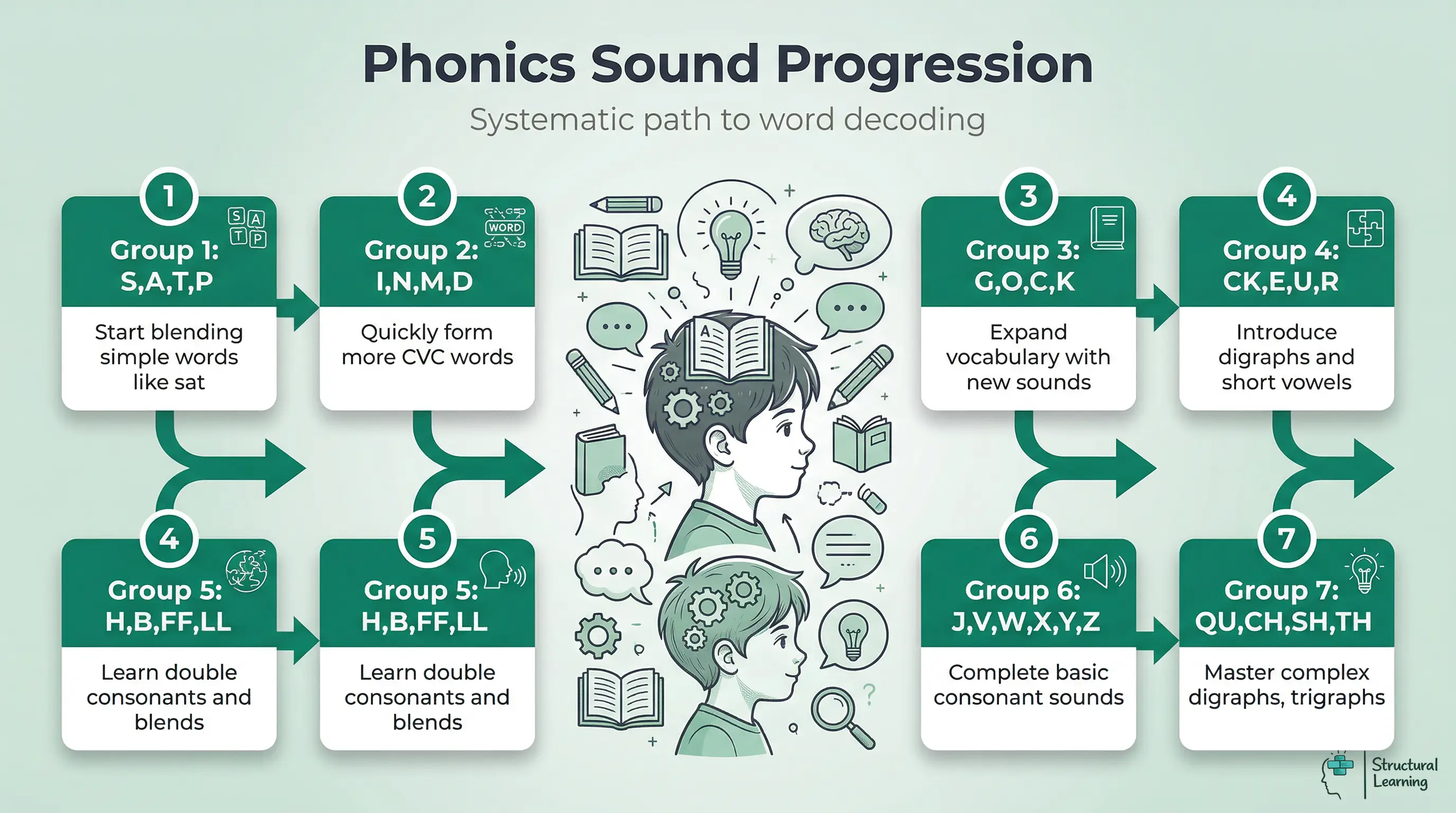
Jolly Phonics organises 42 letter sounds into seven groups, each taught over approximately one week in a Reception or Year 1 classroom. The grouping is deliberate, designed so that children can blend words as early as possible and experience early success.

Group 1: /s/, /a/, /t/, /p/ — allows blending of words like "sat", "tap", "pat", "spa"

Group 2: /i/, /n/, /m/, /d/ — adds words like "sit", "dip", "dim", "mid", "nit"

Group 3: /g/, /o/, /c/, /k/ — extends to "cod", "got", "dog", "cot", "oak"

Group 4: /ck/, /e/, /u/, /r/ — introduces the trigraph "ck" and vowel /e/, /u/ for "duck", "truck", "red", "bed", "run"

Group 5: /h/, /b/, /f/, /ff/, /l/, /ll/ — teaches /h/, /b/, digraph /ff/, /ll/ for "hill", "bill", "huff", "buff", "full"

Group 6: /j/, /v/, /w/, /x/, /y/, /z/, /zz/ — covers remaining consonants and digraphs for "jam", "van", "wig", "box", "yes", "zip"

Group 7: /qu/, /ch/, /sh/, /th/, /ng/, /nk/ — focuses on digraphs and trigraphs for "ship", "chip", "thing", "king", "bank"

This sequence matters because early groups are phonically "rich" (many possible blends), allowing children to decode words immediately and build phonemic awareness. By contrast, if the programme taught all consonants first, children would struggle to hear themselves blend sounds into recognisable words.

A Year 1 teacher using Jolly Phonics typically introduces one group per week. On day one, children learn the four new sounds plus an action for each. By day five, they have blended words, segmented familiar words, and written CVC (consonant-vowel-consonant) words using the new sounds. This rapid progression builds confidence and momentum, especially for children who have experienced slow-paced phonics in Reception.

The Five Skills: Blending, Segmenting, and Beyond

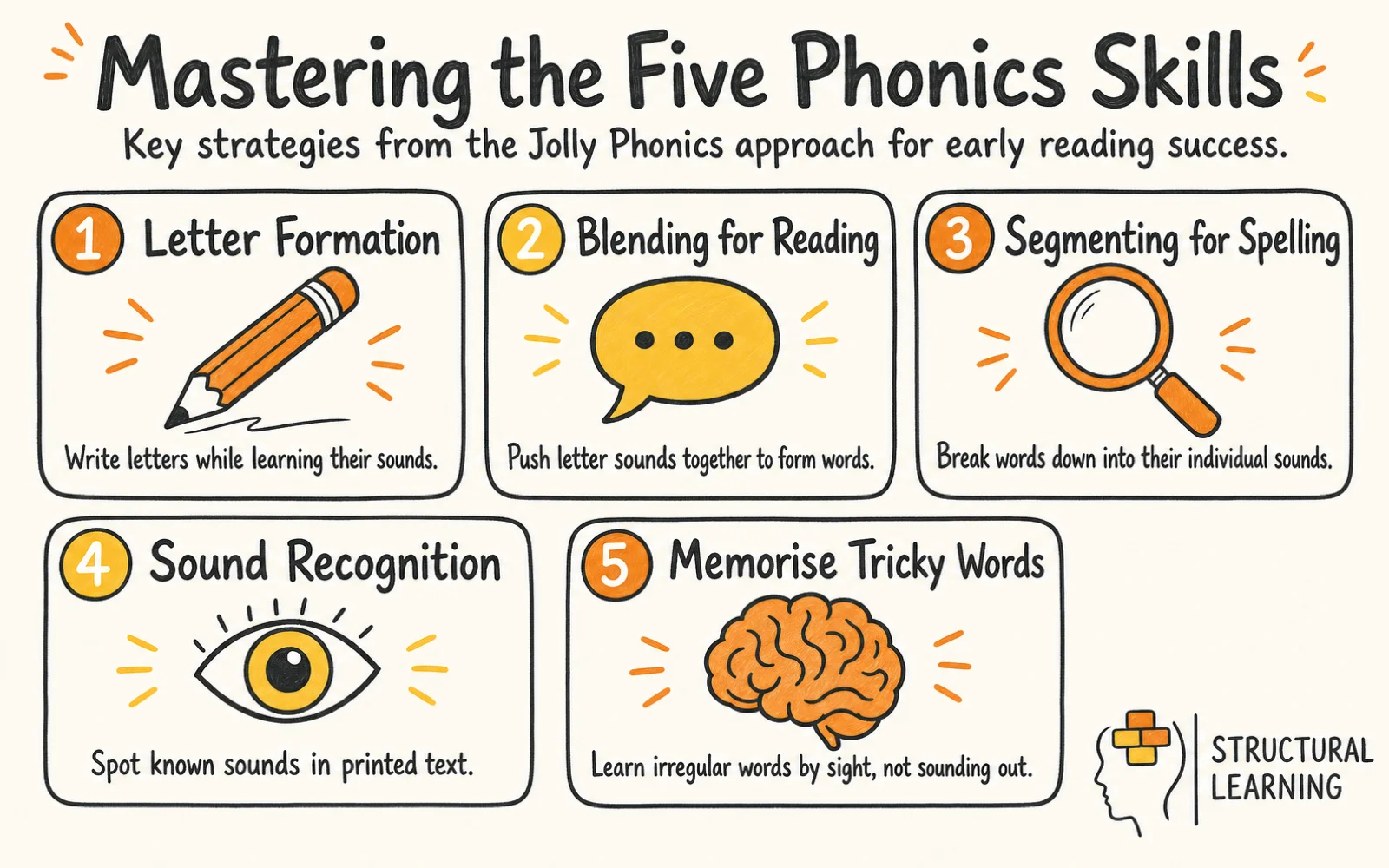
Jolly Phonics doesn't treat phonics as just "learning letter sounds". Instead, it develops five core skills that constitute phonemic awareness and decoding ability.

Skill 1: Letter Formation — Children write the letter as they learn its sound. Writing engages motor memory and binds the sound to its visual form more deeply than tracing or copying. In a typical session, a Reception child might write /s/ on a whiteboard, in sand, and in a workbook, building muscle memory alongside sound knowledge.

Skill 2: Blending (Synthesis) — Children push sounds together to form words. "C-a-t" becomes "cat". Blending is not intuitive; many children who know letter sounds cannot yet blend. Jolly Phonics teaches blending explicitly, using oral rehearsal (sounds said aloud, then blended) before reading the word. For example, a teacher shows the word "pin", points to each letter saying /p/, /i/, /n/, then runs a finger under the whole word saying "piiiin".

Skill 3: Segmenting (Phoneme Isolation) — Children break words into individual sounds. This is the reverse of blending and is essential for spelling. When a teacher says "sit", a child identifies /s/, /i/, /t/ and writes each letter. Segmenting develops phonological awareness and supports writing more than reading, but both are essential (Ehri, 2014).

Skill 4: Sound Recognition — Children recognise written letters and their sounds in printed text. This goes beyond reading; it includes spotting sounds in environmental print, signs, or shared texts. A Year 1 classroom might have a "sound wall" where children add pictures and words for each letter sound as it's learned.

Skill 5: Tricky Word Knowledge — Some words break phonetic rules (irregular words like "the", "said", "one"). Rather than trying to segment these, children memorise them by sight. Jolly Phonics teaches these separately, which is explored later in this guide.

These five skills are not taught in isolation. In a typical Jolly Phonics lesson, all five are practised: children write the letters (skill 1), blend words using them (skill 2), segment words for spelling (skill 3), recognise the sounds in text (skill 4), and practise sight words (skill 5). This integrated approach develops reading fluency faster than phoneme-by-phoneme instruction.

What a Jolly Phonics Lesson Looks Like in Reception

A single Jolly Phonics lesson typically lasts 20-30 minutes and follows a consistent structure. Here is a realistic snapshot from a Reception classroom introducing Group 1 sounds.

Segment 1: Revisit and Review (3-5 minutes) — The teacher calls out four previously learned sounds (or starts with a quick recap if day one). Children respond by making the sound and performing the associated action. These actions are distinctive: /s/ is accompanied by a slithering snake motion, /a/ with an arm movement, /t/ with a tapping gesture. The multi-sensory action helps children remember the sound and makes learning more engaging than rote repetition.

Segment 2: New Sound Introduction (2-3 minutes) — The teacher introduces one new sound from the group. The letter appears on the whiteboard or interactive screen. Children see it, hear the sound modelled, and see the action demonstrated. The teacher emphasises the sound, not the letter name: "This letter makes the sound /s/. It's like a snake. Let's make the sound and the action together."

Segment 3: Letter Formation (5-7 minutes) — Children write the new letter in sand, on whiteboards, or in books while saying the sound aloud. The teacher circulates, checking correct letter formation and proper sound production. A child who writes the letter while saying /s/ encodes the symbol-sound mapping more robustly than one who simply watches.

Segment 4: Blending Practice (5-8 minutes) — Once children have learned three or four sounds from the group, the teacher begins blending words. The teacher writes a simple CVC word (e.g., "sat") on the board, points to each letter, children say the sound aloud, then blend: "s-a-t, sat". Initially, the teacher models and leads; later, children do this independently with a partner or small group. Blending should feel playful, not laboured.

Segment 5: Segmenting and Spelling (3-5 minutes) — The teacher says a word aloud ("tap"). Children say the individual sounds (/t/, /a/, /p/) and hold up letters (from letter cards) or write them. This reversal of blending consolidates both skills and directly supports spelling.

Segment 6: Tricky Words and Sight Reading (optional, 2-3 minutes) — If the lesson has time, the teacher introduces one tricky word (like "the" or "is"). The word is displayed on a flashcard, said aloud several times, and practised in context. For example, "Is it a cat?" introduces both the word "is" and applies the child's newly learned sound knowledge to other words in the sentence.

Segment 7: Application and Assessment (optional, 2-3 minutes) — Children might read a short decodable book, a sentence on the whiteboard, or environmental print using the sounds learned so far. The teacher observes, notes who can blend and who needs more support, and formative assessment informs whether the group is ready to move on or needs consolidation.

The entire lesson is teacher-led, fast-paced, and multi-sensory. No lesson is spent on "fun letter sound activities" that don't directly teach phonics. The focus is relentless: children learn sounds, blend words, and read. This pedagogical clarity is part of Jolly Phonics' strength and, for some teachers, part of its limitation.

Tricky Words: Teaching High-Frequency Words That Break the Rules

Not all English words can be decoded phonetically. "The", "said", "one", "two", "here", "where", and "come" are phonetically irregular. Pronouncing /th/-/e/ does not produce "the"; sounding out "said" as /s/-/a/-/i/-/d/ gives the wrong pronunciation. These are tricky words (or irregular words, or sight words, depending on terminology).
Jolly Phonics addresses these by teaching them as whole units that must be memorised, not decoded. This is pragmatic and research-backed: children cannot avoid these words, and trying to segment them causes confusion. Instead, the words are introduced in a systematic order, learned by sight, and practised in context (Ehri, 2014).

A Reception or Year 1 teacher using Jolly Phonics introduces tricky words gradually, typically one or two per week, alongside phonetically regular instruction. The word "the" appears early because it's the most frequent word in English texts. Children see it on flashcards, see it highlighted in shared reading texts, and read it in decodable sentences.

For example, in a Year 1 class learning Group 2 sounds, the teacher might write: "The cat sat. The dog sat." Children blend the decodable words (cat, sat, dog) and sight-read "the". Over time, repeated exposure in context moves "the" from a word children have to sound out from a flashcard to one they recognise instantly in text.

Tricky words can be a sticking point for beginning readers. A child who sounds out every other word fluently but halts at "said", unable to decode it, experiences frustration. Explicitly teaching these words as exceptions, rather than expecting children to generalise phonetic rules to irregular words, reduces that frustration and builds reading confidence.

The 7 Groups: A Journey Through Letter Sounds infographic for teachers
The 7 Groups: A Journey Through Letter Sounds

Jolly Phonics vs Letters and Sounds: Key Differences

Letters and Sounds was the government-recommended phonics scheme from 2007 to 2019 and remains widely used in UK schools. Both are systematic synthetic phonics programmes, but they differ in structure, pacing, and design.

Sound order: Jolly Phonics groups sounds to maximise early blending. Letters and Sounds introduces sounds more gradually and in a different sequence. For instance, Jolly Phonics teaches /a/ in Group 1, allowing immediate CVC blends; Letters and Sounds introduces vowels more gradually, meaning children cannot blend words as quickly.

Pacing: Jolly Phonics typically covers all 42 sounds by the end of Reception or early Year 1. Letters and Sounds phases are longer, with Phase 2 and Phase 3 spreading over many weeks in Reception, meaning full phonetic coverage takes longer.

Intensity: Jolly Phonics lessons are short, frequent, and focused. A typical session lasts 20-30 minutes and addresses only one or two new sounds, with substantial revision and blending. Letters and Sounds lessons can be longer and may introduce more sounds per session.

Tricky words: Both programmes teach irregular words separately. The order differs slightly, but the principle is identical.

Multi-sensory approach: Jolly Phonics emphasises actions, writing, and kinaesthetic engagement as built-in features. Letters and Sounds includes multi-sensory work but does not mandate actions for every sound.

Research basis: Both are grounded in systematic synthetic phonics research (Rose, 2006). Neither has a significantly stronger evidence base than the other; effectiveness depends largely on implementation fidelity and teacher knowledge.

A school choosing between them typically considers: Do teachers prefer the shorter, higher-frequency Jolly Phonics sessions or the more measured Letters and Sounds pace? Can teachers commit to the actions and multi-sensory approach? Will resources and staff training support consistent delivery? Both deliver results when implemented with fidelity.

Common Implementation Mistakes and How to Avoid Them

Even well-intentioned teachers make mistakes when implementing Jolly Phonics. These are the most common pitfalls and how to sidestep them.

Mistake 1: Rushing through sounds without sufficient blending practice. A teacher introduces four new sounds in a week but spends only 2-3 minutes on blending. Children know the sounds but cannot yet blend them into words. By the end of the group, they feel lost and disheartened.

Solution: Spend at least half your phonics lesson time on blending once you have introduced three or four sounds. Children must experience success in reading CVC words before moving to the next group. If blending is weak, stay in the current group for an extra week.

Mistake 2: Teaching letter names instead of sounds. A child learns that the letter "S" is called "ess", not the sound /s/. This causes confusion when blending: the child tries to say "ess-a-t", which doesn't work.

Solution: Never teach letter names in the same lesson as sounds. If a child asks "What's that letter called?", say "It makes the sound /s/." Once phonics is secure (late Year 1 or Year 2), introduce letter names as a separate, parallel learning goal. This is not confusing if phonetic knowledge is already established.

Mistake 3: Relying on worksheets instead of oral blending and reading. A Reception class spends 15 minutes on Jolly Phonics, then 10 minutes colouring pictures of objects that start with the new sound. The phonetic instruction is lost.

Solution: Every minute of phonics time should directly teach phonetic skills. Worksheets are fine for consolidation or for children working independently while you conduct small-group blending sessions, but they cannot replace direct teaching. Use the time to blend, segment, and read.

Mistake 4: Not assessing segmentation and encoding (spelling) alongside decoding. A teacher assumes that if children can read CVC words, they can spell them. In reality, segmentation is a separate skill that develops slightly later.

Solution: Include segmentation and spelling in every lesson, even a brief 2-minute segment. Have children write dictated CVC words or hold up letter cards to spell words you say aloud. This builds spelling confidence and reveals whether blending is truly secure.

Mistake 5: Inconsistent tricky word teaching. Tricky words are introduced haphazardly. A teacher teaches "the" one week but doesn't revisit it in shared reading. Children forget it because they see it only once.

Solution: Once a tricky word is introduced, it must appear in every shared reading text and be reviewed daily on flashcards for at least 2-3 weeks. Create a word wall and point to it during reading. Tricky words require spaced revision to become automatic.

Mistake 6: Not differentiating for struggling readers. A teacher expects all children to move through groups at the same pace. Some children are still blending Group 1 words while the class moves to Group 2.

Solution: Use small-group intervention. While the main class moves on, run a separate 10-minute session with children who need consolidation, focusing on blending within the current group. This prevents gaps from widening. Some children will need two weeks in a group; others will move through in five days. This variation is normal and necessary.

Using Jolly Phonics with EAL and SEND Learners

Jolly Phonics is effective for most children, but it requires adaptation for learners with different starting points or needs.

EAL learners: A child whose home language is not English may not hear or distinguish English sounds clearly. The /th/ sound (as in "the") doesn't exist in many languages; a child learning English may substitute /f/ or /d/, saying "fis" instead of "this". Jolly Phonics' emphasis on clear sound modelling and repeated oral practice helps, but additional scaffolding is needed.

For EAL learners, extend the oral blending phase. Before expecting reading, spend time helping the child hear and pronounce the sounds correctly. Use the actions to reinforce sound-shape associations; kinaesthetic memory is often stronger than auditory memory for second-language learners. Pair EAL children with English-speaking partners during blending games so they hear correct pronunciation modelled. If a sound doesn't exist in the child's home language (like /th/ for many Asian languages), be explicit about mouth position and exaggerate the sound.

Consider also that some EAL learners come with advanced phonetic knowledge in their first language. A child who speaks Mandarin Chinese may be reading characters, not phonetically; the transition to alphabet-based English phonics is conceptually different. Reassure these learners that phonics is a valid system in English, even if it's not how they read at home.

Learners with phonological processing difficulties: Some children have working memory or auditory processing difficulties. They struggle to hear or remember the sequence of sounds in a word. These learners need additional support with the auditory-oral aspects of phonics.

Provide visual supports. Show picture cues for each sound alongside the letter. Use the actions consistently; they provide a visual-kinaesthetic anchor. Slow down the pace of blending; instead of three sounds per word, start with two. Use fewer words per session, with more repetition. Consider letter cards or tiles that the child can move around while blending, engaging visual and tactile memory alongside auditory.

Learners with dyslexia: Dyslexia is a phonological processing disorder that makes phoneme awareness and letter-sound retention difficult. Standard Jolly Phonics may move too quickly. These learners benefit from significantly slower pacing, multisensory approaches beyond Jolly Phonics' standard delivery (like tracing letters in sand or using textured letter tiles), explicit instruction in metacognition (what strategies help you remember?), and smaller group sizes.

Coloured overlays or reading rulers may help reduce visual stress. Some dyslexic learners benefit from coloured letter tiles or from writing letters in colours, engaging visual distinctiveness. Consider also that some dyslexic children benefit from additional oral blending before reading; they may need to hear a sound said, blended, and heard again before attempting to blend visually.

None of these adaptations reject Jolly Phonics' core methodology. Rather, they slow it down, add visual and tactile supports, and provide more frequent review and practise.

Phonics Screening Check: How Jolly Phonics Prepares Year 1

The Year 1 Phonics Screening Check is a statutory assessment in England, introduced in 2012, that tests children's ability to decode regular words and pseudowords (nonsense words like "dron" or "plig"). It assesses phonetic knowledge, not comprehension. A child must score 32 out of 40 to "pass".

Jolly Phonics, if taught systematically through Reception and Year 1, prepares children well for the screening check. The check contains only regular, decodable words and phonetically regular pseudowords. Since Jolly Phonics teaches all 42 sounds plus blending and segmenting, children learn exactly what the check assesses.

However, there are two nuances worth considering.

First, the screening check includes some less common graphemes, like /oo/ (as in "book" or "boot"), /aw/ (as in "saw"), and /ue/ (as in "blue"). If Jolly Phonics is taught only through Group 7 (digraphs like /ch/, /sh/), children may not have covered all the digraphs and trigraphs needed. Most Jolly Phonics schools extend beyond Group 7 in Year 1 to teach the remaining graphemes. Check your scheme's progression.

Second, pseudowords (made-up words like "sig" or "trom") test whether children can apply phonetic knowledge flexibly. A child who has memorised every word in the Jolly Phonics decodable readers but hasn't practised blending novel words may struggle with pseudowords. The solution is straightforward: include novel word blending in your practice, not just words from the scheme's readers. Make up your own CVC and CCVC words and have children blend them.

Most schools using Jolly Phonics report that children pass the screening check at or above the national average. The scheme aligns well with the assessment because both are grounded in the same phonetic progression.

Why Teachers Choose Jolly Phonics: The Multi-Sensory Advantage infographic for teachers
Why Teachers Choose Jolly Phonics: The Multi-Sensory Advantage

When to Move Beyond Jolly Phonics

Jolly Phonics is designed as the foundation for reading, but it is not the entirety of reading instruction. By the end of Year 1 (or in some cases, early Year 2), children have completed all 42 sounds and the main tricky word set. What comes next?

Phase 4-5 Consolidation: Around the transition to Year 2, children should consolidate their phonetic knowledge through repeated reading, writing, and blending of longer words and sentences. This is not new sound teaching but rather extensive practise applying known sounds to real reading and writing tasks. Some schools call this "Phase 4" (consolidation of Phases 2-3) and "Phase 5" (introducing alternative graphemes, like /oa/ as an alternative to /o/, and /ai/ as an alternative to /a/).

Morphological awareness: As children move through Year 2 and beyond, they benefit from explicit teaching of suffixes, prefixes, and word families. The word "cat" is not just /c-a-t/; it becomes "cats" (plural), "catting" (verb, though not a real word), and can be understood as related to other words. Teaching morphology (the structure of words) becomes increasingly important as reading demands shift from decoding CVC words to understanding longer, more complex words.

Fluency and comprehension: Once decoding is secure, the focus shifts to reading fluency (reading accurately and at a reasonable pace) and comprehension (understanding what you read). Jolly Phonics is a decoding tool; it doesn't teach children to understand stories or to discuss what they have read. Guided reading, shared reading, and independent reading become increasingly central to literacy instruction.

Spelling: Jolly Phonics includes segmentation work that supports early spelling, but it is not a complete spelling programme. By Year 2, children benefit from explicit teaching of spelling patterns, rules, and exceptions. Programmes like Read Write Inc. Spelling or commercial spelling schemes take over from phonics-based spelling teaching.

The transition away from phonics-focused teaching is gradual, not abrupt. By the end of Year 2, phonics instruction typically occupies a smaller part of the literacy hour, while guided reading, writing, and word study become more prominent. This is developmentally appropriate and aligns with the science of reading: decoding is a necessary foundation, but fluent, comprehending reading requires more.

Some children will still need phonics-based intervention in Year 2, Year 3, or beyond. Children with dyslexia or persistent reading difficulties may need a second or third systematic phonics programme, taught with even greater intensity and support. This is not a failure of Jolly Phonics but rather a recognition that children develop at different rates and some need more support to secure phonetic knowledge.

---

If you are considering adopting Jolly Phonics or are already using it, start by auditing your current teaching: Are children blending confidently? Are segmentation and spelling developing alongside reading? Are tricky words being revised regularly? Are you differentiating for children who need slower pacing or additional scaffolding? Address any gaps in your implementation, and Jolly Phonics will serve your children well. If gaps are structural or children are not making progress despite good teaching, consider an audit by a phonics specialist or SLT review of your phonics provision.

Loading audit...

Jolly Phonics is a systematic synthetic phonics programme that teaches reading through an explicit, multi-sensory approach to letter-sound knowledge. Developed by Sue Lloyd and Sara Wernham in the 1980s, it has become one of the most widely adopted phonics schemes in UK schools, with its core philosophy aligned to the Rose Review recommendation for synthetic phonics as the starting point for reading instruction (Rose, 2006). This guide explains how Jolly Phonics works, why teachers choose it, and how to implement it effectively in your classroom.

Jolly Phonics vs. Whole Word: How Children Learn to Read infographic for teachers
Jolly Phonics vs. Whole Word: How Children Learn to Read

What Is Jolly Phonics and How Does It Teach Reading?

Jolly Phonics teaches children to recognise letter sounds and blend them into words. Rather than starting with letter names (A-B-C), children learn sounds first; "S" is pronounced as /s/ not "ess", which allows them to blend immediately into simple words like "sit" and "sat". This sound-first approach is grounded in the science of reading, where phonological awareness (understanding that words break down into sounds) precedes letter knowledge (Goswami, 1990).

The programme combines multi-sensory engagement: children see the letter, hear the sound, say it aloud, and perform an action or write it. This combination of visual, auditory, kinaesthetic and writing-based learning supports working memory retention and encodes sounds more deeply than flashcard drilling alone. For example, in a Reception class learning the sound /m/, children might see the letter M, say the sound aloud while drawing an "M" shape in the air, and then write it on sand trays or magnetic boards.

Jolly Phonics avoids the whole-word "look and say" approach that dominated UK primary schools before the 2006 Rose Review. Instead, it insists that systematic phonics (teaching sounds in a deliberate sequence, not randomly) is the most efficient route to word reading for most children. The research evidence is strong: meta-analyses show synthetic phonics produces significantly better reading outcomes than mixed methods (EEF, 2017).

The Seven Groups: How Jolly Phonics Sequences Letter Sounds

Jolly Phonics organises 42 letter sounds into seven groups, each taught over approximately one week in a Reception or Year 1 classroom. The grouping is deliberate, designed so that children can blend words as early as possible and experience early success.

Group 1: /s/, /a/, /t/, /p/ — allows blending of words like "sat", "tap", "pat", "spa"

Group 2: /i/, /n/, /m/, /d/ — adds words like "sit", "dip", "dim", "mid", "nit"

Group 3: /g/, /o/, /c/, /k/ — extends to "cod", "got", "dog", "cot", "oak"

Group 4: /ck/, /e/, /u/, /r/ — introduces the trigraph "ck" and vowel /e/, /u/ for "duck", "truck", "red", "bed", "run"

Group 5: /h/, /b/, /f/, /ff/, /l/, /ll/ — teaches /h/, /b/, digraph /ff/, /ll/ for "hill", "bill", "huff", "buff", "full"

Group 6: /j/, /v/, /w/, /x/, /y/, /z/, /zz/ — covers remaining consonants and digraphs for "jam", "van", "wig", "box", "yes", "zip"

Group 7: /qu/, /ch/, /sh/, /th/, /ng/, /nk/ — focuses on digraphs and trigraphs for "ship", "chip", "thing", "king", "bank"

This sequence matters because early groups are phonically "rich" (many possible blends), allowing children to decode words immediately and build phonemic awareness. By contrast, if the programme taught all consonants first, children would struggle to hear themselves blend sounds into recognisable words.

A Year 1 teacher using Jolly Phonics typically introduces one group per week. On day one, children learn the four new sounds plus an action for each. By day five, they have blended words, segmented familiar words, and written CVC (consonant-vowel-consonant) words using the new sounds. This rapid progression builds confidence and momentum, especially for children who have experienced slow-paced phonics in Reception.

The Five Skills: Blending, Segmenting, and Beyond

Jolly Phonics doesn't treat phonics as just "learning letter sounds". Instead, it develops five core skills that constitute phonemic awareness and decoding ability.

Skill 1: Letter Formation — Children write the letter as they learn its sound. Writing engages motor memory and binds the sound to its visual form more deeply than tracing or copying. In a typical session, a Reception child might write /s/ on a whiteboard, in sand, and in a workbook, building muscle memory alongside sound knowledge.

Skill 2: Blending (Synthesis) — Children push sounds together to form words. "C-a-t" becomes "cat". Blending is not intuitive; many children who know letter sounds cannot yet blend. Jolly Phonics teaches blending explicitly, using oral rehearsal (sounds said aloud, then blended) before reading the word. For example, a teacher shows the word "pin", points to each letter saying /p/, /i/, /n/, then runs a finger under the whole word saying "piiiin".

Skill 3: Segmenting (Phoneme Isolation) — Children break words into individual sounds. This is the reverse of blending and is essential for spelling. When a teacher says "sit", a child identifies /s/, /i/, /t/ and writes each letter. Segmenting develops phonological awareness and supports writing more than reading, but both are essential (Ehri, 2014).

Skill 4: Sound Recognition — Children recognise written letters and their sounds in printed text. This goes beyond reading; it includes spotting sounds in environmental print, signs, or shared texts. A Year 1 classroom might have a "sound wall" where children add pictures and words for each letter sound as it's learned.

Skill 5: Tricky Word Knowledge — Some words break phonetic rules (irregular words like "the", "said", "one"). Rather than trying to segment these, children memorise them by sight. Jolly Phonics teaches these separately, which is explored later in this guide.

These five skills are not taught in isolation. In a typical Jolly Phonics lesson, all five are practised: children write the letters (skill 1), blend words using them (skill 2), segment words for spelling (skill 3), recognise the sounds in text (skill 4), and practise sight words (skill 5). This integrated approach develops reading fluency faster than phoneme-by-phoneme instruction.

What a Jolly Phonics Lesson Looks Like in Reception

A single Jolly Phonics lesson typically lasts 20-30 minutes and follows a consistent structure. Here is a realistic snapshot from a Reception classroom introducing Group 1 sounds.

Segment 1: Revisit and Review (3-5 minutes) — The teacher calls out four previously learned sounds (or starts with a quick recap if day one). Children respond by making the sound and performing the associated action. These actions are distinctive: /s/ is accompanied by a slithering snake motion, /a/ with an arm movement, /t/ with a tapping gesture. The multi-sensory action helps children remember the sound and makes learning more engaging than rote repetition.

Segment 2: New Sound Introduction (2-3 minutes) — The teacher introduces one new sound from the group. The letter appears on the whiteboard or interactive screen. Children see it, hear the sound modelled, and see the action demonstrated. The teacher emphasises the sound, not the letter name: "This letter makes the sound /s/. It's like a snake. Let's make the sound and the action together."

Segment 3: Letter Formation (5-7 minutes) — Children write the new letter in sand, on whiteboards, or in books while saying the sound aloud. The teacher circulates, checking correct letter formation and proper sound production. A child who writes the letter while saying /s/ encodes the symbol-sound mapping more robustly than one who simply watches.

Segment 4: Blending Practice (5-8 minutes) — Once children have learned three or four sounds from the group, the teacher begins blending words. The teacher writes a simple CVC word (e.g., "sat") on the board, points to each letter, children say the sound aloud, then blend: "s-a-t, sat". Initially, the teacher models and leads; later, children do this independently with a partner or small group. Blending should feel playful, not laboured.

Segment 5: Segmenting and Spelling (3-5 minutes) — The teacher says a word aloud ("tap"). Children say the individual sounds (/t/, /a/, /p/) and hold up letters (from letter cards) or write them. This reversal of blending consolidates both skills and directly supports spelling.

Segment 6: Tricky Words and Sight Reading (optional, 2-3 minutes) — If the lesson has time, the teacher introduces one tricky word (like "the" or "is"). The word is displayed on a flashcard, said aloud several times, and practised in context. For example, "Is it a cat?" introduces both the word "is" and applies the child's newly learned sound knowledge to other words in the sentence.

Segment 7: Application and Assessment (optional, 2-3 minutes) — Children might read a short decodable book, a sentence on the whiteboard, or environmental print using the sounds learned so far. The teacher observes, notes who can blend and who needs more support, and formative assessment informs whether the group is ready to move on or needs consolidation.

The entire lesson is teacher-led, fast-paced, and multi-sensory. No lesson is spent on "fun letter sound activities" that don't directly teach phonics. The focus is relentless: children learn sounds, blend words, and read. This pedagogical clarity is part of Jolly Phonics' strength and, for some teachers, part of its limitation.

Tricky Words: Teaching High-Frequency Words That Break the Rules

Not all English words can be decoded phonetically. "The", "said", "one", "two", "here", "where", and "come" are phonetically irregular. Pronouncing /th/-/e/ does not produce "the"; sounding out "said" as /s/-/a/-/i/-/d/ gives the wrong pronunciation. These are tricky words (or irregular words, or sight words, depending on terminology).

Jolly Phonics addresses these by teaching them as whole units that must be memorised, not decoded. This is pragmatic and research-backed: children cannot avoid these words, and trying to segment them causes confusion. Instead, the words are introduced in a systematic order, learned by sight, and practised in context (Ehri, 2014).

A Reception or Year 1 teacher using Jolly Phonics introduces tricky words gradually, typically one or two per week, alongside phonetically regular instruction. The word "the" appears early because it's the most frequent word in English texts. Children see it on flashcards, see it highlighted in shared reading texts, and read it in decodable sentences.

For example, in a Year 1 class learning Group 2 sounds, the teacher might write: "The cat sat. The dog sat." Children blend the decodable words (cat, sat, dog) and sight-read "the". Over time, repeated exposure in context moves "the" from a word children have to sound out from a flashcard to one they recognise instantly in text.

Tricky words can be a sticking point for beginning readers. A child who sounds out every other word fluently but halts at "said", unable to decode it, experiences frustration. Explicitly teaching these words as exceptions, rather than expecting children to generalise phonetic rules to irregular words, reduces that frustration and builds reading confidence.

The 7 Groups: A Journey Through Letter Sounds infographic for teachers
The 7 Groups: A Journey Through Letter Sounds

Jolly Phonics vs Letters and Sounds: Key Differences

Letters and Sounds was the government-recommended phonics scheme from 2007 to 2019 and remains widely used in UK schools. Both are systematic synthetic phonics programmes, but they differ in structure, pacing, and design.

Sound order: Jolly Phonics groups sounds to maximise early blending. Letters and Sounds introduces sounds more gradually and in a different sequence. For instance, Jolly Phonics teaches /a/ in Group 1, allowing immediate CVC blends; Letters and Sounds introduces vowels more gradually, meaning children cannot blend words as quickly.

Pacing: Jolly Phonics typically covers all 42 sounds by the end of Reception or early Year 1. Letters and Sounds phases are longer, with Phase 2 and Phase 3 spreading over many weeks in Reception, meaning full phonetic coverage takes longer.

Intensity: Jolly Phonics lessons are short, frequent, and focused. A typical session lasts 20-30 minutes and addresses only one or two new sounds, with substantial revision and blending. Letters and Sounds lessons can be longer and may introduce more sounds per session.

Tricky words: Both programmes teach irregular words separately. The order differs slightly, but the principle is identical.

Multi-sensory approach: Jolly Phonics emphasises actions, writing, and kinaesthetic engagement as built-in features. Letters and Sounds includes multi-sensory work but does not mandate actions for every sound.

Research basis: Both are grounded in systematic synthetic phonics research (Rose, 2006). Neither has a significantly stronger evidence base than the other; effectiveness depends largely on implementation fidelity and teacher knowledge.

A school choosing between them typically considers: Do teachers prefer the shorter, higher-frequency Jolly Phonics sessions or the more measured Letters and Sounds pace? Can teachers commit to the actions and multi-sensory approach? Will resources and staff training support consistent delivery? Both deliver results when implemented with fidelity.

Common Implementation Mistakes and How to Avoid Them

Even well-intentioned teachers make mistakes when implementing Jolly Phonics. These are the most common pitfalls and how to sidestep them.

Mistake 1: Rushing through sounds without sufficient blending practice. A teacher introduces four new sounds in a week but spends only 2-3 minutes on blending. Children know the sounds but cannot yet blend them into words. By the end of the group, they feel lost and disheartened.

Solution: Spend at least half your phonics lesson time on blending once you have introduced three or four sounds. Children must experience success in reading CVC words before moving to the next group. If blending is weak, stay in the current group for an extra week.

Mistake 2: Teaching letter names instead of sounds. A child learns that the letter "S" is called "ess", not the sound /s/. This causes confusion when blending: the child tries to say "ess-a-t", which doesn't work.

Solution: Never teach letter names in the same lesson as sounds. If a child asks "What's that letter called?", say "It makes the sound /s/." Once phonics is secure (late Year 1 or Year 2), introduce letter names as a separate, parallel learning goal. This is not confusing if phonetic knowledge is already established.

Mistake 3: Relying on worksheets instead of oral blending and reading. A Reception class spends 15 minutes on Jolly Phonics, then 10 minutes colouring pictures of objects that start with the new sound. The phonetic instruction is lost.

Solution: Every minute of phonics time should directly teach phonetic skills. Worksheets are fine for consolidation or for children working independently while you conduct small-group blending sessions, but they cannot replace direct teaching. Use the time to blend, segment, and read.

Mistake 4: Not assessing segmentation and encoding (spelling) alongside decoding. A teacher assumes that if children can read CVC words, they can spell them. In reality, segmentation is a separate skill that develops slightly later.

Solution: Include segmentation and spelling in every lesson, even a brief 2-minute segment. Have children write dictated CVC words or hold up letter cards to spell words you say aloud. This builds spelling confidence and reveals whether blending is truly secure.

Mistake 5: Inconsistent tricky word teaching. Tricky words are introduced haphazardly. A teacher teaches "the" one week but doesn't revisit it in shared reading. Children forget it because they see it only once.

Solution: Once a tricky word is introduced, it must appear in every shared reading text and be reviewed daily on flashcards for at least 2-3 weeks. Create a word wall and point to it during reading. Tricky words require spaced revision to become automatic.

Mistake 6: Not differentiating for struggling readers. A teacher expects all children to move through groups at the same pace. Some children are still blending Group 1 words while the class moves to Group 2.

Solution: Use small-group intervention. While the main class moves on, run a separate 10-minute session with children who need consolidation, focusing on blending within the current group. This prevents gaps from widening. Some children will need two weeks in a group; others will move through in five days. This variation is normal and necessary.

Using Jolly Phonics with EAL and SEND Learners

Jolly Phonics is effective for most children, but it requires adaptation for learners with different starting points or needs.

EAL learners: A child whose home language is not English may not hear or distinguish English sounds clearly. The /th/ sound (as in "the") doesn't exist in many languages; a child learning English may substitute /f/ or /d/, saying "fis" instead of "this". Jolly Phonics' emphasis on clear sound modelling and repeated oral practice helps, but additional scaffolding is needed.

For EAL learners, extend the oral blending phase. Before expecting reading, spend time helping the child hear and pronounce the sounds correctly. Use the actions to reinforce sound-shape associations; kinaesthetic memory is often stronger than auditory memory for second-language learners. Pair EAL children with English-speaking partners during blending games so they hear correct pronunciation modelled. If a sound doesn't exist in the child's home language (like /th/ for many Asian languages), be explicit about mouth position and exaggerate the sound.

Consider also that some EAL learners come with advanced phonetic knowledge in their first language. A child who speaks Mandarin Chinese may be reading characters, not phonetically; the transition to alphabet-based English phonics is conceptually different. Reassure these learners that phonics is a valid system in English, even if it's not how they read at home.

Learners with phonological processing difficulties: Some children have working memory or auditory processing difficulties. They struggle to hear or remember the sequence of sounds in a word. These learners need additional support with the auditory-oral aspects of phonics.

Provide visual supports. Show picture cues for each sound alongside the letter. Use the actions consistently; they provide a visual-kinaesthetic anchor. Slow down the pace of blending; instead of three sounds per word, start with two. Use fewer words per session, with more repetition. Consider letter cards or tiles that the child can move around while blending, engaging visual and tactile memory alongside auditory.

Learners with dyslexia: Dyslexia is a phonological processing disorder that makes phoneme awareness and letter-sound retention difficult. Standard Jolly Phonics may move too quickly. These learners benefit from significantly slower pacing, multisensory approaches beyond Jolly Phonics' standard delivery (like tracing letters in sand or using textured letter tiles), explicit instruction in metacognition (what strategies help you remember?), and smaller group sizes.

Coloured overlays or reading rulers may help reduce visual stress. Some dyslexic learners benefit from coloured letter tiles or from writing letters in colours, engaging visual distinctiveness. Consider also that some dyslexic children benefit from additional oral blending before reading; they may need to hear a sound said, blended, and heard again before attempting to blend visually.

None of these adaptations reject Jolly Phonics' core methodology. Rather, they slow it down, add visual and tactile supports, and provide more frequent review and practise.

Phonics Screening Check: How Jolly Phonics Prepares Year 1

The Year 1 Phonics Screening Check is a statutory assessment in England, introduced in 2012, that tests children's ability to decode regular words and pseudowords (nonsense words like "dron" or "plig"). It assesses phonetic knowledge, not comprehension. A child must score 32 out of 40 to "pass".

Jolly Phonics, if taught systematically through Reception and Year 1, prepares children well for the screening check. The check contains only regular, decodable words and phonetically regular pseudowords. Since Jolly Phonics teaches all 42 sounds plus blending and segmenting, children learn exactly what the check assesses.

However, there are two nuances worth considering.

First, the screening check includes some less common graphemes, like /oo/ (as in "book" or "boot"), /aw/ (as in "saw"), and /ue/ (as in "blue"). If Jolly Phonics is taught only through Group 7 (digraphs like /ch/, /sh/), children may not have covered all the digraphs and trigraphs needed. Most Jolly Phonics schools extend beyond Group 7 in Year 1 to teach the remaining graphemes. Check your scheme's progression.

Second, pseudowords (made-up words like "sig" or "trom") test whether children can apply phonetic knowledge flexibly. A child who has memorised every word in the Jolly Phonics decodable readers but hasn't practised blending novel words may struggle with pseudowords. The solution is straightforward: include novel word blending in your practice, not just words from the scheme's readers. Make up your own CVC and CCVC words and have children blend them.

Most schools using Jolly Phonics report that children pass the screening check at or above the national average. The scheme aligns well with the assessment because both are grounded in the same phonetic progression.

Why Teachers Choose Jolly Phonics: The Multi-Sensory Advantage infographic for teachers
Why Teachers Choose Jolly Phonics: The Multi-Sensory Advantage

When to Move Beyond Jolly Phonics

Jolly Phonics is designed as the foundation for reading, but it is not the entirety of reading instruction. By the end of Year 1 (or in some cases, early Year 2), children have completed all 42 sounds and the main tricky word set. What comes next?

Phase 4-5 Consolidation: Around the transition to Year 2, children should consolidate their phonetic knowledge through repeated reading, writing, and blending of longer words and sentences. This is not new sound teaching but rather extensive practise applying known sounds to real reading and writing tasks. Some schools call this "Phase 4" (consolidation of Phases 2-3) and "Phase 5" (introducing alternative graphemes, like /oa/ as an alternative to /o/, and /ai/ as an alternative to /a/).

Morphological awareness: As children move through Year 2 and beyond, they benefit from explicit teaching of suffixes, prefixes, and word families. The word "cat" is not just /c-a-t/; it becomes "cats" (plural), "catting" (verb, though not a real word), and can be understood as related to other words. Teaching morphology (the structure of words) becomes increasingly important as reading demands shift from decoding CVC words to understanding longer, more complex words.

Fluency and comprehension: Once decoding is secure, the focus shifts to reading fluency (reading accurately and at a reasonable pace) and comprehension (understanding what you read). Jolly Phonics is a decoding tool; it doesn't teach children to understand stories or to discuss what they have read. Guided reading, shared reading, and independent reading become increasingly central to literacy instruction.

Spelling: Jolly Phonics includes segmentation work that supports early spelling, but it is not a complete spelling programme. By Year 2, children benefit from explicit teaching of spelling patterns, rules, and exceptions. Programmes like Read Write Inc. Spelling or commercial spelling schemes take over from phonics-based spelling teaching.

The transition away from phonics-focused teaching is gradual, not abrupt. By the end of Year 2, phonics instruction typically occupies a smaller part of the literacy hour, while guided reading, writing, and word study become more prominent. This is developmentally appropriate and aligns with the science of reading: decoding is a necessary foundation, but fluent, comprehending reading requires more.

Some children will still need phonics-based intervention in Year 2, Year 3, or beyond. Children with dyslexia or persistent reading difficulties may need a second or third systematic phonics programme, taught with even greater intensity and support. This is not a failure of Jolly Phonics but rather a recognition that children develop at different rates and some need more support to secure phonetic knowledge.

---

If you are considering adopting Jolly Phonics or are already using it, start by auditing your current teaching: Are children blending confidently? Are segmentation and spelling developing alongside reading? Are tricky words being revised regularly? Are you differentiating for children who need slower pacing or additional scaffolding? Address any gaps in your implementation, and Jolly Phonics will serve your children well. If gaps are structural or children are not making progress despite good teaching, consider an audit by a phonics specialist or SLT review of your phonics provision.

Educational Technology

Back to Blog

{"@context":"https://schema.org","@graph":[{"@type":"Organization","@id":"https://www.structural-learning.com/#org","name":"Structural Learning","url":"https://www.structural-learning.com/","logo":{"@type":"ImageObject","url":"https://cdn.prod.website-files.com/5b69a01ba2e409501de055d1/5b69a01ba2e40996a5e055f4_structural-learning-logo.png"}},{"@type":"Person","@id":"https://www.structural-learning.com/team/paul-main/#person","name":"Paul Main","url":"https://www.structural-learning.com/team/paul-main","jobTitle":"Founder","affiliation":{"@id":"https://www.structural-learning.com/#org"}},{"@type":"BreadcrumbList","@id":"https://www.structural-learning.com/post/jolly-phonics-teachers-guide-synthetic#breadcrumb","itemListElement":[{"@type":"ListItem","position":1,"name":"Home","item":"https://www.structural-learning.com/"},{"@type":"ListItem","position":2,"name":"Blog","item":"https://www.structural-learning.com/blog"},{"@type":"ListItem","position":3,"name":"Jolly Phonics: A Teacher's Guide to Synthetic Phonics","item":"https://www.structural-learning.com/post/jolly-phonics-teachers-guide-synthetic"}]},{"@type":"BlogPosting","@id":"https://www.structural-learning.com/post/jolly-phonics-teachers-guide-synthetic#article","headline":"Jolly Phonics: A Teacher's Guide to Synthetic Phonics","description":"","author":{"@id":"https://www.structural-learning.com/team/paul-main/#person"},"publisher":{"@id":"https://www.structural-learning.com/#org"},"datePublished":"2026-02-19","dateModified":"2026-02-19","inLanguage":"en-GB"}]}