A practical guide for SENCOs and teachers on the SNIP Literacy Programme, explaining who it's for, how it works, and the evidence supporting its use for spelling and word-reading interventions.
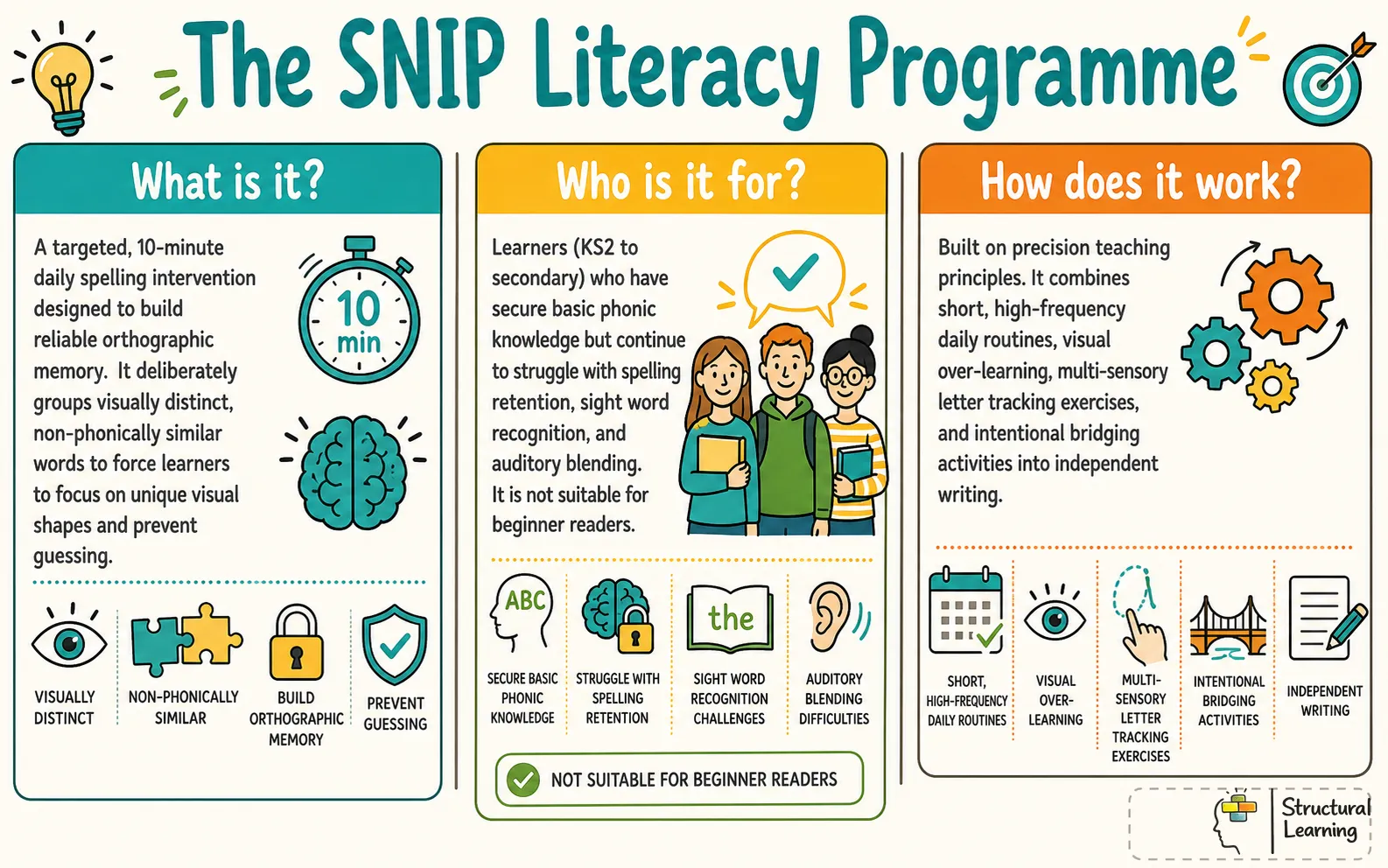
Who it's for: SNIP is a targeted intervention for learners who have basic phonic knowledge but struggle with spelling, sight word recognition, and auditory blending. It is not a programme for beginner readers.
Core Method: It uses short, daily sessions focusing on visually distinct, non-phonically similar words to build orthographic memory and prevent guessing.
Time-Efficient: The programme is designed for a 10-minute daily commitment, making it easier to timetable than longer withdrawal interventions.
Evidence: Action research cited by NEPS (2019) shows significant gains in word reading and spelling, though its impact on reading comprehension is limited.
Implementation: Success depends on correct learner identification, a consistent daily routine, and bridging the gap between isolated spelling practice and meaningful writing.
The SNIP Literacy Programme is a structured, time-efficient intervention designed to improve the spelling and word-reading accuracy of struggling learners. Created by Carol and Phil Smart, it is widely used in UK and international schools. It supports learners who have not made progress with traditional phonics-based approaches alone.
Unlike many spelling programmes, SNIP’s core principle is that target words are deliberately grouped so they are not phonically similar. This counter-intuitive approach forces learners to attend to the unique visual shape of each word, preventing them from simply guessing word endings based on a shared pattern (e.g., night, right, light). It is designed as a precise tool for building reliable orthographic memory.
Who is the SNIP Programme For? (And Who Is It Not For?)
SNIP is a targeted intervention, not a whole-class teaching tool. It is most effective when used with learners who fit a specific profile. It is designed for learners with a basic grasp of letter-sound relationships. However, they still struggle with accurate spelling and automatic sight word recognition.
The programme is often used from Key Stage 2 upwards, including secondary school. It helps learners who have become 'stuck' despite repeated phonics instruction.
Is SNIP the right fit for your learner?
Use this checklist to guide your decision-making.
Strength: The learner has secure basic phonic knowledge (can identify sounds for most single letters and simple digraphs).
Difficulty: The learner struggles to spell high-frequency words correctly and consistently.
Difficulty: The learner’s reading is slow and lacks fluency due to poor sight word vocabulary.
Difficulty: The learner struggles with auditory blending or has difficulty holding a sequence of sounds in their head to form a word.
Observation: The learner often guesses words based on the first letter and context, rather than decoding fully.
Observation: The learner makes progress with a spelling pattern during a lesson but cannot retain it long-term.
SNIP is not suitable for learners who are in the very early stages of reading and have not yet developed basic letter-sound correspondence. It is also not a reading comprehension programme. If a learner's main difficulty is understanding text, use a different intervention. However, SNIP can run alongside it to address a co-occurring word-level deficit.
How Does SNIP Work? The Core Mechanisms
SNIP is built on principles of precision teaching, using short, frequent sessions and a high degree of structure to secure learning. The programme targets the cognitive processes that underpin fluent spelling and reading.
Visual Over-learning and Orthographic Memory
By presenting visually distinct words, SNIP forces the brain to create a unique and stable memory for each word's letter sequence, its orthography. This stops learners from relying on rhyme or phonic patterns. These shortcuts are often weak strategies for those with poor phonological processing.
Multi-sensory Letter Tracking
A core activity in SNIP is the Tracking exercise. Learners scan a line of random letters to find and circle the target word's letters in sequence. They say each sound as they find it. This multi-sensory process (visual search, motor action of looping, and auditory feedback from saying the sound) strengthens the neural pathway for that specific word.
Bridging from Words to Sentences
To ensure spelling is not learned in a vacuum, the programme includes sentence-level work. After practising individual words, learners read a sentence containing a target word, cover it, and then write it from memory. This task strengthens orthographic memory in a meaningful context and reinforces correct capitalisation and punctuation.
A Step-by-Step Guide to Implementing SNIP in Your School
Successful implementation depends on careful planning, consistent delivery, and accurate progress monitoring.
Step 1: Assessment and Learner Selection
Administer a standardised spelling test to obtain a baseline spelling age for potential learners. Use the checklist above to identify individuals who fit the SNIP profile. The programme is most effective as a one-to-one intervention but can be run with small, well-matched groups of two or three.
Step 2: Timetabling and Resources
The primary advantage of SNIP is its time efficiency. Schedule a protected 10-15 minute slot for each learner, every day. This could be during morning registration, form time, or a dedicated intervention block. Consistency is more important than session length.
The SNIP Literacy Programme
You will need the SNIP programme manuals and a quiet space to work. The programme is designed to be delivered by a teacher or a trained teaching assistant.
Step 3: The Weekly Session Structure
SNIP is paced at one session (or "pack") per week. This pace ensures sufficient repetition for the learning to become secure.
A typical 10-minute daily session follows this structure:
Shared Reading (1 minute): The learner reads the list of target words for the week. The adult gives corrective feedback and discusses the meaning of any unfamiliar words.
Spelling Practice (3-4 minutes): The learner practises spelling the target words using the ‘look, say, cover, write, check’ method.
Tracking Exercise (3-4 minutes): The learner completes the multi-sensory tracking exercise for one or two of the target words.
Sentence Writing (1-2 minutes): The learner reads, covers, and writes a sentence containing a target word.
Step 4: Monitoring Progress
After a set block of intervention (e.g., 12 weeks), re-administer the same standardised spelling test used at baseline. Calculate the gain in spelling age to measure the impact of the intervention. This data is important for reporting to parents and senior leaders and for making decisions about continuing or changing the support.
A Concrete Classroom Example: SNIP in a Year 5 Setting
A Year 5 learner has a reading age in line with his peers but a spelling age that is 18 months behind. He knows his sounds but struggles to apply them, frequently misspelling common words in his independent writing. His teacher decides to start the SNIP programme.
The Setting: A quiet corner of the classroom during the first 10 minutes of the day.
The Task: SNIP Session 4. The target words are: they, you, going, yes, all, she, day, about, after.
What the Teacher Says:
(Shared Reading): "Let's read our new words for this week. Notice how different they all look. We have to learn them by sight. Can you use the word 'about' in a sentence for me?"
(Tracking): "Great. Now let's track the word 'she'. Put your pencil here and slide it along the line. Every time you see a letter from 'she', loop it and say the sound."
(Sentence Writing): "Excellent. Now read this sentence: 'The girl said that she had a long walk to get home.' Cover it with this card. Now write it in the box below, just as you remember it."
What the Learner Does:
The learner reads the list of words. He says, "I was thinking about my football match."
He slowly moves his pencil along the line of random letters: she smi hgaeuognork as wl bdho soucdetk n i. He loops the 's', the 'h', and the 'e', saying each sound.
He covers the model sentence and writes it out, successfully spelling 'she' correctly in a meaningful context.
Intended Learning Gain: The learner builds a secure orthographic representation of the word 'she'. They connect its visual form to its sound and meaning using a structured, multi-sensory routine. This repeated, daily practice will move the word from his working memory into his long-term memory.
Connecting SNIP to Classroom Practice: The 'Transfer Gap'
A significant challenge with any isolated intervention is ensuring the skills are transferred back into the learner's independent work. Learners can become very good at spelling words in the 10-minute SNIP session but continue to misspell them in their extended writing. This is the 'transfer gap'.
To bridge this gap, spelling practice must be explicitly connected to meaning and sentence construction. This is where the principles of Structural Learning can be applied.
Map It: After a SNIP session, ask the learner to choose one or two target words. Then, ask them to connect these to related ideas. For the word 'about', they could create a quick concept map of things they are thinking 'about', a holiday, a book, a friend. This links the spelling of the word to its semantic network.
Build It: Use the target words as anchors for sentence-building exercises. Provide the learner with a target word, such as 'after', and ask them to build a sentence around it. This moves beyond rote recall and into active use, helping to automate the spelling in a generative context.
SNIP vs. Other Literacy Interventions
SENCOs must choose from a wide range of interventions. This table compares SNIP to other common approaches.
The Evidence for SNIP: What Does the Research Say?
There are few large-scale, peer-reviewed randomised controlled trials on the SNIP programme itself. However, it is supported by strong practitioner-led action research and endorsed by educational bodies.
Intervention Approach
Primary Focus
Typical Time Commitment
Best For...
SNIP Literacy Programme
Spelling and sight word recognition for learners with phonological difficulties.
10-15 minutes daily.
Learners who know phonics but can't spell or read high-frequency words fluently.
Improving a learner's ability to understand and analyse text.
30-45 minute group sessions.
Learners who can decode words but struggle to derive meaning from sentences and paragraphs.
The most prominent citation comes from Ireland's National Educational Psychological Service (NEPS, 2019). In their guidance for teachers, Effective Interventions for Struggling Readers, NEPS reports on national trials of the programme. The findings were positive for word-level skills, with one project showing an average 14-month gain in word reading after just 3 months of intervention. A more recent school-based evaluation at Linlithgow Academy (2025) found that targeted secondary school learners achieved an average spelling age increase of 4.5 months.
However, it is important to acknowledge the programme's limitations. The NEPS evaluation found that SNIP has a negligible impact on reading comprehension. This is not a failure of the programme, but a confirmation of its specific purpose: it is a tool for fixing word-level decoding and spelling, not for teaching text comprehension.
The underlying principles of SNIP, structured, systematic instruction focusing on morphology and phonological awareness, are well-supported by the wider research base on literacy interventions (Goodwin et al., 2013; Galuschka et al., 2020).
SENCO and Teacher Checklist for SNIP Implementation
Identify Learner: Have you used a standardised assessment to confirm the learner has a specific difficulty with spelling and sight words, not just general reading delay?
Check Foundations: Is the learner secure in their basic letter-sound knowledge?
Timetable: Have you scheduled a consistent 10-15 minute daily slot for the intervention?
Train Deliverer: Is the person delivering the intervention (teacher or TA) familiar with the programme's structure and the importance of the 'non-phonic grouping' principle?
Set Baseline: Have you recorded the learner’s baseline spelling age and word-reading score?
Bridge the Gap: Is there a plan to connect the SNIP target words to the learner's daily writing and vocabulary work?
Review and Monitor: Is there a set date (e.g. after 12 weeks) to reassess the learner? This helps you measure the impact of the intervention.
Frequently Asked Questions (FAQs) about the SNIP Programme
Can I use SNIP with my whole class?
No. SNIP is a targeted intervention designed for one-to-one or very small group delivery. Its methods are not suitable for whole-class instruction.
Why aren't the spelling lists grouped by phonic patterns?
This is the most important and unique feature of the programme. By using visually distinct words, SNIP prevents struggling learners from guessing based on a familiar rhyme or pattern. It forces them to process the entire word, which is essential for building a secure orthographic memory.
How quickly should I expect to see results?
The evidence from NEPS (2019) suggests that measurable progress in word reading and spelling can be seen within one term of consistent, daily implementation.
Do I need expensive training to deliver SNIP?
The programme is designed to be accessible for teachers and teaching assistants. The manuals provide a clear, structured sequence for each session, reducing the need for extensive external training.
Your Next Step
Identify one learner in your class who knows their phonics but consistently misspells high-frequency words. Before your next literacy lesson, find the SNIP tracking exercise for one of their error words. In a quiet moment, ask the learner to complete the multi-sensory tracking task. Observe if this focused, visual approach helps them better secure the spelling.
Research sources
Further reading from peer-reviewed research
These 5 studies give source context for the classroom guidance in this article on SNIP Literacy Programme: When and How to Use It. They are included as starting points for deeper reading, not as a substitute for local professional judgement.
Meta Analysis122 citationstandfonline.com
Effectiveness of spelling interventions for learners with dyslexia: A meta-analysis and systematic review
Katharina Galuschka et al. (2020) | Educational Psychologist
Translate the finding into explicit modelling, guided practice and progress monitoring rather than relying on one-off exposure.
Paul Main is an educator and metacognition researcher who founded Structural Learning in 2002. With a psychology degree from the University of Sunderland and 22+ years helping schools embed thinking skills, he bridges the gap between educational research and classroom practice. Fellow of the RSA and Chartered College of Teaching, with 128+ Google Scholar citations.