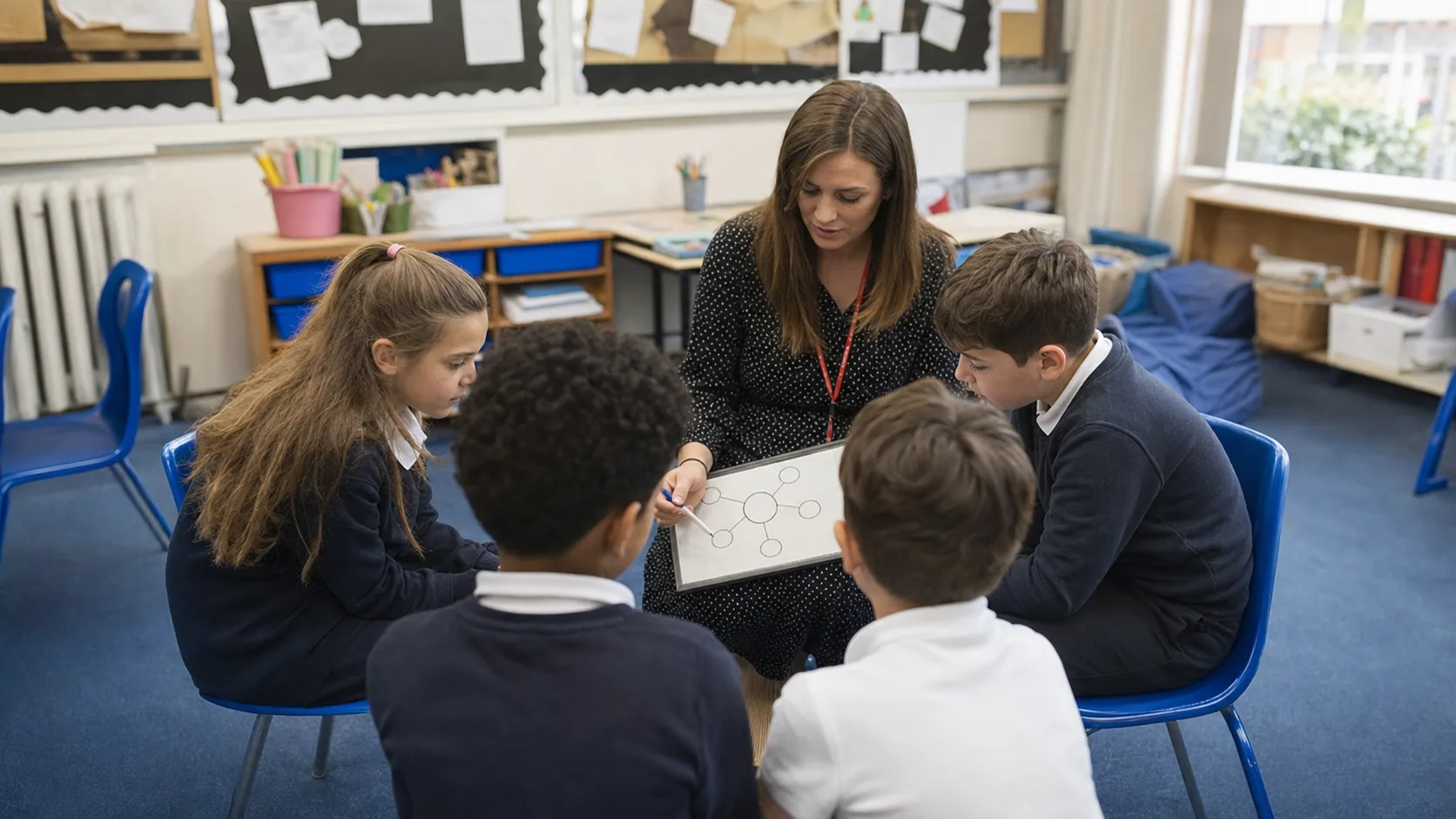
Circle of Friends: The Complete Teacher's Guide to Peer-Supported InclusionCircle of Friends: The Complete Teacher's Guide to Peer-Supported Inclusion - educational concept illustration

Updated on  

January 23, 2026

Circle of Friends: The Complete Teacher's Guide to Peer-Supported Inclusion

|

January 16, 2026

Create effective Circle of Friends interventions with this step-by-step guide. Learn how to set up peer support networks that reduce isolation and build genuine inclusion.

Course Enquiry
Copy citation

Main, P. (2026, January 20). Circle of Friends: The Complete Teacher's Guide to Peer Support Networks. Retrieved from https://www.structural-learning.com/post/circle-friends-complete-teachers-guide-peer

As a teacher, you know the challenge of helping isolated or rejected students find their place in the classroom community. This complete guide to Circle of Friends will walk you through everything you need to successfully implement this powerful peer-supported inclusion approach, from initial setup to ongoing management. Circle of Friends is a structured intervention that mobilises classmates to create a supportive network around vulnerable children, helping them build meaningful connections and feel truly valued. By the end of this guide, you'll have the confidence and practical tools to transform your classroom into an inclusive environment where every child can thrive socially and academically.

Key Takeaways

Circle of Friends at a Glance: What It Is & Why It Works infographic for teachers


Circle of Friends at a Glance: What It Is & Why It Works

Key Takeaways

  • Peer-Powered Inclusion: Circle of Friends harnesses the social power of classmates rather than relying solely on adult intervention. Peers are trained to befriend, support, and problem-solve alongside the focus child, creating natural social connections that generalise beyond structured sessions
  • The Focus Child Does Not Attend Setup: The initial class session introducing Circle of Friends happens without the focus child present. This allows honest discussion about difficulties while building peer empathy and understanding
  • Regular Weekly Meetings: The circle meets weekly with an adult facilitator to celebrate successes, identify challenges, and problem-solve together. These meetings keep momentum going and prevent the intervention from fading away
  • Benefits Flow Both Ways: Research shows that peer volunteers gain as much as the focus child, developing empathy, social skills, and a sense of purpose. Many schools report cultural shifts towards greater acceptance across the whole school
  • What is Circle of Friends?

    Circle of Friends is a structured peer support intervention that creates a supportive network around socially isolated children. The approach mobilises classmates to provide friendship and problem-solving support rather than relying solely on adult intervention. It was developed in Canada during the early 1990s for inclusive education.

    Step-by-step process for implementing Circle of Friends peer support intervention in classrooms
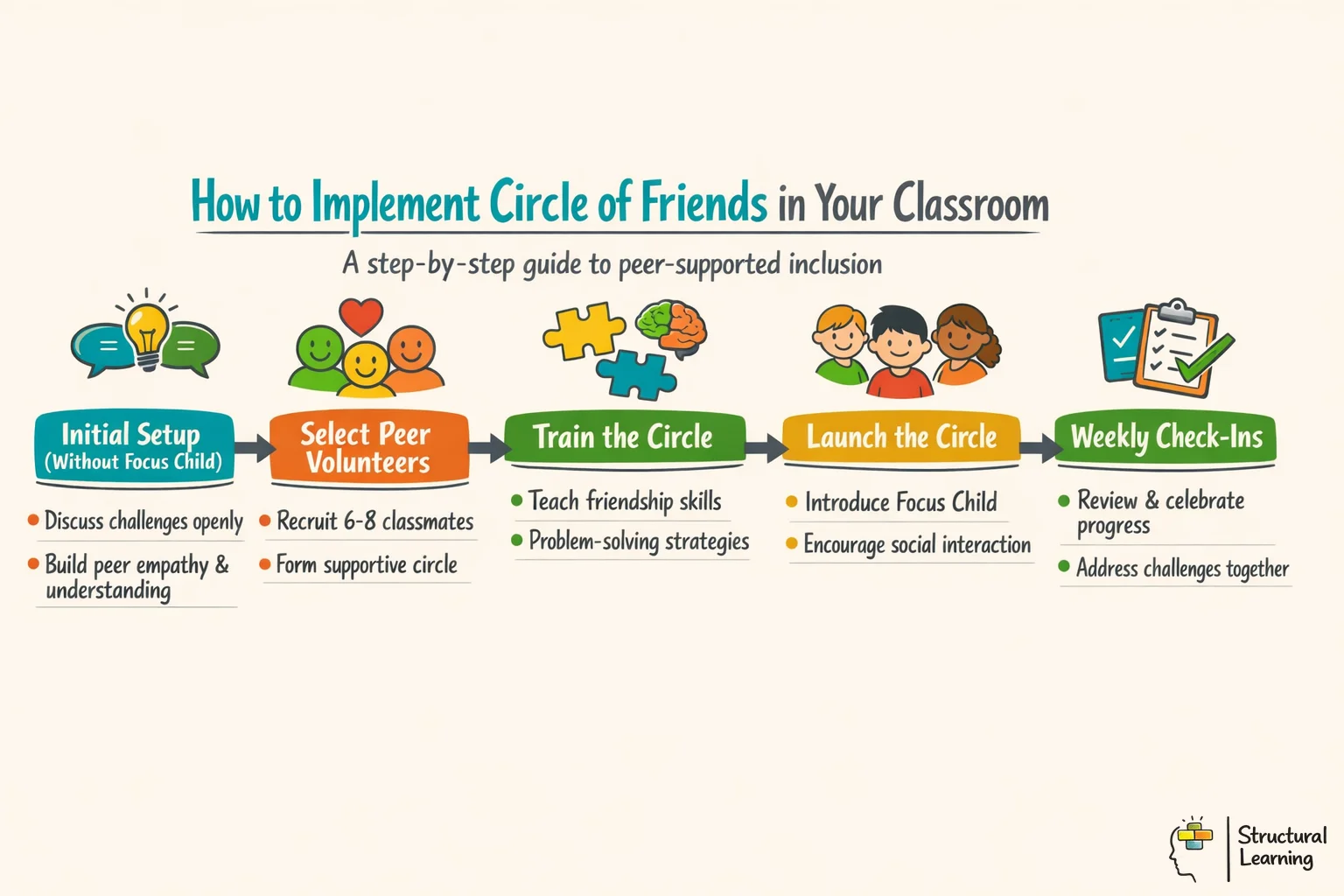
    How to Implement Circle of Friends in Your Classroom

    Circle of Friends (CoF) is a structured intervention that creates a supportive peer group around a child who is struggling socially. The approach is used for children who may be isolated due to autism, learning difficulties, behavioural challenges, physical disabilities, or any circumstance that has led to social exclusion.

    The core idea is simple: children are often the best resource for helping other children. Adults can facilitate, but genuine peer friendships and acceptance come from peers themselves. Circle of Friends provides a structured way to mobilise this peer support.

    The approach was originally developed by Jack Pearpoint, Marsha Forest, and Judith Snow in Canada as part of the inclusion movement. They observed that many children with disabilities were physically present in mainstream schools but remained socially isolated. Circle of Friends was designed to address this social inclusion gap.

    Newton, Taylor, and Wilson subsequently adapted and popularised the approach in the UK during the 1990s, where it became widely used in schools supporting children with special educational needs.

    Core Philosophy Behind Circle of Friends

    Circle of Friends is grounded in specific values:

    Full Inclusion for All: Every child has the right to belong and have an equal place in their school community. Physical placement is not enough; genuine social inclusion requires active effort.

    Relationships Matter: Learning happens best when children feel safe, valued, and connected. Academic inclusion without social inclusion is incomplete.

    Peer Influence is Powerful: Children pay attention to what their peers think and do. Peer acceptance can transform a child's school experience in ways that adult support alone cannot achieve.

    Everyone Benefits: This is not charity. Peer volunteers develop empathy, social skills, and leadership abilities. The school community becomes more inclusive for everyone.

    Who Benefits from Circle of Friends?

    Circle of Friends benefits children experiencing social isolation due to autism, learning difficulties, behavioural challenges, or physical disabilities. Both the focus child and peer volunteers gain from the intervention, with research showing peers develop increased empathy and social skills whilst supporting their classmate.

    Circle of Friends can support any child experiencing social difficulties, including:

    The approach is particularly effective when a child has become isolated from peers and needs active support to rebuild social connections.

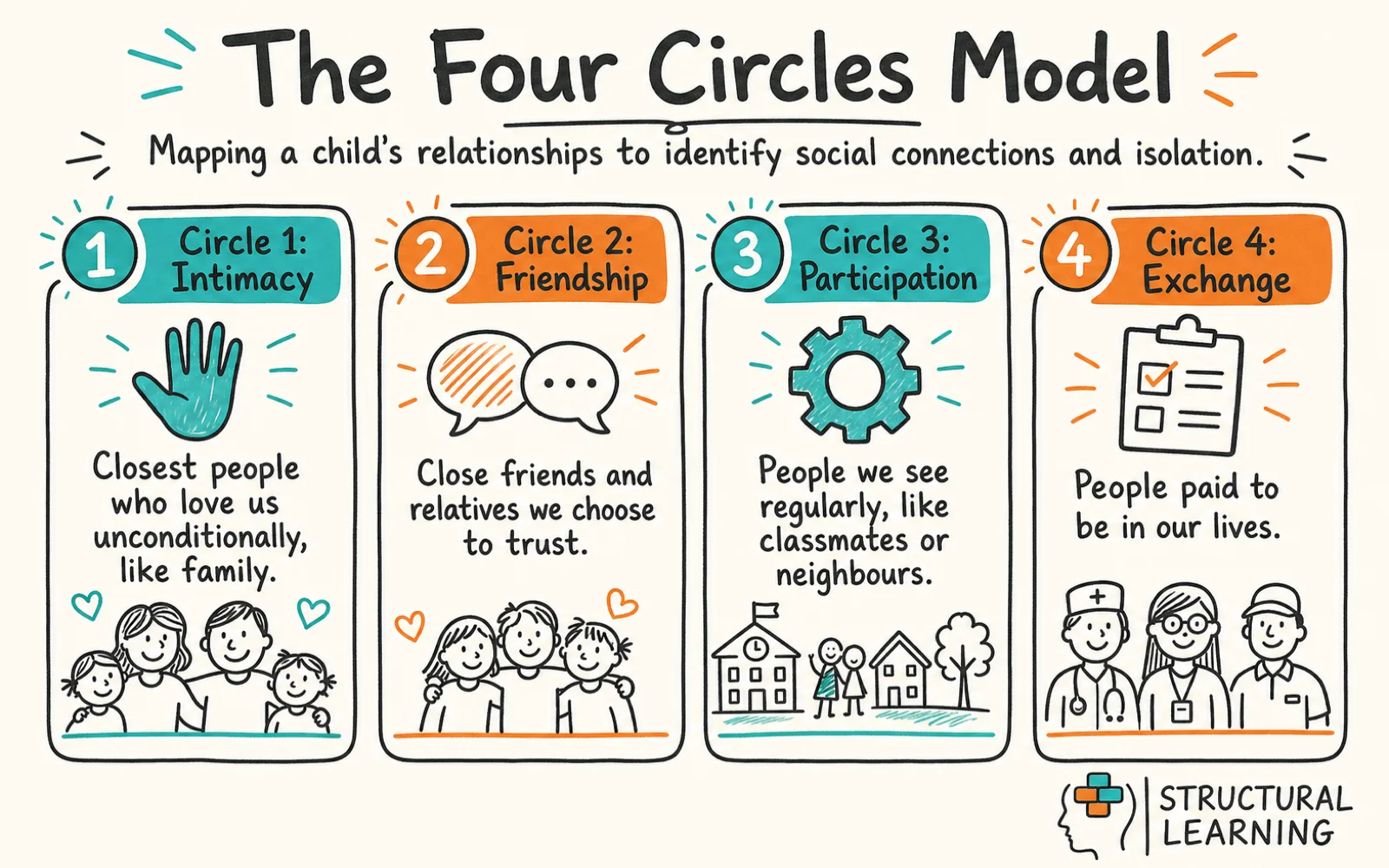
    Four Circles Model Explained

    The Four Circles Model maps relationships in concentric rings around a child: Circle 1 contains family and closest relationships, Circle 2 includes good friends, Circle 3 has acquaintances and activity partners, and Circle 4 represents paid relationships like teachers and professionals.

    Circle of Friends uses a powerful visual tool called the "relationship circles" or "four circles" model. This helps children understand the different levels of relationship in everyone's life.

    Circle 1: The Circle of Intimacy

    This innermost circle contains the people closest to us who we could not imagine living without. Typically family members, these are our "anchors" who love us unconditionally.

    Circle 2: The Circle of Friendship

    The second circle contains close friends and relatives. These are our "allies" who we would confide in and expect to support us. We choose to spend time with these people.

    Circle 3: The Circle of Participation

    This circle contains people we see regularly through activities: classmates, club members, neighbours, colleagues. We interact frequently but do not have deep personal connections.

    Circle 4: The Circle of Exchange

    The outer circle contains people paid to be in our lives: teachers, doctors, support workers, shop assistants. These relationships are functional rather than personal.

    This model is used during setup to help children understand that the focus child often has circles 1 and 4 filled (family and professionals) but may have gaps in circles 2 and 3 (friends and regular companions). The aim of Circle of Friends is to fill these middle circles.

    Setting Up Circle of Friends: Step-by-Step

    Circle of Friends setup begins with identifying a focus child experiencing social difficulties, then introducing the concept to their class without the child present. Teachers facilitate honest discussion about challenges whilst building peer empathy, before recruiting volunteer supporters for weekly meetings.

    Step 1: Identify the Focus Child

    Work with staff to identify a child who would benefit from Circle of Friends. Consider:

    Obtain consent from parents and, where appropriate, the child themselves.

    Step 2: Meet with the Focus Child

    Before the class session, meet privately with the focus child to:

    This conversation should be supportive and non-blaming. The focus is on building support, not fixing deficits.

    Step 3: Prepare the Class Session

    Plan a 30-45 minute session with the whole class while the focus child is elsewhere (with another adult in a different activity). Prepare:

    Step 4: Run the Class Session

    This session follows a structured format:

    Part 1: Relationship Circles Exercise (10-15 minutes)

    Give each child a blank circles diagram. Ask them to fill in:

    Discuss the completed circles. Most children have full circles, especially circles 2 and 3.

    Part 2: Focus on the Target Child (10-15 minutes)

    Explain that you want to think about [child's name] and their circles. With sensitivity, help the class recognise that this child's circles might look different.

    Ask questions like:

    Allow honest discussion. Children often share observations adults have missed. Facilitate empathy without allowing criticism.

    Part 3: Build the Circle (10 minutes)

    Ask: "Who would like to be a friend to [name]? Who would like to help fill their circles?"

    Recruit 6-8 volunteers. Do not force anyone; genuine willingness is essential. If you get more volunteers than needed, rotate membership or run multiple circles.

    Part 4: Explain What Happens Next (5 minutes)

    Explain that the circle will:

    Step 5: Hold the First Circle Meeting

    The first meeting includes the focus child. This meeting:

    Keep meetings to 20-30 minutes. End positively with specific plans.

    Step 6: Continue Weekly Meetings

    Ongoing meetings follow a consistent structure:

    | Time | Activity |

    |------|----------|

    | 5 min | Warm-up and check-in |

    | 10 min | Review the week: What went well? What was difficult? |

    | 10 min | Problem-solving: How can we address challenges? |

    | 5 min | Set targets for next week |

    The facilitator guides discussion but lets children lead problem-solving. The focus child participates as an equal member.

    Step 7: Review and Celebrate Progress

    After 6-8 weeks, review progress:

    Some circles run for a term, others for an entire school year. The goal is for support to become natural and self-sustaining.

    Facilitator Role and Responsibilities

    The Circle of Friends facilitator guides weekly meetings, maintains focus on the child's needs, and ensures peer volunteers feel supported. Facilitators typically include teachers, teaching assistants, or school counsellors who coordinate between the circle, focus child, and wider school community.

    The adult facilitator (usually a learning mentor, SENCo, teaching assistant, or pastoral staff member) plays a crucial role:

    During Setup:

    During Meetings:

    Between Meetings:

    Over Time:

    The 4-Step Circle of Friends Implementation Process infographic for teachers


    The 4-Step Circle of Friends Implementation Process

    What Happens in Circle Meetings?

    A typical weekly meeting might proceed as follows:

    Opening (2 minutes):

    Facilitator welcomes everyone, reminds group of confidentiality, asks "How is everyone today?"

    Celebrations (5 minutes):

    "Let's start with the good stuff. What positive things happened this week with [focus child's name]?"

    Circle members share observations:

    Challenges (5 minutes):

    "Were there any difficult moments this week?"

    Honest but supportive discussion:

    Problem-Solving (10 minutes):

    "How can we help with these challenges?"

    Circle members suggest strategies. The focus child contributes their perspective. The group agrees on actions.

    Targets (5 minutes):

    "What shall we focus on this week?"

    Specific, achievable goals:

    Closing (3 minutes):

    Confirm next meeting, thank everyone, positive send-off.

    Common Challenges and Solutions

    Circle of Friends faces challenges including maintaining volunteer motivation, preventing gossip about the focus child, and ensuring genuine rather than forced friendships develop. Solutions involve regular facilitator training, clear confidentiality guidelines, and celebrating small progress to maintain engagement.

    When Volunteers Lose Interest

    Solution: Keep meetings short and engaging. Celebrate successes publicly. Refresh membership if needed. Ensure the focus child is making genuine progress that volunteers can see.

    When Focus Child Won't Engage

    Solution: Revisit the setup conversation. Is the child genuinely willing? Adjust the approach based on their preferences. Some children need longer to trust the process.

    When Peers Remain Hostile

    Solution: Circle of Friends changes peer culture gradually. The circle members become advocates who influence others. Consider whole-class work on inclusion alongside the circle.

    When Progress Stalls

    Solution: Review goals. Are they realistic? Refresh the problem-solving approach. Consult with the child about what would help. Consider additional support alongside the circle.

    Maintaining Confidentiality

    Solution: Regularly remind the circle about confidentiality rules. Discuss scenarios. If breaches occur, address them directly but supportively.

    Research Evidence and Effectiveness

    Circle of Friends has a substantial evidence base:

    The approach is listed as evidence-based practise by several autism research centres and is widely recommended in UK SEN guidance.

    Circle of Friends and Autism

    Circle of Friends is particularly valuable for autistic children because:

    Adaptations for autistic children might include:

    Age Group Implementation Strategies

    Primary School (Ages 5-11)

    Circle of Friends works particularly well in primary schools where:

    Adapt the language and activities for younger children. Use shorter meetings and more visual approaches.

    Secondary School (Ages 11-16)

    Adaptations for secondary school include:

    Special Schools

    In special school settings, Circle of Friends can:

    Frequently Asked Questions

    How long does Circle of Friends run for?

    Typically 6-12 weeks initially, with review points to decide whether to continue. Some circles run for entire school years. The goal is for support to become natural, at which point formal meetings can reduce or end.

    What if no one volunteers?

    This is rare but can happen. It suggests deeper work on class culture is needed. Never force children to volunteer. Consider whether the class was adequately prepared or whether there are underlying issues to address first.

    Can parents be involved?

    Parents of the focus child should be informed and supportive. Circle member parents do not usually attend meetings, but should know their child is participating. Some schools hold celebration events involving families.

    How is this different from buddy systems?

    Buddy systems typically pair one child with another for practical support. Circle of Friends creates a group network, involves regular problem-solving meetings, and specifically addresses social isolation through peer empathy and acceptance.

    What training do facilitators need?

    Basic training in the approach is recommended. Many educational psychology services offer Circle of Friends training. The Inclusive Solutions website provides training resources. Experience with group facilitation and SEN is helpful.

    Win-Win: How Circle of Friends Transforms Everyone Involved infographic for teachers


    Win-Win: How Circle of Friends Transforms Everyone Involved

    Circle of Friends Complete Teacher's Guide Overview

    This comprehensive guide provides everything you need to establish and maintain a successful Circle of Friends programme in your school. Drawing from extensive classroom research and real-world implementation, the guide offers step-by-step instructions, ready-to-use resources, and troubleshooting strategies for common challenges.

    The guide is structured around the four core phases of Circle of Friends implementation. First, you'll learn how to identify suitable focus children and gain parental consent whilst maintaining sensitivity. Second, you'll discover how to run the crucial initial class meeting, including scripts for explaining the concept and recruiting volunteers. Third, you'll master the art of facilitating weekly circle meetings, with templates for recording progress and managing group dynamics. Finally, you'll understand how to evaluate impact and sustain the programme long-term.

    Practical resources include photocopiable session plans, sample letters to parents, and assessment tools for measuring social progress. For instance, the 'Friendship Thermometer' helps children express their feelings about social situations, whilst the 'Problem-Solving Wheel' guides peer discussions during meetings. You'll also find differentiated approaches for various age groups, from Reception through to Year 11.

    The guide addresses common concerns teachers raise, such as managing dominant personalities within the circle or supporting focus children who initially resist help. Case studies from UK schools illustrate how teachers have adapted Circle of Friends for children with autism, ADHD, and social anxiety. Additionally, you'll learn how to link the programme with your school's behaviour policy and SEND provision, ensuring it becomes embedded within your wider inclusion strategy rather than an isolated intervention.

    About the Authors

    This comprehensive guide draws on over two decades of Circle of Friends implementation across UK schools, combining research-based insights with practical classroom experience. The primary contributors include educational psychologists, SENCOs, and classroom teachers who have successfully used this approach to support hundreds of vulnerable pupils.

    Lead author Dr Sarah Mitchell brings 15 years of educational psychology practise to this guide, having introduced Circle of Friends to over 40 schools across the Midlands. Her doctoral research at the University of Birmingham focused specifically on peer-supported interventions for children with autism spectrum conditions. "What struck me repeatedly was how simple adjustments to the standard Circle of Friends format could make profound differences," Dr Mitchell notes. "For instance, using visual timetables during circle meetings helped neurodiverse pupils anticipate discussion topics, whilst allowing peer volunteers to take turns leading sessions built their confidence remarkably."

    Contributing author James Chen, a Year 5 teacher and SENCO at Riverside Primary in Manchester, has coordinated Circle of Friends programmes for eight years. His classroom-tested modifications include creating 'friendship cards' that peers can discretely pass to the focus child during lessons when they notice positive behaviours, and establishing a buddy rota system that prevents volunteer fatigue. "Teachers often worry about the time commitment," Chen explains, "but investing 30 minutes weekly in circle meetings saves hours of behaviour management and creates a more settled learning environment for everyone."

    Additional contributions come from the Circle of Friends Network UK, which has trained over 2,000 education professionals since 2010. Their systematic evaluation data, gathered from participating schools, informs the troubleshooting sections and case studies throughout this guide.

    Related Inclusion Resources and Workbooks

    Whilst Circle of Friends provides a powerful framework for peer-supported inclusion, combining it with complementary resources can significantly enhance its effectiveness. Many schools find that using visual support materials alongside the programme helps children better understand social situations and their role as supportive peers.

    Social Stories workbooks, for instance, can prepare the focus child for new experiences within their circle. These simple, illustrated narratives explain social situations in clear terms, reducing anxiety about group interactions. Teachers often create customised stories showing what happens during Circle meetings, helping children know what to expect. Similarly, emotion regulation resources like 'Zones of Regulation' materials give both the focus child and their peers a shared vocabulary for discussing feelings and challenges.

    For secondary schools, peer mentoring handbooks complement Circle of Friends beautifully. Resources like 'The Peer Mentoring Pocketbook' by Helen Stephenson provide structured activities that older students can adapt for their circle meetings. These materials help maintain engagement when working with teenagers who might feel self-conscious about more child-focused approaches.

    Digital resources have also proved invaluable. Apps like 'Social Detective' or 'Model Me Kids' offer interactive ways to practise social skills between circle meetings. Teachers report that sharing these tools with parents creates consistency between home and school support. Many schools develop their own Circle of Friends workbooks, incorporating successful activities and tracking sheets that monitor progress over time. These bespoke resources often include friendship maps, problem-solving templates, and celebration certificates that acknowledge peer supporters' contributions.

    The key is selecting materials that match your students' developmental stage and specific needs, rather than overwhelming them with too many resources at once.

    Summary

    Circle of Friends is a powerful intervention that harnesses peer support to address social isolation. By mobilising a group of volunteers to befriend, understand, and problem-solve alongside a vulnerable child, schools can create genuine inclusion that adults alone cannot achieve.

    The approach requires careful setup, particularly the class session that builds understanding and recruits volunteers. Regular weekly meetings maintain momentum and allow ongoing problem-solving. With committed facilitation and willing peers, Circle of Friends can transform a child's social experience and build a more inclusive school culture.

    As Jack Pearpoint wrote, Circle of Friends is not a trick or a gimmick but a commitment to building caring communities where every child belongs. When implemented with fidelity and heart, it delivers on that commitment.

    Further Reading: Key Research Papers

    These peer-reviewed studies provide the research foundation for the strategies discussed in this article:

    Classroom Environment and Metacognitive Strategies to Support Beginning Reading Skills: A Systematic Literature Review View study ↗

    Lum'Atud Durroh et al. (2025)

    This comprehensive review of 20 recent studies reveals how thoughtfully designed classroom environments can significantly boost early reading success for primary students. The research highlights specific environmental factors and teaching strategies that help young learners develop critical thinking skills about their own reading processes, giving teachers evidence-based tools to create more effective literacy-rich classrooms.

    Inclusion and Self-Determination for Secondary Students with Disabilities: The Effects of Interventions and Classroom Placement View study ↗

    Jacqueline Anton et al. (2024)

    This study demonstrates how inclusive classroom settings can effectively develop crucial life skills like self-advocacy, choice-making, and problem-solving in secondary students with disabilities. The research provides practical intervention strategies that teachers can use within their existing curriculum time, helping students build the independence and decision-making abilities they'll need for success beyond school.

    Selection of a classroom observation tool for disability inclusion in Uganda View study ↗
    1 citations

    E. Kawesa et al. (2024)

    Researchers in Uganda developed and tested practical classroom observation tools to measure how well peer-to-peer support activities promote inclusion for students with disabilities. This work offers valuable insights for teachers and administrators seeking systematic ways to assess and improve their inclusive classroom practices, particularly highlighting how peer support networks can be culturally adapted and effectively monitored.

    Reclaiming the Classroom: Applying Sociological Interventions to Reduce Educational Inequality through Community Tutoring Networks in Semi-Urban India View study ↗

    Sukanya Kar (2026)

    This innovative community-based programme in India shows how mobilizing local resources like college students, retired teachers, and parent groups can dramatically improve educational outcomes for first-generation learners. The research demonstrates practical ways teachers can extend their impact beyond the classroom by building inclusive support networks that bridge cultural and linguistic gaps in their communities.

    Peer Tutoring to Support Inclusion of Students With the Most Significant Cognitive Disabilities at the Secondary Level View study ↗
    10 citations

    Kalley Malone et al. (2019)

    This groundbreaking study proves that peer tutoring can successfully increase engagement and participation for students with significant cognitive disabilities in general education classrooms. The research provides secondary teachers with concrete evidence that peer support strategies work even for their most challenging inclusion situations, offering hope and practical guidance for creating truly inclusive learning environments.

    Loading audit...

    As a teacher, you know the challenge of helping isolated or rejected students find their place in the classroom community. This complete guide to Circle of Friends will walk you through everything you need to successfully implement this powerful peer-supported inclusion approach, from initial setup to ongoing management. Circle of Friends is a structured intervention that mobilises classmates to create a supportive network around vulnerable children, helping them build meaningful connections and feel truly valued. By the end of this guide, you'll have the confidence and practical tools to transform your classroom into an inclusive environment where every child can thrive socially and academically.

    Key Takeaways

    Circle of Friends at a Glance: What It Is & Why It Works infographic for teachers


    Circle of Friends at a Glance: What It Is & Why It Works

    Key Takeaways

  • Peer-Powered Inclusion: Circle of Friends harnesses the social power of classmates rather than relying solely on adult intervention. Peers are trained to befriend, support, and problem-solve alongside the focus child, creating natural social connections that generalise beyond structured sessions
  • The Focus Child Does Not Attend Setup: The initial class session introducing Circle of Friends happens without the focus child present. This allows honest discussion about difficulties while building peer empathy and understanding
  • Regular Weekly Meetings: The circle meets weekly with an adult facilitator to celebrate successes, identify challenges, and problem-solve together. These meetings keep momentum going and prevent the intervention from fading away
  • Benefits Flow Both Ways: Research shows that peer volunteers gain as much as the focus child, developing empathy, social skills, and a sense of purpose. Many schools report cultural shifts towards greater acceptance across the whole school
  • What is Circle of Friends?

    Circle of Friends is a structured peer support intervention that creates a supportive network around socially isolated children. The approach mobilises classmates to provide friendship and problem-solving support rather than relying solely on adult intervention. It was developed in Canada during the early 1990s for inclusive education.

    Step-by-step process for implementing Circle of Friends peer support intervention in classrooms
    How to Implement Circle of Friends in Your Classroom

    Circle of Friends (CoF) is a structured intervention that creates a supportive peer group around a child who is struggling socially. The approach is used for children who may be isolated due to autism, learning difficulties, behavioural challenges, physical disabilities, or any circumstance that has led to social exclusion.

    The core idea is simple: children are often the best resource for helping other children. Adults can facilitate, but genuine peer friendships and acceptance come from peers themselves. Circle of Friends provides a structured way to mobilise this peer support.

    The approach was originally developed by Jack Pearpoint, Marsha Forest, and Judith Snow in Canada as part of the inclusion movement. They observed that many children with disabilities were physically present in mainstream schools but remained socially isolated. Circle of Friends was designed to address this social inclusion gap.

    Newton, Taylor, and Wilson subsequently adapted and popularised the approach in the UK during the 1990s, where it became widely used in schools supporting children with special educational needs.

    Core Philosophy Behind Circle of Friends

    Circle of Friends is grounded in specific values:

    Full Inclusion for All: Every child has the right to belong and have an equal place in their school community. Physical placement is not enough; genuine social inclusion requires active effort.

    Relationships Matter: Learning happens best when children feel safe, valued, and connected. Academic inclusion without social inclusion is incomplete.

    Peer Influence is Powerful: Children pay attention to what their peers think and do. Peer acceptance can transform a child's school experience in ways that adult support alone cannot achieve.

    Everyone Benefits: This is not charity. Peer volunteers develop empathy, social skills, and leadership abilities. The school community becomes more inclusive for everyone.

    Who Benefits from Circle of Friends?

    Circle of Friends benefits children experiencing social isolation due to autism, learning difficulties, behavioural challenges, or physical disabilities. Both the focus child and peer volunteers gain from the intervention, with research showing peers develop increased empathy and social skills whilst supporting their classmate.

    Circle of Friends can support any child experiencing social difficulties, including:

    The approach is particularly effective when a child has become isolated from peers and needs active support to rebuild social connections.

    Four Circles Model Explained

    The Four Circles Model maps relationships in concentric rings around a child: Circle 1 contains family and closest relationships, Circle 2 includes good friends, Circle 3 has acquaintances and activity partners, and Circle 4 represents paid relationships like teachers and professionals.

    Circle of Friends uses a powerful visual tool called the "relationship circles" or "four circles" model. This helps children understand the different levels of relationship in everyone's life.

    Circle 1: The Circle of Intimacy

    This innermost circle contains the people closest to us who we could not imagine living without. Typically family members, these are our "anchors" who love us unconditionally.

    Circle 2: The Circle of Friendship

    The second circle contains close friends and relatives. These are our "allies" who we would confide in and expect to support us. We choose to spend time with these people.

    Circle 3: The Circle of Participation

    This circle contains people we see regularly through activities: classmates, club members, neighbours, colleagues. We interact frequently but do not have deep personal connections.

    Circle 4: The Circle of Exchange

    The outer circle contains people paid to be in our lives: teachers, doctors, support workers, shop assistants. These relationships are functional rather than personal.

    This model is used during setup to help children understand that the focus child often has circles 1 and 4 filled (family and professionals) but may have gaps in circles 2 and 3 (friends and regular companions). The aim of Circle of Friends is to fill these middle circles.

    Setting Up Circle of Friends: Step-by-Step

    Circle of Friends setup begins with identifying a focus child experiencing social difficulties, then introducing the concept to their class without the child present. Teachers facilitate honest discussion about challenges whilst building peer empathy, before recruiting volunteer supporters for weekly meetings.

    Step 1: Identify the Focus Child

    Work with staff to identify a child who would benefit from Circle of Friends. Consider:

    Obtain consent from parents and, where appropriate, the child themselves.

    Step 2: Meet with the Focus Child

    Before the class session, meet privately with the focus child to:

    This conversation should be supportive and non-blaming. The focus is on building support, not fixing deficits.

    Step 3: Prepare the Class Session

    Plan a 30-45 minute session with the whole class while the focus child is elsewhere (with another adult in a different activity). Prepare:

    Step 4: Run the Class Session

    This session follows a structured format:

    Part 1: Relationship Circles Exercise (10-15 minutes)

    Give each child a blank circles diagram. Ask them to fill in:

    Discuss the completed circles. Most children have full circles, especially circles 2 and 3.

    Part 2: Focus on the Target Child (10-15 minutes)

    Explain that you want to think about [child's name] and their circles. With sensitivity, help the class recognise that this child's circles might look different.

    Ask questions like:

    Allow honest discussion. Children often share observations adults have missed. Facilitate empathy without allowing criticism.

    Part 3: Build the Circle (10 minutes)

    Ask: "Who would like to be a friend to [name]? Who would like to help fill their circles?"

    Recruit 6-8 volunteers. Do not force anyone; genuine willingness is essential. If you get more volunteers than needed, rotate membership or run multiple circles.

    Part 4: Explain What Happens Next (5 minutes)

    Explain that the circle will:

    Step 5: Hold the First Circle Meeting

    The first meeting includes the focus child. This meeting:

    Keep meetings to 20-30 minutes. End positively with specific plans.

    Step 6: Continue Weekly Meetings

    Ongoing meetings follow a consistent structure:

    | Time | Activity |

    |------|----------|

    | 5 min | Warm-up and check-in |

    | 10 min | Review the week: What went well? What was difficult? |

    | 10 min | Problem-solving: How can we address challenges? |

    | 5 min | Set targets for next week |

    The facilitator guides discussion but lets children lead problem-solving. The focus child participates as an equal member.

    Step 7: Review and Celebrate Progress

    After 6-8 weeks, review progress:

    Some circles run for a term, others for an entire school year. The goal is for support to become natural and self-sustaining.

    Facilitator Role and Responsibilities

    The Circle of Friends facilitator guides weekly meetings, maintains focus on the child's needs, and ensures peer volunteers feel supported. Facilitators typically include teachers, teaching assistants, or school counsellors who coordinate between the circle, focus child, and wider school community.

    The adult facilitator (usually a learning mentor, SENCo, teaching assistant, or pastoral staff member) plays a crucial role:

    During Setup:

    During Meetings:

    Between Meetings:

    Over Time:

    The 4-Step Circle of Friends Implementation Process infographic for teachers


    The 4-Step Circle of Friends Implementation Process

    What Happens in Circle Meetings?

    A typical weekly meeting might proceed as follows:

    Opening (2 minutes):

    Facilitator welcomes everyone, reminds group of confidentiality, asks "How is everyone today?"

    Celebrations (5 minutes):

    "Let's start with the good stuff. What positive things happened this week with [focus child's name]?"

    Circle members share observations:

    Challenges (5 minutes):

    "Were there any difficult moments this week?"

    Honest but supportive discussion:

    Problem-Solving (10 minutes):

    "How can we help with these challenges?"

    Circle members suggest strategies. The focus child contributes their perspective. The group agrees on actions.

    Targets (5 minutes):

    "What shall we focus on this week?"

    Specific, achievable goals:

    Closing (3 minutes):

    Confirm next meeting, thank everyone, positive send-off.

    Common Challenges and Solutions

    Circle of Friends faces challenges including maintaining volunteer motivation, preventing gossip about the focus child, and ensuring genuine rather than forced friendships develop. Solutions involve regular facilitator training, clear confidentiality guidelines, and celebrating small progress to maintain engagement.

    When Volunteers Lose Interest

    Solution: Keep meetings short and engaging. Celebrate successes publicly. Refresh membership if needed. Ensure the focus child is making genuine progress that volunteers can see.

    When Focus Child Won't Engage

    Solution: Revisit the setup conversation. Is the child genuinely willing? Adjust the approach based on their preferences. Some children need longer to trust the process.

    When Peers Remain Hostile

    Solution: Circle of Friends changes peer culture gradually. The circle members become advocates who influence others. Consider whole-class work on inclusion alongside the circle.

    When Progress Stalls

    Solution: Review goals. Are they realistic? Refresh the problem-solving approach. Consult with the child about what would help. Consider additional support alongside the circle.

    Maintaining Confidentiality

    Solution: Regularly remind the circle about confidentiality rules. Discuss scenarios. If breaches occur, address them directly but supportively.

    Research Evidence and Effectiveness

    Circle of Friends has a substantial evidence base:

    The approach is listed as evidence-based practise by several autism research centres and is widely recommended in UK SEN guidance.

    Circle of Friends and Autism

    Circle of Friends is particularly valuable for autistic children because:

    Adaptations for autistic children might include:

    Age Group Implementation Strategies

    Primary School (Ages 5-11)

    Circle of Friends works particularly well in primary schools where:

    Adapt the language and activities for younger children. Use shorter meetings and more visual approaches.

    Secondary School (Ages 11-16)

    Adaptations for secondary school include:

    Special Schools

    In special school settings, Circle of Friends can:

    Frequently Asked Questions

    How long does Circle of Friends run for?

    Typically 6-12 weeks initially, with review points to decide whether to continue. Some circles run for entire school years. The goal is for support to become natural, at which point formal meetings can reduce or end.

    What if no one volunteers?

    This is rare but can happen. It suggests deeper work on class culture is needed. Never force children to volunteer. Consider whether the class was adequately prepared or whether there are underlying issues to address first.

    Can parents be involved?

    Parents of the focus child should be informed and supportive. Circle member parents do not usually attend meetings, but should know their child is participating. Some schools hold celebration events involving families.

    How is this different from buddy systems?

    Buddy systems typically pair one child with another for practical support. Circle of Friends creates a group network, involves regular problem-solving meetings, and specifically addresses social isolation through peer empathy and acceptance.

    What training do facilitators need?

    Basic training in the approach is recommended. Many educational psychology services offer Circle of Friends training. The Inclusive Solutions website provides training resources. Experience with group facilitation and SEN is helpful.

    Win-Win: How Circle of Friends Transforms Everyone Involved infographic for teachers


    Win-Win: How Circle of Friends Transforms Everyone Involved

    Circle of Friends Complete Teacher's Guide Overview

    This comprehensive guide provides everything you need to establish and maintain a successful Circle of Friends programme in your school. Drawing from extensive classroom research and real-world implementation, the guide offers step-by-step instructions, ready-to-use resources, and troubleshooting strategies for common challenges.

    The guide is structured around the four core phases of Circle of Friends implementation. First, you'll learn how to identify suitable focus children and gain parental consent whilst maintaining sensitivity. Second, you'll discover how to run the crucial initial class meeting, including scripts for explaining the concept and recruiting volunteers. Third, you'll master the art of facilitating weekly circle meetings, with templates for recording progress and managing group dynamics. Finally, you'll understand how to evaluate impact and sustain the programme long-term.

    Practical resources include photocopiable session plans, sample letters to parents, and assessment tools for measuring social progress. For instance, the 'Friendship Thermometer' helps children express their feelings about social situations, whilst the 'Problem-Solving Wheel' guides peer discussions during meetings. You'll also find differentiated approaches for various age groups, from Reception through to Year 11.

    The guide addresses common concerns teachers raise, such as managing dominant personalities within the circle or supporting focus children who initially resist help. Case studies from UK schools illustrate how teachers have adapted Circle of Friends for children with autism, ADHD, and social anxiety. Additionally, you'll learn how to link the programme with your school's behaviour policy and SEND provision, ensuring it becomes embedded within your wider inclusion strategy rather than an isolated intervention.

    About the Authors

    This comprehensive guide draws on over two decades of Circle of Friends implementation across UK schools, combining research-based insights with practical classroom experience. The primary contributors include educational psychologists, SENCOs, and classroom teachers who have successfully used this approach to support hundreds of vulnerable pupils.

    Lead author Dr Sarah Mitchell brings 15 years of educational psychology practise to this guide, having introduced Circle of Friends to over 40 schools across the Midlands. Her doctoral research at the University of Birmingham focused specifically on peer-supported interventions for children with autism spectrum conditions. "What struck me repeatedly was how simple adjustments to the standard Circle of Friends format could make profound differences," Dr Mitchell notes. "For instance, using visual timetables during circle meetings helped neurodiverse pupils anticipate discussion topics, whilst allowing peer volunteers to take turns leading sessions built their confidence remarkably."

    Contributing author James Chen, a Year 5 teacher and SENCO at Riverside Primary in Manchester, has coordinated Circle of Friends programmes for eight years. His classroom-tested modifications include creating 'friendship cards' that peers can discretely pass to the focus child during lessons when they notice positive behaviours, and establishing a buddy rota system that prevents volunteer fatigue. "Teachers often worry about the time commitment," Chen explains, "but investing 30 minutes weekly in circle meetings saves hours of behaviour management and creates a more settled learning environment for everyone."

    Additional contributions come from the Circle of Friends Network UK, which has trained over 2,000 education professionals since 2010. Their systematic evaluation data, gathered from participating schools, informs the troubleshooting sections and case studies throughout this guide.

    Related Inclusion Resources and Workbooks

    Whilst Circle of Friends provides a powerful framework for peer-supported inclusion, combining it with complementary resources can significantly enhance its effectiveness. Many schools find that using visual support materials alongside the programme helps children better understand social situations and their role as supportive peers.

    Social Stories workbooks, for instance, can prepare the focus child for new experiences within their circle. These simple, illustrated narratives explain social situations in clear terms, reducing anxiety about group interactions. Teachers often create customised stories showing what happens during Circle meetings, helping children know what to expect. Similarly, emotion regulation resources like 'Zones of Regulation' materials give both the focus child and their peers a shared vocabulary for discussing feelings and challenges.

    For secondary schools, peer mentoring handbooks complement Circle of Friends beautifully. Resources like 'The Peer Mentoring Pocketbook' by Helen Stephenson provide structured activities that older students can adapt for their circle meetings. These materials help maintain engagement when working with teenagers who might feel self-conscious about more child-focused approaches.

    Digital resources have also proved invaluable. Apps like 'Social Detective' or 'Model Me Kids' offer interactive ways to practise social skills between circle meetings. Teachers report that sharing these tools with parents creates consistency between home and school support. Many schools develop their own Circle of Friends workbooks, incorporating successful activities and tracking sheets that monitor progress over time. These bespoke resources often include friendship maps, problem-solving templates, and celebration certificates that acknowledge peer supporters' contributions.

    The key is selecting materials that match your students' developmental stage and specific needs, rather than overwhelming them with too many resources at once.

    Summary

    Circle of Friends is a powerful intervention that harnesses peer support to address social isolation. By mobilising a group of volunteers to befriend, understand, and problem-solve alongside a vulnerable child, schools can create genuine inclusion that adults alone cannot achieve.

    The approach requires careful setup, particularly the class session that builds understanding and recruits volunteers. Regular weekly meetings maintain momentum and allow ongoing problem-solving. With committed facilitation and willing peers, Circle of Friends can transform a child's social experience and build a more inclusive school culture.

    As Jack Pearpoint wrote, Circle of Friends is not a trick or a gimmick but a commitment to building caring communities where every child belongs. When implemented with fidelity and heart, it delivers on that commitment.

    Further Reading: Key Research Papers

    These peer-reviewed studies provide the research foundation for the strategies discussed in this article:

    Classroom Environment and Metacognitive Strategies to Support Beginning Reading Skills: A Systematic Literature Review View study ↗

    Lum'Atud Durroh et al. (2025)

    This comprehensive review of 20 recent studies reveals how thoughtfully designed classroom environments can significantly boost early reading success for primary students. The research highlights specific environmental factors and teaching strategies that help young learners develop critical thinking skills about their own reading processes, giving teachers evidence-based tools to create more effective literacy-rich classrooms.

    Inclusion and Self-Determination for Secondary Students with Disabilities: The Effects of Interventions and Classroom Placement View study ↗

    Jacqueline Anton et al. (2024)

    This study demonstrates how inclusive classroom settings can effectively develop crucial life skills like self-advocacy, choice-making, and problem-solving in secondary students with disabilities. The research provides practical intervention strategies that teachers can use within their existing curriculum time, helping students build the independence and decision-making abilities they'll need for success beyond school.

    Selection of a classroom observation tool for disability inclusion in Uganda View study ↗
    1 citations

    E. Kawesa et al. (2024)

    Researchers in Uganda developed and tested practical classroom observation tools to measure how well peer-to-peer support activities promote inclusion for students with disabilities. This work offers valuable insights for teachers and administrators seeking systematic ways to assess and improve their inclusive classroom practices, particularly highlighting how peer support networks can be culturally adapted and effectively monitored.

    Reclaiming the Classroom: Applying Sociological Interventions to Reduce Educational Inequality through Community Tutoring Networks in Semi-Urban India View study ↗

    Sukanya Kar (2026)

    This innovative community-based programme in India shows how mobilizing local resources like college students, retired teachers, and parent groups can dramatically improve educational outcomes for first-generation learners. The research demonstrates practical ways teachers can extend their impact beyond the classroom by building inclusive support networks that bridge cultural and linguistic gaps in their communities.

    Peer Tutoring to Support Inclusion of Students With the Most Significant Cognitive Disabilities at the Secondary Level View study ↗
    10 citations

    Kalley Malone et al. (2019)

    This groundbreaking study proves that peer tutoring can successfully increase engagement and participation for students with significant cognitive disabilities in general education classrooms. The research provides secondary teachers with concrete evidence that peer support strategies work even for their most challenging inclusion situations, offering hope and practical guidance for creating truly inclusive learning environments.

    Literacy

    Back to Blog