Hinge Questions: A Teacher's Complete Guide to Formative AssessmentHinge Questions: A Teacher's Complete Guide to Formative Assessment - educational concept illustration

Updated on  

January 23, 2026

Hinge Questions: A Teacher's Complete Guide to Formative Assessment

|

January 21, 2026

Use hinge questions for real-time formative assessment. Learn to design diagnostic questions that reveal student understanding during lessons.


Course Enquiry
Copy citation

Main, P. (2026, January 21). Hinge Questions: A Teacher's Complete Guide to Formative Assessment. Retrieved from www.structural-learning.com/post/hinge-questions-teachers-complete-guide

Hinge questions are carefully designed multiple-choice questions that reveal student understanding at critical points in a lesson, allowing teachers to make immediate instructional decisions. This assessment technique, championed by Dylan Wiliam as part of Assessment for Learning, gives you real-time insight into whether students are ready to move forward or need additional support.

Hinge Questions at a Glance: What Makes Them Different infographic for teachers
Hinge Questions at a Glance: What Makes Them Different

Key Takeaways

  • Rapid diagnostic tool: Hinge questions take less than two minutes to answer and under 30 seconds to analyse, making them practical for busy classrooms.
  • Misconception detection: Well-designed distractors expose common misunderstandings, not just whether students got the right answer.
  • Decision point in lessons: Use hinge questions at the "hinge" moment when you need to decide whether to proceed, reteach, or differentiate.
  • Design matters: Effective hinge questions require plausible distractors based on genuine student misconceptions.
  • What Are Hinge Questions?

    A hinge question is a diagnostic question asked at a pivotal moment in a lesson. The lesson "hinges" on this point because your next instructional move depends entirely on how students respond. Unlike traditional assessment questions that check learning after the fact, hinge questions inform teaching decisions in the moment.
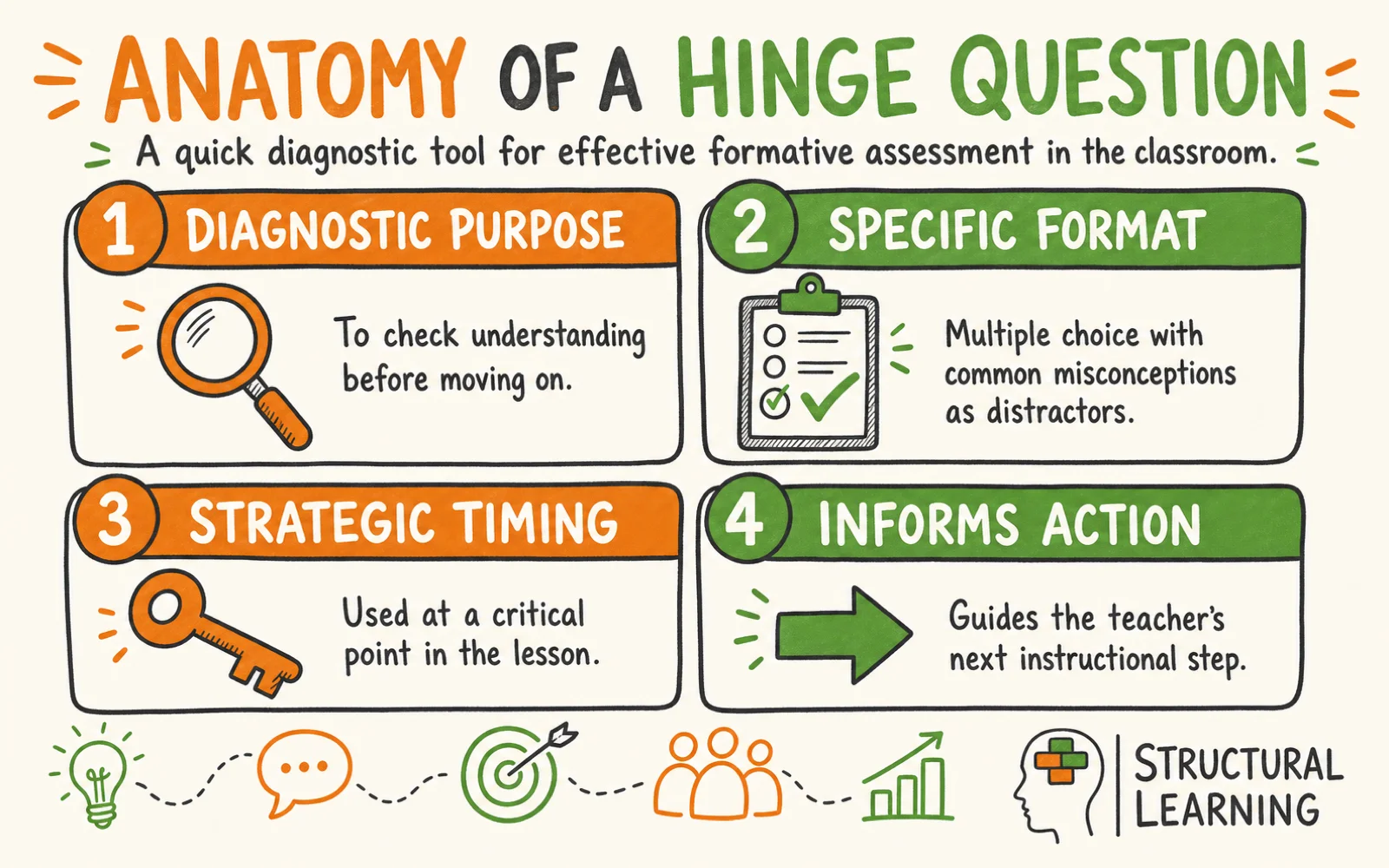
    The concept emerged from Dylan Wiliam's work on formative assessment, where he identified the need for teachers to gather quick, actionable data about student understanding without disrupting lesson flow. A well-crafted hinge question should take students between one and two minutes to answer, and the teacher should be able to interpret the results within 30 seconds.

    What distinguishes hinge questions from ordinary comprehension checks is their diagnostic power. Each answer option, including incorrect ones, tells you something specific about student thinking. When a student selects a particular wrong answer, you learn exactly which misconception they hold.

    Why Hinge Questions Transform Classroom Practice

    Traditional teaching often follows a "teach, test, move on" pattern where misunderstandings only surface days or weeks later in formal assessments. By then, misconceptions have solidified and become harder to address. Hinge questions break this pattern by surfacing problems immediately.

    Consider the alternative: you teach a concept, assign independent practice, and discover during marking that half the class misunderstood. Now you must either ignore the problem and push forward, or backtrack and reteach, disrupting your planned sequence. With hinge questions, you identify the gap while students are still in learning mode.

    Research into metacognition shows that immediate feedback strengthens learning. When students receive information about their understanding within seconds of attempting a question, they can immediately correct their thinking. This rapid feedback loop accelerates concept acquisition.

    Hinge questions also support differentiation. When you see the class split between correct and incorrect responses, you can group students accordingly: those who understood can tackle extension work while you provide targeted support to those who need it. This responsive teaching requires knowing, in real time, what each student understands.

    Designing Effective Hinge Questions

    The art of hinge question design lies in the distractors. Each wrong answer must be plausible and must reveal a specific misconception. Random wrong answers provide no diagnostic information.

    Start with misconceptions

    Begin by identifying the most common errors students make with your topic. If you have taught the concept before, think about the mistakes you have seen. Consult with colleagues or research common misconceptions in your subject area. These misconceptions become your distractors.

    For example, in a maths lesson on fractions, students might believe that 1/4 is larger than 1/3 because 4 is larger than 3. A hinge question could exploit this by asking which fraction is larger, with 1/4 as one distractor. Students who choose it reveal this specific misconception.

    Ensure each response is diagnostic

    Every answer option should provide information. If two distractors reveal the same misconception, combine them or replace one. If a distractor would never be chosen by a thoughtful student, it wastes a response option.

    Design your question so that:

    • The correct answer requires genuine understanding
    • Each incorrect answer maps to a known misconception
    • Students cannot guess correctly through elimination or pattern recognition

    Keep it quick

    Remember the time constraints: under two minutes to answer, under 30 seconds to analyse. This means:

    • Single-step reasoning (not multi-step problems)
    • Clear, unambiguous wording
    • Limited reading required
    • Four or five response options maximum

    Test before using

    Run your hinge question past a colleague or try it with a small group first. Does it genuinely distinguish understanding from misconception? Do the distractors attract students with the predicted errors? Refine based on what you observe.

    How to Use Hinge Questions in Lessons

    The placement of a hinge question matters as much as its design. These questions work best at natural decision points in your lesson structure.

    Timing your hinge point

    Identify where your lesson naturally divides into phases. After introducing a core concept, before moving to application. After guided practice, before independent work. At these transition moments, ask yourself: "If students have not understood this, should I proceed?" If the answer is no, you have found your hinge point.

    Avoid placing hinge questions too early (before students have had any opportunity to learn) or too late (when moving on regardless has already happened mentally).

    Gathering responses quickly

    For speed, use methods that let you see all responses simultaneously:

    • Mini whiteboards: Students hold up their answer (A, B, C, D)
    • Finger voting: Students show 1, 2, 3, or 4 fingers
    • Coloured cards: Each answer corresponds to a colour
    • Digital response systems: Tools like Plickers, Mentimeter, or Google Forms

    Avoid methods requiring you to collect and review individual papers. The power of hinge questions lies in immediate analysis.

    Interpreting results

    Scan responses in seconds. Look for:

    • Predominantly correct: Safe to proceed
    • Predominantly one wrong answer: Address that specific misconception with the whole class
    • Split responses: Group students for differentiated follow-up
    • Scattered wrong answers: May indicate the question was unclear, or fundamental confusion requiring reteaching

    Acting on what you learn

    Have contingency plans ready. If students understand, proceed with your extension activity. If they do not, have a backup explanation, a different representation, or peer teaching ready to deploy. The hinge question is only valuable if you act on its information.

    Subject-Specific Hinge Question Examples

    Mathematics

    Concept: Order of operations

    Question: What is the value of 3 + 4 × 2?

    • A) 14 (reveals left-to-right calculation error)
    • B) 11 (correct, applies multiplication first)
    • C) 24 (reveals multiplying all numbers)
    • D) 9 (reveals adding before multiplying, then multiplying result by original factor)

    Science

    Concept: Photosynthesis

    Question: What do plants release during photosynthesis?

    • A) Carbon dioxide (reveals confusion with respiration)
    • B) Oxygen (correct)
    • C) Water (reveals misconception about water's role)
    • D) Glucose (reveals confusion about what is stored versus released)

    English

    Concept: Identifying the subject of a sentence

    Question: In the sentence "The old cat sat quietly on the warm mat," what is the subject?

    • A) The old cat (correct)
    • B) The mat (reveals object confusion)
    • C) Old (reveals confusion with adjectives)
    • D) Sat (reveals confusion with verbs)

    History

    Concept: Causes of World War I

    Question: Which was the immediate trigger for the start of World War I?

    • A) The assassination of Archduke Franz Ferdinand (correct)
    • B) The signing of the Treaty of Versailles (reveals chronology confusion)
    • C) The invasion of Poland (reveals confusion with World War II)
    • D) The sinking of the Lusitania (reveals confusion with US entry)

    Traditional Teaching vs. Hinge Question Approach infographic for teachers
    Traditional Teaching vs. Hinge Question Approach

    Hinge Questions and Retrieval Practice

    Hinge questions complement retrieval practice strategies. While retrieval practice focuses on strengthening memory through the act of recall, hinge questions focus on diagnosing current understanding. Used together, they create a powerful assessment loop.

    Begin a lesson with retrieval practice on previous content, then use hinge questions at decision points during new learning. The retrieval strengthens prior knowledge while the hinge questions ensure new concepts are building correctly on that foundation.

    This combination supports spaced practice by regularly returning to key concepts through well-designed questions. Over time, your bank of hinge questions becomes a resource for both formative assessment and distributed retrieval.

    Common Mistakes to Avoid

    Questions that are too easy

    If nearly everyone gets the answer right regardless of understanding, the question is not diagnostic. A good hinge question should genuinely distinguish those who understand from those who do not.

    Questions with one obviously wrong answer

    Students may use elimination rather than understanding. If one distractor is clearly absurd, remove it and replace it with a more plausible misconception.

    Questions requiring too much reading

    Long stems or wordy options slow students down and may introduce reading comprehension as a confounding factor. Keep language tight and accessible.

    Asking without acting

    The most common implementation failure is gathering hinge question data and then proceeding regardless. If you do not change your instruction based on the responses, you have conducted a check without the benefit of responsiveness.

    Building Your Hinge Question Bank

    Developing quality hinge questions takes time, so build a reusable bank organised by topic and misconception. After each use, note which distractors attracted responses and refine accordingly.

    Collaborate with colleagues to share and refine questions. A department-wide bank means one teacher's investment benefits everyone. Include notes about typical response distributions and effective follow-up activities for common error patterns.

    Store your questions in a format that makes retrieval easy: organised by curriculum area, tagged by common misconception, with quick reference to the concepts assessed.

    Frequently Asked Questions

    How many hinge questions should I use in a lesson?

    One or two at most. Hinge questions are for critical decision points, not continuous assessment. Overuse dilutes their purpose and disrupts lesson flow.

    What if students take longer than two minutes?

    The question may be too complex or the concept not ready for assessment. Simplify the question or provide more teaching time before assessing.

    Can I use hinge questions with younger children?

    Yes, but adapt the format. Images instead of text options, thumbs up/down for binary choices, or moving to different areas of the room for different answers all work with younger learners.

    Should I grade hinge question responses?

    No. Hinge questions are formative, not summative. Grading them would undermine their purpose of encouraging honest revelation of understanding.

    Conclusion

    Hinge questions represent one of the most practical applications of formative assessment theory. By investing time in designing quality questions with diagnostic distractors, you gain the ability to read your class's understanding in real time and respond accordingly.

    Start small: identify one topic where students commonly struggle, research the typical misconceptions, and craft a single hinge question with carefully designed wrong answers. Use it, observe what you learn, and refine. Over time, your growing bank of hinge questions will transform how responsively you teach.

    The Hinge Question Decision Tree infographic for teachers
    The Hinge Question Decision Tree

    Further Reading

    The concept of hinge questions emerged from the broader Assessment for Learning movement. Dylan Wiliam's work, particularly "Embedded Formative Assessment," provides the theoretical foundation and practical guidance for implementing this approach across subjects and age groups.

    Loading audit...

    Hinge questions are carefully designed multiple-choice questions that reveal student understanding at critical points in a lesson, allowing teachers to make immediate instructional decisions. This assessment technique, championed by Dylan Wiliam as part of Assessment for Learning, gives you real-time insight into whether students are ready to move forward or need additional support.

    Hinge Questions at a Glance: What Makes Them Different infographic for teachers
    Hinge Questions at a Glance: What Makes Them Different

    Key Takeaways

  • Rapid diagnostic tool: Hinge questions take less than two minutes to answer and under 30 seconds to analyse, making them practical for busy classrooms.
  • Misconception detection: Well-designed distractors expose common misunderstandings, not just whether students got the right answer.
  • Decision point in lessons: Use hinge questions at the "hinge" moment when you need to decide whether to proceed, reteach, or differentiate.
  • Design matters: Effective hinge questions require plausible distractors based on genuine student misconceptions.
  • What Are Hinge Questions?

    A hinge question is a diagnostic question asked at a pivotal moment in a lesson. The lesson "hinges" on this point because your next instructional move depends entirely on how students respond. Unlike traditional assessment questions that check learning after the fact, hinge questions inform teaching decisions in the moment.

    The concept emerged from Dylan Wiliam's work on formative assessment, where he identified the need for teachers to gather quick, actionable data about student understanding without disrupting lesson flow. A well-crafted hinge question should take students between one and two minutes to answer, and the teacher should be able to interpret the results within 30 seconds.

    What distinguishes hinge questions from ordinary comprehension checks is their diagnostic power. Each answer option, including incorrect ones, tells you something specific about student thinking. When a student selects a particular wrong answer, you learn exactly which misconception they hold.

    Why Hinge Questions Transform Classroom Practice

    Traditional teaching often follows a "teach, test, move on" pattern where misunderstandings only surface days or weeks later in formal assessments. By then, misconceptions have solidified and become harder to address. Hinge questions break this pattern by surfacing problems immediately.

    Consider the alternative: you teach a concept, assign independent practice, and discover during marking that half the class misunderstood. Now you must either ignore the problem and push forward, or backtrack and reteach, disrupting your planned sequence. With hinge questions, you identify the gap while students are still in learning mode.

    Research into metacognition shows that immediate feedback strengthens learning. When students receive information about their understanding within seconds of attempting a question, they can immediately correct their thinking. This rapid feedback loop accelerates concept acquisition.

    Hinge questions also support differentiation. When you see the class split between correct and incorrect responses, you can group students accordingly: those who understood can tackle extension work while you provide targeted support to those who need it. This responsive teaching requires knowing, in real time, what each student understands.

    Designing Effective Hinge Questions

    The art of hinge question design lies in the distractors. Each wrong answer must be plausible and must reveal a specific misconception. Random wrong answers provide no diagnostic information.

    Start with misconceptions

    Begin by identifying the most common errors students make with your topic. If you have taught the concept before, think about the mistakes you have seen. Consult with colleagues or research common misconceptions in your subject area. These misconceptions become your distractors.

    For example, in a maths lesson on fractions, students might believe that 1/4 is larger than 1/3 because 4 is larger than 3. A hinge question could exploit this by asking which fraction is larger, with 1/4 as one distractor. Students who choose it reveal this specific misconception.

    Ensure each response is diagnostic

    Every answer option should provide information. If two distractors reveal the same misconception, combine them or replace one. If a distractor would never be chosen by a thoughtful student, it wastes a response option.

    Design your question so that:

    • The correct answer requires genuine understanding
    • Each incorrect answer maps to a known misconception
    • Students cannot guess correctly through elimination or pattern recognition

    Keep it quick

    Remember the time constraints: under two minutes to answer, under 30 seconds to analyse. This means:

    • Single-step reasoning (not multi-step problems)
    • Clear, unambiguous wording
    • Limited reading required
    • Four or five response options maximum

    Test before using

    Run your hinge question past a colleague or try it with a small group first. Does it genuinely distinguish understanding from misconception? Do the distractors attract students with the predicted errors? Refine based on what you observe.

    How to Use Hinge Questions in Lessons

    The placement of a hinge question matters as much as its design. These questions work best at natural decision points in your lesson structure.

    Timing your hinge point

    Identify where your lesson naturally divides into phases. After introducing a core concept, before moving to application. After guided practice, before independent work. At these transition moments, ask yourself: "If students have not understood this, should I proceed?" If the answer is no, you have found your hinge point.

    Avoid placing hinge questions too early (before students have had any opportunity to learn) or too late (when moving on regardless has already happened mentally).

    Gathering responses quickly

    For speed, use methods that let you see all responses simultaneously:

    • Mini whiteboards: Students hold up their answer (A, B, C, D)
    • Finger voting: Students show 1, 2, 3, or 4 fingers
    • Coloured cards: Each answer corresponds to a colour
    • Digital response systems: Tools like Plickers, Mentimeter, or Google Forms

    Avoid methods requiring you to collect and review individual papers. The power of hinge questions lies in immediate analysis.

    Interpreting results

    Scan responses in seconds. Look for:

    • Predominantly correct: Safe to proceed
    • Predominantly one wrong answer: Address that specific misconception with the whole class
    • Split responses: Group students for differentiated follow-up
    • Scattered wrong answers: May indicate the question was unclear, or fundamental confusion requiring reteaching

    Acting on what you learn

    Have contingency plans ready. If students understand, proceed with your extension activity. If they do not, have a backup explanation, a different representation, or peer teaching ready to deploy. The hinge question is only valuable if you act on its information.

    Subject-Specific Hinge Question Examples

    Mathematics

    Concept: Order of operations

    Question: What is the value of 3 + 4 × 2?

    • A) 14 (reveals left-to-right calculation error)
    • B) 11 (correct, applies multiplication first)
    • C) 24 (reveals multiplying all numbers)
    • D) 9 (reveals adding before multiplying, then multiplying result by original factor)

    Science

    Concept: Photosynthesis

    Question: What do plants release during photosynthesis?

    • A) Carbon dioxide (reveals confusion with respiration)
    • B) Oxygen (correct)
    • C) Water (reveals misconception about water's role)
    • D) Glucose (reveals confusion about what is stored versus released)

    English

    Concept: Identifying the subject of a sentence

    Question: In the sentence "The old cat sat quietly on the warm mat," what is the subject?

    • A) The old cat (correct)
    • B) The mat (reveals object confusion)
    • C) Old (reveals confusion with adjectives)
    • D) Sat (reveals confusion with verbs)

    History

    Concept: Causes of World War I

    Question: Which was the immediate trigger for the start of World War I?

    • A) The assassination of Archduke Franz Ferdinand (correct)
    • B) The signing of the Treaty of Versailles (reveals chronology confusion)
    • C) The invasion of Poland (reveals confusion with World War II)
    • D) The sinking of the Lusitania (reveals confusion with US entry)

    Traditional Teaching vs. Hinge Question Approach infographic for teachers
    Traditional Teaching vs. Hinge Question Approach

    Hinge Questions and Retrieval Practice

    Hinge questions complement retrieval practice strategies. While retrieval practice focuses on strengthening memory through the act of recall, hinge questions focus on diagnosing current understanding. Used together, they create a powerful assessment loop.

    Begin a lesson with retrieval practice on previous content, then use hinge questions at decision points during new learning. The retrieval strengthens prior knowledge while the hinge questions ensure new concepts are building correctly on that foundation.

    This combination supports spaced practice by regularly returning to key concepts through well-designed questions. Over time, your bank of hinge questions becomes a resource for both formative assessment and distributed retrieval.

    Common Mistakes to Avoid

    Questions that are too easy

    If nearly everyone gets the answer right regardless of understanding, the question is not diagnostic. A good hinge question should genuinely distinguish those who understand from those who do not.

    Questions with one obviously wrong answer

    Students may use elimination rather than understanding. If one distractor is clearly absurd, remove it and replace it with a more plausible misconception.

    Questions requiring too much reading

    Long stems or wordy options slow students down and may introduce reading comprehension as a confounding factor. Keep language tight and accessible.

    Asking without acting

    The most common implementation failure is gathering hinge question data and then proceeding regardless. If you do not change your instruction based on the responses, you have conducted a check without the benefit of responsiveness.

    Building Your Hinge Question Bank

    Developing quality hinge questions takes time, so build a reusable bank organised by topic and misconception. After each use, note which distractors attracted responses and refine accordingly.

    Collaborate with colleagues to share and refine questions. A department-wide bank means one teacher's investment benefits everyone. Include notes about typical response distributions and effective follow-up activities for common error patterns.

    Store your questions in a format that makes retrieval easy: organised by curriculum area, tagged by common misconception, with quick reference to the concepts assessed.

    Frequently Asked Questions

    How many hinge questions should I use in a lesson?

    One or two at most. Hinge questions are for critical decision points, not continuous assessment. Overuse dilutes their purpose and disrupts lesson flow.

    What if students take longer than two minutes?

    The question may be too complex or the concept not ready for assessment. Simplify the question or provide more teaching time before assessing.

    Can I use hinge questions with younger children?

    Yes, but adapt the format. Images instead of text options, thumbs up/down for binary choices, or moving to different areas of the room for different answers all work with younger learners.

    Should I grade hinge question responses?

    No. Hinge questions are formative, not summative. Grading them would undermine their purpose of encouraging honest revelation of understanding.

    Conclusion

    Hinge questions represent one of the most practical applications of formative assessment theory. By investing time in designing quality questions with diagnostic distractors, you gain the ability to read your class's understanding in real time and respond accordingly.

    Start small: identify one topic where students commonly struggle, research the typical misconceptions, and craft a single hinge question with carefully designed wrong answers. Use it, observe what you learn, and refine. Over time, your growing bank of hinge questions will transform how responsively you teach.

    The Hinge Question Decision Tree infographic for teachers
    The Hinge Question Decision Tree

    Further Reading

    The concept of hinge questions emerged from the broader Assessment for Learning movement. Dylan Wiliam's work, particularly "Embedded Formative Assessment," provides the theoretical foundation and practical guidance for implementing this approach across subjects and age groups.

    Educational Technology

    Back to Blog