Language for Thinking: developing inference and verbal reasoningLanguage for Thinking: developing inference and verbal reasoning: practical strategies for teachers

Updated on  

June 13, 2026

Language for Thinking: developing inference and verbal reasoning

|

June 13, 2026

A comprehensive practitioner guide to using structured verbal reasoning scaffolding, Marion Blank's levels of questioning, and classroom-based spoken language interventions to develop inferential comprehension in school-aged learners.

Key Takeaways

  • Language for Thinking is a systematic classroom-based framework that develops children's underlying verbal reasoning and inferential comprehension rather than drilling vocabulary in isolation.
  • The approach is built upon Marion Blank's four levels of language, moving sequentially from concrete observation to highly abstract, logical reasoning.
  • Educators can use everyday classroom picture scenarios to establish a conceptual communicative need to talk, which naturally scaffolds the acquisition of more complex grammatical structures.
  • The wider evidence base on spoken language interventions suggests that structured, oral inferential comprehension training is highly effective when implemented with high fidelity across the school day.
  • To avoid the isolation trap, language interventions should be embedded directly within daily subject teaching rather than treated as short-term, isolated pull-out sessions.

What is Language for Thinking?

Language for thinking refers to the deliberate process of developing a learner's verbal reasoning and abstract comprehension through structured spoken language interactions. Unlike simple grammatical drilling or basic vocabulary instruction, this framework targets a learner's ability to process, interpret, and infer meaning from the language they hear and read. The primary goal of the approach is to move learners beyond literal comprehension of the immediate, physical environment towards abstract, higher-order reasoning.
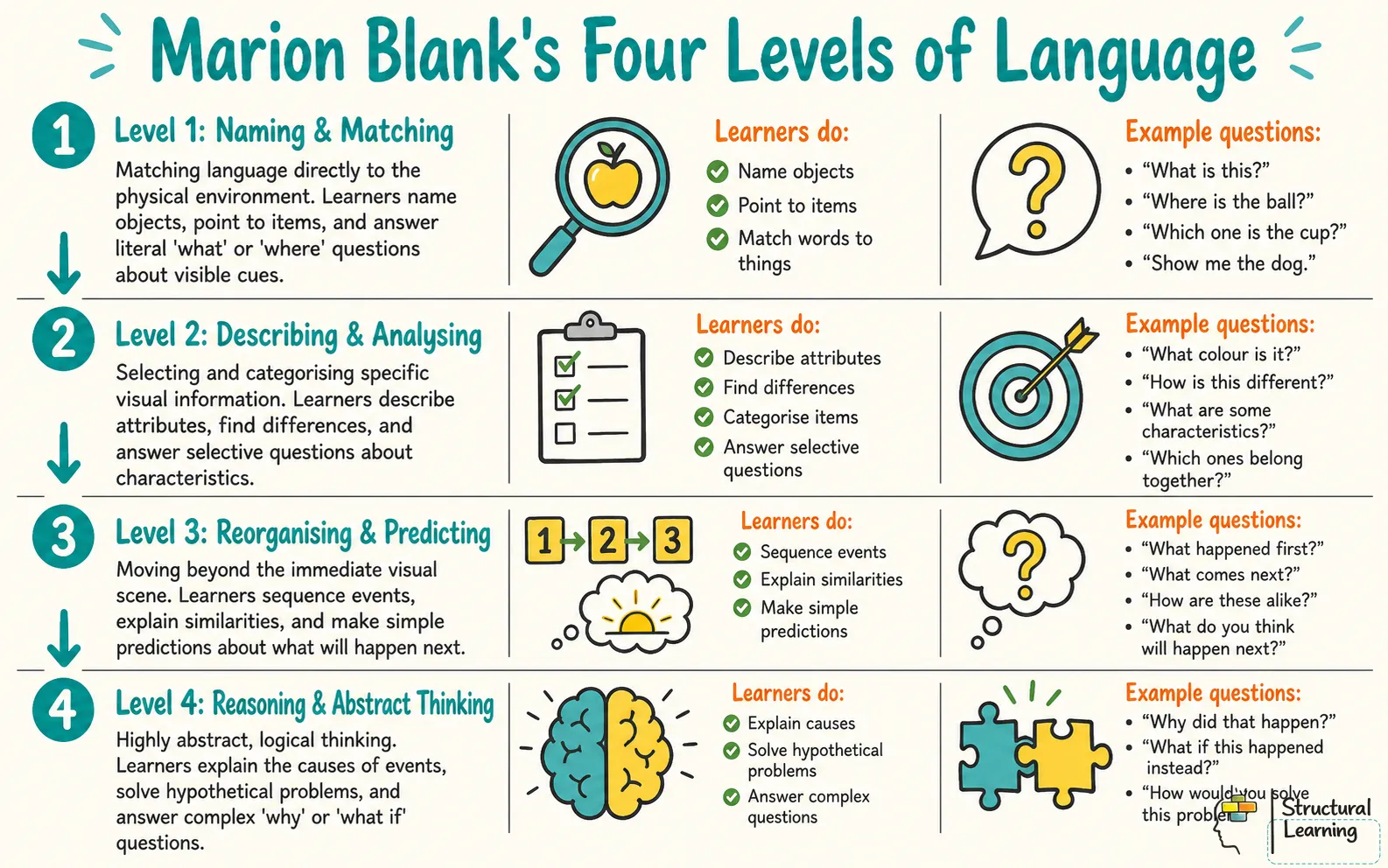
Stages infographic displaying Marion Blank's Four Levels of Language, scaffolding verbal reasoning from concrete naming to abstract logical thinking.
Marion Blank's Four Levels of Language

The foundation of this method lies in the understanding that oral language comprehension and reading comprehension share deep cognitive roots. When a child struggles to answer questions that are not explicitly stated in a text, the issue is rarely a simple reading decoding error. Instead, the learner is often experiencing a deeper, invisible gap in verbal comprehension. By targeting these abstract language skills through structured visual scenarios and scaffolded dialogue, practitioners can help learners build the semantic networks required for academic success.

This pedagogical framework is heavily detailed in the work of Stephen Parsons and Anna Branagan (2017), who structured a formalised classroom intervention around these principles. Their systematic approach uses visual scene cards and a highly structured sequence of questions to guide learners from simple naming tasks to complex, hypothetical reasoning. In doing so, the intervention makes the implicit thinking demands of classroom talk explicit and accessible for all children.


Who is the Intervention For?

This spoken language intervention is designed for school-aged learners who present with subtle, abstract language and verbal reasoning difficulties. These learners are frequently missed in busy classrooms because, unlike children with overt speech production errors or physical needs, their verbal difficulties are largely invisible during routine, everyday social interactions. They may appear fluent and communicative on the playground, but they struggle to cope with the complex, abstract language demands of the curriculum.

Target Learner Profile

The approach is particularly beneficial for learners who display specific communication and cognitive profiles. These profiles typically include:

  • Learners with diagnosed Developmental Language Disorder (DLD) who require explicit, systematic scaffolding to access inferential language.
  • Learners on the autism spectrum who struggle with the pragmatic, social, and non-literal aspects of classroom communication.
  • Children who experience difficulties with reading comprehension despite having strong word-reading and decoding skills.
  • Learners from disadvantaged backgrounds who may have had fewer opportunities for rich, academic talk in early childhood.

Exclusion Criteria and Cautions

While the principles of verbal reasoning apply widely, the structured paper-based materials of this specific intervention are not appropriate for all learners. The framework should be adapted or avoided in the following instances:

Learner Profile Reason for Exclusion or Adaptation Recommended Alternative Approach
Learners operating at very early cognitive stages Paper-based scenarios are too abstract and lack sensory feedback. Use concrete, hands-on objects and real-life, immediate experiences.
Learners with profound speech sound disorders The child's primary barrier is motor speech production rather than verbal comprehension. Deliver targeted phonological or speech-sound therapy led by a speech and language therapist.
Learners who are completely non-verbal The intervention relies heavily on spoken output or structured alternative communication. Implement robust Augmentative and Alternative Communication (AAC) systems first.


The Cognitive and Linguistic Mechanism

Developing verbal reasoning requires an understanding of how language and cognition interact within the working memory. When a teacher asks a question, the learner must decode the auditory information, retrieve relevant semantic knowledge from long-term memory, formulate a logical response, and organize that response into grammatically correct speech. This process places a high cognitive load on children with developmental language difficulties.

To reduce this cognitive load, the intervention establishes a communicative need to talk before demanding complex grammatical structures. Traditional language interventions often make the mistake of teaching grammar and vocabulary through rote drilling. However, clinical evidence suggests that when the conceptual need to discuss a scenario is firmly established in the learner's mind, the appropriate language structures are acquired more naturally and retained more permanently.

The visual scene card acts as an external cognitive anchor. By keeping the visual scenario constant, the learner does not have to expend working memory capacity on holding an imaginary scene in their head. They can use their limited cognitive resources to focus entirely on the logical relationships, predictions, and inferences demanded by the teacher's questions. This visual scaffolding supports the transition from concrete thinking to the abstract manipulation of ideas.


Marion Blank's Four Levels of Language

The theoretical backbone of Language for Thinking is the verbal reasoning model developed by Marion Blank. This model categorises classroom questions and dialogue into four distinct levels of abstraction, moving from the most concrete to the most complex.

Level 1: Naming and Matching (The Immediate Classroom Environment)

At this level, the language refers directly to the immediate, physical world. The learner is required to look, point, touch, or name objects and actions that are directly in front of them. The visual information is present and does not require any interpretation or inference.

  • Teacher Prompt: "Point to the bucket."
  • Cognitive Demand: Simple perception and identification.
  • Classroom Example: In a primary science lesson, the teacher points to a visual diagram of a plant and asks the learner to touch the leaf.

Level 2: Describing and Categorising (Reordering Information)

Level 2 questions require the learner to focus on specific attributes of an object or scenario. They must select and reorder the visual information, noticing details such as size, colour, shape, function, or location. The answers are still visible, but they require the learner to process the details systematically.

  • Teacher Prompt: "What colour is the boy's coat?" or "Find all the things we can eat."
  • Cognitive Demand: Analysis of characteristics, classification, and relational thinking.
  • Classroom Example: During a geography task, the teacher asks a learner to group photographs of houses into those made of brick and those made of wood.

Level 3: Reordering and Synthesising (Relating Known to Unknown)

At this level, the language begins to move away from the direct visual scene. The learner must use the visual clues to make simple predictions, describe personal experiences related to the topic, or restructure the information they have been given. The answer is not directly visible on the page; it must be constructed by the learner.

  • Teacher Prompt: "What will happen next?" or "How are these two characters different?"
  • Cognitive Demand: Prediction, sequencing, taking another person's perspective, and narrative structure.
  • Classroom Example: In a secondary English lesson, the teacher asks learners to look at an illustration of a character's room and describe what kind of hobbies that character might enjoy.

Level 4: Reasoning and Justifying (Abstract Verbal Reasoning)

This is the most abstract level of language, requiring the learner to explain the causes, reasons, and logical principles behind a scenario. The learner must go beyond what is happening and explain why it is happening. They are required to formulate hypotheses, justify their opinions, and solve problems verbally.

  • Teacher Prompt: "Why can we not build a house out of paper?" or "How do we know the man is angry?"
  • Cognitive Demand: Deduction, justification, problem-solving, and logical analysis.
  • Classroom Example: In a history lesson, the teacher asks learners to look at a medieval map and justify why a castle was built on top of a steep hill rather than in the valley.

Classroom Implementation Sequence

To implement this verbal reasoning framework successfully within a busy school, educators should follow a structured, five-step sequence. This sequence ensures that the intervention is targeted, consistent, and integrated into daily learning.

Step 1: Baseline Assessment

Before beginning the intervention, the teacher or Special Educational Needs Coordinator (SENCO) must assess the learner's current level of verbal reasoning. Using a standardized screening tool based on Marion Blank's levels, the practitioner identifies the highest level at which the learner can consistently respond accurately. This prevents the learner from becoming frustrated by questions that are too abstract, or bored by questions that are too simple.

Step 2: Selecting Visual Scenarios

The practitioner selects visual scenarios that are highly relevant to the curriculum or the learner's lived experiences. While commercial visual cards are available, teachers can create highly effective scenarios using textbook illustrations, high-quality photographs, or historical paintings. The chosen image must contain enough visual detail to support questions across all four of Marion Blank's levels.

Step 3: Structuring Question Levels

The teacher plans a sequence of questions based on the baseline assessment. A typical session with a learner might involve ten questions: two at the level below their baseline to build confidence, six at their target baseline level to stretch their thinking, and two at the level above to introduce higher-order reasoning. The table below outlines a planning template for a single scene depicting a wet, muddy playground.

Question Level Classroom Question Prompt Expected Learner Response Required Scaffolding Support
Level 1 "Touch the puddle of water." Learner points to the puddle on the card. Point to the general area of the puddle if the learner hesitates.
Level 2 "What is the girl wearing on her feet?" "She has got boots on." Give a choice: "Are those shoes or boots?"
Level 3 "What will happen if the boy runs into the puddle?" "He will splash water everywhere." Use an incomplete sentence: "If he runs fast, the water will..."
Level 4 "Why does the teacher look worried?" "Because the children might slip and get hurt." Frame the reason: "The ground is wet, so the danger is..."

Step 4: Delivering Structured Dialogue

During the session, which can be delivered one-to-one or in a small group, the teacher uses specific scaffolding techniques to guide the learner. If a learner struggles to answer a Level 4 question, the teacher does not simply give the answer. Instead, they systematically drop back down to a Level 2 or Level 3 question to rebuild the logical pathway. Once the concrete details are secure, the teacher prompts the learner to try the abstract question again.

Step 5: Monitoring and Generalisation

The ultimate goal of the intervention is for the learner to apply these verbal reasoning skills across the school day. The teacher monitors whether the learner is beginning to use Level 3 and Level 4 language during independent class discussions, playground play, and written tasks. The intervention is only successful when the scaffolded oral language begins to appear in the learner's spontaneous, independent speech.


Integrating Structural Learning Thinking Actions

To make the abstract demands of Marion Blank's levels of questioning completely explicit, teachers can integrate the visual thinking actions of the Structural Learning framework. By associating specific thinking verbs with concrete visual prompts, we can remove the cognitive ambiguity that often surrounds verbal reasoning tasks.

The Describe Action (Aligning with Levels 1 and 2)

Before a learner can infer why a situation has occurred, they must first notice and describe the concrete elements of the scene. The describe action prompts the learner to look closely and catalog the facts of the scenario. The teacher can use a green visual prompt to signal that the learner is currently working at a factual, descriptive level.

  • Classroom Application: The teacher says: "Let us use our describe action. Tell me three things you can see in this Roman market scene."
  • Cognitive Gain: Secures the literal comprehension foundation before attempting higher-order inference.

The Connect Action (Aligning with Level 2 and 3)

Once the individual elements are identified, the learner must link them together. The connect action prompts the learner to find relationships, cause-and-effect patterns, and categories. This visual thinking action helps learners transition from isolated observations to sequential narratives.

  • Classroom Application: The teacher says: "Let us use our connect action. How is the dry, yellow soil connected to the dead plant?"
  • Cognitive Gain: Helps the learner identify causal links and sequence events logically.

The Predict Action (Aligning with Level 3)

The predict action asks the learner to project their thinking forward in time or space. By using the visible clues, the learner must construct a logical hypothesis about what will happen next. This action requires the learner to go beyond the immediate visual evidence and use their real-world schema.

  • Classroom Application: The teacher says: "Let us use our predict action. Look at the dark clouds on the horizon. What will happen to the dry field in an hour?"
  • Cognitive Gain: Develops temporal sequencing and the ability to formulate logical, schema-based hypotheses.

The Justify Action (Aligning with Level 4)

The justify action requires the learner to defend their logical conclusions with verbal evidence. When a learner makes an inference, they must point to the specific visual clues or prior knowledge that led to their thinking. This visual action makes the process of logical proof explicit.

  • Classroom Application: The teacher says: "Let us use our justify action. You think the builder is tired. What visual evidence on the card can you find to justify that statement?"
  • Cognitive Gain: Strengthens verbal reasoning, logical deduction, and the use of explicit evidence in argument.

Evidence and Practical Limitations

When evaluating the efficacy of Language for Thinking, practitioners must look closely at the wider scientific evidence surrounding oral language and verbal reasoning interventions. Because developmental language needs represent a persistent challenge for many children, implementing evidence-based approaches with high fidelity is crucial for securing positive learning outcomes.

The peer-reviewed literature on oral inferential comprehension training demonstrates the strength of structured spoken language interventions. A notable randomized controlled trial conducted by Dawes, Leitão, Claessen, and Kane (2018) evaluated the effects of an oral inferential comprehension intervention for young children with Developmental Language Disorder (DLD). Their findings indicated that structured, oral inferential comprehension training resulted in significant improvements in abstract verbal reasoning and oral language outcomes. This study highlights the value of targeting oral inferencing directly, rather than waiting for these skills to develop through reading instruction alone.

Language for Thinking Study Notes preview
◆ Structural Learning
Language for Thinking Study Notes
Study notesOne-page revision sheet

Download a one-page study note for Language for Thinking, with the key ideas, limitations and classroom links in one place.

Something went wrong - please try again.

This clinical finding is supported by a comprehensive rapid evidence review published by the UK Department for Education (DfE), authored by McKean et al. (2025). The review, Supporting stammering, speech, and language needs in the early years, concluded that explicit, scaffolded instruction in verbal reasoning, dialogic reading, and structured language-supporting prompts are essential, evidence-based components of high-quality classroom language provision. This national review reinforces the principle that targeted, systematic spoken language frameworks must be a core part of a school's universal and targeted speech and language offer.

Critical Practical Limitations

Despite the strong theoretical and clinical foundation, practitioners frequently encounter significant challenges when implementing Language for Thinking in school environments. It is essential to recognize these limitations to plan effective delivery.

  • The Isolation Trap: The most common implementation failure is treating the intervention as an isolated, short-term pull-out session delivered by a teaching assistant in a quiet corridor. When verbal reasoning is taught in clinical isolation, learners rarely transfer these skills back into the noisy, complex environment of the mainstream classroom. Spoken language support must be embedded across the entire school day, in every subject, to achieve long-term cognitive change.
  • Workforce and Time Pressures: Acute pressures within UK schools routinely undermine the fidelity of the intervention. High staff turnover, staff sickness, and a lack of dedicated planning time mean that teaching assistants and designated language leads frequently miss essential training or coordination sessions. Without consistent, daily delivery, the efficacy of the intervention drops significantly.
  • Clinical Skill and Interpretation Gaps: The structured questions require teachers and support staff to make rapid, live judgments about a learner's language level. However, support staff are often delegated this task without ongoing, specialist speech and language training. If a practitioner cannot accurately identify the subtle difference between a Level 3 and a Level 4 response, they cannot provide the precise scaffolding required to stretch the learner's thinking.
  • Resource and Preparation Demands: Preparing, organising, and laminating the visual resources for dozens of different curriculum topics requires significant educator time. Many schools struggle to maintain a high-quality library of diverse visual scenarios, leading to repetitive or unengaging sessions that fail to motivate older learners.

Comparison with Similar Spoken Language Interventions

To help school leaders make informed decisions about their speech and language provision, it is helpful to compare the principles of Language for Thinking with other widely used educational interventions.

Intervention Framework Core Pedagogical Target Primary Delivery Method Best Suited For Key Difference
Language for Thinking Inferential comprehension and verbal reasoning based on Marion Blank's levels. Structured questioning using visual scene cards; small group or 1:1. Learners with invisible verbal reasoning gaps who struggle with abstract academic talk. Focuses entirely on the cognitive hierarchy of questioning (Blank's levels) to build logical inference.
Word Aware Vocabulary acquisition, semantic enrichment, and word learning strategies. WHOLE-class and targeted small-group teaching of specific academic vocabulary. Learners with vocabulary deficits or English as an Additional Language (EAL) needs. Targets the breadth and depth of word knowledge rather than the logical reasoning structure of sentences.
Nuffield Early Language Intervention (NELI) Narrative skills, vocabulary, phonological awareness, and active listening. Highly structured, scripted daily sessions delivered by trained TAs in reception classes. Young children in the early years showing significant language delays upon starting school. Designed strictly as an early years, manualised preventative programme rather than a flexible KS1/KS2 framework.
Talk for Writing Narrative structure, grammatical pattern internalization, and oral storytelling. Whole-class imitation, innovation, and independent application of spoken texts. All learners, particularly those who struggle with writing structure and story generation. Uses physical imitation and oral rehearsal of whole texts as a direct pathway to written composition.


Detailed Classroom Scenario: KS2 History

To understand how these abstract levels of language function in a real classroom, let us observe a Year 5 History lesson investigating the Viking invasion of Britain. The class is looking at a high-quality illustration depicting a Viking longship arriving on a stormy beach near a wooden Anglo-Saxon settlement. The local Anglo-Saxons are shown running towards the village, while some look on from behind trees.

The teacher has identified three learners in this class who struggle significantly with abstract verbal reasoning. Rather than asking a broad, cognitively overwhelming question to the whole class, the teacher uses targeted, scaffolded questioning based on Marion Blank's levels to guide these learners through the historical source.

The Dialogue in Action

The teacher approaches the first learner, who is currently working at Level 1 (Naming and Matching).

  • Teacher: "Let us look closely at this scene. Use your describe action and point to the wooden shields on the side of the Viking ship."
  • Learner: (Points directly to the shields on the image.)
  • Teacher: "Excellent. You found the shields. Now, tell me, what are they made of?"
  • Learner: "Wood."
  • Teacher: "Perfect. The shields are made of wood."

The teacher now turns to the second learner, who is working towards Level 2 (Describing and Categorising).

  • Teacher: "Now let us look at the Anglo-Saxon people on the beach. Look at their faces. Describe how they are moving."
  • Learner: "They are running fast away from the water."
  • Teacher: "Yes, they are running away. Let us connect these two ideas. Why are they running away from the longship?"
  • Learner: "Because they are scared."
  • Teacher: "Brilliant. They are running because they are scared of the ship arriving."

The teacher then challenges the third learner, who is working at Level 3 (Reordering and Synthesising) and ready to attempt Level 4 (Reasoning and Justifying).

  • Teacher: "Look at the stormy sky, the rough waves, and the heavy shields. Use your justify action. Why did the Vikings choose to travel in this longship despite the dangerous, stormy weather?"
  • Learner: "To get land."
  • Teacher: "Let us push that thinking further. The weather is highly dangerous. If they sailed through a massive storm, what does that tell us about how much they needed new land?"
  • Learner: "They must have really needed it. Their old home might have had no food, so they risked their lives."
  • Teacher: "That is a superb historical inference. You have justified that their process was a desperate search for survival, using the evidence of the storm and their dangerous ship."

By structuring the dialogue in this sequential manner, the teacher has allowed every learner to participate in the historical analysis without experiencing cognitive overload. The lower-level questions secured the concrete facts, which then acted as the raw materials for the higher-level, abstract historical reasoning.


The SENCO and Teacher Resource Planner

To help coordinators design and manage a high-quality spoken language intervention, this section provides a practical toolkit. Use these planning guides to structure sessions and monitor the quality of delivery across the school.

Spoken Language Intervention Checklist

This quality checklist should be used by SENCOs or school leaders during learning walks to ensure that targeted spoken language interventions are being implemented with high fidelity.

  • Baseline Secured: The learner's current verbal reasoning level has been assessed and is noted on the session planner.
  • Visual Anchor Present: A clear, detailed visual scenario is placed between the practitioner and the learners.
  • Conceptual Need Established: The practitioner establishes the communicative need to talk before demanding specific grammatical structures.
  • Systematic Questioning: The questions are planned and delivered across multiple, sequential levels of Marion Blank's framework.
  • Flexible Scaffolding: If a learner struggles, the practitioner immediately drops back down to a lower, more concrete level of questioning.
  • Expressive Vocabulary Modeled: The practitioner models high-quality, academic vocabulary during the session.
  • Collaborative Talk Prompted: Learners are encouraged to discuss the visual scene in pairs or small groups to reduce performance pressure.
  • Generalisation Planned: The teacher has a clear strategy to prompt the learner's target verbal reasoning level during mainstream, independent lessons.

Intervention Suitability Decision Matrix

Use this decision matrix to determine whether Language for Thinking is the correct intervention for a specific learner, or if an alternative approach is required.

Is the learner's primary barrier a lack of abstract verbal reasoning? ├── YES: Are they able to access paper-based, 2D visual resources? │ ├── YES: Implement Language for Thinking with daily classroom integration. │ └── NO: Adapt the framework using concrete, 3D objects and sensory play. └── NO: Is their barrier primarily speech sound production or physical? ├── YES: Refer to a Speech and Language Therapist for targeted clinical support. └── NO: Is it a literal vocabulary deficit or EAL need? ├── YES: Implement Word Aware or structured vocabulary instruction. └── NO: Conduct a broader educational psychology assessment.


Research Evidence Check

Evidence Synthesis

What is the evidence that inferential language teaching improves verbal reasoning and comprehension?

Mixed evidence: The Consensus search returns a mixed or indirect evidence base, so claims should be framed around the underlying teaching principle rather than the branded programme alone.

0% Yes from 8 studiesstrong evidence
  • Yes0%
  • Possibly50%
  • Mixed13%
  • No38%
Teacher takeaway

Use the approach as a structured support, not a guarantee: identify the target skill, teach it explicitly, and monitor whether it transfers into classroom language, reading or writing.

View the evidence behind this answer8 studies
1Oral language interventions can improve language outcomes in children with neurodevelopmental disorders: A systematic review and meta‐analysisEnrica Donolato et al. (2023) · Campbell Systematic Reviews
meta analysismixed202329 citations

Young people who fail to develop language as expected face significant challenges in all aspects of life. Unfortunately, language disorders are common, either as a distinct condition (e.g., Developmental Language Disorder) or as a part of another neurodevelopmental condition (e.g., autism). Finding ways to attenuate language problems through intervention has the potential to yield great benefits not only for the individual but also for society as a whole. This meta-analytic review examined the effect of oral language interventions for children with neurodevelopmental disorders. The last electronic search was conducted in April 2022. Intervention studies had to target language skills for children from 2 to 18 years of age with Developmental Language Disorder, autism, intellectual disability, Down syndrome, Fragile X syndrome, and Williams syndrome in randomised controlled trials or quasi-experimental designs. Control groups had to include business-as-usual, waiting list, passive or active conditions. However, we excluded studies in which the active control group received a different type, delivery, or dosage of another language intervention. Eligible interventions implemented explicit and structured activities (i.e., explicit instruction of vocabulary, narrative structure or grammatical rules) and/or implicit and broad activities (i.e., shared book reading, general language stimulation). The intervention studies had to assess language skills in receptive and/or expressive modalities. The search provided 8195 records after deduplication. Records were screened by title and abstract, leading to full-text examinations of 448 records. We performed Correlated and Hierarchical Effects models and ran a retrospective power analysis via simulation. Publication bias was assessed via-curve and precision-effect estimate. We examined 38 studies, with 46 group comparisons and 108 effects comparing pre-/post-tests and eight studies, with 12 group comparisons and 21 effects at follow-up. The results showed a mean effect size of = 0.27 at the post-test and = 0.18 at follow-up. However, there was evidence of publication bias and overestimation of the mean effects. Effects from the meta-analysis were significantly related to these elements: (1) receptive vocabulary and omnibus receptive measures showed smaller effect sizes relative to expressive vocabulary, grammar, expressive and receptive discourse, and omnibus expressive tests; and (2) the length of the intervention, where longer sessions conducted over a longer period of time were more beneficial than brief sessions and short-term interventions. Neither moderators concerning participants' characteristics (children's diagnosis, diagnostic status, age, sex, and non-verbal cognitive ability and severity of language impairment), nor those regarding of the treatment components and implementation of the language interventions (intervention content, setting, delivery agent, session structure of the intervention or total number of sessions) reached significance. The same occurred to indicators of study quality. The risk of bias assessment showed that reporting quality for the studies examined in the review was poor. In sum, the current evidence base is promising but inconclusive. Pre-registration and replication of more robust and adequately powered trials, which include a wider range of diagnostic conditions, together with more long-term follow-up comparisons, are needed to drive evidence-based practice and policy.

Classroom implication: Use this as a caution: check learner fit, delivery quality and progress data before treating the approach as settled practice.

2The effects of parent-implemented language interventions on child linguistic outcomes: A meta-analysisJodi K. Heidlage et al. (2019) · Early Childhood Research Quarterly
meta analysispossibly2019200 citations

Abstract Intervening early is important to minimize persistent difficulties in language and related domains in young children with or at-risk for language impairment (LI; Rescorla, 2009). Because language is first learned in caregiver–child interactions, parent-implemented interventions are potentially an important early intervention for children with or at-risk for LI. Previous meta-analyses have examined outcomes of parent-implemented interventions for children with primary and secondary LI, but have not included children at-risk for LI due to low SES. A systematic review of the literature identified 25 randomized controlled trials of parent-implemented language interventions examining linguistic outcomes for young children. Studies included 1734 participants (M = 3.7 years) with or at-risk for LI due to low SES. Results of these meta-analyses indicated modest improvements in expressive vocabulary and small improvements in expressive language for children with or at-risk for LI. The effect size for expressive vocabulary outcomes was significant for shared book reading interventions (g = 0.37, 95% CI [0.15–0.59]) and interventions implemented in play and/or routines (g = 0.50, 95% CI [0.05–0.95]). The effect size for expressive language was significant (g = 0.42, 95% CI [0.19–0.65]), but not for receptive language (g = 0.07, ns), and the effect size for receptive vocabulary was not significant (g = 0.18, ns). Sub-group analyses for expressive vocabulary and expressive language indicated moderate to large significant effects for children with or at-risk for primary LI and smaller, non-significant effects for children with Autism Spectrum Disorder. Findings are generally consistent with a previous meta-analysis (Roberts & Kaiser, 2011), indicating parent-implemented language interventions may have positive effects on linguistic outcomes for young children with or at-risk for LI. Limited measures of parent training procedures and varied measures of parent outcomes limited the analysis of how child outcomes were achieved.

Classroom implication: Translate the finding into explicit modelling, guided practice and progress monitoring rather than relying on one-off exposure.

3Language Interventions for School-Aged Children Who Are d/Deaf and Hard of Hearing: A Systematic Review and Meta-Analysis.Andréa Chanell Jønsberg et al. (2025) · Journal of Speech, Language, and Hearing Research
meta analysispossibly20252 citations

The main aim of the systematic review and meta-analysis was to evaluate the effectiveness of language interventions for school-aged children who are d/Deaf and hard of hearing (DHH). We focused on studies targeting meaning-based aspects of language, such as vocabulary, grammar, and narrative skills. We included randomized controlled trials and quasi-experiments with a control group and a pre-post design. A secondary aim was to describe the characteristics of effective interventions identified in the systematic review. The review was preregistered in PROSPERO (ID CRD42021236085). We searched 10 academic databases for peer-reviewed journal articles reporting language interventions for children who are DHH aged 6-12 years. We assessed the quality of included studies using Critical Appraisal Skills Programme checklists. A meta-analysis was conducted on the overall effect of interventions. In addition, we calculated separate effect sizes for vocabulary and morphosyntactic knowledge. We identified 14 studies totaling 794 children. Quality assessment revealed concerns of risk of bias in most studies because study characteristics were not comprehensively reported. The meta-analyses of language interventions revealed a large main effect of= 0.79Subdomain analyses revealed similar effects for morphosyntactic knowledge= 0.81 and vocabulary= 0.71. Few high-quality studies examine the effects of language interventions for children who are DHH. However, the studies that exist reveal robust effects, especially for morphosyntactic abilities. Intervention approaches were diverse, and the largest intervention effects were found in studies with a randomized controlled design and near-transfer outcome measures closely aligned with the intervention content. Future studies should adhere to established guidelines for reporting results from controlled experimental study designs.

Classroom implication: Translate the finding into explicit modelling, guided practice and progress monitoring rather than relying on one-off exposure.

4Efficacy of the Treatment of Developmental Language Disorder: A Systematic ReviewS. Rinaldi et al. (2021) · Brain Sciences
systematic reviewno202183 citations

Language disorder is the most frequent developmental disorder in childhood and it has a significant negative impact on children's development. The goal of the present review was to systematically analyze the effectiveness of interventions in children with developmental language disorder (DLD) from an evidence-based perspective. We considered systematic reviews, meta-analyses of randomized controlled trials (RCTs), control group cohort studies on any type of intervention aimed at improving children's skills in the phono-articulatory, phonological, semantic-lexical, and morpho-syntactic fields in preschool and primary school children (up to eight years of age) that were diagnosed with DLD. We identified 27 full-length studies, 26 RCT and one review. Early intensive intervention in three- and four-year-old children has a positive effect on phonological expressive and receptive skills and acquisitions are maintained in the medium term. Less evidence is available on the treatment of expressive vocabulary (and no evidence on receptive vocabulary). Intervention on morphological and syntactic skills has effective results on expressive (but not receptive) skills; however, a number of inconsistent results have also been reported. Only one study reports a positive effect of treatment on inferential narrative skills. Limited evidence is also available on the treatment of meta-phonological skills. More studies investigated the effectiveness of interventions on general language skills, which now appears as a promising area of investigation, even though results are not all consistent. The effectiveness of interventions over expressive and receptive phonological skills, morpho-syntactic skills, as well as inferential skills in narrative context underscores the importance that these trainings be implemented in children with DLD.

Classroom implication: Use this as a caution: check learner fit, delivery quality and progress data before treating the approach as settled practice.

5A systematic review of pragmatic language interventions for children with autism spectrum disorderLauren Parsons et al. (2017) · PLOS ONE
meta analysispossibly2017136 citations

There is a need for evidence based interventions for children with autism spectrum disorder (ASD) to limit the life-long, psychosocial impact of pragmatic language impairments. This systematic review identified 22 studies reporting on 20 pragmatic language interventions for children with ASD aged 0-18 years. The characteristics of each study, components of the interventions, and the methodological quality of each study were reviewed. Meta-analysis was conducted to assess the effectiveness of 15 interventions. Results revealed some promising approaches, indicating that active inclusion of the child and parent in the intervention was a significant mediator of intervention effect. Participant age, therapy setting or modality were not significant mediators between the interventions and measures of pragmatic language. The long-term effects of these interventions and the generalisation of learning to new contexts is largely unknown. Implications for clinical practice and directions for future research are discussed.

Classroom implication: Translate the finding into explicit modelling, guided practice and progress monitoring rather than relying on one-off exposure.

6Children with Down syndrome can benefit from language interventions; Results from a systematic review and meta-analysis.Elizabeth Smith et al. (2020) · Journal of Communication Disorders
meta analysisno202038 citations

Language disorder is a cardinal challenge for children with Down syndrome, and their learning capacity has been debated. The aim of the current study was to conduct a systematic review and meta-analysis of existing language interventions for children with Down syndrome to reveal knowledge about the effects of these interventions and identify any common characteristics specific to effective or ineffective interventions. A systematic search was conducted in databases relevant for education, speech and language therapy, and psychology. Based on a set of predefined inclusion criteria, the hits were screened and coded. Eight studies were synthesised in a systematic review and four in a meta-analysis. The overall effect of the interventions was large (g = 1.01), but significant transfer effects to untrained aspects of language were rarely found. Interventions showing significant effects varied with regards to numerous characteristics including the age of the target group, the intervention approach, the dosage, and the implementer. The common characteristic across the effective interventions was simply the aim of improving language skills in children with Down syndrome. Overall, there was a moderate to high risk of bias across all studies. To conclude, children with Down syndrome have the potential to respond to language intervention. However, more interventions that reach transfer effects are needed to maximise children's language outcomes. Based on the limited number of studies and a moderate to high risk of bias across the studies, there is a great need for more robust intervention studies to ensure that future interventions are informed by high-quality research.

Classroom implication: Use this as a caution: check learner fit, delivery quality and progress data before treating the approach as settled practice.

7Efficacy, model of delivery, intensity and targets of pragmatic interventions for children with developmental language disorder: A systematic reviewKristine M. Jensen de López et al. (2022) · International Journal of Language & Communication Disorders
systematic reviewpossibly202219 citations

It is widely acknowledged that children with developmental language disorder (DLD) predominantly have difficulties in the areas of grammar and vocabulary, with preserved pragmatic skills. Consequently, few studies focus on the pragmatic skills of children with DLD, and there is a distinct lack of studies examining the effectiveness of pragmatic interventions. To carry out a systematic review of the literature on pragmatic interventions for children with DLD. This systematic review was registered with PROSPERO (ID = CRD42017067239). A systematic search in seven databases yielded 1031 papers, of which 11 met our inclusion criteria. The included papers focused on interventions for children with DLD (mean = 3-18 years), enhancing oral language pragmatic skills, published between January 2006 and May 2020, and were based on a group-study design such as randomized control trial or pre-post-testing. Study participants were monolingual speakers. The quality of papers was appraised using the Cochrane Risk of bias tool for randomized controlled trials. There was a high degree of variability between the included intervention studies, especially regarding intensity, intervention targets and outcomes. The evidence suggested that pragmatic intervention is feasible for all models of delivery (individual, small and large group) and that interventions for pragmatic language are mostly focused on encouragement of conversation and narrative skills observed through parent-child interaction or shared book-reading activities. This study highlights the importance of promoting and explicitly teaching pragmatic skills to children with DLD in structured interventions. A narrative synthesis of the included studies revealed that in addition to direct intervention, indirect intervention can also contribute to improving oral pragmatic skills of children with DLD. What is already known on the subject? An increasing number of studies have shown that difficulties in acquiring pragmatic language is not only present in children with autism. What this study adds to existing knowledge? Interventions for pragmatic language in children with DLD are mostly focused on encouragement of conversation and narrative skills, very often through parent-child interaction or shared book-reading activities. Interventions that target language pragmatic are feasible for all models of delivery (individual, small and large group). What are the potential or actual clinical implications of this work? The efficacy of the existing studies varies, and it is difficult to give recommendations regarding the intensity and duration of the specific intervention. In addition to offering pragmatic intervention directly from a specialist, pragmatic interventions can also be carried out indirectly if the intervention is under the continuous supervision of a specialist.

Classroom implication: Translate the finding into explicit modelling, guided practice and progress monitoring rather than relying on one-off exposure.

8A randomized controlled trial of an oral inferential comprehension intervention for young children with developmental language disorderE. Dawes et al. (2018) · Child Language Teaching and Therapy
randomised controlled trialno201834 citations

Although children with developmental language disorder demonstrate poor inferential comprehension, few studies have evaluated the effect of interventions to improve inferencing. This study aimed to investigate the efficacy of a small-group intervention designed to improve oral inferential comprehension of narrative discourse. Thirty-seven 5- to 6-year-old children with developmental language disorder participated. The participants were randomly allocated to the oral inferential comprehension (IC) intervention or a control phonological awareness (PA) intervention. Small-group sessions took place twice a week over 8 weeks. Participants were assessed on narrative comprehension and phonological awareness skills pre- and post-intervention, and after a maintenance period of 8 weeks. Compared to the control PA group, the participants in the IC group demonstrated a significant increase in inferential comprehension scores from pre- to post-intervention, which was maintained over time. In addition, the IC group scored significantly higher than the PA group for inferential comprehension on a post-intervention generalization measure. There was no significant difference between the two groups for literal comprehension scores at any assessment point. The results demonstrate that the small-group intervention was effective at improving inferential comprehension of narratives in 5- to 6-year-old children with developmental language disorder. Additionally, generalized improvement was shown across the narrative context, and improvements were maintained two months following the intervention.

Classroom implication: Use this as a caution: check learner fit, delivery quality and progress data before treating the approach as settled practice.

Frequently Asked Questions

Can this intervention be delivered effectively by teaching assistants?

Yes, teaching assistants can deliver this intervention highly effectively, but only when they are provided with systematic training, clear planning templates, and ongoing support. Delivering targeted verbal reasoning questions requires a high level of live clinical skill; assistants must be able to recognize when a learner is experiencing cognitive overload and immediately adapt their questioning level. Schools should avoid simply handing the intervention manual to an untrained assistant. Regular supervision sessions with the SENCO or a speech and language therapist are essential to ensure implementation fidelity.

How does verbal reasoning difficulty impact written work?

Verbal reasoning is the direct precursor to written composition. If a learner cannot verbally sequence events, explain cause-and-effect relationships, or justify an opinion in spoken language, they will not be able to produce these logical structures in their independent writing. Often, what appears to be a "writer's block" or a lack of writing stamina is actually an underlying verbal reasoning difficulty. By strengthening oral inferencing and sentence construction during spoken language sessions, teachers provide the cognitive templates that learners need to draft coherent, structured written paragraphs.

Should we use the exact commercial picture cards, or can we make our own?

While the official commercial picture cards are highly structured and useful, making your own curriculum-linked resources is often more effective for older learners. Using textbook illustrations, historical paintings, or scientific diagrams as your visual scenarios ensures that the language intervention directly supports the learner's academic progress. The key is to ensure that the homemade images are visually rich enough to support deep questioning. An image that only depicts static objects will not support Level 3 and Level 4 questions; the visual scene must contain an active story, implicit emotions, cause-and-effect relationships, or a visible problem that needs solving.


Next Lesson Action

Next lesson, select a central image or diagram from your curriculum topic and use it to ask one targeted learner a sequence of three structured questions: start with a concrete Level 2 question about a visible detail, move to a Level 3 prediction based on that detail, and finish by asking them to justify their thinking using the visual evidence.

Research sources

Further reading from peer-reviewed research

These 5 studies give source context for the classroom guidance in this article on Language for Thinking: developing inference and verbal reasoning. They are included as starting points for deeper reading, not as a substitute for local professional judgement.

Randomised Controlled Trial 34 citations journals.sagepub.com

A randomized controlled trial of an oral inferential comprehension intervention for young children with developmental language disorder

E. Dawes et al. (2018) | Child Language Teaching and Therapy

Use this as a caution: check learner fit, delivery quality and progress data before treating the approach as settled practice.

View study

Systematic Review 83 citations mdpi.com

Efficacy of the Treatment of Developmental Language Disorder: A Systematic Review

S. Rinaldi et al. (2021) | Brain Sciences

Use this as a caution: check learner fit, delivery quality and progress data before treating the approach as settled practice.

View study

Meta Analysis 200 citations linkinghub.elsevier.com

The effects of parent-implemented language interventions on child linguistic outcomes: A meta-analysis

Jodi K. Heidlage et al. (2019) | Early Childhood Research Quarterly

Translate the finding into explicit modelling, guided practice and progress monitoring rather than relying on one-off exposure.

View study

Meta Analysis 136 citations journals.plos.org

A systematic review of pragmatic language interventions for children with autism spectrum disorder

Lauren Parsons et al. (2017) | PLOS ONE

Translate the finding into explicit modelling, guided practice and progress monitoring rather than relying on one-off exposure.

View study

Meta Analysis 38 citations linkinghub.elsevier.com

Children with Down syndrome can benefit from language interventions; Results from a systematic review and meta-analysis.

Elizabeth Smith et al. (2020) | Journal of Communication Disorders

Use this as a caution: check learner fit, delivery quality and progress data before treating the approach as settled practice.

View study

Paul Main, Founder of Structural Learning
About the Author
Paul Main
Founder & Metacognition Researcher

Paul Main is an educator and metacognition researcher who founded Structural Learning in 2002. With a psychology degree from the University of Sunderland and 22+ years helping schools embed thinking skills, he bridges the gap between educational research and classroom practice. Fellow of the RSA and Chartered College of Teaching, with 128+ Google Scholar citations.

More →

SEND

Back to Blog