Updated on
June 13, 2026
WellComm: using the speech and language toolkit well
A practical guide for SENCOs and teachers on implementing the WellComm toolkit, moving from screening to effective classroom-based language support.


Updated on
June 13, 2026
A practical guide for SENCOs and teachers on implementing the WellComm toolkit, moving from screening to effective classroom-based language support.
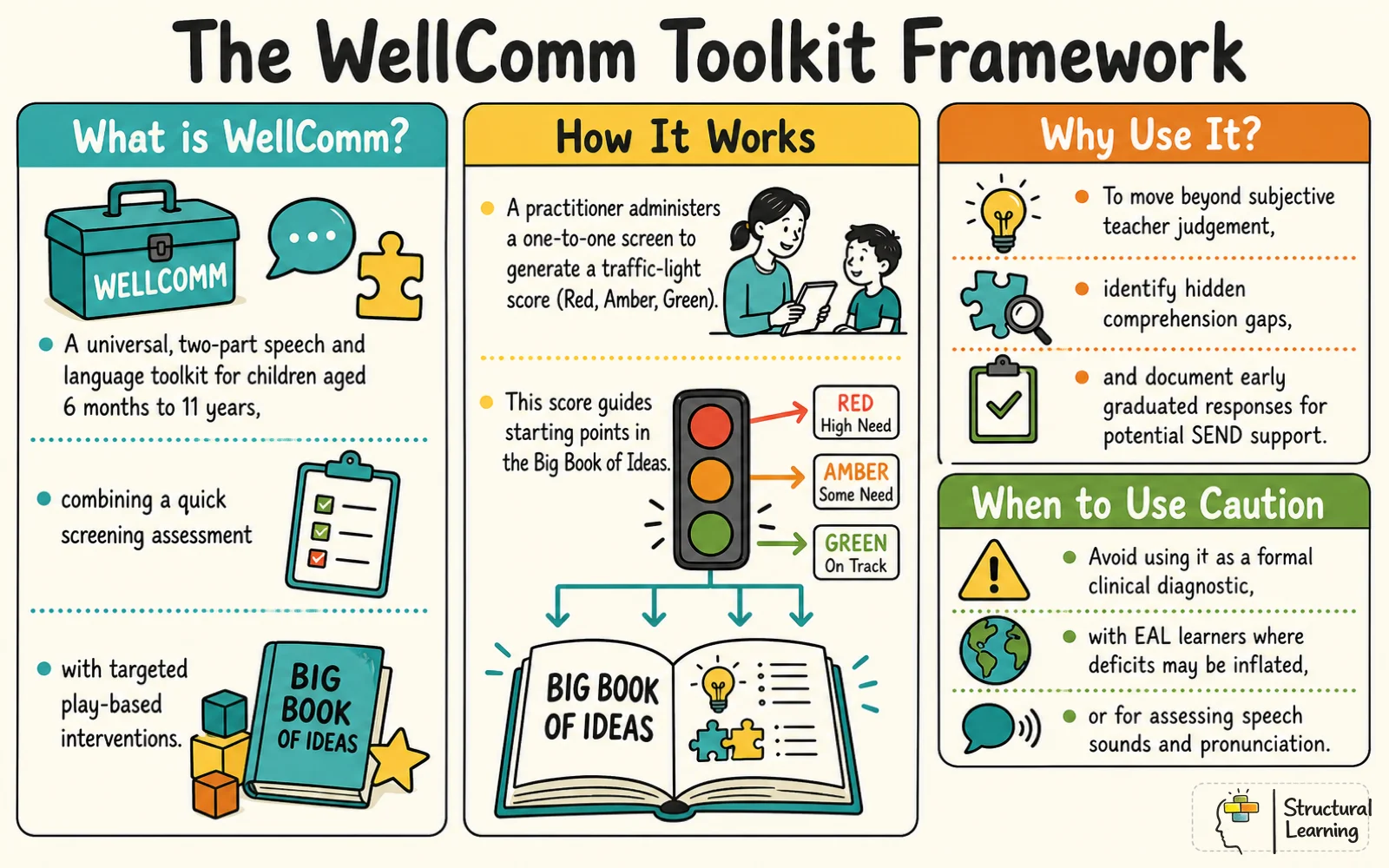
The WellComm Speech and Language Toolkit is a widely used screening and intervention resource for identifying and supporting learners with language difficulties. It is designed for use with children from 6 months to 11 years of age, providing a structured approach to assessing language skills and offering targeted activities to address areas of need.

For many schools, WellComm is the first step in building a more systematic approach to speech and language support. It helps move practice beyond subjective teacher judgement to a more data-informed process. However, moving from the toolkit's traffic-light report to effective, manageable classroom action presents a significant challenge.
The toolkit consists of two core components: a screening assessment and a bank of intervention activities.
The central process involves using the screening tool to generate a "traffic light" score, Red (significant delay), Amber (some delay), or Green (within expected range). This score then guides the practitioner to an appropriate starting point for intervention within The Big Book of Ideas.
WellComm is designed as a universal screening tool. Its main strength lies in its ability to quickly survey a whole cohort and flag children who might have underlying language difficulties, including those who appear confident and articulate but may have hidden comprehension gaps (GL Assessment, 2021).
However, it is crucial to understand its limitations.
WellComm is a good fit for:
Use WellComm with caution for:
Implementing WellComm follows a clear, structured sequence. The goal is to connect the data from the screening to a specific, targeted action.
The real power of any intervention is its ability to enhance learning within the curriculum. The activities in The Big Book of Ideas should not be confined to withdrawal sessions. They provide a blueprint for the kind of language scaffolding that can be woven into everyday lessons.
This approach, embedding language support into high-quality continuous provision, is particularly effective for learners with identified language delays or those with SEND.

Download a one-page study note for WellComm, with the key ideas, limitations and classroom links in one place.
Here is a realistic example of a Year 5 teacher putting WellComm principles into action during a science experiment on filtration.
The evidence base for early language intervention is generally positive, suggesting that targeted support can improve outcomes (Feltner et al., 2024; Rodgers et al., 2024). However, the evidence for screening tools themselves, including WellComm, is more mixed and warrants careful consideration (Wallace et al., 2015).
SENCOs and school leaders should be aware of three specific critiques when interpreting WellComm data.
A 2025 rapid evidence review commissioned by the Department for Education (DfE) rated WellComm's diagnostic accuracy as "low" (McKean et al., 2025). The review highlighted studies showing the tool's specificity could be as low as 58.5%.
In a classroom context, low specificity means a high number of "false positives." Many learners who are flagged as Amber or Red may not have a genuine underlying language disorder. They may simply have had less exposure to the specific vocabulary or concepts assessed. This means the tool can lead to the over-identification of needs, creating unnecessary work and anxiety.
Academic evaluations note that WellComm does not assess all aspects of language. Crucially, it does not evaluate speech sound production, meaning it can miss learners with Speech Sound Disorders (Dysart and Code, 2024).
Furthermore, the tool's developmental norms were not created from an independent standardisation sample but derived from previous literature. This, combined with its prescriptive English-normed design, makes it less reliable for assessing learners from diverse backgrounds, especially those with EAL or other SEND (McKean et al., 2025). Practitioners report the scripted questions can feel "alien" and unnatural, potentially confusing learners and impacting the reliability of their responses.
In practice, the one-to-one, time-intensive nature of the screening is a significant barrier. Studies have found that under severe time and staffing pressures, practitioners often compromise the standardised administration, using their "best judgement" to tick boxes rather than completing the full assessment (McKean et al., 2025). This fundamentally undermines the reliability of the data collected.
For SENCOs, the key takeaway is to treat WellComm as a valuable but imperfect screener. It is the start of an investigation into a learner's needs, not a definitive diagnosis.
WellComm is one of several popular language screening tools used in UK schools. Understanding the differences is key to choosing the right tool for your setting's needs.
| Feature | WellComm Toolkit | LanguageScreen | Speech Link |
|---|---|---|---|
| Age Range | 6 months - 11 years | 3 years - 8 years | 4 years - 8 years |
| What it Assesses | Receptive & expressive language (mainly vocabulary and concepts). | Receptive & expressive language. | Receptive language, speech sounds. |
| How it's Administered | One-to-one, paper-based, by a trained adult. | Online, adaptive, self-administered by the child with supervision. | One-to-one, administered by a trained adult using a laptop/tablet. |
| Key Strength | Provides a linked, comprehensive book of intervention activities. Covers a very wide age range. | Fast and efficient for whole-cohort screening. Highly engaging for learners. | Includes assessment of speech sound production, a key gap in other screeners. |
| Key Limitation | Time-intensive to administer. Criticised for low diagnostic accuracy and EAL/SEND suitability. | Intervention resources are less comprehensive than WellComm. Shorter age range. | More focused on speech sounds than broader language comprehension. |
Effective implementation requires careful planning to mitigate the tool's limitations.
Research Evidence Check
What is the evidence that early language screening plus targeted oral language intervention improves language outcomes?
Mixed evidence: The Consensus search returns a mixed or indirect evidence base, so claims should be framed around the underlying teaching principle rather than the branded programme alone.
Use the approach as a structured support, not a guarantee: identify the target skill, teach it explicitly, and monitor whether it transfers into classroom language, reading or writing.
Young people who fail to develop language as expected face significant challenges in all aspects of life. Unfortunately, language disorders are common, either as a distinct condition (e.g., Developmental Language Disorder) or as a part of another neurodevelopmental condition (e.g., autism). Finding ways to attenuate language problems through intervention has the potential to yield great benefits not only for the individual but also for society as a whole. This meta-analytic review examined the effect of oral language interventions for children with neurodevelopmental disorders. The last electronic search was conducted in April 2022. Intervention studies had to target language skills for children from 2 to 18 years of age with Developmental Language Disorder, autism, intellectual disability, Down syndrome, Fragile X syndrome, and Williams syndrome in randomised controlled trials or quasi-experimental designs. Control groups had to include business-as-usual, waiting list, passive or active conditions. However, we excluded studies in which the active control group received a different type, delivery, or dosage of another language intervention. Eligible interventions implemented explicit and structured activities (i.e., explicit instruction of vocabulary, narrative structure or grammatical rules) and/or implicit and broad activities (i.e., shared book reading, general language stimulation). The intervention studies had to assess language skills in receptive and/or expressive modalities. The search provided 8195 records after deduplication. Records were screened by title and abstract, leading to full-text examinations of 448 records. We performed Correlated and Hierarchical Effects models and ran a retrospective power analysis via simulation. Publication bias was assessed via-curve and precision-effect estimate. We examined 38 studies, with 46 group comparisons and 108 effects comparing pre-/post-tests and eight studies, with 12 group comparisons and 21 effects at follow-up. The results showed a mean effect size of = 0.27 at the post-test and = 0.18 at follow-up. However, there was evidence of publication bias and overestimation of the mean effects. Effects from the meta-analysis were significantly related to these elements: (1) receptive vocabulary and omnibus receptive measures showed smaller effect sizes relative to expressive vocabulary, grammar, expressive and receptive discourse, and omnibus expressive tests; and (2) the length of the intervention, where longer sessions conducted over a longer period of time were more beneficial than brief sessions and short-term interventions. Neither moderators concerning participants' characteristics (children's diagnosis, diagnostic status, age, sex, and non-verbal cognitive ability and severity of language impairment), nor those regarding of the treatment components and implementation of the language interventions (intervention content, setting, delivery agent, session structure of the intervention or total number of sessions) reached significance. The same occurred to indicators of study quality. The risk of bias assessment showed that reporting quality for the studies examined in the review was poor. In sum, the current evidence base is promising but inconclusive. Pre-registration and replication of more robust and adequately powered trials, which include a wider range of diagnostic conditions, together with more long-term follow-up comparisons, are needed to drive evidence-based practice and policy.
Classroom implication: Use this as a caution: check learner fit, delivery quality and progress data before treating the approach as settled practice.
Early language and communication interventions for children with language impairments have been shown to be effective in assessments administered immediately after treatment. The purpose of the current systematic review and meta-analysis was to assess the overall durability of those effects over time and whether durability was related to outcome type, etiology of child language impairments, implementer of intervention, magnitude of posttest effects, time between intervention and follow-up, and study risk of bias. We conducted a systematic search of online databases and reference lists to identify experimental and quasi-experimental group design studies. All studies tested the effects of early communication interventions at least 3 months post-intervention. Participants were children 0-5 years old with language impairments. Coders identified study features and rated methodological quality indicators for all studies. Effect sizes at long-term timepoints and associations with potential moderators were estimated using multilevel meta-analysis with robust variance estimation. Twenty studies with 129 long-term outcome effect sizes met inclusion criteria. Studies included children with developmental language disorders or language impairment associated with autism. The overall average effect size was small and significant (= .22,= .002). Effect size estimates were larger for prelinguistic outcomes (= .36,< .001) than for linguistic outcomes (= .14,= .101). Significant factors were the posttest effect sizes, the risk of bias for randomized trials, and etiology of language impairment for linguistic outcomes. Time post-intervention did not significantly predict long-term effect sizes. Outcomes of early language and communication interventions appear to persist for at least several months post-intervention. More research is needed with collection and evaluation of long-term outcomes, a focus on measurement, and consistency of primary study reporting. https://doi.org/10.23641/asha.23589648.
Classroom implication: Translate the finding into explicit modelling, guided practice and progress monitoring rather than relying on one-off exposure.
Abstract Intervening early is important to minimize persistent difficulties in language and related domains in young children with or at-risk for language impairment (LI; Rescorla, 2009). Because language is first learned in caregiver–child interactions, parent-implemented interventions are potentially an important early intervention for children with or at-risk for LI. Previous meta-analyses have examined outcomes of parent-implemented interventions for children with primary and secondary LI, but have not included children at-risk for LI due to low SES. A systematic review of the literature identified 25 randomized controlled trials of parent-implemented language interventions examining linguistic outcomes for young children. Studies included 1734 participants (M = 3.7 years) with or at-risk for LI due to low SES. Results of these meta-analyses indicated modest improvements in expressive vocabulary and small improvements in expressive language for children with or at-risk for LI. The effect size for expressive vocabulary outcomes was significant for shared book reading interventions (g = 0.37, 95% CI [0.15–0.59]) and interventions implemented in play and/or routines (g = 0.50, 95% CI [0.05–0.95]). The effect size for expressive language was significant (g = 0.42, 95% CI [0.19–0.65]), but not for receptive language (g = 0.07, ns), and the effect size for receptive vocabulary was not significant (g = 0.18, ns). Sub-group analyses for expressive vocabulary and expressive language indicated moderate to large significant effects for children with or at-risk for primary LI and smaller, non-significant effects for children with Autism Spectrum Disorder. Findings are generally consistent with a previous meta-analysis (Roberts & Kaiser, 2011), indicating parent-implemented language interventions may have positive effects on linguistic outcomes for young children with or at-risk for LI. Limited measures of parent training procedures and varied measures of parent outcomes limited the analysis of how child outcomes were achieved.
Classroom implication: Translate the finding into explicit modelling, guided practice and progress monitoring rather than relying on one-off exposure.
Children with speech and language difficulties are at risk for learning and behavioral problems. To review the evidence on screening for speech and language delay or disorders in children 5 years or younger to inform the US Preventive Services Task Force. PubMed/MEDLINE, Cochrane Library, PsycInfo, ERIC, Linguistic and Language Behavior Abstracts (ProQuest), and trial registries through January 17, 2023; surveillance through November 24, 2023. English-language studies of screening test accuracy, trials or cohort studies comparing screening vs no screening; randomized clinical trials (RCTs) of interventions. Dual review of abstracts, full-text articles, study quality, and data extraction; results were narratively summarized. Screening test accuracy, speech and language outcomes, school performance, function, quality of life, and harms. Thirty-eight studies in 41 articles were included (N = 9006). No study evaluated the direct benefits of screening vs no screening. Twenty-one studies (n = 7489) assessed the accuracy of 23 different screening tools that varied with regard to whether they were designed to be completed by parents vs trained examiners, and to screen for global (any) language problems vs specific skills (eg, expressive language). Three studies assessing parent-reported tools for expressive language skills found consistently high sensitivity (range, 88%-93%) and specificity (range, 88%-85%). The accuracy of other screening tools varied widely. Seventeen RCTs (n = 1517) evaluated interventions for speech and language delay or disorders, although none enrolled children identified by routine screening in primary care. Two RCTs evaluating relatively intensive parental group training interventions (11 sessions) found benefit for different measures of expressive language skills, and 1 evaluating a less intensive intervention (6 sessions) found no difference between groups for any outcome. Two RCTs (n = 76) evaluating the Lidcombe Program of Early Stuttering Intervention delivered by speech-language pathologists featuring parent training found a 2.3% to 3.0% lower proportion of syllables stuttered at 9 months compared with the control group when delivered in clinic and via telehealth, respectively. Evidence on other interventions was limited. No RCTs reported on the harms of interventions. No studies directly assessed the benefits and harms of screening. Some parent-reported screening tools for expressive language skills had reasonable accuracy for detecting expressive language delay. Group parent training programs for speech delay that provided at least 11 parental training sessions improved expressive language skills, and a stuttering intervention delivered by speech-language pathologists reduced stuttering frequency.
Classroom implication: Translate the finding into explicit modelling, guided practice and progress monitoring rather than relying on one-off exposure.
PEDIATRICS (ISSN Numbers: Print, 0031-4005; Online, 1098-4275). Published in the public domain by the American Academy of Pediatrics. Speech and language development is a useful indicator of a child's overall development and cognitive ability and is related to school success. Identification of children at risk for developmental delay or related problems may lead to intervention services and family assistance at a young age, when the chances for improvement are best. However, optimal methods for screening for speech and language delay have not been identified, and screening is practiced inconsistently in primary care. We sought to evaluate the strengths and limits of evidence about the effectiveness of screening and interventions for speech and language delay in preschool-aged children to determine the balance of benefits and adverse effects of routine screening in primary care for the development of guidelines by the US Preventive Services Task Force. The target population includes all children up to 5 years old without previously known conditions associated with speech and language delay, such as hearing and neurologic impairments. Studies were identified from Medline, PsycINFO, and CINAHL databases (1966 to November 19, 2004), systematic reviews, reference lists, and experts. The evidence review included only English-language, published articles that are available through libraries. Only randomized, controlled trials were considered for examining the effectiveness of interventions. Outcome measures were considered if they were obtained at any time or age after screening and/or intervention as long as the initial assessment occurred while the child was < or =5 years old. Outcomes included speech and language measures and other functional and health outcomes such as social behavior. A total of 745 full-text articles met our eligibility criteria and were reviewed. Data were extracted from each included study, summarized descriptively, and rated for quality by using criteria specific to different study designs developed by the US Preventive Services Task Force. The use of risk factors for selective screening has not been evaluated, and a list of specific risk factors to guide primary care physicians has not been developed or tested. Sixteen studies about potential risk factors for speech and language delay in children enrolled heterogeneous populations, had dissimilar inclusion and exclusion criteria, and measured different risk factors and outcomes. The most consistently reported risk factors included a family history of speech and language delay, male gender, and perinatal factors. Other risk factors reported less consistently included educational levels of the mother and father, childhood illnesses, birth order, and family size. The performance characteristics of evaluation techniques that take < or =10 minutes to administer were described in 24 studies relevant to screening. Studies that were rated good to fair quality reported wide ranges of sensitivity and specificity when compared with reference standards (sensitivity: 17-100%; specificity: 45-100%). Most of the evaluations, however, were not designed for screening purposes, the instruments measured different domains, and the study populations and settings were often outside of primary care. No "gold standard" has been developed and tested for screening, reference standards varied across studies, few studies compared the performance of > or =2 screening techniques in 1 population, and comparisons of a single screening technique across different populations are lacking. Fourteen good- and fair-quality randomized, controlled trials of interventions reported significantly improved speech and language outcomes compared with control groups. Improvement was demonstrated in several domains including articulation, phonology, expressive language, receptive language, lexical acquisition, and syntax among children in all age groups studied and across multiple therapeutic settings. Improvement in other functional outcomes such as socialization skills, self-esteem, and improved play themes were demonstrated in some, but not all, of the 4 studies that measured them. In general, studies of interventions were small and heterogeneous, may be subject to plateau effects, and reported short-term outcomes based on various instruments and measures. As a result, long-term outcomes are not known, interventions could not be compared directly, and generalizability is questionable. Use of risk factors to guide selective screening is not supported by studies. Several aspects of screening have been inadequately studied to determine optimal methods, including which instrument to use, the age at which to screen, and which interval is most useful. Trials of interventions demonstrate improvement in some outcome measures, but conclusions and generalizability are limited. Data are not available addressing other key issues including the effectiveness of screening in primary care settings, role of enhanced surveillance by primary care physicians before referral for diagnostic evaluation, non-speech and language and long-term benefits of interventions, and adverse effects of screening and interventions.
Classroom implication: Use this as a caution: check learner fit, delivery quality and progress data before treating the approach as settled practice.
No recommendation exists for or against routine use of brief, formal screening instruments in primary care to detect speech and language delay in children through 5 years of age. This review aimed to update the evidence on screening and treating children for speech and language since the 2006 US Preventive Services Task Force systematic review. Medline, the Cochrane Library, PsycInfo, Cumulative Index to Nursing and Allied Health Literature, ClinicalTrials.gov, and reference lists. We included studies reporting diagnostic accuracy of screening tools and randomized controlled trials reporting benefits and harms of treatment of speech and language. Two independent reviewers extracted data, checked accuracy, and assigned quality ratings using predefined criteria. We found no evidence for the impact of screening on speech and language outcomes. In 23 studies evaluating the accuracy of screening tools, sensitivity ranged between 50% and 94%, and specificity ranged between 45% and 96%. Twelve treatment studies improved various outcomes in language, articulation, and stuttering; little evidence emerged for interventions improving other outcomes or for adverse effects of treatment. Risk factors associated with speech and language delay were male gender, family history, and low parental education. A limitation of this review is the lack of well-designed, well-conducted studies addressing whether screening for speech and language delay or disorders improves outcomes. Several screening tools can accurately identify children for diagnostic evaluations and interventions, but evidence is inadequate regarding applicability in primary care settings. Some treatments for young children identified with speech and language delays and disorders may be effective.
Classroom implication: Use this as a caution: check learner fit, delivery quality and progress data before treating the approach as settled practice.
To descriptively compare and contrast intervention techniques for preschool children with features of developmental language disorder (outcome: oral vocabulary) and speech sound disorder (outcome: speech comprehensibility) and analyse them in relation to effectiveness and theory. This is a systematic review with narrative synthesis. The process was supported by an expert steering group consisting of relevant professionals and people with lived experience. Ovid Emcare, MEDLINE Complete, CINAHL, APA PsycINFO, ERIC, and Communication Source from January 2012 were searched. Relevant studies were obtained from an initial published review (up to January 2012). Interventions for preschool children (80% aged 2:0-5:11 years) with idiopathic speech or language needs; outcomes relating to either oral vocabulary or speech comprehensibility. Searches were conducted on 27 January 2023. Two independent researchers screened at abstract and full-text levels. Data regarding intervention content (eg, techniques) and format/delivery (eg, dosage, location) were extracted. Data were synthesised narratively according to the methods of Campbell. 24 studies were included: 18 for oral vocabulary and 6 for speech comprehensibility. There were 11 randomised controlled trials, 2 cohort studies and 11 case series. Similarities included a focus on input-related techniques and similar therapy activities. Speech studies were more likely to be professional-led and clinic-led, rather than at home and through a parent. Analysis was restricted by heterogeneity in study design and terminology, as well as gaps within intervention reporting. Information deemed important to the expert steering group was missing. Similarities and differences between intervention techniques for oral vocabulary and speech comprehensibility have been identified and synthesised. However, analysis of effectiveness was limited due to issues with study design and heterogeneity within studies. This has implications for the progression of the evidence base within the field. CRD42022373931.
Classroom implication: Translate the finding into explicit modelling, guided practice and progress monitoring rather than relying on one-off exposure.
Although spoken-language deficits are not core to an autism spectrum disorder (ASD) diagnosis, many children with ASD do present with delays in this area. Previous meta-analyses have assessed the effects of intervention on reducing autism symptomatology, but have not determined if intervention improves spoken language. This analysis examines the effects of early interventions on spoken-language in children with ASD. A systematic review of 1756 studies of children with ASD who participated in early intervention resulted in the inclusion of 26 studies in the current review. These studies included 1738 participants with ASD who were, on average, 3.3 years old (SD = 0.91). This random-effects meta-analysis of spoken-language outcomes for children with ASD who received early intervention as compared with usual treatments yielded a significant overall mean effect size of g = 0.26 (CI = 0.11 to 0.42). On average, children with ASD significantly increased their use of spoken-language following experimental early interventions. Treatments delivered simultaneously by a clinician and a parent resulted in greater gains in spoken-language than treatments delivered by a clinician or parent only. No other participant or study characteristics predicted individual-study effect sizes. Early intervention improves spoken-language outcomes for children with ASD, and the largest effects are found when both parent and clinician implement the intervention. Recommendations for practice include adding systematic parent training to interventions for spoken language to potentially improve outcomes. Future research should report standard language measures as well as child (cognitive ability and socio-economic status) and intervention characteristics to improve evidence related to the effects of interventions on spoken communication in children with ASD.
Classroom implication: Translate the finding into explicit modelling, guided practice and progress monitoring rather than relying on one-off exposure.
1. Can I use WellComm for EAL learners? You can, but with significant caution. It is an assessment of English, not underlying ability. A low score for an early-stage EAL learner is expected and does not necessarily indicate a speech and language disorder. The data is best used to guide EAL support, not to diagnose SEND.
2. Is a WellComm report enough to refer to a Speech and Language Therapist? No. An external therapist will conduct their own formal, diagnostic assessments. However, a WellComm report provides excellent evidence that the school has identified a need, put in a cycle of targeted support, and monitored the impact, which is a crucial part of the referral process.
3. How long does the screening take per child? Allow for 15-20 minutes per child. For a class of 30, this represents a significant time commitment of around 10 hours. This must be factored into any implementation plan.
4. Can I just buy The Big Book of Ideas? No, the two components are designed as an integrated system. The value of The Big Book of Ideas comes from its direct links to the assessment, allowing for targeted, data-driven intervention.
Choose one specific language target from the WellComm 'Big Book of Ideas', such as understanding 'before' and 'after' or using regular plurals, and deliberately plan to teach and model it within one of your existing curriculum lessons next week. Observe which learners can use the language independently and which require more scaffolding. This small step will begin to shift your practice from isolated intervention to integrated, whole-class language support.