Mastering Story Champs: Enhancing Language and Reading Comprehension in Primary SettingsMastering Story Champs: Enhancing Language and Reading Comprehension in Primary Settings: practical strategies for teachers

Updated on  

June 13, 2026

Mastering Story Champs: Enhancing Language and Reading Comprehension in Primary Settings

|

June 13, 2026

An intervention guide for teachers, SENDCos and school leaders on using the Story Champs narrative programme to improve oral language, story retelling and reading comprehension.

Story Champs is a structured language curriculum designed to build the narrative and academic language skills of primary-aged learners. It provides a multi-tiered system of support (MTSS) that can be delivered to a whole class, in small groups, or as an individual intervention. Developed by the Language Dynamics Group, its primary aim is to improve oral language, story comprehension, and the foundational skills required for proficient writing.

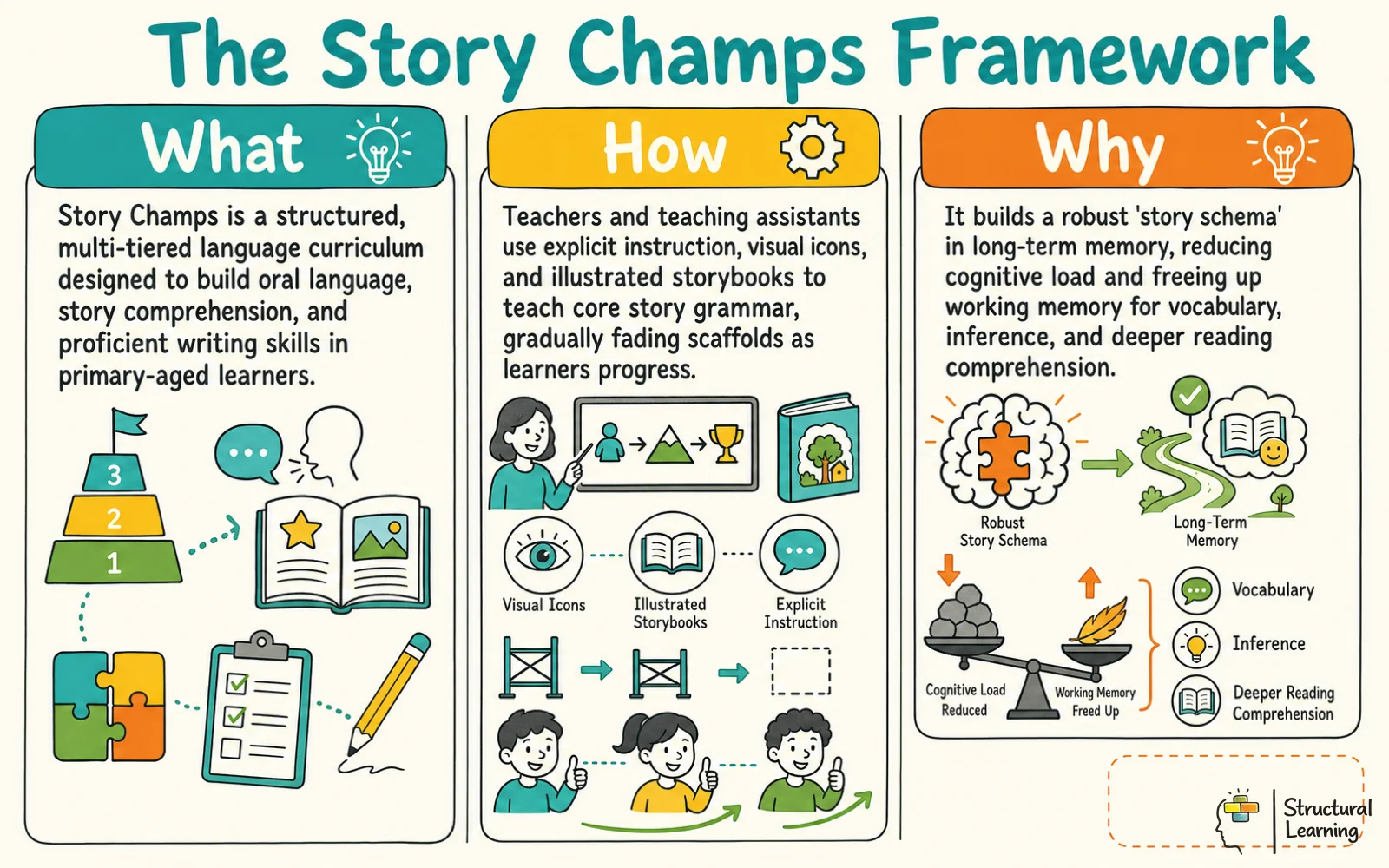
A framework infographic outlining the What, How, and Why of the Story Champs narrative intervention programme.
The Story Champs Framework

Unlike simple story grammar aids, Story Champs is a comprehensive programme with detailed lesson plans, illustrative materials, and assessment tools. The core of the intervention is built on explicitly teaching learners the structure of stories, helping them to internalise a mental model, or schema, for how narratives work. This approach is grounded in research suggesting that a strong narrative schema not only improves a learner's ability to retell stories but also supports their wider reading comprehension and writing skills (Pico et al., 2021).

Key Takeaways

  • What it is: Story Champs is a multi-tiered language intervention curriculum, not just a set of story-mapping resources. It is designed to be implemented by teachers and teaching assistants.
  • Who it is for: It is suitable for whole-class teaching in Early Years and Key Stage 1, and for targeted intervention in Key Stage 2 for learners with language difficulties or those who are learning English as an Additional Language (EAL).
  • The 'How': The programme uses explicit instruction, visual icons, and illustrated storybooks to teach story components. It progresses from simple story structures to more complex narratives including informational texts.
  • The Evidence: The core programme is supported by high-quality research, including a large-scale randomised controlled trial (Petersen et al., 2022). However, evidence is more mixed for learners with specific or complex needs, and successful outcomes depend heavily on implementation fidelity.

The Cognitive Science Behind Narrative Intervention

The ability to understand and tell stories is a cornerstone of human communication and a critical academic skill. From a cognitive perspective, narrative interventions like Story Champs work by explicitly building a learner's mental model for stories. This ‘story schema’ acts as a framework in long-term memory, allowing learners to organise incoming information efficiently.

When a learner listens to or reads a story, a well-developed narrative schema helps them to anticipate the structure: there will be a character, in a setting, who encounters a problem, attempts to solve it, and reaches a resolution. This predictability reduces cognitive load, freeing up finite working memory to focus on understanding vocabulary, making inferences, and connecting ideas. Without this schema, a story is just a sequence of disconnected events, placing a heavy burden on working memory.

Research into narrative language consistently shows a strong link between early narrative skill and later literacy outcomes. A systematic review by Pico et al. (2021) confirmed that interventions designed to improve narrative language are effective for school-age children. By making the implicit structure of stories explicit, Story Champs helps learners build a robust cognitive framework that supports both language comprehension and production.

Core Components of the Story Champs Programme

Story Champs is a physical kit containing a range of materials designed for ease of use in a busy school environment. These components are carefully designed to provide scaffolded instruction that can be gradually faded as learners become more proficient.

The main components include:

  • Master Lesson Plans: These provide teachers and TAs with scripts for explicit instruction. The plans detail what to say, what to do, and how to provide corrective feedback.
  • Story Illustrations: The programme includes a series of colourful, large-format storybooks with minimal text. The illustrations are intentionally designed to depict the key story grammar elements, providing strong visual support for learners.
  • Story Icons: A set of simple, memorable icons represents the core elements of a story (e.g., a head for 'Character', a star for 'Problem', a shoe for the 'Kick-off' event). These are used to visually map out the story structure and prompt learners during retelling.
  • Tiered Stories: The programme is organised into multiple levels of increasing complexity. Early levels focus on basic story structures (Character, Problem, Action, Resolution), while later levels introduce more complex elements like internal responses (feelings and plans) and informational (non-fiction) text structures.

These components work together to provide a systematic and explicit approach. The teacher uses the lesson plan and illustrations to model a story, explicitly highlighting the structural parts with the icons. Learners then practise retelling the story, using the same visual supports to structure their own language.

A Practical Guide to Implementing Story Champs

The programme is designed as a multi-tiered system of support, making it flexible enough for different school contexts.

Tier 1: Whole-Class Implementation

In an Early Years or Year 1 classroom, Story Champs can be used as a whole-class language programme during carpet time. The teacher can conduct a 15, 20 minute session two or three times a week.

Classroom Example: Year 1 Whole-Class Session

  • Teacher Action: The teacher displays the five illustration cards for a simple story on the interactive whiteboard. They also display the story icons for Character, Setting, Problem, Action, and Resolution. They point to the 'Character' icon and say, "This is our character, Leo the lion." They then use gestures and choral response to engage the class.
  • Teacher Says: "Listen to our story. 'Leo the lion was in the jungle. He lost his roar. He looked behind a big rock. He found his roar!' Now, let's tell the story together. Who was the character?"
  • Learner Action: The class chorally responds, "Leo the lion!" They proceed to retell each part of the story, prompted by the teacher pointing to the relevant icon and illustration.

Tier 2 & 3: Small-Group and Individual Intervention

For older learners in Key Stage 2 who struggle with language, or for learners with identified Speech, Language and Communication Needs (SLCN), Story Champs is an effective small-group intervention. These sessions are typically run by a trained teaching assistant.

The focus in Tier 2/3 is more intensive. The TA might work with a group of 3-4 learners for 30 minutes, three times a week. The goal is to provide more repetition, more targeted feedback, and more opportunities for each learner to practise. The programme includes progress monitoring tools to track individual learner progress and decide when they are ready to move to a more complex level or return to whole-class instruction.

Progressing from Retelling to Generation

A common challenge with narrative programmes is getting stuck on simple retelling. The aim of Story Champs is to move learners towards independent narrative generation. This is achieved by systematically fading the scaffolds.

  1. Retell with all scaffolds: Learners retell the story using the illustrations and icons.
  2. Retell with fewer scaffolds: The TA might hide the illustrations and ask the learner to retell the story using only the icons.
  3. Retell without scaffolds: The learner retells the story from memory.
  4. Generate a new story: The learner is given the same set of icons and asked to create their own story about a different character.

This progression moves the cognitive demand from recognition and recall to creative generation, building greater language autonomy.

Adapting Story Champs for Diverse Learners

Supporting Learners with SEND

For learners with Developmental Language Disorder (DLD) or other SLCN, the highly structured and visual nature of Story Champs can be particularly beneficial. The explicit teaching of story structure provides a clear and predictable framework that can reduce the high cognitive load associated with language processing.

However, it is not a magic bullet. Some research has shown that while narrative interventions improve story structure, they may not automatically improve grammatical complexity for children with DLD (Favot et al., 2020). SENCOs should ensure that interventionists are monitoring not just the story components, but also the quality of the sentences learners are using. Progress may also be slower, and some learners may require a much higher number of repetitions to internalise the schema.

Supporting EAL Learners

For learners who are new to English, Story Champs offers an excellent entry point into academic language. The reliance on illustrations means that learners can access the story's meaning and structure before they have the full vocabulary to express it.

Classroom Example: EAL Small Group

A TA works with a small group of EAL learners. They begin by using the illustrations to pre-teach key vocabulary from the story (e.g., 'castle', 'dragon', 'knight'). During the retelling, learners are encouraged to use single words or simple phrases for each story part, with the TA recasting their utterances into more complex sentences. This provides a low-pressure environment to practise new vocabulary and sentence structures within a meaningful context.

Connecting Story Champs to Structural Learning Principles

The cognitive science underpinning Story Champs aligns closely with the principles of making thinking visible. The programme's methods can be enhanced by integrating them with other visual pedagogies.

Using 'Map It' to Deconstruct Story Structure

The icons used in Story Champs serve the same function as a graphic organiser. After learners have heard a story, they can use a 'Map It' template to visually deconstruct its components.

For example, using a simple story map, learners can draw or write the key information for each part:
  • Character: A drawing of Leo the lion.
  • Setting: A drawing of a jungle.
  • Problem: Leo with his mouth open but no sound coming out.
  • Action: Leo looking behind a rock.
  • Resolution: Leo roaring happily.

This act of externalising the story structure reinforces the schema and provides a stable visual reference for oral or written retelling.

Using 'Build It' to Construct Complex Sentences

To move from oral retelling to written composition, learners need to be ableto construct complex sentences. Structural Learning's 'Build It' (Writer's Block) can be used to bridge this gap.

After mapping the story, the teacher can focus on a specific connection. For instance, linking the problem and the action.

Teacher Says: "Why did Leo look behind the rock? He looked behind the rock because he had lost his roar."

Story Champs Study Notes preview
◆ Structural Learning
Story Champs Study Notes
Study notesOne-page revision sheet

Download a one-page study note for Story Champs, with the key ideas, limitations and classroom links in one place.

Something went wrong - please try again.

The teacher can model how to build this sentence using physical blocks, with one block representing "He looked behind the rock," another for "he had lost his roar," and a connecting block for "because." Learners can then physically manipulate these blocks to create their own sentences, solidifying their understanding of causal and temporal conjunctions before committing them to paper.

The Evidence Base: What Does the Research Say?

When choosing an intervention, schools need to be confident that it is backed by robust evidence.

Key Supporting Evidence

Story Champs has a stronger evidence base than many other commercially available language programmes. The most significant study is a large-scale randomised controlled trial (RCT) involving over 600 kindergarten children in the US (Petersen et al., 2022). The study found that learners who received the Story Champs intervention made statistically significant gains in narrative language, expository retells, and writing compared to a control group.

This finding is supported by a wider body of research into narrative intervention. Multiple systematic reviews and meta-analyses have concluded that teaching narrative skills is an effective way to improve a range of language and literacy outcomes in school-aged children (Pico et al., 2021; Favot et al., 2020).

Limitations and Practical Cautions

Despite the positive headline findings, it is important for school leaders to be aware of the limitations.

  1. Not a Universal Fix: Some studies have found that narrative intervention is less effective for specific groups or for improving all aspects of language. One systematic review concluded that there is mixed evidence for the impact on children with DLD (Winters et al., 2022). Another found that while story grammar improved, grammatical complexity did not always follow.
  2. Implementation Fidelity is Crucial: The success of Story Champs is highly dependent on the quality of its delivery. The scripted lesson plans must be followed closely. If TAs are not adequately trained or supported, the intervention can quickly become a simple 'story time' session, losing its therapeutic power.
  3. Assessment Sensitivity: Some researchers have noted that the progress monitoring tools, while useful, may not capture small, incremental steps of progress, particularly for learners with more significant needs.
  4. US-Centric Research: The majority of the research has been conducted in the United States. While the underlying principles are universal, UK schools should be mindful of cultural and curricular differences when implementing the programme.

The evidence suggests that Story Champs is an effective tool when used as intended, for the right learners. It is not a replacement for high-quality, whole-class teaching, nor is it a guaranteed solution for every child with language difficulties.

Story Champs Implementation Checklist

For SENCOs and teachers considering or using Story Champs:

Planning & Setup

  • Have the staff delivering the intervention (teachers and/or TAs) received adequate training?
  • Have you identified the target learners using appropriate assessments?
  • Have you scheduled protected time for the intervention sessions (e.g., 3 x 30 mins per week)?
  • Do you have a quiet space with the necessary resources (kit, whiteboard, etc.)?

Delivery & Monitoring

  • Is the interventionist following the master lesson plans with fidelity?
  • Are learners being given sufficient opportunities to practise retelling?
  • Is the interventionist providing specific, corrective feedback as outlined in the plans?
  • Are you using the programme's progress monitoring tools to track learner data?

Review & Adaptation

  • Are you regularly reviewing the progress data (e.g., every 6 weeks)?
  • Are learners who are making good progress being moved to more complex levels or back to Tier 1 instruction?
  • Are learners who are not making progress receiving additional support or being considered for alternative interventions?
  • Is there a plan for fading scaffolds to promote independence?

Research Evidence Check

Evidence Synthesis

What is the evidence that narrative language intervention improves oral language, story retell and literacy outcomes?

Limited support: The Consensus search found relevant papers, but the evidence should be treated as emerging and checked carefully against the article claims.

50% Yes from 8 studiesstrong evidence
  • Yes50%
  • Possibly13%
  • Mixed25%
  • No13%
Teacher takeaway

Use the approach as a structured support, not a guarantee: identify the target skill, teach it explicitly, and monitor whether it transfers into classroom language, reading or writing.

View the evidence behind this answer8 studies
1Interventions Designed to Improve Narrative Language in School-Age Children: A Systematic Review With Meta-Analyses.Danielle L. Pico et al. (2021) · Language, Speech, and Hearing Services in Schools
meta analysisyes202128 citations

Purpose The purpose of this systematic review with meta-analyses was to examine interventions that aimed to improve narrative language outcomes for preschool and elementary school-age children in the United States. Our goal was to examine peer-reviewed publications to describe the characteristics of these interventions and synthesize their overall effectiveness on narrative comprehension and production via meta-analysis. Method We searched electronic databases, examined previously published reviews, and consulted experts in the field to identify published studies that employed robust experimental and quasi-experimental designs. We included randomized controlled trials, studies with nonrandomized comparison groups, and single-case design (SCD) studies. We completed a qualitative synthesis of study factors for all identified studies and calculated meta-analyses for the studies that had sufficient data. All included studies were analyzed for risk of bias. Results Our systematic search yielded 40 studies that included one or more narrative language outcomes as part of their assessment battery. Twenty-four of the included studies were group design studies, including randomized controlled trials and quasi-experimental designs, and the other 16 were SCD studies. Effect sizes were analyzed based on narrative production and comprehension outcomes. The meta-analyses of 26 studies indicated overall positive effects of the interventions, with effect sizes of= 0.51 and 0.54 in the group design studies and= 1.24 in the SCD studies. Conclusions A variety of effective interventions were found that improve narrative production and comprehension outcomes in children with diverse learner characteristics. Some common characteristics across these interventions include manualized curricula, opportunities to produce narrative language, verbal and visual supports, direct instruction of story grammar, and use of authentic children's literature. Supplemental Material https://doi.org/10.23641/asha.15079173.

Classroom implication: Translate the finding into explicit modelling, guided practice and progress monitoring rather than relying on one-off exposure.

2Oral language interventions can improve language outcomes in children with neurodevelopmental disorders: A systematic review and meta‐analysisEnrica Donolato et al. (2023) · Campbell Systematic Reviews
meta analysismixed202329 citations

Young people who fail to develop language as expected face significant challenges in all aspects of life. Unfortunately, language disorders are common, either as a distinct condition (e.g., Developmental Language Disorder) or as a part of another neurodevelopmental condition (e.g., autism). Finding ways to attenuate language problems through intervention has the potential to yield great benefits not only for the individual but also for society as a whole. This meta-analytic review examined the effect of oral language interventions for children with neurodevelopmental disorders. The last electronic search was conducted in April 2022. Intervention studies had to target language skills for children from 2 to 18 years of age with Developmental Language Disorder, autism, intellectual disability, Down syndrome, Fragile X syndrome, and Williams syndrome in randomised controlled trials or quasi-experimental designs. Control groups had to include business-as-usual, waiting list, passive or active conditions. However, we excluded studies in which the active control group received a different type, delivery, or dosage of another language intervention. Eligible interventions implemented explicit and structured activities (i.e., explicit instruction of vocabulary, narrative structure or grammatical rules) and/or implicit and broad activities (i.e., shared book reading, general language stimulation). The intervention studies had to assess language skills in receptive and/or expressive modalities. The search provided 8195 records after deduplication. Records were screened by title and abstract, leading to full-text examinations of 448 records. We performed Correlated and Hierarchical Effects models and ran a retrospective power analysis via simulation. Publication bias was assessed via-curve and precision-effect estimate. We examined 38 studies, with 46 group comparisons and 108 effects comparing pre-/post-tests and eight studies, with 12 group comparisons and 21 effects at follow-up. The results showed a mean effect size of = 0.27 at the post-test and = 0.18 at follow-up. However, there was evidence of publication bias and overestimation of the mean effects. Effects from the meta-analysis were significantly related to these elements: (1) receptive vocabulary and omnibus receptive measures showed smaller effect sizes relative to expressive vocabulary, grammar, expressive and receptive discourse, and omnibus expressive tests; and (2) the length of the intervention, where longer sessions conducted over a longer period of time were more beneficial than brief sessions and short-term interventions. Neither moderators concerning participants' characteristics (children's diagnosis, diagnostic status, age, sex, and non-verbal cognitive ability and severity of language impairment), nor those regarding of the treatment components and implementation of the language interventions (intervention content, setting, delivery agent, session structure of the intervention or total number of sessions) reached significance. The same occurred to indicators of study quality. The risk of bias assessment showed that reporting quality for the studies examined in the review was poor. In sum, the current evidence base is promising but inconclusive. Pre-registration and replication of more robust and adequately powered trials, which include a wider range of diagnostic conditions, together with more long-term follow-up comparisons, are needed to drive evidence-based practice and policy.

Classroom implication: Use this as a caution: check learner fit, delivery quality and progress data before treating the approach as settled practice.

3Language Interventions for School-Aged Children Who Are d/Deaf and Hard of Hearing: A Systematic Review and Meta-Analysis.Andréa Chanell Jønsberg et al. (2025) · Journal of Speech, Language, and Hearing Research
meta analysisyes20252 citations

The main aim of the systematic review and meta-analysis was to evaluate the effectiveness of language interventions for school-aged children who are d/Deaf and hard of hearing (DHH). We focused on studies targeting meaning-based aspects of language, such as vocabulary, grammar, and narrative skills. We included randomized controlled trials and quasi-experiments with a control group and a pre-post design. A secondary aim was to describe the characteristics of effective interventions identified in the systematic review. The review was preregistered in PROSPERO (ID CRD42021236085). We searched 10 academic databases for peer-reviewed journal articles reporting language interventions for children who are DHH aged 6-12 years. We assessed the quality of included studies using Critical Appraisal Skills Programme checklists. A meta-analysis was conducted on the overall effect of interventions. In addition, we calculated separate effect sizes for vocabulary and morphosyntactic knowledge. We identified 14 studies totaling 794 children. Quality assessment revealed concerns of risk of bias in most studies because study characteristics were not comprehensively reported. The meta-analyses of language interventions revealed a large main effect of= 0.79Subdomain analyses revealed similar effects for morphosyntactic knowledge= 0.81 and vocabulary= 0.71. Few high-quality studies examine the effects of language interventions for children who are DHH. However, the studies that exist reveal robust effects, especially for morphosyntactic abilities. Intervention approaches were diverse, and the largest intervention effects were found in studies with a randomized controlled design and near-transfer outcome measures closely aligned with the intervention content. Future studies should adhere to established guidelines for reporting results from controlled experimental study designs.

Classroom implication: Translate the finding into explicit modelling, guided practice and progress monitoring rather than relying on one-off exposure.

4Efficacy, model of delivery, intensity and targets of pragmatic interventions for children with developmental language disorder: A systematic reviewKristine M. Jensen de López et al. (2022) · International Journal of Language & Communication Disorders
systematic reviewyes202219 citations

It is widely acknowledged that children with developmental language disorder (DLD) predominantly have difficulties in the areas of grammar and vocabulary, with preserved pragmatic skills. Consequently, few studies focus on the pragmatic skills of children with DLD, and there is a distinct lack of studies examining the effectiveness of pragmatic interventions. To carry out a systematic review of the literature on pragmatic interventions for children with DLD. This systematic review was registered with PROSPERO (ID = CRD42017067239). A systematic search in seven databases yielded 1031 papers, of which 11 met our inclusion criteria. The included papers focused on interventions for children with DLD (mean = 3-18 years), enhancing oral language pragmatic skills, published between January 2006 and May 2020, and were based on a group-study design such as randomized control trial or pre-post-testing. Study participants were monolingual speakers. The quality of papers was appraised using the Cochrane Risk of bias tool for randomized controlled trials. There was a high degree of variability between the included intervention studies, especially regarding intensity, intervention targets and outcomes. The evidence suggested that pragmatic intervention is feasible for all models of delivery (individual, small and large group) and that interventions for pragmatic language are mostly focused on encouragement of conversation and narrative skills observed through parent-child interaction or shared book-reading activities. This study highlights the importance of promoting and explicitly teaching pragmatic skills to children with DLD in structured interventions. A narrative synthesis of the included studies revealed that in addition to direct intervention, indirect intervention can also contribute to improving oral pragmatic skills of children with DLD. What is already known on the subject? An increasing number of studies have shown that difficulties in acquiring pragmatic language is not only present in children with autism. What this study adds to existing knowledge? Interventions for pragmatic language in children with DLD are mostly focused on encouragement of conversation and narrative skills, very often through parent-child interaction or shared book-reading activities. Interventions that target language pragmatic are feasible for all models of delivery (individual, small and large group). What are the potential or actual clinical implications of this work? The efficacy of the existing studies varies, and it is difficult to give recommendations regarding the intensity and duration of the specific intervention. In addition to offering pragmatic intervention directly from a specialist, pragmatic interventions can also be carried out indirectly if the intervention is under the continuous supervision of a specialist.

Classroom implication: Translate the finding into explicit modelling, guided practice and progress monitoring rather than relying on one-off exposure.

5Investigating Narrative Performance in Children With Developmental Language Disorder: A Systematic Review and Meta-Analysis.K. Winters et al. (2022) · Journal of Speech, Language, and Hearing Research
meta analysismixed202216 citations

Narrative assessment is one potentially underutilized and inconsistent method speech-language pathologists may use when considering a diagnosis of developmental language disorder (DLD). However, narration research encompasses many varied methodologies. This systematic review and meta-analysis aimed to (a) investigate how various narrative assessment types (e.g., macrostructure, microstructure, and internal state language) differentiate children with typical development (TD) from children with DLD, (b) identify specific narrative assessment measures that result in greater group differences, and (c) evaluate participant and sample characteristics that may influence performance differences. Electronic databases (PsycINFO, ERIC, and PubMed) and ASHAWire were searched on July 30, 2019, to locate studies that reported oral narrative language measures for both DLD and TD groups between ages 4 and 12 years; studies focusing on written narration or other developmental disorders only were excluded. We extracted data related to sample participants, narrative task(s) and assessment measures, and research design. Group differences were quantified using standardized mean differences. Analyses used mixed-effects meta-regression with robust variance estimation to account for effect size dependencies. Searches identified 37 eligible studies published between 1987 and 2019, including 382 effect sizes. Overall meta-analysis showed that children with DLD had decreased narrative performance relative to TD peers, with an overall average effect of -0.82, 95% confidence interval [-0.99, -0.66]. Effect sizes showed significant heterogeneity both between and within studies, even after accounting for effect size-, sample-, and study-level predictors. Across model specifications, grammatical accuracy (microstructure) and story grammar (macrostructure) yielded the most consistent evidence of TD-DLD group differences. Present findings suggest some narrative assessment measures yield significantly different performance between children with and without DLD. However, researchers need to improve consistency of inclusionary criteria, descriptions of sample characteristics, and reporting of correlations between measures to determine which assessment measures reliably distinguish between groups. https://doi.org/10.23641/asha.21200380.

Classroom implication: Use this as a caution: check learner fit, delivery quality and progress data before treating the approach as settled practice.

6Efficacy of the Treatment of Developmental Language Disorder: A Systematic ReviewS. Rinaldi et al. (2021) · Brain Sciences
systematic reviewno202183 citations

Language disorder is the most frequent developmental disorder in childhood and it has a significant negative impact on children's development. The goal of the present review was to systematically analyze the effectiveness of interventions in children with developmental language disorder (DLD) from an evidence-based perspective. We considered systematic reviews, meta-analyses of randomized controlled trials (RCTs), control group cohort studies on any type of intervention aimed at improving children's skills in the phono-articulatory, phonological, semantic-lexical, and morpho-syntactic fields in preschool and primary school children (up to eight years of age) that were diagnosed with DLD. We identified 27 full-length studies, 26 RCT and one review. Early intensive intervention in three- and four-year-old children has a positive effect on phonological expressive and receptive skills and acquisitions are maintained in the medium term. Less evidence is available on the treatment of expressive vocabulary (and no evidence on receptive vocabulary). Intervention on morphological and syntactic skills has effective results on expressive (but not receptive) skills; however, a number of inconsistent results have also been reported. Only one study reports a positive effect of treatment on inferential narrative skills. Limited evidence is also available on the treatment of meta-phonological skills. More studies investigated the effectiveness of interventions on general language skills, which now appears as a promising area of investigation, even though results are not all consistent. The effectiveness of interventions over expressive and receptive phonological skills, morpho-syntactic skills, as well as inferential skills in narrative context underscores the importance that these trainings be implemented in children with DLD.

Classroom implication: Use this as a caution: check learner fit, delivery quality and progress data before treating the approach as settled practice.

7A Systematic Review of Narrative-Based Language Intervention With Children Who Have Language ImpairmentDouglas B. Petersen (2011) · Communication Disorders Quarterly
systematic reviewpossibly2011152 citations

This systematic review focuses on research articles published since 1980 that assess outcomes of narrative-based language intervention for preschool and school-age children with language impairment. The author conducted a comprehensive search of electronic databases and hand searches of other sources for studies using all research designs except nonexperimental case studies. The results of the studies were converted to a common metric using effect sizes. The review yielded nine studies that met inclusion criteria. The majority of studies reported moderate to large effect sizes for narrative macrostructure and microstructure. Although the results of the studies were generally positive, each of the studies had a limited number of participants, limited experimental control, and considerable variation in the procedures and materials used. Clinicians should be cautious when interpreting the results of these studies. Narrative intervention is at an emerging stage of evidence and needs further investigation.

Classroom implication: Translate the finding into explicit modelling, guided practice and progress monitoring rather than relying on one-off exposure.

8The Effects of Oral Narrative Intervention on the Narratives of Children with Language Disorder: a Systematic Literature ReviewKate Favot et al. (2020) · Journal of Developmental and Physical Disabilities
systematic reviewyes202039 citations

This systematic review provides an examination of the quality, efficacy, and common features of oral narrative interventions on the narratives of children with language disorder. Searches of electronic data bases, ancestral searches and database alerts identified studies that addressed oral narrative intervention in children with language disorder. Structured inclusion procedures were used to select and examine the quality, efficacy and common features of the included studies. Twenty-four research articles published between 1993 and 2018 were included for review. Apart from measures of social validity, the single case research studies were generally of good quality and results can be interpreted with confidence. The group studies were generally of low quality and only four included comparison groups. Single case effects sizes for macrostructure were moderate with lower effect sizes for microstructure. The results for group studies were variable. Successful interventions included the use of icons, visuals, clinician modelling and the participants being provided with an opportunity to state an entire narrative each intervention session. Oral narrative intervention to develop the narratives of children with language disorder may be effective. Areas for future research were identified and include more robust research designs, intervention being delivered to participants in groups, conducting intervention with participants with more significant disabilities, more research conducted with personal narrative, and including more generalization measures.

Classroom implication: Translate the finding into explicit modelling, guided practice and progress monitoring rather than relying on one-off exposure.

Frequently Asked Questions (FAQs)

1. Is Story Champs just another story grammar tool? No. While it teaches story grammar, it is a complete, multi-tiered curriculum with structured lesson plans, tiered levels of complexity, and embedded assessment tools designed to improve a wide range of academic language skills.

2. How does it differ from other narrative programmes? Its main differentiators are its strong evidence base, particularly the large-scale RCT, and its explicit design as a multi-tiered system of support, making it suitable for Tiers 1, 2, and 3.

3. Can it be used with older learners in KS3? The core programme is designed for primary-aged learners. While the principles of teaching narrative structure are applicable to all ages, the illustrations and story content may not be age-appropriate for secondary learners without significant adaptation.

4. How long does it take to see results? The Petersen et al. (2022) study demonstrated significant effects after 14 weeks of instruction. However, the rate of progress will vary depending on the learner's starting point and the intensity of the intervention.


Your Next Step

To begin applying the principles of narrative intervention in your classroom, select a simple, familiar story that you have recently shared with your learners. Next lesson, before asking them to write about it, work with them to create a visual map of the story's key components: Who was the main character? Where were they? What problem did they face? What did they do? And how did it end? This simple act of making the story's structure visible provides a powerful scaffold for both oral and written retelling.

Research sources

Further reading from peer-reviewed research

These 5 studies give source context for the classroom guidance in this article on Mastering Story Champs: Enhancing Language and Reading Comprehension in Primary Settings. They are included as starting points for deeper reading, not as a substitute for local professional judgement.

Systematic Review 83 citations mdpi.com

Efficacy of the Treatment of Developmental Language Disorder: A Systematic Review

S. Rinaldi et al. (2021) | Brain Sciences

Use this as a caution: check learner fit, delivery quality and progress data before treating the approach as settled practice.

View study

Systematic Review 39 citations idp.springer.com

The Effects of Oral Narrative Intervention on the Narratives of Children with Language Disorder: a Systematic Literature Review

Kate Favot et al. (2020) | Journal of Developmental and Physical Disabilities

Translate the finding into explicit modelling, guided practice and progress monitoring rather than relying on one-off exposure.

View study

Meta Analysis 29 citations journals.sagepub.com

Oral language interventions can improve language outcomes in children with neurodevelopmental disorders: A systematic review and meta‐analysis

Enrica Donolato et al. (2023) | Campbell Systematic Reviews

Use this as a caution: check learner fit, delivery quality and progress data before treating the approach as settled practice.

View study

Meta Analysis 28 citations pubs.asha.org

Interventions Designed to Improve Narrative Language in School-Age Children: A Systematic Review With Meta-Analyses.

Danielle L. Pico et al. (2021) | Language, Speech, and Hearing Services in Schools

Translate the finding into explicit modelling, guided practice and progress monitoring rather than relying on one-off exposure.

View study

Systematic Review 19 citations onlinelibrary.wiley.com

Efficacy, model of delivery, intensity and targets of pragmatic interventions for children with developmental language disorder: A systematic review

Kristine M. Jensen de López et al. (2022) | International Journal of Language & Communication Disorders

Translate the finding into explicit modelling, guided practice and progress monitoring rather than relying on one-off exposure.

View study

Paul Main, Founder of Structural Learning
About the Author
Paul Main
Founder & Metacognition Researcher

Paul Main is an educator and metacognition researcher who founded Structural Learning in 2002. With a psychology degree from the University of Sunderland and 22+ years helping schools embed thinking skills, he bridges the gap between educational research and classroom practice. Fellow of the RSA and Chartered College of Teaching, with 128+ Google Scholar citations.

More →

SEND

Back to Blog