The Educator's Guide to Targeted Reading Comprehension Interventions
|
June 13, 2026
A diagnostic guide for UK teachers on implementing reading comprehension interventions like inference training for learners who can decode words but struggle to understand the meaning of a text.
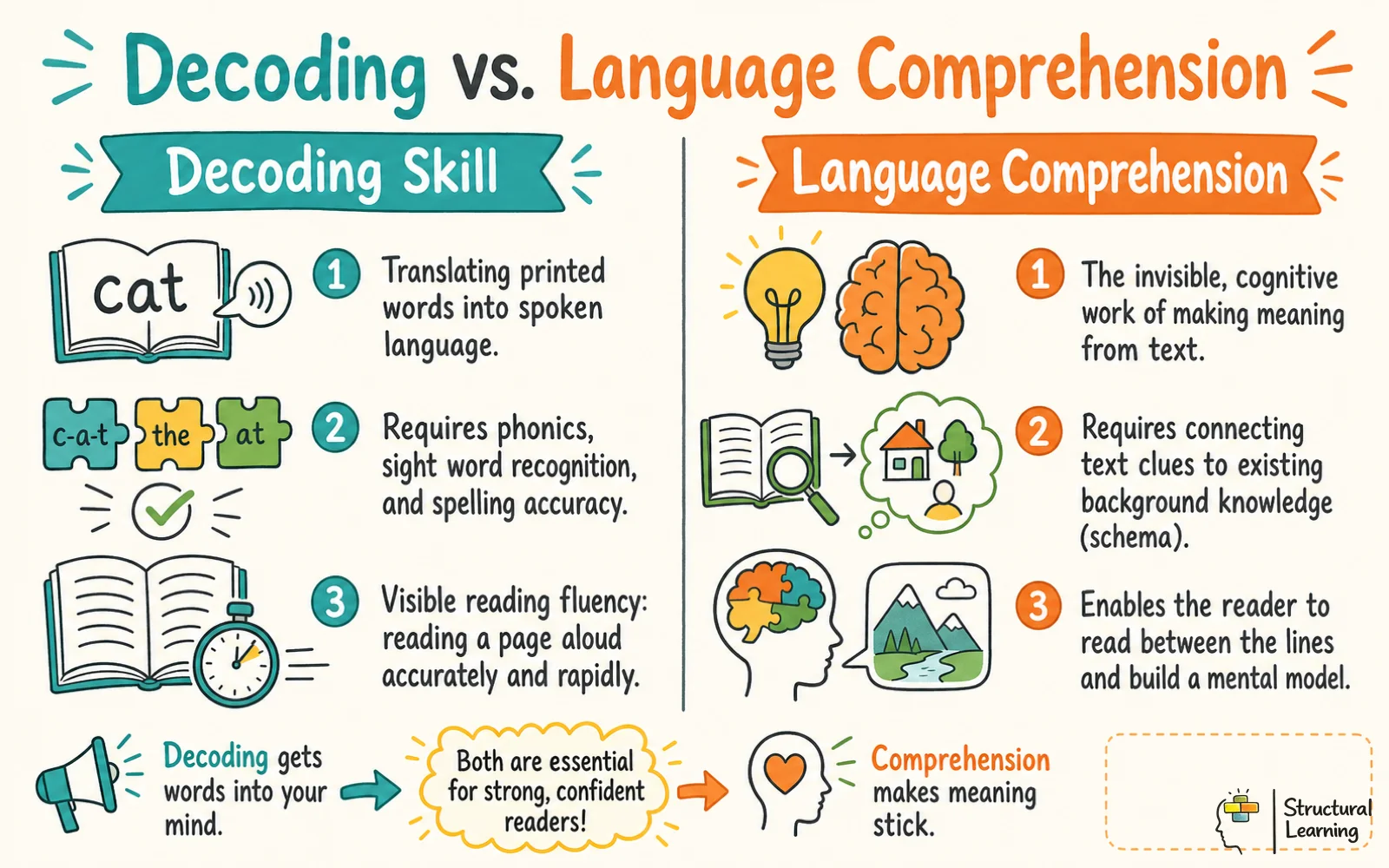
Reading comprehension is a product of both decoding skill and language comprehension. Many learners can read fluently but miss the meaning.
Making an inference is not a generic skill; it depends heavily on the reader's background knowledge related to the text.
Effective intervention involves explicit instruction, not just repeated practice. Teachers should model their thinking process using "think-alouds".
Inference training is a targeted intervention for small groups, not a whole-class teaching method. It is most effective for learners in KS2 and KS3 with secure decoding skills.
Evidence suggests combining strategy instruction with knowledge-building is more effective than teaching comprehension strategies in isolation (Peng et al., 2023).
The Reading Comprehension Puzzle: When Decoding Isn't Enough
Many teachers are familiar with a particular type of reader. This learner can read a page of text aloud with perfect fluency and accuracy, yet when asked what it was about, they can offer only a blank look or a vague summary. They have mastered decoding, the ability to translate printed words into speech, but they struggle with comprehension, the ultimate purpose of reading.
Decoding vs. Language Comprehension
This gap between fluent reading and poor understanding is a common and complex challenge in classrooms from Key Stage 2 upwards. It highlights a crucial principle defined by the Simple View of Reading: comprehension is the product of decoding and language comprehension. If either part is weak, understanding will fail.
For learners whose decoding is secure, the difficulty almost always lies in the invisible, cognitive work of making meaning. They struggle to connect ideas, read between the lines, and build a coherent mental model of the text. Inference training is one of the most effective and well-evidenced ways to address this specific difficulty.
What is Inference Training? A Precise Definition
Inference training is a structured, evidence-based reading intervention designed to explicitly teach learners how to make inferences. An inference is a conclusion reached on the basis of evidence and reasoning; in reading, it’s the process of figuring out what the author means but hasn't stated directly.
This is not a whole-class strategy. It is a targeted intervention for a specific group of learners:
Who it is for: Small groups of learners (typically 3-4) in KS2 or KS3 who have good decoding skills but poor reading comprehension.
Who it is not for: Learners who are still developing decoding fluency. Their primary need is phonics and word recognition support, not high-level comprehension strategies.
The core of the intervention is making the implicit act of inferring explicit. A useful analogy for learners is the iceberg. The words on the page are the tip of the iceberg, the visible part. The inferred meaning, the author's intent, and the connections to our own knowledge lie beneath the surface. The job of the reader is to look at the clues in the text and dive down to uncover that hidden meaning.
The Cognitive Science Behind Making Inferences
A common misconception is that comprehension strategies can be taught as generic, transferable skills that work on any text. The evidence suggests this is not the case. While strategy instruction is vital, its benefits depend heavily on the reader's existing knowledge.
Cognitive science shows that making an inference is not a single skill. It's an interaction between the clues in the text and the reader’s background knowledge, or schema, stored in their long-term memory. Without the relevant schema, a reader has nothing to connect the clues to. For instance, to infer a character is anxious, a learner needs to recognise clues like a "racing heart" and "sweaty palms" and connect them to their existing knowledge about the physical symptoms of anxiety.
This explains why the benefits of strategy instruction can plateau quickly (Willingham, 2006). A few hours of explicit teaching can show a learner how to make an inference, but drilling the strategy for weeks on end with disconnected texts yields diminishing returns. The most effective approach, supported by recent meta-analyses, combines strategy instruction with the systematic building of background knowledge (Peng et al., 2023). Inference ability is central to processing discourse and is a cornerstone of all major models of reading comprehension (Elleman, 2017).
A Step-by-Step Guide to Implementing Inference Training
A typical inference training cycle runs for 8-10 weeks, with two or three short, focused sessions per week.
1. Identify the Right Learners
Use a combination of standardised test data (if available) and classroom observation. Look for learners who have accurate and fluent decoding but score poorly on comprehension assessments. A simple diagnostic is to have them read a short, age-appropriate paragraph and ask them a mix of literal ("who," "what," "where") and inferential ("why," "how do you know," "what is the character feeling?") questions.
2. Select Appropriate Texts
Choose short, high-interest texts. The goal is to focus on comprehension, not stamina. Prepare the text by identifying key points where an important inference is required. Mark these with a sticky note as stopping points for discussion. Novels like Wonder by R.J. Palacio are often used because they are rich with opportunities for social and emotional inference.
◆ Structural Learning
Inference Training Study Notes
Study notesOne-page revision sheet
Download a one-page study note for Inference Training, with the key ideas, limitations and classroom links in one place.
3. Model with Think-Alouds
The most powerful tool in the intervention is the teacher 'think-aloud'. The teacher reads a portion of the text and verbalises their own internal thought process, making the invisible act of inferring visible and audible. This modelling should be explicit and deliberate.
4. Explicitly Teach Inference Types
Show learners the different kinds of thinking they are doing. This might include:
Pronoun Referents: Figuring out who 'he', 'she', or 'they' refers to.
Causal Inferences: Understanding the cause of an event (e.g., "The character slammed the door because they were angry").
Predictive Inferences: Guessing what might happen next based on clues.
Character Feelings: Deducing a character's emotional state from their actions, thoughts, or dialogue.
5. Use Graphic Organisers for Guided Practice
During the guided practice portion of the session, use a simple graphic organiser to structure learners' thinking. This externalises the cognitive process and provides a scaffold for their thoughts.
6. Move to Independent Practice
Gradually release responsibility. In later sessions, have learners identify their own stopping points in the text and fill out the graphic organiser with a partner before sharing with the group.
7. Measure Impact
Avoid relying solely on reading age scores. The best measure of success is improved verbal reasoning and articulation during the sessions. Can learners now explain how they know something? Can they justify their inference by pointing to a specific clue in the text and connecting it to their own knowledge? This qualitative data is far more valuable than a standardised score.
Classroom in Action: A KS3 English Example
Mrs. Adler is working with four Year 7 learners who are all competent decoders but struggle to follow plots and understand character motivations. They are reading Wonder.
Teacher: (Reads aloud) "'Via was furious with Auggie, but she knew he couldn't help it.' Right, let's pause here. The author uses the pronoun 'she'. If we don't figure out who 'she' is, the rest of the chapter won't make sense. I think 'she' must be Via. Let me test that by putting the name back in: 'Via was furious with Auggie, but Via knew he couldn't help it.' Yes, that makes sense. I've used the clues to make an inference."
Later in the chapter, she stops at another point.
Teacher: (Reads aloud) "'Auggie's mother sighed and held his hand tightly.' Okay, let's use our organiser. In the first column, 'Text Clue,' what should we write?"
Learner 1: "She sighed and held his hand tightly."
Teacher: "Perfect. Now, the next column: 'My Background Knowledge.' What do we know from our own lives about why a parent might sigh and hold their child's hand?"
Learner 2: "Maybe because they're sad? Or worried?"
Teacher: "Good thinking. So, for our final column, 'My Inference,' what can we infer about Auggie's mother?"
Learner 1: "She's feeling worried about him."
Teacher: "Excellent. And how do you know? You've connected the text clue, the sigh, with your own knowledge about what a sigh can mean. That's it. That's making an inference."
Connecting Inference Training to Structural Learning's 'Map It'
The graphic organisers used in inference training are a perfect application of Structural Learning's 'Map It' tool. The goal of 'Map It' is to make thinking visible by externalising the connections between ideas. An inference map helps learners structure their reasoning and provides a repeatable process.
A simple and effective inference map could have three columns:
Text Clue (What the author says)
My Background Knowledge (What I already know)
My Inference (What I can figure out)
"The boy ran from the room, slamming the door behind him."
People often slam doors when they are angry or upset.
The boy is feeling angry.
"Her eyes were glued to the television screen."
'Glued' means stuck fast. When you are very interested in something, you can't look away.
She is completely focused on the television programme.
By using this structure, learners are explicitly guided to combine information from the text with their own schema to generate a logical inference. The process becomes systematic, not guesswork.
Evidence and Limitations: What Does the Research Say?
Inference training is one of the most well-researched reading comprehension interventions. A major meta-analysis found that inference instruction has a reliable and positive impact on both literal and inferential comprehension for a wide range of readers (Elleman, 2017). Intervention research from the UK has also shown that programmes with a strong focus on inference can double the normal rate of reading progress for struggling comprehenders (Lavan & Talcott, 2020).
However, it's important to be aware of the limitations:
Knowledge is Key: As noted, strategy instruction is most effective when combined with building background knowledge. The intervention should not be a substitute for a rich, knowledge-heavy curriculum (Peng et al., 2023).
Dosage and Time: The benefits of learning the strategy of how to infer can be seen relatively quickly. Extended drilling of the strategy itself is less productive than applying it in varied, knowledge-rich contexts (Willingham, 2006).
Implementation Fidelity: The success of the intervention depends on how well it is delivered. It requires teacher training and a commitment to the explicit, structured format.
SENCO & Teacher Checklist for Inference Intervention
Before starting an inference training group, consider the following:
Screening and Selection:
Does the learner have secure, age-appropriate decoding skills?
Is there a clear gap between their decoding ability and their comprehension ability?
Have you ruled out other primary barriers (e.g., significant vocabulary deficits, uncorrected vision issues)?
Implementation:
Is the group small (ideally 3-5 learners)?
Are the sessions short (20-30 minutes) and regular (2-3 times per week)?
Have you selected a high-interest text suitable for the group?
Are you prepared to explicitly model your thinking using think-alouds?
Do you have a simple graphic organiser ready to scaffold learner thinking?
What is the evidence that explicit inference instruction improves reading comprehension?
Promising support: The Consensus search is broadly supportive for the underlying approach, with classroom impact still dependent on delivery, dosage and learner fit.
75% Yes from 8 studiesstrong evidence
62
Yes75%
Possibly25%
Mixed0%
No0%
Teacher takeaway
Use the approach as an explicit routine: model the target skill, give guided practice, build in repetition, and check whether pupils can use it beyond the intervention session.
Inference ability is considered central to discourse processing and has been shown to be important across models of reading comprehension. To evaluate the impact of inference instruction, a meta-analysis of 25 inference studies in Grades K–12 was conducted. Results showed that inference instruction was effective for increasing students’ general comprehension, d = 0.58, inferential comprehension, d = 0.68, and literal comprehension, d = 0.28. Although skilled and less skilled readers responded similarly on general and inference outcomes, less skilled readers benefited more on literal outcomes, d = 0.97, than skilled readers, d = 0.06. Findings suggest that students can increase their inference ability and that less skilled readers gain the extra benefit of increases in literal comprehension. Findings also suggest that instruction provided in small groups is beneficial for increasing readers’ inferential understanding of text.
Classroom implication: Translate the finding into explicit modelling, guided practice and progress monitoring rather than relying on one-off exposure.
This systematic review examines the effects of summarizing and main idea interventions on the reading comprehension outcomes of struggling readers in Grades 3 through 12. A comprehensive search identified 30 studies published in peer-reviewed journals between 1978 and 2016. Studies included struggling reader participants in Grades 3 through 12; targeted summarizing or main idea instruction; used an experimental, quasi-experimental, or single-case design; and included a reading comprehension outcome. A meta-analysis of 23 group design studies resulted in a statistically significant mean effect of 0.97. Group size, number of sessions, grade level, and publication year did not moderate treatment effect. Visual analysis of six single-case designs yielded strong evidence for retell measures and a range of evidence for short-answer comprehension measures. Findings suggest that main idea and summarizing instruction may improve struggling readers’ main idea identification and reading comprehension. Limitations include the lack of standardized measures and the unreported, changing description of the counterfactual.
Classroom implication: Translate the finding into explicit modelling, guided practice and progress monitoring rather than relying on one-off exposure.
A systematic review of interventions to improve reading comprehension was conducted in Spanishspeaking students. Studies included had to have an experimental or quasi experimental design, the equivalence of groups in reading comprehension before intervention had to be controlled, and the participants had to be school-age. Thirty nine studies met the above criteria and were considered. A meta-analysis of random effects was carried out obtaining a combined effect-size estimate of 0.71. The interventions that proved to be more effective were those based on comprehension strategies like locating the main ideas or making inferences, and those interventions combining teaching of strategies with other methods such as motivation or improvement of decoding. Only two studies reported about whether results remained over time after intervention, so maintenance of results is an aspect that should be included in future research.
Classroom implication: Translate the finding into explicit modelling, guided practice and progress monitoring rather than relying on one-off exposure.
This study sought to conduct an interpretive systematic review (ISR) of the authors’ research on EFL reading instruction published between 2001 and 2025. The ISR consists of twenty-seven studies categorized into 6 clusters: EFL reading material used, specialized reading texts and skills, reading combined with other skills, extensive reading, technology enhanced EFL reading instruction, and EFL reading assessment and material coverage. Across the corpus, the ISR shows that effective EFL reading instruction is multidimensional, authentic, strategically scaffolded, and enriched by technology and culturally responsive materials. The studies consistently demonstrate that learners progress most when instruction moves beyond the textbook and immerses them in real world genres, multimodal resources, and collaborative environments that mirror contemporary literacy practices. Authenticity was a recurring strength: exposure to genres such as inspirational quotes, linguistic landscapes, multicultural stories, mobile fiction apps, art texts, news headlines, advertisements, and legal documents expanded learners’ cultural awareness, strengthened inferential and critical reading skills, and prepared them to process specialized texts prior to translation tasks. Findings across clusters highlight several converging principles. Authentic materials enhance comprehension, technology increases engagement, explicit strategy instruction deepens processing, and extensive reading fosters autonomy and fluency. At the same time, the studies reveal persistent challenges, particularly with text structure, cohesive ties, genre specific features, and vocabulary inference, indicating the need for sustained, systematic instructional support. Structural issues also emerged, including limited textbook coverage and misalignment between curriculum and assessment, underscoring the importance of coherent program design and stronger teacher preparation. Technology enhanced studies showed that mobile e books, mind mapping software, online courses, synchronous web conferencing, reading apps, and online videos significantly improved comprehension, vocabulary, and engagement, especially for struggling readers. Assessment focused studies emphasized the need to align tests with instructional goals and learners’ linguistic and cognitive needs. The meta conclusion of this ISR is that EFL reading development is maximized when instruction is integrative, student centered, and responsive to learners’ linguistic, cognitive, and cultural needs, and when assessment and material coverage are aligned with these broader pedagogical aims. Overall, the ISR points toward a holistic, authentic, technology supported, and strategically scaffolded model of EFL reading instruction capable of meeting the complex demands of contemporary learners.
Classroom implication: Translate the finding into explicit modelling, guided practice and progress monitoring rather than relying on one-off exposure.
Based on 52 studies with samples mostly from English-speaking countries, the current study used Bayesian network meta-analysis to investigate the intervention effectiveness of different reading comprehension strategy combinations on reading comprehension among students with reading difficulties in 3rd through 12th grade. We focused on commonly researched strategies: main idea, inference, text structure, retell, prediction, self-monitoring, and graphic organizers. Results showed (1) instruction of more strategies did not necessarily have stronger effects on reading comprehension; (2) there was no single reading comprehension strategy that produced the strongest effect; (3) main idea, text structure, and retell, taught together as the primary strategies, seemed the most effective; and (4) the effects of strategies only held when background knowledge instruction was included. These findings suggest strategy instruction among students with reading difficulties follows an ingredient-interaction model—that is, no single strategy works the best. It is not “the more we teach, the better outcomes to expect.” Instead, different strategy combinations may produce different effects on reading comprehension. Main idea, text structure, and retell together may best optimize the cognitive load during reading comprehension. Background knowledge instruction should be combined with strategy instruction to facilitate knowledge retrieval as to reduce the cognitive load of using strategies.
Classroom implication: Translate the finding into explicit modelling, guided practice and progress monitoring rather than relying on one-off exposure.
English language learners make up the largest portion of English speakers all over the world. Moreover, the population of English language learners is growing fast these days. Therefore, teachers need to learn more effective teaching strategies to handle this rapid change. When studying English, reading comprehension has always been one of the most important skills that students should acquire. This review is a systematic review divided into two parts. The first part focuses on two of What Works Clearinghouses reviews; valuable reading comprehension instruction strategies were sifted out. The second part of the review selects four strategies published recently from 2019-2021. These strategies were chosen to support reading comprehension instruction by improving students vocabulary inference ability, knowledge connection ability, content prediction ability, and motivation.
Classroom implication: Translate the finding into explicit modelling, guided practice and progress monitoring rather than relying on one-off exposure.
Higher education aims for university students to produce knowledge from the critical reflection of scientific texts. Therefore, it is necessary to develop a deep mental representation of written information. The objective of this research was to determine through a systematic review and meta-analysis the proportion of university students who have an optimal performance at each level of reading comprehension. Systematic review of empirical studies has been limited from 2010 to March 2021 using the Web of Science, Scopus, Medline, and PsycINFO databases. Two reviewers performed data extraction independently. A random-effects model of proportions was used for the meta-analysis and heterogeneity was assessed with. To analyze the influence of moderating variables, meta-regression was used and two ways were used to study publication bias. Seven articles were identified with a total sample of the seven of 1,044. The proportion of students at the literal level was 56% (95% CI = 39-72%,= 96.3%), inferential level 33% (95% CI = 19-46%,= 95.2%), critical level 22% (95% CI = 9-35%,= 99.04%), and organizational level 22% (95% CI = 6-37%,= 99.67%). Comparing reading comprehension levels, there is a significant higher proportion of university students who have an optimal level of literal compared to the rest of the reading comprehension levels. The results have to be interpreted with caution but are a guide for future research.
Classroom implication: Translate the finding into explicit modelling, guided practice and progress monitoring rather than relying on one-off exposure.
Inferential comprehension is necessary to connect ideas in a text together in a meaningful manner. There have been multiple studies on inferential comprehension involving texts of different genres (narrative and expository), but not a coherent overview of the findings of inferential comprehension by genre. The purpose of this study is to provide a coherent overview by conducting a meta-analysis of the findings of inferential comprehension by genre. A systematic review of the literature yielded 18 reports with 19 independent studies involving 1714 participants in which inferential comprehension was compared by genre. Based on robust variance estimation, scores on measures of inferential comprehension were higher for narrative texts than expository texts (g = .36, p = .02). This effect did not vary depending on whether inferential comprehension was assessed during or after reading, whether the texts for each genre were matched for readability, whether the reader was an adult or child, and whether the inference connected different ideas in the text (text connecting) or the text to background knowledge (knowledge based). Potential explanations of genre differences in inferential comprehension and future directions for research are discussed.
Classroom implication: Translate the finding into explicit modelling, guided practice and progress monitoring rather than relying on one-off exposure.
1. How long does it take to see an impact?
You should see learners begin to use the language of inference and apply the strategies during sessions within a few weeks. A full 8-10 week cycle is typically needed to see a more stable improvement.
2. Can this be used with a whole class?
The core components, like teacher think-alouds and using graphic organisers, are excellent universal teaching strategies. However, inference training as a targeted intervention is most effective in small groups where interaction and feedback can be tailored to individual needs.
3. What's the difference between this and guided reading?
While there are overlaps, inference training is more specific and systematic. It has a singular focus on teaching the cognitive strategies of inference, whereas a guided reading session might cover a broader range of reading skills.
4. Is this suitable for EAL learners?
Yes, with adaptations. For English Language Learners, inference difficulties can be compounded by vocabulary gaps or unfamiliar cultural contexts. The explicit, structured nature of inference training can be very supportive. Pre-teaching key vocabulary and carefully selecting texts with familiar contexts is crucial (Chen, 2023).
Your Next Step in the Classroom
You do not need a formal programme to begin applying the principles of this intervention. Next lesson, take a single paragraph from a text your class is reading. Before they read it, tell them you are going to show them how you "read between the lines." Model a single think-aloud, explaining one inference you made, what clue you used, and what background knowledge you connected it to. Make one piece of your invisible thinking visible.
Research sources
Further reading from peer-reviewed research
These 5 studies give source context for the classroom guidance in this article on The Educator's Guide to Targeted Reading Comprehension Interventions. They are included as starting points for deeper reading, not as a substitute for local professional judgement.
Meta Analysis65 citationsfrontiersin.org
Levels of Reading Comprehension in Higher Education: Systematic Review and Meta-Analysis
C. de-la-Peña et al. (2021) | Frontiers in Psychology
Translate the finding into explicit modelling, guided practice and progress monitoring rather than relying on one-off exposure.
Paul Main is an educator and metacognition researcher who founded Structural Learning in 2002. With a psychology degree from the University of Sunderland and 22+ years helping schools embed thinking skills, he bridges the gap between educational research and classroom practice. Fellow of the RSA and Chartered College of Teaching, with 128+ Google Scholar citations.