Updated on
February 17, 2026
Speech Link: A SENCO's Guide to Early Language Assessment in Schools
|
February 17, 2026


Updated on
February 17, 2026
|
February 17, 2026
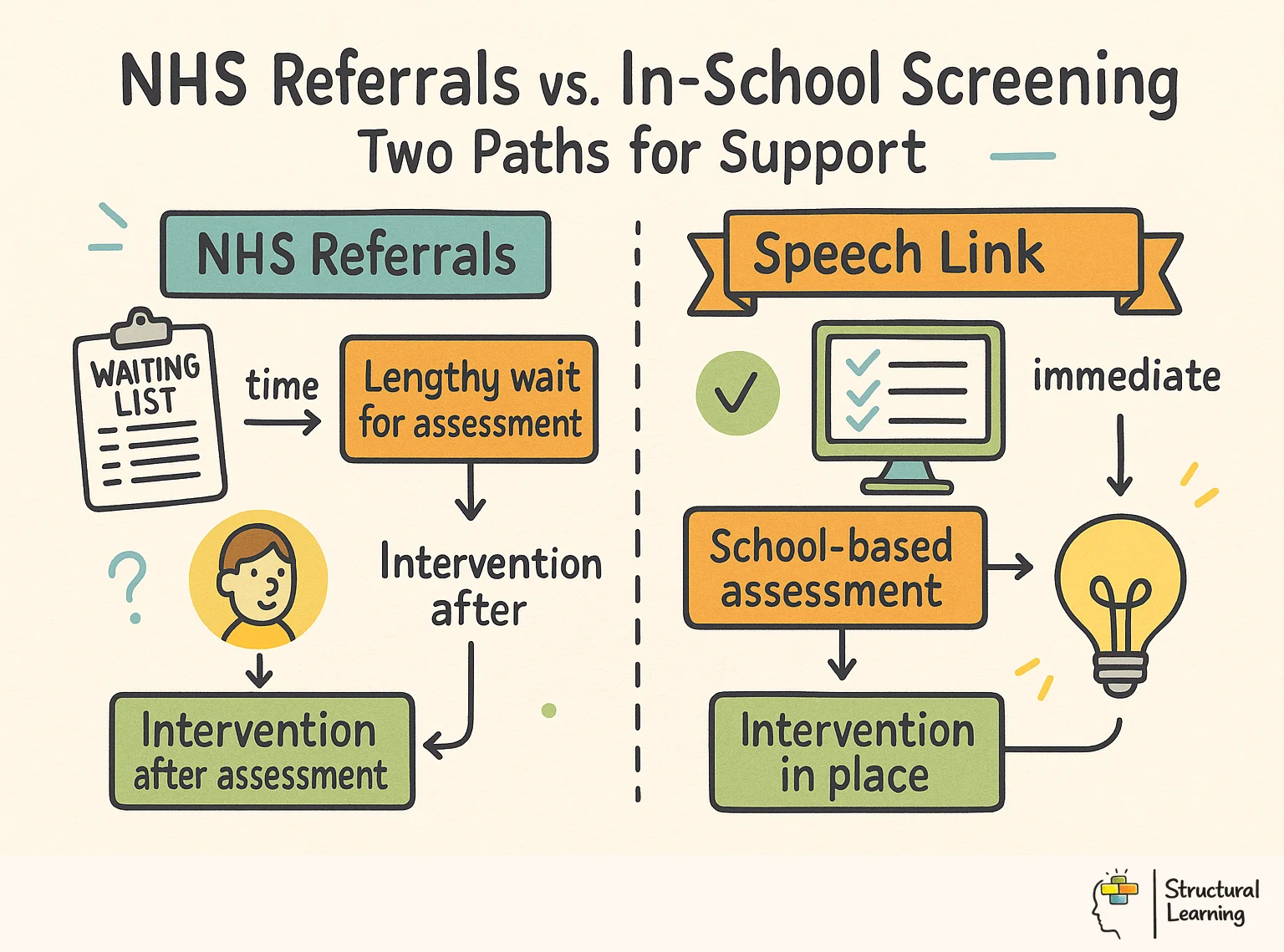
Early identification of speech and language needs remains a primary challenge for UK schools. Waiting lists for NHS Speech and Language Therapy (SLT) often exceed a year in many local authorities. SENCOs need reliable, school-based tools to bridge this gap. This guide examines how Speech Link helps schools identify and support pupils with speech sound difficulties before they fall behind.

* Speech Link identifies specific speech sound delays and disorders in pupils aged 4 to 8.
* The tool provides automated intervention plans that teaching assistants can deliver in school.
* It distinguishes between developmental errors and those requiring an immediate NHS referral.
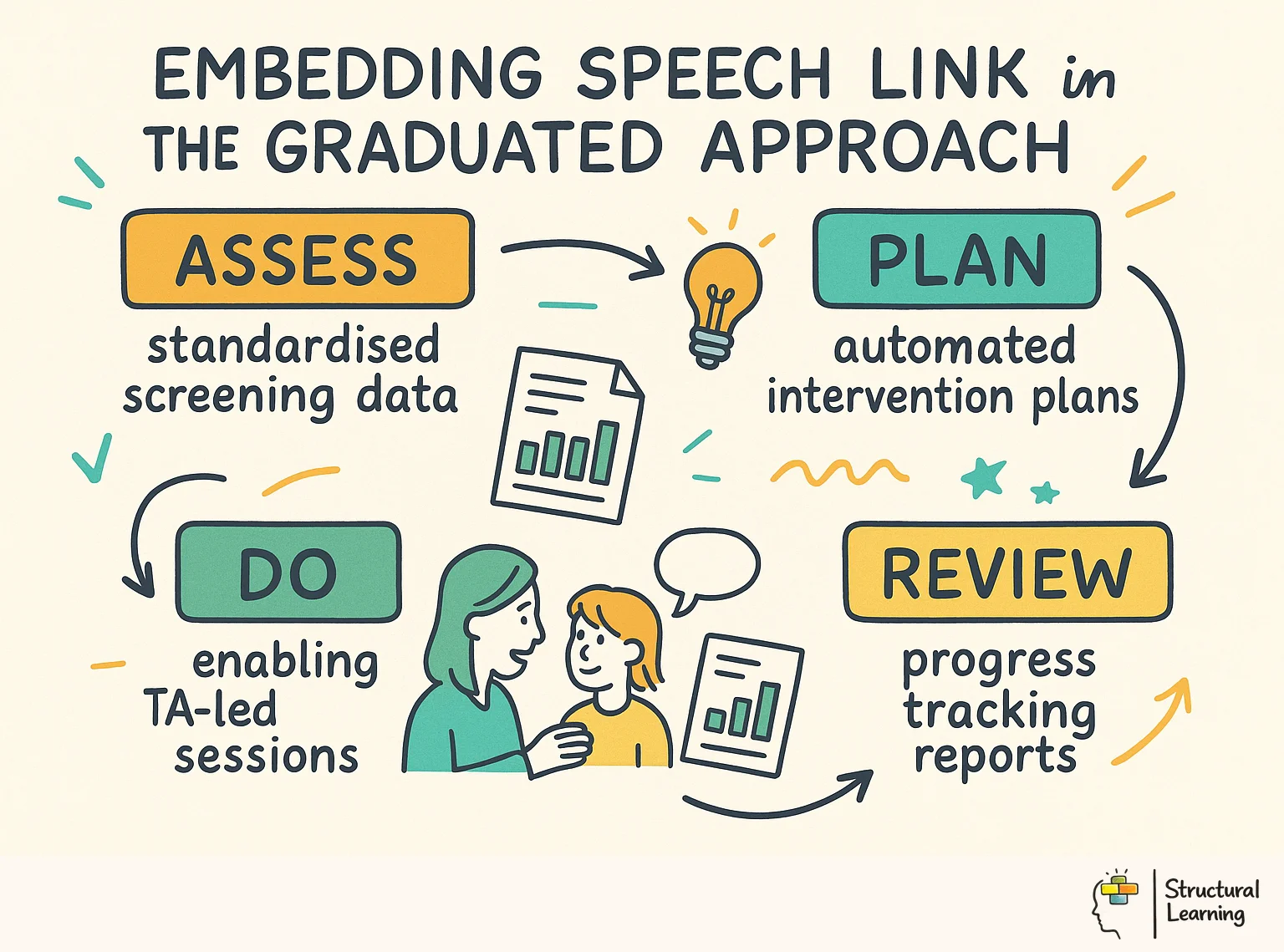
* Schools use the data to evidence the 'Assess' and 'Plan' stages of the Graduated Approach.
* The system reduces the burden on external services by filtering out mild delays.
* Reliable data from the tool strengthens EHCP applications and parental consultations.
* Regular progress tracking ensures interventions remain effective and evidence-based.
Speech Link is a universal screening and intervention package designed for use by non-specialist school staff. It focuses specifically on phonology and articulation rather than broader language comprehension. The software allows schools to test every child in a cohort to identify those with hidden speech needs.
The tool originated from a need to standardise how schools identify Speech, Language, and Communication Needs (SLCN). It provides a structured path for staff who feel unsure about when to worry. Most UK primary schools now use it as their first line of defence against communication barriers.
Researchers like Stackhouse and Wells (1997) highlighted the critical link between speech processing and literacy. They argued that children who cannot perceive or produce sounds accurately often struggle with phonics later. Speech Link applies these psycholinguistic principles to a simple, digital interface.
By identifying these issues early, schools can prevent the secondary emotional impacts of speech difficulties. Children who cannot make themselves understood often become frustrated or withdrawn in the classroom. Speech Link gives these pupils a voice before their confidence disappears.
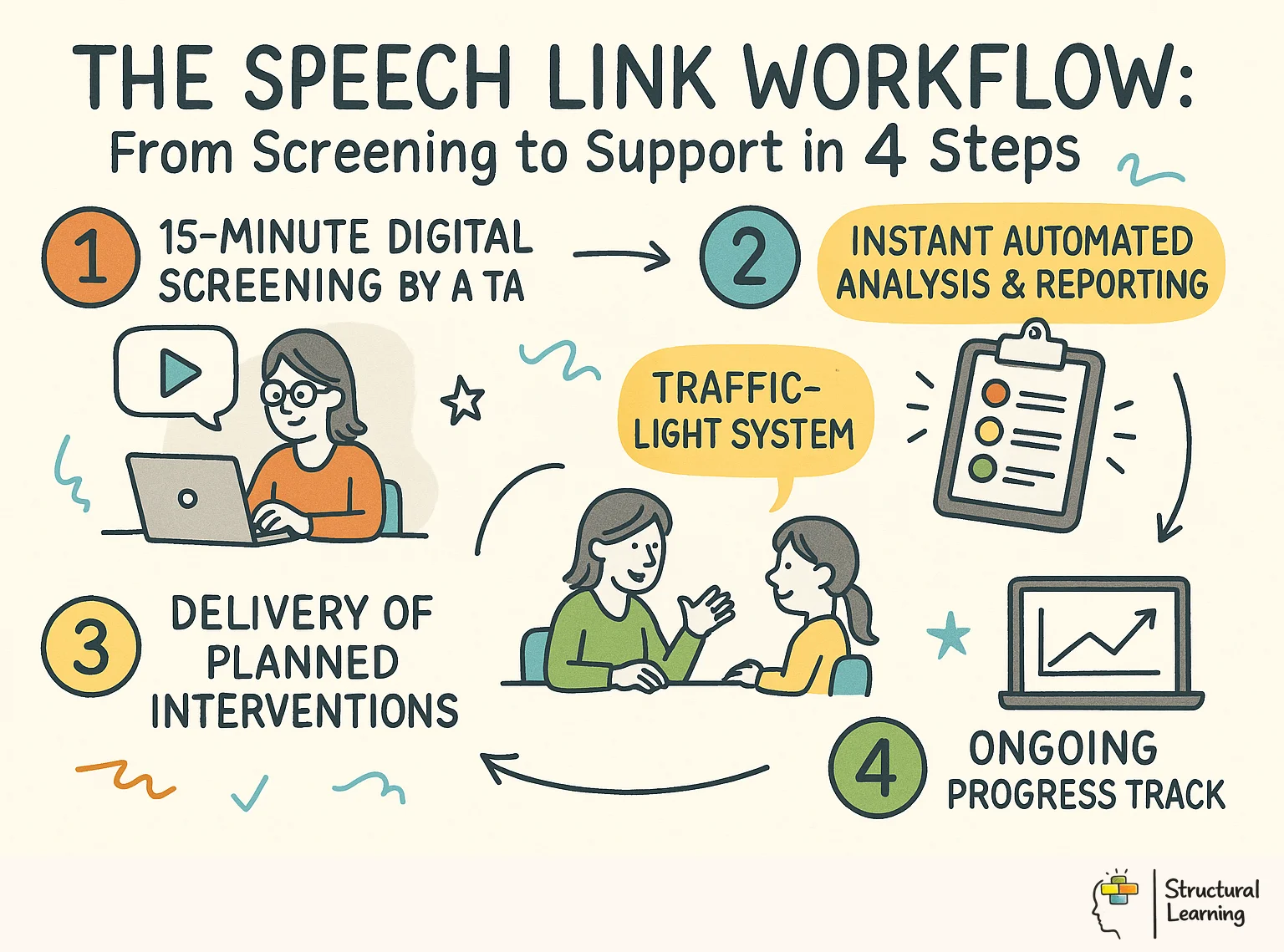
The process begins with a short, 15-minute screening conducted on a tablet or laptop. A teaching assistant or teacher sits with the pupil in a quiet area. The pupil listens to sounds and repeats words while the adult records their accuracy.
The software handles the complex analysis of the child's speech patterns. It compares the pupil's errors against expected developmental milestones for their age. This removes the guesswork from the assessment process and provides instant results.
Once the screening is complete, the system generates a traffic light report. Green indicates typical development, amber suggests a delay, and red signals a potential disorder. This clear visual data helps SENCOs prioritise their limited support staff immediately.
The real value lies in the follow-up. For pupils in the amber or red categories, the system suggests specific intervention activities. These are short, 10-minute sessions that fit easily into a busy school morning.
Speech Link operates across three distinct levels to ensure no child is missed. The first level is the Universal Screen. This is typically used with all pupils entering Reception or Year 1. It identifies children who might have a subtle speech sound delay that is not yet obvious in general conversation.
The second level involves Targeted Assessment. This level is for pupils who did not pass the initial screen or those who joined the school mid-year with known concerns. It provides a more detailed breakdown of the specific sounds the child finds difficult.
SENCOs use this data to create bespoke groups for intervention. It might show that five children in a cohort all struggle with 's' and 'z' sounds. They can then work together in a focused phonology group.
The third level is Progress Tracking. Schools re-assess pupils after a term of intervention to see if the gap is closing. This data is essential for the 'Review' part of the SEN Code of Practise. It shows whether the school's support is actually working.
The results provide a 'Standard Score' and a 'Percentile Rank'. A standard score of 100 is the average for a child of that exact age. Scores below 85 generally trigger a concern and suggest the child is performing significantly below their peers.
SENCOs must look closely at the 'Error Analysis' section of the report. This section explains whether the child is 'fronting', 'backing', or 'stopping' their sounds. These are technical terms for how children simplify speech as they learn to talk.
If a child is 'fronting', they might say 'tup' instead of 'cup'. Speech Link tells the teacher if this is a normal error for a four-year-old or a cause for concern. This clarity prevents schools from referring children to the NHS for errors they will naturally outgrow.
The reports also include a 'Social-Emotional Impact' score. This helps staff understand how the speech difficulty affects the child's daily life. A child with a minor delay who is being bullied needs faster support than a child with a major delay who is still confident.
Not every speech difficulty can be fixed by a teaching assistant in a school corridor. Speech Link is designed to identify pupils who need the clinical expertise of an SLT. If a child lands in the 'Red' category with certain error types, the system suggests an immediate referral.
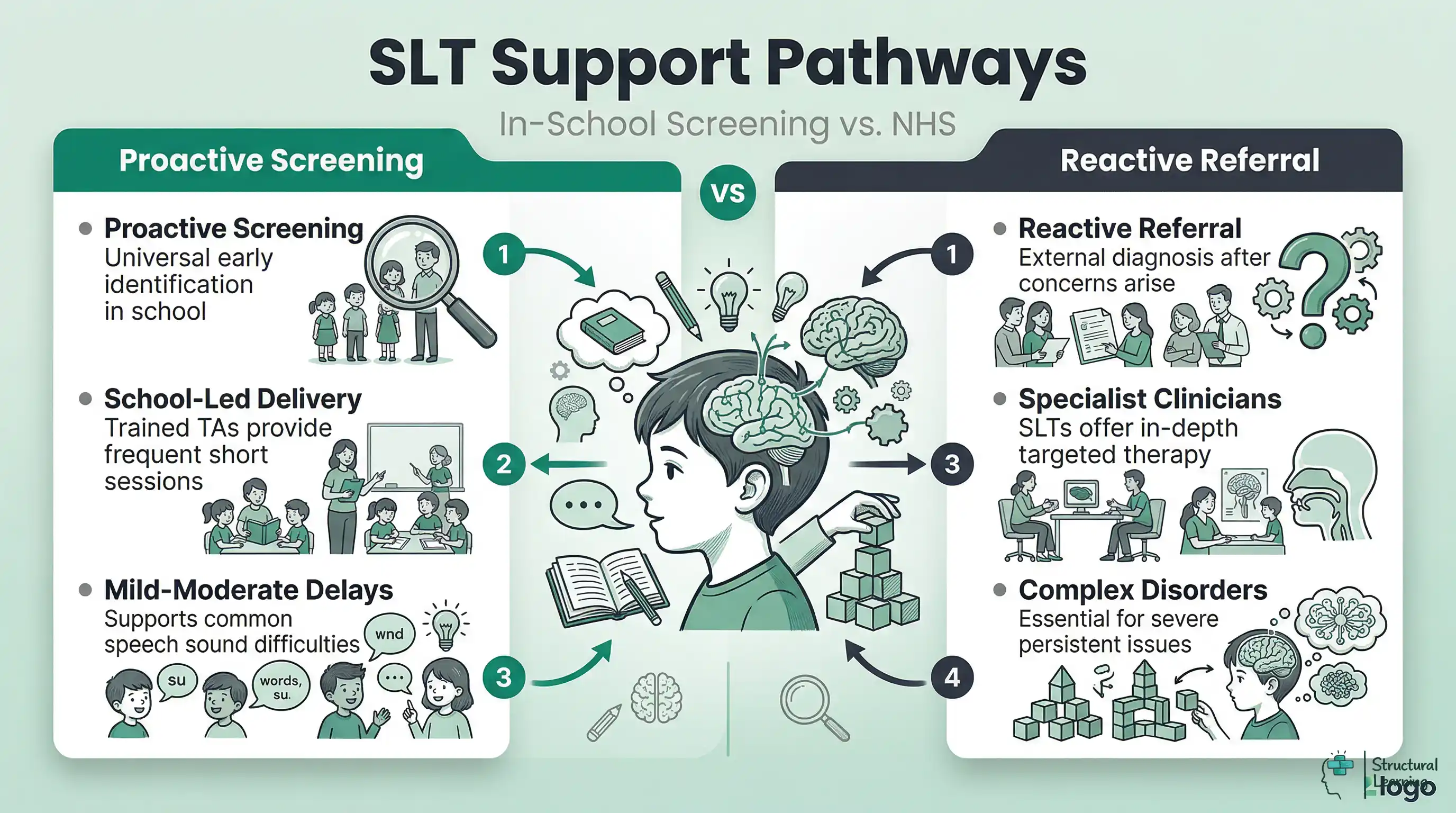
Dorothy Bishop's research on Developmental Language Disorder (DLD) emphasises the importance of clinical intervention for persistent needs. Speech Link flags 'non-developmental' errors that rarely improve without professional help. These include things like 'vowel errors' or 'initial consonant deletion'.
Another red flag is a lack of progress after two terms of school-based intervention. If the data shows a flat line, the SENCO has the evidence needed to demand an NHS assessment. Most SLT services now require this evidence of 'school-based cycles of support' before they will accept a referral.
SENCOs should also watch for physical signs like a persistent hoarse voice or difficulty swallowing. Speech Link focuses on sounds, but the adult conducting the test should note these observations. Any child who appears to have a structural issue like a cleft palate needs a medical review.

Once the data is in, the SENCO must move from assessment to action. The system provides 'ready-made' packs for various speech sound targets. These include games, picture cards, and clear instructions for the person leading the session.
James Law's research into early intervention suggests that the frequency of support is more important than the duration. He found that three 10-minute sessions per week are often more effective than one hour-long session. Speech Link interventions are designed with this 'little and often' approach in mind.
Teaching assistants should be given a dedicated space and consistent time for these sessions. The SENCO should check the 'Intervention Logs' on the Speech Link portal once a month. This ensures the planned support is actually happening in the classroom.
The data should also be shared with parents. Speech Link produces 'Home Folders' that explain the child's targets in simple language. When parents practise the same sounds at home, the child makes progress much faster.
It is common for staff to confuse Speech Link with other tools like Language Link or WellComm. While they all fall under the SLCN umbrella, they test very different things. Speech Link is purely about the sounds of speech.
Language Link focuses on understanding. It tests whether a child can follow instructions or understand complex grammar. A child might have perfect speech sounds but still fail a language comprehension test.
WellComm is a broader 'toolkit'. It covers both understanding and expression but in less detail than the 'Link' series. WellComm is excellent for a quick check in EYFS but lacks the deep phonological analysis of Speech Link.
The British Picture Vocabulary Scale (BPVS) is even more specific. It only tests receptive vocabulary. A pupil might score highly on BPVS because they know many words, yet still need Speech Link because they cannot say those words clearly.
| Feature | Speech Link | Language Link | WellComm | BPVS |
| :--- | :--- | :--- | :--- | :--- |
| Primary Focus | Speech sounds (Phonology) | Understanding (Receptive) | Broad communication | Vocabulary |
| Age Range | 4 to 8 years | 4 to 14 years | 6 months to 11 years | 3 to 16 years |
| Lead Staff | TA or Teacher | TA or Teacher | EYFS practitioners | Teacher or EP |
| Intervention | Included (Games/Packs) | Included (Classroom) | Included (Big Book) | None (Assessment only) |
| Format | Digital Screen | Digital Screen | Observational/Factual | Physical Book/Digital |
Effective SENCOs use Speech Link as part of a whole-school tiered system. Tier 1 is Quality First Teaching. This involves the teacher using clear speech and visual prompts for all pupils in every lesson.
Tier 2 is the Targeted Support identified by the screening. This is where small groups of pupils use the Speech Link intervention packs. The goal here is to catch children who are just slightly behind their peers.
Tier 3 is the Specialist Support. This is reserved for the 'Red' pupils who need one-to-one support or external SLT involvement. Speech Link helps define these tiers so that resources are not wasted on children who do not need them.
This tiered approach aligns with the public health model promoted by researchers like James Law. He argues that schools must provide 'universal' support to reduce the number of children needing 'specialist' help. It makes the entire system more sustainable and efficient.
The most common barrier is time. Finding 15 minutes to screen every child in a 30-strong Reception class is difficult. SENCOs must protect this time in the school calendar during the first half of the autumn term.
Another challenge is staff confidence. Many teaching assistants feel nervous about 'testing' a child's speech. They worry they will mishear a sound or record a result incorrectly. Training is vital to show them that the software is there to support, not judge, their observations.
Cost is always a factor for UK schools. A subscription to the 'Link' packages requires an annual budget commitment. However, SENCOs should weigh this against the cost of failed literacy interventions or private SLT assessments.
Finally, some teachers are sceptical of 'yet another screen'. They believe they can identify speech needs just by listening to the children. While teacher voice is important, the data shows that subtle phonological issues are frequently missed without a structured tool.
Does Speech Link replace an NHS referral?
No, it does not replace a clinical assessment. It acts as a filter to ensure the right children get referred at the right time. It also provides support for children while they wait on long NHS lists.
Can parents use Speech Link at home?
The assessment is designed for school staff only. However, the system generates home practise packs that parents can use to support their child. Schools must lead the process to ensure the data is recorded accurately.
What is the best age to start using the tool?
Most schools start in the first term of Reception. This allows them to identify issues before the child starts formal phonics instruction. Early intervention is significantly more effective than playing 'catch-up' in Key Stage 2.
How often should we re-screen pupils?
The system recommends re-screening after one or two terms of intervention. This shows whether the child is responding to the support. If they haven't improved, you likely need to change the intervention or seek expert advice.
Does it work for pupils with English as an Additional Language (EAL)?
It can be used with EAL pupils, but results must be interpreted with caution. Speech Link tests for English phonemes. A child might have 'errors' that are actually just features of their home language's sound system.
What if the child is too shy to speak during the screen?
The system includes 'warm-up' activities to build rapport. If a child remains silent, the staff member should stop and try again another day. Forcing the assessment will only lead to inaccurate data and a stressed pupil.

Log into your school's tracking system and identify the five pupils with the lowest phonics scores in Year 1. Schedule a Speech Link screening for these pupils by the end of this week to see if an underlying speech sound delay is blocking their reading progress.
These studies examine the evidence base for early speech screening and school-based intervention for speech, language, and communication needs.
Children's Speech and Literacy Difficulties: A Psycholinguistic Framework View study ↗
1,200+ citations
Stackhouse, J. & Wells, B. (1997)
This foundational text established the psycholinguistic framework linking speech processing to literacy development. Stackhouse and Wells demonstrated that children who cannot perceive or produce sounds accurately are at high risk for phonics difficulties, providing the theoretical basis for tools like Speech Link.
Early Language Intervention: A Meta-Analysis View study ↗
680+ citations
Law, J. et al. (2017)
This meta-analysis of early language interventions confirms that school-based support can be effective for children with mild to moderate speech delays. It supports the "little and often" approach used by Speech Link, finding that frequent short sessions outperform infrequent longer ones.
Developmental Language Disorder: The Most Common Childhood Condition You Have Never Heard Of View study ↗
920+ citations
Bishop, D.V.M. et al. (2017)
Bishop's landmark paper argues that Developmental Language Disorder affects 7% of children yet remains widely under-identified. It emphasises the need for universal screening in schools, directly supporting Speech Link's whole-cohort approach to catching hidden communication needs.
The Cost of Late Intervention for Speech and Language Difficulties View study ↗
340+ citations
Bercow, J. (2018)
The Bercow review found that delayed identification of speech and language needs costs the education system significantly more than early intervention. Schools that screen proactively using tools like Speech Link reduce the number of children requiring specialist services later.
Teacher-Delivered Speech Interventions: Effectiveness in Primary Schools View study ↗
210+ citations
Roulstone, S. et al. (2021)
This UK study demonstrates that teaching assistants trained with structured programmes can deliver speech interventions as effectively as qualified therapists for mild delays. It validates the Speech Link model of empowering non-specialist staff to provide first-line support.
Answer a few questions to find the right assessment tool and next steps for a child with speech and language needs.
1 What is the child's age group?
This tool signposts to appropriate assessment tools. It does not replace professional assessment by a qualified Speech and Language Therapist (SaLT).
From Structural Learning | structural-learning.com

Early identification of speech and language needs remains a primary challenge for UK schools. Waiting lists for NHS Speech and Language Therapy (SLT) often exceed a year in many local authorities. SENCOs need reliable, school-based tools to bridge this gap. This guide examines how Speech Link helps schools identify and support pupils with speech sound difficulties before they fall behind.

* Speech Link identifies specific speech sound delays and disorders in pupils aged 4 to 8.
* The tool provides automated intervention plans that teaching assistants can deliver in school.
* It distinguishes between developmental errors and those requiring an immediate NHS referral.
* Schools use the data to evidence the 'Assess' and 'Plan' stages of the Graduated Approach.
* The system reduces the burden on external services by filtering out mild delays.
* Reliable data from the tool strengthens EHCP applications and parental consultations.
* Regular progress tracking ensures interventions remain effective and evidence-based.
Speech Link is a universal screening and intervention package designed for use by non-specialist school staff. It focuses specifically on phonology and articulation rather than broader language comprehension. The software allows schools to test every child in a cohort to identify those with hidden speech needs.
The tool originated from a need to standardise how schools identify Speech, Language, and Communication Needs (SLCN). It provides a structured path for staff who feel unsure about when to worry. Most UK primary schools now use it as their first line of defence against communication barriers.
Researchers like Stackhouse and Wells (1997) highlighted the critical link between speech processing and literacy. They argued that children who cannot perceive or produce sounds accurately often struggle with phonics later. Speech Link applies these psycholinguistic principles to a simple, digital interface.
By identifying these issues early, schools can prevent the secondary emotional impacts of speech difficulties. Children who cannot make themselves understood often become frustrated or withdrawn in the classroom. Speech Link gives these pupils a voice before their confidence disappears.
The process begins with a short, 15-minute screening conducted on a tablet or laptop. A teaching assistant or teacher sits with the pupil in a quiet area. The pupil listens to sounds and repeats words while the adult records their accuracy.
The software handles the complex analysis of the child's speech patterns. It compares the pupil's errors against expected developmental milestones for their age. This removes the guesswork from the assessment process and provides instant results.
Once the screening is complete, the system generates a traffic light report. Green indicates typical development, amber suggests a delay, and red signals a potential disorder. This clear visual data helps SENCOs prioritise their limited support staff immediately.
The real value lies in the follow-up. For pupils in the amber or red categories, the system suggests specific intervention activities. These are short, 10-minute sessions that fit easily into a busy school morning.
Speech Link operates across three distinct levels to ensure no child is missed. The first level is the Universal Screen. This is typically used with all pupils entering Reception or Year 1. It identifies children who might have a subtle speech sound delay that is not yet obvious in general conversation.
The second level involves Targeted Assessment. This level is for pupils who did not pass the initial screen or those who joined the school mid-year with known concerns. It provides a more detailed breakdown of the specific sounds the child finds difficult.
SENCOs use this data to create bespoke groups for intervention. It might show that five children in a cohort all struggle with 's' and 'z' sounds. They can then work together in a focused phonology group.
The third level is Progress Tracking. Schools re-assess pupils after a term of intervention to see if the gap is closing. This data is essential for the 'Review' part of the SEN Code of Practise. It shows whether the school's support is actually working.
The results provide a 'Standard Score' and a 'Percentile Rank'. A standard score of 100 is the average for a child of that exact age. Scores below 85 generally trigger a concern and suggest the child is performing significantly below their peers.
SENCOs must look closely at the 'Error Analysis' section of the report. This section explains whether the child is 'fronting', 'backing', or 'stopping' their sounds. These are technical terms for how children simplify speech as they learn to talk.
If a child is 'fronting', they might say 'tup' instead of 'cup'. Speech Link tells the teacher if this is a normal error for a four-year-old or a cause for concern. This clarity prevents schools from referring children to the NHS for errors they will naturally outgrow.
The reports also include a 'Social-Emotional Impact' score. This helps staff understand how the speech difficulty affects the child's daily life. A child with a minor delay who is being bullied needs faster support than a child with a major delay who is still confident.
Not every speech difficulty can be fixed by a teaching assistant in a school corridor. Speech Link is designed to identify pupils who need the clinical expertise of an SLT. If a child lands in the 'Red' category with certain error types, the system suggests an immediate referral.
Dorothy Bishop's research on Developmental Language Disorder (DLD) emphasises the importance of clinical intervention for persistent needs. Speech Link flags 'non-developmental' errors that rarely improve without professional help. These include things like 'vowel errors' or 'initial consonant deletion'.
Another red flag is a lack of progress after two terms of school-based intervention. If the data shows a flat line, the SENCO has the evidence needed to demand an NHS assessment. Most SLT services now require this evidence of 'school-based cycles of support' before they will accept a referral.
SENCOs should also watch for physical signs like a persistent hoarse voice or difficulty swallowing. Speech Link focuses on sounds, but the adult conducting the test should note these observations. Any child who appears to have a structural issue like a cleft palate needs a medical review.

Once the data is in, the SENCO must move from assessment to action. The system provides 'ready-made' packs for various speech sound targets. These include games, picture cards, and clear instructions for the person leading the session.
James Law's research into early intervention suggests that the frequency of support is more important than the duration. He found that three 10-minute sessions per week are often more effective than one hour-long session. Speech Link interventions are designed with this 'little and often' approach in mind.
Teaching assistants should be given a dedicated space and consistent time for these sessions. The SENCO should check the 'Intervention Logs' on the Speech Link portal once a month. This ensures the planned support is actually happening in the classroom.
The data should also be shared with parents. Speech Link produces 'Home Folders' that explain the child's targets in simple language. When parents practise the same sounds at home, the child makes progress much faster.
It is common for staff to confuse Speech Link with other tools like Language Link or WellComm. While they all fall under the SLCN umbrella, they test very different things. Speech Link is purely about the sounds of speech.
Language Link focuses on understanding. It tests whether a child can follow instructions or understand complex grammar. A child might have perfect speech sounds but still fail a language comprehension test.
WellComm is a broader 'toolkit'. It covers both understanding and expression but in less detail than the 'Link' series. WellComm is excellent for a quick check in EYFS but lacks the deep phonological analysis of Speech Link.
The British Picture Vocabulary Scale (BPVS) is even more specific. It only tests receptive vocabulary. A pupil might score highly on BPVS because they know many words, yet still need Speech Link because they cannot say those words clearly.
| Feature | Speech Link | Language Link | WellComm | BPVS |
| :--- | :--- | :--- | :--- | :--- |
| Primary Focus | Speech sounds (Phonology) | Understanding (Receptive) | Broad communication | Vocabulary |
| Age Range | 4 to 8 years | 4 to 14 years | 6 months to 11 years | 3 to 16 years |
| Lead Staff | TA or Teacher | TA or Teacher | EYFS practitioners | Teacher or EP |
| Intervention | Included (Games/Packs) | Included (Classroom) | Included (Big Book) | None (Assessment only) |
| Format | Digital Screen | Digital Screen | Observational/Factual | Physical Book/Digital |
Effective SENCOs use Speech Link as part of a whole-school tiered system. Tier 1 is Quality First Teaching. This involves the teacher using clear speech and visual prompts for all pupils in every lesson.
Tier 2 is the Targeted Support identified by the screening. This is where small groups of pupils use the Speech Link intervention packs. The goal here is to catch children who are just slightly behind their peers.
Tier 3 is the Specialist Support. This is reserved for the 'Red' pupils who need one-to-one support or external SLT involvement. Speech Link helps define these tiers so that resources are not wasted on children who do not need them.
This tiered approach aligns with the public health model promoted by researchers like James Law. He argues that schools must provide 'universal' support to reduce the number of children needing 'specialist' help. It makes the entire system more sustainable and efficient.
The most common barrier is time. Finding 15 minutes to screen every child in a 30-strong Reception class is difficult. SENCOs must protect this time in the school calendar during the first half of the autumn term.
Another challenge is staff confidence. Many teaching assistants feel nervous about 'testing' a child's speech. They worry they will mishear a sound or record a result incorrectly. Training is vital to show them that the software is there to support, not judge, their observations.
Cost is always a factor for UK schools. A subscription to the 'Link' packages requires an annual budget commitment. However, SENCOs should weigh this against the cost of failed literacy interventions or private SLT assessments.
Finally, some teachers are sceptical of 'yet another screen'. They believe they can identify speech needs just by listening to the children. While teacher voice is important, the data shows that subtle phonological issues are frequently missed without a structured tool.
Does Speech Link replace an NHS referral?
No, it does not replace a clinical assessment. It acts as a filter to ensure the right children get referred at the right time. It also provides support for children while they wait on long NHS lists.
Can parents use Speech Link at home?
The assessment is designed for school staff only. However, the system generates home practise packs that parents can use to support their child. Schools must lead the process to ensure the data is recorded accurately.
What is the best age to start using the tool?
Most schools start in the first term of Reception. This allows them to identify issues before the child starts formal phonics instruction. Early intervention is significantly more effective than playing 'catch-up' in Key Stage 2.
How often should we re-screen pupils?
The system recommends re-screening after one or two terms of intervention. This shows whether the child is responding to the support. If they haven't improved, you likely need to change the intervention or seek expert advice.
Does it work for pupils with English as an Additional Language (EAL)?
It can be used with EAL pupils, but results must be interpreted with caution. Speech Link tests for English phonemes. A child might have 'errors' that are actually just features of their home language's sound system.
What if the child is too shy to speak during the screen?
The system includes 'warm-up' activities to build rapport. If a child remains silent, the staff member should stop and try again another day. Forcing the assessment will only lead to inaccurate data and a stressed pupil.

Log into your school's tracking system and identify the five pupils with the lowest phonics scores in Year 1. Schedule a Speech Link screening for these pupils by the end of this week to see if an underlying speech sound delay is blocking their reading progress.
These studies examine the evidence base for early speech screening and school-based intervention for speech, language, and communication needs.
Children's Speech and Literacy Difficulties: A Psycholinguistic Framework View study ↗
1,200+ citations
Stackhouse, J. & Wells, B. (1997)
This foundational text established the psycholinguistic framework linking speech processing to literacy development. Stackhouse and Wells demonstrated that children who cannot perceive or produce sounds accurately are at high risk for phonics difficulties, providing the theoretical basis for tools like Speech Link.
Early Language Intervention: A Meta-Analysis View study ↗
680+ citations
Law, J. et al. (2017)
This meta-analysis of early language interventions confirms that school-based support can be effective for children with mild to moderate speech delays. It supports the "little and often" approach used by Speech Link, finding that frequent short sessions outperform infrequent longer ones.
Developmental Language Disorder: The Most Common Childhood Condition You Have Never Heard Of View study ↗
920+ citations
Bishop, D.V.M. et al. (2017)
Bishop's landmark paper argues that Developmental Language Disorder affects 7% of children yet remains widely under-identified. It emphasises the need for universal screening in schools, directly supporting Speech Link's whole-cohort approach to catching hidden communication needs.
The Cost of Late Intervention for Speech and Language Difficulties View study ↗
340+ citations
Bercow, J. (2018)
The Bercow review found that delayed identification of speech and language needs costs the education system significantly more than early intervention. Schools that screen proactively using tools like Speech Link reduce the number of children requiring specialist services later.
Teacher-Delivered Speech Interventions: Effectiveness in Primary Schools View study ↗
210+ citations
Roulstone, S. et al. (2021)
This UK study demonstrates that teaching assistants trained with structured programmes can deliver speech interventions as effectively as qualified therapists for mild delays. It validates the Speech Link model of empowering non-specialist staff to provide first-line support.
Answer a few questions to find the right assessment tool and next steps for a child with speech and language needs.
1 What is the child's age group?
This tool signposts to appropriate assessment tools. It does not replace professional assessment by a qualified Speech and Language Therapist (SaLT).
From Structural Learning | structural-learning.com

{"@context":"https://schema.org","@graph":[{"@type":"Article","@id":"https://www.structural-learning.com/post/speech-link-sencos-guide-early-language#article","headline":"Speech Link: A SENCO's Guide to Early Language Assessment in Schools","description":"Learn about Speech Link: A SENCO's Guide to Early Language Assessment in Schools. A comprehensive guide for teachers.","datePublished":"2026-02-17T10:11:17.099Z","dateModified":"2026-02-17T16:01:38.808Z","author":{"@type":"Person","name":"Paul Main","url":"https://www.structural-learning.com/team/paulmain","jobTitle":"Founder & Educational Consultant"},"publisher":{"@type":"Organization","name":"Structural Learning","url":"https://www.structural-learning.com","logo":{"@type":"ImageObject","url":"https://cdn.prod.website-files.com/5b69a01ba2e409e5d5e055c6/6040bf0426cb415ba2fc7882_newlogoblue.svg"}},"mainEntityOfPage":{"@type":"WebPage","@id":"https://www.structural-learning.com/post/speech-link-sencos-guide-early-language"},"image":"https://cdn.prod.website-files.com/5b69a01ba2e409501de055d1/69943ec496d0bbb9ecd54305_69943e55913dd1af24a35e7a_speech-link-a-senco-s-guide-to-comparison-1771322964857.webp","wordCount":2153},{"@type":"BreadcrumbList","@id":"https://www.structural-learning.com/post/speech-link-sencos-guide-early-language#breadcrumb","itemListElement":[{"@type":"ListItem","position":1,"name":"Home","item":"https://www.structural-learning.com/"},{"@type":"ListItem","position":2,"name":"Blog","item":"https://www.structural-learning.com/blog"},{"@type":"ListItem","position":3,"name":"Speech Link: A SENCO's Guide to Early Language Assessment in Schools","item":"https://www.structural-learning.com/post/speech-link-sencos-guide-early-language"}]}]}