Updated on
June 13, 2026
Talk Boost: What Schools Need to Know
A practical guide for teachers and SENCOs on the Talk Boost intervention, covering who it's for, how it works, the evidence, and implementation challenges.


Updated on
June 13, 2026
A practical guide for teachers and SENCOs on the Talk Boost intervention, covering who it's for, how it works, the evidence, and implementation challenges.
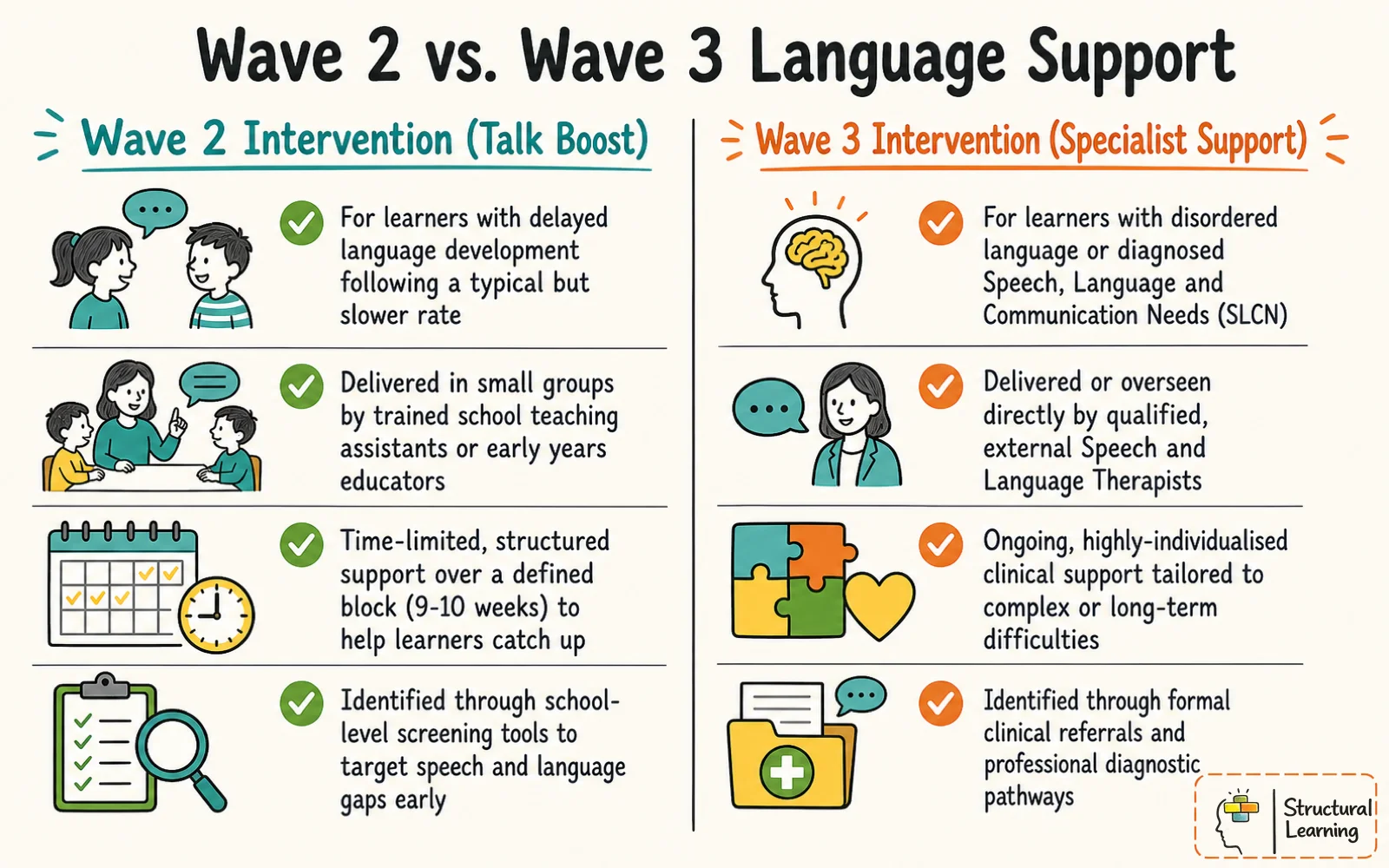
Talk Boost is a structured, time-limited language intervention for learners with delayed, but not disordered, language development. Delivered in small groups by trained teaching assistants or early years educators, it aims to accelerate progress in core spoken language skills. This guide explains what the programme involves, which learners are the best fit, and how to navigate the practical challenges of implementing it in a busy school environment.

Talk Boost is a series of targeted language interventions developed by the UK charity Speech and Language UK. It is designed to be delivered in primary schools and early years settings by trained staff members, typically teaching assistants (TAs). The core purpose of the programme is to improve the spoken language skills of children identified as having delayed language development.
The intervention works by providing a block of intensive, regular support in small groups. Using a set of structured activities and resources, it focuses on developing fundamental skills that underpin both academic learning and social communication.
There are several versions of the programme:
In all versions, children are selected using a screening tool. They then participate in several group sessions per week, led by a trained adult, alongside whole-class activities that help them generalise their new skills.
Correctly identifying learners is the most critical factor in the success of any intervention. Talk Boost is designed for a specific subset of learners who are falling behind their peers in language development.
Talk Boost is for learners who:
The most common misconception is that Talk Boost is a catch-all solution for any child with a communication difficulty. The evidence and programme guidelines are clear that it is not suitable for all learners.
| Not Recommended For | Reason Why | Alternative Approach |
|---|---|---|
| Learners with diagnosed SEN | These learners require a more specialist, individualised, and long-term approach (Wave 3) than a 9-week group programme can provide. | Referral to a specialist Speech and Language Therapist (SLT) for diagnosis and a personalised therapy plan. |
| EAL learners (in early stages) | The programme is not designed for bilingual learners acquiring English. Their language profile must be assessed in their home language first to distinguish a language delay from a language disorder. | Focus on high-quality EAL provision, immersive language environments, and assessing skills in their home language before considering an intervention for a disorder. |
| Learners with suspected DLD | Developmental Language Disorder (DLD) is a significant, long-term condition. These learners need a formal diagnosis and specialist SLT support. | Use a DLD screening tool and refer to an SLT for a full assessment. |
| Whole classes or large groups | The intervention is designed and evidenced for small groups (typically 4-8 learners). The benefits are diluted in larger groups. | Use high-quality universal oracy and vocabulary strategies for the whole class, such as those embedded in Structural Learning's Talk Tactics. |
The Talk Boost intervention follows a systematic process designed to build language skills sequentially.
Screening and Selection: The process begins with the Talk Boost Tracker, an online screening tool. Teachers assess learners against a set of criteria to identify those whose language skills are behind the expected level for their age. The tracker helps pinpoint the specific areas of language a child is struggling with and confirms their suitability for the intervention.
Small Group Sessions: Selected learners take part in group sessions, typically held three times a week for around 30-40 minutes. These are led by a trained teaching assistant or educator in a quiet space away from the main classroom. The sessions are built around a series of structured activities, often involving a character or story to engage the children. For example, in Early Talk Boost, the activities are based around characters like Tizzy the Tiger.
Skill Development: The activities are carefully sequenced to build on each other. They cover core language components, including:
Classroom Transfer: A crucial part of the programme is a weekly whole-class activity led by the class teacher. This is designed to help the learners in the intervention group practise and apply their new skills in the context of the main classroom. It also has the benefit of reinforcing good language skills for all learners.
Parental Engagement: The programme encourages schools to involve parents by sharing information about what their child is learning. Resources like activity books are provided to help parents practise the skills at home, creating a vital link between school and home life.
Implementing Talk Boost effectively requires careful planning and coordination.
Secure Senior Leadership Buy-In: The first step is to ensure the Senior Leadership Team (SLT) understands the resource implications, including the cost of training, the need for a dedicated quiet space, and the timetabling of a trained staff member.
Identify and Train Staff: Select a teaching assistant or educator to be trained. This person must attend the official Talk Boost training delivered by a licensed tutor. Remember, this training cannot be cascaded to other staff members.
Timetable the Intervention: This is often the biggest hurdle. The school must commit to releasing the trained staff member for the required number of sessions per week for the full duration of the programme (around 9-10 weeks). A consistent, quiet, and distraction-free space must be allocated for the sessions.
Screen Learners: The class teacher uses the online Talk Boost Tracker to screen their whole class. This should be done carefully to ensure the correct learners are identified. The SENCO should oversee this process to ensure consistency.
Group the Learners: Based on the tracker results, select a group of up to 8 learners (for Early Talk Boost) or 4 learners (for KS1/KS2) to form the intervention group. Inform parents that their child has been selected for this supportive programme.
Run the Sessions: The trained TA delivers the sessions as prescribed in the manual, following the structured activities. Fidelity to the programme is key to achieving the intended outcomes.
Monitor Progress: The tracker is used again at the end of the intervention block to measure progress. The SENCO and class teacher should review this data to evaluate the impact and decide on next steps for each learner. Some may have caught up, while others may require further support or referral to a specialist.
When considering any intervention, it is vital to look critically at the evidence. While Talk Boost is widely used, the evidence for its effectiveness is emerging and has some important limitations.
A 2025 review commissioned by the Department for Education (McKean et al.) identified Talk Boost as a targeted intervention with good-quality evidence. The review cited trial data showing that Talk Boost KS1 produced significant gains in expressive narrative skills for Year 1 learners.
However, other evaluations have raised questions. The core academic trial on Early Talk Boost (Reeves et al., 2018) found that while children made progress, the statistical impact (measured by Hedges' g) was very low. This makes it difficult to be certain that the progress was caused by the intervention rather than by natural development.

Download a one-page study note for Talk Boost, with the key ideas, limitations and classroom links in one place.
Furthermore, a large-scale efficacy trial funded by the Education Endowment Foundation (EEF) was cancelled in early 2024 due to significant implementation challenges in real-world school settings. This highlights the difficulty schools face in delivering the programme with high fidelity due to issues like staff turnover and timetabling pressures.
The consensus from multiple systematic reviews on oral language interventions more broadly is that small-group work can be effective (Donolato et al., 2023; Heidlage et al., 2019). The key is the quality of the implementation: the intervention must be delivered as designed, by a trained adult, to the specific learners it was intended for. When schools adapt the programme by increasing group sizes, using untrained staff, or applying it to learners with complex needs, its effectiveness is likely to be significantly reduced.
The ultimate goal of any small-group intervention is for the skills to transfer back into the whole-class environment. A teacher can use principles from Talk Boost to strengthen universal provision for all learners, particularly in vocabulary and comprehension.
This example shows how a Year 5 teacher could adapt Talk Boost KS2 principles for a geography lesson on coastal landscapes.
1. Activating Listening and Comprehension Monitoring
2. Scaffolding Vocabulary
This approach, inspired by the explicit instruction in Talk Boost, helps transition the targeted strategies from the intervention group to become part of the daily classroom culture, benefiting all learners.
Before committing to Talk Boost, use this checklist to assess if it's the right fit for your school and learners.
Pupil Selection
Logistics and Resources
Implementation and Monitoring
Research Evidence Check
What is the evidence that small-group oral language interventions improve early language and classroom communication?
Promising support: The Consensus search found relevant papers, but the evidence should be treated as emerging and checked carefully against the article claims.
Use the approach as an explicit routine: model the target skill, give guided practice, build in repetition, and check whether pupils can use it beyond the intervention session.
Young people who fail to develop language as expected face significant challenges in all aspects of life. Unfortunately, language disorders are common, either as a distinct condition (e.g., Developmental Language Disorder) or as a part of another neurodevelopmental condition (e.g., autism). Finding ways to attenuate language problems through intervention has the potential to yield great benefits not only for the individual but also for society as a whole. This meta-analytic review examined the effect of oral language interventions for children with neurodevelopmental disorders. The last electronic search was conducted in April 2022. Intervention studies had to target language skills for children from 2 to 18 years of age with Developmental Language Disorder, autism, intellectual disability, Down syndrome, Fragile X syndrome, and Williams syndrome in randomised controlled trials or quasi-experimental designs. Control groups had to include business-as-usual, waiting list, passive or active conditions. However, we excluded studies in which the active control group received a different type, delivery, or dosage of another language intervention. Eligible interventions implemented explicit and structured activities (i.e., explicit instruction of vocabulary, narrative structure or grammatical rules) and/or implicit and broad activities (i.e., shared book reading, general language stimulation). The intervention studies had to assess language skills in receptive and/or expressive modalities. The search provided 8195 records after deduplication. Records were screened by title and abstract, leading to full-text examinations of 448 records. We performed Correlated and Hierarchical Effects models and ran a retrospective power analysis via simulation. Publication bias was assessed via-curve and precision-effect estimate. We examined 38 studies, with 46 group comparisons and 108 effects comparing pre-/post-tests and eight studies, with 12 group comparisons and 21 effects at follow-up. The results showed a mean effect size of = 0.27 at the post-test and = 0.18 at follow-up. However, there was evidence of publication bias and overestimation of the mean effects. Effects from the meta-analysis were significantly related to these elements: (1) receptive vocabulary and omnibus receptive measures showed smaller effect sizes relative to expressive vocabulary, grammar, expressive and receptive discourse, and omnibus expressive tests; and (2) the length of the intervention, where longer sessions conducted over a longer period of time were more beneficial than brief sessions and short-term interventions. Neither moderators concerning participants' characteristics (children's diagnosis, diagnostic status, age, sex, and non-verbal cognitive ability and severity of language impairment), nor those regarding of the treatment components and implementation of the language interventions (intervention content, setting, delivery agent, session structure of the intervention or total number of sessions) reached significance. The same occurred to indicators of study quality. The risk of bias assessment showed that reporting quality for the studies examined in the review was poor. In sum, the current evidence base is promising but inconclusive. Pre-registration and replication of more robust and adequately powered trials, which include a wider range of diagnostic conditions, together with more long-term follow-up comparisons, are needed to drive evidence-based practice and policy.
Classroom implication: Use this as a caution: check learner fit, delivery quality and progress data before treating the approach as settled practice.
Abstract Intervening early is important to minimize persistent difficulties in language and related domains in young children with or at-risk for language impairment (LI; Rescorla, 2009). Because language is first learned in caregiver–child interactions, parent-implemented interventions are potentially an important early intervention for children with or at-risk for LI. Previous meta-analyses have examined outcomes of parent-implemented interventions for children with primary and secondary LI, but have not included children at-risk for LI due to low SES. A systematic review of the literature identified 25 randomized controlled trials of parent-implemented language interventions examining linguistic outcomes for young children. Studies included 1734 participants (M = 3.7 years) with or at-risk for LI due to low SES. Results of these meta-analyses indicated modest improvements in expressive vocabulary and small improvements in expressive language for children with or at-risk for LI. The effect size for expressive vocabulary outcomes was significant for shared book reading interventions (g = 0.37, 95% CI [0.15–0.59]) and interventions implemented in play and/or routines (g = 0.50, 95% CI [0.05–0.95]). The effect size for expressive language was significant (g = 0.42, 95% CI [0.19–0.65]), but not for receptive language (g = 0.07, ns), and the effect size for receptive vocabulary was not significant (g = 0.18, ns). Sub-group analyses for expressive vocabulary and expressive language indicated moderate to large significant effects for children with or at-risk for primary LI and smaller, non-significant effects for children with Autism Spectrum Disorder. Findings are generally consistent with a previous meta-analysis (Roberts & Kaiser, 2011), indicating parent-implemented language interventions may have positive effects on linguistic outcomes for young children with or at-risk for LI. Limited measures of parent training procedures and varied measures of parent outcomes limited the analysis of how child outcomes were achieved.
Classroom implication: Translate the finding into explicit modelling, guided practice and progress monitoring rather than relying on one-off exposure.
The main aim of the systematic review and meta-analysis was to evaluate the effectiveness of language interventions for school-aged children who are d/Deaf and hard of hearing (DHH). We focused on studies targeting meaning-based aspects of language, such as vocabulary, grammar, and narrative skills. We included randomized controlled trials and quasi-experiments with a control group and a pre-post design. A secondary aim was to describe the characteristics of effective interventions identified in the systematic review. The review was preregistered in PROSPERO (ID CRD42021236085). We searched 10 academic databases for peer-reviewed journal articles reporting language interventions for children who are DHH aged 6-12 years. We assessed the quality of included studies using Critical Appraisal Skills Programme checklists. A meta-analysis was conducted on the overall effect of interventions. In addition, we calculated separate effect sizes for vocabulary and morphosyntactic knowledge. We identified 14 studies totaling 794 children. Quality assessment revealed concerns of risk of bias in most studies because study characteristics were not comprehensively reported. The meta-analyses of language interventions revealed a large main effect of= 0.79Subdomain analyses revealed similar effects for morphosyntactic knowledge= 0.81 and vocabulary= 0.71. Few high-quality studies examine the effects of language interventions for children who are DHH. However, the studies that exist reveal robust effects, especially for morphosyntactic abilities. Intervention approaches were diverse, and the largest intervention effects were found in studies with a randomized controlled design and near-transfer outcome measures closely aligned with the intervention content. Future studies should adhere to established guidelines for reporting results from controlled experimental study designs.
Classroom implication: Translate the finding into explicit modelling, guided practice and progress monitoring rather than relying on one-off exposure.
This systematic review focuses on peer-reviewed articles published since 1985 that assess the outcomes of language intervention practices for school-age students with spoken language disorders. We conducted computer searches of electronic databases and hand searches of other sources for studies that used experimental designs that were considered to be reliable and valid: randomized clinical trials, nonrandomized comparison studies, and multiple-baseline single-subject design studies. The review yielded 21 studies concerning the efficacy or effectiveness of language intervention practices with school-age children since 1985. Eleven of the studies limited participants to children in kindergarten and first grade, and no studies were located that focused on students in middle grades or high school. The relatively high quality of the studies that met our criteria, and the moderate-to-high effect sizes we calculated for the majority of studies, suggests that clinicians can have some confidence in the specific language intervention practices examined. The fact that only 21 studies met our criteria means that there is relatively little evidence supporting the language intervention practices that are currently being used with school-age children with language disorders. We outline significant gaps in the evidence and discuss the implications for clinical practice in schools.
Classroom implication: Translate the finding into explicit modelling, guided practice and progress monitoring rather than relying on one-off exposure.
It is widely acknowledged that children with developmental language disorder (DLD) predominantly have difficulties in the areas of grammar and vocabulary, with preserved pragmatic skills. Consequently, few studies focus on the pragmatic skills of children with DLD, and there is a distinct lack of studies examining the effectiveness of pragmatic interventions. To carry out a systematic review of the literature on pragmatic interventions for children with DLD. This systematic review was registered with PROSPERO (ID = CRD42017067239). A systematic search in seven databases yielded 1031 papers, of which 11 met our inclusion criteria. The included papers focused on interventions for children with DLD (mean = 3-18 years), enhancing oral language pragmatic skills, published between January 2006 and May 2020, and were based on a group-study design such as randomized control trial or pre-post-testing. Study participants were monolingual speakers. The quality of papers was appraised using the Cochrane Risk of bias tool for randomized controlled trials. There was a high degree of variability between the included intervention studies, especially regarding intensity, intervention targets and outcomes. The evidence suggested that pragmatic intervention is feasible for all models of delivery (individual, small and large group) and that interventions for pragmatic language are mostly focused on encouragement of conversation and narrative skills observed through parent-child interaction or shared book-reading activities. This study highlights the importance of promoting and explicitly teaching pragmatic skills to children with DLD in structured interventions. A narrative synthesis of the included studies revealed that in addition to direct intervention, indirect intervention can also contribute to improving oral pragmatic skills of children with DLD. What is already known on the subject? An increasing number of studies have shown that difficulties in acquiring pragmatic language is not only present in children with autism. What this study adds to existing knowledge? Interventions for pragmatic language in children with DLD are mostly focused on encouragement of conversation and narrative skills, very often through parent-child interaction or shared book-reading activities. Interventions that target language pragmatic are feasible for all models of delivery (individual, small and large group). What are the potential or actual clinical implications of this work? The efficacy of the existing studies varies, and it is difficult to give recommendations regarding the intensity and duration of the specific intervention. In addition to offering pragmatic intervention directly from a specialist, pragmatic interventions can also be carried out indirectly if the intervention is under the continuous supervision of a specialist.
Classroom implication: Translate the finding into explicit modelling, guided practice and progress monitoring rather than relying on one-off exposure.
Although spoken-language deficits are not core to an autism spectrum disorder (ASD) diagnosis, many children with ASD do present with delays in this area. Previous meta-analyses have assessed the effects of intervention on reducing autism symptomatology, but have not determined if intervention improves spoken language. This analysis examines the effects of early interventions on spoken-language in children with ASD. A systematic review of 1756 studies of children with ASD who participated in early intervention resulted in the inclusion of 26 studies in the current review. These studies included 1738 participants with ASD who were, on average, 3.3 years old (SD = 0.91). This random-effects meta-analysis of spoken-language outcomes for children with ASD who received early intervention as compared with usual treatments yielded a significant overall mean effect size of g = 0.26 (CI = 0.11 to 0.42). On average, children with ASD significantly increased their use of spoken-language following experimental early interventions. Treatments delivered simultaneously by a clinician and a parent resulted in greater gains in spoken-language than treatments delivered by a clinician or parent only. No other participant or study characteristics predicted individual-study effect sizes. Early intervention improves spoken-language outcomes for children with ASD, and the largest effects are found when both parent and clinician implement the intervention. Recommendations for practice include adding systematic parent training to interventions for spoken language to potentially improve outcomes. Future research should report standard language measures as well as child (cognitive ability and socio-economic status) and intervention characteristics to improve evidence related to the effects of interventions on spoken communication in children with ASD.
Classroom implication: Translate the finding into explicit modelling, guided practice and progress monitoring rather than relying on one-off exposure.
Phonological difficulties are prevalent in children with speech and/or language disorders and may hamper their later language outcomes and academic achievements. These children often form a significant proportion of speech and language therapists' caseloads. There is a shortage of information on evidence-based interventions for improving phonological skills in children and adolescents with speech and language disorder. The aim of this systematic literature review and meta-analysis was to systematically examine the effects of different intervention approaches on speech production accuracy and phonological representation skills in children with speech and language disorders. A preregistered systematic review (International Prospective Register of Systematic Reviews ID: CRD42017076075) adhering to Preferred Reporting Items for Systematic Reviews and Meta-Analyses guidelines was completed. Seven electronic databases (PubMed, Web of Science, ERIC, PsychINFO, Cochrane Library, SCOPUS and Linguistics & Language Behavior Abstracts) were searched for studies related to oral language interventions with children with developmental speech and/or language disorder (mean age ranging from 3-18 years) published between January 2006 and August 2022. The included articles reported intervention studies with a group design in which speech production accuracy was the outcome measure. Studies were appraised using the Cochrane risk of bias tool, and individual effect sizes were calculated using standardised means differences when enough data was available. A meta-analysis was conducted obtaining the average standardised mean difference d. Heterogeneity, influence of possible moderator variables and publication bias were explored. The 23 studies that met the inclusion criteria presented low-medium risk of bias. Nine effect sizes were obtained from seven of these studies that presented a pre-post-test with a control group design. Medium-high average effect sizes were found in phonological accuracy. Heterogeneity was found between individual effect sizes. Significant moderator variables and publication bias were not detected. The results of this meta-analysis indicate positive effects on speech production accuracy. Based on this review, further improvements in the quality of reporting for intervention research are required in developing the evidence base for practice. What is already known on the subject An increasing number of interventions is available for children and adolescents with developmental speech and/or language disorders. Previous reviews suggest relatively low levels of evidence of interventions having phonology as an outcome measure. What this paper adds to the existing knowledge This review and meta-analysis summarise the intervention evidence from a substantial body of group design studies, indicating positive results from a range of interventions with phonological outcomes. It highlights the need to systematically implement and replicate different intervention procedures to understand factors that will maximise positive outcomes and to grow the evidence base for best practice. What are the potential or actual clinical implications of this study? Tentative evidence is emerging for the effectiveness of various approaches in enhancing speech production accuracy skills of children and adolescents with developmental speech and/or language disorder.
Classroom implication: Translate the finding into explicit modelling, guided practice and progress monitoring rather than relying on one-off exposure.
The aim of this systematic review was to examine the empirical evidence on interventions for late talkers between 18 and 42 months according to type of intervention approach (direct, indirect, and hybrid), reporting of intervention elements, and outcomes for receptive and expressive vocabulary. This review was registered with PROSPERO and followed Preferred Reporting Items for Systematic Reviews and Meta-Analysis guidelines. Eleven databases were systematically searched with 34 intervention studies involving 1,207 participants meeting criteria. Studies were categorized as using a direct, indirect, or hybrid intervention approach, then examined according to intervention elements, vocabulary outcomes, as well as reported tools and type of score used to evaluate outcomes. Across 34 studies, nine used a direct intervention approach, 10 an indirect intervention approach, and 14 a hybrid intervention approach. One study compared direct and hybrid intervention approaches. All indirect and hybrid approaches included parent training; direct approaches did not. The type and degree of reporting of other intervention elements, as well as the tools and type of score used to evaluate outcomes, varied within and across approaches. Overall, improvements in expressive vocabulary were reported by 93% of studies, with variable results for the nine studies reporting receptive vocabulary outcomes. The direct, indirect, and hybrid intervention approaches were typified by specific intervention elements; however, there was diversity in how other elements comprising the approaches were arranged. When making decisions about which intervention approach to use, clinicians need to be mindful of the differences among approaches, how they discuss those differences with parents, and which approaches and elements might be best suited to individual children and their families. https://doi.org/10.23641/asha.21291405.
Classroom implication: Translate the finding into explicit modelling, guided practice and progress monitoring rather than relying on one-off exposure.
Can't one trained TA just show the other TAs how to do it? No. Speech and Language UK explicitly forbids cascade training. The programme's effectiveness is linked to the quality of delivery, which depends on the official training.
Can we run it with a larger group to help more children? The programme is designed and evidenced for small groups. Increasing the group size will reduce the intensity and individual attention for each child, diluting the impact. It is better to run the intervention properly with one group than poorly with two.
What if a child is still struggling after the intervention? If a learner does not make expected progress after completing Talk Boost, it may indicate a more complex underlying need. This is the point at which to consider a referral to a specialist Speech and Language Therapist for a more detailed assessment.
How long does it take to see an impact? The programme is designed to show progress over its 9 or 10-week duration. The post-intervention tracker is the primary tool for measuring this change.

Start building comprehension monitoring into your whole-class teaching. Before explaining a new concept, explicitly tell your learners: "Your job is to listen carefully and to tell me if any part of my explanation is not clear. It helps me become a better teacher." This simple instruction begins to shift the classroom culture from passive listening to active thinking, a core principle that underpins the Talk Boost approach and benefits every learner in the room.