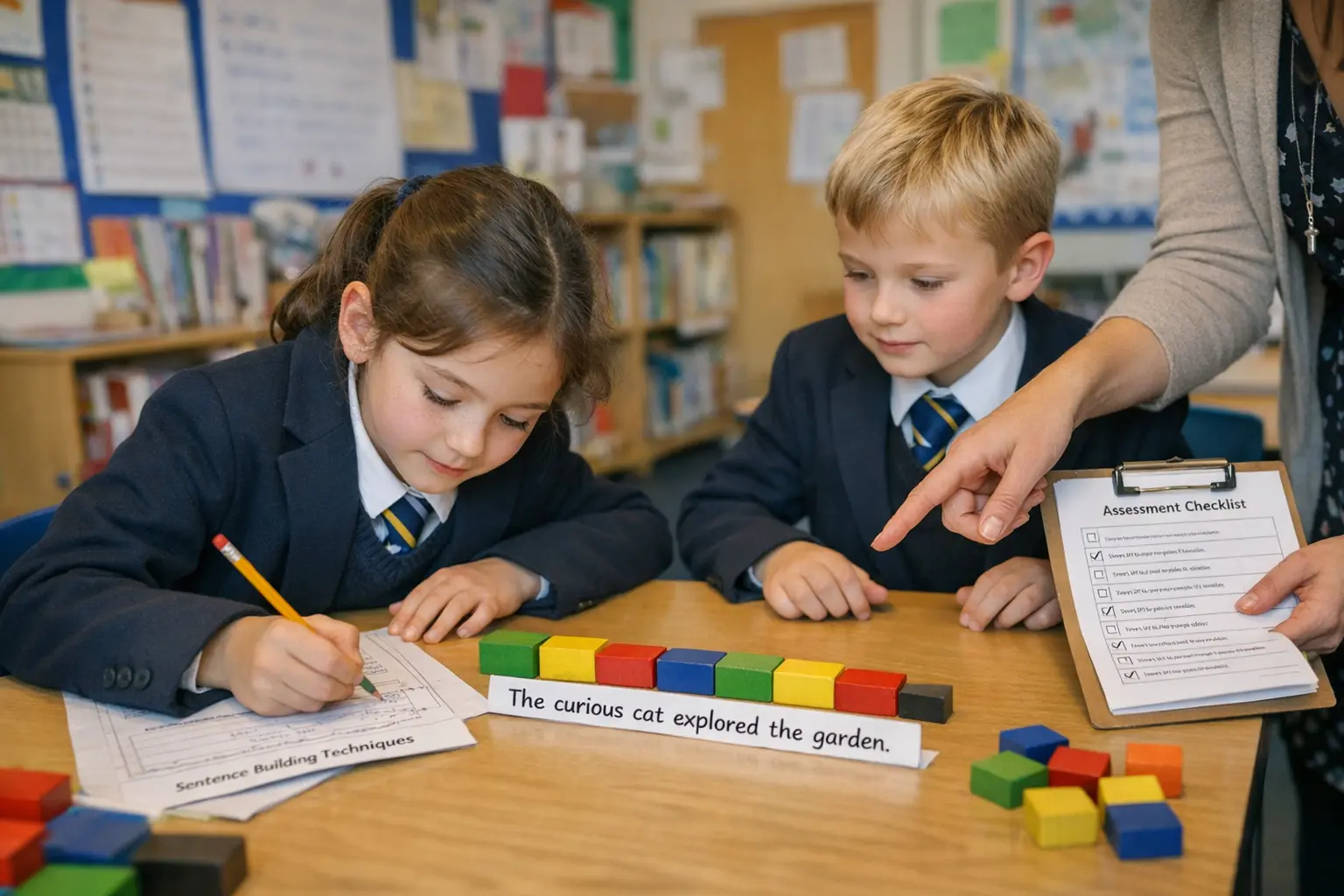
Building Better Sentences: Strategies for Developing Writing SkillsTwo children in navy blazers work together at a colorful classroom table, building sentences with blocks while a teacher guides them.

Updated on  

February 5, 2026

Building Better Sentences: Strategies for Developing Writing Skills

|

December 12, 2018

Help students build better sentences with practical strategies. Learn techniques for developing sentence variety, complexity, and precision across all year groups.

Course Enquiry
Copy citation

Francksen, R (2018, December 12). Building better sentences. Retrieved from https://www.structural-learning.com/post/building-better-sentences

The ability to construct effective sentences lies at the heart of written communication. For teachers working to develop pupils' writing skills, understanding how sentences work and how to teach sentence construction systematically can transform outcomes across the curriculum, from handwriting to reading comprehension to nonfiction writing to creative expression. This guide explores evidence-informed approaches to sentence building, drawing on decades of research into what actually works in the classroom.

Key Takeaways

  1. Beyond Grammar Drills: Discover how sentence-combining skills transform KS2 writing quality more effectively than traditional grammar exercises, with surprising research evidence.
  2. The Blockplay Connection: Uncover Rob Francksen's fascinating findings on how structural learning techniques from early years can transform Upper KS2 writing.
  3. Making Writing Visible: Learn how exposing pupils' thought processes during composition leads to breakthrough improvements in sentence construction and meaning-making.
  4. The REAch2 Results: See the concrete assessment outcomes when prioritising, sequencing and manipulating ideas becomes the core of writing instruction.

What is Sentence Building?

Sentence building refers to the explicit teaching of how sentences are constructed, combined, and manipulated to convey meaning effectively through strategic vocabulary development and word choice. Rather than treating sentences as isolated grammatical exercises, this approach recognises that sentences are the fundamental building blocks of all written communication. When pupils understand how sentences work, they gain control over their writing in ways that transform both quality and confidence.

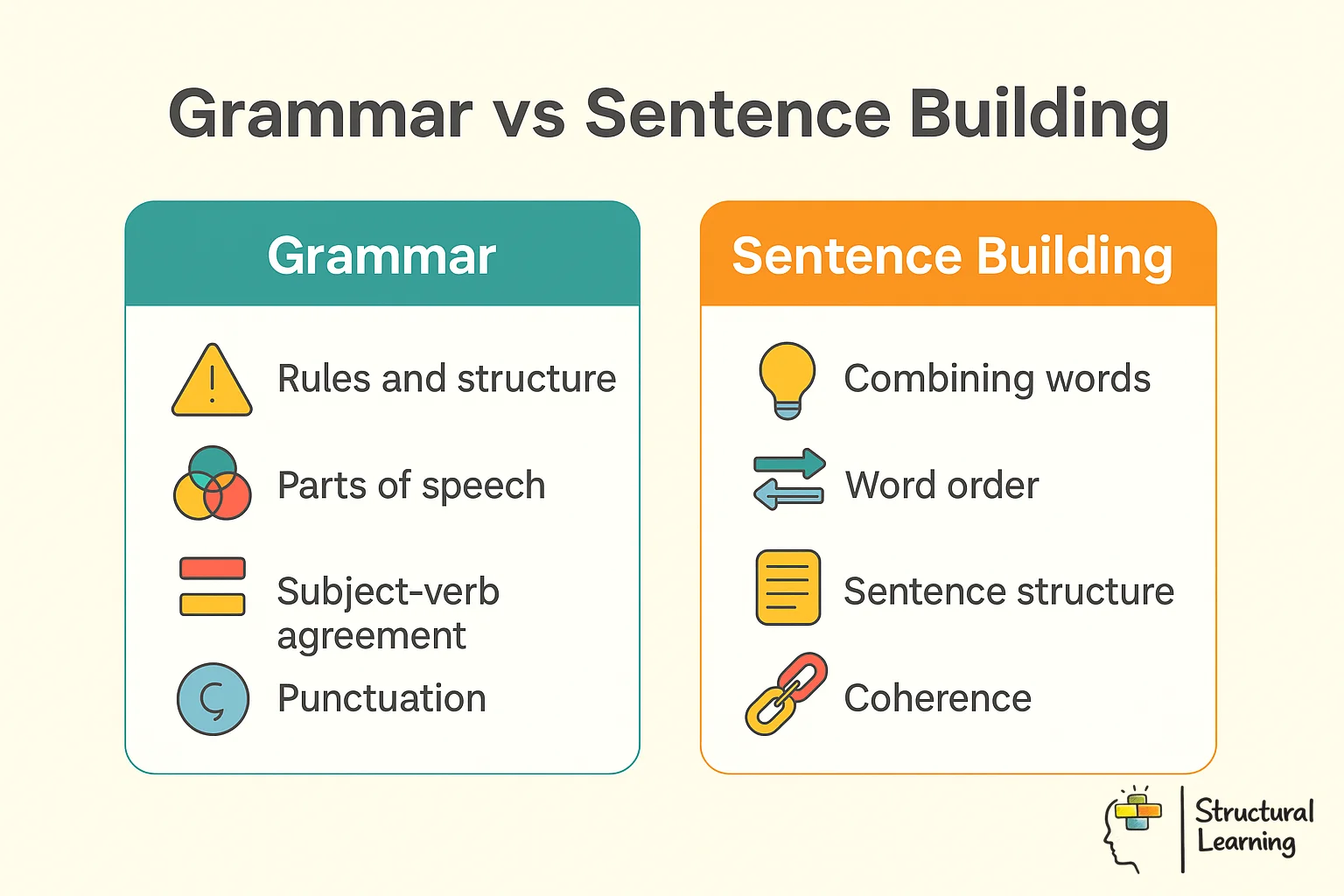
Comparison infographic showing traditional grammar teaching versus sentence building approach
Grammar vs Sentence Building

At its core, sentence building involves three interconnected skills: understanding sentence structure, combining simple sentences into more complex ones, and manipulating sentence elements to achieve specific effects. These skills develop progressively, with early sentence work focusing on basic patterns before moving to more sophisticated constructions.

The approach differs significantly from traditional grammar instruction. Where grammar lessons often focus on identifying and labelling parts of speech, sentence building emphasises the construction of meaning through deliberate choices about word order, clause combination, and syntactic variety. This shift from analysis to synthesis has profound implications for how we teach writing.

What Does Research Say About Sentence Combining?

Research shows that sentence combining activities improve writing quality more effectively than traditional grammar drills, with effect sizes ranging from 0.5 to 0.7 standard deviations. Studies spanning 40 years consistently demonstrate that students who practice combining simple sentences into complex ones write with greater syntactic maturity and clarity. The approach works particularly well when taught explicitly alongside meaningful writing tasks.

The evidence base for sentence combining as an instructional approach is remarkably strong. Research dating back to the 1960s and 1970s consistently demonstrates its effectiveness, yet many teachers remain unfamiliar with this body of work.

Kellogg Hunt's pioneering research in 1965 established the concept of the "T-unit" (minimal terminable unit) as a measure of syntactic maturity in writing. Hunt found that as writers develop, their sentences become longer and more complex, with more embedded clauses and modifying phrases. This research provided a framework for understanding how sentence sophistication develops and how instruction might accelerate this development.

Frank O'Hare's landmark 1973 study provided compelling evidence for sentence combining instruction. Working with seventh-grade students, O'Hare found that pupils who received systematic sentence combining instruction significantly outperformed control groups on measures of syntactic maturity. Crucially, these gains transferred to their independent writing, not just to controlled exercises.

More recent meta-analyses have confirmed these findings. Graham and Perin's 2007 review of writing instruction research identified sentence combining as one of the most effective interventions for improving writing quality, with an effect size of 0.50. This places it among the most impactful approaches available to teachers.

Why Is Sentence Combining More Effective Than Grammar Exercises?

Sentence combining works better because it focuses on meaning-making and communication rather than isolated rule memorization. Students learn grammar in context by actively manipulating sentences to express ideas more precisely and fluently. This hands-on approach develops both implicit knowledge of sentence patterns and explicit understanding of how language works.

The superiority of sentence combining over traditional grammar instruction stems from several factors. First, sentence combining is inherently generative: pupils create new sentences rather than simply analysing existing ones. This active construction engages different cognitive processes than passive identification.

Second, sentence combining provides immediate feedback on meaning. When pupils combine sentences, they can immediately see whether the result makes sense and sounds right. This self-correction mechanism is largely absent from traditional grammar exercises, where pupils might correctly identify a noun without any engagement with meaning.

Third, sentence combining develops what researchers call "syntactic fluency": the ability to manipulate sentence structures automatically. Just as fluent readers decode words without conscious effort, fluent writers construct sentences without laborious grammatical analysis. Sentence combining builds this fluency through practice with varied structures.

Research by Hillocks and Smith (1991) found that traditional grammar instruction had no significant effect on writing quality, while sentence combining showed consistent positive effects. This finding has been replicated across multiple studies and age groups, suggesting that the time spent on grammar worksheets might be better invested in sentence combining activities.

Core Sentence Building Strategies for the Classroom

Starting with Kernel Sentences

Effective sentence building instruction begins with "kernel sentences": simple, basic sentence patterns that form the foundation for more complex constructions. These typically follow the subject-verb-object pattern and contain no embedded clauses or complex modifications.

For example, teachers might present pupils with three kernel sentences:

  • The dog barked.
  • The dog was large.
  • The dog frightened the postman.
  • lass="w-richtext-figure-type-image w-richtext-align-center" data-rt-type="image" data-rt-align="center">
    Kernel Sentences

    Pupils are then challenged to combine these sentences into a single, more complex sentence that retains the meaning of the originals. For example: "The large dog barked and frightened the postman."

    This process allows pupils to see how individual pieces of information can be woven together to create a more nuanced and informative whole. By starting with simple elements, teachers can scaffold the process of sentence construction and build pupils' confidence gradually.

    Sentence Expansion with Adjectives and Adverbs

    Once pupils are comfortable with kernel sentences, the next step is to expand them by adding adjectives and adverbs. This simple technique can dramatically increase the descriptive power of their writing.

    Teachers might provide pupils with a sentence like "The bird flew" and challenge them to add adjectives and adverbs to make it more vivid and engaging. For example: "The colourful bird flew swiftly."

    By experimenting with different adjectives and adverbs, pupils learn how these words can modify meaning and create specific effects. They also develop a deeper understanding of how word choice impacts the overall quality of their writing.

    Subordinating Conjunctions to Add Detail

    Subordinating conjunctions (e.g., because, although, if, when, while) allow pupils to connect ideas and create more complex relationships between clauses. Teaching pupils how to use these conjunctions effectively is crucial for developing syntactic maturity.

    Teachers can present pupils with two simple sentences and challenge them to combine them using a subordinating conjunction. For example:

    • The rain started.
    • We went inside.

    Pupils might combine these sentences as: "Because the rain started, we went inside." or "We went inside when the rain started."

    By exploring different subordinating conjunctions, pupils learn how to express cause-and-effect relationships, contrasts, and other complex ideas.

    Sentence Manipulation

    Sentence manipulation involves rearranging sentence elements to achieve specific stylistic effects. This technique helps pupils develop a more sophisticated understanding of sentence structure and its impact on meaning.

    One common technique is to move adverbial phrases to different positions within a sentence. For example, consider the sentence: "The cat slept soundly on the mat."

    Pupils could be challenged to move the adverbial phrase "on the mat" to the beginning of the sentence: "On the mat, the cat slept soundly." This simple change can alter the emphasis of the sentence and create a different effect on the reader.

    Practical Classroom Activities

    There are many engaging activities teachers can use to implement sentence building strategies in the classroom:

    • Sentence Combining Games: Use dice or cards to generate sentence elements (subjects, verbs, objects, conjunctions) and challenge pupils to combine them into coherent sentences.
    • Picture Prompts: Provide pupils with images and ask them to write sentences that describe what they see, using specific sentence structures or vocabulary.
    • Sentence Unscramble: Present pupils with jumbled words and challenge them to create grammatically correct and meaningful sentences.
    • "Add a Detail" Activity: Start with a simple sentence and have pupils take turns adding details to expand it, focusing on using adjectives, adverbs, and prepositional phrases.
    • Peer Editing: Encourage pupils to review each other's writing and provide feedback on sentence structure, clarity, and variety.

    By incorporating these activities into your teaching, you can create a dynamic and engaging learning environment that creates sentence building skills and improves pupils' overall writing quality.

    Conclusion

    Sentence building offers a powerful alternative to traditional grammar instruction, focusing on the active construction of meaning through deliberate manipulation of sentence elements. By understanding how sentences work and how to teach sentence construction systematically, teachers can transform pupils' writing skills and enable their creative potential. The research is clear: sentence combining and related strategies have a significant impact on writing quality, syntactic fluency, and overall communication skills.

    By incorporating sentence building strategies into your teaching practice, you can helps pupils to become more confident and effective writers. Start with kernel sentences, gradually introduce more complex structures, and provide ample opportunities for pupils to experiment and practice. The result will be pupils who not only understand grammar but also know how to use it strategically to express their ideas with clarity, precision, and flair.

    Further Reading

    Sentence construction research

    Writing instruction

    Sentence-level writing

    • Hunt, K. W. (1965). *Grammatical structures written at three grade levels*. National Council of Teachers of English.
    • O'Hare, F. (1973). *Sentence combining: Improving student writing without formal grammar instruction*. National Council of Teachers of English.
    • Graham, S., & Perin, D. (2007). Writing next: Effective strategies to improve writing of adolescents in middle and high schools. *Alliance for Excellent Education*.
    • Hillocks, G., & Smith, M. W. (1991). Grammar and usage. In J. Flood, J. M. Jensen, D. Lapp, & J. R. Squire (Eds.), *Handbook of research on teaching the English language arts* (pp. 591-603). Macmillan.
    • Saddler, B., & Graham, S. (2005). The effects of peer-assisted sentence combining on the writing quality of students with learning disabilities. *Journal of Special Education, 39*(1), 23-33.
Loading audit...

The ability to construct effective sentences lies at the heart of written communication. For teachers working to develop pupils' writing skills, understanding how sentences work and how to teach sentence construction systematically can transform outcomes across the curriculum, from handwriting to reading comprehension to nonfiction writing to creative expression. This guide explores evidence-informed approaches to sentence building, drawing on decades of research into what actually works in the classroom.

Key Takeaways

  1. Beyond Grammar Drills: Discover how sentence-combining skills transform KS2 writing quality more effectively than traditional grammar exercises, with surprising research evidence.
  2. The Blockplay Connection: Uncover Rob Francksen's fascinating findings on how structural learning techniques from early years can transform Upper KS2 writing.
  3. Making Writing Visible: Learn how exposing pupils' thought processes during composition leads to breakthrough improvements in sentence construction and meaning-making.
  4. The REAch2 Results: See the concrete assessment outcomes when prioritising, sequencing and manipulating ideas becomes the core of writing instruction.

What is Sentence Building?

Sentence building refers to the explicit teaching of how sentences are constructed, combined, and manipulated to convey meaning effectively through strategic vocabulary development and word choice. Rather than treating sentences as isolated grammatical exercises, this approach recognises that sentences are the fundamental building blocks of all written communication. When pupils understand how sentences work, they gain control over their writing in ways that transform both quality and confidence.

Comparison infographic showing traditional grammar teaching versus sentence building approach
Grammar vs Sentence Building

At its core, sentence building involves three interconnected skills: understanding sentence structure, combining simple sentences into more complex ones, and manipulating sentence elements to achieve specific effects. These skills develop progressively, with early sentence work focusing on basic patterns before moving to more sophisticated constructions.

The approach differs significantly from traditional grammar instruction. Where grammar lessons often focus on identifying and labelling parts of speech, sentence building emphasises the construction of meaning through deliberate choices about word order, clause combination, and syntactic variety. This shift from analysis to synthesis has profound implications for how we teach writing.

What Does Research Say About Sentence Combining?

Research shows that sentence combining activities improve writing quality more effectively than traditional grammar drills, with effect sizes ranging from 0.5 to 0.7 standard deviations. Studies spanning 40 years consistently demonstrate that students who practice combining simple sentences into complex ones write with greater syntactic maturity and clarity. The approach works particularly well when taught explicitly alongside meaningful writing tasks.

The evidence base for sentence combining as an instructional approach is remarkably strong. Research dating back to the 1960s and 1970s consistently demonstrates its effectiveness, yet many teachers remain unfamiliar with this body of work.

Kellogg Hunt's pioneering research in 1965 established the concept of the "T-unit" (minimal terminable unit) as a measure of syntactic maturity in writing. Hunt found that as writers develop, their sentences become longer and more complex, with more embedded clauses and modifying phrases. This research provided a framework for understanding how sentence sophistication develops and how instruction might accelerate this development.

Frank O'Hare's landmark 1973 study provided compelling evidence for sentence combining instruction. Working with seventh-grade students, O'Hare found that pupils who received systematic sentence combining instruction significantly outperformed control groups on measures of syntactic maturity. Crucially, these gains transferred to their independent writing, not just to controlled exercises.

More recent meta-analyses have confirmed these findings. Graham and Perin's 2007 review of writing instruction research identified sentence combining as one of the most effective interventions for improving writing quality, with an effect size of 0.50. This places it among the most impactful approaches available to teachers.

Why Is Sentence Combining More Effective Than Grammar Exercises?

Sentence combining works better because it focuses on meaning-making and communication rather than isolated rule memorization. Students learn grammar in context by actively manipulating sentences to express ideas more precisely and fluently. This hands-on approach develops both implicit knowledge of sentence patterns and explicit understanding of how language works.

The superiority of sentence combining over traditional grammar instruction stems from several factors. First, sentence combining is inherently generative: pupils create new sentences rather than simply analysing existing ones. This active construction engages different cognitive processes than passive identification.

Second, sentence combining provides immediate feedback on meaning. When pupils combine sentences, they can immediately see whether the result makes sense and sounds right. This self-correction mechanism is largely absent from traditional grammar exercises, where pupils might correctly identify a noun without any engagement with meaning.

Third, sentence combining develops what researchers call "syntactic fluency": the ability to manipulate sentence structures automatically. Just as fluent readers decode words without conscious effort, fluent writers construct sentences without laborious grammatical analysis. Sentence combining builds this fluency through practice with varied structures.

Research by Hillocks and Smith (1991) found that traditional grammar instruction had no significant effect on writing quality, while sentence combining showed consistent positive effects. This finding has been replicated across multiple studies and age groups, suggesting that the time spent on grammar worksheets might be better invested in sentence combining activities.

Core Sentence Building Strategies for the Classroom

Starting with Kernel Sentences

Effective sentence building instruction begins with "kernel sentences": simple, basic sentence patterns that form the foundation for more complex constructions. These typically follow the subject-verb-object pattern and contain no embedded clauses or complex modifications.

For example, teachers might present pupils with three kernel sentences:

  • The dog barked.
  • The dog was large.
  • The dog frightened the postman.
  • lass="w-richtext-figure-type-image w-richtext-align-center" data-rt-type="image" data-rt-align="center">
    Kernel Sentences

    Pupils are then challenged to combine these sentences into a single, more complex sentence that retains the meaning of the originals. For example: "The large dog barked and frightened the postman."

    This process allows pupils to see how individual pieces of information can be woven together to create a more nuanced and informative whole. By starting with simple elements, teachers can scaffold the process of sentence construction and build pupils' confidence gradually.

    Sentence Expansion with Adjectives and Adverbs

    Once pupils are comfortable with kernel sentences, the next step is to expand them by adding adjectives and adverbs. This simple technique can dramatically increase the descriptive power of their writing.

    Teachers might provide pupils with a sentence like "The bird flew" and challenge them to add adjectives and adverbs to make it more vivid and engaging. For example: "The colourful bird flew swiftly."

    By experimenting with different adjectives and adverbs, pupils learn how these words can modify meaning and create specific effects. They also develop a deeper understanding of how word choice impacts the overall quality of their writing.

    Subordinating Conjunctions to Add Detail

    Subordinating conjunctions (e.g., because, although, if, when, while) allow pupils to connect ideas and create more complex relationships between clauses. Teaching pupils how to use these conjunctions effectively is crucial for developing syntactic maturity.

    Teachers can present pupils with two simple sentences and challenge them to combine them using a subordinating conjunction. For example:

    • The rain started.
    • We went inside.

    Pupils might combine these sentences as: "Because the rain started, we went inside." or "We went inside when the rain started."

    By exploring different subordinating conjunctions, pupils learn how to express cause-and-effect relationships, contrasts, and other complex ideas.

    Sentence Manipulation

    Sentence manipulation involves rearranging sentence elements to achieve specific stylistic effects. This technique helps pupils develop a more sophisticated understanding of sentence structure and its impact on meaning.

    One common technique is to move adverbial phrases to different positions within a sentence. For example, consider the sentence: "The cat slept soundly on the mat."

    Pupils could be challenged to move the adverbial phrase "on the mat" to the beginning of the sentence: "On the mat, the cat slept soundly." This simple change can alter the emphasis of the sentence and create a different effect on the reader.

    Practical Classroom Activities

    There are many engaging activities teachers can use to implement sentence building strategies in the classroom:

    • Sentence Combining Games: Use dice or cards to generate sentence elements (subjects, verbs, objects, conjunctions) and challenge pupils to combine them into coherent sentences.
    • Picture Prompts: Provide pupils with images and ask them to write sentences that describe what they see, using specific sentence structures or vocabulary.
    • Sentence Unscramble: Present pupils with jumbled words and challenge them to create grammatically correct and meaningful sentences.
    • "Add a Detail" Activity: Start with a simple sentence and have pupils take turns adding details to expand it, focusing on using adjectives, adverbs, and prepositional phrases.
    • Peer Editing: Encourage pupils to review each other's writing and provide feedback on sentence structure, clarity, and variety.

    By incorporating these activities into your teaching, you can create a dynamic and engaging learning environment that creates sentence building skills and improves pupils' overall writing quality.

    Conclusion

    Sentence building offers a powerful alternative to traditional grammar instruction, focusing on the active construction of meaning through deliberate manipulation of sentence elements. By understanding how sentences work and how to teach sentence construction systematically, teachers can transform pupils' writing skills and enable their creative potential. The research is clear: sentence combining and related strategies have a significant impact on writing quality, syntactic fluency, and overall communication skills.

    By incorporating sentence building strategies into your teaching practice, you can helps pupils to become more confident and effective writers. Start with kernel sentences, gradually introduce more complex structures, and provide ample opportunities for pupils to experiment and practice. The result will be pupils who not only understand grammar but also know how to use it strategically to express their ideas with clarity, precision, and flair.

    Further Reading

    Sentence construction research

    Writing instruction

    Sentence-level writing

    • Hunt, K. W. (1965). *Grammatical structures written at three grade levels*. National Council of Teachers of English.
    • O'Hare, F. (1973). *Sentence combining: Improving student writing without formal grammar instruction*. National Council of Teachers of English.
    • Graham, S., & Perin, D. (2007). Writing next: Effective strategies to improve writing of adolescents in middle and high schools. *Alliance for Excellent Education*.
    • Hillocks, G., & Smith, M. W. (1991). Grammar and usage. In J. Flood, J. M. Jensen, D. Lapp, & J. R. Squire (Eds.), *Handbook of research on teaching the English language arts* (pp. 591-603). Macmillan.
    • Saddler, B., & Graham, S. (2005). The effects of peer-assisted sentence combining on the writing quality of students with learning disabilities. *Journal of Special Education, 39*(1), 23-33.

Classroom Practice

Back to Blog

{"@context":"https://schema.org","@graph":[{"@type":"Article","@id":"https://www.structural-learning.com/post/building-better-sentences#article","headline":"Building Better Sentences: Strategies for Developing Writing Skills","description":"Help students construct better sentences with practical strategies. Learn approaches for developing sentence variety, complexity, and precision from early...","datePublished":"2018-12-12T17:42:28.706Z","dateModified":"2026-01-26T10:09:32.212Z","author":{"@type":"Person","name":"Paul Main","url":"https://www.structural-learning.com/team/paulmain","jobTitle":"Founder & Educational Consultant"},"publisher":{"@type":"Organization","name":"Structural Learning","url":"https://www.structural-learning.com","logo":{"@type":"ImageObject","url":"https://cdn.prod.website-files.com/5b69a01ba2e409e5d5e055c6/6040bf0426cb415ba2fc7882_newlogoblue.svg"}},"mainEntityOfPage":{"@type":"WebPage","@id":"https://www.structural-learning.com/post/building-better-sentences"},"image":"https://cdn.prod.website-files.com/5b69a01ba2e409501de055d1/696a175470b608ee06c37ea2_696a1752e18464b01f934812_building-better-sentences-infographic.webp","wordCount":3928},{"@type":"BreadcrumbList","@id":"https://www.structural-learning.com/post/building-better-sentences#breadcrumb","itemListElement":[{"@type":"ListItem","position":1,"name":"Home","item":"https://www.structural-learning.com/"},{"@type":"ListItem","position":2,"name":"Blog","item":"https://www.structural-learning.com/blog"},{"@type":"ListItem","position":3,"name":"Building Better Sentences: Strategies for Developing Writing Skills","item":"https://www.structural-learning.com/post/building-better-sentences"}]},{"@type":"FAQPage","mainEntity":[{"@type":"Question","name":"What is Sentence Building?","acceptedAnswer":{"@type":"Answer","text":"Sentence building refers to the explicit teaching of how sentences are constructed, combined, and manipulated to convey meaning effectively through strategic vocabulary development and word choice. Rather than treating sentences as isolated grammatical exercises, this approach recognises that sentences are the fundamental building blocks of all written communication. When pupils understand how sentences work, they gain control over their writing in ways that transform both quality and confidence"}},{"@type":"Question","name":"What Does Research Say About Sentence Combining?","acceptedAnswer":{"@type":"Answer","text":"Research shows that sentence combining activities improve writing quality more effectively than traditional grammar drills, with effect sizes ranging from 0.5 to 0.7 standard deviations. Studies spanning 40 years consistently demonstrate that students who practice combining simple sentences into complex ones write with greater syntactic maturity and clarity. The approach works particularly well when taught explicitly alongside meaningful writing tasks."}},{"@type":"Question","name":"Why Is Sentence Combining More Effective Than Grammar Exercises?","acceptedAnswer":{"@type":"Answer","text":"Sentence combining works better because it focuses on meaning-making and communication rather than isolated rule memorization. Students learn grammar in context by actively manipulating sentences to express ideas more precisely and fluently. This hands-on approach develops both implicit knowledge of sentence patterns and explicit understanding of how language works."}}]}]}