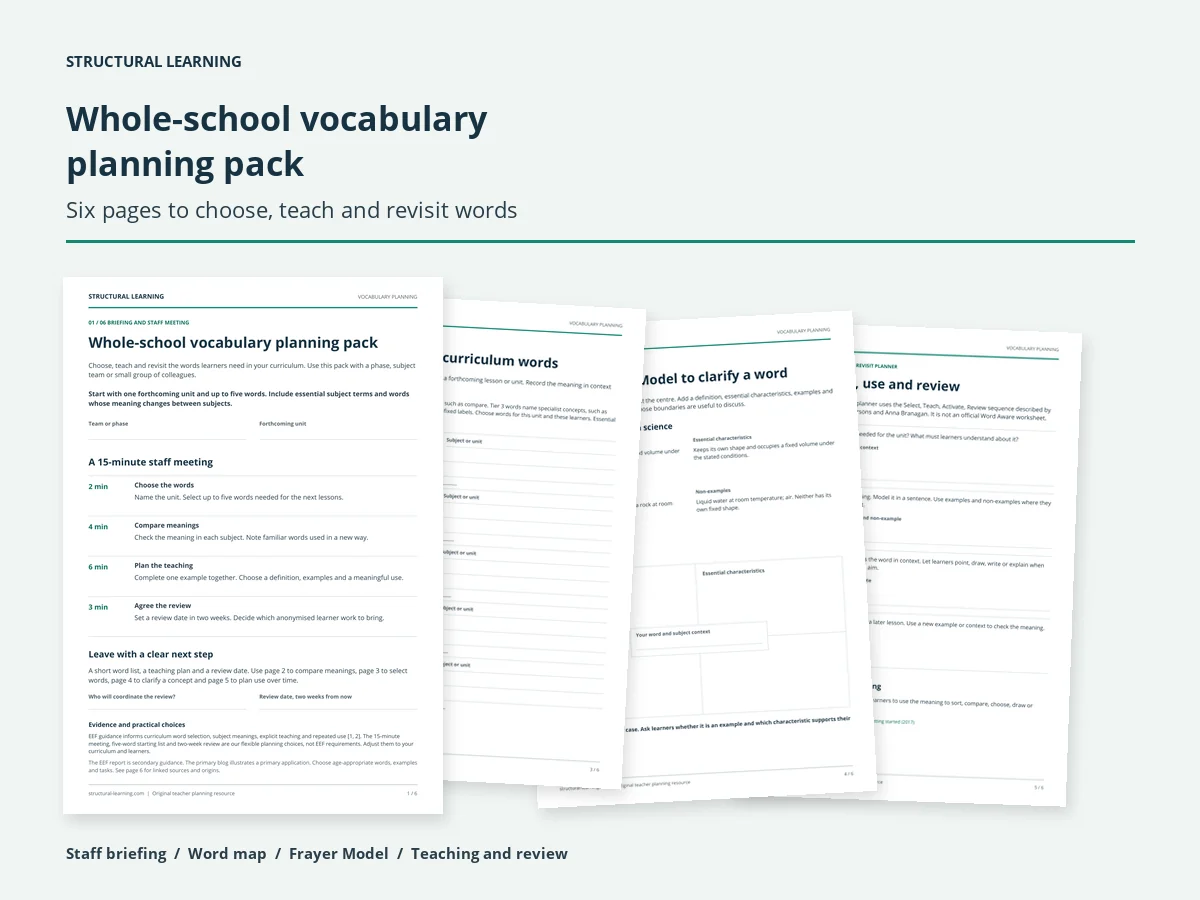
Vocabulary Tiers: Teaching Tier 2 and Tier 3 VocabularyVocabulary Tiers: Teaching Tier 2 and Tier 3 Vocabulary - educational concept illustration

Updated on  

March 3, 2026

Vocabulary Tiers: Teaching Tier 2 and Tier 3 Vocabulary

|

March 2, 2026

Teaching Tier 2 and Tier 3 vocabulary effectively requires understanding which words to prioritise and how to make them stick with your students.

Teaching Tier 2 and Tier 3 vocabulary effectively requires understanding which words to prioritise and how to make them stick with your students. This strategic approach, developed by Isabel Beck, Margaret McKeown, and Linda Kucan, focuses on high-utility academic words (Tier 2) that appear across subjects and domain-specific technical terms (Tier 3) that are essential for subject mastery. Rather than overwhelming students with random word lists, successful vocabulary instruction targets these carefully selected words using proven methods that build deep understanding. The difference between students who struggle with academic texts and those who thrive often comes down to this systematic approach to vocabulary development.

Key Takeaways

  1. Vocabulary Gaps Lock Students Out: Students who don't understand 'analyse' or 'evaluate' can't access top grades, regardless of their subject knowledge in any discipline.
  2. Tier 2 Words Appear Everywhere: Words like 'compare', 'significant', and 'justify' unlock exam success across English, Science, History, Geography, and Maths simultaneously.
  3. Most Schools Miss the Priority: Teachers focus on subject-specific terms but ignore the academic vocabulary that determines whether students understand exam questions.
  4. Physical Cards Build Word Power: The Thinking Framework transforms abstract command words into concrete actions, making 'compare' and 'evaluate' stick in memory.

The research is clear: vocabulary knowledge is one of the strongest predictors of reading comprehension (Cunningham and Stanovich, 1997) and academic achievement across all subjects. Students who enter secondary school with a limited vocabulary face a compounding disadvantage. Each year, the gap between word-rich and word-poor students widens because vocabulary enables access to increasingly complex text, which in turn builds more vocabulary.

The Three-Tier Vocabulary Pyramid infographic for teachers
The Three-Tier Vocabulary Pyramid

What Are Vocabulary Tiers?

Tier 1: Everyday Words

Tier 1 words are basic, high-frequency words that most students acquire through everyday conversation. Examples: table, happy, run, big, house. These words rarely need explicit teaching for native English speakers, though they may need direct instruction for students learning English as an additional language.

An infographic showing the Matthew Effect Cycle for vocabulary. It illustrates how strong vocabulary leads to accessing complex texts, which deepens learning, improves reading fluency, and fosters academic growth, creating a positive feedback loop.
Matthew Effect Cycle

Tier 2: High-Utility Academic Words

Tier 2 words are the priority for classroom vocabulary instruction. They appear across multiple subjects, carry precise meanings, and distinguish fluent academic readers from struggling ones. Examples:

  • analyse (used in English, Science, History, Geography, Maths)
  • compare (appears in virtually every subject)
  • significant (History, Science, PSHE)
  • justify (Maths, English, Design Technology)
  • evaluate (ubiquitous in exam command words)
  • consequence (History, PSHE, Science)

A Year 7 student who understands "analyse" can access exam questions in every subject. A student who does not understand it is locked out of the highest grades regardless of their subject knowledge. This is why Tier 2 vocabulary instruction has the highest return on investment of any vocabulary teaching.

The Structural Learning Thinking Framework aligns with Tier 2 vocabulary because its thinking skills use precisely these kinds of words. When students learn to "Categorise," "Compare," "Sequence," or "Evaluate" using the Thinking Framework cards, they are simultaneously building the Tier 2 vocabulary they need for academic success. The orange "Target" vocabulary cards specifically scaffold students to identify and use precise academic language.

Tier 3: Domain-Specific Technical Words

Tier 3 words belong to particular subjects. They are essential within that domain but rarely transfer. Examples:

  • photosynthesis (Science)
  • isosceles (Maths)
  • onomatopoeia (English)
  • tectonic (Geography)
  • feudalism (History)

These words are typically taught within their subject context and supported by textbooks, displays, and glossaries. Most subject teachers already teach Tier 3 vocabulary. The gap in most schools is Tier 2.

Vocabulary Tiers Quick Reference Guide

| Tier | Type | Examples | Who Teaches It | Teaching Priority |

|------|------|----------|---------------|------------------|

| Tier 1 | Everyday words | run, happy, table | Acquired naturally (EAL exception) | Low for most students |

| Tier 2 | Academic words | analyse, compare, significant, justify | Every teacher, every lesson | Highest priority |

| Tier 3 | Technical terms | photosynthesis, isosceles, onomatopoeia | Subject specialists | High within subject |

Why Tier 2 Vocabulary Matters Most

The Matthew Effect in Vocabulary

Keith Stanovich (1986) described the "Matthew Effect" in reading: students who read well read more, learn more words, and read even better. Students who struggle read less, learn fewer words, and fall further behind. Vocabulary is the mechanism through which this cycle operates.

A student with a strong Tier 2 vocabulary can access a GCSE History source about the "consequences of industrialisation" because they know what "consequences" and "industrialisation" mean independently of the History content. A student without that vocabulary must decode the question before they can even begin the History thinking.

This connects to cognitive load theory. When a student must spend working memory resources decoding unfamiliar words, they have fewer resources available for the actual subject content. Explicit Tier 2 instruction reduces this extraneous load by making the language of learning automatic.

Tier 2 and Exam Access

Every exam board in England uses Tier 2 vocabulary in its command words. A student who does not understand the difference between "describe" and "explain," or between "compare" and "evaluate," will underperform regardless of their subject knowledge.

| Command Word | Tier Level | What Students Must Do | Common Misunderstanding |

|-------------|-----------|----------------------|------------------------|

| Describe | Tier 2 | State features or characteristics | Confused with "explain" (adding reasons) |

Vocabulary tiers comparison infographic showing Tier 1, 2, and 3 words with key characteristics for educators
Vocabulary Tiers Compared

| Explain | Tier 2 | Give reasons for why something happens | Students describe instead of explaining |

| Compare | Tier 2 | Identify similarities and differences | Students write about each thing separately |

| Evaluate | Tier 2 | Make a judgement supported by evidence | Students list points without weighing them |

| Analyse | Tier 2 | Break down into parts and examine relationships | Students summarise rather than unpick |

| Justify | Tier 2 | Give reasons to support a decision | Students state their opinion without evidence |

The Structural Learning Thinking Framework makes these command words concrete through physical manipulation. When students use the blue "Compare" card, they physically sort similarities and differences. When they use the red "Evaluate" card, they rank and weigh evidence. The physical action builds understanding of the vocabulary in a way that dictionary definitions cannot.

Five Evidence-Based Tier 2 Teaching Strategies

Strategy 1: Explicit Instruction with Multiple Exposures

Beck, McKeown, and Kucan (2002) recommend that students need 12 or more encounters with a word before it becomes part of their active vocabulary. A single definition on the board is not enough. Design instruction so that students meet each target word in multiple contexts across multiple lessons.

A school teaching the word "significant" might:

  • Define it in a History lesson: "Significant means important enough to be worth attention"
  • Use it in Science: "The results show a significant increase in temperature"
  • Apply it in English: "Identify a significant moment in the protagonist's development"
  • Retrieve it using a retrieval grid: "What does 'significant' mean? Use it in a sentence from today's lesson"
  • Display it on a Tier 2 vocabulary wall visible in all classrooms

Strategy 2: The Frayer Model

The Frayer Model is a graphic organiser that builds deep word knowledge by exploring four dimensions: definition, characteristics, examples, and non-examples. Using the Structural Learning Map It approach, students organise their understanding visually:

| Definition | Characteristics |

|-----------|----------------|

| What it means in your own words | Features of the concept |

| Examples | Non-Examples |

| Situations where it applies | Situations where it does not apply |

For the word "resilience":

  • Definition: The ability to recover from setbacks and keep working
  • Characteristics: Persistence, flexibility, willingness to try again
  • Examples: A student who gets a low score and asks for feedback; a footballer who misses a penalty and takes the next one
  • Non-Examples: Giving up after one attempt; refusing to try something difficult; blaming others

The Frayer Model works because it forces elaborative processing. Students must think about the word from multiple angles, creating richer memory traces than a simple definition (Craik and Lockhart, 1972).

Strategy 3: Morphological Awareness

Teaching students to break words into meaningful parts (prefixes, roots, suffixes) gives them tools to decode unfamiliar words independently. This is particularly effective for Tier 2 and Tier 3 vocabulary.

| Root/Prefix/Suffix | Meaning | Example Words |

|--------------------|---------|---------------|

| -tion / -sion | The process of | evaporation, conclusion, decision |

| re- | Again | retrieve, reconstruct, reconsider |

| un- | Not | unreliable, unprecedented, uncertain |

| -ify | To make | classify, simplify, justify |

| inter- | Between | interleave, interact, international |

| -ment | The result of | development, assessment, achievement |

Vocabulary tiers pyramid diagram showing three-tier classification system for educational words
Three-tier pyramid diagram: Vocabulary Tiers Classification System

| pre- | Before | predict, prerequisite, preview |

A teacher who explicitly teaches these patterns equips students to handle thousands of unfamiliar words. When a Year 9 student encounters "unprecedented" in a History source, they can decode it: un- (not) + precedent (something that happened before) + -ed (past state) = something that has never happened before.

Strategy 4: Contextual Learning Through Wide Reading

Direct instruction is necessary, but insufficient. Students also need extensive exposure to Tier 2 words through reading. The research on reading volume and vocabulary acquisition (Cunningham and Stanovich, 1997) shows that students who read widely encounter and absorb vocabulary at rates that no amount of direct teaching can match.

Combine explicit instruction with structured reading activities. Use reciprocal reading approaches where students identify unfamiliar Tier 2 words during the "clarify" phase. The Thinking Framework's orange "Target" vocabulary cards prompt students to circle, define, and then use unfamiliar words, creating a repeatable vocabulary routine within any reading activity.

Strategy 5: Word-Conscious Classrooms

Create an environment where noticing and discussing words is normal. Practical steps:

  • Maintain a class Tier 2 word wall that grows weekly
  • Award "word detective" recognition when students spot Tier 2 words in unexpected contexts
  • Use a "word of the week" with a challenge to use it correctly in three different lessons
  • When students use imprecise language, prompt them: "Can you find a more precise word?"

This approach develops metacognitive awareness of language. Students begin to notice their own vocabulary gaps and actively work to fill them.

Tier 2 vs Tier 3: Which Words Should You Teach? infographic for teachers
Tier 2 vs Tier 3: Which Words Should You Teach?

Age-Appropriate Vocabulary Instruction by Key Stage

KS1-2 (Ages 5-11)

Focus on building a strong Tier 2 foundation. Primary teachers often teach Tier 3 well (subject vocabulary on displays) but neglect Tier 2. Target words that will transfer to secondary: similar, different, because, therefore, although, however.

A Year 3 teacher might use a simple vocabulary grid:

| Word | What It Means | Picture/Symbol | My Sentence |

|------|--------------|----------------|-------------|

| similar | Like something else, but not exactly the same | Two cats of different colours | The two stories have similar endings |

| compare | To look at two things and find what is the same and different | A balance scale | We can compare the weight of the objects |

KS3 (Ages 11-14)

This is the critical intervention point. Students arrive at secondary with wide variations in Tier 2 vocabulary. A whole-school approach is needed: every subject teacher explicitly teaches 5-10 Tier 2 words per half term, with shared definitions and consistent usage.

Create a cross-curricular vocabulary document that maps which Tier 2 words each department teaches and when. This prevents gaps and creates interleaving: students meet the same words in different subject contexts.

KS4-5 (Ages 14-18)

At GCSE and A-Level, Tier 2 vocabulary becomes inseparable from exam technique. Students need to understand command words (see table above) and subject-specific academic language. Vocabulary instruction at this stage should focus on precision: the difference between "affect" and "effect," between "infer" and "imply," between "correlation" and "causation."

Supporting SEND Students with Vocabulary

Students with special educational needs often have significant vocabulary gaps that compound their other learning difficulties. Students with speech and language needs, those on the autism spectrum, and students with specific learning difficulties all benefit from structured vocabulary approaches.

Key adaptations:

  • Visual supports: Use images alongside every new word. The Structural Learning Thinking Framework cards provide visual anchors for abstract Tier 2 concepts.
  • Overlearning: SEND students may need 20-30 exposures rather than 12. Build vocabulary retrieval into daily routines.
  • Physical manipulation: Sort word cards into tiers. Match words to definitions. Use the Map It approach to physically organise vocabulary.
  • Reduced load: Teach fewer words more deeply rather than many words superficially.
  • Pre-teaching: Introduce key vocabulary before the lesson so SEND students can focus on content rather than decoding words.

Why Tier 2 Vocabulary Unlocks Academic Success infographic for teachers
Why Tier 2 Vocabulary Unlocks Academic Success

AI-Powered Vocabulary Assessment and Intervention

Adaptive assessment platforms now identify tier 2 vocabulary gaps automatically as students write, eliminating the guesswork from vocabulary instruction. Natural language processing algorithms scan student work in real-time, flagging when pupils avoid sophisticated vocabulary or misuse academic terms. Teachers receive instant diagnostic reports showing precisely which tier 2 words each student lacks, transforming vocabulary assessment from annual testing to continuous monitoring.

Machine learning vocabulary systems create personalised pathways based on individual gap analysis. When Year 8 students submit geography coursework, AI diagnostic tools might identify that Sarah avoids "significant" and "consequence" whilst overusing basic connectives like "and" and "because." The system immediately generates targeted activities practising these missing tier 2 words within geographical contexts. This automated gap analysis means teachers spend less time diagnosing and more time teaching.

Real-time assessment enables immediate intervention during lessons. As students type responses to exam-style questions, intelligent tutoring systems suggest tier 2 alternatives when pupils choose tier 1 words. Research by Chen and Wang (2024) demonstrates that students using AI-powered vocabulary scaffolding showed 23% greater improvement in academic writing compared to traditional word list approaches. The technology prompts students to replace "big" with "significant" or "shows" with "demonstrates" at the point of writing.

The most effective implementations combine human expertise with machine precision. Teachers use AI-generated vocabulary reports to inform whole-class instruction whilst maintaining their professional judgement about individual student needs. This approach ensures that vocabulary intervention becomes systematic rather than accidental, addressing the persistent challenge of identifying which students need which words at which moment.

Understanding the Three-Tier Vocabulary Framework

The three-tier vocabulary framework transforms how teachers think about word instruction by categorising vocabulary into distinct levels of complexity and utility. Rather than treating all words equally, this evidence-based system helps teachers identify which words deserve precious classroom time and which can be learned through everyday exposure.

Tier 1 consists of basic words that most students acquire naturally through conversation and daily life: words like 'book', 'happy', or 'run'. These rarely need explicit teaching except for English language learners. Tier 2 includes sophisticated academic words that appear across multiple subjects, such as 'analyse', 'significant', or 'interpret'. These high-utility words unlock understanding across the curriculum and directly impact exam performance. Tier 3 encompasses specialised vocabulary specific to individual subjects: 'photosynthesis' in biology, 'alliteration' in English, or 'hypotenuse' in mathematics.

Research by Beck, McKeown and Kucan (2002) demonstrates that focusing instruction on Tier 2 words provides the greatest return on teaching investment. A student who masters 'evaluate' can apply this skill in history essays, science investigations, and literature analysis. Meanwhile, Tier 3 words, whilst essential for subject mastery, have limited transfer value beyond their specific domain.

In practise, successful teachers use this framework to make strategic decisions about vocabulary instruction. During a Year 8 history lesson on the Industrial Revolution, for instance, a teacher might briefly define Tier 1 words like 'factory' if needed, spend substantial time unpacking Tier 2 words like 'consequence' and 'transform', and explicitly teach Tier 3 terms like 'urbanisation' and 'mechanisation' as they arise in context. This targeted approach ensures students build both the academic language needed for cross-curricular success and the technical vocabulary required for subject expertise.

Tier 1 Vocabulary: The Foundation of Everyday Language

Tier 1 vocabulary consists of the basic words children learn naturally through everyday conversation and early reading. These are words like 'house', 'run', 'happy', and 'big' that most students acquire without explicit instruction. By the time children enter primary school, they typically know between 2,500 and 5,000 of these fundamental words (Biemiller, 2001). These words form the bedrock upon which more complex vocabulary builds.

For most students, Tier 1 words require minimal classroom attention because they're picked up through daily interactions at home and in the community. However, teachers shouldn't assume all students arrive with the same foundation. Children from language-rich homes may enter school knowing 6,000 words, whilst those from less advantaged backgrounds might know only 3,000. This early gap has profound implications for later learning, as students with stronger Tier 1 foundations find it easier to grasp Tier 2 and Tier 3 vocabulary.

Teachers can quickly assess Tier 1 gaps through simple picture-naming activities or basic comprehension checks during guided reading. When gaps appear, addressing them becomes urgent; a Year 7 student who doesn't know words like 'beneath' or 'similar' will struggle to understand more complex academic language. Support strategies include pairing pictures with words, using gesture and demonstration, and ensuring these students hear the words repeatedly in meaningful contexts. Remember, whilst Tier 1 words seem simple, they're the essential scaffolding that supports all academic vocabulary development.

Measuring Vocabulary Growth

Track vocabulary development through:

  • Termly vocabulary assessments (can students define and use target words?)
  • Retrieval practise grids that include vocabulary questions
  • Writing analysis: count the frequency and accuracy of Tier 2 words in student writing
  • Student self-assessment: "Rate your confidence with each word: green, amber, red"

Research by Beck and McKeown (2007) found that students who received strong vocabulary instruction used target words four times more frequently in their writing and showed significantly better reading comprehension than control groups. The investment in Tier 2 vocabulary teaching pays compound returns across every subject.

Next lesson, identify three Tier 2 words that will appear in your teaching. Define them explicitly, use them repeatedly, and ask students to use them in their responses. Track which words stick and which need more practise.

Further Reading: Key Research Papers

These peer-reviewed studies provide the research foundation for the strategies discussed in this article:

Kindergarten Teachers' Vocabulary Knowledge, Practices, and Influential Factors: A Multiple Case Study View study ↗
2 citations

Tara Johnston (2024)

This study reveals that kindergarten teachers often lack knowledge about effective vocabulary instruction strategies, particularly for multilingual learners and students with reading difficulties. The research highlights significant gaps in teacher preparation and suggests that many educators rely on inconsistent approaches that may not serve all students effectively. These findings underscore the urgent need for better professional development and training in evidence-based vocabulary instruction methods.

Flipped classroom with gamified technology and paper-based method for teaching vocabulary View study ↗
31 citations

Damar Isti Pratiwi et al. (2024)

This research compared digital games with traditional paper-based activities in flipped classroom vocabulary instruction, finding benefits and drawbacks to both approaches. The study helps teachers understand when technology enhances learning versus when simpler methods might be more effective. These findings are particularly valuable for educators trying to balance innovative teaching tools with proven traditional methods in their vocabulary instruction.

Loading audit...

Teaching Tier 2 and Tier 3 vocabulary effectively requires understanding which words to prioritise and how to make them stick with your students. This strategic approach, developed by Isabel Beck, Margaret McKeown, and Linda Kucan, focuses on high-utility academic words (Tier 2) that appear across subjects and domain-specific technical terms (Tier 3) that are essential for subject mastery. Rather than overwhelming students with random word lists, successful vocabulary instruction targets these carefully selected words using proven methods that build deep understanding. The difference between students who struggle with academic texts and those who thrive often comes down to this systematic approach to vocabulary development.

Key Takeaways

  1. Vocabulary Gaps Lock Students Out: Students who don't understand 'analyse' or 'evaluate' can't access top grades, regardless of their subject knowledge in any discipline.
  2. Tier 2 Words Appear Everywhere: Words like 'compare', 'significant', and 'justify' unlock exam success across English, Science, History, Geography, and Maths simultaneously.
  3. Most Schools Miss the Priority: Teachers focus on subject-specific terms but ignore the academic vocabulary that determines whether students understand exam questions.
  4. Physical Cards Build Word Power: The Thinking Framework transforms abstract command words into concrete actions, making 'compare' and 'evaluate' stick in memory.

The research is clear: vocabulary knowledge is one of the strongest predictors of reading comprehension (Cunningham and Stanovich, 1997) and academic achievement across all subjects. Students who enter secondary school with a limited vocabulary face a compounding disadvantage. Each year, the gap between word-rich and word-poor students widens because vocabulary enables access to increasingly complex text, which in turn builds more vocabulary.

The Three-Tier Vocabulary Pyramid infographic for teachers
The Three-Tier Vocabulary Pyramid

What Are Vocabulary Tiers?

Tier 1: Everyday Words

Tier 1 words are basic, high-frequency words that most students acquire through everyday conversation. Examples: table, happy, run, big, house. These words rarely need explicit teaching for native English speakers, though they may need direct instruction for students learning English as an additional language.

An infographic showing the Matthew Effect Cycle for vocabulary. It illustrates how strong vocabulary leads to accessing complex texts, which deepens learning, improves reading fluency, and fosters academic growth, creating a positive feedback loop.
Matthew Effect Cycle

Tier 2: High-Utility Academic Words

Tier 2 words are the priority for classroom vocabulary instruction. They appear across multiple subjects, carry precise meanings, and distinguish fluent academic readers from struggling ones. Examples:

  • analyse (used in English, Science, History, Geography, Maths)
  • compare (appears in virtually every subject)
  • significant (History, Science, PSHE)
  • justify (Maths, English, Design Technology)
  • evaluate (ubiquitous in exam command words)
  • consequence (History, PSHE, Science)

A Year 7 student who understands "analyse" can access exam questions in every subject. A student who does not understand it is locked out of the highest grades regardless of their subject knowledge. This is why Tier 2 vocabulary instruction has the highest return on investment of any vocabulary teaching.

The Structural Learning Thinking Framework aligns with Tier 2 vocabulary because its thinking skills use precisely these kinds of words. When students learn to "Categorise," "Compare," "Sequence," or "Evaluate" using the Thinking Framework cards, they are simultaneously building the Tier 2 vocabulary they need for academic success. The orange "Target" vocabulary cards specifically scaffold students to identify and use precise academic language.

Tier 3: Domain-Specific Technical Words

Tier 3 words belong to particular subjects. They are essential within that domain but rarely transfer. Examples:

  • photosynthesis (Science)
  • isosceles (Maths)
  • onomatopoeia (English)
  • tectonic (Geography)
  • feudalism (History)

These words are typically taught within their subject context and supported by textbooks, displays, and glossaries. Most subject teachers already teach Tier 3 vocabulary. The gap in most schools is Tier 2.

Vocabulary Tiers Quick Reference Guide

| Tier | Type | Examples | Who Teaches It | Teaching Priority |

|------|------|----------|---------------|------------------|

| Tier 1 | Everyday words | run, happy, table | Acquired naturally (EAL exception) | Low for most students |

| Tier 2 | Academic words | analyse, compare, significant, justify | Every teacher, every lesson | Highest priority |

| Tier 3 | Technical terms | photosynthesis, isosceles, onomatopoeia | Subject specialists | High within subject |

Why Tier 2 Vocabulary Matters Most

The Matthew Effect in Vocabulary

Keith Stanovich (1986) described the "Matthew Effect" in reading: students who read well read more, learn more words, and read even better. Students who struggle read less, learn fewer words, and fall further behind. Vocabulary is the mechanism through which this cycle operates.

A student with a strong Tier 2 vocabulary can access a GCSE History source about the "consequences of industrialisation" because they know what "consequences" and "industrialisation" mean independently of the History content. A student without that vocabulary must decode the question before they can even begin the History thinking.

This connects to cognitive load theory. When a student must spend working memory resources decoding unfamiliar words, they have fewer resources available for the actual subject content. Explicit Tier 2 instruction reduces this extraneous load by making the language of learning automatic.

Tier 2 and Exam Access

Every exam board in England uses Tier 2 vocabulary in its command words. A student who does not understand the difference between "describe" and "explain," or between "compare" and "evaluate," will underperform regardless of their subject knowledge.

| Command Word | Tier Level | What Students Must Do | Common Misunderstanding |

|-------------|-----------|----------------------|------------------------|

| Describe | Tier 2 | State features or characteristics | Confused with "explain" (adding reasons) |

Vocabulary tiers comparison infographic showing Tier 1, 2, and 3 words with key characteristics for educators
Vocabulary Tiers Compared

| Explain | Tier 2 | Give reasons for why something happens | Students describe instead of explaining |

| Compare | Tier 2 | Identify similarities and differences | Students write about each thing separately |

| Evaluate | Tier 2 | Make a judgement supported by evidence | Students list points without weighing them |

| Analyse | Tier 2 | Break down into parts and examine relationships | Students summarise rather than unpick |

| Justify | Tier 2 | Give reasons to support a decision | Students state their opinion without evidence |

The Structural Learning Thinking Framework makes these command words concrete through physical manipulation. When students use the blue "Compare" card, they physically sort similarities and differences. When they use the red "Evaluate" card, they rank and weigh evidence. The physical action builds understanding of the vocabulary in a way that dictionary definitions cannot.

Five Evidence-Based Tier 2 Teaching Strategies

Strategy 1: Explicit Instruction with Multiple Exposures

Beck, McKeown, and Kucan (2002) recommend that students need 12 or more encounters with a word before it becomes part of their active vocabulary. A single definition on the board is not enough. Design instruction so that students meet each target word in multiple contexts across multiple lessons.

A school teaching the word "significant" might:

  • Define it in a History lesson: "Significant means important enough to be worth attention"
  • Use it in Science: "The results show a significant increase in temperature"
  • Apply it in English: "Identify a significant moment in the protagonist's development"
  • Retrieve it using a retrieval grid: "What does 'significant' mean? Use it in a sentence from today's lesson"
  • Display it on a Tier 2 vocabulary wall visible in all classrooms

Strategy 2: The Frayer Model

The Frayer Model is a graphic organiser that builds deep word knowledge by exploring four dimensions: definition, characteristics, examples, and non-examples. Using the Structural Learning Map It approach, students organise their understanding visually:

| Definition | Characteristics |

|-----------|----------------|

| What it means in your own words | Features of the concept |

| Examples | Non-Examples |

| Situations where it applies | Situations where it does not apply |

For the word "resilience":

  • Definition: The ability to recover from setbacks and keep working
  • Characteristics: Persistence, flexibility, willingness to try again
  • Examples: A student who gets a low score and asks for feedback; a footballer who misses a penalty and takes the next one
  • Non-Examples: Giving up after one attempt; refusing to try something difficult; blaming others

The Frayer Model works because it forces elaborative processing. Students must think about the word from multiple angles, creating richer memory traces than a simple definition (Craik and Lockhart, 1972).

Strategy 3: Morphological Awareness

Teaching students to break words into meaningful parts (prefixes, roots, suffixes) gives them tools to decode unfamiliar words independently. This is particularly effective for Tier 2 and Tier 3 vocabulary.

| Root/Prefix/Suffix | Meaning | Example Words |

|--------------------|---------|---------------|

| -tion / -sion | The process of | evaporation, conclusion, decision |

| re- | Again | retrieve, reconstruct, reconsider |

| un- | Not | unreliable, unprecedented, uncertain |

| -ify | To make | classify, simplify, justify |

| inter- | Between | interleave, interact, international |

| -ment | The result of | development, assessment, achievement |

Vocabulary tiers pyramid diagram showing three-tier classification system for educational words
Three-tier pyramid diagram: Vocabulary Tiers Classification System

| pre- | Before | predict, prerequisite, preview |

A teacher who explicitly teaches these patterns equips students to handle thousands of unfamiliar words. When a Year 9 student encounters "unprecedented" in a History source, they can decode it: un- (not) + precedent (something that happened before) + -ed (past state) = something that has never happened before.

Strategy 4: Contextual Learning Through Wide Reading

Direct instruction is necessary, but insufficient. Students also need extensive exposure to Tier 2 words through reading. The research on reading volume and vocabulary acquisition (Cunningham and Stanovich, 1997) shows that students who read widely encounter and absorb vocabulary at rates that no amount of direct teaching can match.

Combine explicit instruction with structured reading activities. Use reciprocal reading approaches where students identify unfamiliar Tier 2 words during the "clarify" phase. The Thinking Framework's orange "Target" vocabulary cards prompt students to circle, define, and then use unfamiliar words, creating a repeatable vocabulary routine within any reading activity.

Strategy 5: Word-Conscious Classrooms

Create an environment where noticing and discussing words is normal. Practical steps:

  • Maintain a class Tier 2 word wall that grows weekly
  • Award "word detective" recognition when students spot Tier 2 words in unexpected contexts
  • Use a "word of the week" with a challenge to use it correctly in three different lessons
  • When students use imprecise language, prompt them: "Can you find a more precise word?"

This approach develops metacognitive awareness of language. Students begin to notice their own vocabulary gaps and actively work to fill them.

Tier 2 vs Tier 3: Which Words Should You Teach? infographic for teachers
Tier 2 vs Tier 3: Which Words Should You Teach?

Age-Appropriate Vocabulary Instruction by Key Stage

KS1-2 (Ages 5-11)

Focus on building a strong Tier 2 foundation. Primary teachers often teach Tier 3 well (subject vocabulary on displays) but neglect Tier 2. Target words that will transfer to secondary: similar, different, because, therefore, although, however.

A Year 3 teacher might use a simple vocabulary grid:

| Word | What It Means | Picture/Symbol | My Sentence |

|------|--------------|----------------|-------------|

| similar | Like something else, but not exactly the same | Two cats of different colours | The two stories have similar endings |

| compare | To look at two things and find what is the same and different | A balance scale | We can compare the weight of the objects |

KS3 (Ages 11-14)

This is the critical intervention point. Students arrive at secondary with wide variations in Tier 2 vocabulary. A whole-school approach is needed: every subject teacher explicitly teaches 5-10 Tier 2 words per half term, with shared definitions and consistent usage.

Create a cross-curricular vocabulary document that maps which Tier 2 words each department teaches and when. This prevents gaps and creates interleaving: students meet the same words in different subject contexts.

KS4-5 (Ages 14-18)

At GCSE and A-Level, Tier 2 vocabulary becomes inseparable from exam technique. Students need to understand command words (see table above) and subject-specific academic language. Vocabulary instruction at this stage should focus on precision: the difference between "affect" and "effect," between "infer" and "imply," between "correlation" and "causation."

Supporting SEND Students with Vocabulary

Students with special educational needs often have significant vocabulary gaps that compound their other learning difficulties. Students with speech and language needs, those on the autism spectrum, and students with specific learning difficulties all benefit from structured vocabulary approaches.

Key adaptations:

  • Visual supports: Use images alongside every new word. The Structural Learning Thinking Framework cards provide visual anchors for abstract Tier 2 concepts.
  • Overlearning: SEND students may need 20-30 exposures rather than 12. Build vocabulary retrieval into daily routines.
  • Physical manipulation: Sort word cards into tiers. Match words to definitions. Use the Map It approach to physically organise vocabulary.
  • Reduced load: Teach fewer words more deeply rather than many words superficially.
  • Pre-teaching: Introduce key vocabulary before the lesson so SEND students can focus on content rather than decoding words.

Why Tier 2 Vocabulary Unlocks Academic Success infographic for teachers
Why Tier 2 Vocabulary Unlocks Academic Success

AI-Powered Vocabulary Assessment and Intervention

Adaptive assessment platforms now identify tier 2 vocabulary gaps automatically as students write, eliminating the guesswork from vocabulary instruction. Natural language processing algorithms scan student work in real-time, flagging when pupils avoid sophisticated vocabulary or misuse academic terms. Teachers receive instant diagnostic reports showing precisely which tier 2 words each student lacks, transforming vocabulary assessment from annual testing to continuous monitoring.

Machine learning vocabulary systems create personalised pathways based on individual gap analysis. When Year 8 students submit geography coursework, AI diagnostic tools might identify that Sarah avoids "significant" and "consequence" whilst overusing basic connectives like "and" and "because." The system immediately generates targeted activities practising these missing tier 2 words within geographical contexts. This automated gap analysis means teachers spend less time diagnosing and more time teaching.

Real-time assessment enables immediate intervention during lessons. As students type responses to exam-style questions, intelligent tutoring systems suggest tier 2 alternatives when pupils choose tier 1 words. Research by Chen and Wang (2024) demonstrates that students using AI-powered vocabulary scaffolding showed 23% greater improvement in academic writing compared to traditional word list approaches. The technology prompts students to replace "big" with "significant" or "shows" with "demonstrates" at the point of writing.

The most effective implementations combine human expertise with machine precision. Teachers use AI-generated vocabulary reports to inform whole-class instruction whilst maintaining their professional judgement about individual student needs. This approach ensures that vocabulary intervention becomes systematic rather than accidental, addressing the persistent challenge of identifying which students need which words at which moment.

Understanding the Three-Tier Vocabulary Framework

The three-tier vocabulary framework transforms how teachers think about word instruction by categorising vocabulary into distinct levels of complexity and utility. Rather than treating all words equally, this evidence-based system helps teachers identify which words deserve precious classroom time and which can be learned through everyday exposure.

Tier 1 consists of basic words that most students acquire naturally through conversation and daily life: words like 'book', 'happy', or 'run'. These rarely need explicit teaching except for English language learners. Tier 2 includes sophisticated academic words that appear across multiple subjects, such as 'analyse', 'significant', or 'interpret'. These high-utility words unlock understanding across the curriculum and directly impact exam performance. Tier 3 encompasses specialised vocabulary specific to individual subjects: 'photosynthesis' in biology, 'alliteration' in English, or 'hypotenuse' in mathematics.

Research by Beck, McKeown and Kucan (2002) demonstrates that focusing instruction on Tier 2 words provides the greatest return on teaching investment. A student who masters 'evaluate' can apply this skill in history essays, science investigations, and literature analysis. Meanwhile, Tier 3 words, whilst essential for subject mastery, have limited transfer value beyond their specific domain.

In practise, successful teachers use this framework to make strategic decisions about vocabulary instruction. During a Year 8 history lesson on the Industrial Revolution, for instance, a teacher might briefly define Tier 1 words like 'factory' if needed, spend substantial time unpacking Tier 2 words like 'consequence' and 'transform', and explicitly teach Tier 3 terms like 'urbanisation' and 'mechanisation' as they arise in context. This targeted approach ensures students build both the academic language needed for cross-curricular success and the technical vocabulary required for subject expertise.

Tier 1 Vocabulary: The Foundation of Everyday Language

Tier 1 vocabulary consists of the basic words children learn naturally through everyday conversation and early reading. These are words like 'house', 'run', 'happy', and 'big' that most students acquire without explicit instruction. By the time children enter primary school, they typically know between 2,500 and 5,000 of these fundamental words (Biemiller, 2001). These words form the bedrock upon which more complex vocabulary builds.

For most students, Tier 1 words require minimal classroom attention because they're picked up through daily interactions at home and in the community. However, teachers shouldn't assume all students arrive with the same foundation. Children from language-rich homes may enter school knowing 6,000 words, whilst those from less advantaged backgrounds might know only 3,000. This early gap has profound implications for later learning, as students with stronger Tier 1 foundations find it easier to grasp Tier 2 and Tier 3 vocabulary.

Teachers can quickly assess Tier 1 gaps through simple picture-naming activities or basic comprehension checks during guided reading. When gaps appear, addressing them becomes urgent; a Year 7 student who doesn't know words like 'beneath' or 'similar' will struggle to understand more complex academic language. Support strategies include pairing pictures with words, using gesture and demonstration, and ensuring these students hear the words repeatedly in meaningful contexts. Remember, whilst Tier 1 words seem simple, they're the essential scaffolding that supports all academic vocabulary development.

Measuring Vocabulary Growth

Track vocabulary development through:

  • Termly vocabulary assessments (can students define and use target words?)
  • Retrieval practise grids that include vocabulary questions
  • Writing analysis: count the frequency and accuracy of Tier 2 words in student writing
  • Student self-assessment: "Rate your confidence with each word: green, amber, red"

Research by Beck and McKeown (2007) found that students who received strong vocabulary instruction used target words four times more frequently in their writing and showed significantly better reading comprehension than control groups. The investment in Tier 2 vocabulary teaching pays compound returns across every subject.

Next lesson, identify three Tier 2 words that will appear in your teaching. Define them explicitly, use them repeatedly, and ask students to use them in their responses. Track which words stick and which need more practise.

Further Reading: Key Research Papers

These peer-reviewed studies provide the research foundation for the strategies discussed in this article:

Kindergarten Teachers' Vocabulary Knowledge, Practices, and Influential Factors: A Multiple Case Study View study ↗
2 citations

Tara Johnston (2024)

This study reveals that kindergarten teachers often lack knowledge about effective vocabulary instruction strategies, particularly for multilingual learners and students with reading difficulties. The research highlights significant gaps in teacher preparation and suggests that many educators rely on inconsistent approaches that may not serve all students effectively. These findings underscore the urgent need for better professional development and training in evidence-based vocabulary instruction methods.

Flipped classroom with gamified technology and paper-based method for teaching vocabulary View study ↗
31 citations

Damar Isti Pratiwi et al. (2024)

This research compared digital games with traditional paper-based activities in flipped classroom vocabulary instruction, finding benefits and drawbacks to both approaches. The study helps teachers understand when technology enhances learning versus when simpler methods might be more effective. These findings are particularly valuable for educators trying to balance innovative teaching tools with proven traditional methods in their vocabulary instruction.

Educational Technology

Back to Blog

<script type="application/ld+json">{"@context":"https://schema.org","@graph":[{"@type":"Article","@id":"https://www.structural-learning.com/post/vocabulary-tiers-teaching-tier-2-tier-3#article","headline":"Vocabulary Tiers: Teaching Tier 2 and Tier 3 Vocabulary","description":"Teaching Tier 2 and Tier 3 vocabulary effectively requires understanding which words to prioritise and how to make them stick with your students.","datePublished":"2026-03-02T16:01:26.475Z","dateModified":"2026-03-02T16:09:34.506Z","author":{"@type":"Person","name":"Paul Main","url":"https://www.structural-learning.com/team/paulmain","jobTitle":"Founder & Educational Consultant"},"publisher":{"@type":"Organization","name":"Structural Learning","url":"https://www.structural-learning.com","logo":{"@type":"ImageObject","url":"https://cdn.prod.website-files.com/5b69a01ba2e409e5d5e055c6/6040bf0426cb415ba2fc7882_newlogoblue.svg"}},"mainEntityOfPage":{"@type":"WebPage","@id":"https://www.structural-learning.com/post/vocabulary-tiers-teaching-tier-2-tier-3"},"image":"https://cdn.prod.website-files.com/5b69a01ba2e409501de055d1/69a5b4564a10824c71977e3c_69a5b3f165421d13cc402168_vocabulary-tiers-teaching-tier-framework-1772467185472.webp","wordCount":3191},{"@type":"BreadcrumbList","@id":"https://www.structural-learning.com/post/vocabulary-tiers-teaching-tier-2-tier-3#breadcrumb","itemListElement":[{"@type":"ListItem","position":1,"name":"Home","item":"https://www.structural-learning.com/"},{"@type":"ListItem","position":2,"name":"Blog","item":"https://www.structural-learning.com/blog"},{"@type":"ListItem","position":3,"name":"Vocabulary Tiers: Teaching Tier 2 and Tier 3 Vocabulary","item":"https://www.structural-learning.com/post/vocabulary-tiers-teaching-tier-2-tier-3"}]}]}</script>