Maximising Communication: How Language Link Transforms Primary ClassroomsMaximising Communication: How Language Link Transforms Primary Classrooms: practical strategies for teachers

Updated on  

June 13, 2026

Maximising Communication: How Language Link Transforms Primary Classrooms

|

June 13, 2026

A practical guide for teachers and SENCOs on using Language Link to identify and support learners with Speech, Language and Communication Needs (SLCN) in primary schools.

Key Takeaways

  • What It Is: Language Link is a digital assessment and intervention package used in UK primary schools to screen for receptive language difficulties and provide targeted support.
  • Purpose: It helps teachers identify learners with hidden Speech, Language and Communication Needs (SLCN) who might otherwise be missed, allowing for early, targeted intervention.
  • How It Works: The package involves whole-class online screening, which generates reports that group learners by need. It then provides structured intervention plans and resources for teachers and teaching assistants to deliver.
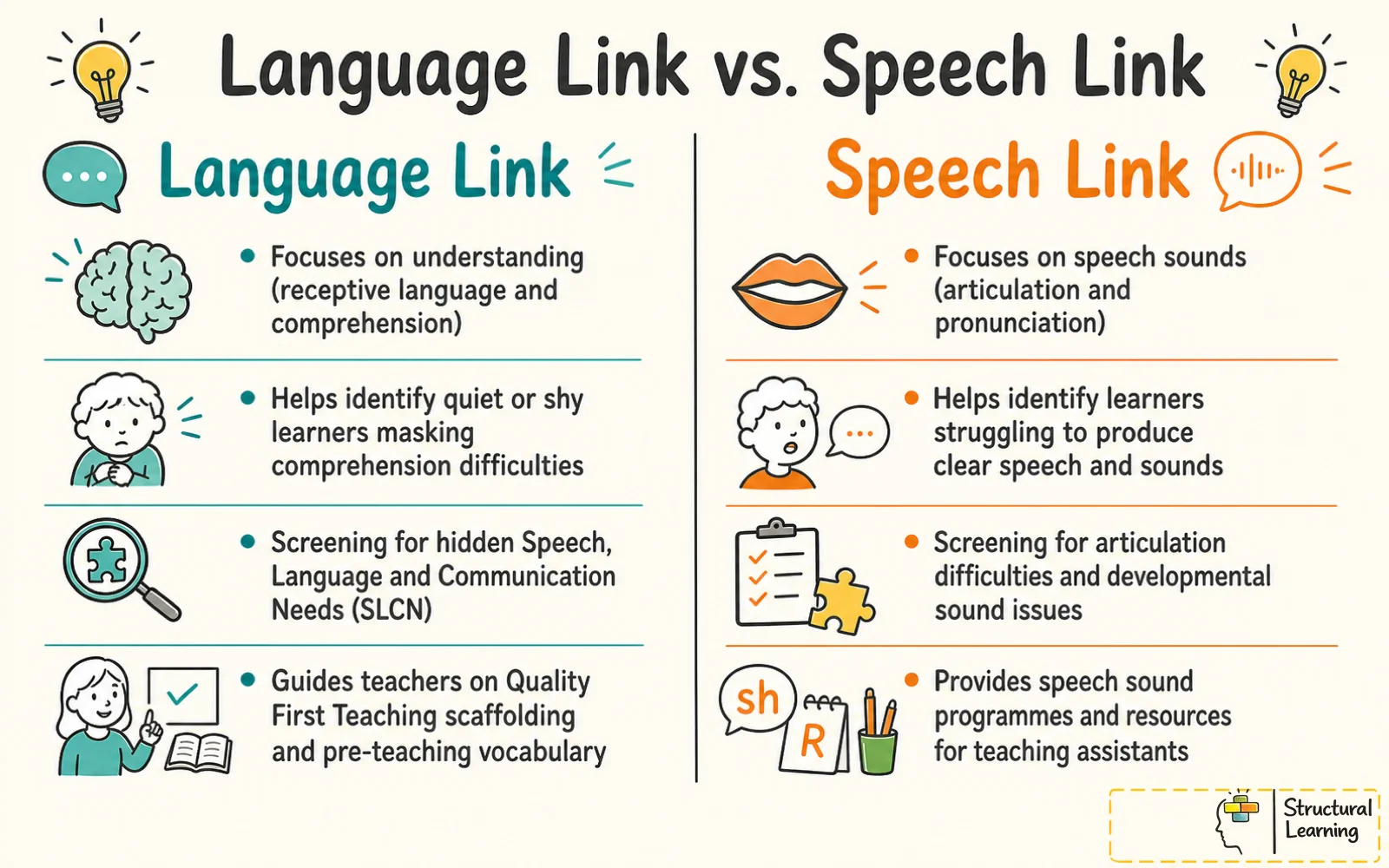
  • Key Distinction: Language Link focuses on understanding (receptive language), while its sister package, Speech Link, focuses on speech sounds (articulation). It is a screening tool, not a diagnostic one.
  • Classroom Connection: Results from Language Link inform Quality First Teaching by helping teachers scaffold language, pre-teach vocabulary and monitor comprehension for at-risk learners.

For busy teachers, spotting a quiet learner who is struggling to understand is one of the biggest challenges. Outwardly, they may seem well-behaved or simply shy. Inwardly, they may be missing crucial instructions and falling behind. Language Link is a digital package designed to bring these hidden difficulties to light. It provides a standardised assessment and intervention framework to help primary schools identify and support learners with underlying receptive language needs, directly in the classroom.

Comparison chart of Language Link versus Speech Link, contrasting receptive language comprehension with speech sound articulation in UK schools.
Language Link vs. Speech Link

This guide explains what Language Link is, how it works, and how to use its results to create effective support within a graduated SEND approach.

What is Language Link and Who is it For?

Language Link is a comprehensive assessment and intervention package designed for primary schools. Its primary function is to identify learners with potential receptive language difficulties, that is, problems with understanding spoken language. It is not designed to assess speech production (articulation), which is the focus of its sister programme, Speech Link.

The package is built for whole-class or targeted screening, enabling schools to quickly get a baseline of language comprehension skills across a year group. Following the assessment, it provides detailed reports and a suite of planned interventions for teachers and teaching assistants (TAs) to deliver.

Who is it for?

  • Primary School Learners: The assessments (Infant and Junior Link) are designed for children from Reception to Year 6.
  • SENCOs and Leadership: The tool provides school-wide data for tracking cohorts, allocating resources, and demonstrating provision to Ofsted.
  • Class Teachers: It offers insights and strategies to support learners through Quality First Teaching.
  • Teaching Assistants: It provides structured, easy-to-follow intervention plans and resources for small group work.

Who is it not for?

Language Link is a screening tool, not a diagnostic one. It flags learners who are at risk of having a language difficulty. A formal diagnosis of a Developmental Language Disorder (DLD) can only be made by a qualified Speech and Language Therapist (SaLT). The results from Language Link provide valuable evidence for a referral, but they do not replace the need for specialist assessment.

The Hidden Impact of Speech, Language and Communication Needs (SLCN)

Children with speech, language and communication needs (SLCN) are at significant risk of facing challenges in learning and behaviour (Feltner et al., 2024). Difficulties with oral language are a primary cause of later problems with reading comprehension and academic progress (Fricke et al., 2012; Rogde et al., 2019).

Many learners become experts at masking their difficulties. They might be highly articulate in social situations or copy their peers to follow instructions. This can lead teachers to misinterpret a lack of comprehension as defiance, poor attention or a lack of cooperation.

Signs of Hidden Language Difficulties in the Classroom

A learner struggling with receptive language might:

  • Appear to be listening but not retain instructions.
  • Successfully complete the first part of a multi-step instruction but not the rest.
  • Frequently watch and copy what other learners are doing before starting a task.
  • Provide answers that are off-topic or only relate to the last few words they heard.
  • Be labelled as ‘disruptive’ or ‘inattentive’ during whole-class teaching.

Universal screening is vital because it provides objective data that can uncover these hidden gaps, moving beyond behavioural labels to identify the underlying need.

How the Language Link Assessment and Interventions Work

The Language Link package is a cyclical process of assessment, planning, intervention and review, designed to fit within the UK's graduated approach to SEND.

1. The Assessment: Screening the Whole Class

The process begins with an online assessment. This is typically carried out with a whole class, with learners wearing headphones and listening to instructions. The assessment is gamified and interactive, designed to be engaging for young learners. It automatically adapts to the learner's ability, taking around 15-20 minutes to complete.
The assessment standardises the process, ensuring every child receives the same instructions in the same way, removing potential bias from adult delivery.

2. The Reports: Interpreting the Results

Once the assessment is complete, the software instantly generates reports. These reports typically use a Red, Amber, Green (RAG) rating system to indicate each learner's level of need compared to their peers.

  • Green: Learners are developing within the expected range.
  • Amber: Learners may have some language difficulties and would benefit from targeted support.
  • Red: Learners are showing significant difficulties and are at high risk. They require targeted intervention and may need a referral to a Speech and Language Therapist.

These reports provide a clear starting point for discussion between the class teacher, SENCO, and parents.

3. The Interventions: From Small Groups to Whole-Class Strategies

Based on the assessment results, Language Link provides a bank of resources.

  • Targeted Small Group Work: For learners in the 'Red' and 'Amber' bands, the package offers structured intervention plans. These are designed to be delivered by a TA over a set number of weeks. Each session is fully planned with printable resources, focusing on specific skills like understanding concepts, following instructions, or developing vocabulary.
  • Universal Quality First Teaching: The results also support class teachers to adapt their practice. A teacher might use the information to pre-teach vocabulary before a science lesson, use visual aids to support verbal instructions, or check for understanding with specific learners using targeted questions.

Implementation in the Classroom: A Practical Example

Let's consider a Year 5 Science class investigating thermal insulation. The teacher has used Junior Language Link and identified 'Leo' as a learner with low-average receptive language skills. He often masks his comprehension gaps by copying his peers.

The Ineffective Approach (High Language Demand): The teacher gives a multi-step verbal instruction: "First, wrap each of the beakers in the different materials, then use the thermometer to record the starting temperature on your sheet, and after ten minutes, record the finishing temperature before writing a conclusion to explain which was the most efficient insulator and why."

Leo is immediately overloaded. He hears the first part ("wrap the beakers") and the last part ("most efficient insulator") but misses the steps in between. He watches his partner and copies what they do, completing the task without understanding the scientific reasoning.

The Language Link-Informed Approach (Scaffolded): The teacher knows Leo's profile and adapts her language and resources.

  1. Breaking Down Instructions: She uses a visual planning sheet with simple diagrams for each step of the experiment. She gives one instruction at a time, pointing to the relevant diagram.
  2. Monitoring Comprehension: Instead of asking "Do you understand?", which often elicits a simple 'yes', she asks, "Leo, tell me in your own words what you need to do first."
  3. Forced Alternatives: While Leo is measuring, she asks a direct, closed question to focus his thinking: "Is the heat escaping or is it staying inside the beaker?"
  4. Scaffolded Justification: For the conclusion, she provides a sentence completion frame on the board for everyone to use: "The bubble wrap is the best insulator because..."

This scaffolded sequence allows Leo to access the science curriculum. He is not reliant on copying and can engage with the cognitive work of the lesson: explaining, justifying and providing evidence. The intervention shifts him from passive imitation to active reasoning.

Evidence, Limitations and Responsible Use

Oral language skills are foundational to educational success (West et al., 2021; Fricke et al., 2012). Evidence suggests that early language interventions can be effective when delivered at scale (West et al., 2021) and that intensive, small-group support can improve language and literacy development (Phillips et al., 2021). Oral language support can be effective even in the late primary years (Esposito et al., 2024).

However, it is crucial for schools to use screening tools like Language Link responsibly.

Limitations to Consider

  • Screening vs. Diagnosis: A screening tool identifies risk, not a disorder. Teachers and SENCOs should avoid the "RAG trap" of treating automated scores as a definitive diagnosis. They are an indicator, not a label, and must be combined with teacher observation and parental discussion.
  • Psychometric Gaps: Independent evaluation has noted that while useful, the standardisation samples for Language Link have limitations, including a geographic bias towards Southern England and a lack of standardisation on bilingual or multilingual populations. This means results for learners with English as an Additional Language (EAL) must be interpreted with particular care, as typical second-language acquisition patterns can be mistaken for a disorder.
  • Fidelity is Key: The effectiveness of the provided interventions depends on them being delivered as intended. This requires adequate time for TAs to prepare and run the groups, as well as ongoing support from the SENCO.

Language Link vs. Speech Link: What's the Difference?

It is a common point of confusion, but the two packages are designed for different purposes.

Feature Language Link Speech Link
Focus Understanding of language (receptive) Production of speech sounds (articulation/phonology)
Identifies Learners who struggle to understand words, concepts, and instructions. Learners who have difficulty saying specific sounds or words clearly.
Example A learner who can't follow a 3-part instruction. A learner who says "wabbit" instead of "rabbit".
Intervention Focuses on vocabulary, concepts, and sentence structure. Focuses on exercises to produce specific speech sounds.

A learner can have difficulties in one area, or both. The two packages are complementary and provide a comprehensive overview of a learner's speech and language profile.

A Checklist for SENCOs and Teachers

To ensure Language Link is used effectively and responsibly:

  • [ ] Plan for whole-cohort screening: Schedule time for assessments at the start of the academic year to establish a baseline.
  • [ ] Triangulate the data: Always discuss the RAG-rated results with the class teacher. Do the results match their classroom observations?
  • [ ] Involve parents early: Share the screening results as part of a supportive conversation, explaining what they mean and what the school's next steps will be.
  • [ ] Timetable the intervention: Ensure TAs have protected time to prepare for and deliver the small group sessions consistently.
  • [ ] Link to Quality First Teaching: Use a staff meeting to share the key patterns emerging from the data. How can all teachers adapt their language to support the 'Amber' learners?
  • [ ] Monitor progress: Use the built-in re-assessment tools to track progress. Is the intervention having an impact?
  • [ ] Know when to refer: For learners in the 'Red' band who are not making progress, use the Language Link reports as evidence for a referral to a Speech and Language Therapist.

Frequently Asked Questions

Is Language Link a replacement for a Speech and Language Therapist? No. It is a screening and intervention tool. A SaLT is a highly trained professional who can provide a formal diagnosis and specialist therapy for learners with complex needs. Language Link helps schools identify which learners need this specialist support.

How long do the TA-led interventions take? The interventions are designed as a block of sessions, typically running for around 10-12 weeks. Each small group session usually lasts for about 20-30 minutes and is repeated 2-3 times a week.

Can Language Link be used for learners with EAL? Yes, but with caution. The assessment is not standardised for bilingual learners. A low score for an EAL learner may reflect their stage of English acquisition rather than an underlying language disorder. The results should be used alongside a more broader assessment of their language skills in all languages they speak.


Your Next-Lesson Action

Choose one learner in your class who you suspect has difficulty following instructions. Before your next lesson, adapt one activity by creating a simple visual sequence or a sentence starter to scaffold the language. Observe if this small change helps them to engage with the task more independently.

Research sources

Further reading from peer-reviewed research

These 5 studies give source context for the classroom guidance in this article on Maximising Communication: How Language Link Transforms Primary Classrooms. They are included as starting points for deeper reading, not as a substitute for local professional judgement.

Randomised Controlled Trial 233 citations acamh.onlinelibrary.wiley.com

Efficacy of language intervention in the early years

Silke Fricke et al. (2012) | Journal of Child Psychology and Psychiatry

Keep the intervention routine structured and measurable so classroom use can be compared with baseline performance.

View study

Randomised Controlled Trial 38 citations acamh.onlinelibrary.wiley.com

Early language screening and intervention can be delivered successfully at scale: evidence from a cluster randomized controlled trial.

G. West et al. (2021) | Journal of Child Psychology and Psychiatry

Keep the intervention routine structured and measurable so classroom use can be compared with baseline performance.

View study

Peer Reviewed Study acamh.onlinelibrary.wiley.com

Oral language intervention in the late primary school years is effective: evidence from a randomised control trial

R. Esposito et al. (2024) | Journal of Child Psychology and Psychiatry

Translate the finding into explicit modelling, guided practice and progress monitoring rather than relying on one-off exposure.

View study

Randomised Controlled Trial 32 citations linkinghub.elsevier.com

Supporting language and literacy development with intensive small-group interventions: An early childhood efficacy study

Beth M. Phillips et al. (2021) | Early Childhood Research Quarterly

Keep the intervention routine structured and measurable so classroom use can be compared with baseline performance.

View study

Meta Analysis 29 citations journals.sagepub.com

Oral language interventions can improve language outcomes in children with neurodevelopmental disorders: A systematic review and meta‐analysis

Enrica Donolato et al. (2023) | Campbell Systematic Reviews

Use this as a caution: check learner fit, delivery quality and progress data before treating the approach as settled practice.

View study

Paul Main, Founder of Structural Learning
About the Author
Paul Main
Founder & Metacognition Researcher

Paul Main is an educator and metacognition researcher who founded Structural Learning in 2002. With a psychology degree from the University of Sunderland and 22+ years helping schools embed thinking skills, he bridges the gap between educational research and classroom practice. Fellow of the RSA and Chartered College of Teaching, with 128+ Google Scholar citations.

More →

SEND

Back to Blog