Updated on
September 24, 2026
B Squared Assessment: A SENCO's Complete Guide to SEND Data
A practical guide to B Squared assessment for SENCOs. Covers Connecting Steps, Engagement Profile, EHCP evidence, target-setting, moderation.


Updated on
September 24, 2026
A practical guide to B Squared assessment for SENCOs. Covers Connecting Steps, Engagement Profile, EHCP evidence, target-setting, moderation.
B Squared assessment gives SENCOs a shared way to record small steps of progress for learners working below National Curriculum expectations. Finally, a framework that acknowledged what we'd always known: learners with SEND don't develop in neat boxes. But the space that opened up was also the problem. Without a shared language for tracking progress below National Curriculum expectations, schools defaulted to whatever they'd always done, or bought software and hoped for the best.
B Squared solved the naming problem. What it doesn't do is tell you how to use it well. Research on SEND assessment consistency (Carpenter, 2015) shows that without structured frameworks, teacher judgement can be highly variable, leading to significant inconsistencies in how SEND progress is recorded. B Squared doesn't eliminate this variance, but it makes it visible and manageable.
B Squared assessment is a structured SEND assessment system. It records small learning steps that staff can see in practice. It is for learners working below, or outside, age-related curriculum expectations. This includes progress towards Pre-Key Stage Standards and engagement with learning (Standards and Testing Agency, 2020).
This guide walks you through the reality of B Squared assessment. It is not a replacement for good teaching. Instead, it is a discipline that helps teachers be honest about what learners can actually do, what they should learn next, and whether we are fooling ourselves about progress.
B Squared is a curriculum assessment tool for learners working below the National Curriculum. This includes learners working towards Pre-Key Stage Standards (Standards and Testing Agency, 2020). It works where the curriculum doesn't. In plain terms, it tracks learning in smaller steps for the learners who need smaller steps.
The DfE's Pre-Key Stage Standards (2020) sit at the top of B Squared. The DfE/STA pre-key-stage framework has four KS1 standards and six KS2 standards; these are end-of-key-stage assessment standards, not age-band levels. Underneath each standard, B Squared divides learning into "Connecting Steps": individual competencies that add up to the broader standard. One step might be "Learner responds to their own name in quiet conditions," another "Learner recognises common objects in photos," another "Learner initiates communication without adult prompt." This is not a tidy learning progression, and it should not be treated as proof that development is linear.
Connecting Steps are evidence points. Used badly, they can produce splinter skills: a learner may tick a step in an adult-led task but fail to use the skill in play, self-care or peer interaction. Florian's account of inclusive pedagogy warns against reducing participation to individual deficits (Florian, 2014), and autism research shows why linear sequences can misread uneven neurodivergent profiles (Fletcher-Watson and Happé, 2019). It's more like a map of actual skills that get in the way.
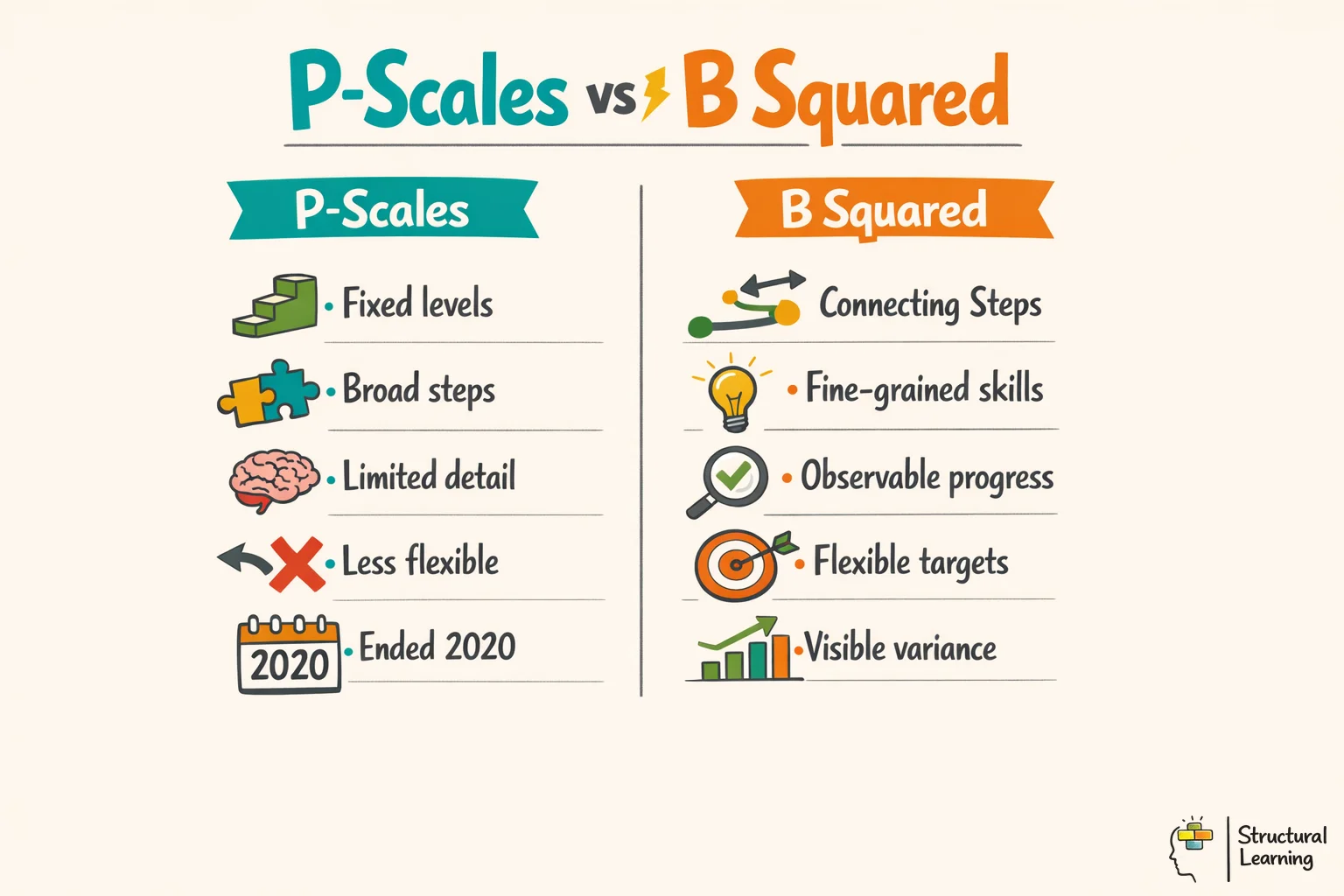
The truth SENCOs live with: you cannot use National Curriculum levels for learners with significant SEND because the gaps are too large. You can't jump from "cannot reliably identify basic classroom objects" to "sorts objects by colour." That's not differentiation. That's a different curriculum entirely. B Squared names the steps between.
Why it matters. Before B Squared, schools used spreadsheets, their own frameworks, or (this happened more than anyone admits) didn't track SEND learner progress systematically at all. This left SENCOs vulnerable: unable to evidence progress in EHCP annual reviews, unable to challenge assumptions about what learners could learn, and unable to spot when "no progress" was actually "no good teaching." B Squared forced standardisation. Not perfection, but a shared vocabulary.
A classroom example. In Year 3, Maya has significant language and learning needs.
Her previous school's data said "not making progress in communication." B Squared forced specificity: she could request a drink by pointing. She could follow one-step instructions with visual support. She could not initiate communication.
Within ten months on Connecting Steps, focussed work on this last barrier shifted her to initiating requests. The emphasis on observing actual scaffolding techniques showed where she was stuck. The old spreadsheet would have said "still in Level 1." B Squared said "made two important steps." That difference is why your EHCP panel takes you seriously when you present B Squared data.
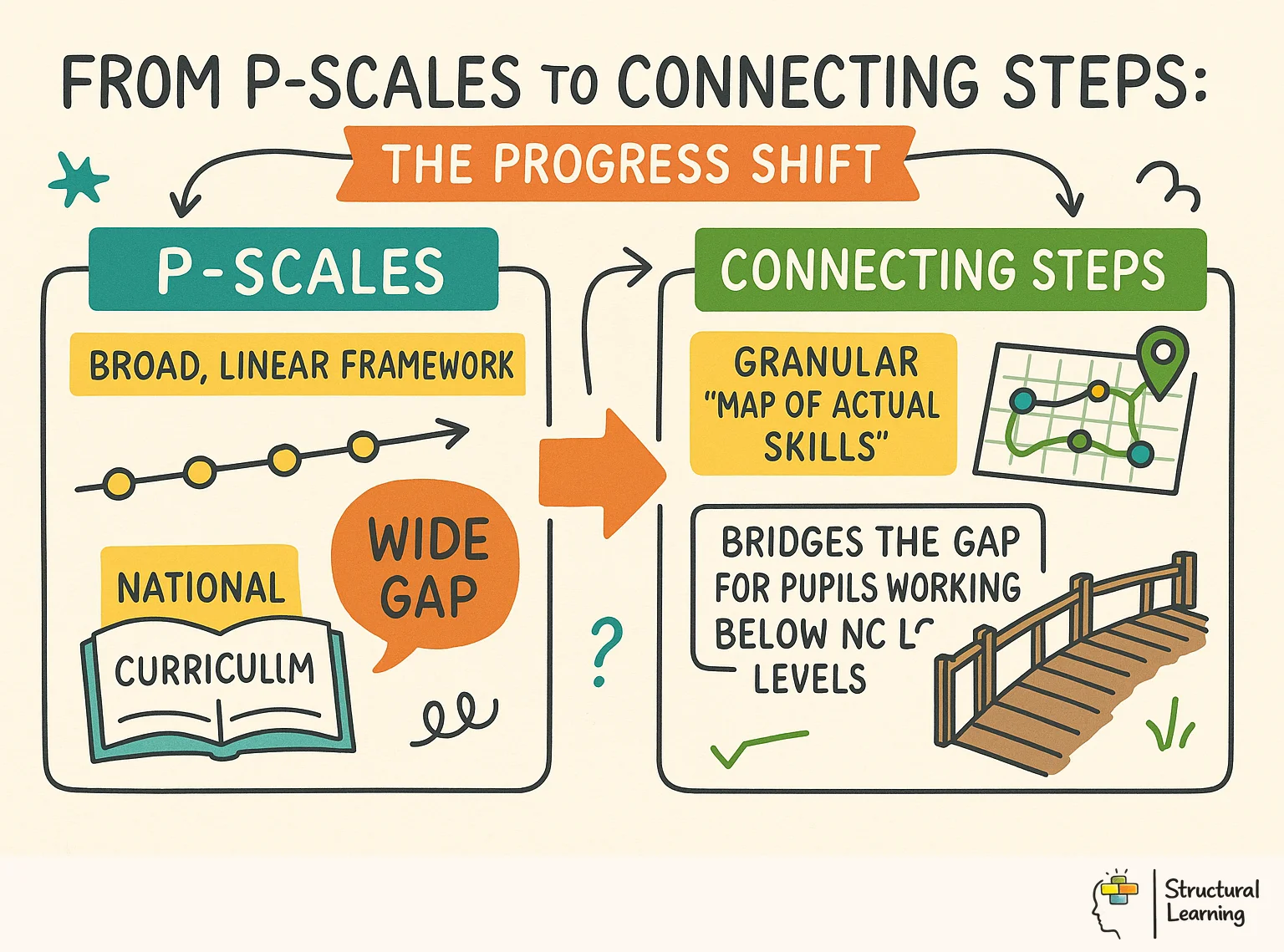
P-Scales are gone. The Rochford Review recommended removing the statutory requirement to assess learners working below the standard using P scales and making pre-key-stage standards permanent for learners engaged in subject-specific learning... freezing them there for years, teaching them nothing new. The assumption was that smaller steps meant smaller expectations. It didn't.
Connecting Steps (the main module in B Squared for learners below National Curriculum) was designed explicitly to replace P-Scales. The DfE's Pre-Key Stage Standards sit above Connecting Steps as the target framework. If you're tracking a learner in B Squared, your annual review paperwork should reference which Pre-Key Stage Standard they're working towards, not how many steps they've completed.
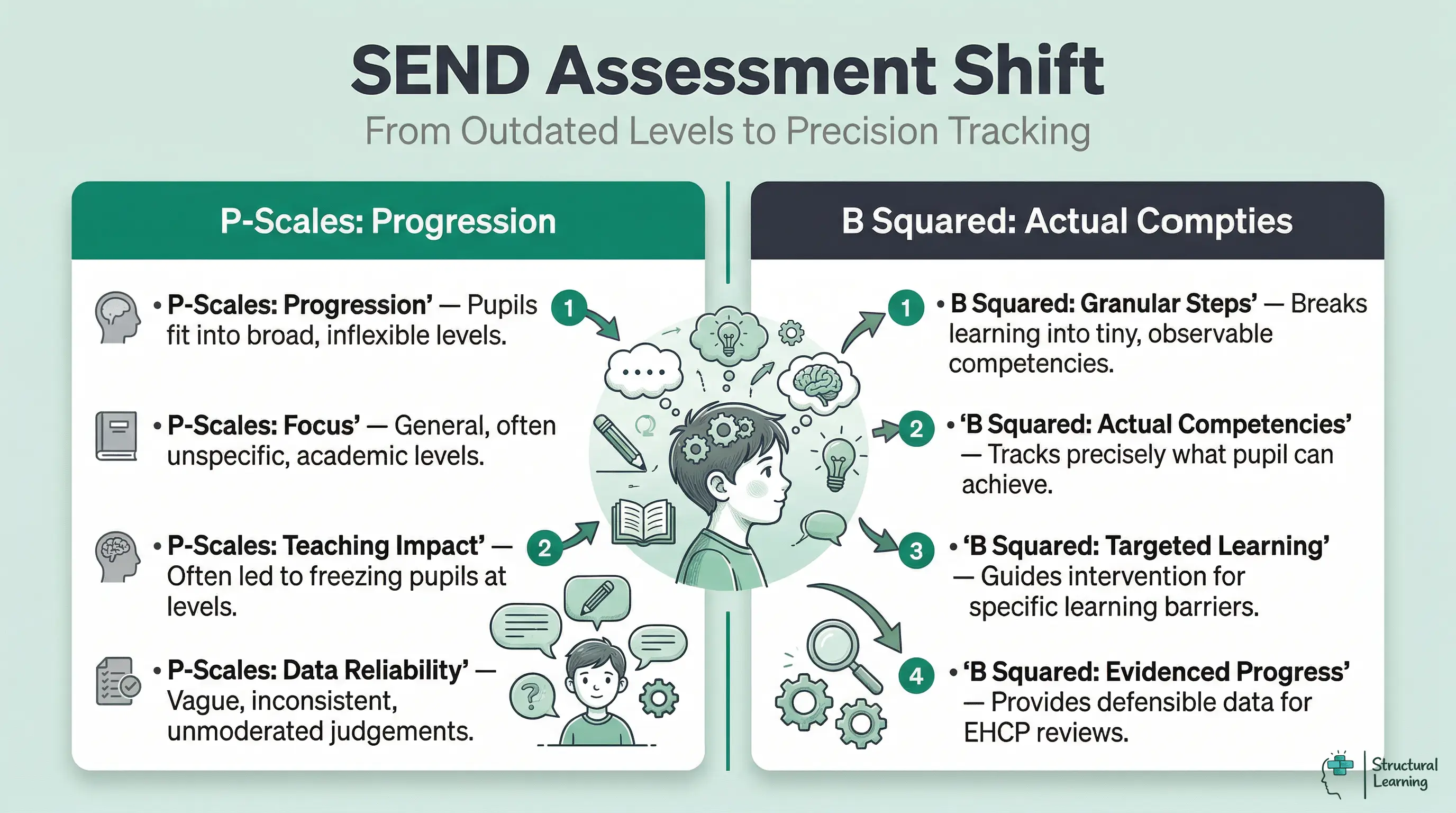
What changed in practice. Under P-Scales, a learner "at P7" was thought to be nearly at Level 1. Under Pre-Key Stage Standards, you say "working towards PKS2 in Reading." This sounds like a tiny shift in language.
It completely changes the conversation. A parent, a teacher, an EHCP officer all hear "working towards this recognised standard" instead of "in some weird in-between place."
The leadership risk. B Squared can produce graphs that look persuasive for governors, Ofsted and EHCP panels, but graphs do not prove that provision is working.
A headteacher should ask three questions each term: which learners have stalled, what teaching changed because of the data, and whether the next review shows transfer beyond the assessed step. Without that link, B Squared becomes defensive paperwork. Your local authority almost certainly has a B Squared subscription already.
| Feature | P-Levels (Withdrawn 2020) | Pre-Key Stage Standards (DfE) | B Squared Connecting Steps |
|---|---|---|---|
| What it covers | 8 broad performance levels (P1i to P8) for learners below NC Level 1 | 6 standards (PKS1 to PKS4+) describing expected attainment below NC | Hundreds of small, observable learning steps organised by subject and PKS level |
| Age range | 5 to 16 (statutory reporting age) | KS1 and KS2 statutory assessment points | EYFS through KS4 (with pre-baseline for earliest learners) |
| Granularity | Low: large gaps between levels led to learners "stuck" for years | Medium: broad descriptors without sub-steps | High: individual competencies such as "responds to own name" or "initiates communication" |
| Strengths | Familiar to teachers; widely understood before withdrawal | Statutory framework; shared language across LAs; free to use | Observable criteria; tracks small steps of progress; supports EHCP evidence; includes Engagement Profile |
| Limitations | Withdrawn by DfE; encouraged low expectations; not observable | Too broad for day-to-day teaching; doesn't capture engagement or participation | Requires subscription; relies on teacher observation quality; needs moderation |
P scales are withdrawn for statutory reporting; pre-key-stage standards are statutory at KS2 for eligible learners but optional/no longer reportable at KS1; B Squared Connecting Steps is a commercial framework, not a statutory requirement. B Squared Connecting Steps tell you the route to get there. P-Levels tried to do both and did neither well, which is why the DfE replaced them. For SENCOs writing EHCP annual reviews, B Squared data provides the granular evidence that Pre-Key Stage Standards alone cannot supply.
B Squared has three main modules. Most SENCOs know this. Most use them inconsistently.
Connecting Steps is the workhorse. These are small learning steps organised by curriculum area and Pre-Key Stage Standard level.
A learner might be working on ten different Connecting Steps simultaneously: maybe "Points to body parts" in Communication, "Grasps a range of objects" in Physical Development, "Responds to simple classroom routine" in Personal Development. Each step has observable criteria, which is the hard part. More on that in a moment.
SOLAR (Structured Observational Learning and Assessment Record) is the monitoring module. You take learners off Connecting Steps and put them on SOLAR when you want to monitor a specific behaviour or skill in detail without committing to a full Connecting Step.
This is where many schools make a mistake: they use SOLAR as a "pending" zone for learners who haven't been assessed yet. SOLAR should be used when you're intensively observing something.
A learner learning to use visual timetables. A learner you suspect is dysregulated in large group times. A learner trying a new communication system. Not "we haven't done baseline yet."
Engagement Profile is where the real insight lives, and where most schools don't dig deep enough. This is not a step-by-step tracker.
It's a profile of how a learner learns, where they are most engaged, what barriers they face, and what support is working. Questions cover: Does the learner show sustained engagement? With what type of activity?
What physical environment helps? What type of adult interaction works best? Are there sensory sensitivities? Does the learner initiate activity or mostly respond?
The Engagement Profile is worth more than twenty Connecting Steps because it tells you whether your teaching is actually landing or whether the learner is just going through motions.
When to use each. Connecting Steps = "We're teaching this and tracking progress with formative assessment." SOLAR = "We're intensively observing this for two to four weeks." Engagement Profile = "We need to understand this learner before we write their learning plan." Many schools loop through: Engagement Profile first (baseline), Connecting Steps for teaching and monitoring, SOLAR for troubleshooting when a learner plateaus, back to Engagement Profile to reassess why.
This is where B Squared assessment either sharpens teaching or exposes weak target-setting.
Most schools start B Squared well: baseline assessment in the first few weeks, careful observation, thoughtful selection of steps. Then target-setting. And this is where it falls apart, because SENCOs inherit target-setting practices from mainstream assessment that don't work in SEND.
The baseline trap is a counting error: A Year 5 learner is assessed on Connecting Steps. They're able to do 12 out of 30 steps at their relevant standard level.
So the target is set: "Complete 15 steps by the end of the year." Three more steps. That's the plan. Eleven months to move through three steps, and somehow this count is a success metric.
What went wrong? The school confused "steps available" with "steps the learner is ready to learn." A learner might be unable to do 18 of the available steps, but that doesn't mean they need to learn all of them. Maybe the learner needs to learn communication first, but 8 of the 18 uncompleted steps are about numeracy. Maybe the learner can only manage one new concept at a time, so three steps is too ambitious anyway.
Meaningful targets start with the barrier to learning, not the next empty box. Choose one or two curriculum areas for the year. Within each area, identify three or four Connecting Steps that are genuinely next for this learner, then build teaching around those steps.
If the learner completes them, the target has done its job. If progress appears in literacy but stalls in numeracy, treat that as diagnostic information, not failure. Choose maybe two curriculum areas to focus on this year.
Within one curriculum area, identify three to four Connecting Steps that are genuinely next for this learner, not just available. Build the teaching plan around those steps.
If the learner completes them, the target is met. If they complete three steps in literacy but plateau in numeracy, that's useful data. It doesn't mean failure; it means "numeracy was too ambitious, try again next year."
For example, Ella is in Year 4 and has a global developmental delay. B Squared shows she has mastered 8 steps in Physical Development, but only 3 in Communication. It may feel right to set targets in both areas: Physical Development, because she is ready to move on, and Communication, because she is behind. A better plan is to focus the year on Communication, because this blocks almost everything else: she cannot tell people what she wants, ask for help, or join group activities.
Research on growth mindset and target-setting shows that learners with multiple learning barriers benefit from focussed, sequential progression rather than parallel development. Crack that barrier, and next year Physical and Academic Development move faster. The target is: "Adds three new steps in Communication (Requests help, Initiates interaction with peer, Uses 10+ words functionally)." That is one focussed, defensible target that actually shapes teaching.
Standard teaching looks like this: teacher delivers input, learners practice, learners show learning. For learners with SEND, this sequence doesn't work unless the learner is first engaged. An engaged learner who struggles with numeracy will have a chance. A disengaged learner with no learning barriers at all will learn nothing.
The Engagement Profile measures this. It asks: How long does the learner sustain focus on an activity? Does their engagement differ by subject, setting, or adult?
What type of materials hold their attention? Are they engaged with the learning or just compliant? Does the learner show persistence or avoid challenge?
These questions sound soft. They're not. A learner who is engaged for three minutes, then avoids, learns at 20% of the rate of one who engages for fifteen. This is why Engagement Profile data should shape your timetable, room layout, and adult deployment at least as much as academic targets do.
An example of what Engagement Profile catches. Amir, Year 6, SLCN and probable autism. His Connecting Steps data is reasonable for his age: he's making progress in most areas. His engagement profile reveals the hidden issue: he's engaged consistently only in structured turn-taking activities.
In free-choice time, large-group time, and transition between tasks, he avoids and becomes anxious. His teachers thought Amir was coping, but the pattern suggested he was managing only tightly structured tasks.
The profile showed he was coping within a narrow band and spent the rest of the day minimising discomfort, not learning. The evidence for metacognition in self-regulation shows that learners need explicit instruction in managing transitions, not just natural exposure. The TA's redeployment (from group support to Amir-specific scaffolding through transitions) followed this insight, not from lesson planning, but from the Engagement Profile.
B Squared has a set of engagement descriptors: Early Engagement (brief, reactive focus), focussed Engagement (sustained 5+ minutes), Deep Engagement (shows curiosity and persistence). The profile asks which conditions produce each level.
Most SENCOs never scroll down to this section. If you're not looking at which contexts engage your learners, you're assessing steps on learners who are barely paying attention. That's not failure to progress; that's failure to create conditions for learning.

Your EHCP annual review document must reference progress in special educational needs learners. B Squared is the only defensible source for learners working below National Curriculum. Here's how to make it meaningful instead of a data dump.
What panels actually want to know: Is the learner making progress at an expected rate? If not, why? Is the provision working? Should it stay the same, increase, or change direction?
What most schools say: Learner completed 6 new steps this year, compared to 3 last year. Progress is accelerating.
What's actually useful: Learner completed 6 steps, mainly in Communication, after the teacher moved from group targets to an individual AAC system; this led to faster progress. Numeracy has plateaued, so it needs more investigation; the likely issue is a conceptual barrier rather than motivation. The Engagement Profile shows that the learner now initiates peer interaction consistently, which is new and important. Revised target: maintain Communication momentum and redirect numeracy teaching.
The panel reads the second version and can see the professional judgement behind the data. They can connect progress, barriers and provision.
Using B Squared in the review meeting. Bring a one-page summary, not the B Squared printout. Three columns: Area, Progress This Year, Plan for Next Year. Under Progress, use Connecting Steps data but always translate: "3 steps in Literacy = now reads CVC words; previously only read initial letters." Under Plan, be specific about what will change. "Continue current Speech and Language approach (which is working) plus add visual structure support (which Engagement Profile shows helps)." Webster, Blatchford and Russell (2013) found that schools can change teaching assistant deployment practices through the Effective Deployment of Teaching Assistants project.
Parent officers see a hundred reviews. They trust the ones that: (1) use assessment data but don't hide behind numbers, (2) explain what the learner has actually learned in plain language, (3) give a reason for the targets, and (4) connect targets to provision. B Squared does all of this if you translate it.
Here's something SENCOs rarely hear: parents don't care about Connecting Steps. They care about their child, whether their child is happy, and what the child can do now that they couldn't do before.
A B Squared-based progress report can speak both languages, or it can be technical and useless. Most choose useless by accident.
What not to do: "Jackson has completed Connecting Steps 2, 5, and 9 in Literacy. He is working towards PKS2. This represents continued progress within the Connecting Steps framework."
What actually tells a parent something: "Jackson is learning to recognise and name common objects (his school, his teacher, a cup). This term, he started pointing to the object when you say the word, which is new. Before Christmas, he could only look when you pointed. This is important because he's showing he understands what words mean, which is the foundation for everything else in learning to read and talk."
The shift: from "completed steps" to "can do X, which is new because previously they couldn't, and here's why that matters."
B Squared data enables this report because you have the before-and-after. A step like "Recognises three familiar objects when named" is specific and clear.
A parent understands it. You can photograph it happening. You can say "when you ask 'Where's the dog?' he points every time now." That's a progress report that lands.
Many schools still write prose reports for SEND learners with no reference to actual learning outcomes, just opinions: "Jackson is a lovely boy, engaged and happy, trying hard." Parents of SEND children have heard this a thousand times. They want to know: Did he learn something? What will he learn next?
B Squared gives you the evidence to answer these questions honestly. The pre-key-stage standards require teacher assessment judgements to be based on evidence against 'learner can' statements; they.
Here's what everyone says: learner voice is important. Here's what most schools do: exclude learners from target-setting because it's "administrative."
B Squared targets don't need to happen in a staffroom. Much of it can happen with the learner.
For learners with communication barriers. Use their communication system. Show them Connecting Steps using visual supports. "This is your current learning. You can do these four things now.
This is what we're learning next." For learners with AAC devices, even very low-tech communication boards, target-setting can include their confirmation. "Are you working on communication next?" (Point to yes/no). "Are you working on numbers?" (Yes, head nod, verbal confirmation, or eye gaze).
This practice aligns with person-centred SEND planning and learner participation (Department for Education and Department of Health, 2015; Carpenter et al., 2015): learners learn best when they understand their own targets, even in simple formats.
For learners with more developed understanding. Involve them in identifying learning barriers. Many learners with SEND can name what's hard: "I can't remember the days," "I get confused when there's too much," "I don't know what to do." These observations often map onto Connecting Steps or Engagement Profile findings. A joint conversation ("What are you learning about?", "What's hard?", "What should we practice?") helps learners invest in their targets and helps teachers see the learner's perspective on their own learning.
An example. Sasha, Year 5, developmental speech/language needs and mild learning delay. In spring term target review, she was shown her Communication targets on a visual chart: one completed, two in progress, one being introduced. Asked "Which one are you happy about?", she pointed to the completed one and said "I can do it now." Asked "Which is hard?", she pointed to a target about "using sentences with who and what" and demonstrated by saying "I confused.
I don't know when." The SENCO rewrote the plan: drop one target (too much), focus the emerging target with sentence stems ("Who are we talking about? What is happening?"), and included Sasha's own words in the review: "Sasha knows which target is hard and is practising every day." Parents read that report, saw their daughter knew what she was learning, and engagement at home improved because there was specificity to support.
Learner voice in targets does not mean learners choose the curriculum. It means learners know what they're learning and contribute to the plan. B Squared is opaque enough without also hiding it from the learners involved.

B Squared is based on teacher observation. This is its strength and its catastrophic weakness.
Teacher observation becomes more reliable when teachers are trained, consistent and scrutinised. Most schools have none of these things.
A Connecting Step like "Learner grasps a range of objects" requires judgment. One teacher marks this as achieved when a learner grasps three objects in a structured session. Another marks it achieved when the learner grasps any object at any time, including accidentally grabbing.
By the end of the year, the first teacher's data shows the learner made two steps. The second teacher's data shows five. Same learner, same teaching, same progress.
Different data. This inconsistency is well documented in assessment research on complex learning difficulties and teacher judgement (Carpenter et al., 2015; Wiliam, 2011).
Where inconsistency hides. Across year groups (Year 1 teacher is stricter than Year 2), across staff (TAs assess differently than teachers), across time (everyone's standards slip by summer term), and across contexts (learner shows the skill in one-to-one but not in group).
This is why B Squared data needs moderation.
Moderation done well. A group of teachers from your school (or your local authority if you're tiny) gather with the same learner's observations and decide: does this learner meet this step or not? The conversation surfaces hidden standards. "I would have marked that as achieved, but actually the learner did it once in ten tries." "I'm counting scaffolded success as independent. Should I be?"
Moderation also builds confidence. Teachers realise their standards are roughly aligned and start feeling secure in their assessments.
Moderation done badly. Schools run moderation as a checkbox: "Everyone agrees she's on step 5." No conversation, no scrutiny, just consensus. You now have aligned-but-wrong data, which is worse than nothing because it's confidently wrong.
If you're a SENCO in a school of fewer than a hundred learners, you probably can't moderate internally. Join your local authority's moderation network, or do paired moderation with another school's SENCO. Once a term, spend two hours on B Squared consistency. You'll uncover things (hidden standards, unclear step criteria, TAs assessing too generously) that improve both assessment and teaching.
For further reading on this topic, explore our guide to SEND Reforms 2026.
For further reading on this topic, explore our guide to Visual organisers.
For further reading on this topic, explore our guide to SEND Acronyms Decoded.
A hidden problem: digital drift. B Squared can make an achieved step look permanent, but learners can lose skills when health, fatigue, anxiety, sensory load or context changes.
Build in maintenance checks, not just new steps. Once a learner is marked as having achieved a step in B Squared, the system shows that as done. Except nothing prevents a learner from losing a skill.
A learner learns to use a cup with two hands; six months later, due to decreased tone, they're back to needing to use both hands gripping. Has the learner lost the step, or is this temporary? B Squared doesn't capture regression well. You need a teaching conversation in addition to your data system: "Has this learner maintained skills over time, or slipped on anything?" Write it down somewhere your successor will see it.
Transition is when inconsistent B Squared data becomes dangerous.
A Year 6 learner who is assessed at a higher level than they actually perform will arrive at secondary and immediately fail. Their new teachers will assume they can do things they can't, set targets they can't meet, and the learner's confidence crashes. Alternatively, a learner assessed conservatively will arrive with low expectations and won't be challenged. Both happen because the secondary school trusts the data without checking.
Before transition. Do moderation moderation across primary and secondary. Invite the secondary teachers to your summer term data meetings. Show them the learner's Connecting Steps and Engagement Profile.
More importantly: show them video or photos of the learner doing the skill. If you mark "Uses single words to request" without showing what "request" means in your school, the secondary teacher might think the learner can do something they can't.
Transition visits should always include a B Squared discussion. Not "here's your data" but "here's what this learner can do, here's how we've been supporting them, here's what they find hard."
What to transfer. Do not transfer last year's targets, because the secondary teacher will have different priorities, curriculum, and approaches. Do transfer the Engagement Profile, because it gives key information: "This learner learns best with visual structure and one-to-one check-ins," or "This learner engages consistently with peer activities, less with adult-led work." The Engagement Profile is curriculum-independent, so the secondary teacher needs it to understand how this learner engages.
Transfer high-priority Connecting Steps for areas where the learner is close to progress. "They've completed 4 of 6 communication steps at this level" is more useful than twenty steps of background data.
An example of what goes wrong: Jamal, Year 7, SLCN. Primary school data shows he's been "working on" a communication step for two years: "Uses 5-10 words functionally." In primary, he did use about eight words, mostly with visual support.
Secondary teacher sees data, assumes he's stuck on a low target, doesn't push. Jamal stays at eight words all year. If the primary data had said "Uses 8 words in structured settings, 3-4 in unstructured; target this year: expand to more contexts," secondary might have approached it differently.

Most of this guide assumes your school already uses B Squared, or at least has a subscription. If you're just starting, the first mistake is uploading learner data without training anyone.
Week 1: Admin foundations. Someone (you, probably) needs to set up the B Squared system correctly. Learners entered with correct year group, starting date, and baseline assessment completed before teachers start recording steps.
This sounds basic. Many schools create a thousand learners in B Squared and then nobody knows whose class is whose.
Then run a whole-school training on what B Squared is and isn't. This complements quality first teaching rather than replacing it.
Not a two-hour flog through the software. A one-hour conversation about: What are Connecting Steps?
Why do we track below National Curriculum? What's the Engagement Profile for? How will this change your day-to-day?
Week 2-4: Subject moderation. Bring teachers together by subject (Literacy people, then Numeracy, then Physical, etc.) to look at actual steps and ask: What does this step actually mean?
When have we seen this? What are we looking for? This isn't rote learning.
This is building shared understanding. A Literacy teacher might think "Recognises own name" means the child reads it unprompted in any context. Another might count recognising it on a label in their own tray. Clarify this before everyone starts assessing.
Month 2: First baseline. Teachers start entering baseline observations. The temptation: rush this. Resist.
A slow, careful baseline with well-considered evidence (observation notes, photos, even short videos) takes longer but prevents six months of corrections. If you rush baseline, you'll spend October and November hunting down teachers for missing details.
Month 3: First review. Look at data not to judge progress (it's too early) but to audit for mistakes. Did everyone understand what a step is?
Are there steps nobody has ever entered data for (probably means the step is confusing)? Are there year groups where almost everyone's marked the same step achieved (suggests either the step is too easy or everyone's being generous)?
Ongoing: Monthly SENCO supervision with class staff. Not "check in on data," which is soul-crushing.
Have a real conversation about one learner: "This learner's Connecting Steps look good, but their Engagement Profile worries me. What are we seeing?" That conversation is the point. The data is just the starting point.
Training materials. B Squared provides video training. Watch it once. Then adapt it to your school's evidence standard.
Instead, create your own one-page guide to your school's standards. "When we say a learner has 'completed' a Connecting Step, we mean they've shown the skill on at least three occasions, in more than one context, with minimal adult support (or whatever your standard is)." Every teacher gets a copy. Every September, it's reviewed. This document is worth more than the software manual.
TAs need specific training. Teaching Assistants often carry out observations and record steps. They need to understand that their observations should be evidence-based and specific, not inferences. "Requested help three times independently this week" is evidence. "Learner is understanding they can ask for help" is an inference that might follow from it, but they're not the same.
TAs who are trained to observe precisely will give you data you can actually use. This separation of observation and interpretation is fundamental to reliable assessment (NASEN guidance on SEND assessment).
Secure backing from the deputy or another leader. B Squared success requires that someone (probably not the SENCO, who has seventy other things) champions it. This person checks in termly, celebrates examples of good data being used to change teaching, and holds the line on moderate (don't let it become a data-entry burden). Without a champion, B Squared becomes your solo project and it won't scale.
B Squared is an assessment tool designed for learners working below the National Curriculum. It uses a framework called Connecting Steps to break down learning into small, observable competencies. This system replaced P-Scales in 2020 to provide more precise tracking of learner progress and align with Pre-Key Stage Standards.
Teachers watch learners during daily activities. They record what learners can do against specific competencies in the Connecting Steps framework. Staff do not need to wait for formal testing; they update the system when they see consistent evidence of a new skill. This ongoing observation helps teachers adjust their planning and target specific learning barriers.
The primary advantage is that it gives schools a shared language to discuss progress for learners who do not fit typical curriculum expectations. It provides concrete evidence of learning for EHCP annual reviews and helps parents understand exactly what their child can do. Furthermore, it highlights specific areas where a learner is stuck so teachers can adjust their support.
Research shows that teacher judgement of SEND learner progress can vary a lot without a structured framework. Systems like B Squared give schools that structure. This can reduce variation and make assessment more objective. However, evidence also shows that these tools are only reliable when schools hold regular moderation sessions across their staff.
A frequent error is treating the assessment framework as a checklist to be completed rather than a tool to inform teaching. Schools often set targets based on the next available step rather than identifying the most meaningful skill for the learner. Additionally, failing to moderate data across different classes leads to inconsistent and unreliable progress reports.
B Squared can make SEND assessment more precise, but precision is not the same as validity. Its Connecting Steps framework can split learning into small behaviours that look measurable while failing to show whether the learner can use the skill in a meaningful context. Florian (2014) warns that inclusive pedagogy loses force when difference is reduced to individual deficits rather than participation in shared classroom life.
A second limitation is psychometric. B Squared presents progress in a staged sequence, yet many neurodivergent learners have uneven profiles: a learner may decode print, struggle with transitions and communicate well with one adult but not with peers. Autism research cautions against treating development as a single ladder (Fletcher-Watson and Happé, 2019).
There is also a cultural and methodological risk. Teachers may confuse SEND with low attainment, English as an additional language, poverty, trauma or post-pandemic social delay. Statutory guidance warns that slow progress alone does not prove SEN (Department for Education and Department of Health, 2015). In 2026, this matters because many early years learners have missed ordinary social and language experiences, so step data must be read with family context, observation and specialist advice.
Finally, the software can create a compliance effect: clean graphs for governors, Ofsted or EHCP panels may hide weak teaching. B Squared remains valuable when SENCOs use it as evidence for better provision, not as proof that provision is working.
Carpenter (2015).
Carpenter (2011).
Fletcher-Watson and Happé (2019).
Florian (2014).
Gross (2015).
Webster and Blatchford (2014).
Wiliam (2011).
These publications provide the evidence base and policy context for B Squared assessment and SEND progress tracking in English schools.
The Rochford Review: Final Report
Rochford, D. (2016). Department for Education.
This independent review recommended replacing P-Levels with the Pre-Key Stage Standards framework that B Squared now maps to. It established the principle that assessment for learners with SEND should focus on what they can do, not where they sit on a linear scale. Essential reading for any SENCO justifying their assessment approach to governors or inspectors.
SEND Code of Practice: 0 to 25 Years
Department for Education and Department of Health (2015).
The statutory guidance that underpins all SEND provision in England. Chapter 6 covers the graduated approach (assess, plan, do, review) that B Squared data directly supports. Chapter 9 details EHCP annual review requirements where B Squared evidence is most commonly presented. Every SENCO should have this bookmarked.
Engagement for Learning: A Framework for Learners with PMLD
Carpenter, B., Egerton, J., Brooks, T., Cockbill, B., Fotheringham, J., and Rawson, H. (2015). CLDD.
Barry Carpenter's work on engagement as a prerequisite for learning directly informed B Squared's Engagement Profile module. The framework identifies seven engagement indicators (awareness, curiosity, investigation, discovery, anticipation, persistence, initiation) that teachers can observe and track. This research makes the case that measuring engagement is as important as measuring attainment for learners with complex needs.
Pre-Key Stage Standards: Learners Working Below the National Curriculum
Standards and Testing Agency (2020). Department for Education.
The current statutory assessment framework for learners working below the National Curriculum at the end of Key Stages 1 and 2. B Squared's Connecting Steps map directly to these standards, making it the most widely used tool for demonstrating progress towards them. Understanding these standards is essential for accurate statutory reporting.
Maximising the Impact of Teaching Assistants
Webster, R. and Blatchford, P. (2014). Education Endowment Foundation.
This guidance report on TA deployment is directly relevant to B Squared implementation because TAs frequently carry out observations and record Connecting Steps data. The research shows that effective TA use requires structured training in observation and assessment, not just proximity to the learner. Schools using B Squared should read this alongside their TA training programme.
---
The honest truth about B Squared: it's only as good as you make it. The software is neutral. It doesn't make anyone teach better. What it does is force specificity.
You can no longer say "SEND progress is hard to measure." You have to say what the learner learned, when they learned it, and what they're learning next. That conversation is where better teaching happens.
The assess, plan, do, review cycle applies directly to B Squared target-setting. Start with one thing: meaningful targets that actually reflect what learners should learn, not what steps exist. Get that right, and the rest of B Squared becomes useful instead of burdensome.
Half the schools in the local area are on it. This means: (1) you must be using it for learners on EHCPs, (2) you cannot claim significant progress without showing step-level movement in B Squared, and (3) audits will check whether your B Squared data matches your annual review narrative. Beating Bureaucracy in SEN (Gross, 2015) advises against parallel systems precisely because they create duplication without clarity. If you're running a parallel assessment system, you're creating work.
Where it breaks. Early development is messier than B Squared assumes. An EYFS class with three learners with significant needs doesn't fit the "Connecting Steps" framework easily. They're learning to sit, to tolerate transition, to notice other people.
This isn't in Connecting Steps because it's theoretically not SEND, it's child development. But these learners aren't developing typically. We'll come back to how the Engagement Profile solves this.
B Squared acknowledged this problem by creating Pre-Baseline data for very young children and very low-attaining learners. You can track "Learner makes eye contact with a preferred adult" before any Connecting Step makes sense. Use it. Your EYFS and early primary SEND learners won't fit the normal steps anyway.
Schools often confuse these three frameworks. Each one has a different purpose in SEND assessment. When staff understand the differences, they are less likely to misuse data or set misaligned expectations.