Ordinarily Available Provision: A Teacher's Guide

Updated on  

February 27, 2026

Ordinarily Available Provision: A Teacher's Guide

|

February 26, 2026

What ordinarily available provision means in practice: the EEF five-a-day framework, the graduated approach, Ofsted expectations, and a whole-school OAP framework for teachers and SENCOs.

Ordinarily available provision (OAP) is the baseline of inclusive teaching that every school in England is expected to deliver, without a diagnosis, without an Education, Health and Care Plan, and without additional funding. It is what good schools do as a matter of course: reasonable adjustments, quality-first teaching, and a graduated response to emerging need. The term was first used formally by the Department for Education in 2023 and is now central to the 2026 Schools White Paper. Despite this, most teachers have encountered OAP only as a phrase in a local authority PDF, with little guidance on what it actually looks like in a classroom.

Key Takeaways

  1. OAP is a statutory baseline, not a favour: Every school is expected to provide high-quality inclusive teaching as the foundation of SEND support, regardless of diagnosis or additional funding.
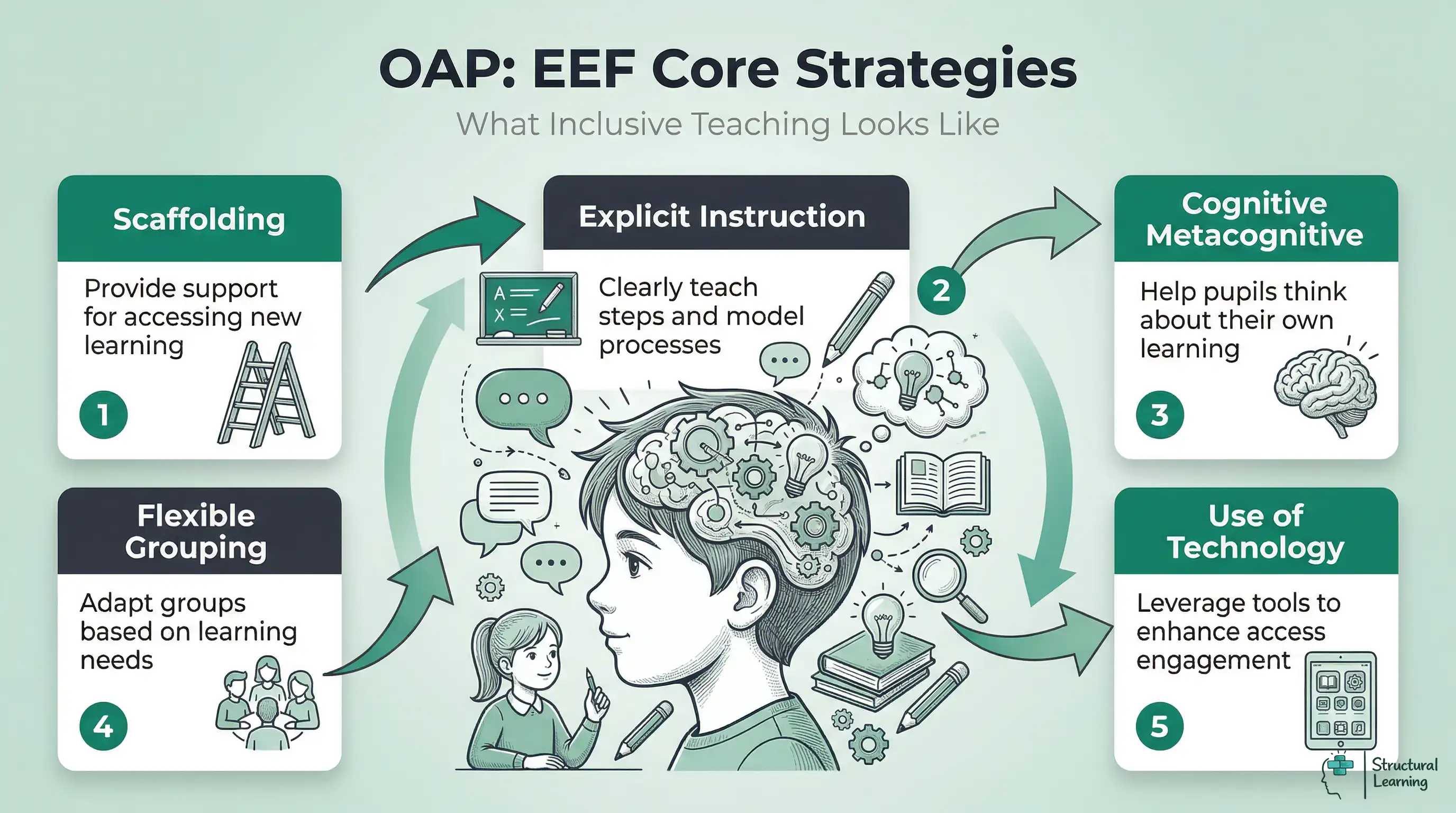
  2. The EEF Five-a-Day maps directly onto OAP: Scaffolding, explicit instruction, cognitive and metacognitive strategies, flexible grouping, and use of technology are the evidence base for what OAP looks like in practice.
  3. Documentation matters before EHCNA: Local authorities expect evidence of at least two full Assess-Plan-Do-Review cycles, with impact data, before a statutory assessment request is considered.
  4. National standards are coming: The 2026 Schools White Paper introduces National Inclusion Standards and mandatory annual inclusion strategies, meaning OAP expectations will be codified in law for the first time.

What Ordinarily Available Provision Actually Means

The SEND Code of Practice (2015) establishes at paragraph 6.15 that a pupil has special educational needs where their learning difficulty "calls for special educational provision, namely provision different from or additional to that normally available to pupils of the same age." Ordinarily available provision is that baseline, the "normally available" against which additional needs are measured. If your school's normal teaching already includes well-structured explanations, visual supports, and flexible seating, then the threshold for what counts as "additional" provision rises accordingly.

The Children and Families Act 2014, at section 36(8), sets the legal test for an Education, Health and Care Needs Assessment (EHCNA): the local authority must consider whether a child "may have" SEN and whether it "may be necessary" to make an EHC Plan. That test is deliberately low. But it only applies after the school has demonstrated that its own provision, OAP and then targeted support, has not been sufficient. OAP is therefore the foundation on which every SEND decision in your school rests.

Hertfordshire's updated guidance (September 2025) defines OAP as "inclusive, high-quality teaching and everyday adjustments that all early years settings, mainstream schools, and colleges are expected to provide." The language differs slightly across local authorities, but the core expectation is consistent: reasonable adjustments without diagnosis, applied routinely, documented carefully. Devon describes it as "Ordinarily Available Inclusive Provision" and positions it as the starting point for all settings, from early years through post-16. Essex structures it as a two-tier model, separating "inclusive teaching" (universal) from "targeted support" (additional). Surrey provides the most thorough online guidance, organising OAP across all four areas of need from the SEND Code of Practice.

The three-tier model most local authorities now use looks like this:

Tier What it includes Funding source Documentation required
Ordinarily Available Provision Quality-first teaching, reasonable adjustments, differentiation, access arrangements available to all Core school budget (AWPU) Class teacher records, lesson planning
SEN Support Targeted interventions, provision mapping, APDR cycle, parental involvement Core budget + notional SEN budget (up to £6,000) SEN Support record, provision map, APDR documentation
EHCP Specialist, specified, and quantified provision; statutory rights; LA oversight High Needs Block (above £6,000 threshold) Full multi-agency assessment, legally binding plan

The EEF Five-a-Day for SEND

The Education Endowment Foundation's guidance report "Special Educational Needs in Mainstream Schools" (EEF, 2020) identifies five evidence-based approaches that should form the core of any school's SEND provision. These five approaches are not specialist interventions. They are quality-first teaching strategies, which is precisely why they map so cleanly onto what OAP expects.

The EEF is explicit on this point: "High quality teaching, differentiated for individual pupils, is the first step in responding to pupils who have or may have SEND. Additional support cannot compensate for a lack of good teaching." OAP, in other words, is not a safety net that catches pupils after good teaching has failed. It is the good teaching itself, applied with deliberate attention to individual needs.

EEF Approach What it means in OAP terms Classroom example
Scaffolding Temporary, structured support matched to where a pupil is now, withdrawn as competence grows Sentence starters for a Year 7 pupil with language difficulties; word banks removed once the pupil can generate vocabulary independently
Explicit Instruction Breaking tasks into small steps, modelling thinking aloud, checking understanding before moving on A Maths teacher narrates each step of long division before asking pupils to attempt it; a TA does not prompt until the pupil has had 30 seconds to try independently
Cognitive and Metacognitive Strategies Teaching pupils to plan, monitor, and evaluate their own thinking; reducing unnecessary cognitive load A SENCO trains staff to use "think alouds" with pupils who have working memory difficulties, narrating the steps before writing
Flexible Grouping Grouping by current need rather than fixed ability; changing groups regularly to avoid labelling A teacher groups three pupils together for a guided reading session based on a shared decoding difficulty, not their general reading level
Using Technology Assistive technology and digital tools that give access to the curriculum, not replace it Text-to-speech software available to any pupil who needs it; speech-to-text for pupils whose ideas outrun their handwriting speed

These five approaches are consistently linked in the research to improved outcomes for pupils with special educational needs. The EEF meta-analysis found that scaffolding is associated with up to five months of additional progress, and metacognitive strategies with seven months (EEF, 2020). The implication for OAP is clear: if these approaches are embedded in your whole-school teaching, you have a defensible, evidence-based foundation for your inclusive provision.

How Much Is Enough Before EHCNA?

This is the question SENCOs ask most frequently, and local authority guidance is frustratingly inconsistent. There is no statutory minimum number of APDR cycles before a request for an Education, Health and Care Needs Assessment. The legal test in section 36(8) of the Children and Families Act 2014 is simply whether the child "may have" SEN and whether it "may be necessary" to make a plan. Some authorities expect two full cycles; others accept one if the evidence is compelling. The key variable is not time, it is evidence quality.

What local authorities consistently look for in a strong EHCNA request is documented APDR cycles with clear targets, strategies used, and measured outcomes. They expect evidence that OAP has been applied consistently and with fidelity, not just recorded on paper. Involvement of parents and carers at each stage is essential, as are the views of the pupil. Any external professional involvement already obtained or requested strengthens the submission significantly.

Devon's OAIP framework includes a clear statement that schools should "demonstrate the range and level of provision already being made" and that this should be "qualitative as well as quantitative." A provision map alone is not sufficient. You need to show what you tried, at what intensity, for how long, and what happened as a result.

Evidence type Sufficient for EHCNA? Notes
Single APDR cycle with impact data Sometimes Only if evidence is urgent (safeguarding link, rapid deterioration, early years transition)
Two APDR cycles with impact data Usually Most LAs treat this as the baseline expectation
Provision map only (no impact data) No Describes what was done; does not show whether it worked
External professional report (EP, SALT) Strengthens significantly Not always required, but rare to succeed without one for complex needs
Parental and pupil voice records Essential, not optional Absence of these weakens any submission regardless of other evidence

A common misconception is that two school terms of provision is a statutory requirement before EHCNA. It is not. The requirement is evidence of a sustained and documented graduated response, which often takes two terms, but the time itself is not the measure. Another misconception is that a diagnosis triggers an automatic right to an EHCP. It does not. A diagnosis may be part of the evidence, but the legal test remains whether a plan is "necessary."

The Graduated Approach in Practice

The graduated approach is the SEND Code of Practice's framework for how schools respond to emerging need. It is a four-stage cycle: Assess, Plan, Do, Review. At OAP level, this cycle operates within normal class teaching rather than as a separate SEN process. The class teacher leads it, with the SENCO advising. It is not additional to good teaching; it is how good teaching responds to individual need.

A worked example makes this concrete. Consider a Year 4 pupil, Amara, who is falling behind in reading despite receiving the same literacy instruction as her peers. Her class teacher notices she struggles with phoneme-grapheme correspondence and loses her place frequently when reading aloud.

Assess: The teacher uses the school's screening tool alongside observation notes from guided reading sessions. She speaks to Amara's parents, who mention that Amara also finds it hard to follow sequences of instructions at home. The SENCO reviews the picture and agrees it warrants a formal OAP response. There is no referral yet, no diagnosis sought, and no specialist involved.

Plan: The teacher sets two specific, measurable targets for the next six weeks: Amara will decode consonant clusters with 80% accuracy in isolation, and she will track text without losing her place using a reading ruler. The plan records what additional strategies will be in place during whole-class and guided reading, what the teacher will do differently, and what Amara's parents will do at home. Amara is involved in agreeing what help she wants.

Do: Over six weeks, the teacher applies the planned strategies consistently. She uses differentiation strategies, adjusts her grouping during guided reading, and ensures Amara has access to a reading ruler and large-print text when needed. She records brief observations twice a week. OAP operates within the classroom, so no withdrawal or additional adult support is introduced at this stage.

Review: At six weeks, the teacher and SENCO review impact against the targets. Amara has improved her decoding accuracy from 43% to 71%. She has not yet reached 80%. The cycle repeats: new targets are set, strategies are adjusted, parents are updated. This second cycle produces fresh evidence. If, after two cycles, Amara has made insufficient progress despite consistent OAP, the SENCO begins to consider whether SEN Support, with its additional resources and formal provision map, is needed.

The graduated approach is not a linear sequence from OAP to EHCP. A pupil may move between tiers in both directions. A pupil on SEN Support who responds well to targeted intervention may return to OAP. The cycle is iterative, not a conveyor belt.

What Ofsted Expects Under the 2025 Framework

Ofsted's revised Education Inspection Framework (November 2025) introduced a standalone "inclusion" evaluation area, separate from the quality of education judgement. Previously, inclusion was assessed as part of personal development or leadership. Now inspectors make a specific evaluation of how well a school meets the needs of its most vulnerable pupils, including those with SEND. This is a significant structural change.

What inspectors look for is "observable in practice, not just policy." A well-written SEND policy and a thorough provision map will not satisfy an Ofsted inspector who observes teachers doing something different in classrooms. The inspection framework expects all teachers to understand the needs of SEND pupils in their classes, not just the SENCO. It expects classroom observation of adaptive teaching and pupils with SEND accessing the same ambitious curriculum as their peers, with adjustments that maintain access rather than reducing content.

Under the new grading system (Expected, Strong, Exceptional), a school is unlikely to achieve Strong or Exceptional for inclusion without demonstrating that OAP is embedded in whole-school teaching culture. The 2026 White Paper goes further: from September 2026, all schools will have a statutory duty to produce an annual inclusion strategy, which Ofsted will inspect. This means OAP expectations will be publicly visible and formally evaluated at every inspection.

SENCOs preparing for inspection should compile a brief OAP evidence portfolio: three or four anonymised APDR case studies showing the cycle in action, a summary of staff training on adaptive teaching, and examples of the formative assessment strategies teachers use to identify and respond to need. This is not additional work if the systems are already in place. It is a summary of what should already be happening.

Building a Whole-School OAP Framework

OAP fails when it is understood only by the SENCO. It succeeds when every teacher knows what it means for their classroom, what they are expected to do without referral, and where the threshold is for seeking SENCO advice. Building that shared understanding requires three things: a clear audit of current provision, structured staff training, and a monitoring system that does not create unreasonable workload.

Audit: Start by mapping what your school currently provides against the four areas of need in the SEND Code of Practice: Communication and Interaction, Cognition and Learning, Social, Emotional and Mental Health (SEMH), and Sensory and/or Physical needs. For each area, ask what adjustments are available to all pupils without referral, what strategies teachers are trained to use, and what documentation currently captures this. Surrey's OAP guidance provides a detailed framework for this audit, organised by area of need and age phase.

Staff Training: The most common gap in OAP implementation is inconsistency. Teachers who understand adaptive teaching apply it; teachers who do not default to referral. SENCO-led CPD sessions using the EEF Five-a-Day as a framework give teachers a shared language and a concrete repertoire. Training that includes classroom observation and coaching is significantly more effective than one-off presentations (EEF, 2020). Cognitive load theory and scaffolding principles are natural starting points for staff who teach pupils with working memory or processing difficulties.

Monitoring: A light-touch monitoring system asks class teachers to flag pupils where OAP does not appear to be sufficient, at half-termly SEND surgeries with the SENCO. The SENCO reviews patterns across year groups: are particular needs appearing frequently? Is a specific teaching strategy working less well than expected? Are referral rates clustered in certain classrooms, suggesting a training need rather than a pupil need? A shared spreadsheet tracking the APDR cycle, updated each half-term, is sufficient for most schools. The SENCO annual calendar provides a useful template for timing these review points across the year.

The 2026 White Paper: What Changes and When

The Schools White Paper "Every Child Achieving and Thriving," published on 23 February 2026, represents the most significant change to the SEND system since the Children and Families Act 2014. Several of its provisions directly affect OAP expectations for all mainstream schools.

The Universal-Targeted-Specialist model formalises the three-tier structure that most local authorities already use informally. The difference is that it will now carry national statutory weight, meaning OAP expectations will no longer vary between local authorities. The House of Commons Library briefing (SN07020) notes that a key recommendation of the SEND and AP Improvement Plan was "national standards for ordinarily available provision and SEN support," and the 2026 White Paper delivers this.

National Inclusion Standards will require all schools to produce an annual inclusion strategy. This strategy must describe the school's OAP across all four areas of need, how it is funded from the core budget, how staff are trained to deliver it, and how its impact is monitored. Schools that have not yet formalised their OAP framework have approximately six months to do so before Ofsted begins inspecting against these standards from September 2026.

The Inclusive Mainstream Fund, worth £1.6bn over three years from 2026-27, will be paid directly to all schools "for early targeted interventions with no formal assessment required." This is significant: schools will receive additional resource for OAP and SEN Support without needing to evidence EHCP need. Pupils who would previously have needed an EHCP to access additional support may, under the new model, receive equivalent provision through the fund. Digital Individual Support Plans (ISPs) will replace informal SEN support records, creating a standardised digital format accessible to parents and professionals. For SENCOs, the ISP will effectively become the primary OAP documentation tool, and the EHCP annual review process will be reformed alongside it.

An OAP Self-Audit for Teachers and SENCOs

The checklist below is organised by the four areas of need from the SEND Code of Practice. Use it to identify where your school's OAP is secure and where gaps exist. Each item should be something any class teacher can deliver without specialist training or additional resources. Items that are not consistently in place represent whole-school training priorities, not individual pupil referrals.

Communication and Interaction: Visual timetables and structured routines are available in all classrooms. Instructions are given in short sequences, checked for understanding before pupils begin. Alternative recording formats are available (voice recording, drawing, dictation). Pre-teaching of vocabulary before new topics is standard practice for pupils who need it. Visual supports such as word banks and picture cues are available without referral.

Cognition and Learning: Tasks are broken into explicit steps with worked examples available. Scaffolding is withdrawn progressively as pupils demonstrate competence. Support for working memory is built into lesson design for all pupils, not only those with a formal identification. Retrieval and review are built into lessons to consolidate learning. Manipulatives, number lines, and concrete materials are available in Maths without stigma. Reading materials are available at accessible levels.

Social, Emotional and Mental Health: The classroom environment is predictable and calm with clear expectations. Restorative approaches are used consistently rather than punitive sanctions. Check-ins with identified pupils are built into the school day. Pupils are taught to identify and name their emotions, and staff respond without judgement. Homework and transition arrangements are communicated clearly and early.

Sensory and/or Physical: Seating positions are considered for pupils with visual or hearing needs. Printed materials use a clear font (minimum 12pt) and high contrast. Movement breaks are available without drawing attention to individuals. PE and practical lessons are adapted for physical needs without withdrawal. Assistive technology including overlays, reading rulers, and text-to-speech is available in all classrooms.

If your school can answer "yes" to every item on this list, your OAP is strong. If several items are amber or red, they represent professional development priorities. A SENCO who notices the same gap appearing across multiple classrooms has identified a training need rather than a reason to add pupils to the SEN register. The connection between whole-school teaching quality and quality-first teaching is not incidental: it is the entire premise of OAP.

Further Reading: Key Papers on Inclusive SEND Provision

These studies and policy documents provide the evidence base for ordinarily available provision and inclusive teaching practice in mainstream schools.

Special Educational Needs in Mainstream Schools View guidance ↗
Policy guidance

Education Endowment Foundation (2020)

This guidance report synthesises international evidence on teaching approaches that benefit pupils with SEND in mainstream settings. It identifies scaffolding, explicit instruction, metacognitive strategies, flexible grouping, and technology as the five highest-evidence approaches, directly mapping onto OAP expectations.

Developing Inclusive Teacher Capacity through Professional Learning View study ↗
Peer reviewed

Florian, L. and Linklater, H. (2010)

This study examines what professional development programmes effectively shift teacher practice towards inclusive provision. The findings show that training embedded in classroom observation and coaching produces significantly more durable changes than one-off awareness sessions, directly informing how schools should design OAP staff development.

Metacognitive and Self-Regulated Learning Guidance Report View guidance ↗
Policy guidance

Education Endowment Foundation (2018)

The EEF metacognition review, with a weighted effect size of +7 months, provides strong justification for including cognitive and metacognitive strategy teaching within OAP. The guidance covers how teachers can build self-regulation skills into everyday lessons without additional resources.

Effective Inclusive Schools and the Role of Teacher Expertise View study ↗
Peer reviewed

Sharma, U. and Loreman, T. (2014)

This international review of inclusive schooling research identifies teacher efficacy as the most consistent predictor of whether SEND pupils access the curriculum alongside peers. The study supports the OAP argument that whole-school teacher development, rather than specialist withdrawal, is the most cost-effective SEND strategy.

Supporting SEND Pupils: Evidence on High-Quality Teaching Adaptations View guidance ↗
Statutory guidance

Department for Education (2015, updated 2020)

The SEND Code of Practice remains the statutory foundation for all OAP decisions. Paragraphs 6.14 to 6.35 cover the school-age graduated response in detail, setting out what schools must do and what local authorities should expect as evidence before considering a statutory assessment.

This week, identify one area from the OAP checklist where your school's provision is inconsistent across classrooms. Bring it to the next staff briefing as a shared question rather than an individual critique. Ask: "What do we all do when a pupil struggles with this?" The answers will tell you whether OAP is embedded in your school's culture or confined to the SENCO's toolkit.

Loading audit...

Ordinarily available provision (OAP) is the baseline of inclusive teaching that every school in England is expected to deliver, without a diagnosis, without an Education, Health and Care Plan, and without additional funding. It is what good schools do as a matter of course: reasonable adjustments, quality-first teaching, and a graduated response to emerging need. The term was first used formally by the Department for Education in 2023 and is now central to the 2026 Schools White Paper. Despite this, most teachers have encountered OAP only as a phrase in a local authority PDF, with little guidance on what it actually looks like in a classroom.

Key Takeaways

  1. OAP is a statutory baseline, not a favour: Every school is expected to provide high-quality inclusive teaching as the foundation of SEND support, regardless of diagnosis or additional funding.
  2. The EEF Five-a-Day maps directly onto OAP: Scaffolding, explicit instruction, cognitive and metacognitive strategies, flexible grouping, and use of technology are the evidence base for what OAP looks like in practice.
  3. Documentation matters before EHCNA: Local authorities expect evidence of at least two full Assess-Plan-Do-Review cycles, with impact data, before a statutory assessment request is considered.
  4. National standards are coming: The 2026 Schools White Paper introduces National Inclusion Standards and mandatory annual inclusion strategies, meaning OAP expectations will be codified in law for the first time.

What Ordinarily Available Provision Actually Means

The SEND Code of Practice (2015) establishes at paragraph 6.15 that a pupil has special educational needs where their learning difficulty "calls for special educational provision, namely provision different from or additional to that normally available to pupils of the same age." Ordinarily available provision is that baseline, the "normally available" against which additional needs are measured. If your school's normal teaching already includes well-structured explanations, visual supports, and flexible seating, then the threshold for what counts as "additional" provision rises accordingly.

The Children and Families Act 2014, at section 36(8), sets the legal test for an Education, Health and Care Needs Assessment (EHCNA): the local authority must consider whether a child "may have" SEN and whether it "may be necessary" to make an EHC Plan. That test is deliberately low. But it only applies after the school has demonstrated that its own provision, OAP and then targeted support, has not been sufficient. OAP is therefore the foundation on which every SEND decision in your school rests.

Hertfordshire's updated guidance (September 2025) defines OAP as "inclusive, high-quality teaching and everyday adjustments that all early years settings, mainstream schools, and colleges are expected to provide." The language differs slightly across local authorities, but the core expectation is consistent: reasonable adjustments without diagnosis, applied routinely, documented carefully. Devon describes it as "Ordinarily Available Inclusive Provision" and positions it as the starting point for all settings, from early years through post-16. Essex structures it as a two-tier model, separating "inclusive teaching" (universal) from "targeted support" (additional). Surrey provides the most thorough online guidance, organising OAP across all four areas of need from the SEND Code of Practice.

The three-tier model most local authorities now use looks like this:

Tier What it includes Funding source Documentation required
Ordinarily Available Provision Quality-first teaching, reasonable adjustments, differentiation, access arrangements available to all Core school budget (AWPU) Class teacher records, lesson planning
SEN Support Targeted interventions, provision mapping, APDR cycle, parental involvement Core budget + notional SEN budget (up to £6,000) SEN Support record, provision map, APDR documentation
EHCP Specialist, specified, and quantified provision; statutory rights; LA oversight High Needs Block (above £6,000 threshold) Full multi-agency assessment, legally binding plan

The EEF Five-a-Day for SEND

The Education Endowment Foundation's guidance report "Special Educational Needs in Mainstream Schools" (EEF, 2020) identifies five evidence-based approaches that should form the core of any school's SEND provision. These five approaches are not specialist interventions. They are quality-first teaching strategies, which is precisely why they map so cleanly onto what OAP expects.

The EEF is explicit on this point: "High quality teaching, differentiated for individual pupils, is the first step in responding to pupils who have or may have SEND. Additional support cannot compensate for a lack of good teaching." OAP, in other words, is not a safety net that catches pupils after good teaching has failed. It is the good teaching itself, applied with deliberate attention to individual needs.

EEF Approach What it means in OAP terms Classroom example
Scaffolding Temporary, structured support matched to where a pupil is now, withdrawn as competence grows Sentence starters for a Year 7 pupil with language difficulties; word banks removed once the pupil can generate vocabulary independently
Explicit Instruction Breaking tasks into small steps, modelling thinking aloud, checking understanding before moving on A Maths teacher narrates each step of long division before asking pupils to attempt it; a TA does not prompt until the pupil has had 30 seconds to try independently
Cognitive and Metacognitive Strategies Teaching pupils to plan, monitor, and evaluate their own thinking; reducing unnecessary cognitive load A SENCO trains staff to use "think alouds" with pupils who have working memory difficulties, narrating the steps before writing
Flexible Grouping Grouping by current need rather than fixed ability; changing groups regularly to avoid labelling A teacher groups three pupils together for a guided reading session based on a shared decoding difficulty, not their general reading level
Using Technology Assistive technology and digital tools that give access to the curriculum, not replace it Text-to-speech software available to any pupil who needs it; speech-to-text for pupils whose ideas outrun their handwriting speed

These five approaches are consistently linked in the research to improved outcomes for pupils with special educational needs. The EEF meta-analysis found that scaffolding is associated with up to five months of additional progress, and metacognitive strategies with seven months (EEF, 2020). The implication for OAP is clear: if these approaches are embedded in your whole-school teaching, you have a defensible, evidence-based foundation for your inclusive provision.

How Much Is Enough Before EHCNA?

This is the question SENCOs ask most frequently, and local authority guidance is frustratingly inconsistent. There is no statutory minimum number of APDR cycles before a request for an Education, Health and Care Needs Assessment. The legal test in section 36(8) of the Children and Families Act 2014 is simply whether the child "may have" SEN and whether it "may be necessary" to make a plan. Some authorities expect two full cycles; others accept one if the evidence is compelling. The key variable is not time, it is evidence quality.

What local authorities consistently look for in a strong EHCNA request is documented APDR cycles with clear targets, strategies used, and measured outcomes. They expect evidence that OAP has been applied consistently and with fidelity, not just recorded on paper. Involvement of parents and carers at each stage is essential, as are the views of the pupil. Any external professional involvement already obtained or requested strengthens the submission significantly.

Devon's OAIP framework includes a clear statement that schools should "demonstrate the range and level of provision already being made" and that this should be "qualitative as well as quantitative." A provision map alone is not sufficient. You need to show what you tried, at what intensity, for how long, and what happened as a result.

Evidence type Sufficient for EHCNA? Notes
Single APDR cycle with impact data Sometimes Only if evidence is urgent (safeguarding link, rapid deterioration, early years transition)
Two APDR cycles with impact data Usually Most LAs treat this as the baseline expectation
Provision map only (no impact data) No Describes what was done; does not show whether it worked
External professional report (EP, SALT) Strengthens significantly Not always required, but rare to succeed without one for complex needs
Parental and pupil voice records Essential, not optional Absence of these weakens any submission regardless of other evidence

A common misconception is that two school terms of provision is a statutory requirement before EHCNA. It is not. The requirement is evidence of a sustained and documented graduated response, which often takes two terms, but the time itself is not the measure. Another misconception is that a diagnosis triggers an automatic right to an EHCP. It does not. A diagnosis may be part of the evidence, but the legal test remains whether a plan is "necessary."

The Graduated Approach in Practice

The graduated approach is the SEND Code of Practice's framework for how schools respond to emerging need. It is a four-stage cycle: Assess, Plan, Do, Review. At OAP level, this cycle operates within normal class teaching rather than as a separate SEN process. The class teacher leads it, with the SENCO advising. It is not additional to good teaching; it is how good teaching responds to individual need.

A worked example makes this concrete. Consider a Year 4 pupil, Amara, who is falling behind in reading despite receiving the same literacy instruction as her peers. Her class teacher notices she struggles with phoneme-grapheme correspondence and loses her place frequently when reading aloud.

Assess: The teacher uses the school's screening tool alongside observation notes from guided reading sessions. She speaks to Amara's parents, who mention that Amara also finds it hard to follow sequences of instructions at home. The SENCO reviews the picture and agrees it warrants a formal OAP response. There is no referral yet, no diagnosis sought, and no specialist involved.

Plan: The teacher sets two specific, measurable targets for the next six weeks: Amara will decode consonant clusters with 80% accuracy in isolation, and she will track text without losing her place using a reading ruler. The plan records what additional strategies will be in place during whole-class and guided reading, what the teacher will do differently, and what Amara's parents will do at home. Amara is involved in agreeing what help she wants.

Do: Over six weeks, the teacher applies the planned strategies consistently. She uses differentiation strategies, adjusts her grouping during guided reading, and ensures Amara has access to a reading ruler and large-print text when needed. She records brief observations twice a week. OAP operates within the classroom, so no withdrawal or additional adult support is introduced at this stage.

Review: At six weeks, the teacher and SENCO review impact against the targets. Amara has improved her decoding accuracy from 43% to 71%. She has not yet reached 80%. The cycle repeats: new targets are set, strategies are adjusted, parents are updated. This second cycle produces fresh evidence. If, after two cycles, Amara has made insufficient progress despite consistent OAP, the SENCO begins to consider whether SEN Support, with its additional resources and formal provision map, is needed.

The graduated approach is not a linear sequence from OAP to EHCP. A pupil may move between tiers in both directions. A pupil on SEN Support who responds well to targeted intervention may return to OAP. The cycle is iterative, not a conveyor belt.

What Ofsted Expects Under the 2025 Framework

Ofsted's revised Education Inspection Framework (November 2025) introduced a standalone "inclusion" evaluation area, separate from the quality of education judgement. Previously, inclusion was assessed as part of personal development or leadership. Now inspectors make a specific evaluation of how well a school meets the needs of its most vulnerable pupils, including those with SEND. This is a significant structural change.

What inspectors look for is "observable in practice, not just policy." A well-written SEND policy and a thorough provision map will not satisfy an Ofsted inspector who observes teachers doing something different in classrooms. The inspection framework expects all teachers to understand the needs of SEND pupils in their classes, not just the SENCO. It expects classroom observation of adaptive teaching and pupils with SEND accessing the same ambitious curriculum as their peers, with adjustments that maintain access rather than reducing content.

Under the new grading system (Expected, Strong, Exceptional), a school is unlikely to achieve Strong or Exceptional for inclusion without demonstrating that OAP is embedded in whole-school teaching culture. The 2026 White Paper goes further: from September 2026, all schools will have a statutory duty to produce an annual inclusion strategy, which Ofsted will inspect. This means OAP expectations will be publicly visible and formally evaluated at every inspection.

SENCOs preparing for inspection should compile a brief OAP evidence portfolio: three or four anonymised APDR case studies showing the cycle in action, a summary of staff training on adaptive teaching, and examples of the formative assessment strategies teachers use to identify and respond to need. This is not additional work if the systems are already in place. It is a summary of what should already be happening.

Building a Whole-School OAP Framework

OAP fails when it is understood only by the SENCO. It succeeds when every teacher knows what it means for their classroom, what they are expected to do without referral, and where the threshold is for seeking SENCO advice. Building that shared understanding requires three things: a clear audit of current provision, structured staff training, and a monitoring system that does not create unreasonable workload.

Audit: Start by mapping what your school currently provides against the four areas of need in the SEND Code of Practice: Communication and Interaction, Cognition and Learning, Social, Emotional and Mental Health (SEMH), and Sensory and/or Physical needs. For each area, ask what adjustments are available to all pupils without referral, what strategies teachers are trained to use, and what documentation currently captures this. Surrey's OAP guidance provides a detailed framework for this audit, organised by area of need and age phase.

Staff Training: The most common gap in OAP implementation is inconsistency. Teachers who understand adaptive teaching apply it; teachers who do not default to referral. SENCO-led CPD sessions using the EEF Five-a-Day as a framework give teachers a shared language and a concrete repertoire. Training that includes classroom observation and coaching is significantly more effective than one-off presentations (EEF, 2020). Cognitive load theory and scaffolding principles are natural starting points for staff who teach pupils with working memory or processing difficulties.

Monitoring: A light-touch monitoring system asks class teachers to flag pupils where OAP does not appear to be sufficient, at half-termly SEND surgeries with the SENCO. The SENCO reviews patterns across year groups: are particular needs appearing frequently? Is a specific teaching strategy working less well than expected? Are referral rates clustered in certain classrooms, suggesting a training need rather than a pupil need? A shared spreadsheet tracking the APDR cycle, updated each half-term, is sufficient for most schools. The SENCO annual calendar provides a useful template for timing these review points across the year.

The 2026 White Paper: What Changes and When

The Schools White Paper "Every Child Achieving and Thriving," published on 23 February 2026, represents the most significant change to the SEND system since the Children and Families Act 2014. Several of its provisions directly affect OAP expectations for all mainstream schools.

The Universal-Targeted-Specialist model formalises the three-tier structure that most local authorities already use informally. The difference is that it will now carry national statutory weight, meaning OAP expectations will no longer vary between local authorities. The House of Commons Library briefing (SN07020) notes that a key recommendation of the SEND and AP Improvement Plan was "national standards for ordinarily available provision and SEN support," and the 2026 White Paper delivers this.

National Inclusion Standards will require all schools to produce an annual inclusion strategy. This strategy must describe the school's OAP across all four areas of need, how it is funded from the core budget, how staff are trained to deliver it, and how its impact is monitored. Schools that have not yet formalised their OAP framework have approximately six months to do so before Ofsted begins inspecting against these standards from September 2026.

The Inclusive Mainstream Fund, worth £1.6bn over three years from 2026-27, will be paid directly to all schools "for early targeted interventions with no formal assessment required." This is significant: schools will receive additional resource for OAP and SEN Support without needing to evidence EHCP need. Pupils who would previously have needed an EHCP to access additional support may, under the new model, receive equivalent provision through the fund. Digital Individual Support Plans (ISPs) will replace informal SEN support records, creating a standardised digital format accessible to parents and professionals. For SENCOs, the ISP will effectively become the primary OAP documentation tool, and the EHCP annual review process will be reformed alongside it.

An OAP Self-Audit for Teachers and SENCOs

The checklist below is organised by the four areas of need from the SEND Code of Practice. Use it to identify where your school's OAP is secure and where gaps exist. Each item should be something any class teacher can deliver without specialist training or additional resources. Items that are not consistently in place represent whole-school training priorities, not individual pupil referrals.

Communication and Interaction: Visual timetables and structured routines are available in all classrooms. Instructions are given in short sequences, checked for understanding before pupils begin. Alternative recording formats are available (voice recording, drawing, dictation). Pre-teaching of vocabulary before new topics is standard practice for pupils who need it. Visual supports such as word banks and picture cues are available without referral.

Cognition and Learning: Tasks are broken into explicit steps with worked examples available. Scaffolding is withdrawn progressively as pupils demonstrate competence. Support for working memory is built into lesson design for all pupils, not only those with a formal identification. Retrieval and review are built into lessons to consolidate learning. Manipulatives, number lines, and concrete materials are available in Maths without stigma. Reading materials are available at accessible levels.

Social, Emotional and Mental Health: The classroom environment is predictable and calm with clear expectations. Restorative approaches are used consistently rather than punitive sanctions. Check-ins with identified pupils are built into the school day. Pupils are taught to identify and name their emotions, and staff respond without judgement. Homework and transition arrangements are communicated clearly and early.

Sensory and/or Physical: Seating positions are considered for pupils with visual or hearing needs. Printed materials use a clear font (minimum 12pt) and high contrast. Movement breaks are available without drawing attention to individuals. PE and practical lessons are adapted for physical needs without withdrawal. Assistive technology including overlays, reading rulers, and text-to-speech is available in all classrooms.

If your school can answer "yes" to every item on this list, your OAP is strong. If several items are amber or red, they represent professional development priorities. A SENCO who notices the same gap appearing across multiple classrooms has identified a training need rather than a reason to add pupils to the SEN register. The connection between whole-school teaching quality and quality-first teaching is not incidental: it is the entire premise of OAP.

Further Reading: Key Papers on Inclusive SEND Provision

These studies and policy documents provide the evidence base for ordinarily available provision and inclusive teaching practice in mainstream schools.

Special Educational Needs in Mainstream Schools View guidance ↗
Policy guidance

Education Endowment Foundation (2020)

This guidance report synthesises international evidence on teaching approaches that benefit pupils with SEND in mainstream settings. It identifies scaffolding, explicit instruction, metacognitive strategies, flexible grouping, and technology as the five highest-evidence approaches, directly mapping onto OAP expectations.

Developing Inclusive Teacher Capacity through Professional Learning View study ↗
Peer reviewed

Florian, L. and Linklater, H. (2010)

This study examines what professional development programmes effectively shift teacher practice towards inclusive provision. The findings show that training embedded in classroom observation and coaching produces significantly more durable changes than one-off awareness sessions, directly informing how schools should design OAP staff development.

Metacognitive and Self-Regulated Learning Guidance Report View guidance ↗
Policy guidance

Education Endowment Foundation (2018)

The EEF metacognition review, with a weighted effect size of +7 months, provides strong justification for including cognitive and metacognitive strategy teaching within OAP. The guidance covers how teachers can build self-regulation skills into everyday lessons without additional resources.

Effective Inclusive Schools and the Role of Teacher Expertise View study ↗
Peer reviewed

Sharma, U. and Loreman, T. (2014)

This international review of inclusive schooling research identifies teacher efficacy as the most consistent predictor of whether SEND pupils access the curriculum alongside peers. The study supports the OAP argument that whole-school teacher development, rather than specialist withdrawal, is the most cost-effective SEND strategy.

Supporting SEND Pupils: Evidence on High-Quality Teaching Adaptations View guidance ↗
Statutory guidance

Department for Education (2015, updated 2020)

The SEND Code of Practice remains the statutory foundation for all OAP decisions. Paragraphs 6.14 to 6.35 cover the school-age graduated response in detail, setting out what schools must do and what local authorities should expect as evidence before considering a statutory assessment.

This week, identify one area from the OAP checklist where your school's provision is inconsistent across classrooms. Bring it to the next staff briefing as a shared question rather than an individual critique. Ask: "What do we all do when a pupil struggles with this?" The answers will tell you whether OAP is embedded in your school's culture or confined to the SENCO's toolkit.

SEND

Back to Blog

{"@context":"https://schema.org","@graph":[{"@type":"Article","@id":"https://www.structural-learning.com/post/ordinarily-available-provision-teachers-guide#article","headline":"Ordinarily Available Provision: A Teacher's Guide","description":"What ordinarily available provision means in practice: the EEF five-a-day framework, the graduated approach, Ofsted expectations, and a whole-school OAP...","datePublished":"2026-02-26T19:25:52.321Z","dateModified":"2026-02-26T19:25:53.012Z","author":{"@type":"Person","name":"Paul Main","url":"https://www.structural-learning.com/team/paulmain","jobTitle":"Founder & Educational Consultant"},"publisher":{"@type":"Organization","name":"Structural Learning","url":"https://www.structural-learning.com","logo":{"@type":"ImageObject","url":"https://cdn.prod.website-files.com/5b69a01ba2e409e5d5e055c6/6040bf0426cb415ba2fc7882_newlogoblue.svg"}},"mainEntityOfPage":{"@type":"WebPage","@id":"https://www.structural-learning.com/post/ordinarily-available-provision-teachers-guide"},"wordCount":3517},{"@type":"BreadcrumbList","@id":"https://www.structural-learning.com/post/ordinarily-available-provision-teachers-guide#breadcrumb","itemListElement":[{"@type":"ListItem","position":1,"name":"Home","item":"https://www.structural-learning.com/"},{"@type":"ListItem","position":2,"name":"Blog","item":"https://www.structural-learning.com/blog"},{"@type":"ListItem","position":3,"name":"Ordinarily Available Provision: A Teacher's Guide","item":"https://www.structural-learning.com/post/ordinarily-available-provision-teachers-guide"}]}]}