The Education Endowment Foundation (EEF): A Teacher's Evidence Hub
|
March 7, 2026
The EEF Teaching and Learning Toolkit ranks 35 strategies by impact, cost and evidence strength. Use this guide to read the evidence and apply it in your classroom.
The Education Endowment Foundation publishes the most comprehensive and accessible evidence base available to classroom teachers in England. Its Teaching and Learning Toolkit translates decades of educational research into straightforward guidance on which classroom strategies produce the greatest gains for the least cost. For many teachers, it is the first and best place to start when evaluating whether a new approach is worth trying.
Yet the Toolkit is often misread. Schools treat effect sizes as guarantees, misunderstand what "months of additional progress" actually means, and import strategies without considering implementation quality. This guide explains what the EEF is, how to read its evidence correctly, and how to use it sensibly in planning and school improvement work.
Key Takeaways
Evidence hub for teachers: The EEF Teaching and Learning Toolkit ranks 35+ strategies by impact, cost, and evidence strength, giving teachers a reliable starting point for instructional decisions.
Effect sizes need context: A strategy showing +5 months progress does not guarantee results; implementation quality, pupil context, and school culture all determine actual outcomes.
High impact does not mean high cost: Feedback (+6 months), metacognition (+7 months), and peer tutoring (+5 months) are among the most effective strategies and cost relatively little to implement well.
Evidence informs, not dictates: The EEF toolkit is a decision-support tool, not a prescription. Teachers must combine evidence with professional judgement and knowledge of their pupils.
What Is the EEF and Why Does It Matter?
The Education Endowment Foundation is an independent charity established in 2011 with a grant from the Department for Education. Its founding mission is to break the link between family income and educational achievement. It funds randomised controlled trials, reviews existing evidence, and publishes free guidance for schools and teachers across England and Wales.
What sets the EEF apart from most educational commentary is its commitment to rigorous methodology. Rather than publishing opinion or anecdote, the EEF funds independent trials, brings together existing systematic reviews, and synthesises findings from thousands of studies. The result is evidence you can compare, question, and apply, rather than simply accept.
For classroom teachers, the practical entry point is the Teaching and Learning Toolkit. First published in 2011 in partnership with the Sutton Trust, the Toolkit currently covers more than 35 instructional strategies (Higgins, Katsipataki, Kokotsaki, Coleman, Major and Coe, 2014). Each entry summarises the average effect on pupil attainment, the cost to implement, and the strength of the underlying evidence base.
Why does it matter? Because many of the most popular classroom approaches, from learning styles to Brain Gym, have little or no robust evidence behind them. The EEF Toolkit helps you distinguish between strategies that have been tested at scale and those that are little more than well-marketed habit. If your school is deciding where to invest Pupil Premium funding, the Toolkit is the most defensible starting point available.
Reading the Teaching and Learning Toolkit
Each entry in the Teaching and Learning Toolkit presents three data points: months of additional progress, cost, and evidence strength. Reading these correctly takes a little practice. Most teachers focus on the months figure and overlook the other two, which is where the most important caveats sit.
Months of additional progress represents an average effect across all the studies included in that strand. A figure of "+6 months" means that, on average, pupils in studies using this approach made six additional months of progress compared to pupils who did not. It does not mean every classroom using the strategy will see this gain. The figure is a population average, and it says nothing about whether the approach will work in your specific school with your specific pupils.
Cost is rated on a five-pound-sign scale. A single pound sign indicates very low cost (typically under £80 per pupil per year); five indicates over £1,200 per pupil per year. This matters because a strategy with a smaller effect size but near-zero cost may represent better value than an expensive intervention with a modestly higher effect.
Evidence strength is perhaps the most underused dimension. It is rated from one to five padlocks. Five padlocks indicates a large body of high-quality evidence, typically including multiple well-conducted randomised controlled trials. One padlock indicates limited or inconsistent evidence. When you see a high effect size paired with a low padlock rating, treat the figure with considerable scepticism. There is a real risk the estimate will not hold up as more research accumulates.
A practical classroom example: imagine you are comparing two strategies for your Year 9 maths class. Metacognition and self-regulation shows +7 months and four padlocks. A particular commercial reading programme shows +8 months and one padlock. The metacognition figure rests on a much stronger evidence base and should, in most cases, be preferred, even though the headline number is slightly lower.
High-Impact, Low-Cost Interventions
The most striking finding in the Toolkit is that several of the highest-impact strategies cost almost nothing to implement. This is not accidental. Strategies rooted in how memory and cognition work, rather than in expensive materials or software, tend to produce large gains because they address the underlying mechanisms of learning.
Metacognition and self-regulation sits at the top of the Toolkit with an average impact of +7 months and four padlocks. Teaching pupils to plan, monitor, and evaluate their own learning has consistent effects across ages and subjects. In practice, this means giving pupils structured time to assess whether their strategy is working and to switch approaches when it is not. A Year 6 teacher might use a short pre-task planning prompt: "What do you already know? What will you do if you get stuck?" followed by a post-task reflection: "Did your strategy work? What would you change?" This costs nothing beyond lesson time.
Feedback shows +6 months and five padlocks, making it the most evidence-secure entry in the entire Toolkit. But the EEF is clear that not all feedback is equal. Research by Hattie and Timperley (2007) shows that feedback focused on the task and on learning strategies is substantially more effective than praise or feedback focused on the pupil as a person. A comment such as "Your paragraph structure is clear; the argument would be stronger if you addressed the counterargument" gives the pupil something to act on. Telling a pupil they are "a natural writer" does not. Formative assessment is the delivery mechanism for effective feedback, and the two entries reinforce each other.
Reading comprehension strategies reach +6 months. When teachers explicitly model how to summarise, question, clarify, and predict while reading, pupils internalise these strategies and apply them independently. A secondary English teacher might use a think-aloud during a shared text, making their own comprehension process visible before asking pupils to practise in pairs.
Collaborative learning shows +5 months, but with a caveat the Toolkit makes explicit: unstructured group work does not produce these gains. The effect applies when tasks are designed so that collaboration is genuinely necessary, roles are clear, and the group has accountability for both the process and the product.
Peer tutoring also reaches +5 months. Structured peer tutoring, where roles are assigned and both tutor and tutee have clear tasks, benefits both parties. The act of explaining material forces the tutor to organise their own understanding, which is why the learning gains are not limited to the pupil being taught. A paired reading programme in Key Stage 2, where older pupils read with younger ones using a structured protocol, is a low-cost example that has been trialled successfully across many schools.
Understanding Effect Sizes in Practice
The "months of additional progress" metric makes the EEF Toolkit readable for busy teachers, but it simplifies a more complex statistical picture. Understanding what lies beneath the figure helps you use it more accurately.
The months figure is derived from an effect size, typically Cohen's d or a similar standardised measure. An effect size of 0.2 is considered small, 0.5 moderate, and 0.8 large. The EEF converts these into months using a standard conversion based on typical academic progress per year, roughly 0.2 standard deviations of improvement per month in primary school. This conversion varies by age and subject, which means the months figure is an approximation, not a precise measurement.
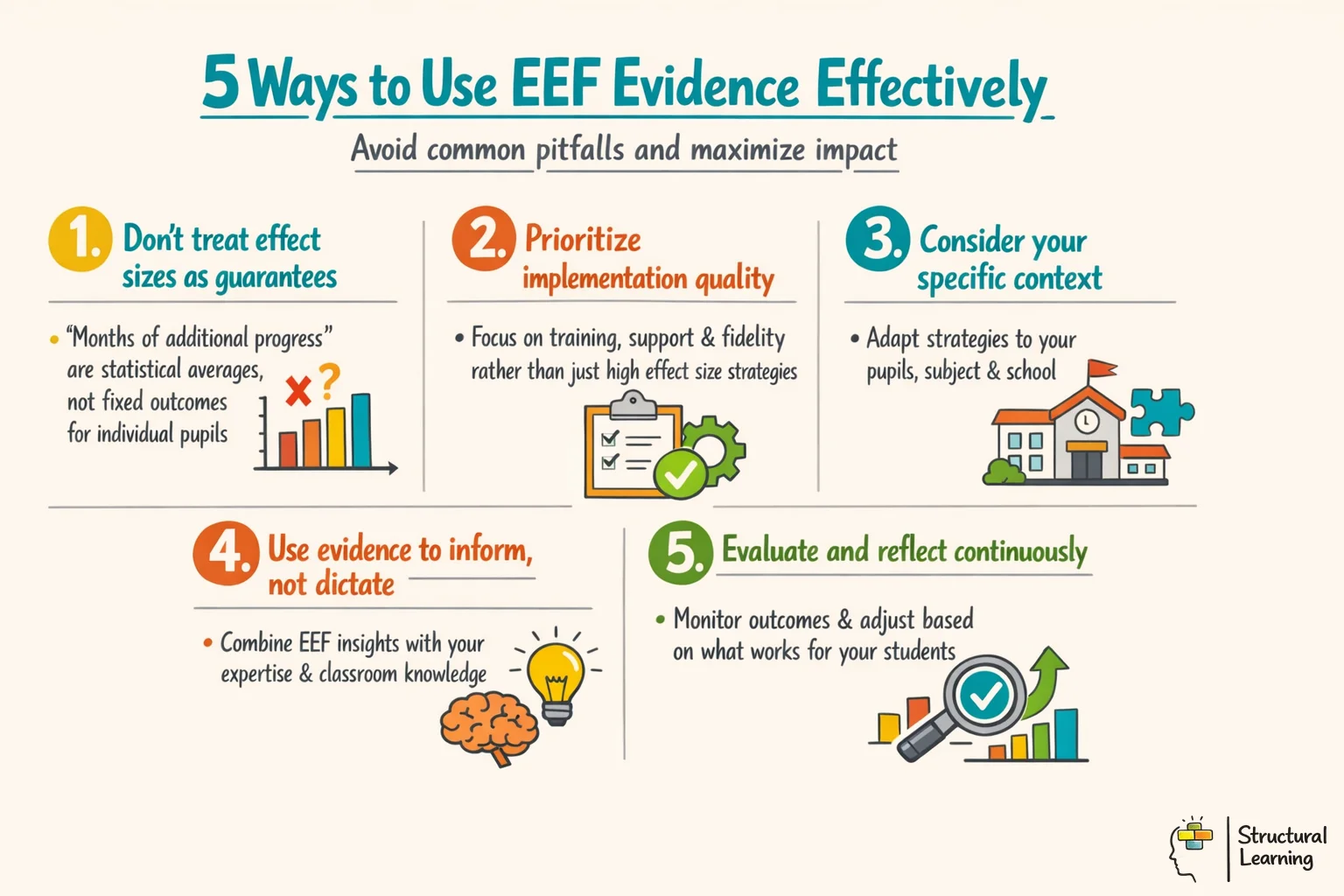
The most important thing to understand is that effect sizes from research studies measure average effects under research conditions. Research conditions include careful implementation, researcher-designed materials, and heightened attention from teachers who know they are being studied. None of these are guaranteed in a normal classroom. Slavin (2020) reviewed implementation quality data from hundreds of trials and found that programmes delivered with low fidelity regularly showed effect sizes close to zero, regardless of what the research literature suggested was possible.
A concrete example from retrieval practice: the Toolkit shows a strong effect for this strategy. But retrieval practice only produces its gains when the retrieval attempt is genuinely effortful, when feedback is provided, and when practice is spaced over time. A low-stakes quiz given once at the end of a unit, without spacing or feedback, will produce far smaller gains than the headline figure suggests. The mechanism matters as much as the label.
Coe, Aloisi, Higgins and Major (2014) published an influential analysis identifying six components of great teaching. They found that the two factors teachers most often cite as indicators of good teaching, pupil enthusiasm and busyness, are among the weakest predictors of learning. The strongest predictors are pedagogical content knowledge and the quality of formative assessment. The EEF Toolkit is most useful when read alongside this kind of deeper analysis of what actually drives classroom learning.
Common EEF Misconceptions
Several persistent misreadings of the EEF Toolkit circulate in schools. Naming them directly is more useful than leaving them implicit.
Misconception 1: Higher months means better. A strategy showing +8 months with one padlock is not necessarily better than one showing +5 months with five padlocks. Evidence strength tells you how reliable the estimate is. An eight-month figure derived from a handful of small, poorly controlled studies is far less trustworthy than a five-month figure supported by dozens of large trials. When evidence strength is low, the real effect could be anywhere from negative to double the stated figure.
Misconception 2: The Toolkit tells you what to do. The EEF is explicit that the Toolkit is not a prescription. It tells you what has worked on average, in other schools, under research conditions. It does not tell you what will work in your school, with your staffing, your pupil demographic, and your existing practice. Goldacre (2013) argued in his influential DfE paper that evidence should inform professional judgement, not replace it. The Toolkit is a starting point for a professional conversation, not a shopping list.
Misconception 3: Zero or negative months means the strategy is harmful. Several entries show modest or near-zero effects. This does not mean the strategy is damaging. It may mean the evidence is mixed, or that context determines whether the strategy works. Inquiry-based learning, for example, shows modest effects on average but produces stronger gains when used with pupils who already have strong foundational knowledge. Average effects obscure important variation.
Misconception 4: The Toolkit covers everything. The Toolkit covers strategies that have been sufficiently studied to produce a meaningful estimate. Many classroom techniques, including some that teachers use daily, have not been studied at scale and therefore do not appear. Absence from the Toolkit is not evidence of ineffectiveness. It is evidence of insufficient research.
Misconception 5: The EEF says learning styles are completely useless. The EEF does not appear in the Toolkit for learning styles because the evidence does not support the practice of teaching to a pupil's preferred style. However, the EEF does support the use of varied representations, including visual and verbal formats. Dual coding, which uses paired visual and verbal information, appears with a positive effect estimate. The distinction is between matching instruction to a supposed fixed learner type (no evidence) and using multiple representations to aid understanding (good evidence).
Integrating EEF Evidence into Lesson Planning
The gap between knowing the evidence and using it in planning is where most schools lose ground. The EEF Toolkit is consulted during Pupil Premium reviews or CPD sessions, then filed away. The strategies that consistently produce gains, feedback, metacognition, retrieval practice, and spaced practice, require deliberate structural choices in lesson planning, not one-off efforts.
Consider how a Year 10 history teacher might integrate three high-impact strategies into a single lesson on the causes of the First World War. At the start of the lesson, a short retrieval quiz covering prior knowledge of European alliances serves the retrieval practice strand. This takes five minutes and requires no marking, as pupils self-check against a visualised answer key, which also serves the dual coding strand. The main teaching phase uses worked examples displayed on the board, reducing the cognitive load that pupils would face if they had to construct both the analysis and the written structure simultaneously. At the end, pupils complete a three-sentence metacognitive reflection: what they understood, what they found difficult, and what they will revisit before the next lesson.
This is not an elaborate departure from normal teaching. It is normal teaching, structured so that the mechanisms that produce learning, retrieval, spacing, feedback, and metacognitive monitoring, are present rather than incidental. The EEF Toolkit points you to the strategies; lesson design is how you make them operational.
Rosenshine's Principles of Instruction complement the EEF Toolkit well here. Rosenshine synthesised findings from process-product research and cognitive science into seventeen instructional behaviours that distinguish more effective from less effective teachers. Several of his principles, including reviewing previous learning, presenting new material in small steps, and checking for understanding frequently, map directly onto the highest-impact EEF strands.
Scaffolding appears in the Toolkit with a positive effect estimate. It refers to temporary, targeted support that is removed as pupils develop independence, not permanent simplification. A scaffold that stays in place indefinitely reduces the effortful retrieval that produces long-term retention. Knowing this changes how you design support: the goal is a planned removal sequence, not a permanent crutch.
Questioning is another lever the Toolkit addresses indirectly through the feedback and formative assessment strands. Cold calling, think-pair-share, and other structured questioning techniques create the retrieval attempts and formative data that make feedback timely and targeted. A teacher who asks only voluntary questions collects a biased picture of class understanding and delivers feedback to the pupils who need it least.
Beyond the Toolkit: Reports and Guidance
The Teaching and Learning Toolkit is the EEF's best-known product, but it sits within a much larger evidence base. The EEF also publishes themed guidance reports, trial results, and implementation frameworks that are worth knowing about.
Guidance Reports cover specific areas of classroom practice in depth. Current reports include guidance on metacognition and self-regulated learning, improving literacy in secondary schools, early language and literacy, mathematics in Key Stage 2, and effective professional development. Each report translates the evidence into numbered, prioritised recommendations with illustrative classroom examples. The metacognition guidance report, for instance, provides a seven-step model for teaching pupils to think about their own thinking, with examples drawn from primary and secondary classrooms across several subjects.
EEF Project Reports are the published results of individual randomised controlled trials and other studies the EEF has funded. These are more technical than the Toolkit summaries but are freely available and searchable on the EEF website. If you want to know whether a specific commercial programme was trialled and what happened, the project reports are the right source. Some results are surprising: several programmes widely used in schools have shown no significant effect in EEF trials, or have shown effects limited to specific pupil groups.
The Early Years Toolkit applies the same framework to provision for three- to five-year-olds, covering strategies such as self-regulation, physical development, and early literacy. Settings funded through maintained nursery school funding or the Early Education and Childcare National formula can use this toolkit to direct spending.
The International Toolkit extends the evidence base beyond England, drawing on studies from other high-income countries. This is useful when considering whether findings from, say, the United States or Australia are likely to transfer to English classrooms. The answer is sometimes yes, sometimes no, and the international toolkit helps you assess which.
Direct instruction features prominently in several EEF guidance reports, particularly in the context of literacy and numeracy for disadvantaged pupils. Understanding what the evidence says about explicit teaching, worked examples, and guided practice helps you evaluate whether an intervention programme is built on sound pedagogical principles before committing to it.
EEF and School Improvement Planning
The EEF was founded, in part, to give school leaders a more rigorous basis for spending Pupil Premium funding. Since 2011, schools in England have been required to publish how they spend their Pupil Premium allocation and to demonstrate its impact. The EEF Toolkit became the dominant reference point for justifying these decisions. When Ofsted inspectors ask about the rationale for a school's Pupil Premium strategy, most senior leaders now point to the Toolkit.
This has had real benefits. Schools are far less likely today than in 2011 to spend Pupil Premium on laptops for disadvantaged pupils, a strategy the Toolkit consistently shows to have minimal impact on attainment, or on one-to-one teaching assistant support structured around adult proximity rather than targeted instruction.
However, the instrumental use of the Toolkit in school improvement carries risks. If leaders use it to justify decisions already made rather than to inform decisions still open, the evidence base becomes a compliance exercise rather than a genuine tool for improvement. The EEF itself is clear on this: effective school improvement involves a cycle of choosing strategies based on evidence, implementing them with high fidelity, and evaluating whether they are working in your context, then adjusting accordingly.
The EEF's Implementation Guidance provides a framework for this cycle. It distinguishes between four stages: exploration (identifying the need and choosing an approach), preparation (designing and planning the intervention), delivery (implementing with fidelity and monitoring), and sustaining change (embedding and refining over time). Schools that skip preparation and go straight to delivery consistently see weaker results than those that invest in professional development and structural planning before the intervention begins.
Differentiation is an area where school improvement planning and EEF evidence sometimes conflict. Many school policies require extensive differentiated materials for every lesson, but the EEF evidence on within-class differentiation is more modest than many leaders assume. The stronger evidence points to working memory-informed instruction, high-quality questioning, and responsive formative assessment as more reliable levers than multiple simultaneous tasks.
When using EEF evidence in school improvement planning, three questions focus the work: What problem are we trying to solve? What does the evidence say about strategies that address this problem? And how will we know whether our implementation is working? The Toolkit answers the second question. Your school's data and professional judgement must answer the first and third.
Strategy
Months Gain
Cost
Evidence Strength
Classroom Starting Point
Metacognition and self-regulation
+7
££ (low)
🔒🔒🔒🔒 (high)
Pre-task planning prompts and post-task reflection for all pupils
Feedback
+6
£ (very low)
🔒🔒🔒🔒🔒 (very high)
Actionable written comments linked to success criteria, not effort
Structured tasks requiring genuine interdependence, not parallel work
Peer tutoring
+5
££ (low)
🔒🔒🔒🔒 (high)
Structured same-age or cross-age paired reading with clear role cards
Mastery learning
+5
££ (low)
🔒🔒🔒 (moderate)
Clear unit outcomes with targeted re-teaching before moving on
Behaviour interventions
+4
££ (low)
🔒🔒🔒 (moderate)
Consistent routines, calm correction, and relationship-building protocols
Extending school time
+2
£££££ (high)
🔒🔒 (low)
Poor value for money; evidence does not support this over better teaching
Digital technology
+4
£££ (moderate)
🔒🔒🔒 (moderate)
Only effective when it makes a specific learning mechanism more accessible
Table 1. Selected EEF Teaching and Learning Toolkit strategies. Months and evidence strength ratings based on EEF Toolkit data (Higgins et al., 2014). Cost indicators are approximate.
Further Reading: Key Papers on Evidence-Based Teaching
The five sources below form the research foundation behind the EEF's approach to evidence-informed practice. Each is freely accessible or widely available through university libraries.
Further Reading: Key Papers on Evidence-Based Teaching
These papers provide the research foundation behind the EEF's approach to evidence-informed practice.
The Sutton Trust-EEF Teaching and Learning ToolkitView study ↗ Cited extensively in English school improvement plans and Ofsted inspections
Higgins, S., Katsipataki, M., Kokotsaki, D., Coleman, R., Major, L.E. and Coe, R. (2014)
The primary reference document for the Toolkit. Provides the methodology for converting effect sizes into months of additional progress, explains the evidence grading system, and summarises all 35+ strategy strands. Essential reading for any school using the Toolkit for Pupil Premium planning.
Visible Learning: A Synthesis of Over 800 Meta-Analyses Relating to AchievementView study ↗ Over 0 citations in educational research literature
Hattie, J. (2009)
Hattie synthesised more than 800 meta-analyses covering millions of pupils to identify which factors most influence pupil achievement. His concept of "visible learning", where teachers see learning through pupils' eyes and pupils see themselves as their own teachers, underpins many of the EEF's highest-rated strategies, particularly feedback and metacognition.
What Makes Great Teaching? Review of the Underpinning ResearchView study ↗ Commissioned by the Sutton Trust; widely cited in ITT and CPD design
Coe, R., Aloisi, C., Higgins, S. and Major, L.E. (2014)
This review identifies six components of effective teaching and critically evaluates the evidence behind each. It challenges many common assumptions, showing that enthusiasm, busyness, and stylistic variation are weak proxies for learning. The most actionable finding is that content knowledge and formative assessment quality are the strongest levers available to classroom teachers.
How Evidence-Based Reform Will Transform Research and Practice in EducationView study ↗ Published in Educational Psychologist, 55(1), 2020
Slavin, R. (2020)
Slavin argues that the shift towards evidence-based education reform, exemplified by organisations like the EEF, represents a fundamental change in how educational research is conducted and used. He provides a framework for evaluating whether a programme's evidence is sufficient to justify adoption, with particular attention to implementation quality and the gap between efficacy trials and real-world effectiveness.
Building Evidence into EducationView study ↗ Published by the Department for Education, 2013
Goldacre, B. (2013)
Goldacre's paper, commissioned by the DfE, makes the case for randomised controlled trials as the gold standard for educational evidence and helped create the policy environment in which the EEF operates. It remains the clearest and most readable account of why anecdote and tradition are insufficient bases for educational decision-making, and why rigorous trial evidence is worth the investment.
If you want to go further, the EEF website provides free access to all published guidance reports, individual trial reports, and a searchable database of evidence summaries. The interleaving strand and the taxonomy of learning objectives both connect productively to the Toolkit's findings on spacing and retrieval.
The Education Endowment Foundation publishes the most comprehensive and accessible evidence base available to classroom teachers in England. Its Teaching and Learning Toolkit translates decades of educational research into straightforward guidance on which classroom strategies produce the greatest gains for the least cost. For many teachers, it is the first and best place to start when evaluating whether a new approach is worth trying.
Yet the Toolkit is often misread. Schools treat effect sizes as guarantees, misunderstand what "months of additional progress" actually means, and import strategies without considering implementation quality. This guide explains what the EEF is, how to read its evidence correctly, and how to use it sensibly in planning and school improvement work.
Key Takeaways
Evidence hub for teachers: The EEF Teaching and Learning Toolkit ranks 35+ strategies by impact, cost, and evidence strength, giving teachers a reliable starting point for instructional decisions.
Effect sizes need context: A strategy showing +5 months progress does not guarantee results; implementation quality, pupil context, and school culture all determine actual outcomes.
High impact does not mean high cost: Feedback (+6 months), metacognition (+7 months), and peer tutoring (+5 months) are among the most effective strategies and cost relatively little to implement well.
Evidence informs, not dictates: The EEF toolkit is a decision-support tool, not a prescription. Teachers must combine evidence with professional judgement and knowledge of their pupils.
What Is the EEF and Why Does It Matter?
The Education Endowment Foundation is an independent charity established in 2011 with a grant from the Department for Education. Its founding mission is to break the link between family income and educational achievement. It funds randomised controlled trials, reviews existing evidence, and publishes free guidance for schools and teachers across England and Wales.
What sets the EEF apart from most educational commentary is its commitment to rigorous methodology. Rather than publishing opinion or anecdote, the EEF funds independent trials, brings together existing systematic reviews, and synthesises findings from thousands of studies. The result is evidence you can compare, question, and apply, rather than simply accept.
For classroom teachers, the practical entry point is the Teaching and Learning Toolkit. First published in 2011 in partnership with the Sutton Trust, the Toolkit currently covers more than 35 instructional strategies (Higgins, Katsipataki, Kokotsaki, Coleman, Major and Coe, 2014). Each entry summarises the average effect on pupil attainment, the cost to implement, and the strength of the underlying evidence base.
Why does it matter? Because many of the most popular classroom approaches, from learning styles to Brain Gym, have little or no robust evidence behind them. The EEF Toolkit helps you distinguish between strategies that have been tested at scale and those that are little more than well-marketed habit. If your school is deciding where to invest Pupil Premium funding, the Toolkit is the most defensible starting point available.
Reading the Teaching and Learning Toolkit
Each entry in the Teaching and Learning Toolkit presents three data points: months of additional progress, cost, and evidence strength. Reading these correctly takes a little practice. Most teachers focus on the months figure and overlook the other two, which is where the most important caveats sit.
Months of additional progress represents an average effect across all the studies included in that strand. A figure of "+6 months" means that, on average, pupils in studies using this approach made six additional months of progress compared to pupils who did not. It does not mean every classroom using the strategy will see this gain. The figure is a population average, and it says nothing about whether the approach will work in your specific school with your specific pupils.
Cost is rated on a five-pound-sign scale. A single pound sign indicates very low cost (typically under £80 per pupil per year); five indicates over £1,200 per pupil per year. This matters because a strategy with a smaller effect size but near-zero cost may represent better value than an expensive intervention with a modestly higher effect.
Evidence strength is perhaps the most underused dimension. It is rated from one to five padlocks. Five padlocks indicates a large body of high-quality evidence, typically including multiple well-conducted randomised controlled trials. One padlock indicates limited or inconsistent evidence. When you see a high effect size paired with a low padlock rating, treat the figure with considerable scepticism. There is a real risk the estimate will not hold up as more research accumulates.
A practical classroom example: imagine you are comparing two strategies for your Year 9 maths class. Metacognition and self-regulation shows +7 months and four padlocks. A particular commercial reading programme shows +8 months and one padlock. The metacognition figure rests on a much stronger evidence base and should, in most cases, be preferred, even though the headline number is slightly lower.
High-Impact, Low-Cost Interventions
The most striking finding in the Toolkit is that several of the highest-impact strategies cost almost nothing to implement. This is not accidental. Strategies rooted in how memory and cognition work, rather than in expensive materials or software, tend to produce large gains because they address the underlying mechanisms of learning.
Metacognition and self-regulation sits at the top of the Toolkit with an average impact of +7 months and four padlocks. Teaching pupils to plan, monitor, and evaluate their own learning has consistent effects across ages and subjects. In practice, this means giving pupils structured time to assess whether their strategy is working and to switch approaches when it is not. A Year 6 teacher might use a short pre-task planning prompt: "What do you already know? What will you do if you get stuck?" followed by a post-task reflection: "Did your strategy work? What would you change?" This costs nothing beyond lesson time.
Feedback shows +6 months and five padlocks, making it the most evidence-secure entry in the entire Toolkit. But the EEF is clear that not all feedback is equal. Research by Hattie and Timperley (2007) shows that feedback focused on the task and on learning strategies is substantially more effective than praise or feedback focused on the pupil as a person. A comment such as "Your paragraph structure is clear; the argument would be stronger if you addressed the counterargument" gives the pupil something to act on. Telling a pupil they are "a natural writer" does not. Formative assessment is the delivery mechanism for effective feedback, and the two entries reinforce each other.
Reading comprehension strategies reach +6 months. When teachers explicitly model how to summarise, question, clarify, and predict while reading, pupils internalise these strategies and apply them independently. A secondary English teacher might use a think-aloud during a shared text, making their own comprehension process visible before asking pupils to practise in pairs.
Collaborative learning shows +5 months, but with a caveat the Toolkit makes explicit: unstructured group work does not produce these gains. The effect applies when tasks are designed so that collaboration is genuinely necessary, roles are clear, and the group has accountability for both the process and the product.
Peer tutoring also reaches +5 months. Structured peer tutoring, where roles are assigned and both tutor and tutee have clear tasks, benefits both parties. The act of explaining material forces the tutor to organise their own understanding, which is why the learning gains are not limited to the pupil being taught. A paired reading programme in Key Stage 2, where older pupils read with younger ones using a structured protocol, is a low-cost example that has been trialled successfully across many schools.
Understanding Effect Sizes in Practice
The "months of additional progress" metric makes the EEF Toolkit readable for busy teachers, but it simplifies a more complex statistical picture. Understanding what lies beneath the figure helps you use it more accurately.
The months figure is derived from an effect size, typically Cohen's d or a similar standardised measure. An effect size of 0.2 is considered small, 0.5 moderate, and 0.8 large. The EEF converts these into months using a standard conversion based on typical academic progress per year, roughly 0.2 standard deviations of improvement per month in primary school. This conversion varies by age and subject, which means the months figure is an approximation, not a precise measurement.
The most important thing to understand is that effect sizes from research studies measure average effects under research conditions. Research conditions include careful implementation, researcher-designed materials, and heightened attention from teachers who know they are being studied. None of these are guaranteed in a normal classroom. Slavin (2020) reviewed implementation quality data from hundreds of trials and found that programmes delivered with low fidelity regularly showed effect sizes close to zero, regardless of what the research literature suggested was possible.
A concrete example from retrieval practice: the Toolkit shows a strong effect for this strategy. But retrieval practice only produces its gains when the retrieval attempt is genuinely effortful, when feedback is provided, and when practice is spaced over time. A low-stakes quiz given once at the end of a unit, without spacing or feedback, will produce far smaller gains than the headline figure suggests. The mechanism matters as much as the label.
Coe, Aloisi, Higgins and Major (2014) published an influential analysis identifying six components of great teaching. They found that the two factors teachers most often cite as indicators of good teaching, pupil enthusiasm and busyness, are among the weakest predictors of learning. The strongest predictors are pedagogical content knowledge and the quality of formative assessment. The EEF Toolkit is most useful when read alongside this kind of deeper analysis of what actually drives classroom learning.
Common EEF Misconceptions
Several persistent misreadings of the EEF Toolkit circulate in schools. Naming them directly is more useful than leaving them implicit.
Misconception 1: Higher months means better. A strategy showing +8 months with one padlock is not necessarily better than one showing +5 months with five padlocks. Evidence strength tells you how reliable the estimate is. An eight-month figure derived from a handful of small, poorly controlled studies is far less trustworthy than a five-month figure supported by dozens of large trials. When evidence strength is low, the real effect could be anywhere from negative to double the stated figure.
Misconception 2: The Toolkit tells you what to do. The EEF is explicit that the Toolkit is not a prescription. It tells you what has worked on average, in other schools, under research conditions. It does not tell you what will work in your school, with your staffing, your pupil demographic, and your existing practice. Goldacre (2013) argued in his influential DfE paper that evidence should inform professional judgement, not replace it. The Toolkit is a starting point for a professional conversation, not a shopping list.
Misconception 3: Zero or negative months means the strategy is harmful. Several entries show modest or near-zero effects. This does not mean the strategy is damaging. It may mean the evidence is mixed, or that context determines whether the strategy works. Inquiry-based learning, for example, shows modest effects on average but produces stronger gains when used with pupils who already have strong foundational knowledge. Average effects obscure important variation.
Misconception 4: The Toolkit covers everything. The Toolkit covers strategies that have been sufficiently studied to produce a meaningful estimate. Many classroom techniques, including some that teachers use daily, have not been studied at scale and therefore do not appear. Absence from the Toolkit is not evidence of ineffectiveness. It is evidence of insufficient research.
Misconception 5: The EEF says learning styles are completely useless. The EEF does not appear in the Toolkit for learning styles because the evidence does not support the practice of teaching to a pupil's preferred style. However, the EEF does support the use of varied representations, including visual and verbal formats. Dual coding, which uses paired visual and verbal information, appears with a positive effect estimate. The distinction is between matching instruction to a supposed fixed learner type (no evidence) and using multiple representations to aid understanding (good evidence).
Integrating EEF Evidence into Lesson Planning
The gap between knowing the evidence and using it in planning is where most schools lose ground. The EEF Toolkit is consulted during Pupil Premium reviews or CPD sessions, then filed away. The strategies that consistently produce gains, feedback, metacognition, retrieval practice, and spaced practice, require deliberate structural choices in lesson planning, not one-off efforts.
Consider how a Year 10 history teacher might integrate three high-impact strategies into a single lesson on the causes of the First World War. At the start of the lesson, a short retrieval quiz covering prior knowledge of European alliances serves the retrieval practice strand. This takes five minutes and requires no marking, as pupils self-check against a visualised answer key, which also serves the dual coding strand. The main teaching phase uses worked examples displayed on the board, reducing the cognitive load that pupils would face if they had to construct both the analysis and the written structure simultaneously. At the end, pupils complete a three-sentence metacognitive reflection: what they understood, what they found difficult, and what they will revisit before the next lesson.
This is not an elaborate departure from normal teaching. It is normal teaching, structured so that the mechanisms that produce learning, retrieval, spacing, feedback, and metacognitive monitoring, are present rather than incidental. The EEF Toolkit points you to the strategies; lesson design is how you make them operational.
Rosenshine's Principles of Instruction complement the EEF Toolkit well here. Rosenshine synthesised findings from process-product research and cognitive science into seventeen instructional behaviours that distinguish more effective from less effective teachers. Several of his principles, including reviewing previous learning, presenting new material in small steps, and checking for understanding frequently, map directly onto the highest-impact EEF strands.
Scaffolding appears in the Toolkit with a positive effect estimate. It refers to temporary, targeted support that is removed as pupils develop independence, not permanent simplification. A scaffold that stays in place indefinitely reduces the effortful retrieval that produces long-term retention. Knowing this changes how you design support: the goal is a planned removal sequence, not a permanent crutch.
Questioning is another lever the Toolkit addresses indirectly through the feedback and formative assessment strands. Cold calling, think-pair-share, and other structured questioning techniques create the retrieval attempts and formative data that make feedback timely and targeted. A teacher who asks only voluntary questions collects a biased picture of class understanding and delivers feedback to the pupils who need it least.
Beyond the Toolkit: Reports and Guidance
The Teaching and Learning Toolkit is the EEF's best-known product, but it sits within a much larger evidence base. The EEF also publishes themed guidance reports, trial results, and implementation frameworks that are worth knowing about.
Guidance Reports cover specific areas of classroom practice in depth. Current reports include guidance on metacognition and self-regulated learning, improving literacy in secondary schools, early language and literacy, mathematics in Key Stage 2, and effective professional development. Each report translates the evidence into numbered, prioritised recommendations with illustrative classroom examples. The metacognition guidance report, for instance, provides a seven-step model for teaching pupils to think about their own thinking, with examples drawn from primary and secondary classrooms across several subjects.
EEF Project Reports are the published results of individual randomised controlled trials and other studies the EEF has funded. These are more technical than the Toolkit summaries but are freely available and searchable on the EEF website. If you want to know whether a specific commercial programme was trialled and what happened, the project reports are the right source. Some results are surprising: several programmes widely used in schools have shown no significant effect in EEF trials, or have shown effects limited to specific pupil groups.
The Early Years Toolkit applies the same framework to provision for three- to five-year-olds, covering strategies such as self-regulation, physical development, and early literacy. Settings funded through maintained nursery school funding or the Early Education and Childcare National formula can use this toolkit to direct spending.
The International Toolkit extends the evidence base beyond England, drawing on studies from other high-income countries. This is useful when considering whether findings from, say, the United States or Australia are likely to transfer to English classrooms. The answer is sometimes yes, sometimes no, and the international toolkit helps you assess which.
Direct instruction features prominently in several EEF guidance reports, particularly in the context of literacy and numeracy for disadvantaged pupils. Understanding what the evidence says about explicit teaching, worked examples, and guided practice helps you evaluate whether an intervention programme is built on sound pedagogical principles before committing to it.
EEF and School Improvement Planning
The EEF was founded, in part, to give school leaders a more rigorous basis for spending Pupil Premium funding. Since 2011, schools in England have been required to publish how they spend their Pupil Premium allocation and to demonstrate its impact. The EEF Toolkit became the dominant reference point for justifying these decisions. When Ofsted inspectors ask about the rationale for a school's Pupil Premium strategy, most senior leaders now point to the Toolkit.
This has had real benefits. Schools are far less likely today than in 2011 to spend Pupil Premium on laptops for disadvantaged pupils, a strategy the Toolkit consistently shows to have minimal impact on attainment, or on one-to-one teaching assistant support structured around adult proximity rather than targeted instruction.
However, the instrumental use of the Toolkit in school improvement carries risks. If leaders use it to justify decisions already made rather than to inform decisions still open, the evidence base becomes a compliance exercise rather than a genuine tool for improvement. The EEF itself is clear on this: effective school improvement involves a cycle of choosing strategies based on evidence, implementing them with high fidelity, and evaluating whether they are working in your context, then adjusting accordingly.
The EEF's Implementation Guidance provides a framework for this cycle. It distinguishes between four stages: exploration (identifying the need and choosing an approach), preparation (designing and planning the intervention), delivery (implementing with fidelity and monitoring), and sustaining change (embedding and refining over time). Schools that skip preparation and go straight to delivery consistently see weaker results than those that invest in professional development and structural planning before the intervention begins.
Differentiation is an area where school improvement planning and EEF evidence sometimes conflict. Many school policies require extensive differentiated materials for every lesson, but the EEF evidence on within-class differentiation is more modest than many leaders assume. The stronger evidence points to working memory-informed instruction, high-quality questioning, and responsive formative assessment as more reliable levers than multiple simultaneous tasks.
When using EEF evidence in school improvement planning, three questions focus the work: What problem are we trying to solve? What does the evidence say about strategies that address this problem? And how will we know whether our implementation is working? The Toolkit answers the second question. Your school's data and professional judgement must answer the first and third.
Strategy
Months Gain
Cost
Evidence Strength
Classroom Starting Point
Metacognition and self-regulation
+7
££ (low)
🔒🔒🔒🔒 (high)
Pre-task planning prompts and post-task reflection for all pupils
Feedback
+6
£ (very low)
🔒🔒🔒🔒🔒 (very high)
Actionable written comments linked to success criteria, not effort
Structured tasks requiring genuine interdependence, not parallel work
Peer tutoring
+5
££ (low)
🔒🔒🔒🔒 (high)
Structured same-age or cross-age paired reading with clear role cards
Mastery learning
+5
££ (low)
🔒🔒🔒 (moderate)
Clear unit outcomes with targeted re-teaching before moving on
Behaviour interventions
+4
££ (low)
🔒🔒🔒 (moderate)
Consistent routines, calm correction, and relationship-building protocols
Extending school time
+2
£££££ (high)
🔒🔒 (low)
Poor value for money; evidence does not support this over better teaching
Digital technology
+4
£££ (moderate)
🔒🔒🔒 (moderate)
Only effective when it makes a specific learning mechanism more accessible
Table 1. Selected EEF Teaching and Learning Toolkit strategies. Months and evidence strength ratings based on EEF Toolkit data (Higgins et al., 2014). Cost indicators are approximate.
Further Reading: Key Papers on Evidence-Based Teaching
The five sources below form the research foundation behind the EEF's approach to evidence-informed practice. Each is freely accessible or widely available through university libraries.
Further Reading: Key Papers on Evidence-Based Teaching
These papers provide the research foundation behind the EEF's approach to evidence-informed practice.
The Sutton Trust-EEF Teaching and Learning ToolkitView study ↗ Cited extensively in English school improvement plans and Ofsted inspections
Higgins, S., Katsipataki, M., Kokotsaki, D., Coleman, R., Major, L.E. and Coe, R. (2014)
The primary reference document for the Toolkit. Provides the methodology for converting effect sizes into months of additional progress, explains the evidence grading system, and summarises all 35+ strategy strands. Essential reading for any school using the Toolkit for Pupil Premium planning.
Visible Learning: A Synthesis of Over 800 Meta-Analyses Relating to AchievementView study ↗ Over 0 citations in educational research literature
Hattie, J. (2009)
Hattie synthesised more than 800 meta-analyses covering millions of pupils to identify which factors most influence pupil achievement. His concept of "visible learning", where teachers see learning through pupils' eyes and pupils see themselves as their own teachers, underpins many of the EEF's highest-rated strategies, particularly feedback and metacognition.
What Makes Great Teaching? Review of the Underpinning ResearchView study ↗ Commissioned by the Sutton Trust; widely cited in ITT and CPD design
Coe, R., Aloisi, C., Higgins, S. and Major, L.E. (2014)
This review identifies six components of effective teaching and critically evaluates the evidence behind each. It challenges many common assumptions, showing that enthusiasm, busyness, and stylistic variation are weak proxies for learning. The most actionable finding is that content knowledge and formative assessment quality are the strongest levers available to classroom teachers.
How Evidence-Based Reform Will Transform Research and Practice in EducationView study ↗ Published in Educational Psychologist, 55(1), 2020
Slavin, R. (2020)
Slavin argues that the shift towards evidence-based education reform, exemplified by organisations like the EEF, represents a fundamental change in how educational research is conducted and used. He provides a framework for evaluating whether a programme's evidence is sufficient to justify adoption, with particular attention to implementation quality and the gap between efficacy trials and real-world effectiveness.
Building Evidence into EducationView study ↗ Published by the Department for Education, 2013
Goldacre, B. (2013)
Goldacre's paper, commissioned by the DfE, makes the case for randomised controlled trials as the gold standard for educational evidence and helped create the policy environment in which the EEF operates. It remains the clearest and most readable account of why anecdote and tradition are insufficient bases for educational decision-making, and why rigorous trial evidence is worth the investment.
If you want to go further, the EEF website provides free access to all published guidance reports, individual trial reports, and a searchable database of evidence summaries. The interleaving strand and the taxonomy of learning objectives both connect productively to the Toolkit's findings on spacing and retrieval.
{"@context":"https://schema.org","@type":"Article","headline":"The Education Endowment Foundation (EEF): A Teacher's Evidence Hub","description":"The EEF Teaching and Learning Toolkit ranks 35 strategies by impact, cost and evidence strength. Use this guide to read the evidence and apply it in your classroom.","author":{"@type":"Person","name":"Structural Learning"},"publisher":{"@type":"Organization","name":"Structural Learning","url":"https://www.structural-learning.com"},"datePublished":"2026-03-07","dateModified":"2026-03-07","mainEntityOfPage":{"@type":"WebPage","@id":"https://www.structural-learning.com/post/eef-teaching-learning-toolkit-guide"},"about":{"@type":"Thing","name":"Education Endowment Foundation Teaching and Learning Toolkit"},"keywords":["EEF toolkit","Education Endowment Foundation","teaching and learning toolkit","evidence-based teaching","Pupil Premium","effect sizes education","metacognition EEF","feedback teaching"]}