Updated on
September 24, 2026
SEND Reforms 2026: What Every School Needs to Know
The 2026 SEND reforms for schools in England: what is current duty, what is still a consultation proposal, and how SENCOs and teachers can prepare now.


Updated on
September 24, 2026
The 2026 SEND reforms for schools in England: what is current duty, what is still a consultation proposal, and how SENCOs and teachers can prepare now.
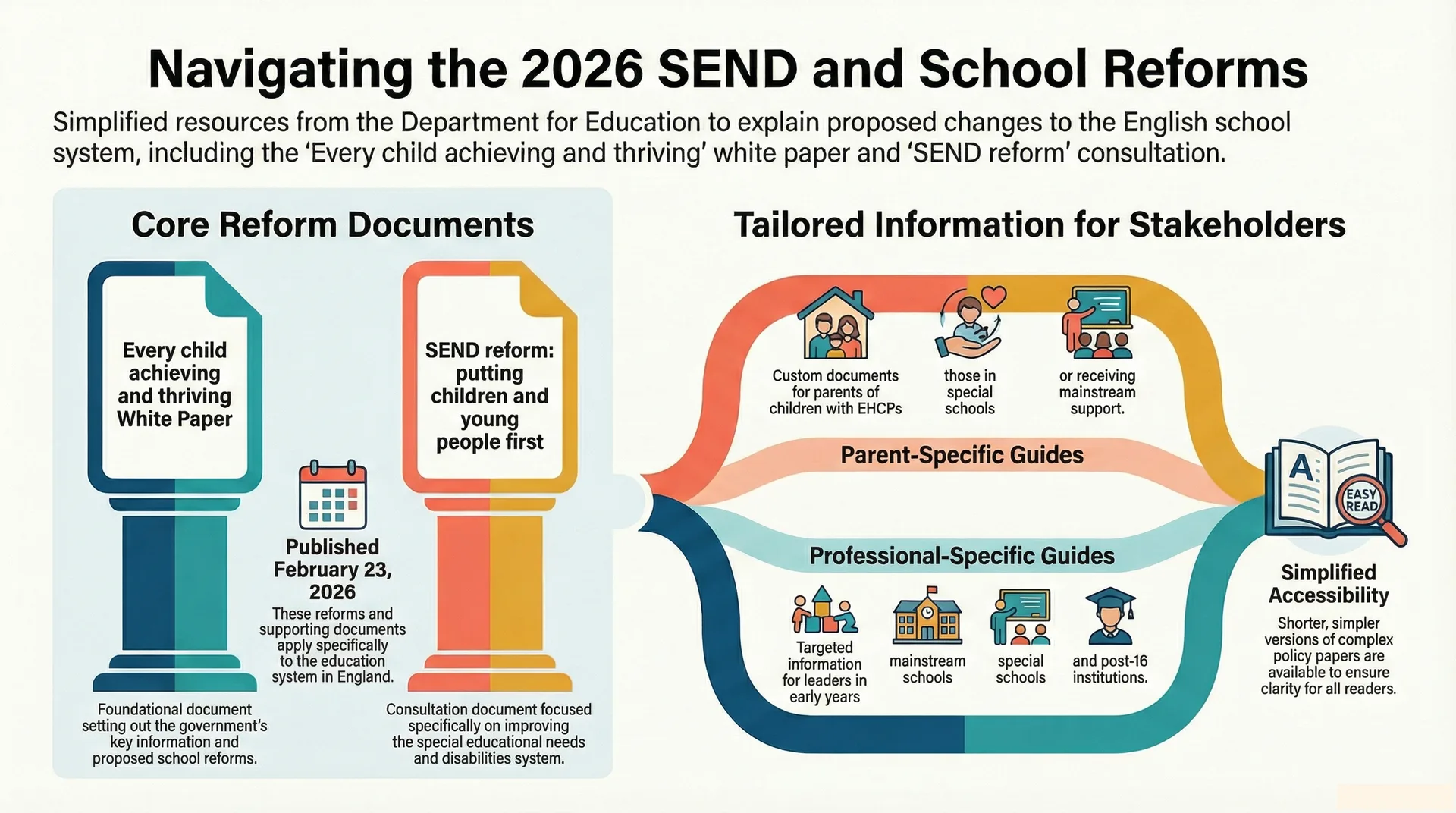
The term SEND reforms 2026 describes proposed changes to England's 0 to 25 SEND system. On 23 February 2026, the Department for Education and Department of Health and Social Care (2026) published Every Child Achieving and Thriving. They published it alongside a formal SEND consultation.
The proposals include national inclusion standards, digital Individual Support Plans and better access to specialist professionals. For now, schools must still follow the SEND Code of Practice: 0 to 25 years. It was last updated on 12 September 2024. It remains the live statutory framework until new law and guidance replace it (Department for Education and Department of Health, 2015).
For schools, the first task is to prepare, while remembering that not every proposal is current law. Start by mapping current SEN Support, EHCP provision, family communication and local consultation evidence against the proposed changes. For a classroom-focussed breakdown, see our practical teacher guide to the 2026 White Paper.
Use this table as a guide to avoid reading too much into the reforms. The 2026 documents set out the future direction, funding, and consultation proposals. However, the current SEND Code remains your legal starting point. This stays in place until new laws and guidance take effect.
| Area | Current position on 20 May 2026 | 2026 proposal or status | School action now |
|---|---|---|---|
| SEN Support | Schools still work from the 0-25 SEND Code of Practice and the graduated approach. | The consultation proposes clearer national inclusion standards and stronger duties for schools and colleges. | Audit Assess, Plan, Do, Review evidence and check that provision records describe what learners actually receive. |
| EHCPs | Existing EHC plans and current legal duties continue. | The proposal retains EHCPs for learners with the most complex needs, with phased transition from 2030. | Give families calm, date-specific messages and keep annual review evidence up to date. |
| Individual Support Plans | Schools should already record needs, provision and outcomes for SEN Support. | The consultation proposes digital ISPs for learners receiving Targeted, Targeted Plus or Specialist support. | Standardise plan templates around need, provision, owner, review date and measurable outcome. |
| Support layers | Schools must make reasonable adjustments and use graduated support. | The proposed model clarifies a universal classroom offer plus Targeted, Targeted Plus and Specialist layers. | Map current provision to those layers, but label the exercise as preparation, not legal reassignment. |
| Consultation | The formal consultation closed on 18 May 2026. Schools should now keep their submitted evidence and any local briefing notes. | The SEND reform consultation closed on 18 May 2026; final policy depends on the government response, legislation and updated guidance. | Use local evidence: waiting times, plan quality, parent feedback, staffing capacity and specialist access. |
The SEND system is under pressure. High-needs spending has risen sharply, and EHCP requests have increased. In many areas, assessment waits are still long and provision varies by local authority (Education Policy Institute, 2025). That is why the 2026 consultation focusses on earlier support, clearer school duties and better coordination between education, health and care.
The Department for Education says the reforms aim to make support more consistent, timely and accessible. The main proposals include National Inclusion Standards and digital Individual Support Plans. They also include Specialist Provision Packages, Inclusion Bases and better access to educational psychologists, speech and language therapists and mental health support.
The key distinction is legal status. For legal status checks, use GOV.UK and the House of Commons Library as the primary record. Inclusion Quality Mark, The Access Group and Mills & Reeve are useful sector explainers, but they cannot make consultation proposals legally binding.
Some funding and preparation work is live in 2026. But many duties still depend on legislation, final guidance and an updated SEND Code of Practice. Schools should prepare carefully while keeping current legal duties clear for staff and families.
The current system still uses the graduated approach: Assess, Plan, Do and Review under the SEND Code (Department for Education and Department of Health, 2015). The 2026 consultation proposes a clearer national structure. It starts with a Universal classroom offer, then adds Targeted, Targeted Plus and Specialist layers for learners who need more specific provision. Schools should treat these as proposed categories until the final legislation and updated Code are published.
In my experience, the current binary system forces us to wait until a child has "failed enough" before we can access meaningful support. I have watched learners struggle for two years while we build the evidence base for an EHCP application. The Graduated Approach in the SEND Code of Practice (DfE, 2015) already tells us to Assess, Plan, Do, Review, but without funding attached to the earlier stages, it often stays on paper.
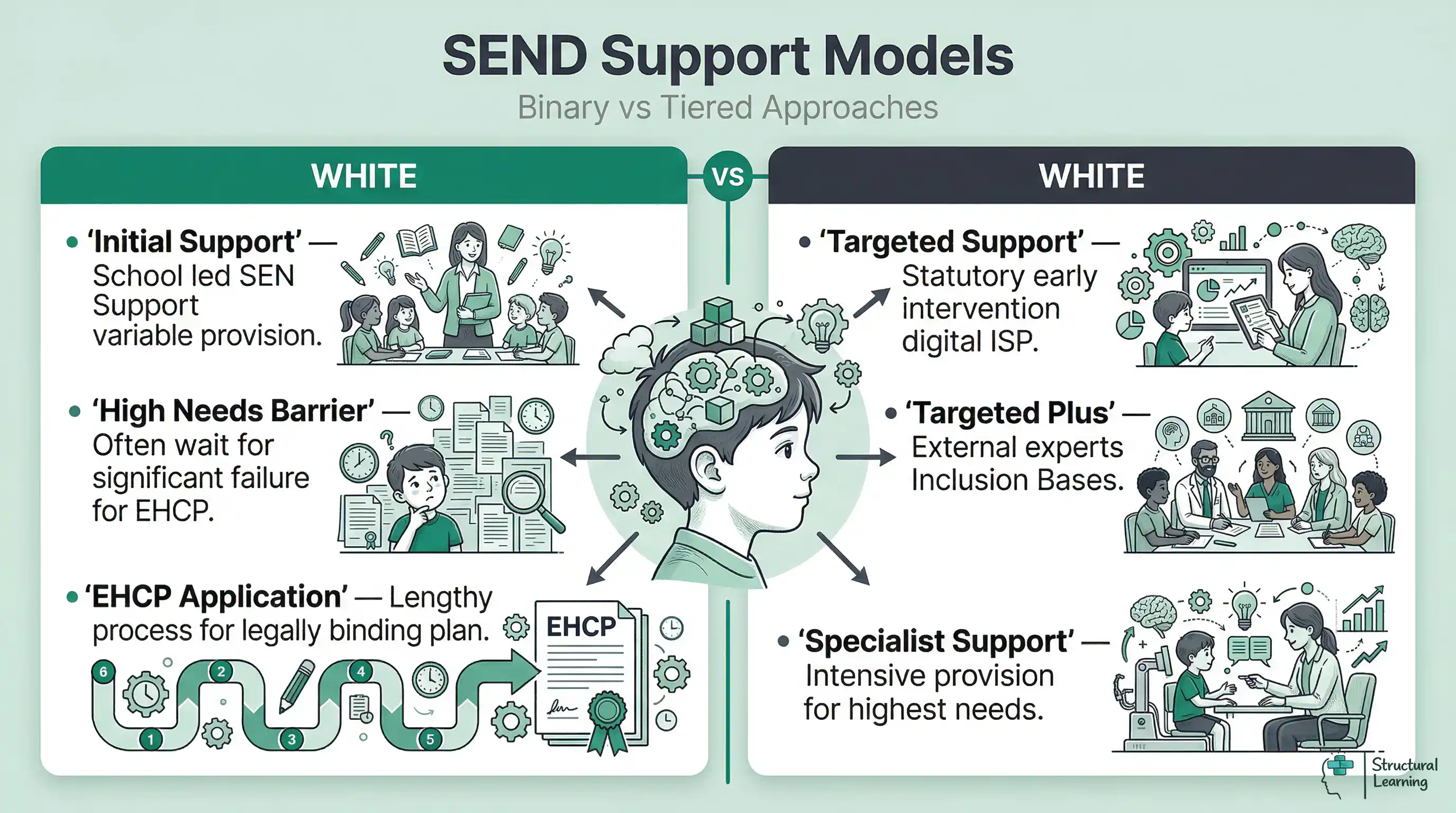
These layers could make earlier support easier to justify. They also move more responsibility into mainstream classrooms. A Targeted layer needs reliable specialist time, funded training and clear thresholds. Without these, it risks becoming rationing by another name.
EPI argues that three pressures sit underneath the reform debate. These are funding pressure, workforce instability and rising childhood needs. Because of this, schools should ask what extra capacity will arrive before EHCP routes narrow (Hutchinson, 2026).
What to do now: Audit your current provision map against the proposed layers. Label the exercise as preparation, not reassignment. For each learner, record the current legal route, the evidence being used, and the specialist advice that would be needed before any support is reduced.
Universal support is the help every learner can expect in class each day. It includes clear explanations, predictable routines, adaptive teaching, reasonable adjustments and curriculum materials that reduce barriers where possible. In a Year 5 science lesson, this could mean teaching key words first, using labelled diagrams and giving learners a structured recording frame before they write on their own.
Universal support matters because it helps schools spot common barriers to curriculum access. It avoids treating these barriers as individual failure. It also gives teachers a clearer baseline before they decide whether a learner needs more targeted support.
However, universal support cannot meet complex neurodevelopmental needs on its own. Webster's observation study found that mainstream attendance does not guarantee access to mainstream learning for learners with high-level SEND (Webster, 2022).
Targeted support is for a learner or small group who needs planned intervention beyond the Universal offer. School staff provide focussed work, adjust classroom tasks and record the support being tried. Because thresholds can be subjective, schools should check whether behaviour, attendance or engagement concerns are masking speech and language needs, anxiety, racism, EAL barriers or neurodivergence, particularly where SEMH labels are being considered (Strand and Lindorff, 2021).
In practice, a Year 4 learner struggling with reading comprehension could receive daily guided reading in a group of four, with the plan naming the phonics gaps being addressed and the progress markers the school is tracking. If the ISP duty is enacted, that record would make provision harder to lose when timetables or staffing change.
The Targeted Plus proposal links school support with advice from outside specialists. Speech and language therapists, educational psychologists, occupational therapists and mental health professionals would help staff adapt teaching. This support would come before a statutory assessment is needed. Some learners could also use an Inclusion Base for structured regulation or short intervention work.

Consider a Year 8 learner with autism who manages most lessons well but finds unstructured time and transitions overwhelming. Under the current system, the school may request an EHCP to access specialist input. Under the proposal, Experts at Hand could provide that input directly, including observation, staff coaching and planned use of an Inclusion Base during break times.
Short-term placements at alternative provision or special schools are also available at this level to help a child re-engage with their mainstream setting.
The proposed plan includes specialist support for learners with complex needs. This is for needs that the Universal, Targeted or Targeted Plus layers cannot meet alone.
The consultation outlines new Specialist Provision Packages, defined at national level. Experts designed these packages, and families tested them. The goal is to make support more consistent across different local areas.
Specialist Provision Packages are not yet a finished entitlement for learners. They are currently part of the reform proposal. We still need more details on eligibility, assessment processes and health input.
We also need to know how parents can challenge decisions and how local authorities will apply them. Schools should avoid promising a specific package before the final framework is published.
Where a child or young person is assessed as needing the Specialist layer, the proposal is that an EHCP would be based on the relevant package and retain legal protection for the provision it specifies.
The consultation proposes digital Individual Support Plans for learners receiving Targeted, Targeted Plus or Specialist support. This would become a school and college duty only when the relevant law and guidance are in force. Digital plans are not just online paperwork.
They create structured data about need, provision and progress. Schools must decide who can view the data, whether analytics will influence resource allocation and how staff can challenge automated decisions about a child (ICO, 2026).
Let me be direct: proposed statutory ISPs are both promising and demanding. Promising, because I have spent years writing provision maps that become fragile when budgets tighten. Demanding, because statutory wording means schools must be able to show that what is written down is being delivered.
The SEND Code of Practice expects schools to keep and share records of outcomes, actions and support for learners receiving SEN Support, especially in paragraphs 6.71 to 6.74. Even so, compliance has been inconsistent. Parent-advocacy evidence has repeatedly identified weak records of school-based support as a source of conflict between families, schools and local authorities (IPSEA, 2024).
The new ISP framework forces consistency, so paperwork needs to be precise. "Additional literacy support" will not cut it. You need to name the intervention, frequency, duration, and success criteria.
What to do now: Draft a template ISP using the DfE's existing SEN Support record format. Trial it with five learners this term. The feedback from teachers and parents will reveal gaps before the statutory requirement lands.
The ISP records three things: the child's needs, the support they are receiving, and what that support should help them achieve. It is developed with parents and carers and updated regularly.
Many schools already use provision mapping or similar tracking systems. For them, ISPs would formalise what strong SENCOs already do.
The difference would be clearer accountability. If a parent is unhappy with support described in an ISP, the proposal includes a strengthened complaints route. This includes a panel with an independent SEND expert.
ISPs should be specific enough to teach from and audit. Instead of "literacy support," write: "Three weekly Precision Teaching sessions for word recognition, delivered by the named adult, reviewed half-termly against 30 words read correctly per minute" (Daly et al., 2023). Add a teacher note on what changes in class, such as a pre-taught word bank before independent reading.
EHCPs are retained in the published proposals, and existing EHC plans do not disappear because a consultation has opened. ISPs would not replace EHCPs for learners who need statutory specialist support; they would replace weaker local records for Targeted or Targeted Plus support. Current provision continues unless changed through the normal legal review, amendment, appeal or transition processes. For learners with the most complex needs, the proposal keeps EHCPs as the legal route to provision.
Parents are frightened. Let me acknowledge that directly. Every SENCO with an open inbox knows that families are asking whether their child's EHCP will be taken away. The answer from the government is unequivocal: existing EHCPs are retained, and no child transitions before 2030.
The risk is not that EHCPs vanish overnight. The risk is that local systems start applying the future Specialist tier as if it already limits today's legal duties. The publication of a white paper does not change existing SEND law, so leaders should challenge any reduction in support that is justified only by the 2026 proposals and ask for the statutory basis in writing (Contact, 2026).
What to do now: If you have learners with EHCPs due for annual review before 2030, reassure parents explicitly in writing that their child's plan remains in force. Document this in your annual review paperwork.
If the government introduces Specialist Provision Packages across England, the EHCP structure may change for new assessments. This could make EHCP quality more even across local authorities. However, it could also limit judgement if local panels treat national packages as fixed limits, rather than starting points. Headteachers should keep current annual review evidence, professional advice and parent views separate from any local rehearsal of the 2026 model.
The published transition timeline is phased. No child moves to the new system before the 2030 school year. The first cohorts to be assessed under the proposed framework are those at the end of primary, secondary and post-16 in the 2029/30 school year.
Children attending special schools can stay for the duration of their education. The government explicitly states that no child will be forced into a mainstream setting.
The proposal says every secondary school should have an Inclusion Base. Over time, the same number of primary schools should have one too. An Inclusion Base is a dedicated space in a mainstream school for targeted intervention, regulation support or specialist sessions. It should help learners stay part of their school community, not become a permanent replacement for adapted classroom teaching.
I welcome Inclusion Bases, but I have seen similar initiatives become "holding pens" when mainstream classrooms remain unadapted. Ofsted's 2024 Annual Report raised concerns about the rise of part-time timetables and internal exclusion spaces that removed learners from learning rather than supporting their access to it. We cannot repeat that pattern.
The main success factor is whether the Base functions as a bridge back to the classroom or a permanent alternative to it. Special Needs Jungle's analysis of these reforms asks whether schools will receive enough training alongside the physical space. A room with beanbags is not an Inclusion Base. A trained HLTA running structured regulation sessions, with clear re-entry protocols and teacher liaison time, is closer to the intended model.
What to do now: Walk your school building this week. Identify the space that could become your Inclusion Base. Then write a one-page proposal showing your SLT how it would function differently from a withdrawal room, with clear entry and exit criteria for learners.
This is not a withdrawal unit in the traditional sense. The government describes it as a space where children can "receive targeted interventions and support or spend time to help them regulate and access their education." The emphasis is on the child remaining part of their mainstream school community while accessing the specific support they need.
For teachers, Inclusion Bases mean that colleagues running interventions will have a purpose-built space rather than making do with a corridor table or a shared office. For SENCOs, it means a physical hub for coordinating the layered support model.
The capital investment for building and equipping Inclusion Bases comes from the 3.7 billion pound fund that also covers 60,000 new specialist places across the country.
Experts at Hand is the proposed specialist access programme. It is backed by £1.8 billion over three years. The consultation focusses on better access to educational psychologists, speech and language therapists, occupational therapists and mental health professionals. The aim is for support to reach classrooms earlier.
The practical test is workforce capacity. EPI reports a stark gap in educational psychology provision. Some areas have one educational psychologist for every 480 learners. In the lowest-provision areas, there is one for every 9,400 learners (Zuccollo and Hutchinson, 2026).
Those of us who have been in this role for more than five years will remember promises of specialist access that never materialised. The Royal College of Speech and Language Therapists reported in 2023 that average waiting times for children's NHS speech therapy exceeded 18 months in some areas. So when the government promises 160 days of specialist time per secondary school per year, my first question is: where are these professionals coming from?
The NASUWT's Matt Wrack put it bluntly: specialists are "already supposed to have that access under current arrangements" but shortages persist. The 1.8 billion pound investment is welcome, but training a speech and language therapist takes four years. We need honest timelines about when capacity will actually match the policy commitment.
That said, if even half this promise is delivered, it transforms our work. Instead of writing referrals and waiting, I could consult directly with an EP about a learner's assessment profile that same week. That is a different profession entirely.
What to do now: Compile a list of your current specialist referrals, waiting times, and gaps. This becomes your evidence base for requesting Experts at Hand allocation when the service launches in your area.
Schools often rely on EHCP routes or busy local authority services when specialist advice is needed. The proposed model gives each secondary school a clearer allocation of specialist time each year, with primary schools and early years settings also receiving support.
For a classroom teacher, this changes the practice of supporting learners with additional needs. Rather than writing a referral and waiting, a teacher could consult the speech and language therapist working with the school that week. The therapist can observe a lesson, suggest specific strategies and model an approach that the teacher continues independently.
Florian and Black-Hawkins (2011) argue that inclusive pedagogy improves when specialist knowledge strengthens mainstream teaching rather than removing learners from the shared curriculum. That is the promise of Experts at Hand: practical advice that changes the next lesson, not advice that sits in a report.
The published package lists specific funding commitments. It also includes proposals that still need consultation, delivery planning and, in some areas, new laws. Read the funding section as both investment and risk. Talk about inclusion will only be credible if mainstream schools get specialist capacity before thresholds for statutory support change.

The Inclusive Mainstream Fund is listed at £1.6 billion over three years. It is intended to support early years settings, schools and colleges to build inclusive practice and meet needs earlier.
Experts at Hand is listed at £1.8 billion over three years. Its purpose is to bring specialist advice closer to classrooms without making every request depend on statutory assessment.
Councils are due to receive transformation funding to support SEND service reform. For schools, the key question is how local areas will use this money. It needs to lead to clearer pathways, faster decisions and professional advice that staff can use.
National SEND training investment is listed at over £200 million. The aim is for more staff to support learners with additional needs confidently.
Capital investment is listed at £3.7 billion for new specialist places, Inclusion Bases and accessible buildings across schools and colleges.
Early identification funding includes support for Best Start Family Hubs and early years inclusion. For Reception and Key Stage 1 teachers, the aim is to get key information earlier. This information should cover communication, sensory, developmental and learning needs. The goal is to act before classroom difficulties become fixed.
High-needs funding is also due to rise, reaching £3.5 billion in 2028-29. The government has allocated over £40 million to increase specialist staffing. This includes more educational psychologists and speech and language therapists. Schools should still plan for uneven local delivery, because staff supply and local authority capacity will shape what reaches classrooms.
The reforms are phased across several years. Schools do not need to implement everything at once, but they should understand which activity is preparation, which funding stream is starting, and which duty depends on legislation or final guidance.
This phase includes consultation, investment planning, training and early system-building. Capital funding begins for Inclusion Bases and specialist places. The national SEND training programme also starts to develop. Best Start Family Hubs are also part of the early identification plan.
Draft Specialist Provision Packages are expected for further development and testing.
School action: review your current SEND provision and identify staff training needs. Check the quality of your records. Gather evidence for the consultation response before 18 May 2026.
We expect this next phase to bring more detail on the Specialist Provision Packages. It should also clarify the needs assessment process and the laws required for these new duties. The exact way this works in schools will depend on final policy decisions.
School action: set up recording systems that are ready for ISPs. Work with families through co-production, so plans are shaped with them. Build links with any local specialist professionals who come through Experts at Hand.
New needs assessments are expected to begin from September 2029 for relevant transition cohorts. For learners with existing EHCPs, movement to the new system begins from 2030 and only at natural phase changes, such as primary to secondary or secondary to post-16.
| Funding Stream | Amount | What It Funds |
|---|---|---|
| Inclusive Mainstream Fund | 1.6 billion (3 years) | Direct funding to schools to support children with SEND |
| Experts at Hand | 1.8 billion (3 years) | EPs, SLTs, and OTs deployed into mainstream settings |
| Capital Investment | 3.7 billion | 60,000 new specialist places, Inclusion Bases, accessible buildings |
| SEND Training | 200 million+ | National training programme for all school staff |
| Best Start Family Hubs | 200 million+ | SEND practitioners in every community hub |
| LA Transformation | 200 million | Local authority SEND service reform |
| Total New Investment | 4 billion+ | Plus high needs funding rising to 3.5 billion in 2028-29 |
School action: check that ISP systems, annual review records, family communication and Inclusion Base routines are working well. Do this before learners reach transition points.
Special schools are not being diminished by these reforms. The government describes them as "vital" and commits to increasing places through the capital programme. What changes is their role in the wider system. Special schools will act as outreach hubs, sharing their expertise with local mainstream settings.
Alternative provision should be judged by whether it improves attendance, learning and re-engagement, not by whether it removes pressure from mainstream classrooms. The proposed AP model uses three tiers: outreach, short placements and longer placements. Block funding may give AP settings more financial certainty, but schools still need review points so learners do not drift away from the shared curriculum (Bennister et al., 2020; Higgins, 2022).
Independent special schools will face new regulations on admissions, financial transparency, and value for money. Price restrictions will apply from Phase 3 of the reforms.
For the youngest children, the reforms include additional early years inclusion funding for 2026-27. The consultation also proposes a fast-track route for Specialist Provision Packages and EHCPs for children under five with complex needs.
Best Start Family Hubs are expected to help staff spot needs earlier. They do this by linking health, education and family support. For early years staff, this means clear records of what they notice. These records should cover communication, sensory, physical and developmental needs, so Reception teachers get useful information.
Family Hub contact can help Reception and Key Stage 1 teachers plan support before a learner arrives in class. The aim is earlier action, clearer handover and fewer long waits before needs are understood.
Young people with SEND are at higher risk of being not in education, employment or training. The reforms address this through transition planning, college access to mental health support and clearer continuity of support after school.
Mental Health Support Teams are expected to be available in all colleges by 2029-30. New Level 1 stepping-stone qualifications would provide preparation for GCSEs for learners who need them. A 12-month advance transition planning process would help schools prepare learners with SEND for their post-16 destination before they leave.
ISPs would move with learners into their post-16 setting. They would also form part of accountability conversations, so expectations are clearer about how well colleges support learners with additional needs.
The proposals place inclusion more clearly within accountability. Ofsted would inspect how well settings support learners with SEND. This would include the quality of Targeted and Targeted Plus provision.
Schools would also be expected to publish an Inclusion Strategy showing how resources are used. Governors therefore need clear evidence that funding decisions changed provision, not just paperwork.
Where local authorities and Integrated Care Boards fail to meet expected standards, the government says it will intervene. The Children's Commissioner is being asked to oversee the reforms with a focus on the most vulnerable groups.
| Year Group (Sept 2029) | When They Transition | What Happens |
|---|---|---|
| Year 6 | September 2030 | Assessed from Sept 2029; move to new system when starting secondary. Priority admission. |
| Year 11 | September 2030 | Assessed from Sept 2029; move to new system when transitioning to post-16. |
| Year 3 | When they reach Year 7 | No change until secondary. Current EHCP continues. |
| Year 7 | When they finish Year 11 | No change until post-16. Current EHCP continues throughout secondary. |
| Special school (any year) | Place guaranteed | Can stay for their full education unless the family chooses to move. |
The consultation also proposes stronger complaints routes. SEND complaints would be heard by a panel including an independent SEND expert, while the SEND tribunal remains for EHCP disputes.
This table shows when learners with existing EHCPs move to the new system. No learner transitions before September 2030, and only at natural phase changes.
The reforms are phased, but preparation should begin now. Three practical steps will put schools in a better position as the consultation, legislation and local delivery plans develop. Start with one learner: identify the current legal route, record evidence from more than one lesson, and agree the next classroom adjustment with the SENCO or family.
First, audit current SEND provision against the proposed support layers. Map each child currently receiving SEND support to the Universal, Targeted, Targeted Plus or Specialist layer they would probably sit within. Label this as planning, not reassignment.
Second, review your assessment and tracking systems. ISPs require specific, measurable recording of needs, support and outcomes. If current SEND records describe support in general terms, begin shifting to the precise format the reforms are likely to require.
Staff need basic neurodevelopmental knowledge. This means knowing how brain development can affect learning, behaviour and daily school life. The training programme aims to build skills across the whole school, not only SENCO expertise. Start by identifying which colleagues need support with adaptive teaching, communication needs, sensory access or regulation.
Next lesson, take your SEND register and sort each child into Universal, Targeted, Targeted Plus or Specialist preparation groups. Share the framework with your department and note where specialist advice would improve classroom access.
The first limitation is legal status. The 2026 SEND reforms are consultation proposals for England, not implemented law, so schools should not treat Individual Support Plans or Specialist Provision Packages as replacements for current SEN support, EHCP duties or reasonable adjustments until Parliament changes the statutory framework (Department for Education and Department of Health and Social Care, 2026; ).
Second, scholars warn that inclusion policy can move responsibility to mainstream teachers without resolving the practical tensions between recognising difference and avoiding stigma. Brahm Norwich describes this as a dilemma of difference: learners sometimes need named support, but labels can narrow expectations (Norwich, 2014). Lani Florian also argues that special and inclusive education must work together; removing specialist expertise from ordinary schools would weaken, not strengthen, inclusion (Florian, 2019).
Third, the evidence base behind classroom interventions is uneven. Many studies use small or selective samples, short follow-up periods, and measures that do not capture communication, belonging, attendance or family trust. Results may transfer poorly across learners with complex co-occurring needs, learners learning English as an additional language, and schools serving high poverty communities.
Fourth, disability studies critics argue that reform can keep ableist assumptions in place if accountability, curriculum and assessment remain narrowly competitive (Slee, 2018; Tomlinson, 2017). Despite these limits, inclusive education theory retains enduring value because it asks schools to identify barriers early, adapt teaching in ordinary classrooms and keep specialist help close to learners who need it.
These peer-reviewed sources underpin the evidence base for this article. Consensus.app links aggregate the paper with its journal DOI.
Professionals' views on the new policy for special educational needs in England: ideology versus implementation View study ↗
28 citations
Palikara (2019), European Journal of Special Needs Education
Survey of 349 professionals on the 2014 SEND reforms. Headline finding: the principles are widely endorsed but tight timelines, budget cuts, and weak education-health-care collaboration produce 'rather fragmented implementation'. Educational psychologists and SENCos disagree on t
Implementing the 2014 SEND reforms in England: perspectives from SENCOs View study ↗
Tysoe (2021), Support for Learning
SWOT-style study with five London SENCos two years post-reform. The reform principles are supported, but the SEND Code of Practice procedures push SENCos into administrative compliance rather than the cultural-and-pedagogical change the reforms intended.
Fair funding for SEND in England View study ↗
Marsh et al. (2024), British Educational Research Journal
BERJ analysis of the National Funding Formula and High Needs Block. Despite a 75 per cent real-terms HNB increase since 2013, demographically similar local authorities still receive funding that varies by up to £49m, sustained by historical-spending factors. Funding is closely li
The consultation proposes four levels of support. These are a Universal classroom offer, Targeted support, Targeted Plus support and Specialist support. Universal support covers inclusive teaching and reasonable adjustments.
Targeted support adds planned school intervention. Targeted Plus brings in specialist advice. Specialist support is for learners with the most complex needs and may still involve an EHCP.
No immediate loss follows from the consultation. Existing EHC plans retain their current legal force unless changed through the normal legal process. The published transition plan starts from 2030 and is tied to natural phase changes, not sudden mid-year movement.
An Individual Support Plan is a proposed digital record for learners receiving Targeted, Targeted Plus or Specialist support. It records need, provision, intended outcomes and review arrangements. Schools should prepare by improving current SEN Support plans, but the new ISP duty depends on legislation and final guidance.
Specialist Provision Packages are proposed nationally defined packages of education, health and care support for learners with complex needs. They are intended to reduce local variation in EHCP provision. The detail is still subject to consultation, testing and final guidance, so schools should not promise a specific package before the framework is published.
The published package includes £1.6 billion for inclusive mainstream support over three years, £1.8 billion for Experts at Hand, £3.7 billion in capital investment and over £200 million for SEND training. Local impact will depend on workforce capacity, local authority delivery and the final shape of the reforms.
The consultation closed on 18 May 2026. Investment, training and preparation can still begin before the main legal changes happen. New assessment and transition arrangements are expected later in the decade.
An Inclusion Base is a proposed dedicated space within a mainstream school. Schools would use this space for targeted intervention, regulation support and specialist sessions. However, it should only support access to mainstream education. It must not replace inclusive teaching in the regular classroom.
Experts at Hand is the proposed model for access to specialists. It aims to bring educational psychologists, speech and language therapists, occupational therapists and mental health professionals closer to schools. Its quality will depend on staffing, local deployment and whether the advice changes classroom practice.

(2023).
DfE (2015).