Provision Mapping: Templates, Examples and the Complete Teacher's Guide
Free provision map template with worked examples for all four SEND areas of need. Three-tier model (Wave 1, 2, 3) with specific interventions for SEMH.


Free provision map template with worked examples for all four SEND areas of need. Three-tier model (Wave 1, 2, 3) with specific interventions for SEMH.
A provision map is a way to show and document the types of interventions, support and additional staffing offered to the learners at an educational setting that is different from and additional to the ones offered via the school's differentiated curriculum. These tools offer key staff an insight into the provision and an overview of the children who need extra support. It is a challenge for senior staff to keep tabs on what interventions are being facilitated to ensure inclusion across the curriculum. These devices don't need to be complex, a simple provision map template similar to a timetable can ensure suitable levels of provision across the school.
Provision maps allow schools to look strategically at their pupils' needs, including inclusive education for those belonging to underprivileged groups, to identify their needs and strengths. Then it can be made possible to plan provisions to fulfil their needs and to track individual pupils progress to enhance learning outcomes. Any additional funding coming into school has to be accounted for and these types of mechanisms can also act as an accountability measure.
A provision map ensures the entitlement of each student and increases standards and achievement. An effective provision of resources shows a clear connection between current provision and student progress. Provision maps may also involve each of the key staff and can be vital to the whole-school planning and development process.
These two terms are frequently used interchangeably, yet they describe distinct (and complementary) functions within a school's SEND framework. Understanding the difference matters because conflating them can lead to schools documenting provision without ever analysing it, or managing budgets without connecting decisions to what pupils actually receive.
Provision mapping is the act of recording and communicating what support is currently in place. It answers the question: what does every pupil receive? A provision map documents interventions, their frequency, the member of staff delivering them, and the pupils involved. It is primarily a transparency tool: a snapshot of provision at a given point in time. Warnock (1978) first proposed that schools should be able to articulate clearly what support they offer and to whom, a principle that underpins all modern SEND documentation requirements.
Provision management, by contrast, is the strategic process of overseeing, evaluating, and improving that provision. It answers the question: is our provision working and is it worth the investment? Provision management sits at the level of the SENCO and school leadership team. It involves analysing impact data across the whole school, making decisions about resource allocation, reviewing which interventions should be scaled up or discontinued, and ensuring that spending on SEND support is justifiable (Gross, 2008).
A helpful way to hold the distinction is this: provision mapping tells you what you are doing; provision management tells you whether it is working and what to do next.
Effective SEND practice requires both. A school with strong mapping but weak management will have detailed records of interventions that are never scrutinised for impact. A school that attempts strategic management without rigorous mapping will be making decisions based on incomplete data. The DfE (2015) SEND Code of Practice makes clear that the graduated approach (assess, plan, do, review) requires evidence at each stage, which means mapping and management must function as a continuous cycle rather than isolated tasks.
In practice, the SENCO typically owns both functions but may delegate aspects of mapping to class teachers and teaching assistants. Management decisions, however, should always involve school leadership, particularly when budget implications or specialist referrals are being considered.
| Dimension | Provision Mapping | Provision Management |
|---|---|---|
| Core question | What support does each pupil receive? | Is the support working and worth the cost? |
| Primary audience | Teachers, parents, Ofsted, EHC review panels | SENCO, headteacher, governors, local authority |
| Output | Provision map document (grid or database) | Strategic review, budget decisions, CPD commissioning |
| Frequency | Updated termly or when provision changes | Reviewed termly; full strategic review annually |
| Statutory basis | SEND Code of Practice 2015, Section 6.2 | Children and Families Act 2014; Equality Act 2010 |
For a broader context on how these duties sit within special educational needs policy, see our dedicated guide. Schools looking to strengthen their strategic oversight should ensure that provision management meetings are timetabled formally rather than treated as ad hoc conversations. A rhythm of termly review aligned to pupil progress data cycles is considered best practice by Gross and White (2003).
Schools can use provision maps in several ways to support and inform their improvement plan. Usually, in the form of a piece of software, they provide teachers with a way of managing the key resources. One of the main uses of provision maps is to track the progress of individual pupils. By using data and assessment information, teachers can identify areas where a student may need additional support or intervention. The provision map can then be used to plan and monitor the provision that is put in place to help the student achieve their targets. This can be especially useful for pupils with special educational needs or those who require additional support to reach their full potential.

Their uses can include:
Provision maps for schools include whole-school maps showing all interventions across year groups, individual pupil maps tracking specific support packages, and subject-specific maps focusing on curriculum areas. Schools typically use intervention maps for targeted support, funding maps for accountability, and progress maps for outcome tracking.
Provision maps can document the variety of additional support, staffing and provision. The first type of provision map is one created by the school's Provision Map Writer. This map is used to identify the needs of individual students and to plan the appropriate support and interventions required to meet those needs. It is a collaborative effort between teachers, parents, and other professionals involved in the student's education.
The Provision Map Writer is responsible for ensuring that the map is regularly reviewed and updated to reflect progress and changes in the student's needs. This type of provision map is an essential tool for ensuring that students receive the support they need to reach their full potential.
They canaccess different types of data and assessment information; therefore, schools can create specific provision maps that will best fit their needs.
Provision mapping starts with knowing each pupil. Use this tool to create a quick pupil passport that captures needs, strengths, and strategies in a printable A4 format. A useful companion to your provision map.
A well-structured provision map shows exactly what every pupil receives at each tier of support. The tables below cover all four areas of the SEND Code of Practice, organised into three tiers: what all pupils receive through Quality First Teaching, what some pupils receive through targeted group interventions, and what a few pupils receive through specialist individual support. These examples are adapted from whole-school provision maps shared within the SENsible SENCO community.
Abstract frameworks become meaningful when applied to a real scenario. The following worked example traces the provision mapping journey for a fictional Year 4 pupil, referred to here as Maya, who has been identified as having dyslexia. It illustrates how the three waves of provision interact and how the assess-plan-do-review cycle drives decision-making at each stage.
Maya is eight years old. Her class teacher notices that despite average verbal contributions in class, she is struggling to read independently and her written work does not reflect her evident understanding. She frequently avoids reading tasks and appears frustrated when asked to write. The class teacher raises a concern with the SENCO in October of the autumn term.
The SENCO runs a screening assessment using a standardised dyslexia tool (e.g., the Dyslexia Screener, Lucid Research). Results indicate significant difficulties with phonological processing, working memory, and rapid naming, all markers consistent with a dyslexia profile (Elliott and Grigorenko, 2014). Maya's reading age is assessed at two years below her chronological age.
This assessment stage generates the evidence base that will inform the provision map.
Before any additional provision is put in place, the class teacher first ensures that classroom-level adaptations are implemented consistently. These are ordinarily available provision: adjustments that all pupils with dyslexic profiles should receive as a matter of course.
| Adaptation | How it helps Maya | Who delivers |
|---|---|---|
| Cream or pale yellow paper for all written materials | Reduces visual stress associated with high contrast black-on-white text | Class teacher |
| Dyslexia-friendly font (e.g., Arial 14pt) on all worksheets | Reduces letter confusion; improves decoding speed | Class teacher / admin |
| Oral alternatives to written tasks where appropriate | Allows Maya to demonstrate knowledge without penalising writing difficulties | Class teacher |
| Pre-teaching key vocabulary before each lesson | Builds phonological familiarity; reduces cognitive load during class reading | Class teacher or TA |
| Use of visual timetables and structured lesson previews | Supports working memory; reduces anxiety about transitions | Class teacher |
The class teacher documents these adaptations in the Wave 1 column of the whole-school provision map. Progress is monitored informally over the following six weeks.
After six weeks, the class teacher reviews Maya's progress. Reading accuracy has improved slightly, but fluency and confidence remain low. The SENCO agrees that a targeted intervention is warranted. Maya is placed in a small group of four pupils who will receive Precision Teaching three times per week for ten minutes, delivered by a trained teaching assistant.
The Wave 2 provision map entry records:
At the midpoint review (week 6), data shows Maya is making progress but some letter reversals persist. The TA adjusts the prompt hierarchy used in Precision Teaching sessions, incorporating Colourful Semantics-style colour coding to reinforce letter-sound correspondences visually.
At the end of the 12-week block, the end-of-cycle review shows Maya has made four months' reading age progress, below the six-month target. Her phonological processing difficulties are persistent. The SENCO refers Maya for a specialist assessment by the local authority's specialist teacher for literacy. This assessment confirms a diagnosis of dyslexia and recommends a structured, cumulative phonics programme (e.g., Sound Reading System or Barton Reading and Spelling).
Wave 3 provision is recorded on the provision map as:
Maya's journey illustrates that the graduated approach is not a one-off process. It is a continuous cycle that tightens the match between a pupil's needs and the provision they receive. Each review generates new evidence that feeds back into the assessment stage, updating the provision map and refining the plan. By the end of the summer term, Maya's provision map holds a complete, chronological record of every decision made on her behalf: invaluable evidence for any EHCP application or annual review (DfE, 2015).
Covers anxiety, depression, attachment difficulties and ADHD/ADD.
| All Pupils (Wave 1: QFT) | Some Pupils (Wave 2: Targeted) | Few Pupils (Wave 3: Specialist) |
|---|---|---|
| Quality First Teaching Consistent adult approach PSHE curriculum (Jigsaw) Safeguarding-trained staff Zones of Regulation Reward systems (house points, golden tickets) Organisational reminders Movement and sensory breaks Soft start to the day Brain breaks |
Worry box or feelings box Social or nurture group Alternative soft start activities Playground monitoring Buddy system Home-school communication Comic strip conversations Individual timetable CPOMS incident monitoring |
Sensory resources Access to quieter areas Person-centred tools Key adult allocated 1:1 Zones of Regulation Social stories Allocated seating Risk assessment Reduced timetable External support (School Nursing, LINKs, Circle of Friends, CAMHs) |
Covers speech, language and communication needs (SLCN) and autism spectrum conditions affecting social use of language.
| All Pupils (Wave 1: QFT) | Some Pupils (Wave 2: Targeted) | Few Pupils (Wave 3: Specialist) |
|---|---|---|
| Quality First Teaching Talking partners and group work Teacher modelling Clear class communication expectations Organisational reminders Choice of independent or paired work Visual timetables Mind mapping Differentiated teacher communication Relevant marking |
Social group Speaking and listening intervention Playground support and monitoring Buddy system Structured routines Visual prompts Communication cue cards Social stories Comic strip conversations Lego Building Club |
PECs Makaton Now and Next board Time out card Pre-teaching vocabulary and concepts Visual coding SALT support SLCA advisory teacher Programme planned by outside agency |
Covers general learning difficulties and specific learning difficulties (SpLD) including dyslexia, dyscalculia and dyspraxia.
| All Pupils (Wave 1: QFT) | Some Pupils (Wave 2: Targeted) | Few Pupils (Wave 3: Specialist) |
|---|---|---|
| Broad and balanced curriculum Quality First Teaching Nessy programme Visual prompts and resources Non-negotiable reminders Task planners Targeted adult support |
Phonics intervention SpLD phonics programme Numeracy intervention Literacy intervention Reading intervention Spelling intervention (SpLD) Individualised phonics and spelling mats Pre-teaching Individual assessment arrangements Now/Next board Additional processing time |
Differentiated curriculum Individual interventions Specific resources Tinted paper or coloured overlays Scribe Regular access to ICT Touch typing practice Organisational reminders SpLD outreach support Educational Psychologist |
Covers visual impairments, hearing impairments, physical disabilities and sensory processing difficulties.
| All Pupils (Wave 1: QFT) | Some Pupils (Wave 2: Targeted) | Few Pupils (Wave 3: Specialist) |
|---|---|---|
| Quality First Teaching Regular handwriting practice Regular fine motor activities (KS1) Pencils and scissors tailored to need Brain breaks Outdoor learning opportunities Broad PE curriculum |
Sound field system Specialist equipment Ear defenders Gross motor skills activities Weighted blanket PE support Resistance band Wobble cushion Writing slope Fine motor intervention (Jimbo Fun) Pencil grips and adapted pencils Fiddle toys Sensory resources Access to quieter areas |
Additional movement and sensory breaks 1:1 PE support Enlarged or adapted texts Risk assessment Outside agency support Programme planned by outside agency |
Adapted from whole-school provision maps shared within the SENsible SENCO community. These examples show one school's approach; adapt the specific interventions to match your setting's resources and expertise.
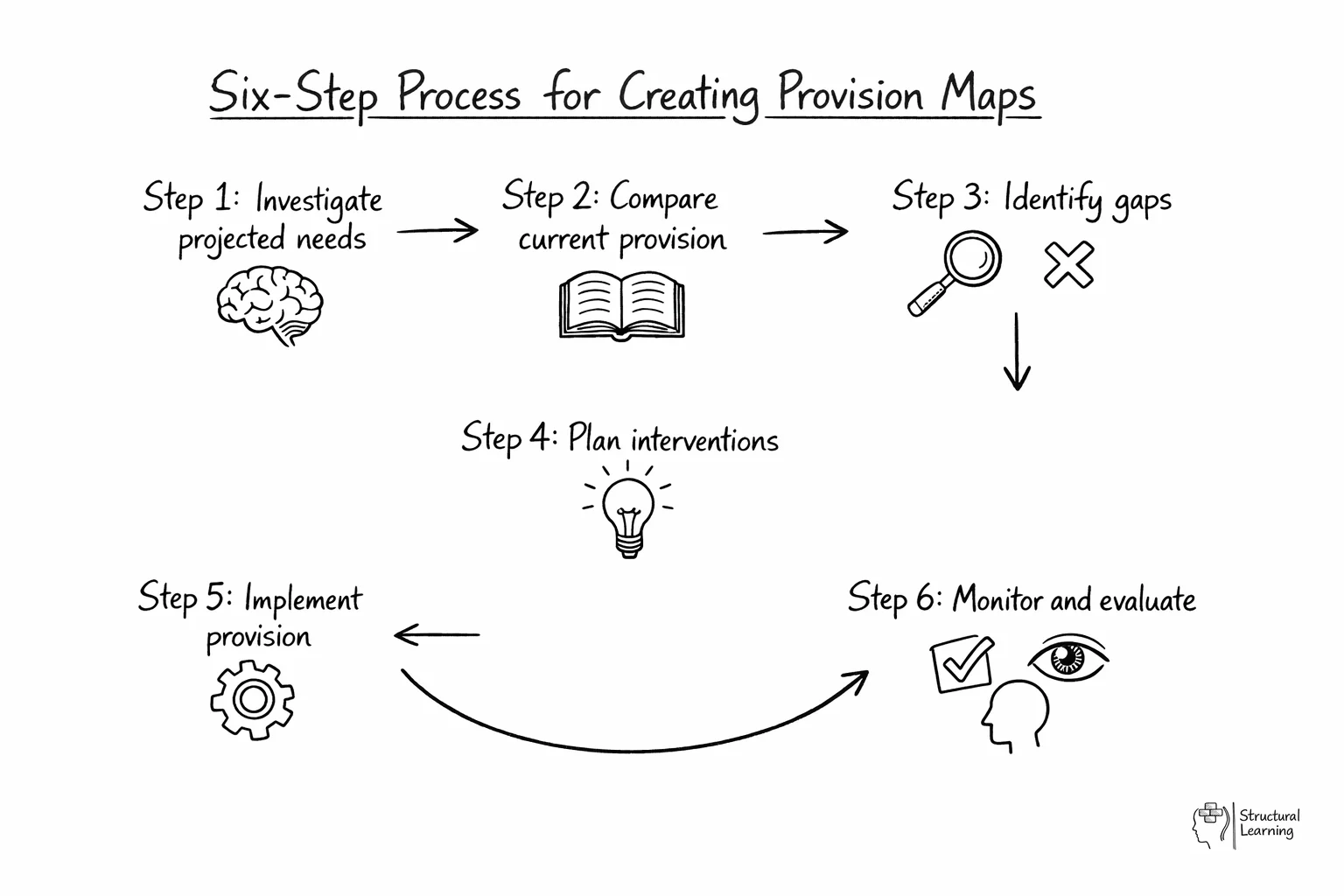
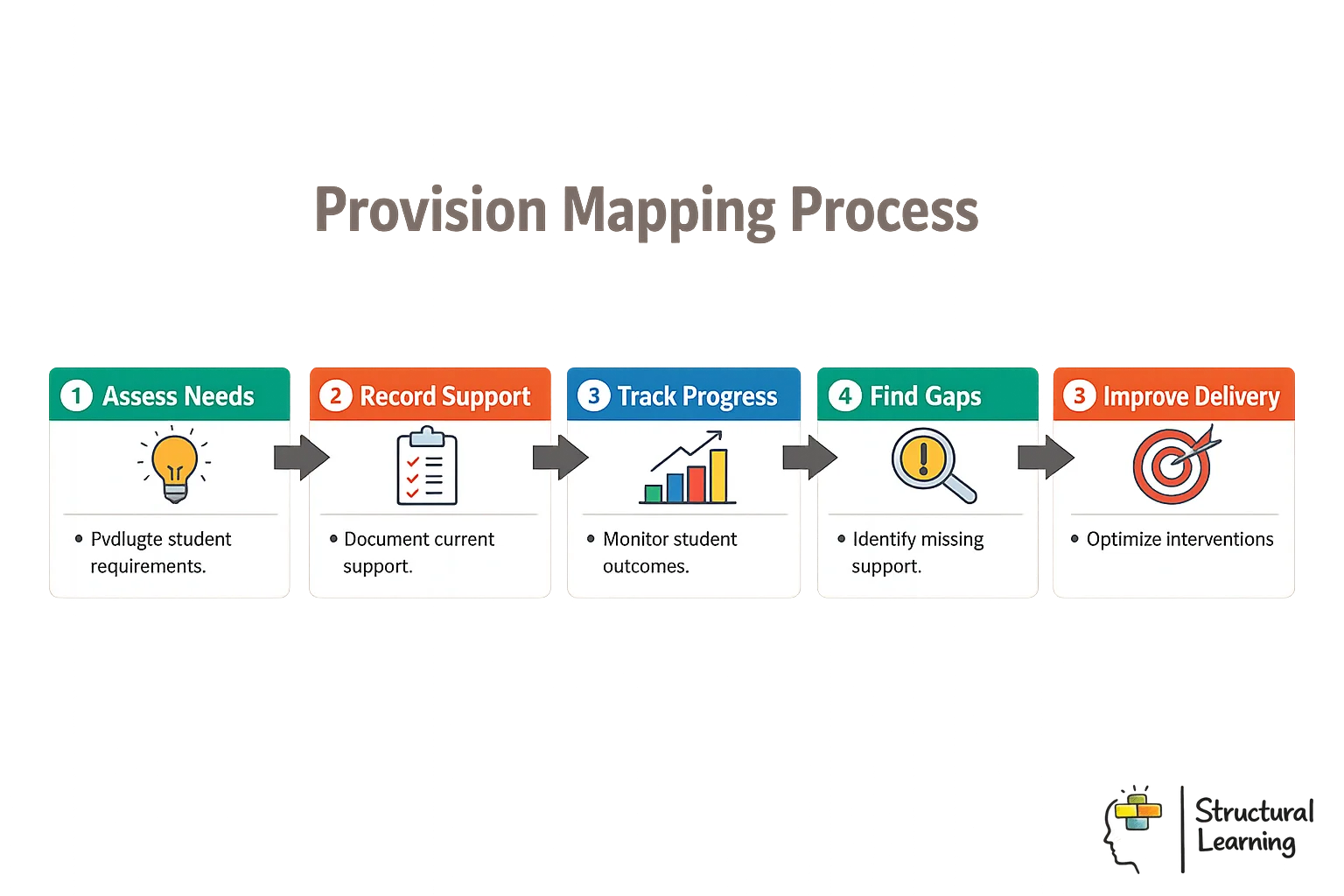
Creating an effective provision map requires a systematic approach. The first step is to gather comprehensive data on all students, including their academic performance, attendance records, and any identified special educational needs. This data should be used to identify students who require additional support or intervention. The next step is to develop a clear and concise plan for providing that support. This plan should include specific goals, strategies, and resources. It should also outline the roles and responsibilities of all staff members involved in the provision of support.
Once the plan has been developed, it should be implemented consistently and monitored regularly. Data should be collected to track the progress of students receiving support, and the plan should be adjusted as needed. Regular communication with parents is also essential to ensure that they are aware of the support being provided and are able to contribute to their child's learning.
Implementing provision maps offers multiple benefits to a school setting. These benefits can impact the provision of resources to the monitoring of student development and learning.
Effective provision mapping delivers multiple benefits across different stakeholder groups. For school leadership teams, it provides clear visibility of resource allocation and enables strategic planning for future SEND investments. Leaders can identify gaps in provision, eliminate duplication, and ensure equitable distribution of support across year groups and need types.
Teachers benefit from having structured frameworks for intervention planning and clear protocols for escalating concerns. The mapping process supports professional development by helping staff understand the full range of available interventions and their appropriate applications. For students and families, provision maps ensure transparency about available support and create clear pathways for accessing additional help when needed.
From a compliance perspective, comprehensive provision mapping supports Ofsted inspections and local authority reviews by demonstrating systematic approaches to SEND support. Schools can evidence their commitment to
The shift towards digital provision mapping has transformed how schools track and monitor SEND support across year groups. Cloud-based platforms now enable SENCOs to update provision maps in real-time, share data instantly with colleagues, and generate reports that would previously take hours to compile. These systems typically feature colour-coded dashboards showing intervention timetables, cost analyses, and progress tracking for individual pupils or specific cohorts.
Popular software solutions like Provision Map Writer and Edukey offer pre-built templates that align with Education, Health and Care Plan (EHCP) outcomes and statutory requirements. For instance, a primary school in Manchester reduced their provision mapping workload by 60% after implementing digital tracking, allowing their SENCO to spend more time observing interventions and supporting classroom teachers. These platforms often integrate with existing school management systems, automatically pulling through pupil data and assessment results to create comprehensive provision overviews.
However, successful digital implementation requires careful planning and staff training. Start by mapping your current paper-based system to identify which features you need most; intervention scheduling, impact measurement, or budget tracking. Consider appointing 'provision champions' in each
When selecting software, prioritise systems that offer mobile access for teaching assistants to record session notes immediately after interventions. This real-time data capture significantly improves the accuracy of impact assessments and helps SENCOs identify which provisions deliver the best outcomes for specific needs. Remember that the most expensive solution isn't always the most suitable; some schools achieve excellent results with simple spreadsheet templates customised to their specific requirements.
Effective provision mapping extends beyond simply recording interventions; it requires systematic measurement of impact on student progress. By establishing clear baseline assessments and regular monitoring points, schools can demonstrate whether their SEND support genuinely improves outcomes. This evidence-based approach not only satisfies Ofsted requirements but, more importantly, ensures that precious resources and time are invested in strategies that actually work for individual pupils.
Creating meaningful impact measures starts with setting specific, measurable targets for each intervention. For instance, if a Year 3 pupil receives additional phonics support three times weekly, the provision map should include their current reading age, target improvement, and assessment schedule. Schools might track progress through standardised tests, teacher assessments, or specialist screening tools, recording data directly on the provision map. This creates a visual timeline showing whether interventions are closing attainment gaps or require adjustment.
Regular provision map reviews, ideally half-termly, allow SENCOs and senior leaders to identify patterns across year groups and intervention types. One primary school in Birmingham discovered through their provision mapping data that small-group maths interventions showed minimal impact compared to one-to-one support, leading them to restructure their approach. Similarly, tracking emotional wellbeing scores alongside academic progress revealed that pupils receiving both learning mentor support and curriculum interventions made significantly better progress than those receiving academic support alone.
The key to successful impact measurement lies in making data collection manageable for busy teachers. Simple rating scales, brief observation notes, or digital tracking systems can capture essential information without creating excessive workload. When provision maps clearly demonstrate positive outcomes, they become powerful tools for celebrating success with pupils and parents whilst providing concrete evidence of the difference that targeted support makes.

The SEND Code of Practise 2015 establishes clear statutory requirements for schools to assess, plan, implement and review support for pupils with special educational needs. Provision mapping serves as a critical tool for demonstrating compliance with these duties, particularly the requirement to maintain detailed records of interventions and their effectiveness. Schools must show a graduated approach to SEND support, and systematic tracking through provision maps provides the evidence base that inspectors and local authorities expect to see.
Under the Equality Act 2010 and Children and Families Act 2014, schools have legal obligations to make reasonable adjustments and provide appropriate support for SEND students. Provision mapping directly supports compliance by documenting resource allocation, intervention timings, and progress monitoring. This systematic approach ensures that schools can demonstrate they are meeting their duty to use their best endeavours to secure special educational provision, whilst also providing transparency for parents and external agencies about the support being delivered.
Effective provision mapping must include clear entry and exit criteria, measurable outcomes, and regular review cycles to satisfy legal requirements. Schools should ensure their provision maps capture both universal and targeted interventions, enabling them to show the full spectrum of support offered. This comprehensive documentation becomes invaluable during inspections, tribunal proceedings, or when justifying resource requests to governing bodies and local authorities.
The graduated approach is the statutory framework that governs how schools identify and support pupils with special educational needs. Introduced in the original Code of Practice (DfE, 1994) and substantially refined in the current SEND Code of Practice (DfE, 2015), it describes a four-stage cycle: Assess, Plan, Do, Review. Schools must follow this cycle for every pupil receiving SEN support, and provision mapping is the documentary mechanism through which the cycle is made visible, auditable, and communicable.
Crucially, the graduated approach is not a linear progression but a spiral. Each completed cycle informs the next, gradually tightening the fit between a pupil's identified needs and the support they receive. The DfE (2015, 6.44) is explicit that "the assess, plan, do, review cycle should not be seen as a series of stages that happen once and then stop."
The class teacher, often working alongside the SENCO, gathers a broad picture of the pupil's strengths, difficulties, and progress. This includes teacher observations, standardised assessments, pupil voice, and information from parents and carers. Where relevant, it may include reports from external agencies such as educational psychologists, speech and language therapists, or paediatricians. The assessment stage produces the evidence base that justifies any additional or different provision, and that evidence must be documented in the provision map.
The SENCO and class teacher, in consultation with parents and the pupil, agree on the outcomes to be achieved and the interventions to be put in place. The plan specifies what will be done, by whom, how often, and how success will be measured. This is the stage at which the provision map is updated: new rows are added, intervention details are recorded, and review dates are set. Planning without reference to the provision map risks duplication of effort or gaps in support that only become apparent at the review stage.
Interventions are delivered as planned. The class teacher retains overall responsibility for the progress of all pupils, including those receiving additional support. Where a teaching assistant or external specialist delivers an intervention, the teacher must maintain sufficient oversight to be aware of how the pupil is responding. Day-to-day delivery notes, brief records from TAs, and in-class observation all contribute to the evidence gathered during the Do stage and feed into the subsequent review.
At the agreed review point, typically each term, the effectiveness of the provision is evaluated against the outcomes set in the Plan stage. Parents and carers are involved in this process, and the pupil's views are sought wherever possible. The review should result in a clear decision: is the provision working and should it continue; does it need to be modified; or is there sufficient concern to consider whether a statutory EHC needs assessment is warranted?
| Stage | What happens | Provision map role | Who is involved |
|---|---|---|---|
| Assess | Gathering evidence of need: assessments, observations, parental input, pupil voice, external reports | Baseline data recorded; pupil added to map if SEN support is agreed | Class teacher, SENCO, parents, pupil, external agencies |
| Plan | Agreeing outcomes, selecting interventions, setting review dates, allocating resources | Provision map updated: intervention, frequency, staff, start/end dates, target outcomes added | SENCO, class teacher, parents; pupil consulted where appropriate |
| Do | Delivering agreed interventions; monitoring pupil engagement and early response | Delivery records maintained; any significant changes noted on map | Class teacher, teaching assistant, specialist staff |
| Review | Evaluating outcomes against targets; updating provision; involving parents and pupil | Impact data entered; provision continued, modified, escalated or exited; cycle begins again | SENCO, class teacher, parents, pupil, any specialists involved |
The practical strength of this framework is that provision mapping provides the documentary spine through which each stage can be demonstrated. When an Ofsted inspector or local authority officer asks to see evidence of the graduated approach for a named pupil, the provision map (showing assessments, agreed interventions, delivery records, and review outcomes) is the primary source. Schools that maintain rigorous provision maps are not simply complying with bureaucratic requirements: they are building an evidence base that protects pupils, informs professional decision-making, and demonstrates the school's commitment to inclusive education (Norwich and Lewis, 2005).
For guidance on how this cycle applies specifically to pupils who may need an Education, Health and Care Plan, see our article on EHCPs.
Ofsted's approach to SEND inspection has become increasingly focused on the quality and coherence of provision rather than mere compliance with documentation requirements. The 2023 SEND and Alternative Provision Improvement Plan (DfE and DHSC, 2023) and Ofsted's own inspection frameworks signal that inspectors want to understand whether schools genuinely understand their pupils with SEND, not simply whether the paperwork is in order. Provision maps, used well, are one of the most powerful tools a SENCO can deploy during an inspection, precisely because they demonstrate both intent and outcome.
When evaluating SEND provision, Ofsted inspectors typically seek evidence across four broad areas:
Ofsted's 2023 SEND review (Special Educational Needs and Disabilities: Is the system working?) identified a number of recurring weaknesses across settings nationally. Provision maps, when properly maintained, directly address many of them:
SENCOs should be able to walk an inspector through the provision map for any named pupil, narrating the assess-plan-do-review cycle that led to current provision. This is sometimes called a "pupil story": a coherent account of how the school identified need, what it put in place, whether it worked, and how it responded when it did not. A well-maintained provision map makes this narrative straightforward to construct. Schools that struggle to tell this story typically have maps that record what is happening but not why decisions were made or what impact was seen.
The most inspection-ready provision maps are those that are live documents, updated at each review point, accessible to the class teacher, and used as an active planning tool rather than filed away between annual reviews.
Digital provision mapping systems have transformed how schools track and manage SEND interventions, offering significant advantages over traditional paper-based approaches. Modern platforms enable real-time collaboration between teachers, SENCOs, and support staff, whilst providing comprehensive data analytics that reveal patterns in student progress and resource effectiveness. The key benefit lies in the ability to maintain dynamic, living documents that automatically update as interventions evolve, ensuring all stakeholders have access to current information.
When selecting digital tools, schools should prioritise systems that integrate smoothly with existing management information systems and offer customisable tracking fields. Effective platforms typically include visual mapping capabilities, automated reporting functions, and secure data sharing protocols that comply with GDPR requirements. The most successful implementations focus on user-friendly interfaces that reduce administrative burden rather than adding complexity to teachers' workloads.
Implementation success depends heavily on comprehensive staff training and gradual rollout strategies. Begin with a pilot group of experienced users who can identify practical challenges and champion the system's benefits. Regular review meetings during the first term help address technical issues whilst ensuring the chosen platform genuinely enhances provision mapping rather than simply digitising existing processes.
Effective provision mapping relies on strong evaluation mechanisms that move beyond simple compliance to demonstrate genuine impact on student outcomes. Schools must establish clear success criteria for each intervention, incorporating both quantitative measures such as assessment data and reading ages, alongside qualitative indicators including student engagement, confidence levels, and social integration. Regular review cycles, typically termly or half-termly, ensure that provision remains responsive to changing student needs whilst building a comprehensive evidence base for future decision-making.
The most effective evaluation approaches combine multiple data sources to create a complete picture of intervention success. Academic progress tracking should be supplemented by teacher observations, student voice feedback, and parental input to capture the full impact of SEND support. Dylan Wiliam's research on formative assessment emphasises the importance of using this gathered evidence to adapt provision in real-time rather than waiting for formal review periods, ensuring that unsuccessful interventions are modified or discontinued promptly.
Practical evaluation requires SENCOs to develop systematic recording processes that capture both intended and unexpected outcomes from provision mapping initiatives. Consider implementing standardised impact tracking sheets that document baseline measures, intervention details, and progress indicators across consistent timeframes. This systematic approach not only supports individual student planning but also builds institutional knowledge about which interventions work best for specific types of need, creating a valuable resource for future provision mapping decisions.
For pupils with an Education, Health and Care Plan (EHCP), the provision map takes on a heightened statutory significance. The EHCP is a legally binding document that specifies the outcomes a pupil should achieve and the provision required to achieve them. The annual review is the statutory mechanism by which that plan is evaluated and updated. Provision maps, when maintained rigorously throughout the year, provide much of the evidence base that makes annual reviews genuinely purposeful rather than procedurally compliant but substantively empty.
Section F of an EHCP details the special educational provision the local authority is commissioning. This is the most legally significant section from a school's operational perspective: it specifies what must be provided, often in precise detail, for example "thirty minutes per week of speech and language therapy" or "two hours per week of specialist literacy teaching using a structured, cumulative programme." The provision map is the mechanism through which the school demonstrates that what is specified in Section F is actually being delivered.
Schools should ensure that every item recorded in Section F of a pupil's EHCP has a corresponding entry in that pupil's provision map. Where an item is being delivered by an external agency rather than school staff, this should be noted on the map along with the relevant contact and review date. Any discrepancy between what Section F specifies and what the provision map records is a potential compliance failure, and one that is likely to be identified during an annual review or Ofsted inspection.
The annual review meeting brings together the school, parents, the pupil, and any relevant professionals to evaluate whether the EHCP remains appropriate and whether the outcomes are being achieved. The provision map contributes four types of evidence to this process:
Local authorities use annual review evidence to decide whether an EHCP should be maintained as is, amended, or ceased. Schools that can provide a coherent, evidence-rich provision map are far better placed to advocate for the pupil's continued or increased provision than those relying solely on verbal accounts from teachers (Lamb, 2009).
For pupils on SEN support (those who do not yet have an EHCP but whose needs require provision beyond ordinarily available provision), the provision map serves as the primary evidence document if a statutory assessment is later requested. Local authorities must consider whether the school has already taken "relevant and purposeful action" before deciding whether to carry out an EHC needs assessment (DfE, 2015, Section 9.14). A comprehensive provision map demonstrating multiple assess-plan-do-review cycles, with evidence that interventions have been tried, reviewed, and escalated appropriately, is the strongest foundation a school can build for such a request.
For a detailed guide to the EHCP process itself, including how to request a statutory assessment and what to expect at each stage, see our article on EHCPs. Schools working to strengthen the link between SEN support and statutory processes may also find our guide to inclusive education useful for contextualising provision map decisions within a whole-school inclusion framework.
The most prevalent challenge schools face when implementing provision mapping is staff resistance to additional documentation, often stemming from concerns about increased workload. This resistance typically diminishes when teachers understand that effective provision mapping actually streamlines their existing assessment and planning processes rather than adding separate tasks. Successful implementation requires demonstrating how mapping consolidates scattered intervention records into one coherent system, ultimately saving time whilst improving outcomes for SEND students.
Data collection inconsistency represents another significant hurdle, particularly when multiple staff members contribute to mapping without standardised protocols. Schools overcome this by establishing clear criteria for measuring progress and providing structured templates that guide evidence gathering. Regular moderation sessions help maintain consistency, whilst designated provision mapping champions in each department can support colleagues and ensure systematic approaches are maintained across all subject areas.
Time constraints often prevent thorough analysis of collected data, rendering provision maps ineffective planning tools. The solution lies in building review processes into existing meeting structures rather than creating additional sessions. Integrating provision mapping discussions into weekly team meetings, pupil progress reviews, and planning sessions ensures regular evaluation occurs naturally within established workflows, making the system sustainable and genuinely useful for improving SEND support.
Effective provision mapping depends on whole-school capacity, not just SENCO expertise. Class teachers, teaching assistants, and subject specialists must understand how to identify, record, and evaluate interventions systematically. Without comprehensive staff training, provision mapping becomes fragmented, leading to inconsistent data collection and missed opportunities to support SEND students effectively.
Training programmes should focus on practical application rather than theoretical knowledge alone. Staff need hands-on experience using mapping tools, understanding impact measurements, and recognising when interventions require adjustment. Dylan Wiliam's research on formative assessment emphasises the importance of regular review cycles, which directly applies to provision mapping where ongoing evaluation drives decision-making about student support.
Professional development works best when delivered through collaborative coaching models. Pair experienced staff with those new to provision mapping, creating mentoring relationships that embed good practise naturally. Regular staff meetings should include provision mapping updates, allowing teams to share successes, discuss challenges, and refine approaches collectively. This systematic approach ensures that tracking SEND support becomes an integral part of school culture rather than an additional administrative burden.
Provision maps should be reviewed and updated at least termly, though many schools find monthly updates more effective for tracking pupil progress. Key trigger points include after assessment periods, when interventions change, or when new pupils join the school. Regular updates ensure the map remains an accurate reflection of current support rather than outdated documentation.
Popular provision mapping software includes Provision Map Writer, SENDirect, and Arbor's built-in provision mapping features. Many schools also successfully use Microsoft Excel or Google Sheets with custom templates. The key is choosing a system that integrates with your existing school management information system and allows easy data entry by multiple staff members.
Provision maps provide clear evidence of how additional funding is being spent and demonstrate the school's systematic approach to supporting vulnerable pupils. They show inspectors the range of interventions in place, how progress is monitored, and the impact of additional support. Well-maintained provision maps can quickly answer questions about value for money and inclusive practise across the school.
The SENCO typically leads provision mapping, but it requires input from class teachers, teaching assistants, and senior leadership team members. Subject coordinators and pastoral staff also contribute valuable information about specific interventions. Successful provision mapping works best as a collaborative process where all staff understand their role in documenting and reviewing support strategies.
Yes, provision maps should include all pupils receiving additional support, regardless of whether they have formal SEND identification. This includes pupils receiving catch-up interventions, pastoral support, or those identified as disadvantaged. Mapping all additional provision gives a complete picture of school support and helps identify pupils who may need further assessment or different types of intervention.
Rate your school across the five EEF SEND recommendation domains and receive a visual provision map with priority actions.
These peer-reviewed studies provide the research foundation for the strategies discussed in this article:
Effects of Differentiated Instruction on Students' Empowered Learning Skills View study ↗
2 citations
A. Titus (2025)
This experimental study proves that differentiated instruction significantly improves students' ability to take ownership of their own learning, moving beyond the limitations of one-size-fits-all teaching approaches. The research provides concrete evidence that adapting teaching methods to match different learning profiles creates more confident, self-directed learners. Teachers will find valuable insights into how personalised instruction strategies can transform student engagement and academic independence in their classrooms.
Special Education Teachers' Knowledge on Inclusive Education Provision in Nepal View study ↗
1 citations
N. Neupane & Dhruba Prasad Niure (2023)
This study reveals significant gaps in special education teachers' understanding of inclusive education policies and practices in Nepal's schools. The findings highlight the critical need for better teacher training and support systems to ensure students with special needs receive appropriate educational provision. Teachers working in inclusive settings will recognise familiar challenges and gain perspective on how policy knowledge directly impacts classroom practise and student outcomes.
Teachers' Perceptions on Inclusive Education and the Effectiveness of School Assessment for Learners with Disabilities in Public Primary Schools within Nairobi County, Kenya View study ↗
Christine Mwendo Matasio Munala et al. (2023)
This comprehensive study examines how teachers understand inclusive education and evaluates whether current assessment methods effectively measure learning progress for students with disabilities. The research uncovers important insights about the gap between inclusive education theory and actual classroom assessment practices. Teachers will gain valuable understanding of how to adapt assessment strategies to better serve learners with diverse needs and accurately track their academic progress.
Differentiating Instruction in a Mathematics Classroom: Its Effects on Basic 7 Learners' Academic Performance and Engagement in Common Fraction View study ↗
3 citations
Edward Abatanie Padmore et al. (2023)
This experimental study demonstrates that differentiated instruction significantly improves both academic performance and student engagement when teaching fractions to seventh-grade students. The research provides clear evidence that adapting teaching methods to match individual learning needs leads to measurable improvements in mathematics achievement. Mathematics teachers will find practical validation for investing time in differentiated approaches, showing that personalised instruction directly translates to better student outcomes.
Enabling hearing‐impaired students: A mobile learning intervention in Israeli Arab elementary education View study ↗
2 citations
Haneen Vasel & Noa Ragonis (2024)
This study shows how mobile learning technology can dramatically improve educational outcomes for hearing-impaired students in language and mathematics, involving students, teachers, and parents in the evaluation process. The research demonstrates that carefully designed mobile interventions create more accessible and engaging learning experiences for students with hearing difficulties. Teachers supporting students with sensory impairments will discover practical insights into how technology can break down communication barriers and enhance academic achievement.
A provision map is a way to show and document the types of interventions, support and additional staffing offered to the learners at an educational setting that is different from and additional to the ones offered via the school's differentiated curriculum. These tools offer key staff an insight into the provision and an overview of the children who need extra support. It is a challenge for senior staff to keep tabs on what interventions are being facilitated to ensure inclusion across the curriculum. These devices don't need to be complex, a simple provision map template similar to a timetable can ensure suitable levels of provision across the school.
Provision maps allow schools to look strategically at their pupils' needs, including inclusive education for those belonging to underprivileged groups, to identify their needs and strengths. Then it can be made possible to plan provisions to fulfil their needs and to track individual pupils progress to enhance learning outcomes. Any additional funding coming into school has to be accounted for and these types of mechanisms can also act as an accountability measure.
A provision map ensures the entitlement of each student and increases standards and achievement. An effective provision of resources shows a clear connection between current provision and student progress. Provision maps may also involve each of the key staff and can be vital to the whole-school planning and development process.
These two terms are frequently used interchangeably, yet they describe distinct (and complementary) functions within a school's SEND framework. Understanding the difference matters because conflating them can lead to schools documenting provision without ever analysing it, or managing budgets without connecting decisions to what pupils actually receive.
Provision mapping is the act of recording and communicating what support is currently in place. It answers the question: what does every pupil receive? A provision map documents interventions, their frequency, the member of staff delivering them, and the pupils involved. It is primarily a transparency tool: a snapshot of provision at a given point in time. Warnock (1978) first proposed that schools should be able to articulate clearly what support they offer and to whom, a principle that underpins all modern SEND documentation requirements.
Provision management, by contrast, is the strategic process of overseeing, evaluating, and improving that provision. It answers the question: is our provision working and is it worth the investment? Provision management sits at the level of the SENCO and school leadership team. It involves analysing impact data across the whole school, making decisions about resource allocation, reviewing which interventions should be scaled up or discontinued, and ensuring that spending on SEND support is justifiable (Gross, 2008).
A helpful way to hold the distinction is this: provision mapping tells you what you are doing; provision management tells you whether it is working and what to do next.
Effective SEND practice requires both. A school with strong mapping but weak management will have detailed records of interventions that are never scrutinised for impact. A school that attempts strategic management without rigorous mapping will be making decisions based on incomplete data. The DfE (2015) SEND Code of Practice makes clear that the graduated approach (assess, plan, do, review) requires evidence at each stage, which means mapping and management must function as a continuous cycle rather than isolated tasks.
In practice, the SENCO typically owns both functions but may delegate aspects of mapping to class teachers and teaching assistants. Management decisions, however, should always involve school leadership, particularly when budget implications or specialist referrals are being considered.
| Dimension | Provision Mapping | Provision Management |
|---|---|---|
| Core question | What support does each pupil receive? | Is the support working and worth the cost? |
| Primary audience | Teachers, parents, Ofsted, EHC review panels | SENCO, headteacher, governors, local authority |
| Output | Provision map document (grid or database) | Strategic review, budget decisions, CPD commissioning |
| Frequency | Updated termly or when provision changes | Reviewed termly; full strategic review annually |
| Statutory basis | SEND Code of Practice 2015, Section 6.2 | Children and Families Act 2014; Equality Act 2010 |
For a broader context on how these duties sit within special educational needs policy, see our dedicated guide. Schools looking to strengthen their strategic oversight should ensure that provision management meetings are timetabled formally rather than treated as ad hoc conversations. A rhythm of termly review aligned to pupil progress data cycles is considered best practice by Gross and White (2003).
Schools can use provision maps in several ways to support and inform their improvement plan. Usually, in the form of a piece of software, they provide teachers with a way of managing the key resources. One of the main uses of provision maps is to track the progress of individual pupils. By using data and assessment information, teachers can identify areas where a student may need additional support or intervention. The provision map can then be used to plan and monitor the provision that is put in place to help the student achieve their targets. This can be especially useful for pupils with special educational needs or those who require additional support to reach their full potential.

Their uses can include:
Provision maps for schools include whole-school maps showing all interventions across year groups, individual pupil maps tracking specific support packages, and subject-specific maps focusing on curriculum areas. Schools typically use intervention maps for targeted support, funding maps for accountability, and progress maps for outcome tracking.
Provision maps can document the variety of additional support, staffing and provision. The first type of provision map is one created by the school's Provision Map Writer. This map is used to identify the needs of individual students and to plan the appropriate support and interventions required to meet those needs. It is a collaborative effort between teachers, parents, and other professionals involved in the student's education.
The Provision Map Writer is responsible for ensuring that the map is regularly reviewed and updated to reflect progress and changes in the student's needs. This type of provision map is an essential tool for ensuring that students receive the support they need to reach their full potential.
They canaccess different types of data and assessment information; therefore, schools can create specific provision maps that will best fit their needs.
Provision mapping starts with knowing each pupil. Use this tool to create a quick pupil passport that captures needs, strengths, and strategies in a printable A4 format. A useful companion to your provision map.
A well-structured provision map shows exactly what every pupil receives at each tier of support. The tables below cover all four areas of the SEND Code of Practice, organised into three tiers: what all pupils receive through Quality First Teaching, what some pupils receive through targeted group interventions, and what a few pupils receive through specialist individual support. These examples are adapted from whole-school provision maps shared within the SENsible SENCO community.
Abstract frameworks become meaningful when applied to a real scenario. The following worked example traces the provision mapping journey for a fictional Year 4 pupil, referred to here as Maya, who has been identified as having dyslexia. It illustrates how the three waves of provision interact and how the assess-plan-do-review cycle drives decision-making at each stage.
Maya is eight years old. Her class teacher notices that despite average verbal contributions in class, she is struggling to read independently and her written work does not reflect her evident understanding. She frequently avoids reading tasks and appears frustrated when asked to write. The class teacher raises a concern with the SENCO in October of the autumn term.
The SENCO runs a screening assessment using a standardised dyslexia tool (e.g., the Dyslexia Screener, Lucid Research). Results indicate significant difficulties with phonological processing, working memory, and rapid naming, all markers consistent with a dyslexia profile (Elliott and Grigorenko, 2014). Maya's reading age is assessed at two years below her chronological age.
This assessment stage generates the evidence base that will inform the provision map.
Before any additional provision is put in place, the class teacher first ensures that classroom-level adaptations are implemented consistently. These are ordinarily available provision: adjustments that all pupils with dyslexic profiles should receive as a matter of course.
| Adaptation | How it helps Maya | Who delivers |
|---|---|---|
| Cream or pale yellow paper for all written materials | Reduces visual stress associated with high contrast black-on-white text | Class teacher |
| Dyslexia-friendly font (e.g., Arial 14pt) on all worksheets | Reduces letter confusion; improves decoding speed | Class teacher / admin |
| Oral alternatives to written tasks where appropriate | Allows Maya to demonstrate knowledge without penalising writing difficulties | Class teacher |
| Pre-teaching key vocabulary before each lesson | Builds phonological familiarity; reduces cognitive load during class reading | Class teacher or TA |
| Use of visual timetables and structured lesson previews | Supports working memory; reduces anxiety about transitions | Class teacher |
The class teacher documents these adaptations in the Wave 1 column of the whole-school provision map. Progress is monitored informally over the following six weeks.
After six weeks, the class teacher reviews Maya's progress. Reading accuracy has improved slightly, but fluency and confidence remain low. The SENCO agrees that a targeted intervention is warranted. Maya is placed in a small group of four pupils who will receive Precision Teaching three times per week for ten minutes, delivered by a trained teaching assistant.
The Wave 2 provision map entry records:
At the midpoint review (week 6), data shows Maya is making progress but some letter reversals persist. The TA adjusts the prompt hierarchy used in Precision Teaching sessions, incorporating Colourful Semantics-style colour coding to reinforce letter-sound correspondences visually.
At the end of the 12-week block, the end-of-cycle review shows Maya has made four months' reading age progress, below the six-month target. Her phonological processing difficulties are persistent. The SENCO refers Maya for a specialist assessment by the local authority's specialist teacher for literacy. This assessment confirms a diagnosis of dyslexia and recommends a structured, cumulative phonics programme (e.g., Sound Reading System or Barton Reading and Spelling).
Wave 3 provision is recorded on the provision map as:
Maya's journey illustrates that the graduated approach is not a one-off process. It is a continuous cycle that tightens the match between a pupil's needs and the provision they receive. Each review generates new evidence that feeds back into the assessment stage, updating the provision map and refining the plan. By the end of the summer term, Maya's provision map holds a complete, chronological record of every decision made on her behalf: invaluable evidence for any EHCP application or annual review (DfE, 2015).
Covers anxiety, depression, attachment difficulties and ADHD/ADD.
| All Pupils (Wave 1: QFT) | Some Pupils (Wave 2: Targeted) | Few Pupils (Wave 3: Specialist) |
|---|---|---|
| Quality First Teaching Consistent adult approach PSHE curriculum (Jigsaw) Safeguarding-trained staff Zones of Regulation Reward systems (house points, golden tickets) Organisational reminders Movement and sensory breaks Soft start to the day Brain breaks |
Worry box or feelings box Social or nurture group Alternative soft start activities Playground monitoring Buddy system Home-school communication Comic strip conversations Individual timetable CPOMS incident monitoring |
Sensory resources Access to quieter areas Person-centred tools Key adult allocated 1:1 Zones of Regulation Social stories Allocated seating Risk assessment Reduced timetable External support (School Nursing, LINKs, Circle of Friends, CAMHs) |
Covers speech, language and communication needs (SLCN) and autism spectrum conditions affecting social use of language.
| All Pupils (Wave 1: QFT) | Some Pupils (Wave 2: Targeted) | Few Pupils (Wave 3: Specialist) |
|---|---|---|
| Quality First Teaching Talking partners and group work Teacher modelling Clear class communication expectations Organisational reminders Choice of independent or paired work Visual timetables Mind mapping Differentiated teacher communication Relevant marking |
Social group Speaking and listening intervention Playground support and monitoring Buddy system Structured routines Visual prompts Communication cue cards Social stories Comic strip conversations Lego Building Club |
PECs Makaton Now and Next board Time out card Pre-teaching vocabulary and concepts Visual coding SALT support SLCA advisory teacher Programme planned by outside agency |
Covers general learning difficulties and specific learning difficulties (SpLD) including dyslexia, dyscalculia and dyspraxia.
| All Pupils (Wave 1: QFT) | Some Pupils (Wave 2: Targeted) | Few Pupils (Wave 3: Specialist) |
|---|---|---|
| Broad and balanced curriculum Quality First Teaching Nessy programme Visual prompts and resources Non-negotiable reminders Task planners Targeted adult support |
Phonics intervention SpLD phonics programme Numeracy intervention Literacy intervention Reading intervention Spelling intervention (SpLD) Individualised phonics and spelling mats Pre-teaching Individual assessment arrangements Now/Next board Additional processing time |
Differentiated curriculum Individual interventions Specific resources Tinted paper or coloured overlays Scribe Regular access to ICT Touch typing practice Organisational reminders SpLD outreach support Educational Psychologist |
Covers visual impairments, hearing impairments, physical disabilities and sensory processing difficulties.
| All Pupils (Wave 1: QFT) | Some Pupils (Wave 2: Targeted) | Few Pupils (Wave 3: Specialist) |
|---|---|---|
| Quality First Teaching Regular handwriting practice Regular fine motor activities (KS1) Pencils and scissors tailored to need Brain breaks Outdoor learning opportunities Broad PE curriculum |
Sound field system Specialist equipment Ear defenders Gross motor skills activities Weighted blanket PE support Resistance band Wobble cushion Writing slope Fine motor intervention (Jimbo Fun) Pencil grips and adapted pencils Fiddle toys Sensory resources Access to quieter areas |
Additional movement and sensory breaks 1:1 PE support Enlarged or adapted texts Risk assessment Outside agency support Programme planned by outside agency |
Adapted from whole-school provision maps shared within the SENsible SENCO community. These examples show one school's approach; adapt the specific interventions to match your setting's resources and expertise.
Creating an effective provision map requires a systematic approach. The first step is to gather comprehensive data on all students, including their academic performance, attendance records, and any identified special educational needs. This data should be used to identify students who require additional support or intervention. The next step is to develop a clear and concise plan for providing that support. This plan should include specific goals, strategies, and resources. It should also outline the roles and responsibilities of all staff members involved in the provision of support.
Once the plan has been developed, it should be implemented consistently and monitored regularly. Data should be collected to track the progress of students receiving support, and the plan should be adjusted as needed. Regular communication with parents is also essential to ensure that they are aware of the support being provided and are able to contribute to their child's learning.
Implementing provision maps offers multiple benefits to a school setting. These benefits can impact the provision of resources to the monitoring of student development and learning.
Effective provision mapping delivers multiple benefits across different stakeholder groups. For school leadership teams, it provides clear visibility of resource allocation and enables strategic planning for future SEND investments. Leaders can identify gaps in provision, eliminate duplication, and ensure equitable distribution of support across year groups and need types.
Teachers benefit from having structured frameworks for intervention planning and clear protocols for escalating concerns. The mapping process supports professional development by helping staff understand the full range of available interventions and their appropriate applications. For students and families, provision maps ensure transparency about available support and create clear pathways for accessing additional help when needed.
From a compliance perspective, comprehensive provision mapping supports Ofsted inspections and local authority reviews by demonstrating systematic approaches to SEND support. Schools can evidence their commitment to
The shift towards digital provision mapping has transformed how schools track and monitor SEND support across year groups. Cloud-based platforms now enable SENCOs to update provision maps in real-time, share data instantly with colleagues, and generate reports that would previously take hours to compile. These systems typically feature colour-coded dashboards showing intervention timetables, cost analyses, and progress tracking for individual pupils or specific cohorts.
Popular software solutions like Provision Map Writer and Edukey offer pre-built templates that align with Education, Health and Care Plan (EHCP) outcomes and statutory requirements. For instance, a primary school in Manchester reduced their provision mapping workload by 60% after implementing digital tracking, allowing their SENCO to spend more time observing interventions and supporting classroom teachers. These platforms often integrate with existing school management systems, automatically pulling through pupil data and assessment results to create comprehensive provision overviews.
However, successful digital implementation requires careful planning and staff training. Start by mapping your current paper-based system to identify which features you need most; intervention scheduling, impact measurement, or budget tracking. Consider appointing 'provision champions' in each
When selecting software, prioritise systems that offer mobile access for teaching assistants to record session notes immediately after interventions. This real-time data capture significantly improves the accuracy of impact assessments and helps SENCOs identify which provisions deliver the best outcomes for specific needs. Remember that the most expensive solution isn't always the most suitable; some schools achieve excellent results with simple spreadsheet templates customised to their specific requirements.
Effective provision mapping extends beyond simply recording interventions; it requires systematic measurement of impact on student progress. By establishing clear baseline assessments and regular monitoring points, schools can demonstrate whether their SEND support genuinely improves outcomes. This evidence-based approach not only satisfies Ofsted requirements but, more importantly, ensures that precious resources and time are invested in strategies that actually work for individual pupils.
Creating meaningful impact measures starts with setting specific, measurable targets for each intervention. For instance, if a Year 3 pupil receives additional phonics support three times weekly, the provision map should include their current reading age, target improvement, and assessment schedule. Schools might track progress through standardised tests, teacher assessments, or specialist screening tools, recording data directly on the provision map. This creates a visual timeline showing whether interventions are closing attainment gaps or require adjustment.
Regular provision map reviews, ideally half-termly, allow SENCOs and senior leaders to identify patterns across year groups and intervention types. One primary school in Birmingham discovered through their provision mapping data that small-group maths interventions showed minimal impact compared to one-to-one support, leading them to restructure their approach. Similarly, tracking emotional wellbeing scores alongside academic progress revealed that pupils receiving both learning mentor support and curriculum interventions made significantly better progress than those receiving academic support alone.
The key to successful impact measurement lies in making data collection manageable for busy teachers. Simple rating scales, brief observation notes, or digital tracking systems can capture essential information without creating excessive workload. When provision maps clearly demonstrate positive outcomes, they become powerful tools for celebrating success with pupils and parents whilst providing concrete evidence of the difference that targeted support makes.

The SEND Code of Practise 2015 establishes clear statutory requirements for schools to assess, plan, implement and review support for pupils with special educational needs. Provision mapping serves as a critical tool for demonstrating compliance with these duties, particularly the requirement to maintain detailed records of interventions and their effectiveness. Schools must show a graduated approach to SEND support, and systematic tracking through provision maps provides the evidence base that inspectors and local authorities expect to see.
Under the Equality Act 2010 and Children and Families Act 2014, schools have legal obligations to make reasonable adjustments and provide appropriate support for SEND students. Provision mapping directly supports compliance by documenting resource allocation, intervention timings, and progress monitoring. This systematic approach ensures that schools can demonstrate they are meeting their duty to use their best endeavours to secure special educational provision, whilst also providing transparency for parents and external agencies about the support being delivered.
Effective provision mapping must include clear entry and exit criteria, measurable outcomes, and regular review cycles to satisfy legal requirements. Schools should ensure their provision maps capture both universal and targeted interventions, enabling them to show the full spectrum of support offered. This comprehensive documentation becomes invaluable during inspections, tribunal proceedings, or when justifying resource requests to governing bodies and local authorities.
The graduated approach is the statutory framework that governs how schools identify and support pupils with special educational needs. Introduced in the original Code of Practice (DfE, 1994) and substantially refined in the current SEND Code of Practice (DfE, 2015), it describes a four-stage cycle: Assess, Plan, Do, Review. Schools must follow this cycle for every pupil receiving SEN support, and provision mapping is the documentary mechanism through which the cycle is made visible, auditable, and communicable.
Crucially, the graduated approach is not a linear progression but a spiral. Each completed cycle informs the next, gradually tightening the fit between a pupil's identified needs and the support they receive. The DfE (2015, 6.44) is explicit that "the assess, plan, do, review cycle should not be seen as a series of stages that happen once and then stop."
The class teacher, often working alongside the SENCO, gathers a broad picture of the pupil's strengths, difficulties, and progress. This includes teacher observations, standardised assessments, pupil voice, and information from parents and carers. Where relevant, it may include reports from external agencies such as educational psychologists, speech and language therapists, or paediatricians. The assessment stage produces the evidence base that justifies any additional or different provision, and that evidence must be documented in the provision map.
The SENCO and class teacher, in consultation with parents and the pupil, agree on the outcomes to be achieved and the interventions to be put in place. The plan specifies what will be done, by whom, how often, and how success will be measured. This is the stage at which the provision map is updated: new rows are added, intervention details are recorded, and review dates are set. Planning without reference to the provision map risks duplication of effort or gaps in support that only become apparent at the review stage.
Interventions are delivered as planned. The class teacher retains overall responsibility for the progress of all pupils, including those receiving additional support. Where a teaching assistant or external specialist delivers an intervention, the teacher must maintain sufficient oversight to be aware of how the pupil is responding. Day-to-day delivery notes, brief records from TAs, and in-class observation all contribute to the evidence gathered during the Do stage and feed into the subsequent review.
At the agreed review point, typically each term, the effectiveness of the provision is evaluated against the outcomes set in the Plan stage. Parents and carers are involved in this process, and the pupil's views are sought wherever possible. The review should result in a clear decision: is the provision working and should it continue; does it need to be modified; or is there sufficient concern to consider whether a statutory EHC needs assessment is warranted?
| Stage | What happens | Provision map role | Who is involved |
|---|---|---|---|
| Assess | Gathering evidence of need: assessments, observations, parental input, pupil voice, external reports | Baseline data recorded; pupil added to map if SEN support is agreed | Class teacher, SENCO, parents, pupil, external agencies |
| Plan | Agreeing outcomes, selecting interventions, setting review dates, allocating resources | Provision map updated: intervention, frequency, staff, start/end dates, target outcomes added | SENCO, class teacher, parents; pupil consulted where appropriate |
| Do | Delivering agreed interventions; monitoring pupil engagement and early response | Delivery records maintained; any significant changes noted on map | Class teacher, teaching assistant, specialist staff |
| Review | Evaluating outcomes against targets; updating provision; involving parents and pupil | Impact data entered; provision continued, modified, escalated or exited; cycle begins again | SENCO, class teacher, parents, pupil, any specialists involved |
The practical strength of this framework is that provision mapping provides the documentary spine through which each stage can be demonstrated. When an Ofsted inspector or local authority officer asks to see evidence of the graduated approach for a named pupil, the provision map (showing assessments, agreed interventions, delivery records, and review outcomes) is the primary source. Schools that maintain rigorous provision maps are not simply complying with bureaucratic requirements: they are building an evidence base that protects pupils, informs professional decision-making, and demonstrates the school's commitment to inclusive education (Norwich and Lewis, 2005).
For guidance on how this cycle applies specifically to pupils who may need an Education, Health and Care Plan, see our article on EHCPs.
Ofsted's approach to SEND inspection has become increasingly focused on the quality and coherence of provision rather than mere compliance with documentation requirements. The 2023 SEND and Alternative Provision Improvement Plan (DfE and DHSC, 2023) and Ofsted's own inspection frameworks signal that inspectors want to understand whether schools genuinely understand their pupils with SEND, not simply whether the paperwork is in order. Provision maps, used well, are one of the most powerful tools a SENCO can deploy during an inspection, precisely because they demonstrate both intent and outcome.
When evaluating SEND provision, Ofsted inspectors typically seek evidence across four broad areas:
Ofsted's 2023 SEND review (Special Educational Needs and Disabilities: Is the system working?) identified a number of recurring weaknesses across settings nationally. Provision maps, when properly maintained, directly address many of them:
SENCOs should be able to walk an inspector through the provision map for any named pupil, narrating the assess-plan-do-review cycle that led to current provision. This is sometimes called a "pupil story": a coherent account of how the school identified need, what it put in place, whether it worked, and how it responded when it did not. A well-maintained provision map makes this narrative straightforward to construct. Schools that struggle to tell this story typically have maps that record what is happening but not why decisions were made or what impact was seen.
The most inspection-ready provision maps are those that are live documents, updated at each review point, accessible to the class teacher, and used as an active planning tool rather than filed away between annual reviews.
Digital provision mapping systems have transformed how schools track and manage SEND interventions, offering significant advantages over traditional paper-based approaches. Modern platforms enable real-time collaboration between teachers, SENCOs, and support staff, whilst providing comprehensive data analytics that reveal patterns in student progress and resource effectiveness. The key benefit lies in the ability to maintain dynamic, living documents that automatically update as interventions evolve, ensuring all stakeholders have access to current information.
When selecting digital tools, schools should prioritise systems that integrate smoothly with existing management information systems and offer customisable tracking fields. Effective platforms typically include visual mapping capabilities, automated reporting functions, and secure data sharing protocols that comply with GDPR requirements. The most successful implementations focus on user-friendly interfaces that reduce administrative burden rather than adding complexity to teachers' workloads.
Implementation success depends heavily on comprehensive staff training and gradual rollout strategies. Begin with a pilot group of experienced users who can identify practical challenges and champion the system's benefits. Regular review meetings during the first term help address technical issues whilst ensuring the chosen platform genuinely enhances provision mapping rather than simply digitising existing processes.
Effective provision mapping relies on strong evaluation mechanisms that move beyond simple compliance to demonstrate genuine impact on student outcomes. Schools must establish clear success criteria for each intervention, incorporating both quantitative measures such as assessment data and reading ages, alongside qualitative indicators including student engagement, confidence levels, and social integration. Regular review cycles, typically termly or half-termly, ensure that provision remains responsive to changing student needs whilst building a comprehensive evidence base for future decision-making.
The most effective evaluation approaches combine multiple data sources to create a complete picture of intervention success. Academic progress tracking should be supplemented by teacher observations, student voice feedback, and parental input to capture the full impact of SEND support. Dylan Wiliam's research on formative assessment emphasises the importance of using this gathered evidence to adapt provision in real-time rather than waiting for formal review periods, ensuring that unsuccessful interventions are modified or discontinued promptly.
Practical evaluation requires SENCOs to develop systematic recording processes that capture both intended and unexpected outcomes from provision mapping initiatives. Consider implementing standardised impact tracking sheets that document baseline measures, intervention details, and progress indicators across consistent timeframes. This systematic approach not only supports individual student planning but also builds institutional knowledge about which interventions work best for specific types of need, creating a valuable resource for future provision mapping decisions.
For pupils with an Education, Health and Care Plan (EHCP), the provision map takes on a heightened statutory significance. The EHCP is a legally binding document that specifies the outcomes a pupil should achieve and the provision required to achieve them. The annual review is the statutory mechanism by which that plan is evaluated and updated. Provision maps, when maintained rigorously throughout the year, provide much of the evidence base that makes annual reviews genuinely purposeful rather than procedurally compliant but substantively empty.
Section F of an EHCP details the special educational provision the local authority is commissioning. This is the most legally significant section from a school's operational perspective: it specifies what must be provided, often in precise detail, for example "thirty minutes per week of speech and language therapy" or "two hours per week of specialist literacy teaching using a structured, cumulative programme." The provision map is the mechanism through which the school demonstrates that what is specified in Section F is actually being delivered.
Schools should ensure that every item recorded in Section F of a pupil's EHCP has a corresponding entry in that pupil's provision map. Where an item is being delivered by an external agency rather than school staff, this should be noted on the map along with the relevant contact and review date. Any discrepancy between what Section F specifies and what the provision map records is a potential compliance failure, and one that is likely to be identified during an annual review or Ofsted inspection.
The annual review meeting brings together the school, parents, the pupil, and any relevant professionals to evaluate whether the EHCP remains appropriate and whether the outcomes are being achieved. The provision map contributes four types of evidence to this process:
Local authorities use annual review evidence to decide whether an EHCP should be maintained as is, amended, or ceased. Schools that can provide a coherent, evidence-rich provision map are far better placed to advocate for the pupil's continued or increased provision than those relying solely on verbal accounts from teachers (Lamb, 2009).
For pupils on SEN support (those who do not yet have an EHCP but whose needs require provision beyond ordinarily available provision), the provision map serves as the primary evidence document if a statutory assessment is later requested. Local authorities must consider whether the school has already taken "relevant and purposeful action" before deciding whether to carry out an EHC needs assessment (DfE, 2015, Section 9.14). A comprehensive provision map demonstrating multiple assess-plan-do-review cycles, with evidence that interventions have been tried, reviewed, and escalated appropriately, is the strongest foundation a school can build for such a request.
For a detailed guide to the EHCP process itself, including how to request a statutory assessment and what to expect at each stage, see our article on EHCPs. Schools working to strengthen the link between SEN support and statutory processes may also find our guide to inclusive education useful for contextualising provision map decisions within a whole-school inclusion framework.
The most prevalent challenge schools face when implementing provision mapping is staff resistance to additional documentation, often stemming from concerns about increased workload. This resistance typically diminishes when teachers understand that effective provision mapping actually streamlines their existing assessment and planning processes rather than adding separate tasks. Successful implementation requires demonstrating how mapping consolidates scattered intervention records into one coherent system, ultimately saving time whilst improving outcomes for SEND students.
Data collection inconsistency represents another significant hurdle, particularly when multiple staff members contribute to mapping without standardised protocols. Schools overcome this by establishing clear criteria for measuring progress and providing structured templates that guide evidence gathering. Regular moderation sessions help maintain consistency, whilst designated provision mapping champions in each department can support colleagues and ensure systematic approaches are maintained across all subject areas.
Time constraints often prevent thorough analysis of collected data, rendering provision maps ineffective planning tools. The solution lies in building review processes into existing meeting structures rather than creating additional sessions. Integrating provision mapping discussions into weekly team meetings, pupil progress reviews, and planning sessions ensures regular evaluation occurs naturally within established workflows, making the system sustainable and genuinely useful for improving SEND support.
Effective provision mapping depends on whole-school capacity, not just SENCO expertise. Class teachers, teaching assistants, and subject specialists must understand how to identify, record, and evaluate interventions systematically. Without comprehensive staff training, provision mapping becomes fragmented, leading to inconsistent data collection and missed opportunities to support SEND students effectively.
Training programmes should focus on practical application rather than theoretical knowledge alone. Staff need hands-on experience using mapping tools, understanding impact measurements, and recognising when interventions require adjustment. Dylan Wiliam's research on formative assessment emphasises the importance of regular review cycles, which directly applies to provision mapping where ongoing evaluation drives decision-making about student support.
Professional development works best when delivered through collaborative coaching models. Pair experienced staff with those new to provision mapping, creating mentoring relationships that embed good practise naturally. Regular staff meetings should include provision mapping updates, allowing teams to share successes, discuss challenges, and refine approaches collectively. This systematic approach ensures that tracking SEND support becomes an integral part of school culture rather than an additional administrative burden.
Provision maps should be reviewed and updated at least termly, though many schools find monthly updates more effective for tracking pupil progress. Key trigger points include after assessment periods, when interventions change, or when new pupils join the school. Regular updates ensure the map remains an accurate reflection of current support rather than outdated documentation.
Popular provision mapping software includes Provision Map Writer, SENDirect, and Arbor's built-in provision mapping features. Many schools also successfully use Microsoft Excel or Google Sheets with custom templates. The key is choosing a system that integrates with your existing school management information system and allows easy data entry by multiple staff members.
Provision maps provide clear evidence of how additional funding is being spent and demonstrate the school's systematic approach to supporting vulnerable pupils. They show inspectors the range of interventions in place, how progress is monitored, and the impact of additional support. Well-maintained provision maps can quickly answer questions about value for money and inclusive practise across the school.
The SENCO typically leads provision mapping, but it requires input from class teachers, teaching assistants, and senior leadership team members. Subject coordinators and pastoral staff also contribute valuable information about specific interventions. Successful provision mapping works best as a collaborative process where all staff understand their role in documenting and reviewing support strategies.
Yes, provision maps should include all pupils receiving additional support, regardless of whether they have formal SEND identification. This includes pupils receiving catch-up interventions, pastoral support, or those identified as disadvantaged. Mapping all additional provision gives a complete picture of school support and helps identify pupils who may need further assessment or different types of intervention.
Rate your school across the five EEF SEND recommendation domains and receive a visual provision map with priority actions.
These peer-reviewed studies provide the research foundation for the strategies discussed in this article:
Effects of Differentiated Instruction on Students' Empowered Learning Skills View study ↗
2 citations
A. Titus (2025)
This experimental study proves that differentiated instruction significantly improves students' ability to take ownership of their own learning, moving beyond the limitations of one-size-fits-all teaching approaches. The research provides concrete evidence that adapting teaching methods to match different learning profiles creates more confident, self-directed learners. Teachers will find valuable insights into how personalised instruction strategies can transform student engagement and academic independence in their classrooms.
Special Education Teachers' Knowledge on Inclusive Education Provision in Nepal View study ↗
1 citations
N. Neupane & Dhruba Prasad Niure (2023)
This study reveals significant gaps in special education teachers' understanding of inclusive education policies and practices in Nepal's schools. The findings highlight the critical need for better teacher training and support systems to ensure students with special needs receive appropriate educational provision. Teachers working in inclusive settings will recognise familiar challenges and gain perspective on how policy knowledge directly impacts classroom practise and student outcomes.
Teachers' Perceptions on Inclusive Education and the Effectiveness of School Assessment for Learners with Disabilities in Public Primary Schools within Nairobi County, Kenya View study ↗
Christine Mwendo Matasio Munala et al. (2023)
This comprehensive study examines how teachers understand inclusive education and evaluates whether current assessment methods effectively measure learning progress for students with disabilities. The research uncovers important insights about the gap between inclusive education theory and actual classroom assessment practices. Teachers will gain valuable understanding of how to adapt assessment strategies to better serve learners with diverse needs and accurately track their academic progress.
Differentiating Instruction in a Mathematics Classroom: Its Effects on Basic 7 Learners' Academic Performance and Engagement in Common Fraction View study ↗
3 citations
Edward Abatanie Padmore et al. (2023)
This experimental study demonstrates that differentiated instruction significantly improves both academic performance and student engagement when teaching fractions to seventh-grade students. The research provides clear evidence that adapting teaching methods to match individual learning needs leads to measurable improvements in mathematics achievement. Mathematics teachers will find practical validation for investing time in differentiated approaches, showing that personalised instruction directly translates to better student outcomes.
Enabling hearing‐impaired students: A mobile learning intervention in Israeli Arab elementary education View study ↗
2 citations
Haneen Vasel & Noa Ragonis (2024)
This study shows how mobile learning technology can dramatically improve educational outcomes for hearing-impaired students in language and mathematics, involving students, teachers, and parents in the evaluation process. The research demonstrates that carefully designed mobile interventions create more accessible and engaging learning experiences for students with hearing difficulties. Teachers supporting students with sensory impairments will discover practical insights into how technology can break down communication barriers and enhance academic achievement.
{"@context":"https://schema.org","@graph":[{"@type":"Article","@id":"https://www.structural-learning.com/post/provision-maps-a-teachers-guide#article","headline":"Provision Map Examples and Free Template for Schools","description":"Free provision map template with worked examples for all four SEND areas of need. Three-tier model (Wave 1, 2, 3) with specific interventions for SEMH,...","datePublished":"2022-02-10T19:21:01.627Z","dateModified":"2026-03-02T11:01:30.992Z","author":{"@type":"Person","name":"Paul Main","url":"https://www.structural-learning.com/team/paulmain","jobTitle":"Founder & Educational Consultant"},"publisher":{"@type":"Organization","name":"Structural Learning","url":"https://www.structural-learning.com","logo":{"@type":"ImageObject","url":"https://cdn.prod.website-files.com/5b69a01ba2e409e5d5e055c6/6040bf0426cb415ba2fc7882_newlogoblue.svg"}},"mainEntityOfPage":{"@type":"WebPage","@id":"https://www.structural-learning.com/post/provision-maps-a-teachers-guide"},"image":"https://cdn.prod.website-files.com/5b69a01ba2e409501de055d1/69a2c830a36b40d66b726415_69a2c82e717921d46c27a172_provision-map-impact-nb2-infographic.webp","wordCount":4281},{"@type":"BreadcrumbList","@id":"https://www.structural-learning.com/post/provision-maps-a-teachers-guide#breadcrumb","itemListElement":[{"@type":"ListItem","position":1,"name":"Home","item":"https://www.structural-learning.com/"},{"@type":"ListItem","position":2,"name":"Blog","item":"https://www.structural-learning.com/blog"},{"@type":"ListItem","position":3,"name":"Provision Map Examples and Free Template for Schools","item":"https://www.structural-learning.com/post/provision-maps-a-teachers-guide"}]},{"@type":"FAQPage","@id":"https://www.structural-learning.com/post/provision-maps-a-teachers-guide#faq","mainEntity":[{"@type":"Question","name":"What software tools are best for creating digital provision maps?","acceptedAnswer":{"@type":"Answer","text":"Popular provision mapping software includes Provision Map Writer, SENDirect, and Arbor's built-in provision mapping features. Many schools also successfully use Microsoft Excel or Google Sheets with custom templates. The key is choosing a system that integrates with your existing school management i"}},{"@type":"Question","name":"How do provision maps help during Ofsted inspections?","acceptedAnswer":{"@type":"Answer","text":"Provision maps provide clear evidence of how additional funding is being spent and demonstrate the school's systematic approach to supporting vulnerable pupils. They show inspectors the range of interventions in place, how progress is monitored, and the impact of additional support. Well-maintained "}},{"@type":"Question","name":"Can provision maps be used for pupils without formal SEND diagnoses?","acceptedAnswer":{"@type":"Answer","text":"Yes, provision maps should include all pupils receiving additional support, regardless of whether they have formal SEND identification. This includes pupils receiving catch-up interventions, pastoral support, or those identified as disadvantaged. Mapping all additional provision gives a complete pic"}}]}]}