Updated on
July 3, 2026
Scaffolding in Education: A Teacher's Guide (2026)
Eight scaffolding types explained with classroom examples — plus a free diagnostic to match the right scaffold to the roadblock your learners are hitting.


Updated on
July 3, 2026
Eight scaffolding types explained with classroom examples — plus a free diagnostic to match the right scaffold to the roadblock your learners are hitting.
What is scaffolding in education?
Scaffolding in education is the temporary, targeted support a teacher gives so learners can achieve more than they could alone, then gradually removes as competence grows. Rooted in Vygotsky's work and named by Wood, Bruner and Ross (1976), it keeps challenge high while preventing overload—through prompts, modelling, worked examples, and questioning.
Scaffolding, a technique rooted in constructivist learning theory, gives temporary support, keeping challenge high (Wood, Bruner & Ross, 1976). Teachers use visual prompts to bridge gaps in learning. This support helps learners achieve more than they could alone.
This connects to the wider context of fundamental theories of learning in modern classroom practice.
Managing workload boosts learning and confidence. The term describes a structured process for turning evidence into a classroom decision, not a label on its own.
For a broader view of how this fits alongside other classroom methods, see our guide to evidence-based pedagogy.
active learning.
Pearson and Gallagher (1983) introduced Gradual Release of Responsibility. They stated teachers should slowly hand over control to learners. Research shows this helps learners more than direct instruction.
Fisher and Frey (2013) created four phases, including group work. See our piece on Rosenshine's principles (Rosenshine, 2012) for extra help.
The Gradual Release of Responsibility model can improve learners' understanding and motivation. This is especially helpful for lower-attaining learners. It reflects Pearson and Gallagher (1983): scaffolding helps struggling learners succeed.
Year 4 learns material properties. First, the teacher models sorting wood, glass, and metal (Fisher & Frey, 2013). They explain their choices aloud.
Open a free account and help organise learners' thinking with evidence-based graphic organisers. Reduce cognitive load and guide schema building dynamically.
Next, the class discusses rubber and fabric placement, guided by the teacher (Hattie, 2009). Then, pairs sort five materials, checking reasons (Wiliam, 2011). Learners then classify alone, writing explanations (Black & Wiliam, 1998).
The teacher supports and extends learning.
By carefully observing learners and adjusting your support accordingly, you can ensure that your scaffolding is effectively targeting their ZPD. Remember that learning is a social process, as Vygotsky (1978) argued, and scaffolding provides the social support needed for learners to move towards independent mastery. This contrasts with Piaget's theory (Piaget, 1952), which focuses more on individual cognitive development.
| Subject | Common Challenge | Scaffolding Strategy | Example Scaffold |
|---|---|---|---|
| Maths | Abstract concepts | Concrete-Pictorial-Abstract sequence | Fraction bars before fraction notation |
| English | Extended writing | Writing frames and sentence stems | "The author uses X to suggest Y because..." |
| Science | Technical language | Glossary grids and concept mapping | Colour-coded vocabulary cards with definitions |
Wood, Bruner & Ross (1976) said scaffolding keeps work challenging, unlike just changing the outcome. Teachers offer visual aids and similar help so learners can achieve success. Hattie (2009) proved this support boosts both learning and the learner's confidence.
Effective IEPs track learner progress and adjust scaffolds to meet learner needs. When IEP goals match the curriculum, learners can access grade-level learning in meaningful ways (Education Endowment Foundation, 2021).
IEP targets should progress clearly. For instance, a Year 3 learner with dyslexia might read: "Decode CVC and CCVC words at 90% with a phonics mat by July 2026, and 80% without." Teachers use the mat in guided reading. Teaching assistants monitor its use independently.
The SENCo reviews progress every half term. This helps the learner meet the IEP goal, not rely on the scaffold.
Educational support is a short-term frame. It helps learners finish tasks they cannot do alone yet. It mixes subject facts with teaching language skills.
The model has eight clear parts. These include preparation, background, input, and strategies. It also covers interaction, practice, delivery, and review.
The SIOP model has been associated with improvements in EAL learners' writing, speaking, and overall English attainment when teachers apply its eight components consistently (Echevarria, Vogt & Short, 2008).
The teacher shows Year 6 learners the lesson aims. They will explain Rome's fall and use sequencing words. Key words are taught with pictures, like empire, decline, invasion.
Learners use frames like, "Rome declined because..." Learners speak in pairs, then share in English. Thumbs-up show understanding, the teacher adapts speech. This helps EAL learners access the curriculum, as suggested by Gibbons (2002) and Cummins (1979).
Using prior knowledge to support learning means activating what learners already know to help them understand and retain new material. Reviews of prior-knowledge activation have catalogued a range of techniques, including prompts and visuals (Rosenshine, 2012). Activation helps before, during, and after reading, but accuracy matters.
Teacher questions about specific lesson content engage learners better than broad brainstorming. Focused activation of prior knowledge helps reading comprehension more than generic recall (Rosenshine, 2012).
The K-W-L chart (Know, Want to Know, Learned) helps teachers surface prior knowledge before reading or enquiry work. Draw three columns on the board. Before a text on volcanoes, learners add what they already know, such as "volcanoes have lava", then what they want to find out, such as "why do some volcanoes explode?"
After reading, learners record what they learned and compare it with their first ideas. The chart makes misconceptions visible early. With younger learners, model the K column as a whole-class activity, then ask pairs to complete the W and L columns.
Vocabulary frontloading helps learners. Teachers pre-teach key terms like habitat and predator. Learners match terms to pictures before reading. This lessens the burden of processing new words and ideas (Sweller, 1988).
Culturally responsive teaching uses what learners know from their own culture. It connects their past experiences with new school facts. This helps learners understand new ideas much better. Using cultural knowledge closes the gap between home and school (Gay, 2002).
Villegas and Lucas (2002) said teachers should use learner culture in lesson plans. This helps build on what learners already know. Culturally responsive teaching boosts learner engagement and involvement (Gay, 2018; Ladson-Billings, 1995).
Year 3 learners write persuasive letters about local topics. One learner argues that the park should stay open. Another wants a longer Eid holiday.
The teacher uses a "claim, evidence, conclusion" frame. Learners use community knowledge and value diverse views (Gay, 2018; Ladson-Billings, 1995).
Metacognition and Bloom's Taxonomy (Bloom, 1956) use levels of thinking. They help learners check, judge, and deepen their understanding. Used carefully, this lets learners assess their own thinking skills and aim for more developed responses. Scaffolding makes thinking visible.
Anderson and Krathwohl (2001) defined four types of knowledge. These are facts, concepts, steps, and thinking about thinking. Self-questioning improves thinking skills, and teachers can use this approach to support learners' metacognitive development (Black & Wiliam, 1998).
Teachers use Bloom's Taxonomy to plan for thinking skills. For Remember and Understand, use vocab and examples. Apply and Analyse need guided questions and tables. Evaluate and Create benefit from metacognitive prompts (Bloom, 1956).
Give Year 9 learners a "thinking ladder" bookmark. Bookmarks list six levels with self-check questions. Before submission, learners find their highest level and annotate it (Anderson & Krathwohl, 2001). Teachers can fade the bookmark as learners understand the levels.
| Aspect | Scaffolding | Differentiation |
|---|---|---|
| Goal | Maintain high challenge; adjust support | Adjust task to match ability |
| Duration | Temporary; removed as competence grows | May be permanent or long-term |
| Expectation | Same high outcome for all | Different outcomes by ability |
| Research basis | Wood et al. (1976); Hattie (2009) | Mixed evidence base |
| Risk | Creates dependency if not faded | Can lower expectations inadvertently |
Scaffolding and differentiation are often confused, but they solve different classroom problems. Scaffolding keeps the task and curriculum goal ambitious, then changes the temporary support. Differentiation often changes the task, outcome or route for a group of learners.
This distinction matters for adaptive teaching. If support becomes an easier worksheet, expectations can quietly fall. A scaffold should instead name the barrier, such as vocabulary, working memory, organisation or confidence, and give just enough help for the learner to attempt the same high-value work. Understanding differentiation strategies and inclusive education helps teachers decide when to adjust support and when to adjust the task itself.
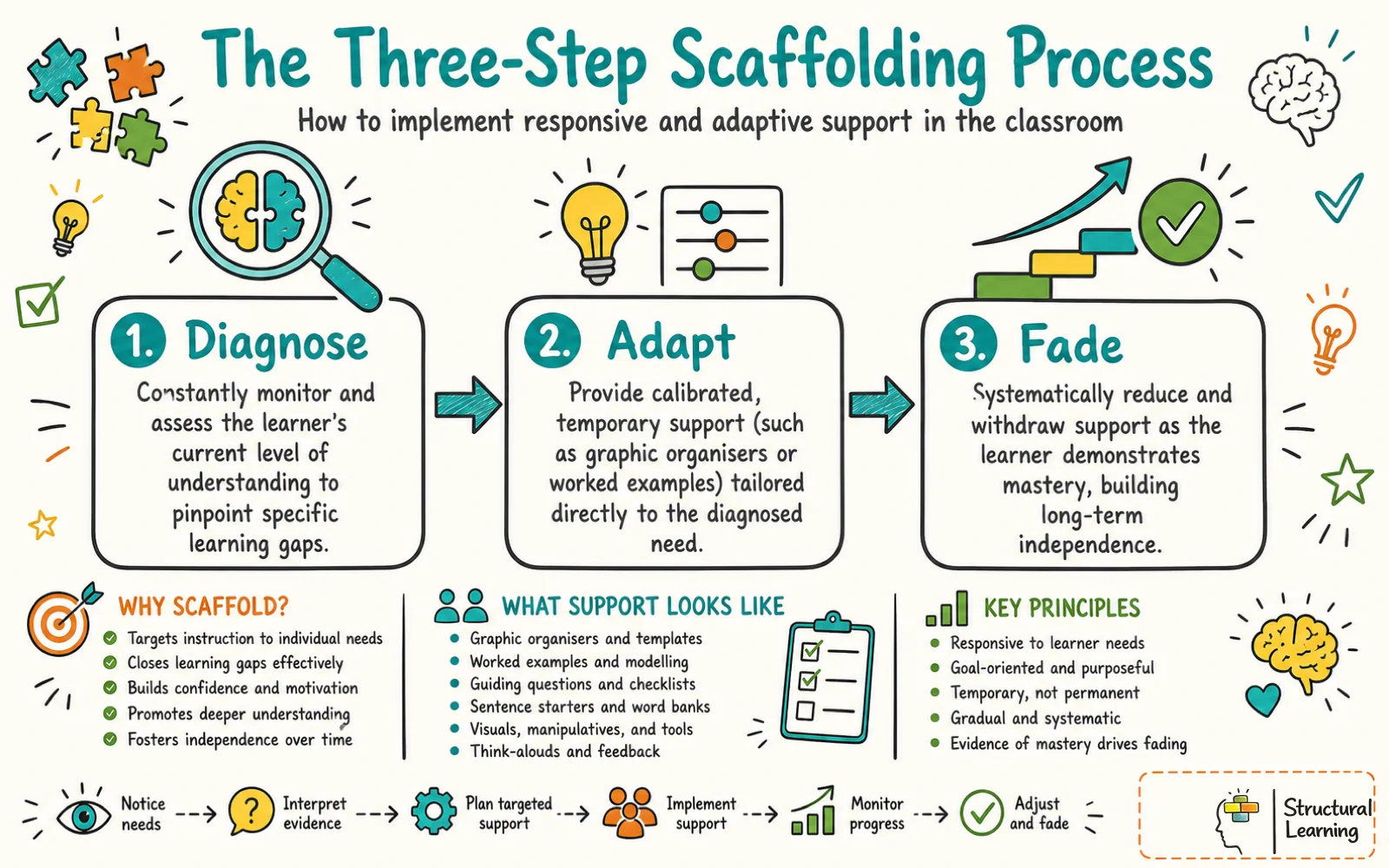
Knowing when support can fade involves identifying clear signs that learners are ready for scaffolds to be reduced. Our process shows teachers how to reduce support step by step. It uses ideas from Wood, Bruner & Ross (1976) and Pearson & Gallagher (1983). This guide helps carefully reduce scaffolding and avoids learner worry.
A research-based decision tree for teachers
Based on Wood, Bruner & Ross (1976), Pearson & Gallagher (1983), and Visible Learning MetaX (2026, d = 0.50 to 0.57)
Readiness signals based on Kalyuga et al. (2003) Expertise Reversal Effect and scaffolding effect sizes (Visible Learning MetaX, 2026, d = 0.50 to 0.57).
Recovery aligned with Wood, Bruner & Ross (1976): scaffolding must be contingent, matched to the learner's current state, not a fixed schedule.
Learners finish tasks well on their own after support ends (Vygotsky, 1978). They work alone to show they have met the learning goals (Bloom, 1956).
Final check: Test retention after 2 weeks. If the learner can still perform without the scaffold after a gap, the learning is secure. If not, a brief reteach + shortened fading cycle may be needed.
Scaffolding aims for learner independence. Van de Pol et al. (2010) state temporary support makes it distinct from permanent help.
Fading is the planned removal of support so that learners take on more of the thinking for themselves. In practical terms, it is the moment when scaffolding moves from helping learners complete a task to helping them manage it independently. This fits with Vygotsky's idea of the zone of proximal development and the gradual release of responsibility, because support should shift as competence grows, not stay fixed.
In the classroom, fading works best when it is planned before the lesson starts. A teacher modelling paragraph writing might begin with a full frame, sentence stems and a vocabulary bank. Next, she reduces the frame to a short checklist and a model opening. Finally, learners write without prompts.
Remove one layer at a time. Watch for whether learners can explain their choices, self-correct and recall the strategy after a short gap, not just whether they finish the page.
A second strategy is to move from worked examples to partially completed tasks, then to independent practice. In maths, for example, learners might first study a modelled solution, then complete missing steps in a similar problem, then solve a new question alone. This approach is supported by research on worked examples and cognitive load, because it reduces unnecessary struggle at the start but avoids long-term prompt dependence. Mini whiteboards, hinge questions and short retrieval checks, drawing on Karpicke's work on retrieval practice (Karpicke & Roediger, 2008), help teachers decide when learners are ready for the next step.
A third approach is to turn teacher scaffolds into learner-owned routines. During reading or discussion, you might start by giving question stems such as compare, infer and justify, then later ask learners to choose the right stem themselves, and finally generate their own prompts. Independence does not mean leaving learners without support, it means shifting the support into habits, checklists and strategies they can use without the teacher standing beside them. Done well, fading keeps challenge high while making success increasingly self-directed.
Scaffolding is a strong teaching method. Clear support helps learners succeed with hard tasks. The idea comes from Vygotsky's zone of proximal development.
Wood, Bruner and Ross developed it further. They showed that learners make better progress with help. Support lets them tackle work just beyond their current level.
Recent reviews by Hattie also show the value of guided teaching. Well-timed support works best when learners face new tasks.
In the classroom, one of the clearest examples is the worked example. In mathematics, a teacher might model how to solve one ratio problem, narrate each step, and then ask learners to complete a similar problem with prompts such as key vocabulary, part-completed calculations, or guiding questions. This reduces unnecessary confusion and helps learners focus on the important idea, rather than getting stuck at the first hurdle. As confidence grows, those prompts can be removed so learners take on more of the thinking themselves.
Scaffolding also works well in literacy. A learner who struggles to write an analytical paragraph needs help. They may benefit from a sentence stem and some subject vocabulary.
They also benefit from a model paragraph explored with the class. In science or history, a teacher might provide a planning frame at first. They then remove sections over time so learners organise ideas themselves.
This gradual release matters. Scaffolding is not about making work easier. It is about making success possible.
The key is that support must be temporary and specific. It must match the task. Too little structure can leave learners struggling.
However, too much help can make them dependent. It can limit independent thinking. Effective teachers watch closely and check understanding.
They adjust the level of help as learners improve. Used well, scaffolding boosts confidence and participation. It improves the quality of learner thinking.
This helps learners meeting new content or managing a high cognitive load.
Adaptive teaching keeps learning goals high for all learners. Teachers change the support, not the ambition. The ITTECF places this inside High-Quality Teaching: teachers should keep goals high and adapt support rather than lower the end point (DfE, 2024).
Scaffolding works at two levels. Macro scaffolding sits in curriculum design: sequencing prior knowledge, vocabulary, models and worked examples before independent work. Micro scaffolding happens during the lesson: a prompt, a pause, a modelled sentence, a reduced choice or a decision to fade support because the learner is ready.
The shift is practical, not just cosmetic. Universal provision means the whole class meets the same core idea. Teachers use strong explanation, modelling, and vocabulary.
Worked examples and checks for understanding also help. Dynamic scaffolding changes as teachers assess in real time. The EEF guidance on teaching learners with SEND agrees.
Approaches supporting learners with SEND improve access for all learners (EEF, 2021).
Picture a Year 7 history lesson on causation. The teacher says, “Everyone is answering the same question: why did William win at Hastings? Start with the model paragraph on the visualiser, use the vocabulary bank if you need it, and I’ll come to the front table for a guided first sentence.” One learner uses sentence stems, another uses a timeline and verbal rehearsal, and a more fluent writer is asked to weigh the causes, but all learners produce an research-informed explanation rather than three different tasks.
This matches current Ofsted expectations. Inspectors look for an ambitious curriculum for all learners, including those with SEND. They want teaching that adapts access without shrinking the curriculum (Ofsted, 2024).
In short, scaffolding is not an extra for some learners. It is the main tool for adaptive teaching. It is the best way to keep expectations high for the whole class.
Scaffolding is not a single, settled intervention. Wood, Bruner and Ross (1976) studied a tightly controlled tutoring task with young children, not a whole-class lesson with thirty learners, behaviour routines and mixed prior knowledge. Renshaw (2013) also notes that the original evidence came from a Western, affluent context, so teachers should be cautious about treating one pattern of adult-child support as culturally neutral.
A second limitation is definition drift. Van de Pol, Volman and Beishuizen (2010) found that studies often use scaffolding to mean different things: contingent support, prompts, tools, modelling, fading or collaborative talk. This makes effect sizes hard to compare. Hattie's Visible Learning summaries also need careful use, because the current MetaX entry for scaffolding and situated learning reports a smaller weighted mean than some older secondary summaries (Hattie, 2009; Hattie, 2023).
Third, support can become counter-productive. Cognitive load research shows that worked examples and prompts help novices but may slow more knowledgeable learners, known as the expertise reversal effect (Kalyuga et al., 2003). Stone (1998) raised a related concern for learners with learning difficulties: poor scaffolding can mask misunderstanding or create dependence rather than transfer responsibility.
These critiques do not make scaffolding weak. They mean it works best when teachers diagnose the barrier, adapt the support, fade it deliberately and check whether learners can use the strategy without the teacher.
Bloom, B. (1956). Taxonomy of educational objectives.
Bruner, J. (1960). The process of education.
Hattie, J. (2009). Visible learning.
Karpicke, J. D., & Roediger, H. L. (2008). The critical importance of retrieval for learning.
Piaget, J. (1952). The origins of intelligence in children.
Rosenshine, B. (2012). Principles of instruction.
Vygotsky, L. (1978). Mind in society: The development of higher psychological processes.
These peer-reviewed studies ground the scaffolding moves described above in the research tradition that started with Vygotsky and was operationalised for classrooms by Bruner, Wood, and Ross.
The Role of Tutoring in Problem Solving View study ↗
Wood, Bruner & Ross (1976), Journal of Child Psychology and Psychiatry
The foundational paper that introduced "scaffolding" as a metaphor for adult-child learning interaction. Identifies six scaffolding functions: recruitment, reduction in degrees of freedom, direction maintenance, marking critical features, frustration control, and demonstration.
Mind in Society: The Development of Higher Psychological Processes View source ↗
Vygotsky (1978), Harvard University Press
Vygotsky's foundational theory of the zone of proximal development (ZPD), which underpins the entire scaffolding concept. Argues that learning happens through social interaction at the edge of what the learner can do alone versus with guidance.
Scaffolding in teacher-student interaction: A decade of research View study ↗
van de Pol, Volman & Beishuizen (2010), Educational Psychology Review
Systematic review of 66 studies on classroom scaffolding. Identifies three characteristics of effective scaffolding: contingency (response to learner need), fading (gradual withdrawal), and transfer of responsibility.
Scaffolding Complex Learning: The Mechanisms of Structuring and Problematizing Student Work View study ↗
Reiser (2004), Journal of the Learning Sciences
Distinguishes two complementary scaffolding mechanisms: structuring (reducing complexity) and problematising (making hidden thinking visible). Essential for teachers designing scaffolding that promotes deeper understanding rather than just task completion.
Scaffolding Instruction for English Language Learners: A Conceptual Framework View study ↗
Walqui (2006), International Journal of Bilingual Education and Bilingualism
Applies scaffolding theory to English language learners. Distinguishes between macro-scaffolding (curriculum design) and micro-scaffolding (moment-to-moment teacher moves). Particularly useful for EAL contexts in UK schools.
Start removing support when learners can explain the process, make sensible choices, and complete key parts independently. You can fade scaffolds in stages by taking away sentence starters, reducing prompts, or asking learners to select their own strategy. A quick check for confidence and accuracy will show whether the class is ready for the next step.
Use scaffolds that can be adjusted rather than giving every learner the same support. Worked examples, vocabulary banks, checklists, and structured questioning let learners access the task while still aiming for the same learning goal. The key is to vary the amount of help, not the level of challenge.
Break the writing task into manageable parts such as planning, vocabulary choice, sentence construction, and editing. Model one strong example, then provide a framework like a paragraph plan or success criteria rather than a full script. This keeps ownership with the learner while still reducing the cognitive load of getting started.
Scaffolding can make success feel achievable by giving learners a clear starting point and a sequence to follow. Short oral rehearsal, paired discussion, and guided examples often help hesitant learners contribute before working alone. As confidence grows, reduce the support so they begin to trust their own thinking.
Give each learner a clear role, a shared outcome, and a simple structure for discussion such as turn-taking prompts or question stems. Provide one recording frame or checklist for the group so the task stays focused without becoming over-directed. Review the structure afterwards and remove parts of it once learners can collaborate more independently.
English Language Learners (ELLs), also known as multilingual learners, need specific scaffolding to access complex academic content while building their English proficiency. They work with new concepts, vocabulary, and grammar, so they often need clear support to bridge language and thinking gaps. Effective scaffolding helps these learners take part fully and reach learning outcomes alongside their peers (Echevarria, Vogt, & Short, 2017).
The SIOP Model (Sheltered Instruction Observation Protocol) gives teachers a clear framework for planning and teaching lessons that make academic content easier for English Language Learners to understand. It brings together content goals and language goals. This means learners learn the subject while also building their English skills. The model has eight linked parts that help teachers scaffold learning in a planned way.
One critical aspect of the SIOP Model is providing comprehensible input. Teachers achieve this by speaking clearly, adjusting their pace, using gestures, and incorporating visuals and realia. Rephrasing complex sentences and explaining idioms also helps learners understand new information without being overwhelmed by unfamiliar language (Echevarria, Vogt, & Short, 2017). This direct linguistic scaffolding allows learners to focus on the content.
In addition, the SIOP Model emphasises teaching and applying various learning strategies. Teachers explicitly model how to use graphic organisers, concept maps, or sentence frames to structure thoughts and responses. For example, in a science lesson on the water cycle, a teacher might provide a partially completed flow chart with key terms and arrows, asking learners to fill in descriptions using sentence starters like "Evaporation is when..." or "Condensation forms when...".
Interaction forms another vital scaffolding component within the SIOP Model. Teachers design activities that encourage learners to discuss content in pairs or small groups, using sentence frames to guide their conversations. This provides opportunities for learners to practise new vocabulary and grammatical structures in a low-stakes environment, building confidence and fluency.
Finally, the SIOP Model stresses ample opportunities for practice and application of both content and language. Teachers assign hands-on tasks, experiments, or collaborative projects where learners apply what they have learned. Regular review of key vocabulary and content concepts, coupled with varied assessment methods, ensures ongoing support and monitors progress for English Language Learners.
Scaffolding has an important role in Special Education. It gives targeted support, so learners with varied needs can access the curriculum and reach their potential. This helps make education fairer for all learners, especially those with identified disabilities.
Individualized Education Programs (IEPs) sit at the centre of Special Education provision. These legal documents describe a learner's current performance, set clear yearly goals, and list the specific services and supports they need. Scaffolding is one main way teachers provide these tailored supports. It helps learners work towards their IEP goals effectively.
The core of an IEP is Specially Designed Instruction (SDI), which refers to adapting the content, methodology, or delivery of instruction to address the unique needs of a learner with a disability. SDI is, in essence, a highly individualised form of scaffolding. It involves modifying teaching strategies, materials, and learning environments to help learners master content that would otherwise be inaccessible.
Teachers use scaffolding to break down complex tasks into manageable steps, providing explicit instruction and guided practice aligned with specific IEP goals. For a learner with a reading comprehension goal, this might involve pre-teaching vocabulary, using graphic organisers to map story elements, or providing sentence starters for written responses. This systematic support helps bridge the gap between a learner’s current ability and the expected learning outcome (Vygotsky, 1978).
Consider a Year 5 learner with an IEP goal to write a multi-paragraph persuasive essay. The teacher implements scaffolding by first providing a partially completed writing frame, including topic sentences and transition words for each paragraph. The learner then focuses on generating supporting details and evidence. The teacher might say, "Remember our discussion about why recycling is important; what are two strong reasons you could include in this paragraph?" This specific guidance helps the learner structure their thoughts and meet the writing objective.
Scaffolding also encompasses various accommodations and modifications detailed within an IEP. An accommodation might involve providing extended time for a task, offering a word bank for a writing assignment, or allowing responses to be dictated rather than written. These adjustments reduce barriers to learning without altering the core content or expectations, enabling learners to demonstrate their knowledge and skills.
Effective scaffolding in Special Education needs ongoing assessment and responsive adjustments. Teachers must keep checking a learner's progress towards their IEP goals. As the learner gains independence and mastery, teachers gradually reduce support. This active process keeps support appropriate and promotes genuine learning, rather than creating dependency (Wood, Bruner & Ross, 1976).
Teachers can strengthen scaffolding through Culturally Responsive Teaching. This approach uses learners' cultural backgrounds, identities, and home languages as key assets for learning. As a teaching framework, it keeps support academically rigorous while making it culturally relevant and affirming (Gay, 2000). By understanding learners' lived experiences, teachers can link new concepts to familiar contexts.
When teachers employ culturally responsive strategies, they effectively scaffold learning by making content more accessible and meaningful. They recognise that learners arrive with diverse knowledge systems and ways of understanding the world, which can serve as powerful starting points for new learning. This approach reduces cognitive load by connecting unfamiliar academic concepts to learners' existing schema.
using learners' cultural backgrounds means drawing on their community practices, family histories, and shared cultural knowledge to explain concepts or frame tasks. For instance, a history teacher introducing a unit on migration might ask learners to share family stories of moving or adapting to new places, validating their experiences as relevant historical narratives. This connection helps learners see themselves within the curriculum, making the learning process more engaging and less daunting.
Affirming learners' identities involves creating a classroom environment where every learner feels seen, valued, and respected for who they are. Teachers can scaffold participation by ensuring diverse voices and perspectives are represented in learning materials and discussions. When learners see their identities reflected positively, they are more likely to engage deeply with the content and take intellectual risks (Ladson-Billings, 1995).
Using learners' home languages is an important scaffold, especially for multilingual learners. A teacher might give key vocabulary in English and in learners' home languages. They might also let learners discuss complex ideas in their first language before explaining them in English. This validates linguistic diversity, supports comprehension, and helps learners access challenging academic content without feeling penalised for their language proficiency.
In a science lesson on interdependence, the teacher can start with environments learners know: a park, a garden, a local river or a family food-growing practice. Learners describe how living things, weather, soil and human choices affect one another before the teacher introduces formal terms.
This keeps the science idea demanding but gives learners a concrete route into it. Multilingual learners may use home-language terms first, then map them onto the English vocabulary for habitat, producer, consumer and dependency.
Activating prior knowledge is a key scaffolding strategy. It makes a clear link between new learning and what learners already know. This helps learners bring back information, experiences, and understanding from long-term memory, giving them a stable base for new concepts.
Teachers use this technique to bridge the gap between known and unknown information, making new content more accessible and meaningful. By making these connections explicit, learners can integrate new ideas into their existing mental frameworks, which is important for deep comprehension and retention (Marzano, Pickering & Pollock, 2001).
One effective method for activating prior knowledge is the K-W-L chart. Before introducing a new topic, such as the water cycle, the teacher presents a three-column chart labelled "Know," "Want to Know," and "Learned." learners first list everything they already know about the water cycle in the first column.
For example, a learner might write, "Rain comes from clouds" or "Rivers flow to the sea." This initial step reveals existing knowledge and potential misconceptions. Next, learners articulate what they want to know about the topic, prompting curiosity and setting learning goals.
After instruction, learners complete the "Learned" column, documenting their new understanding. This reflective process helps learners consolidate new information and recognise how their knowledge has expanded, reinforcing the learning process.
Another powerful strategy is the anticipation guide. This involves presenting learners with a series of statements related to the upcoming content, asking them to agree or disagree before they engage with the material. For a history lesson on the causes of World War I, statements might include, "Alliances always prevent wars" or "Economic competition was the main reason for the conflict."
learners discuss their initial responses, justifying their positions based on their current understanding. This pre-reading or pre-learning activity stimulates thought, highlights existing beliefs, and creates a purpose for learning as learners seek to confirm or challenge their initial ideas.
After reading or instruction, learners revisit the anticipation guide to see if their opinions have changed and why. This comparison helps them identify shifts in their understanding and address any misconceptions they held previously. The teacher supports this by asking, "What evidence from the text changed your mind about this statement?"
Explicitly activating prior knowledge reduces cognitive load by providing a relevant schema for new information, preventing feelings of being overwhelmed (Sweller, 1988). When learners can link new concepts to familiar ones, they process information more efficiently and build stronger, more interconnected knowledge structures.
Teachers need to listen closely to learner answers during these activities. This helps them spot common misconceptions or gaps in understanding. They can then adjust their teaching, give targeted support, and explain complex ideas before mistakes become fixed.
By consistently employing strategies like K-W-L charts and anticipation guides, teachers ensure that learners are not passive recipients of information. Instead, they become active participants in constructing their own understanding, building confidence and building a deeper engagement with learning.
Vocabulary pre-teaching, often called frontloading, is an important scaffolding strategy. It helps prepare learners for new content by introducing and explaining key terms before they meet them in harder texts or tasks. When teachers deal with unfamiliar language early, they reduce barriers to understanding.
The main aim of frontloading vocabulary is to reduce the cognitive load linked to learning new concepts. When learners meet too many unknown words at the same time, their working memory can become overloaded. This makes it harder to process new information (Sweller, 1988). Teachers focus on Tier 2 academic vocabulary, which appears across subjects, and Tier 3 domain-specific vocabulary, which is essential for a particular topic.
Consider a Year 8 History lesson on the Industrial Revolution where learners will read about "urbanisation" and "proletariat". Before distributing the text, the teacher displays these words and provides clear, concise definitions, perhaps alongside relevant images. They might say, "Urbanisation means people moving from the countryside to cities, making cities grow rapidly."
The teacher then asks learners to rephrase the definition in their own words or provide an example of urbanisation from another historical period. They might use a quick check for understanding, asking, "If a village grows into a large town, is that urbanisation?" This ensures initial comprehension before learners engage with the main reading material.
Effective pre-teaching strategies include using graphic organisers like Frayer models, which prompt learners to define a word, list its characteristics, provide examples, and non-examples. Teachers can also use sentence stems or cloze activities where learners practise using the new vocabulary in context. Presenting words in a variety of contexts reinforces understanding and retention (Marzano, 2004).
This explicit instruction is especially useful for learners with limited prior knowledge or for those learning English as an additional language. By frontloading vocabulary, teachers create a fairer learning environment where all learners can access challenging content. It also builds confidence and reduces anxiety when learners meet new academic texts.
Regular vocabulary pre-teaching in lesson planning helps learners understand lessons and make academic progress. It goes beyond simple word definitions. Learners build links between words and use new language with more confidence. This basic scaffold lets them focus on complex ideas, rather than struggle with unfamiliar terms.
One effective scaffolding strategy involves providing learners with concrete, physical objects to bridge understanding between abstract concepts and practical application. This approach is particularly valuable for younger learners or those grappling with new, complex ideas. Such tangible resources offer immediate, hands-on support that can be gradually withdrawn as learners develop conceptual mastery.
Realia refers to real-world objects used in the classroom to make learning more authentic and understandable. These items directly connect abstract ideas to learners' lived experiences, aiding comprehension and retention (Bruner, 1966). For instance, a Year 1 teacher might bring in actual fruit to teach counting, fractions, or healthy eating, allowing learners to physically sort, group, and divide.
Similarly, a geography teacher could use local maps, soil samples, or rock specimens to illustrate geological processes or urban planning concepts. This direct engagement with genuine artefacts helps learners visualise and interact with the subject matter. It grounds theoretical knowledge in observable reality, making abstract principles more accessible.
Manipulatives are hands-on materials that help learners understand maths or science ideas by using them directly. Unlike realia, manipulatives are often tools made for teaching. They show abstract ideas in concrete form, so learners can model problems, explore relationships, and spot patterns.
Consider a Year 4 maths lesson where learners use base ten blocks to understand place value, addition, and subtraction of multi-digit numbers. A teacher might instruct, "Use the hundreds flats and tens rods to show me 235, then add 120 by placing more blocks." This physical representation helps learners grasp the abstract concept of numerical operations. Similarly, Cuisenaire rods assist learners in visualising number bonds, fractions, and algebraic relationships.
In science, learners might use molecular models to build chemical compounds or simple machines to explore forces and motion. These manipulatives provide a temporary, concrete scaffold, enabling learners to experiment and construct their own understanding. As learners demonstrate proficiency, the teacher can reduce reliance on the physical tools, moving towards pictorial representations and then abstract symbols.
Realia and manipulatives both give learners important sensory input. This matters for learners at different stages of cognitive development. These materials help learners take an active role with the content, rather than only receiving information. Teachers can watch how learners use the materials, spot misconceptions, and give targeted feedback that supports learning progress.
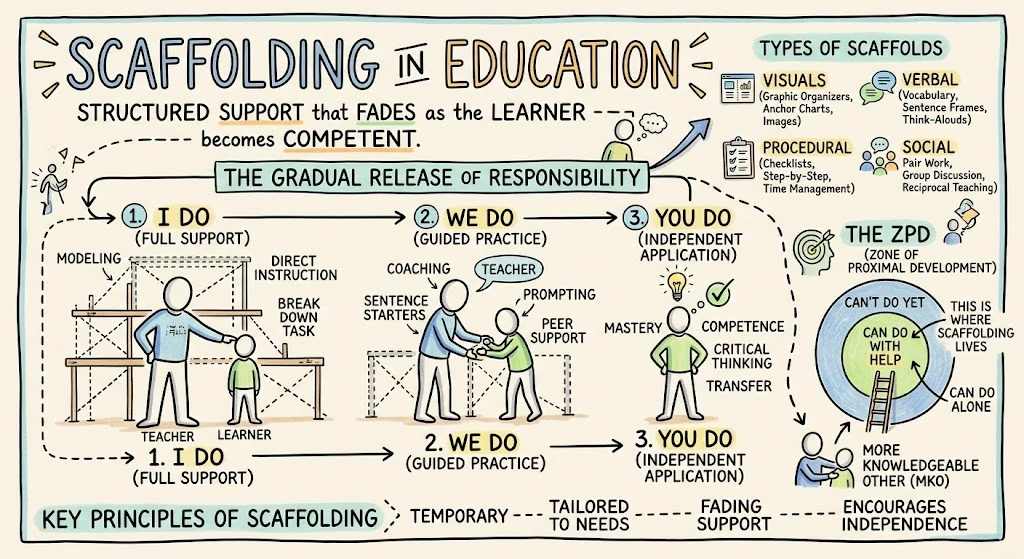
The Gradual Release of Responsibility (GRR) Framework, conceptualised by Pearson and Gallagher (1983), gives teachers a clear way to scaffold instruction. Over time, it moves cognitive load from the teacher to the learner, so learners build independence and mastery. It is a widely recognised model for moving learners from supported learning to autonomous application.
The GRR framework typically unfolds in four distinct phases: "I do" (Modelling), "We do" (Guided Practice), "You do it together" (Collaborative Practice), and "You do it alone" (Independent Practice). Each phase progressively reduces teacher support while increasing learner responsibility. This deliberate reduction of assistance aligns with Vygotsky's (1978) concept of the Zone of Proximal Development, where learning is most effective with appropriate support.
In the "I do" phase, the teacher explicitly models the skill or strategy, often thinking aloud to make their thought processes visible. For instance, a teacher demonstrating how to solve a complex algebraic equation might say, "First, I identify the variables. Then, I consider the order of operations, thinking about how to isolate x." learners observe and listen, internalising the steps and reasoning.
The "We do" phase involves guided practice, where the teacher and learners work through problems or tasks together. The teacher provides prompts, asks questions, and offers immediate feedback, gradually inviting more learner input. For example, when analysing a text, the teacher might ask, "What evidence in this paragraph supports the author's main point? Let's highlight it together and discuss why it's relevant."
Following this, the "You do it together" phase encourages collaborative practice, where learners work in pairs or small groups to apply the learned skill. The teacher circulates, monitoring progress and offering targeted support as needed, allowing learners to articulate their understanding to peers. learners might discuss, "How did you interpret this instruction?" or "Which strategy should we use here?" as they collaboratively solve a problem.
Finally, the "You do it alone" phase requires learners to independently apply the skill or strategy, demonstrating their mastery without direct teacher intervention. This phase confirms that the scaffolding has been successfully removed and the learner can perform the task autonomously. A learner might independently write an argumentative essay, applying all the planning, drafting, and editing strategies previously modelled and practised.
Effective scaffolding does not remove all difficulty from learning. Instead, it carefully manages the level of challenge to create a productive struggle for learners. This psychological concept describes the beneficial effort learners exert when grappling with complex problems or new concepts, which is important for deeper learning and retention (Hiebert & Grouws, 2007).
Scaffolding needs a careful balance. It should give enough support to prevent overwhelming frustration, while still leaving enough friction for real intellectual effort. When teachers give too much assistance, they can remove chances for learners to engage in this essential struggle. This can hinder the development of independent problem-solving skills.
Consider a Year 5 mathematics lesson where learners are solving multi-step word problems. The teacher might provide a partially completed calculation template, acting as a scaffold, but leave key steps for the learners to determine independently. A learner might initially struggle to identify the correct operation for a particular step, experiencing a moment of difficulty.
Instead of immediately providing the answer, the teacher might prompt, "What information do you have, and what are you trying to find out?" This guided questioning encourages the learner to revisit the problem, re-evaluate their understanding, and apply reasoning, rather than passively receiving the solution. The learner experiences productive struggle, working through the difficulty with the teacher's minimal, targeted support (Vygotsky, 1978).
This process strengthens their conceptual understanding and builds resilience. Engaging in productive struggle helps learners develop metacognitive strategies, learning how to monitor their own thinking and adjust their approaches. It moves them beyond rote memorisation towards constructing deeper knowledge, preparing them to tackle future challenges independently.
Sentence frames and stems give learners structured language support. They help learners express complex thoughts and academic concepts more clearly. These scaffolds give partial sentences or phrases for learners to complete, which reduces the cognitive load of forming ideas and using correct grammar at the same time (Sweller, 1988). They are especially useful for building precise academic language across all subjects.
Embedded sentence scaffolds extend beyond simple starters, offering more comprehensive structural guidance. For example, instead of just "I think...", an embedded scaffold might be "Although _____, it is clear that _____ because _____." This helps learners formulate academic language structures by providing templates for comparison, causation, or argumentation, encouraging more sophisticated reasoning.
Teachers often combine sentence frames with targeted word banks to further support learners' expression. A science teacher might provide the frame "The independent variable was _____, which caused the dependent variable to _____ because _____," alongside a word bank containing terms like 'temperature', 'growth rate', 'photosynthesis', and 'enzyme activity'. learners then select appropriate vocabulary to construct their scientific explanations, ensuring accuracy and clarity.
Regular use of these scaffolds helps learners internalise academic language patterns. This helps them express ideas more clearly, with greater precision and coherence. As learners become more skilled, teachers slowly remove the frames and stems so learners can build more complex sentences and paragraphs on their own (Wood, Bruner & Ross, 1976). This planned approach helps learners develop strong writing skills for academic success.
Effective scaffolding depends on intersubjectivity. This means the teacher and learner build a shared understanding of the task. That shared understanding helps the teacher match support to the learner's current needs and view of the task. Without it, the help may miss the mark and become unclear or confusing for the learner.
Achieving intersubjectivity means both parties must grasp the problem, the goal, and the steps required to bridge the learning gap. The teacher needs to understand the learner's perspective, including their misconceptions or areas of difficulty, while the learner needs to comprehend the teacher's instructions and the purpose of the support offered. This reciprocal understanding is fundamental for the scaffolding to be truly effective (Vygotsky, 1978).
Teachers build intersubjectivity through regular dialogic talk and close observation. Intersubjectivity means teacher and learner develop a shared understanding of the task. Teachers ask open-ended questions, listen closely to learner responses, and prompt learners to explain their thinking. This helps the teacher judge the learner's current understanding and adjust their teaching approach.
In a Year 5 multi-step maths problem, Sarah gets stuck on the second step. The teacher does not give the answer. She asks, "Sarah, tell me what you understand about this part of the problem. What is the question asking you to do next?"
Sarah explains her confusion, so the teacher can target the exact gap: "We need to find the total cost before applying the discount. How would you calculate that?" The exchange builds shared understanding of the problem without removing the thinking.
This ongoing negotiation of meaning keeps scaffolding responsive and appropriate. As the learner's understanding grows, the teacher can slowly withdraw support. The teacher can do this with confidence when the learner has internalised the concepts and strategies. Maintaining intersubjectivity is therefore critical for knowledge construction and independent application.
Scaffolding theory comes from the work of Lev Vygotsky, especially his sociocultural theory of cognitive development. Vygotsky argued that learning is social. Learners build knowledge and skills through interaction with more knowledgeable people and with cultural tools (Vygotsky, 1978).
Central to Vygotsky's ideas is the concept of the Zone of Proximal Development (ZPD), which describes the gap between what a learner can achieve independently and what they can achieve with guidance. Scaffolding acts as the temporary support provided within this zone, enabling learners to complete tasks that would otherwise be beyond their current capabilities.
A key aspect of this process is the development of inner or private speech. Initially, learners engage in external social interaction, where a teacher's prompts and questions guide their thinking. For instance, a teacher might ask, "What evidence supports your claim?" during a writing task.
Over time, this external dialogue becomes internalised, transforming into private speech and eventually inner thought. The learner begins to ask themselves, "What evidence do I need here?" without external prompting, demonstrating the internalisation of the teacher's scaffolded questions (Vygotsky, 1978). This transformation from external social interaction to independent cognitive functioning is the ultimate goal of effective scaffolding.
The Zone of Proximal Development (ZPD), a core concept from Vygotsky (1978), defines the space between a learner's actual developmental level and their potential developmental level. A learner's actual developmental level represents what they can accomplish independently, without any assistance. This is their current comfort zone of mastered skills and knowledge.
The potential developmental level is what a learner can achieve with guidance from a teacher or a more knowledgeable peer. The ZPD is the gap between independent performance and supported performance. Scaffolding works in this gap because it gives enough structure for the learner to attempt work that would otherwise be out of reach.
For example, a Year 7 English teacher might provide a writing frame with sentence starters and paragraph prompts for an argumentative essay. The support helps the learner build a coherent argument beyond current independent capacity. Over time, the teacher removes the prompts so the learner internalises the structure for future writing.
While David Wood, Jerome Bruner, and Gail Ross introduced the term 'scaffolding' in their 1976 study, Bruner's broader work on cognitive development provides essential context. Bruner argued that learning is an active process where learners construct new ideas or concepts based upon their current and past knowledge (Bruner, 1966).
This constructivist view underpins his concept of the spiral curriculum, where fundamental ideas are revisited repeatedly over time, each time at a more sophisticated level. Scaffolding is important here, as it provides the temporary support needed for learners to engage with increasingly complex versions of the same concepts.
For example, a science teacher might introduce the concept of 'forces' in Year 3 with simple pushes and pulls. In Year 6, the teacher revisits forces, scaffolding learners to understand friction and gravity through structured experiments and guided inquiry, building on their earlier understanding (Bruner, 1960). This systematic re-engagement, supported by carefully withdrawn assistance, deepens comprehension and builds long-term retention.
Formative assessment is essential for responsive scaffolding because it helps teachers check learner understanding in real time. This ongoing feedback helps teachers decide when to introduce, change, or withdraw support (Wiliam, 2011). It keeps scaffolding matched to the learner's current needs. It also helps avoid giving too little support or letting learners rely on support for too long.
Teachers employ various practical formative assessment tools to gather this immediate data. For instance, an exit ticket asking learners to summarise a key concept or solve a specific problem reveals common misconceptions. A quick poll using hand signals or mini-whiteboards can show which learners have grasped a new procedure and which require further guided practice.
Based on these assessments, a teacher might decide to re-teach a specific step to a small group, provide an additional graphic organiser for those struggling, or move the majority of the class to independent practice. This dynamic adjustment of support, informed by ongoing assessment, is central to effective scaffolding in education.
The Sheltered Instruction Observation Protocol (SIOP®) Model gives teachers a research-based framework for teaching academic content to English Language Learners (ELLs). The model brings together content teaching and language teaching. This helps learners access challenging material while they develop their English proficiency (Echevarria, Vogt & Short, 2017).
SIOP® inherently incorporates scaffolding strategies across its eight components. These components guide teachers in making lessons comprehensible and engaging for learners at various language proficiency levels. The structured approach helps bridge linguistic and academic gaps.
One key component is Comprehensible Input, where teachers adjust their speech and use various aids to make content understandable. For instance, a teacher might speak slower, enunciate clearly, use gestures, or display visual aids and realia when explaining a new science concept.
Building Background also gives important scaffolding by clearly linking new content to learners' prior knowledge and experiences. Teachers pre-teach key vocabulary and concepts. This helps all learners build a basic understanding before they move into complex topics.
Consider a Year 5 science lesson on the water cycle. The teacher, following SIOP® principles, first displays a large diagram of the water cycle, pointing to each stage while using simplified language and gestures. learners then work in small groups, using a graphic organiser to label the diagram and discuss the process in English, supported by sentence starters provided by the teacher.
| SIOP® Component | Scaffolding Function | Classroom Example |
|---|---|---|
| Comprehensible Input | Makes content understandable through modified language and supports. | A teacher uses simplified vocabulary, slower speech, and gestures when explaining photosynthesis. |
| Building Background | Connects new learning to prior knowledge and pre-teaches vocabulary. | Before reading a historical text, learners discuss related personal experiences and learn key terms like 'settlement' and 'colony'. |
| Strategies | Teaches learners explicit learning strategies for content and language. | learners learn to use a 'KWL' chart (Know, Want to Know, Learned) to organise information from a non-fiction text. |
| Interaction | Provides opportunities for learners to interact and practise language. | learners engage in structured pair-share activities to discuss solutions to maths problems, using specific sentence frames. |
Scaffolding is particularly vital for learners with special educational needs (SEN) and those with Individualized Education Programs (IEPs). It provides structured support to help learners access the curriculum and achieve specific learning objectives. This approach acknowledges the wide range of learner variability present in any classroom (Vygotsky, 1978).
IEP goals often target specific academic, social, or functional skills that require explicit instruction and tailored support. Scaffolding allows teachers to break down complex tasks into manageable steps, making ambitious goals attainable for learners. This systematic reduction of support as competence grows is central to effective instruction (Wood, Bruner & Ross, 1976).
learners with SEN exhibit diverse learning profiles, including differences in processing speed, attention, memory, and executive function. Scaffolding provides flexible strategies, such as visual aids, simplified language, or graphic organisers, to meet these varied needs. Teachers can adjust the level of support dynamically, ensuring all learners can engage meaningfully with the material.
Consider an IEP goal for a Year 5 learner: "The learner will independently write a five-sentence paragraph with a clear topic sentence and supporting details." The teacher might provide a partially completed writing frame, offering sentence starters for the topic sentence and transition words for supporting details. The learner then fills in the content, gradually reducing reliance on the frame as their writing skill develops.
| IEP Goal Area | Scaffolding Strategy | Teacher Action | Learner Outcome |
|---|---|---|---|
| Reading Comprehension | Graphic organiser (e.g., KWL chart) | Provides a blank KWL chart and models its use for a new text. | Learner activates prior knowledge, identifies what they want to learn, and summarises new information. |
| Written Expression | Sentence starters/writing frames | Offers a frame with opening phrases for an argumentative essay. | Learner structures their arguments logically and focuses on content rather than sentence construction. |
| Problem Solving (Maths) | Worked examples | Presents a step-by-step solution to a similar problem before independent practice. | Learner follows the model to solve new problems, understanding the process. |
The Gradual Release of Responsibility (GRR) framework systematically transfers cognitive load from the teacher to the learner. This instructional approach ensures learners develop independence in applying new knowledge and skills. It provides structured support that diminishes as learners gain competence, aligning with effective scaffolding principles (Rosenshine, 2012).
The framework is commonly known by its three core stages: "I Do", "We Do", and "You Do". Each stage represents a distinct shift in who holds the primary responsibility for the learning task.
| Stage | Teacher Role | Learner Role |
|---|---|---|
| I Do (Modelling) | Explicitly demonstrates the skill or concept, thinking aloud and explaining decisions. | Observes, listens actively, and asks clarifying questions. |
| We Do (Guided Practice) | Works collaboratively with learners, providing prompts, cues, and corrective feedback. | Practises the skill with teacher and peer support, discussing strategies. |
| You Do (Independent Practice) | Monitors progress, offers minimal support, and assesses understanding. | Applies the skill independently, demonstrating mastery and problem-solving. |
During the "I Do" stage, the teacher explicitly models the desired behaviour or thought process. For example, a history teacher might say, "To analyse this primary source, I first identify the author and date, then consider their perspective and purpose." learners observe how the teacher constructs an argument or solves a problem.
In the "We Do" stage, learners practise the skill with significant teacher guidance and peer collaboration. The teacher might lead a class discussion, asking, "What details from the source suggest the author's bias?" learners collaboratively formulate responses, receiving immediate feedback and support.
Finally, the "You Do" stage requires learners to apply the learned skill independently. learners might write an analytical paragraph about a new primary source, using the strategies modelled and practised. The teacher circulates, offering targeted support only when necessary, allowing learners to consolidate their understanding.
| Scaffolding Technique | Application in English Language Arts | Application in Mathematics |
|---|---|---|
| Structured Prompts / Sentence Starters | learners use "The author's choice of [word/phrase] creates a [mood/tone] because..." to analyse literary devices. | learners use "First, I need to [operation] to find [value], then I can..." to plan problem-solving steps. |
| Graphic Organisers / Visual Aids | learners complete a plot diagram to map story events or a Venn diagram to compare characters. | learners use a number line to visualise integer operations or a bar model to represent fractions. |
Frontloading vocabulary means teaching key terms and concepts before learners meet them in a text or lesson. This reduces cognitive load, or the amount of mental effort needed. When learners understand essential terminology, they can focus on new content instead of struggling with unfamiliar words (Marzano, 2004).
Teachers select important vocabulary and provide definitions, examples, and non-examples. For instance, before a science lesson on networks, a teacher might introduce terms such as "producer," "consumer," and "decomposer." learners could complete a Frayer model graphic organiser, writing definitions, characteristics, examples, and non-examples for each term.
Activating prior knowledge connects new learning to what learners already know, building upon existing schema. This process helps learners make sense of new information by linking it to familiar concepts and experiences (Rosenshine, 2012). It establishes a relevant context for the upcoming lesson.
Before teaching about fractions, a teacher might ask, "When have you shared something equally with friends?" or "What do you know about halves and quarters?" learners might discuss sharing a pizza or cutting a cake, bringing their real-world experiences to the forefront. This initial discussion makes abstract concepts more accessible.
| Strategy | Purpose | Teacher Action | Learner Action |
|---|---|---|---|
| Frontloading Vocabulary | Reduces cognitive load by pre-teaching key terms. | Explicitly teaches definitions, examples, and non-examples of new words. | Defines terms, uses graphic organisers, practises new vocabulary. |
| Activating Prior Knowledge | Connects new information to existing understanding. | Asks questions, uses KWL charts, prompts recall of past experiences. | Recalls relevant information, shares experiences, brainstorms ideas. |
Teachers continuously adjust scaffolding based on learners' ongoing learning needs. Everyday formative assessment provides the important information required to make these real-time instructional decisions. This constant monitoring ensures support is neither too much nor too little, maintaining an appropriate level of challenge.
Formative assessment helps teachers gauge understanding. It shows where learners need more support and where existing support can be withdrawn. Dylan Wiliam (2011) highlights that effective formative assessment involves teachers responding to evidence of learner learning. This responsiveness is central to dynamic scaffolding.
Everyday formative assessment techniques give teachers the data they need to make scaffolding decisions. These methods offer immediate feedback. This feedback guides the teacher's next instructional steps.
| Formative Assessment Method | Scaffolding Adjustment |
|---|---|
| Teacher Observation | Provide a specific prompt or hint; offer a partially completed example. |
| Questioning (Cold Call) | Rephrase the question; break it into smaller parts; provide a sentence starter for the answer. |
| Exit Ticket/Mini-Quiz | Offer a graphic organiser for the next task; provide a worked example for common errors. |
| Learner Self-Correction | Encourage peer feedback; provide a rubric or checklist for self-assessment. |
Consider a Year 5 teacher introducing multi-step problem-solving in maths. After learners attempt the first problem, the teacher circulates, observing their working and asking clarifying questions. If many learners struggle with identifying the correct operations, the teacher might pause the class and provide a simple flow chart as a visual scaffold, directly responding to observations.
Conversely, if learners quickly grasp the concept and demonstrate competence, the teacher fades the scaffold. For example, once learners consistently use the flow chart independently, the teacher might remove it for subsequent problems, encouraging them to internalise the process. This responsive adjustment ensures learners develop independent problem-solving skills.
Scaffolding often focuses on cognitive support, or help with thinking. Yet emotional regulation also affects how well a learner can engage with new material. For neurodivergent learners, managing internal states is often needed before effective learning can happen (Vygotsky, 1978). Emotional scaffolding gives temporary support so learners can recognise, understand, and manage their feelings.
Interoception, the sense of the body's internal state, plays a important role in emotional regulation. This includes awareness of hunger, thirst, temperature, and physiological responses to stress or anxiety. learners who struggle with interoceptive awareness may not recognise early signs of discomfort or overwhelm, leading to sudden emotional outbursts or withdrawal.
Teachers can scaffold interoceptive awareness by helping learners connect body sensations with emotional states. This needs explicit teaching and consistent modelling of self-reflection. When learners identify their internal signals, they gain more agency over their emotional responses.
For example, a Year 2 learner with sensory processing differences might become agitated by classroom noise. The teacher might say, "I notice your shoulders are tense and you're tapping your foot. How does your body feel right now? Sometimes when our bodies feel like that, it means we're feeling a bit overwhelmed." This prompts the learner to link physical sensations to emotional states.
Teachers can use clear strategies to help learners notice their feelings and body signals, known as interoceptive self-awareness. These strategies reduce the mental load caused by emotional distress, so learners can focus on academic tasks. Predictable routines and clear expectations also help learners feel safe and less anxious.
Consider a Year 8 learner with autism who struggles with transitions between lessons. The teacher might provide a visual timetable with specific timings and a "transition toolkit" containing a fidget toy or noise-cancelling headphones. Before a transition, the teacher could prompt, "We're moving to science in two minutes.
How is your body feeling? Do you need your toolkit?"
Another example involves a Year 5 learner with ADHD who becomes frustrated during independent writing tasks. The teacher could introduce a "frustration thermometer" visual aid, helping the learner rate their emotional state from 1 (calm) to 5 (overwhelmed). When the learner indicates a rising level, the teacher might offer a short movement break or a simplified writing frame, explicitly linking the intervention to the learner's internal state.
When teachers directly address emotional and interoceptive needs, they create a more inclusive and effective learning environment. This scaffolding is not just about managing behaviour. It builds basic self-regulation skills that learners need for all learning.
Tactile cognitive scaffolding uses physical objects to show abstract concepts. This makes complex ideas more concrete and easier to manage. The approach goes beyond basic mathematics or vocabulary learning. It also supports higher-order thinking skills, such as metacognition and complex text structuring.
When learners externalise mental processes, they move their thinking into a physical form. They can then handle and reorganise their ideas, which reduces cognitive load and supports deeper understanding (Sweller, 1988). This method creates a clear bridge between concrete experience and abstract reasoning, in line with constructivist principles (Bruner, 1966).
In secondary English, teachers can use physical blocks to help learners plan and structure analytical essays. Each block might represent a distinct paragraph or a key component of an argument, such as an introduction, a main point, supporting evidence, or an explanation.
learners physically arrange and rearrange these blocks on their desk, visually mapping the flow of their argument before writing. This allows them to identify logical gaps or improve coherence, for instance, by moving a "counter-argument" block to a more appropriate position within their essay's structure.
Primary teachers can introduce tactile blocks to scaffold narrative planning for younger learners. Different coloured blocks might represent elements like character, setting, problem, rising action, climax, and resolution.
learners physically select and sequence the blocks to construct their story arc. A learner might say, "My blue block is the character, the green is where they are, and the red block is the big problem they face," thereby externalising their story ideas and making the planning process more concrete.
Fading scaffolds is important for helping learners become more independent. In practice, though, it can be hard for teachers to manage. Simply saying "gradually remove support" misses the real-time interactions and learner responses that happen in class. Effective fading needs planned strategies and clear language to manage the shift.
This process means slowly reducing support as learners show they can do more on their own. It helps prevent cognitive overload and builds self-regulation (Sweller, 1988). Teachers must also spot likely moments of struggle and have precise interventions ready.
Before withdrawing a scaffold, explicitly communicate the intention and rationale to learners. Explain that the support is temporary and designed to help them develop independent skills. For example, a Year 5 teacher might say, "Today, we're going to try writing our conclusions without the sentence starters, because I know you've all mastered writing strong opening sentences."
This transparency helps manage expectations and reduces anxiety when the support is less visible. Remind learners of their prior successes using the scaffold, building their confidence for the next step (Hattie & Timperley, 2007).
When providing verbal prompts, shift from direct questions to more open-ended or metacognitive cues. Instead of asking, "What's the main idea of this paragraph?", a Year 9 History teacher could ask, "What strategy could you use to find the main idea here?"
Further reduction involves prompting learners to recall strategies they have already learned. The teacher might say, "Think back to our lesson on summarising. What was the first step we practised?" This encourages retrieval and application of learned methods (Dunlosky et al., 2013).
For tools like graphic organisers or writing frames, introduce partial completion or optional use. A Key Stage 2 teacher teaching persuasive writing might provide a writing frame with only the topic and conclusion sections filled, leaving the body paragraphs blank.
Alternatively, encourage learners to attempt a task without the frame first, then use it for self-correction or as a reference. The teacher could instruct, "Try to plan your argument using just bullet points, then check if you missed anything important by looking at the graphic organiser."
When a learner expresses "I can't do it!" upon scaffold removal, acknowledge their feeling while redirecting to their capabilities. A Year 7 Maths teacher might respond, "I understand it feels tricky without the example, but remember how you solved similar problems last week? You have the skills for this."
Provide a minimal, targeted prompt that nudges them forward without giving the answer directly. "What's the very first step you do know how to do?" or "Let's just focus on getting the first sentence down. What's one idea you have?" This re-establishes a sense of control and achievable progress (Rosenshine, 2012).
Keep checking learner performance as learning develops. If a learner continues to struggle, be ready to bring back a scaffold for a short time. This responsive approach keeps support temporary while matching it to individual learning needs (Wiliam, 2011).
Teaching learners to use generative artificial intelligence (AI) can make scaffolding more responsive, but only when the teacher sets clear boundaries. Learners can ask for a simpler explanation, a worked example, a quiz question or feedback against agreed criteria. This turns prompt-writing into a metacognitive routine: naming the gap, choosing the support, checking the answer and deciding the next step.
AI should not become a shortcut around thinking. In a secondary lesson, a learner might ask an AI tool to explain a physics concept with an analogy, then compare the response with the textbook and mark any uncertainty for the teacher. The scaffold is the prompt routine and evaluation habit, not the generated text itself.