Updated on
September 17, 2026
Differentiated Instruction: The 4 Key Elements Explained
Differentiated instruction explained: content, process, product and learning environment, with classroom examples of each for mixed-ability groups.

Updated on
September 17, 2026
Differentiated instruction explained: content, process, product and learning environment, with classroom examples of each for mixed-ability groups.
Have you ever spent Sunday planning a lesson? On Monday, half the class is bored and the rest are overwhelmed. You are not alone in this frustration. In 2026, over 80% of primary and secondary teachers found managing mixed abilities their biggest daily pressure (Hattie, 2012). This tension is particularly acute when you must work through strict state standards and IEP requirements in a single lesson. You do not need to create multiple lesson plans. Instead, design one flexible lesson that adapts to your learners.
Differentiated instruction is a structured way to plan and teach lessons. It meets the varied needs of all learners in one classroom. Rather than teaching to the middle, educators adapt their methods to ensure every learner can access rigorous grade-level material. This approach is essential for modern classrooms where diverse readiness levels, specific IEP accommodations, and strict state standards intersect daily.
When you differentiate instruction, you must look closely at the data gathered from everyday interactions. The goal is to design learning pathways that adapt to the learners right in front of you. Understanding individual needs helps you create fair learning environments. You can challenge high achievers while supporting learners who need extra scaffolding.
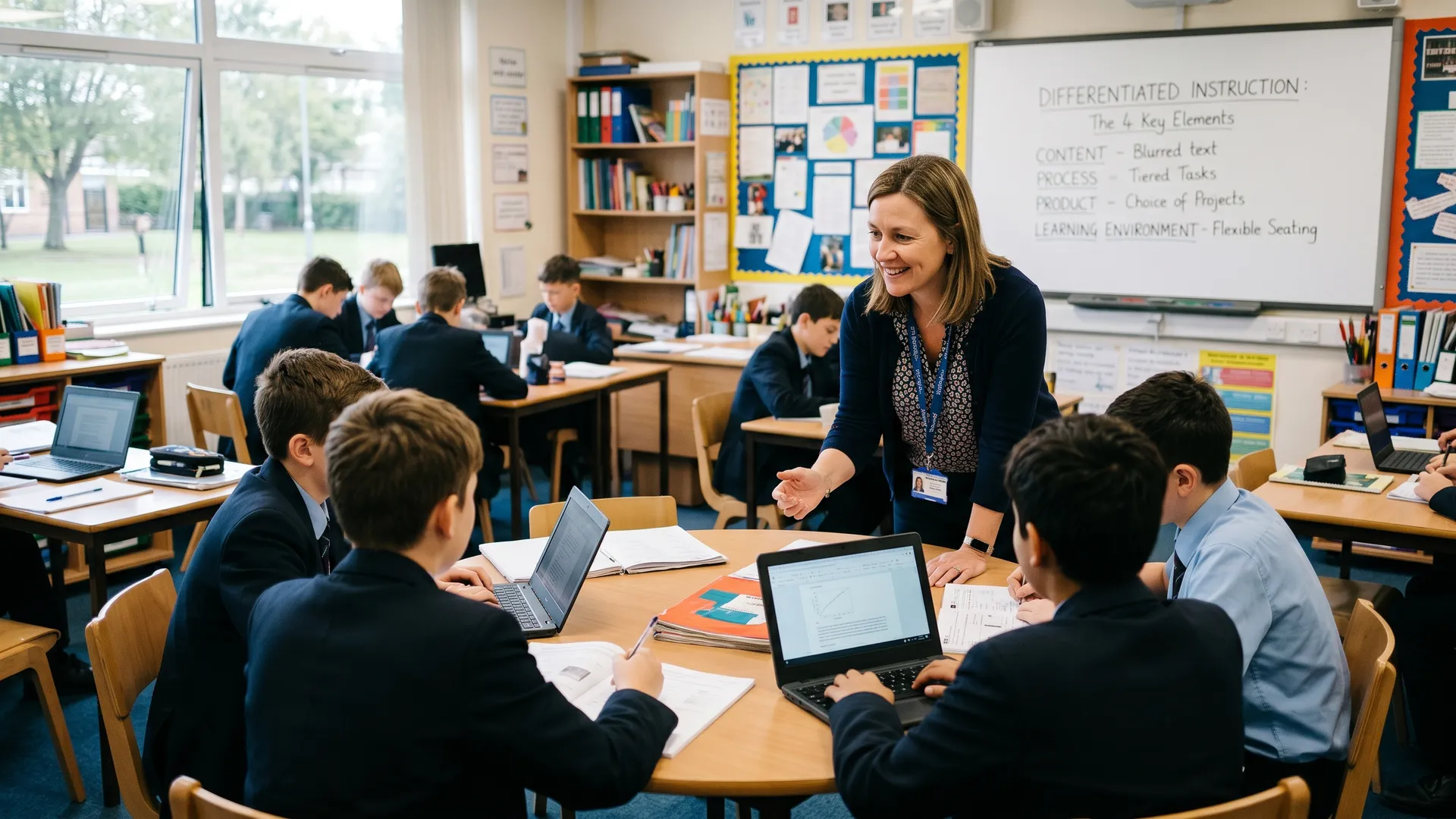
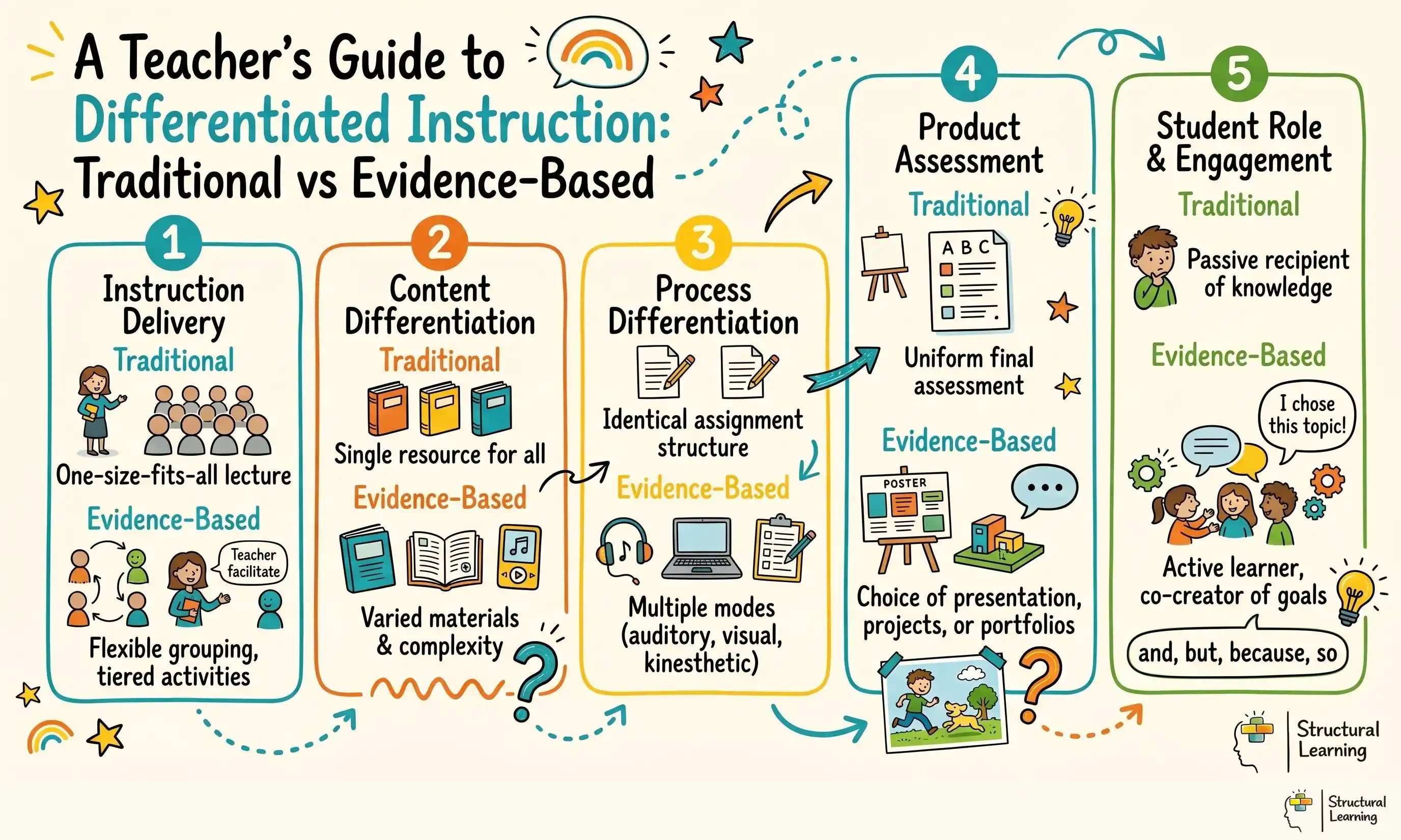
Differentiated instruction is a model for effective teaching. It involves providing different ways to learn content, process ideas, and create products. According to educational expert Carol Ann Tomlinson (2014), educators can differentiate instruction through four specific classroom elements. These elements are content, process, product, and the environment. By carefully adjusting these four areas, teachers ensure that the individual needs of each learner are met with precision and care.
Differentiating content involves modifying what learners learn and how they access the required information. This does not mean removing rigour from the curriculum. For example, a middle school history teacher might provide tiered reading texts on the Industrial Revolution. One group reads a primary source document, while another reads a summary adapted to a lower Lexile level. Both texts cover the exact same standards but match the individual learner readiness level.
Differentiating process changes how learners learn and make sense of the new material. In a primary classroom, a teacher might use small groups to create interactive maths stations. One station features teacher-led guided practice, another uses physical manipulatives, and a third offers independent technology-based review. This allows the teacher to address learner needs exactly where they are, providing immediate corrective feedback.
Differentiating product gives learners specific choices in how they demonstrate their mastery of a topic. A secondary literature teacher might offer a choice board for an end-of-unit assessment. Learners could write an analytical essay, record a podcast analysis of a character, or map out a detailed visual storyboard.
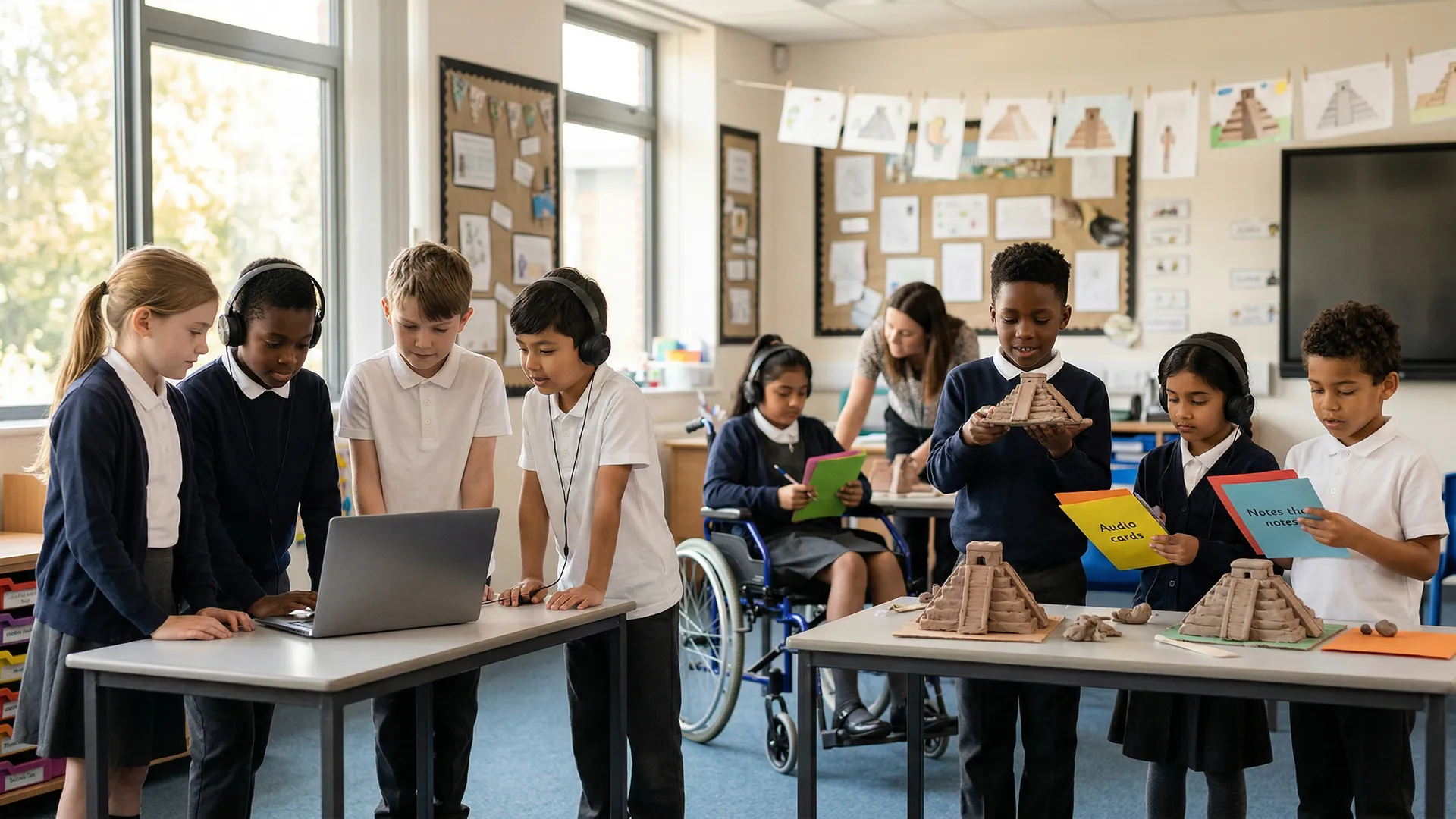
Finally, differentiating the environment involves changing the physical or psychological space. Creating designated quiet workspaces with noise-cancelling headphones supports neurodiverse learners and adheres directly to Section 504 plan accommodations. Altering the physical layout is often the quickest way to support behavioural and academic success.
| Examples of Differentiation ✓ | Non-Examples of Differentiation ✗ |
|---|---|
| Varying the reading scaffolds for a text while keeping the analytical standard identical. | Assigning completely different learning objectives and standards to different groups. |
| Using flexible, temporary groupings that change weekly based on formative exit tickets. | Placing learners into permanent high, middle, and low groups for the entire term. |
| Offering a choice board where all tasks require the same level of critical thinking. | Letting struggling learners do simple colouring tasks while others write analytical paragraphs. |
| Providing guided notes and graphic organisers as optional tools for any learner. | Creating individual lesson plans for every single learner in the classroom. |
Classroom Application (What the teacher does / what learners produce):
The cognitive science of learning strongly supports adapting instruction to match learner capacity. Lev Vygotsky (1978) introduced the concept of the Zone of Proximal Development, highlighting that learning occurs best when tasks are just beyond a learner's current independent ability. Differentiated instruction allows teachers to pinpoint this exact zone for every individual learner in the room, maximising engagement and inclusion.
John Sweller (1988) used Cognitive Load Theory to show that working memory is very limited. It typically holds only about four chunks of information at once (Cowan, 2001). When educators present complex material without scaffolding, they risk overwhelming this working memory. By breaking down complex tasks and providing varied processing pathways, teachers manage cognitive load effectively. Reducing extraneous cognitive load ensures that mental energy is spent on actual learning rather than decoding confusing instructions (Kirschner, Sweller & Clark, 2006).
Many educators feel immense pressure from rigid district pacing guides and high-stakes state testing. However, differentiated instruction does not mean abandoning the required curriculum. Instead, it provides a structured, equitable way to ensure all learners actually reach those high standards. By incorporating low-prep strategies, teachers can avoid burnout while still providing high-quality Tier 1 core instruction.
Classroom Application (What the teacher does / what learners produce):
Applying these educational theories requires practical, repeatable routines that do not require hours of extra planning. The primary goal is to design learning experiences that naturally adapt to the learning that learners do every day. Here are three core strategies for everyday use in any K-12 setting.
Formative assessments are the absolute engine of differentiated instruction. Teachers simply cannot adjust their teaching without accurate, real-time data on learner needs. Exit tickets are a powerful, low-prep way to gather this essential information at the very end of a lesson (Wiliam, 2011).
For example, a primary teacher could end a fractions lesson with a quick task. Learners might solve one short word problem on a sticky note. The teacher quickly sorts these notes into three distinct piles: mastered, partial understanding, and needs reteaching. The very next day, the teacher uses these piles to form targeted small groups. The learners who mastered the concept quickly move on to complex extension tasks, while the others receive immediate, direct instruction.
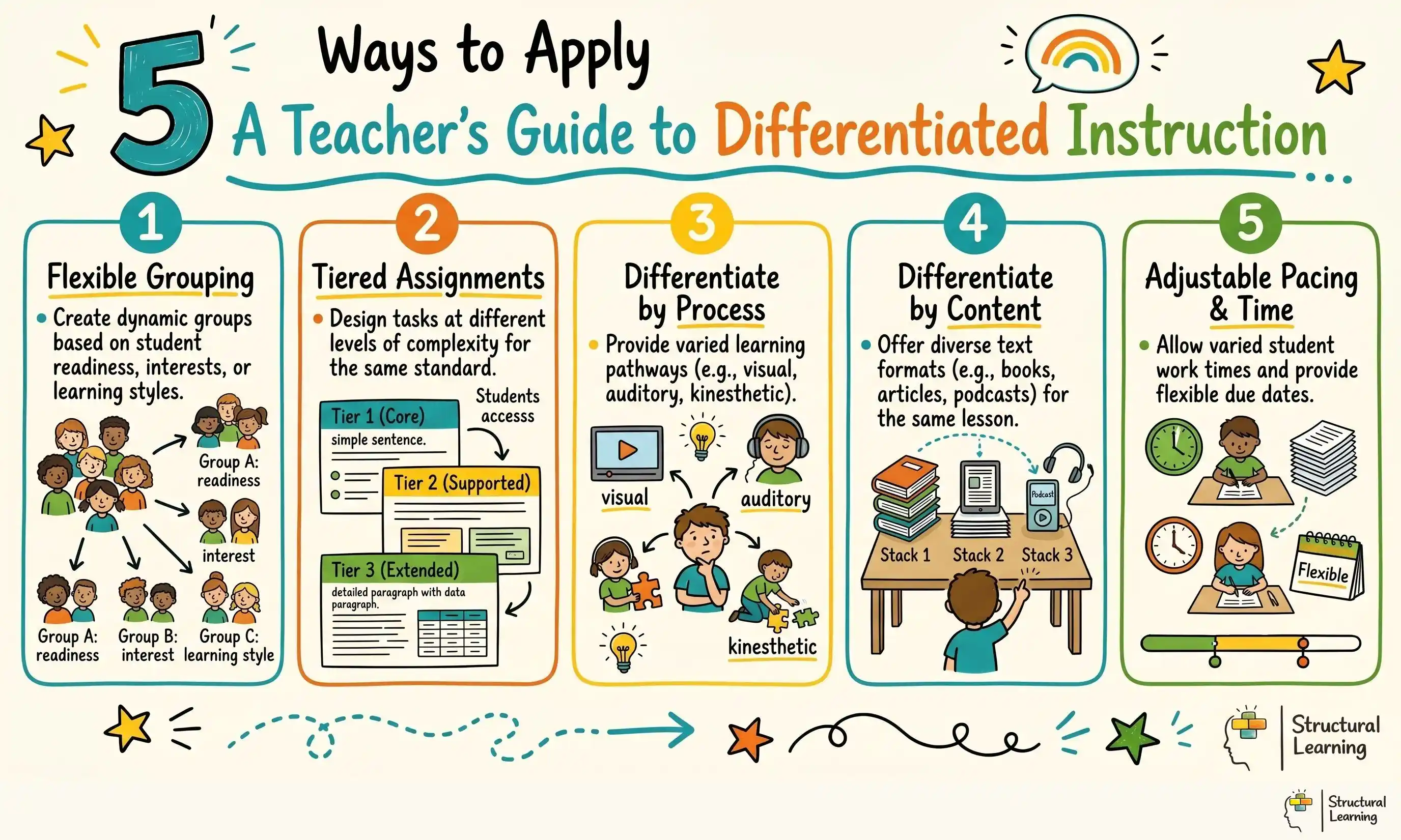
Static ability groups often lead to stigmatisation, low self-esteem, and a fixed mindset among learners (Hattie, 2009). Flexible grouping allows learners to move seamlessly between different peer groups based on the specific academic skill being taught that day. Groups might be based on academic readiness, shared personal interests, or complementary peer strengths.
In a middle school science class, you can group learners heterogeneously for laboratory experiments. This encourages peer modelling and collaborative discussion. The following day, you might use homogeneous flexible grouping to review specific data graphing skills. This ensures that the individual needs of learners dictate their grouping, rather than a permanent academic label. This matches Response to Intervention (RTI) models perfectly. It provides flexible Tier 2 support directly within the main classroom (Fuchs et al., 2010).
Tiered activities allow all learners to focus on the exact same essential understanding but at varying levels of complexity (Tomlinson, 2014). This strategy is absolutely important for mixed-ability classrooms where reading and readiness levels can span several grade equivalents. Teachers design learning tasks that provide multiple, respectful entry points to the same concept.
A secondary history teacher might present a lesson on historical sources. Tier 1 learners might sequence major historical events using a provided timeline graphic organiser. Tier 2 learners might compare and contrast the perspectives of different historical figures using a Venn diagram. Tier 3 learners might analyse a complex historical text to argue whether rapid industrialisation was ultimately beneficial to society. All learners discuss the same overarching historical theme, but the cognitive demand perfectly matches their current readiness.
Classroom Application (What the teacher does / what learners produce):
Despite its immense popularity in teacher preparation programmes, several pervasive myths surround this pedagogical approach. A major misconception involves the concept of catering to learning styles. For decades, teachers were told to design lessons explicitly for visual, auditory, and kinaesthetic preferences. Research consistently shows that matching teaching to learning styles does not improve learner results (Pashler et al., 2008; Willingham, 2009).
Relying heavily on learning styles is an inefficient use of valuable planning time. Instead of focusing on debunked learning styles, teachers should focus on activating prior knowledge and managing working memory capacity. The persistent myth of learning styles distracts from truly evidence-based teaching practices. Furthermore, attempting to audit the entire classroom for learning styles creates an impossible logistical burden for educators.
Another incredibly common myth is that differentiation requires writing a completely individualised lesson plan for every single learner in the room. This is a guaranteed recipe for severe teacher burnout and exhaustion. Effective differentiation involves planning one strong core lesson with strategically built-in scaffolds and extensions. It is about creating a flexible structure, not managing a chaotic set of independent study programmes.
Finally, some teachers believe that differentiating content inherently means lowering expectations for learners who struggle. The goal is to give the support needed so all learners reach the same high standards (Tomlinson et al., 2003). Accommodations provided through an active IEP or Section 504 plan are essential tools for access, not excuses for lowered academic rigour.
Classroom Application (What the teacher does / what learners produce):
Starting with this approach can feel overwhelming for a new teacher. Educators should begin small and gradually build their daily repertoire of instructional strategies. The best approach is to integrate differentiation into existing district MTSS and RTI structures to ensure compliance and effectiveness (Fuchs & Fuchs, 2006).
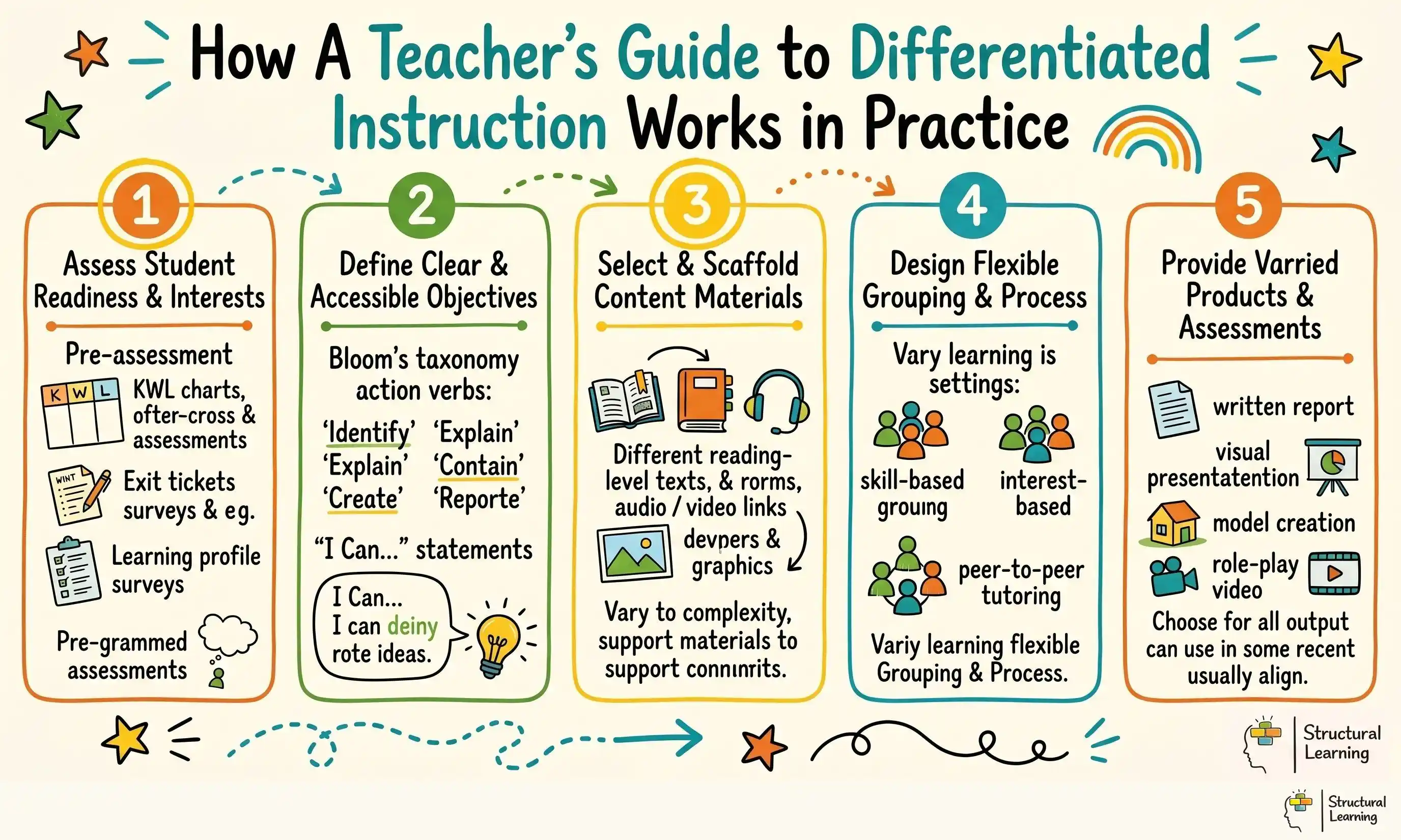
First, review your upcoming instructional unit and clearly identify the non-negotiable standards. Determine exactly what the learners must know and be able to do by the end of the week. Next, look closely at recent benchmark assessment data. This helps predict the needs learners will bring to the new unit.
Choose just one single element to differentiate. If you decide to differentiate process, plan two different ways learners can interact with the new information during independent practice. For example, learners needing writing support might use a graphic organiser with sentence stems. Other learners might use a blank outline. You must carefully address the needs learners exhibit during initial guided practice.
When checking the needs listed in learners' IEPs, make sure to include these required accommodations in your main lesson plan. If a specific learner requires guided notes, provide them to anyone in the room who might benefit. This universal design approach drastically reduces the need for reactive, on-the-fly differentiation during the lesson. Creating responsive learning environments requires proactive, thoughtful planning.
By closely monitoring the learning learners produce, educators can adjust their pacing dynamically. The ultimate goal is to build an environment where accommodating learning needs is simply the standard operating procedure.
Try this tomorrow: design a simple, three-question exit ticket to assess understanding at the end of a lesson. Piles of sticky notes can quickly be sorted into "got it" and "needs help" categories. Use these piles to form two fluid groups for targeted practice the following morning. You will notice immediate improvements in comprehension and engagement without spending hours preparing extra materials.
Classroom Application (What the teacher does / what learners produce):
Differentiation looks unique in every single content area. The underlying pedagogical principles remain exactly the same, but the execution adapts to the specific cognitive demands of the academic discipline. Teachers must use the unique structures of their subject to build highly effective learning environments.
In primary maths, differentiation often centres on the critical progression from concrete to abstract mathematical thinking. A teacher introducing complex decimals might have one group working directly with physical base-ten blocks to physically build the numbers. Another group might draw visual representations on dry-erase whiteboards, while a third group solves abstract, multi-step word problems. All three groups are exploring the exact same mathematical concept, but the level of abstraction varies appropriately.
In secondary English classes, teachers frequently differentiate content through careful text selection. When studying a central literary theme like social justice, the teacher might select three different novels at varying Lexile reading levels. Learners participate in structured literature circles based on their chosen text. Whole-class discussions then focus on the main theme. This allows all learners to contribute meaningfully, no matter which book they read. This respects individual learner choices while maintaining high academic discourse.
In a science lab, differentiating the product lets learners share their findings in ways that show off their unique strengths. After an experiment, learners might submit a written lab report. Alternatively, they could create a video presentation or digital infographic. The grading rubric stays exactly the same across all formats. It focuses on scientific accuracy and data analysis, not the product's format.
Classroom Application (What the teacher does / what learners produce):
Focus on low-prep strategies like quick exit tickets and fluid flexible grouping. Do not attempt to differentiate every single lesson component every single day. Build a strong, reusable library of helpful scaffolds, such as graphic organisers and sentence starters, that learners can access independently as needed.
Absolutely not. This approach is the specific vehicle used to help all learners reach the exact same rigorous standards. You are simply changing the path they take, not the final academic destination. By providing highly targeted scaffolds, you ensure struggling learners can still confidently access grade-level content.
Differentiated instruction serves as the absolute foundation of Tier 1 core instruction within any MTSS framework (Fuchs & Fuchs, 2006). Effective differentiation in daily lessons reduces the number of learners who later need intensive Tier 2 or Tier 3 interventions. It is a highly proactive approach to addressing learning gaps early before they compound over time.
Teachers must carefully design academic choices so that all available options require the exact same level of deep critical thinking. If you offer a classroom choice board, ensure the grading rubric demands rigorous academic analysis across all formats. You can also give learners specific tasks based on their formative assessment data. This keeps the work at the right level of challenge.
An IEP provides strict legal requirements for classroom accommodations and modifications. Differentiating learning environments and instructional processes allows you to weave these legal requirements into the daily lesson flow. Often, supports specifically designed for learners with an IEP, such as visual daily schedules or chunked directions, heavily benefit the entire class.
Pick one lesson this week and design a three-question exit ticket to check understanding. Then, use these results to form two flexible groups for practice the next day.
Classroom Application (What the teacher does / what learners produce):