IB CAS Project Ideas: Meaningful Examples and OutcomesThe Ultimate Guide to IB CAS Project Ideas: Meaningful Examples for UK Schools: practical strategies for teachers

Updated on  

June 5, 2026

IB CAS Project Ideas: Meaningful Examples and Outcomes

|

June 3, 2026

Find impactful IB CAS project ideas and examples. Learn how to map a CAS project to the seven learning outcomes and use the IPARD framework.

The Ultimate Guide to IB CAS Project Ideas: Meaningful Examples for UK Schools shows how Diploma Programme learners can design a CAS project that meets IB requirements. It also helps them avoid treating Creativity, Activity, Service as a list of impressive extras. A CAS project is a learner-initiated Creativity, Activity, Service experience within the DP core.

Key Takeaways

  1. Focus on Local, Sustainable Impact: Guide Year 12 learners to design projects that address immediate school or community needs, such as auditing lunch waste with the site team and training Year 7s, rather than defaulting to expensive, generic overseas trips.
  2. Enforce the IPARD Framework: Structure the entire CAS process systematically by requiring learners to clearly document their Investigation, Preparation, Action, Reflection, and Demonstration stages, ensuring projects move well beyond one-off events like a single bake sale.
  3. Mandate Authentic Collaboration: Ensure every CAS project you approve requires genuine, sustained teamwork, either between Diploma Programme learners or through meaningful, active partnerships with the wider community.
  4. Shift to Metacognitive Reflection: Prompt learners to replace basic, descriptive activity logs with continuous, deep reflections that track their interpersonal growth, perseverance, and adaptability throughout Kolb's experiential learning cycle.
  5. Enforce the One-Month Minimum: Validate during the planning phase that each learner's project will span at least one month from the initial preparation stages to final completion, preventing superficial engagement.
  6. Pre-Map the 7 Learning Outcomes: Require learners to explicitly map their proposed activities to the seven IB CAS learning outcomes *before* they begin any practical work to guarantee purposeful action and alignment with IB requirements.
  7. Implement Rigorous Demonstrations: Challenge learners to formally defend their project's impact and articulate their learning journey through a demonstration, such as a short viva, rather than simply padding a portfolio with unstructured evidence.

It may use one, two or all three strands. It must include real, purposeful activity, planning, reflection and evidence. CAS remains a completion requirement rather than a source of diploma points (International Baccalaureate Organisation, 2026).

For a UK school, that distinction matters. A Year 12 group might audit lunch waste with the site team, prototype a low-cost composting routine, teach Year 7 volunteers how to record food-waste data, and defend the project impact in a short viva rather than padding a portfolio with generic CAS reflections. Research on CAS suggests learners and coordinators value challenge, perseverance and interpersonal growth, but the evidence base is still thinner than many guides admit (Hayden et al., 2017).

Key Takeaways

  • Focus on local community action rather than expensive overseas trips to ensure sustainable and authentic engagement.
  • Ensure every CAS project lasts a minimum of one month from the initial planning stages to final completion.
  • Require genuine collaborative effort between learners for every CAS experience you approve.
  • Structure the entire process systematically using the IPARD stages (Investigation, Preparation, Action, Reflection, Demonstration).
  • Map all learner activities explicitly to the 7 CAS learning outcomes before they begin their practical work.
  • Replace descriptive activity logs with continuous metacognitive reflections that track personal growth and adaptation.

IB CAS Project Definition

An IB CAS project is a sustained set of learner-led experiences completed with others. It must address at least one strand of creativity, activity, or service. The International Baccalaureate asks learners to move beyond traditional academic study and take part in experiential learning, which means learning through direct experience.

Dewey (1938) showed that deep learning happens through direct interaction with the environment and social problems. A standard CAS project formalises this by lasting at least one month. It also requires collaboration among learners or with members of the wider community.

A formal CAS project is very different from a single, standard experience. Learners cannot just attend one beach cleanup or bake sale and say they have met the requirements.

They must investigate a clear issue, plan a targeted response, carry out the action, and show their learning to an audience. Kolb (1984) showed how active experimentation, followed by reflective observation, leads to concrete learning. The CAS project gives learners the clear structure needed to support this experiential learning cycle.

Teachers play a central role in guiding learners toward viable CAS project ideas that match their actual skills and resources. You must help them interpret the requirements without taking over the leadership of the initiative. The goal is to support a process where learners take complete ownership of their CAS experience from inception to conclusion.

In practice, the teacher provides a local environmental mapping tool. The learners produce a comprehensive audit of school energy waste and present their findings to the governing board.

Why an Authentic CAS Project Matters for Teachers

When you guide learners towards real CAS project ideas, a diploma requirement can become real character growth. Teachers often see learners choose shallow tasks just to complete their hours. Strong CAS projects move them beyond basic compliance and into real challenges that build resilience.

Zimmerman (2002) explains that self-regulated learning works in cycles of planning, action, and self-reflection. A well-designed CAS project gives learners the structure they need for this metacognitive development, which means learning to think about and manage their own learning.

When schools promote authentic project ideas rooted in the local community, they build civic responsibility and practical life skills. learners learn to manage complex group dynamics, handle long-term project planning, and solve unstructured problems without direct teacher intervention. This process removes the safety net of the traditional classroom and forces young adults to face the consequences of poor planning or poor communication. These moments of productive struggle are where the most significant personal growth occurs.

A rigorous approach to the creativity, activity, and service requirement can also support academic performance (Hattie, 2009). Learners who manage a demanding CAS project alongside their diploma studies build stronger time management and executive functioning skills. When you expect high-quality CAS project ideas, you prepare learners for the less structured demands of university study and professional employment.

In the classroom, the teacher provides a basic project management spreadsheet. The learners produce a weekly milestones log that tracks their community outreach progress alongside their academic deadlines.

Facilitating CAS Projects in the Classroom

Teachers must act as facilitators rather than directors when managing a CAS project. You guide learners to generate viable ideas, ensure they complete robust risk assessments, and check that they maintain momentum over the required month.

To start this process, the teacher presents three local case studies of social enterprises. The learners produce a mind map connecting these enterprises to potential local interventions.

Here are three concrete strategies showing how to support learners across different strands.

Strategy 1: Study Skills Workshops

The teacher asks Year 12 learners to find common academic struggles among Year 7 learners moving into secondary school. You give them access to anonymised baseline assessment data so they can target their support well. You also give them a basic lesson plan template so they know how to structure their time.

The learners design and deliver a six-week study skills programme for the younger learners. They create interactive resources and teach specific revision techniques. This initiative acts as an excellent creativity and service project.

For example, learners produce a series of bespoke revision flashcards and run weekly after-school coaching sessions in the library. They gather written feedback from the younger learners to refine their teaching methods each week. They log these adaptations as part of their continuous reflection.

Strategy 2: Inclusive Sports Tournament

The teacher connects the IB cohort with a local primary school that lacks specialist physical education provision. You help the learners complete the necessary safeguarding documentation and secure access to the school sports hall. You then step back and require the learners to manage all communication with the primary school staff.

The learners organise a primary sports day with accessible games such as boccia or goalball. This fulfills the activity and service requirement well because it combines physical effort with a clear community benefit. They plan the fixtures, officiate the matches, and make sure every child takes part safely.

In practice, learners run the event and launch a campaign at the same time. They raise money for adaptive sports equipment for the visiting school. They also use the tournament to build awareness of disability inclusion in sport. This turns a simple physical activity into a wider service project.

Strategy 3: Local Entrepreneur Podcast

The teacher introduces learners to basic audio recording equipment and explains the legal requirements for interview consent forms. You set a strict deadline for the delivery of a pilot episode and require the learners to pitch their concept to you before they begin recording.

The learners launch a school-wide podcast interviewing local charity leaders and business owners. This CAS experience requires them to research global issues through a local lens. They must secure guests, schedule recording times, and edit the final audio tracks themselves.

For example, learners write all the interview scripts themselves. They record the audio with school microphones and edit the final tracks using free software. They then run a focused marketing campaign to share the podcast across the local community. This shows strong creativity and calls for real technical problem-solving.

The IPARD Framework: Structuring Your CAS Project

The IPARD framework is the mandatory structure for any successful CAS project. Teachers must enforce this framework to prevent learners from rushing into action without adequate planning. Use it as a starting point for professional discussion: identify the learner's current need, record evidence from more than one lesson, and agree the next classroom adjustment with the SENCO or family.

At the start of the year, the teacher distributes a blank IPARD template. The learners produce a comprehensive project proposal that clearly defines their investigation methods and planned actions.

Investigation

During the investigation phase, challenge learners to identify a genuine, documented need within the school or local community. They must research the root causes of the issue before proposing a solution. A learner cannot simply decide to run a bake sale. They must investigate what specific charity needs funding, exactly what that funding will purchase, and whether a bake sale is the most effective method to raise money. You should require a written investigation brief before allowing them to proceed.

Preparation

Preparation requires learners to map their proposed actions directly against the 7 CAS learning outcomes. They draft detailed timelines, allocate specific roles to team members, and complete mandatory risk assessments. If they are planning a CAS event, they must secure venues, write budgets, and design marketing materials. As a teacher, you review these documents for feasibility and safety but you do not solve their logistical problems for them.

Action

The action phase is the actual execution of the CAS project. learners implement their plan over a minimum of one month. A strong example is a learner-led environmental audit. They assess school waste output, implement an active campus recycling programme, and physically monitor the results over eight weeks. You observe their execution and intervene only if there is a safeguarding or safety concern.

Reflection

Reflection must be continuous throughout the entire IPARD process. Guide learners to use structured metacognitive prompts rather than writing chronological diaries. Ask them to describe a specific moment of failure and explain exactly how they adapted their approach. This turns descriptive logs into analytical thinking. If an event fails due to poor attendance, the reflection should focus on their communication breakdown and their plans for future improvement.

Demonstration

In the final stage, learners present their outcomes and personal growth to a wider audience. They might host an assembly, write a comprehensive article for the school newsletter, or present a digital portfolio to their CAS coordinator. This demonstration requires them to articulate their learning experience clearly and take public ownership of their project results.

How The Ultimate Guide to IB CAS Project Ideas Works in Practice infographic for teachers
How The Ultimate Guide to IB CAS Project Ideas Works in Practice

Common Misconceptions About the Programme

Many teachers and learners misunderstand what makes a CAS project valid. Correcting these misconceptions early helps prevent wasted effort. Use it as a starting point for professional discussion: identify the learner's current need, record evidence from more than one lesson, and agree the next classroom adjustment with the SENCO or family.

When reviewing ideas, the teacher challenges a proposal for an expensive overseas trip. The learners then create an alternative action plan. It focuses on setting up a sustainable recycling initiative in their own postcode.

A primary misconception is that a successful project requires expensive overseas travel. Expensive voluntourism trips are neither required nor recommended by the IB. The most valuable CAS project ideas focus on the immediate local community where learners can sustain long-term engagement and witness the actual impact of their work. A local tutoring programme is far more beneficial than a two-week trip to build a wall abroad.

Another common error is believing that handing over cash constitutes service. Organising a fashion show or a sponsored silence to raise money is an acceptable starting point. However, simply donating the proceeds does not fulfil the deeper learning outcomes. learners must engage with the charity, understand how the funds will be used, and actively raise awareness about the underlying cause.

learners frequently believe that reflection only happens at the very end of the process. If learners only write a descriptive log at the conclusion of their CAS project, they miss all metacognitive benefits. Reflection must happen during the preparation and action phases to allow learners to adjust their failing strategies in real time.

Finally, learners often assume a single project must cover all three strands. A CAS experience only needs to address a single strand to be valid. While many excellent projects combine two strands naturally, forcing a project to cover creativity, activity, and service simultaneously often results in a disjointed experience. Depth of engagement is always more important than breadth of categories.

Practical Implementation Guide

These projects need clear and regular oversight. The guide below gives teachers a practical step-by-step process for managing a whole cohort. Use it as a starting point for professional discussion: identify the learner's current need, record evidence from more than one lesson, and agree the next classroom adjustment with the SENCO or family.

To maintain momentum, the teacher creates a shared digital dashboard for timeline tracking. The learners produce bi-weekly status reports that flag potential risks to their deadlines.

First, establish a firm timeline for the academic year. Require all learners to submit their initial CAS project ideas by the end of October. Use a standardised digital form that forces them to articulate their chosen IPARD stages clearly. Reject any proposal that lacks a clear objective or fails to demonstrate collaboration.

Second, schedule mandatory small-group check-ins every three weeks. Do not wait for learners to come to you with problems. During these meetings, ask pointed questions about their progress. If a group is running an event, demand to see their attendance logs and their upcoming promotional materials. Hold them strictly accountable to the timelines they designed in their preparation phase.

Third, teach explicit reflection skills. Provide them with specific analytical prompts. Instead of asking what they did, ask them to identify the most significant communication breakdown their team experienced and how they resolved it. Require them to link these reflections explicitly to the 7 CAS learning outcomes.

Fourth, curate a bank of previous successful CAS projects to inspire the current cohort. Keep records of exceptional service initiatives or highly successful local community events. When learners struggle to generate their own ideas, present these historical examples to demonstrate the required standard of execution.

Finally, organise a formal showcase event at the end of the year. Require every learner group to set up a display board explaining their CAS experience. Invite younger learners, parents, and community partners to attend. This forces the learners to take the demonstration phase of the IPARD framework seriously and provides closure to their experiential learning experience.

Linking Your Project to the 7 CAS Learning Outcomes

learners must provide evidence that they have met the 7 CAS learning outcomes across their entire portfolio. A single CAS project does not need to hit all seven, but it should explicitly target three or four.

During the preparation phase, the teacher supplies a mapping rubric. The learners produce a cross-referenced matrix linking their proposed actions directly to at least three specific outcomes.

Outcome one requires learners to identify their own strengths and develop areas for growth. A learner managing a creativity project might realise they are excellent at graphic design but struggle with public speaking. Their reflections must document this self-awareness and detail how they pushed themselves to present their designs to the school leadership team.

Outcome two asks learners to demonstrate that challenges have been undertaken, developing new skills in the process. Taking on a new role, such as the logistics manager for a large service event, provides perfect evidence for this outcome. The learner must reflect on the specific organisational skills they acquired through trial and error.

Outcome three asks learners to show how they start and plan a CAS experience. The preparation phase of the IPARD framework meets this outcome directly. To evaluate a learner's CAS project, look at their first planning documents, risk assessments, and budgets. These show whether the learner has taken independent initiative.

Outcome four requires learners to show commitment to and perseverance in CAS experiences. This is why a CAS project must last a minimum of one month. Sustaining an effort over weeks or months inevitably leads to motivational dips and logistical failures. Overcoming these hurdles proves perseverance.

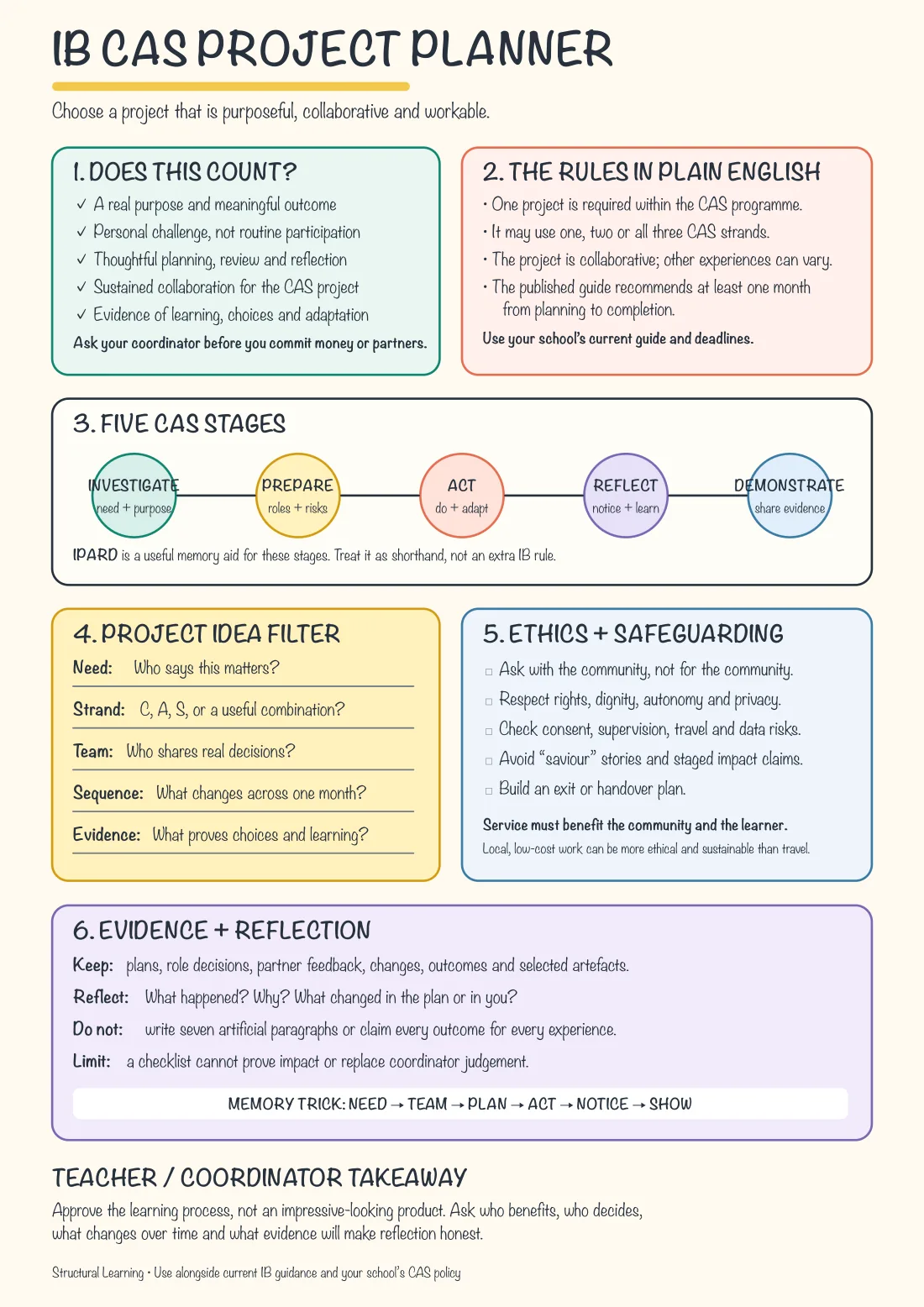
The Ultimate Guide to IB CAS Project Ideas: Meaningful Examples for UK Schools — visual explainer sketchnote
An at-a-glance visual summary of The Ultimate Guide to IB CAS Project Ideas: Meaningful Examples for UK Schools.

Outcome five focuses on demonstrating the skills to recognise the benefits of working collaboratively (Vygotsky, 1978). A solo endeavour cannot be a CAS project. learners must provide evidence of compromise, negotiation, and shared responsibility. They should reflect on how they managed team members who failed to complete their assigned tasks.

Outcome six challenges learners to demonstrate engagement with issues of global significance. The best CAS project ideas take a massive global issue and tackle it at a highly local level. learners might address global climate change by launching a micro-level energy reduction campaign within their own school buildings.

Outcome seven asks learners to notice and think about the ethics of choices and actions. If they run a service project with a vulnerable group, they must reflect on safeguarding, privacy and the ethics of their support. They also need to ask whether their help is truly enabling or accidentally patronising.

CAS Across Subjects

Linking CAS project ideas to specific academic subjects helps learners see how their classroom learning applies in the real world. Use it as a starting point for professional discussion: identify the learner's current need, record evidence from more than one lesson, and agree the next classroom adjustment with the SENCO or family.

To embed this in the curriculum, the teacher allocates ten minutes of subject time for real-world application brainstorming. The learners produce a proposal linking their syllabus content to a tangible community need.

Projects Rooted in Mathematics

Learners who excel in mathematics can tutor primary school children who are falling behind national standards. The teacher links with the local primary school and helps the IB learners understand basic pedagogical principles. The learners design original mathematical games, run the tutoring sessions, and track each tutee's progress with numbers over two months. This creates a strong, academically grounded service framework, while asking IB learners to reflect on how hard it can be to explain abstract concepts to younger children.

Projects Rooted in English and Literature

English learners can organise a creative writing competition for lower years. They could also set up a reading mentoring scheme for reluctant readers. The teacher gives access to the school library and helps find suitable participants.

The learners act as mentors, write the competition guidelines, and organise a final prize-giving ceremony. This fulfills the creativity and service requirements while promoting literacy across the school. The learners also produce an anthology of the winning entries, managing the full editorial and publication process.

Projects Rooted in the Sciences

Science learners can design and build an interactive community garden to raise awareness of local biodiversity issues. The biology teacher helps them understand local soil ecology and safe tool use. The learners clear the land, build raised beds, and plant native species.

They monitor soil pH and track plant growth over the spring term. This brings academic ecological knowledge together with strenuous physical labour. It creates a strong activity and service initiative that benefits the immediate environment.

5 Ways to Apply The Ultimate Guide to IB CAS Project Ideas infographic for teachers
5 Ways to Apply The Ultimate Guide to IB CAS Project Ideas

Common Questions About CAS

To make expectations clear, the teacher brings together an FAQ document based on previous cohorts. Learners then sign a contract to show they understand the minimum requirements and time commitments.

What is an IB CAS Project?

An IB CAS project is mandatory, collaborative, and sustained. It is a series of learner-led experiences that address at least one strand: creativity, activity, or service. It must use the IPARD framework and require real problem-solving outside the academic curriculum.

How long does a CAS project have to be?

A project must last for a minimum of one month from the initial investigation stage to the final demonstration. This extended duration ensures learners have sufficient time to encounter logistical challenges, reflect on their failures, and adapt their leadership approach.

Can a CAS project be just one strand?

Yes. A CAS experience only needs to address a single strand to meet the formal requirements. However, the most effective CAS project ideas naturally combine strands, such as an activity and service project where learners run a sports camp for disadvantaged youth.

How do learners write metacognitive CAS reflections?

learners must move entirely beyond simply listing what they did on a given day. They need to analyse exactly why a specific strategy failed, how they managed their emotions during a difficult team interaction, and what specific leadership skills they intend to change for the next session.

Are overseas trips necessary for a successful project?

No. The IB clearly encourages learners to work deeply with their own local community. A well-planned local project often gives more chances for sustained teamwork and real problem-solving than a short, highly supervised international trip.

What counts as CAS creativity?

To demonstrate CAS creativity, learners need original thinking and a clear product or performance. This could mean writing and directing a play, coding a new application for a local charity, or designing a creative marketing campaign to raise awareness for a specific cause.

Plan tomorrow's lesson with a ten-minute brainstorming task. Ask learners to link one global issue to one possible local action in the community.

Limitations and Critiques

The main limitation is evidential. CAS is widely valued by coordinators and alumni, and the large IB study by Hayden, Hemmens, McIntosh, Sandoval-Hernandez and Thompson found learners often saw it as challenging but worthwhile. Yet much of the evidence is self-report, cross-sectional or alumni recall, so claims about long-term change need caution (Hayden et al., 2017).

A second criticism is about service itself. Mitchell argues that traditional service-learning can leave power relations unchanged unless learners examine privilege, reciprocity and who defines the community need (Mitchell, 2008). In UK schools, this matters when affluent learners treat marginalised communities as CAS project material. It is a problem if the local community has limited control over the work.

Reflection can also be weak as evidence. Macfarlane and Gourlay warn that assessed reflection can become a performance of the approved self, not proof of authentic thinking (Macfarlane & Gourlay, 2009). Generative AI makes this risk clearer. Written CAS reflections now need oral defence, supervisor questioning and local evidence that cannot be produced from a prompt (UNESCO, 2024).

Finally, CAS can assume time, transport and family flexibility that not every learner has. Maire and Windle show how the IB Diploma can reproduce advantage when it operates inside stratified school systems (Maire & Windle, 2021). CAS still has enduring value when schools treat paid work, sibling care and low-cost school community action as valid sites for ethical, sustained learning.

Further Reading: Key Research Papers

These peer-reviewed studies provide the evidence base for the strategies discussed above.

Why Did All the Residents Resign? Key Takeaways From the Junior Physicians' Mass Walkout in South Korea. View study ↗
26 citations

Park et al. (2024)

This study analyses the systemic conflicts behind South Korea’s medical walkout. For teachers, it provides a powerful real-world case study for learners to explore global health policy and civic advocacy, supporting critical thinking in CAS service projects.

Cultivating connectedness and raising educational experiences for international learners in blended learning: reflections from the pandemic era and key takeaways View study ↗

He et al. (2024)

This paper examines how videoconferencing enhances engagement and belonging in blended learning. Teachers can use these insights to design inclusive CAS collaborative projects, helping international learners build peer connections and community engagement through digital mediums.

Who Benefits and under What Conditions from Developmental Education Reform? Key Takeaways from Florida’s Statewide Initiative View study ↗

Mokher et al. (2023)

This research investigates how statewide educational reforms affect diverse learners. It helps teachers understand the conditions required for academic support, guiding them to differentiate instruction and scaffold learner-led CAS mentoring initiatives for younger peers.

Establishing a distance PharmD program: An overview and key takeaways. View study ↗

Rao et al. (2025)

This paper outlines strategies for establishing high-quality remote professional programmes. Teachers can apply these lessons to scaffold remote collaborative CAS projects, helping learners coordinate virtual outreach, digital tutoring, or community service initiatives efficiently.

CANMAT Depression Guidelines: Key Takeaways View study ↗

Unknown (2025)

This guide outlines clinical recommendations for managing and monitoring depression. It informs teachers’ safeguarding practices and pastoral care, enabling them to better support learner mental health and guide sensitive, learner-led CAS projects on wellbeing.

References

Hattie (2009).

Hayden et al. (2017).

Mitchell (2008).

UNESCO (2024).

Vygotsky (1978).

Paul Main, Founder of Structural Learning
About the Author
Paul Main
Founder & Metacognition Researcher

Paul Main is an educator and metacognition researcher who founded Structural Learning in 2002. With a psychology degree from the University of Sunderland and 22+ years helping schools embed thinking skills, he bridges the gap between educational research and classroom practice. Fellow of the RSA and Chartered College of Teaching, with 128+ Google Scholar citations.

More →

Educational Technology

Back to Blog