Updated on
September 24, 2026
Feeling of Knowing: Why Familiarity Misleads Learners
Learn how familiarity can create false confidence, why feeling-of-knowing judgements fail and how retrieval practice reveals what learners really know.


Updated on
September 24, 2026
Learn how familiarity can create false confidence, why feeling-of-knowing judgements fail and how retrieval practice reveals what learners really know.
Ready to introduce metacognition in your classroom but not sure where to begin? Start with three simple questions you can ask your learners during any lesson: "What do you already know about this topic?", "How confident do you feel right now?", and "What's confusing you?" These metacognitive prompts immediately get learners thinking about their thinking, transforming them from passive recipients into active learners who can identify their own knowledge gaps. The beauty of metacognition lies in its simplicity, you don't need special resources or extensive training to begin seeing results. Here's exactly how to weave these powerful techniques into your daily teaching, starting tomorrow.
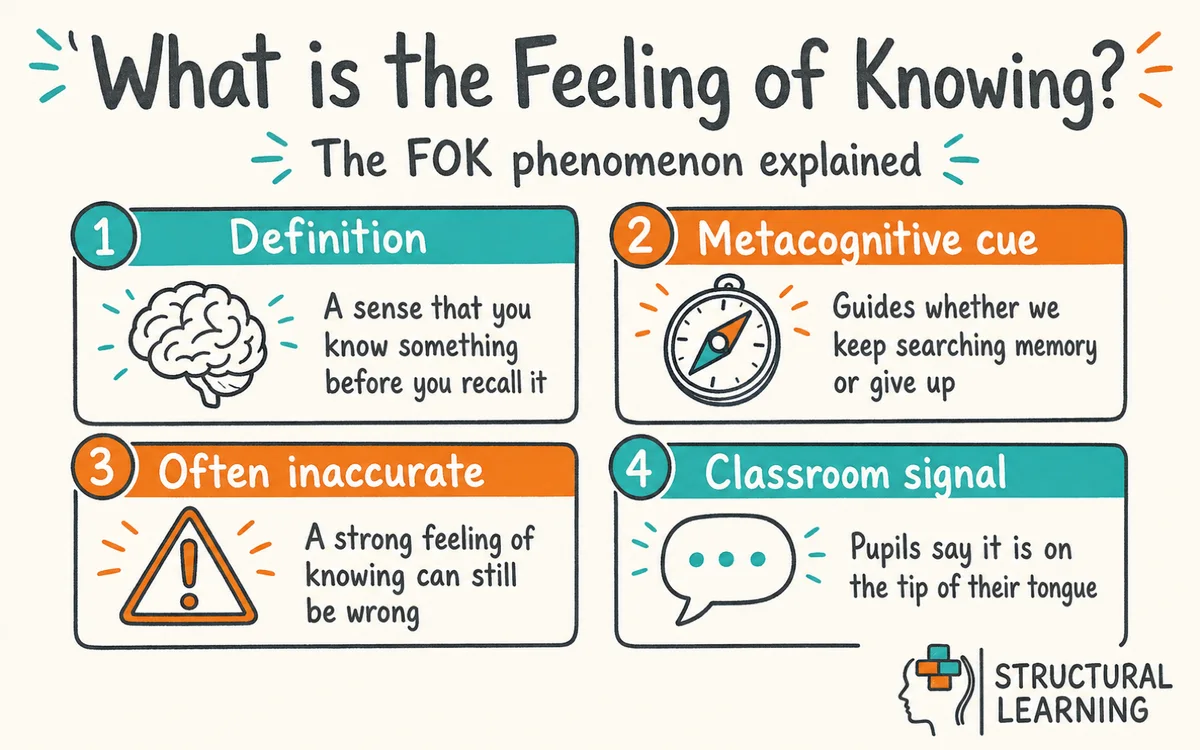
Feeling of knowing is a metacognitive judgement made after failed recall. It happens when a learner predicts whether they would recognise or retrieve the answer later (Hart, 1965; Nelson & Narens, 1990).
A Year 10 learner sits in their mock GCSE biology exam, staring at question 4 about photosynthesis. They know they revised this topic well. They can picture the exact page in their textbook and remember highlighting the key points in yellow.
They also remember feeling confident about it yesterday. But the specific equation will not come to mind. The chloroplast diagram stays blank on their paper.
This frustrating experience is the feeling of knowing (FOK), and it is one of the most common metacognitive illusions plaguing our classrooms. Every teacher has witnessed it: learners who swear they understand the material and nod confidently during lessons. But they cannot remember that knowledge when it matters most.
Learners often confuse familiarity with real understanding, which can harm learning (Kornell & Bjork, 2007). This familiarity error can lead to weak revision choices and overconfidence before tests (Dunlosky & Rawson, 2012; Metcalfe & Finn, 2008). Teachers can use FOK insights to help learners judge their knowledge more accurately (Dunlosky & Rawson, 2012). They can also teach study methods that work better (Rhodes & Tauber, 2011).
Feeling of knowing is when you sense you could recognise or find information with the right hint. This happens even when you cannot access that information right now. You feel the answer hovering just beyond reach, hence the 'tip of the tongue' sensation that gives this phenomenon its colloquial name.
The Hart and Nelson Research
In 1965, Joseph Hart studied feeling-of-knowing (FOK). He asked participants general knowledge questions they could not answer. Next, he asked them to predict recognising the answer in multiple choices. Learners felt confident, yet predictions often missed the mark (Hart, 1965).
In the 1990s, Thomas Nelson built on Hart's work. He developed the theoretical framework that explains why FOK occurs. Nelson's research showed that FOK judgements rely strongly on partial cues and familiarity signals, not actual retrieval strength.
This creates a serious problem in educational contexts. When learners develop stronger conditional knowledge, they learn which situations need careful retrieval checks. They do not just trust their first FOK.
FOK vs Actual Knowledge
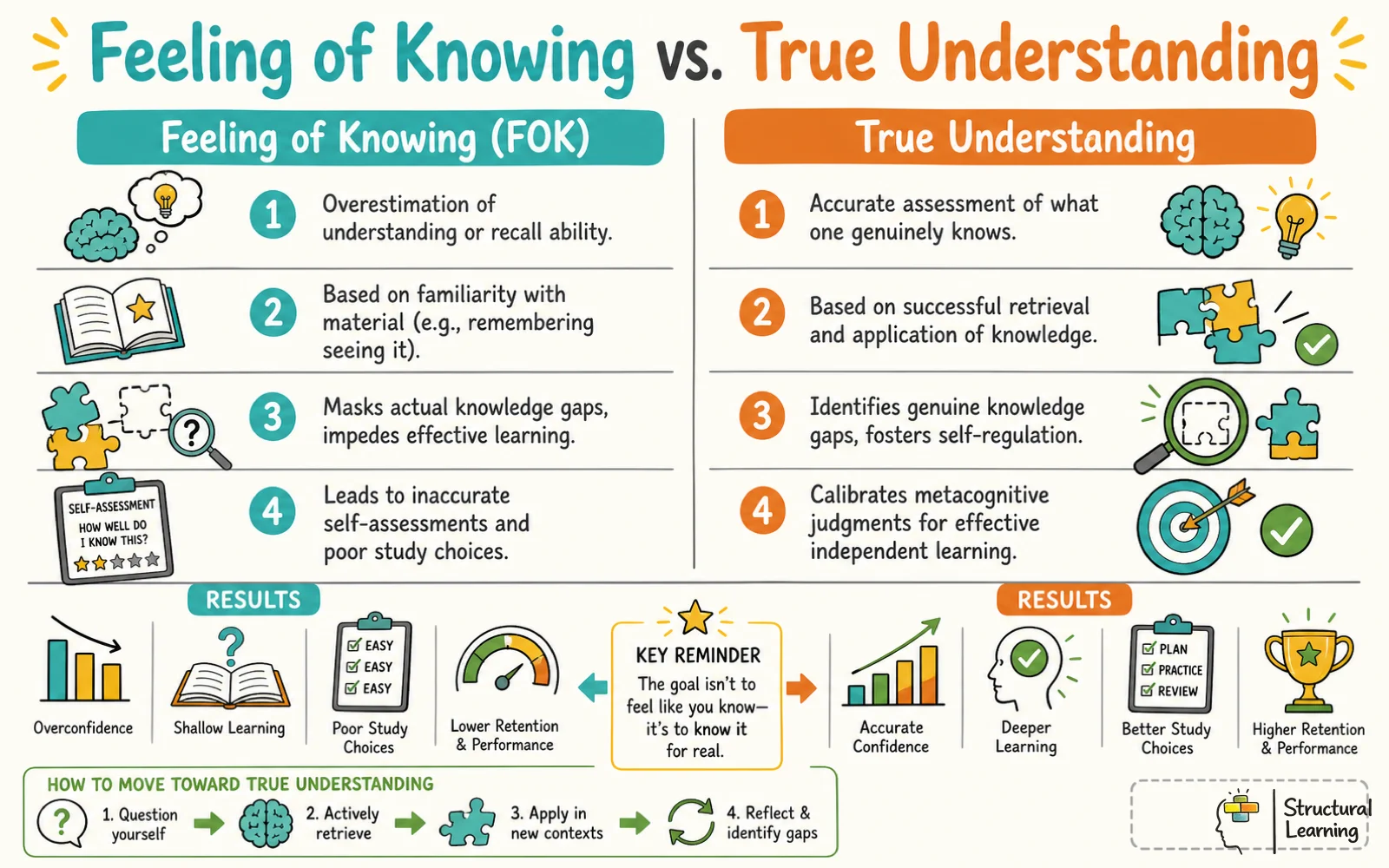
The critical insight from this research is that FOK is often wrong. learners genuinely feel they know information when they do not possess retrievable knowledge. A learner might feel confident about solving quadratic equations because the formula looks familiar, but struggle when required to apply it to word problems. This disconnect between feeling and reality has profound implications for how learners approach revision and self-assessment.
Familiarity Is Not Mastery
Asher Koriat's cue-utilisation account (1997) explains why learners misjudge their knowledge. They use simple cues, such as familiarity, to decide what they know. Recent exposure can make information feel familiar, even when learners cannot actually recall it.
Consider a Year 9 learner preparing for a history test on the causes of World War One. They reread their notes on the assassination of Archduke Franz Ferdinand several times. The facts feel familiar and 'known' because the learner has just seen them.
Then an exam question asks them to explain how this event led to a global conflict. They cannot build a clear response. The familiar feeling was an illusion.
The Fluency Trap
This phenomenon, known as the fluency trap, occurs because repeated reading creates processing fluency, the material feels easy to understand because you have just processed it. learners mistake this ease for learning and mastery. They think, 'I understand this perfectly,' when they have only achieved temporary familiarity.
A concrete example: A GCSE biology learner reads their notes on mitosis three times before bed. Each reading feels smoother and easier to understand than the last.
They close the textbook feeling sure about cell division. The next day, they are asked to explain the difference between mitosis and meiosis without notes. They cannot give a clear answer.
The fluency misled them. They could recognise the information, but they could not retrieve it or use it on their own.
Testing Fixes the Illusion
Retrieval practice is the antidote to FOK illusions. It makes learners test their actual knowledge instead of relying on familiarity cues. When learners try to retrieve information from memory without external support, they receive accurate feedback about their true knowledge state.
Retrieval-practice research by Roediger and Karpicke (2006) shows that trying to recall information reveals gaps that passive review can hide. A learner may feel confident about French vocabulary after reading word lists, but retrieval practice shows which words they cannot recall. This failure gives useful feedback and helps update their FOK more accurately.
Low-stakes testing works well; it reduces learner anxiety and gives useful feedback. Learners see gaps in knowledge when they cannot answer questions (Bjork et al., 2013). This discovery makes them adjust study habits and confidence (Butler & Roediger, 2008).
Why Desirable Difficulties Help
Bjork's (1994) desirable difficulties mean challenge helps learners' metacognition. Easy recall makes learners think they know it well. Effortful recall (Bjork, 1994) shows learners gaps in their knowledge.
A Year 8 mathematics teacher can use this by giving learners retrieval practice questions. These questions ask learners to recall and apply formulae, not just recognise them. At first, learners may be surprised by poor results because their FOK had told them they knew the material.
Over time, they develop more accurate self-assessment and adjust their study strategies. The difficulty was desirable because it showed real knowledge gaps and built better metacognitive awareness.
The Predict-Test-Compare Cycle
Metacognition gets better when learners check how accurate their feeling of knowing (FOK) is. FOK means judging whether they really know something before they try to recall it.
The predict-test-compare cycle makes this clear (Nelson & Narens, 1990). Before retrieval, learners predict their success on a 1-5 scale. They then complete the memory task and compare their prediction with their actual score (Dunlosky et al., 2003).
A primary teacher might use this during weekly spelling tests. Before each word, learners hold up fingers showing their confidence level. After writing their answer, they compare their prediction with their actual success. Over several weeks, learners learn to recognise when their confidence is misplaced and adjust their study focus accordingly.
Confidence Ratings Before Quizzes
Regular confidence ratings before low-stakes quizzes help learners track their FOK accuracy across time. A secondary science teacher begins each lesson with a three-question retrieval quiz from previous topics. Before seeing the questions, learners predict how many they will answer correctly. This routine builds awareness of when confidence aligns with performance and when it does not.
Learners overrate old topic performance, found Dunlosky and Rawson (2012). They accurately predict current topic knowledge, Bjork et al (2013) showed. This helps teachers and learners plan reviews, as suggested by Metcalfe and Finn (2008).
Explain-It-Back Checks
The explain-it-back strategy quickly shows learners' understanding. If learners need notes to explain, their feeling of knowing was wrong (Glenberg et al., 1982). It works across subjects because explaining needs real recall (Griffin et al., 2008; Hattie & Yates, 2014).
In a Year 5 history lesson on Tudor monarchs, learners work in pairs after initial teaching. Partner A explains Henry VIII's break with Rome while Partner B listens and asks clarifying questions. If Partner A struggles or needs to check their notes, they recognise their FOK was wrong and focus additional study on this area. The immediate feedback prevents false confidence from persisting.
Brain Dumps Before Revision
Teacher language: 'Before you open your notes, spend five minutes writing everything you remember about photosynthesis. Do not worry about accuracy, just get your thoughts on paper. Then compare with your notes to see what you missed or got wrong.'
Learner activity: learners create mind maps or lists from memory, then use different coloured pens to add missing information and correct errors. This reveals the gap between what they thought they knew and what they actually remembered.
FOK Traffic Lights
Teacher language: 'Rate each topic using our traffic light system. Green means you can explain it clearly to someone else.
Amber means you recognise it but cannot retrieve details. Red means you have no idea. Be honest, this helps you study well.'
Learner activity: learners colour-code their revision checklists, then focus study time on amber and red topics. They retest themselves weekly and update colours based on actual performance, not feelings.
Spaced Retrieval Schedules
Teacher language: 'We will test Topic A today, Topic B from two lessons ago, and Topic C from last month. This spacing helps you recognise when your confidence is real versus when you need more practise.'
Regular mixed retrieval practice, challenging learner confidence (FOK), is useful. Learners can track when time gaps make them overconfident. They should then adjust their revision schedules (Rhodes & Tauber, 2011).
Peer Teaching Tests
Teacher language: 'If you cannot teach it, you do not truly know it. Partner teaching reveals whether your confidence is justified. Listeners, ask questions that test real understanding, not just repetition.'
Learners teach partners, who then ask questions. Teaching mistakes help learners see what they missed and refocus learning (Bjork, 1994). This helps identify areas learners need to revisit (Metcalfe, 2017).
Exam Wrapper Reflections
Teacher language: 'After each test, reflect on your predictions versus performance. Which topics surprised you? What does this tell you about your study methods and confidence accuracy?'
Learners reflect on pre-test confidence versus scores. They spot patterns in Feeling of Knowing (FOK) accuracy. Then learners adjust study methods (Dunlosky & Metcalfe, 2009; Rhodes & Tauber, 2011; Serra & Dunlosky, 2010; Thiede et al., 2003). This helps learners improve future learning (Kornell & Bjork, 2007).
Primary Classrooms
In Key Stage 2, FOK illusions commonly appear in spelling tests and reading comprehension. A Year 4 learner might feel confident about spelling 'necessary' because they recognise it in their word list. But they struggle to spell it from memory. Teachers can address this by having learners attempt spelling words before checking their lists, revealing the gap between recognition and recall.
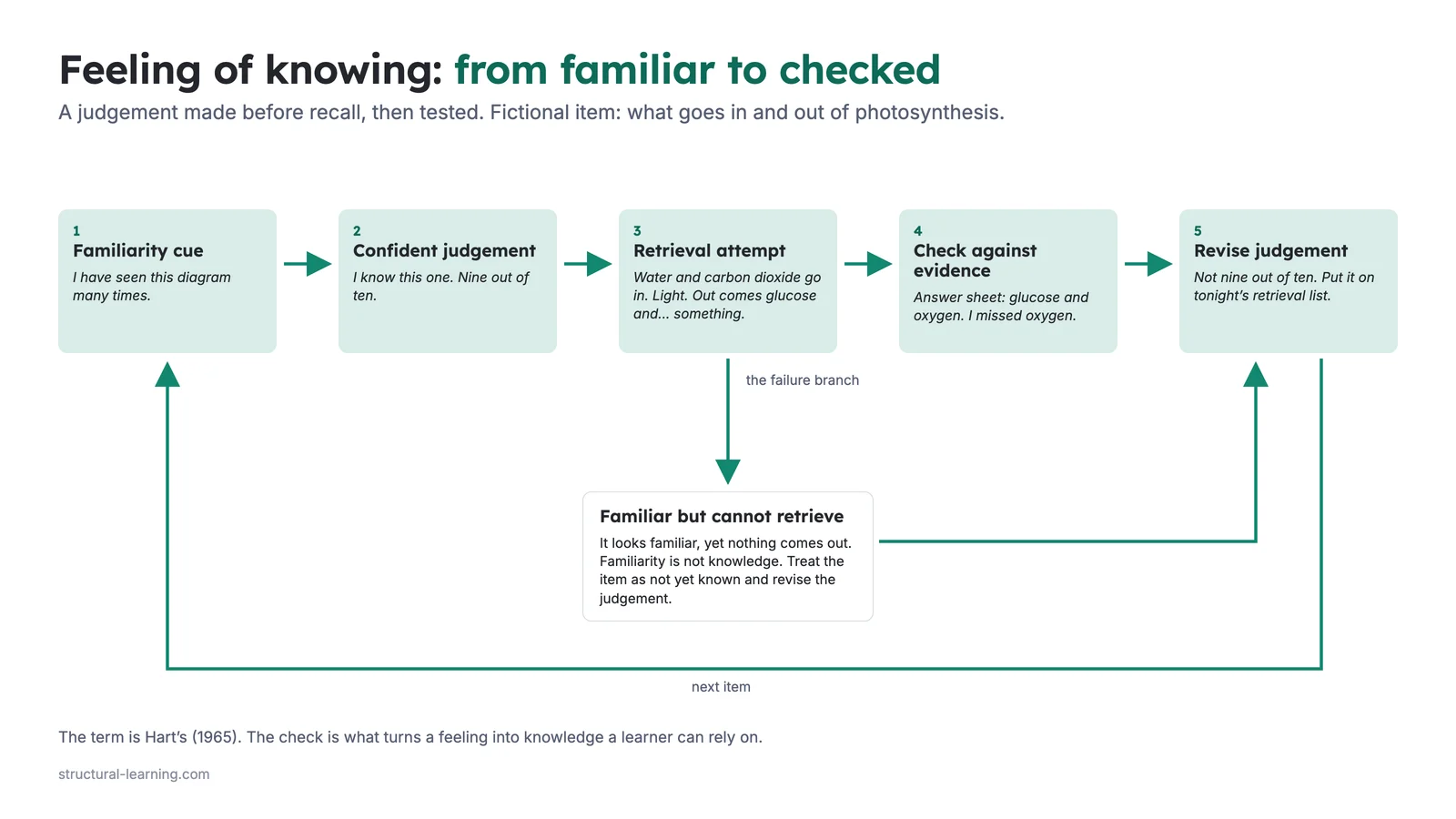
Reading comprehension can be hard to judge. Learners may feel they understand a text. Yet they can still struggle with inference questions unless they reread. Teachers can ask learners to predict how well they understood, then compare this guess with their score (Nelson & Narens, 1994; Dunlosky & Rawson, 2012; Serra & Metcalfe, 2009).
GCSE and A-Level Revision
FOK issues get worse before important exams. When learners feel too confident, they may not prepare well enough.
After review, GCSE mathematics learners can feel good about formulae (Kornell & Bjork, 2008). Yet they may still struggle to apply them (Glenberg et al., 1982).
A-Level history learners may think they know essay content after reading (Rawson et al., 2000). However, they can struggle to argue well when timed (Finn, 2008).
Subject teaching matters. Mathematics teachers can ask learners to recall formulae without looking them up (Karpicke & Blunt, 2011). History teachers can use timed essay plans to check knowledge retrieval and organisation (Willingham, 2009).
Science vocabulary can cause issues across key stages when familiar words hide weak conceptual understanding. Biology teachers can ask learners to define, apply and explain terms from memory, then compare their responses with model answers. This checks true understanding, not just surface familiarity.
What is feeling of knowing?
Feeling of knowing (FOK) is when you sense you could recognise or find information with the right hint. This happens even when you cannot access that information right now. It is the 'tip of the tongue' sensation where knowledge feels present but remains inaccessible.
Why is FOK often inaccurate?
FOK, or feeling of knowing, often relies on familiarity cues rather than real retrieval strength. Learners may trust how familiar something feels, not how well they can recall it. When they review material, it can feel familiar and 'known' because they have just processed it. This can create false confidence, so later they may not retrieve the information on their own.
How does retrieval practice fix FOK illusions?
Retrieval practice makes learners test what they really know, instead of relying on a sense of familiarity. When learners try to recall information without outside support, they get honest feedback about their knowledge. Gaps in recall help learners see when their confidence was misplaced.
How can I help learners distinguish between familiarity and mastery?
Regular prediction tests help learners compare forecasts to task results. "Explain-it-back" lets learners teach concepts without notes. "Brain dumps" have learners write all they recall before checking resources. These activities show learners the difference between confidence and knowledge (Dunlosky et al., 2013; Karpicke, Butler, & Roediger, 2009).
Understanding feeling of knowing changes how we approach learning and revision in our classrooms. Learners need to tell the difference between familiarity and genuine mastery. When they can do this, they make better study choices and develop more accurate self-assessment skills.
The strategies described here give teachers practical tools to tackle a common metacognitive illusion in education. These range from predict-test-compare cycles to brain dumps. Start with one strategy this week, and watch your learners build more honest and effective approaches to learning.
Digital learning tools can help teachers compare learner confidence with actual performance. Treat these tools as prompts for professional judgement, not as diagnostic evidence. A safer classroom routine is simple: ask learners to predict confidence, complete a low-stakes retrieval task, then compare the prediction with the result.
For example, Ms Chen might use an online quiz to spot that Jake is confident on algebra but repeatedly misapplies negative numbers. The useful action is not to label this as a hidden FOK pattern; it is to ask Jake to explain his reasoning, check a worked example and retry a similar problem.
Research on computer-supported self-regulated learning suggests that adaptive prompts and trace data can support monitoring. However, precise accuracy claims depend on the tool, task and validation method. Avoid treating one percentage as a general result for all AI feedback systems (Azevedo & Gašević, 2019).
Data tools are most helpful when they flag differences between predicted and actual performance early enough for teachers to adjust instruction. They should supplement retrieval checks, feedback and teacher questioning, not replace them.
Metacognition means thinking about thinking, and it gives teachers a strong tool for shaping how learners approach learning. When learners build metacognitive skills, they notice their own thinking, choose strategies that work for them, and track progress towards clear goals. This self-awareness helps learners move from taking in information to managing their own learning.
Teachers need to know two parts of metacognition. Metacognitive knowledge means learners understand their own learning strengths (Flavell, 1979). It also includes task awareness and strategy selection (Brown, 1987).
Metacognitive regulation means planning, monitoring, and evaluating learning (Schraw & Dennison, 1994). It also means knowing weaknesses and using methods such as templates (Zimmerman, 2000).
In practice, metacognition looks different across year groups and subjects. A Year 3 learner learning multiplication might ask which known fact can help with a harder one. In GCSE science, the same habit may mean checking whether a graph interpretation comes from the data, not from a familiar keyword.ing cards that prompt them to check their working: 'Did I count the groups correctly?' or 'Can I solve this another way?' Meanwhile, a Year 11 learner preparing for GCSEs might maintain a revision diary, recording which techniques helped them remember key concepts and adjusting their study methods accordingly. The Education Endowment Foundation guidance report says metacognition and self-regulated learning can support progress when teachers explicitly teach planning, monitoring and evaluation, rather than expecting learners to discover those skills unaided.
Start small for manageable changes. Learners reflect for two minutes at lesson start, stating knowledge and confusion. Encourage learners to check their approach midway through independent work. This builds metacognition without changing your lesson structure.
Teaching metacognition helps learners move from passively taking in information to guiding their own learning. Metacognition means thinking about how your mind learns. When learners understand how their minds work, they can gain and keep knowledge more efficiently. This can improve school performance and help them adapt to new challenges beyond the classroom.
EEF research shows metacognition boosts learner progress by eight months annually. Younger learners build stronger skills by reflecting (Education Endowment Foundation). A Year 4 teacher could ask learners to rate confidence, per research by Flavell (1979). This helps them see when they need more help (Hartman, 1998).
Metacognition supports all learners, whatever their ability. High achievers keep stretching themselves instead of becoming complacent. Learners who struggle can also build more independence.
Metacognition helps learners manage GCSE revision across many subjects. For example, a history teacher could use 'knowledge audits' (Winne, 2017; Dunlosky & Metcalfe, 2009). In these audits, learners list what they know, what they doubt, and what they still need to learn (Tanner, 2012).
Most importantly, metacognition reduces cognitive load for both teachers and learners. When learners can judge their own understanding more accurately, they need less constant checking and can focus effort where it is most needed. This leaves more time for meaningful learning and deeper study of subject content.
Try these metacognitive strategies across key stages for a thinking classroom. They need little prep and boost learner self-awareness and results. The Education Endowment Foundation (EEF) found these strategies add seven months' progress.
Start with the 'Exit Ticket Plus' technique at the end of each lesson. Instead of asking learners what they learned, ask three quick questions.
What did you find easiest to understand? Which part confused you most? What would help you understand better next time?
This small addition to standard exit tickets helps learners spot their own knowledge gaps. It also helps them think more clearly about how they learn. Year 7 maths teacher Sarah Thompson reports that learners who regularly complete these enhanced exit tickets show 30% better self-assessment accuracy on unit tests.
Use 'Think-Aloud Modelling' during problem-solving tasks. As you work, say what you are thinking, including doubts and corrections. In chemistry, for example, you might say: "Balance oxygen first? I need to check the rules". This helps learners see that expert thinking includes questions, not only perfect answers, and Zimmerman's research supports this.
Introduce 'Learning Journals' where learners spend five minutes weekly rating their confidence in different topics using a traffic light system, then explaining why they chose each colour. Primary teacher Mark Davies found that Year 5 learners who kept these journals for one term could predict their test performance with 85% accuracy, compared to just 40% for those who didn't use the system.
Feeling of knowing (FOK) is a metacognitive experience where a person believes they know something despite being unable to recall it at that moment. Hart (1965) first described FOK experimentally, and Nelson (1990) established it as a core component of metamemory. The "tip of the tongue" phenomenon is its most familiar form. FOK judgements influence study decisions: learners who feel they know something are less likely to revise it, even when their feeling is inaccurate.
FOK is often wrong as it uses familiarity, not recall. Koriat (1993) says FOK reflects ease of finding related info, not knowing answers. Learners may spot a biology term (high familiarity) but lack the definition. This overconfidence can cause learners to skip important revision.
Retrieval practice tackles FOK illusions because it makes learners check what they can recall. When retrieval fails, it creates a "desirable difficulty" (Bjork, 1994). This brings FOK judgements down and improves self-assessment.
Learners can see what they really know, not only what feels familiar. Regular quizzes strengthen memory and improve metacognition (Brown et al., 2014).
Researchers such as Flavell (1979) find that learners show self-awareness gains in 2-4 weeks with practise. Changes to study habits and grades occur after 6-8 weeks of metacognition (Brown, 1987). Age matters; older learners often adapt more quickly (Vygotsky, 1978).
Primary learners respond well to simple reflection prompts like 'traffic light' self-assessment cards and 'think-pair-share' discussions about their learning process. Exit tickets with questions such as 'What was tricky today?' and learning journals with picture prompts work effectively. These concrete, visual approaches help younger learners develop the vocabulary and awareness needed for metacognitive thinking.
Start by demonstrating the difference through low-stakes classroom experiments where learners compare passive methods with active retrieval. Show them concrete evidence of improved performance when using testing versus rereading. Most importantly, teach them why their brain tricks them into feeling confident with familiar material, helping them recognise the illusion of knowledge for themselves.
Metacognitive strategies help all learners, yet subjects differ in application. Maths and sciences gain from reflecting on problem-solving (Flavell, 1979). English and humanities benefit from comprehension monitoring and strategy choices (Brown, 1987; Hattie, 2009). Adapt prompts to suit each subject's thinking and learning goals (Zimmerman, 2000).
Flavell (1979) linked these behaviours to metacognition. Learners' language shifts during discussions. Learners predict test results more accurately. They also choose better strategies for independent work. Surveys and logs show learners gain awareness. They ask improved questions and seek feedback.
Metacognition is thinking about thinking; it's the awareness and understanding of your own thought processes. When learners engage in metacognition, they step back to observe how they learn, what strategies work best for them, and where they struggle. This self-awareness transforms learning from something that happens to them into something they actively control.
Flavell (1976) explained metacognition simply: knowledge and regulation. Learners develop knowledge by understanding their strengths and weaknesses, plus task demands. Learners then regulate learning; they plan, monitor progress, and assess strategies (Flavell, 1976). They might say: "Mind maps help me plan essays".
In practice, this looks like a Year 8 learner pausing during maths revision to ask themselves, "Am I actually understanding this, or am I just copying the method?" It's a Year 11 student realising their highlighting isn't helping them remember quotes for English literature and switching to creating flashcards instead. These moments of reflection seem small, but they fundamentally change how learners approach learning.
Metacognition helps learners across subjects. Once learners monitor their science thinking, they use it in history and languages. The Education Endowment Foundation guidance report presents metacognition as a promising approach when teachers explicitly model, scaffold and practise planning, monitoring and evaluation. This makes it a valuable teaching approach.
AI scaffolding tools can prompt learners to reflect on strategy, confidence and error patterns, but the evidence is still tool- and context-specific. Teachers should use these prompts as an additional signal alongside retrieval checks, worked examples and classroom questioning.
In Ms Chen's Year 8 mathematics lesson, an online tutoring system might notice repeated errors with negative numbers and ask Jake to explain his reasoning before retrying. The important teaching decision is still human: the teacher checks whether the prompt helped Jake understand the concept or merely produced another answer.
Research on computer-supported self-regulated learning supports the cautious use of adaptive prompts and learner trace data, but it does not justify a general claim that AI regulates learning better than teachers. Well-designed tools can give teachers earlier evidence about confidence, errors and help-seeking patterns (Azevedo & Gašević, 2019).
Intelligent reflection systems work best when teachers show learners how to use prompts well. Learners need training to give considered responses rather than just saying "I'm confident". DfE guidance on generative AI in education asks schools to consider impacts on learning, bias, misinformation and the teacher-learner relationship, so AI should support teacher-led thinking routines rather than replace them.
Researchers such as Nelson and Narens (1990) and Dunlosky and Rawson (2012) found regular metacognitive check-ins work best. Many teachers see increased learner awareness in 2-3 weeks. Self-assessment and study habits improve over a full term (Bjork et al., 2013).
Metacognitive strategies work well from Year 3, but adapt them for age. Younger learners like simple reflection, research shows. Older learners can use complex self-monitoring, said researchers (e.g., Flavell, 1979; Dunlosky & Metcalfe, 2009). Explicit instruction helps sixth form learners, too.
Start with low-stakes responses using whiteboards or exit tickets to reduce stress. Some learners dislike self-reflection initially, so frame questions positively; uncertainty is normal. Build the routine into lessons gradually; make it expected, not extra.
Metacognition can improve behaviour by engaging learners and easing frustration. Understanding their learning makes learners less likely to act out from confusion. Regular teacher check-ins spot issues early (Brown, 1987; Flavell, 1979; Nelson, 1990).
These signs suggest stronger metacognitive skills (Nelson & Narens, 1990). Learners show more awareness of struggles during retrieval and self-checking. They select good revision methods and gauge confidence well (Dunlosky & Metcalfe, 2009). Self-assessment mirrors performance more closely (Kruger & Dunning, 1999).
Feeling of knowing should not be treated as a simple label for being wrong. Hart (1965) and later Nelson and Narens (1990) showed that FOK judgements can predict later recognition, although imperfectly. A stronger critique is that FOK can be led astray by the familiarity of the cue rather than access to the answer. Reder (1987) and Metcalfe (1986) developed this cue-familiarity account, while Koriat (1997) is better read as a wider account of cue use in judgements of learning.
A second limitation is ecological validity. Much FOK research uses word pairs, trivia questions or short recognition tasks. These methods are useful, but they do not fully represent GCSE history essays, multi-step algebra or A Level biology schemas. Van Gog and Sweller (2015) questioned the reach of testing effects for complex material, while Karpicke and Aue (2015) replied that retrieval can still support complex learning when tasks are well designed.
There are also cultural and methodological limits. Many studies rely on self-report scales and laboratory samples from Western, educated contexts. Calibration tasks may penalise EAL learners, neurodivergent learners or learners under stress because confidence, processing speed and verbal explanation are not culturally or cognitively neutral. Fleming (2024) also shows why confidence and performance need to be measured separately.
Even with these limits, FOK remains valuable for education. It gives teachers a clear way to discuss the gap between felt confidence and demonstrated knowledge, as long as it is used with evidence from tasks, not treated as a diagnosis.
Karpicke, J. (2008). The critical importance of retrieval for learning.
Zimmerman, B. (2002). Becoming a self-regulated learner.
They focus on feeling-of-knowing judgements, cue-based confidence, retrieval practice and official classroom guidance.
Memory and the feeling-of-knowing experience
Hart, J. T. (1965). Journal of Educational Psychology, 56(4), 208-216.
Hart's study is the classic experimental source for feeling-of-knowing judgements: people can predict later recognition even when they cannot currently recall an answer.
Monitoring one's own knowledge during study: A cue-utilization approach to judgments of learning
Koriat, A. (1997). Journal of Experimental Psychology: General, 126(4), 349-370.
Koriat's cue-utilisation account explains why learners may use familiarity, fluency and partial cues when judging whether they know something.
Overconfidence produces underachievement
Dunlosky, J. and Rawson, K. A. (2012). Learning and Instruction, 22(4), 271-280.
This paper supports the article's warning that inaccurate self-evaluation can lead learners to stop studying too early and remember less later.
Familiarity and retrieval processes in delayed judgments of learning
Metcalfe, J. and Finn, B. (2008). Journal of Experimental Psychology: Learning, Memory, and Cognition, 34(5), 1084-1097. DOI: 10.1037/a0012580.
Metcalfe and Finn separate familiarity from retrievability, which is the core distinction teachers need when learners feel confident after rereading.
Test-enhanced learning: taking memory tests improves long-term retention
Roediger, H. L. and Karpicke, J. D. (2006). Psychological Science, 17(3), 249-255. DOI: 10.1111/j.1467-9280.2006.01693.x.
This study supports retrieval practice as a stronger check on learning than repeated rereading.
Metacognition and Self-Regulated Learning: Guidance Report
Education Endowment Foundation (2018).
The EEF guidance gives teachers practical recommendations for modelling metacognitive strategies, explicitly teaching planning and monitoring, and avoiding the assumption that learners can regulate learning without instruction.