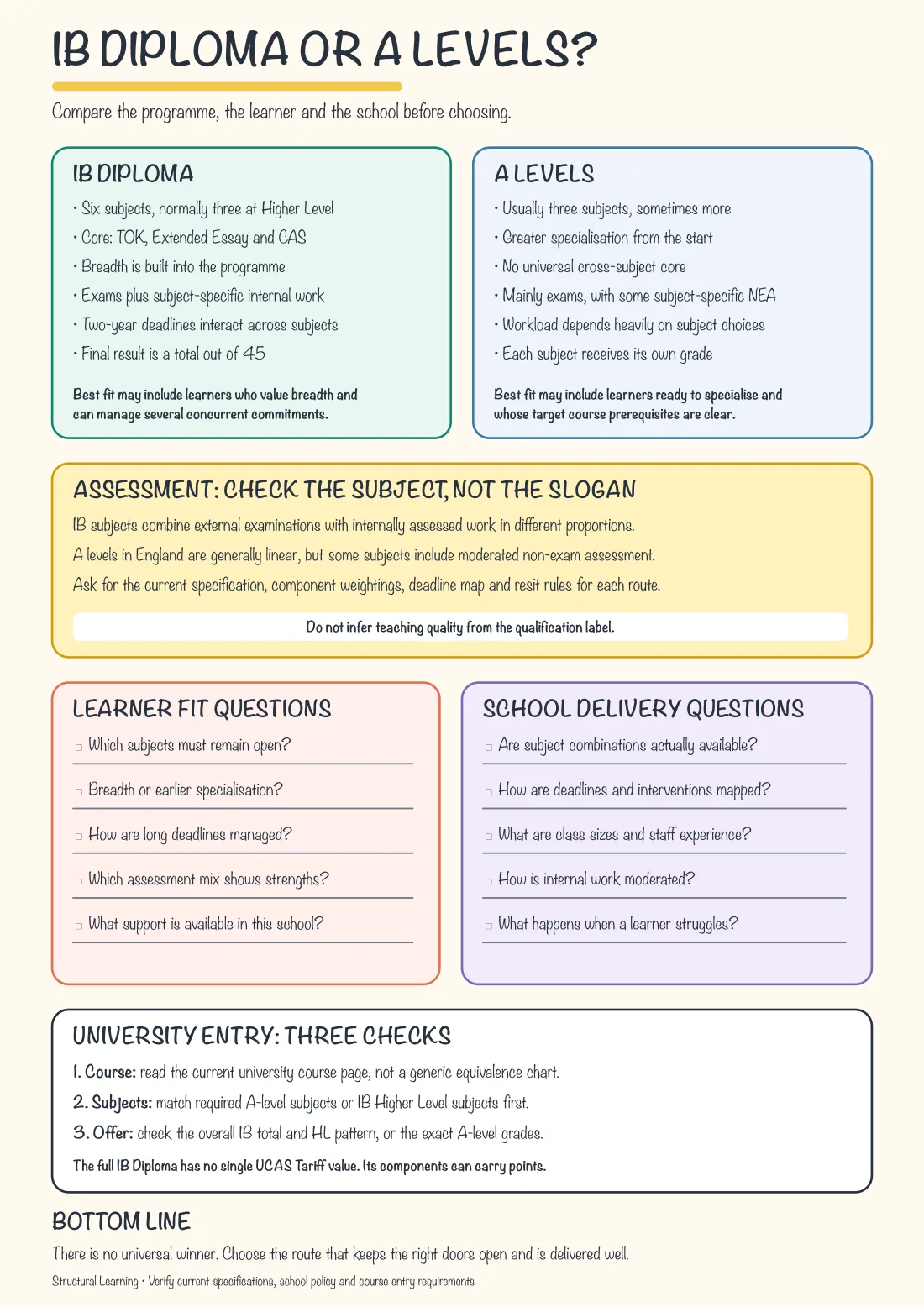
Compare the IB Diploma and A levels accurately across subject breadth, assessment, workload, university entry and school delivery, with a free decision checklist.
Main, P. (2026, June 3). Teaching IB vs A Levels: A Teacher's Guide. Structural Learning. https://www.structural-learning.com/post/ib-vs-a-levels-teachers-guide
The IB Diploma and A levels are both demanding post-16 routes. They organise learning in different ways, and neither is better for everyone. The Diploma keeps six subjects and a core. A levels usually focus on three subjects.
Start with required subjects and real assessment tasks. Then check workload, support and current university course requirements. For school leaders, the choice also affects timetables, staffing, deadline planning and learner support. Official IB guidance confirms the six-subject and core structure (International Baccalaureate, 2026).
IB vs A Levels: The Short Answer
Neither the IB Diploma nor A levels is better for everyone. The IB keeps six subjects and a compulsory core. A levels usually let learners focus on three subjects. Context matters.
The better route fits the learner's subjects, assessment profile, support needs and likely university courses. This International Baccalaureate overview explains the main differences.
Key Takeaways
Breadth and depth differ: the full Diploma combines six subjects with three core parts. These are Theory of Knowledge, the Extended Essay and Creativity, Activity, Service. A levels usually focus teaching time on three subjects.
Assessment must be checked by subject: both routes can combine examinations, oral work, practical work and non-exam assessment. The balance varies by specification and course.
Workload is not a simple ranking: IB learners manage more subjects and core deadlines at once. A-level learners may face great depth and long periods of practice. Some subjects also have substantial non-exam work.
University offers are course-specific: there is no single conversion from an IB total to A-level grades. The full Diploma also has no single UCAS Tariff value.
Delivery quality matters: timetable design, subject choice, deadline planning, teaching expertise and support can matter as much as the programme label.
For example, a learner considering medicine may need Chemistry and another science at set levels and grades. Before discussing prestige, compare those rules with the proposed subject set. Check both the IB Higher Level and A-level options. This is more useful than asking which route is harder.
IB Diploma and A Levels at a Glance
The full IB Diploma is a broad programme with six subjects and three core parts. A levels are separate subject qualifications, usually taken as a smaller set. Both routes often last two years after age 16. Each uses a different timetable, assessment calendar and set of rules.
Feature.
IB Diploma.
A levels.
Typical academic pattern.
Six subjects, commonly three at Higher Level and three at Standard Level, plus the core.
Usually three subjects, although school programmes and learner choices vary.
Main strength.
Maintains academic breadth and requires independent research.
Allows sustained time for subject specialisation.
Assessment.
A subject-specific mix that normally includes written examinations and internally assessed work.
A specification-specific mix, often dominated by examinations but with non-exam assessment in some subjects.
Final reporting.
Subject grades from 1 to 7, core points and a total out of 45 for the full Diploma.
A separate letter grade for each A level.
The Diploma Programme structure means every compulsory area can affect the whole programme. This includes the learner's weakest area. An A-level learner can usually avoid that subject, but doing so may close some degree options. Ask learners to mark the subjects they want and those a future course may require.
Programme Structure and Subject Choice
IB Diploma learners choose subjects across six groups. They also complete Theory of Knowledge, the Extended Essay and Creativity, Activity, Service. A-level learners normally build a smaller subject set without a common core.
Compare the real option blocks at the school. Do not rely on the widest choice shown in its prospectus.
The Diploma has six subject groups and the core. Approved changes and school timetables can shape the final set. Most full Diploma learners take three subjects at Higher Level and three at Standard Level.
Four Higher Level subjects are possible, but they add pressure. Use current official guidance, not old school folklore, to settle programme rules (International Baccalaureate, 2026).
Each part of the core has a clear purpose. The Extended Essay is an independent research paper of up to 4,000 words. Theory of Knowledge looks at how people make and judge knowledge claims.
CAS includes experiences and a project across creativity, activity and service. It is not graded and adds no points. However, learners must complete it to gain the Diploma. Use the Extended Essay guide, Theory of Knowledge guide and CAS guide to plan the three strands accurately.
Schools also need a safe way to change direction. A learner can sometimes change an A-level subject early if the timetable and class size allow it. A full Diploma learner cannot just remove one of the six subjects and complete the full programme.
The school may consider Diploma and individual course routes. The current term for separate subjects is Diploma Programme course results, not the blanket label “IB Certificates”.
Assessment: Compare the Actual Subjects
Do not compare “IB coursework” with “A-level exams”. Neither phrase describes every subject. DP assessment normally includes written exams and work completed with teacher support. Check each current subject specification.
However, the balance and task type vary by subject. A levels can also include non-exam work. Some include practical endorsements, oral assessment or moderated work.
The IB says exams remain important. They provide a common outside basis for judgement. Teachers also support internal assessment that is checked or moderated outside the school (International Baccalaureate, 2026).
The IB assessment guide is a useful starting point. Yet the current subject guide and school calendar remain the main sources.
Subject example.
What an A-level learner may encounter.
What an IB Diploma learner may encounter.
Planning question.
Mathematics.
Written papers set by the chosen awarding organisation.
Written papers plus an internally assessed mathematical exploration.
Does the learner sustain independent mathematical writing as well as timed problem solving?
Sciences.
Written examinations and, in England, a separately reported practical endorsement for relevant specifications.
Written examinations plus an internally assessed scientific investigation.
How much support is available for practical design, data analysis and deadline management?
History or geography.
Written examinations and possible non-exam investigation, depending on subject and specification.
Written examinations plus a subject-specific internal investigation or fieldwork task.
When are research milestones taught, checked and authenticated?
Languages and literature.
Written papers, with oral or non-exam components in relevant qualifications.
Written work and examinations, with oral assessment in relevant language courses.
Does the learner's profile fit sustained writing, speaking and text analysis?
Ofqual's current school guide confirms that some A levels include non-exam assessment. Teachers may mark this work before the awarding body moderates it (Ofqual, 2026). In a Year 12 options workshop, place the real specifications side by side.
Ask learners to mark every exam, oral, investigation, practical and long submission. They can then judge each route.
Student Workload Across Two Years
IB workload is usually broader and needs steady planning. A-level workload is usually narrower, but can become very deep. Neither description predicts one learner's hours or stress. Homework rules, travel, subject choice, assessment bunching, prior learning, language needs and school planning all matter.
IB learners switch between six subjects and the core. Several small tasks can compete for the same evening. The Extended Essay, internal work, oral preparation and CAS can share deadlines.
A-level learners have fewer subjects. Yet hard problem sets, reading, practical work and essay drafts can fill a week. Non-exam work can add more pressure.
Do not measure only the “hours per qualification”. Look at the learner's full fortnight. Map fixed lessons, independent study, travel, paid work, caring duties and rest.
The teacher can then spot clashes. History research may meet a science task and mock revision in one week. A missed deadline may reflect that clash, not weak motivation.
Some learners enjoy variety. Others think best when they stay with one subject for longer. The IB learner profile describes aims, not a test for entry. Good teaching can build planning habits over time.
Schools should publish one assessment map for both years. A named lead can spot crowded weeks. They can ask subject leaders to move flexible dates before pressure grows.
Learners use inquiry routines in an International Baccalaureate classroom.
Teacher Workload and School Delivery
Teacher workload depends on subjects, class size, the timetable, staff skill and school systems. These matter more than a simple rule about either route. The Diploma adds planning across six subjects and the core. A levels can bring heavy exam practice, practical checks and non-exam assessment.
IB teachers may need training on each subject guide. They may also need to agree marking standards and predicted grades. Checks must confirm that work is the learner's own.
Extended Essay supervisors need protected meeting time. TOK and CAS need named leaders. The Diploma coordinator must be able to resolve timetable and deadline clashes.
These school costs should not depend on personal goodwill.
A-level teams also plan for subject exams and practical work. They must manage non-exam assessment where needed. England's reforms kept different assessment needs across subjects. They did not create one model for every subject (Department for Education, 2017).
Plan the calendar before assigning the work
A science teacher may want an IB investigation draft in one week. English may also schedule an oral. The Extended Essay lead may set a reflection deadline at the same time.
Do not just tell learners to be more resilient. The coordinator should find the clash and agree which date can move. All staff then need the new date.
Protect moderation and feedback boundaries
Teachers on both routes must know what feedback they may give before final submission. Schools should provide one current assessment handbook and examples for each subject. They should also set aside time to agree marking standards.
A new teacher should not have to guess the rules from last year's folders. They should not find a conflict with current guidance at the deadline.
University Entry and UCAS Tariff
Universities admit learners to courses, not to one conversion table. Offers name subjects, levels and grades. An IB total cannot safely become one A-level profile for every course. Course requirements change.
The full IB Diploma has no single UCAS Tariff value. However, its separate qualifications can attract points.
UCAS says Tariff points turn certain qualifications into a number. Universities choose whether and how to use that number (UCAS, 2026). Its guidance on UCAS Tariff points explains the system.
Oxford shows why fixed matches fail. It gives a general IB range of 38 to 40 points. This total includes core points.
It also asks for 6s and 7s at Higher Level (University of Oxford, 2026). Its current Medicine course page gives two separate examples. One is A*AA with Chemistry and another named science or Mathematics.
The other is 39 IB points with 766 at Higher Level. It also requires Chemistry and another named science or Mathematics. Applicants must still check the page for their entry year.
In a guidance meeting, open three course pages. Record the total or grade profile and required subjects. Add the subject level, admissions test and language rule.
Then compare both proposed routes. If one lacks a required subject, that finding should guide the decision.
Which Learners May Prefer Each Route?
The IB may suit learners who value breadth, languages and research. It may also suit those who like varied forms of assessment. A levels may suit learners who are ready to focus.
They can spend more time on fewer subjects. Explore these preferences, but do not turn them into personality rules. They say nothing about intelligence, ambition or university potential.
A learner who may prefer the IB Diploma
A learner may want to keep literature and a language. They may also want mathematics, science and humanities. The Diploma could meet that need.
A Year 11 learner can test the fit with a sample week. Include reading, problems, oral work and a short research task.
A learner who may prefer A levels
A learner set on Art, English Literature and History may value longer study blocks. They can use this time for portfolios, reading and essays. Another learner may prefer Mathematics, Further Mathematics and Physics.
The school must still check course entry rules. It must also check how each subject is assessed.
A learner who does not fit either stereotype
A well-organised learner can struggle with an unwanted subject. A learner with uneven GCSE grades can thrive with strong support. An “all-rounder” may still prefer A-level depth.
Judge the fit from lessons, home study and deadlines. Do not rely on labels.
Inclusion, Support and Changing Direction
Inclusion depends on access arrangements, good teaching, early support and a flexible timetable. Neither route is more inclusive by default. Schools should explain how reasonable adjustments apply and which demands must remain. They should also cover changes linked to illness, disability, language needs or new goals.
Access arrangements do not remove the goals of an assessment. Families should ask who gathers the evidence and submits the request. They should check that lesson support matches exam rules. The inclusion lead, exams officer and programme coordinator should give one clear answer.
Schools need a written process for changing direction. For A levels, ask for the last date when a subject change can work. Check the effect on teaching hours.
For the Diploma, ask about moves between Higher and Standard Level. Ask what happens if a learner leaves the full Diploma. Also ask how Diploma Programme course results will be reported.
Do not describe every single course route as an “IB Certificate”.
Questions for Schools and Families
A useful options talk tests the real programme at the school. Ask about subjects, staffing, crowded assessment weeks and support. Ask about recent destinations too. Ask how the school responds.
Do not accept a general claim that the IB builds rounded learners. Nor should you accept that A levels offer an easier path to a UK university.
Which exact subjects and levels will run? Ask what happens if a small class is cancelled. Check whether two preferred options share the same block.
What do current assessment calendars show? Ask for an unnamed Year 12 and Year 13 overview. It should include internal work, oral tasks, mocks and core dates.
How is independent research taught? Look for planned lessons on question design and source checks. Also check academic honesty, data handling and referencing.
Who coordinates workload? Find the person who can move a team deadline when major tasks clash.
How are access arrangements managed? Check how staff gather evidence and set normal ways of working. Ask about deadlines and contact with families.
What changes are possible? Ask about subject swaps and moves between Higher and Standard Level. Check what leaving the full Diploma means for university applications.
How is university guidance kept current? Advisers should use live course pages. They must keep offers separate from UCAS Tariff points.
What additional costs or travel apply? Include books, fieldwork and exam fees where relevant. Add transport and timetable gaps.
During an options evening, give each family one proposed subject set. Add one possible degree course. Ask them to find the entry rules and two busy assessment points.
They should also name the person who would plan support. This turns a broad talk into a test of the decision. It also finds gaps while change is still possible.
Download the IB or A Levels Decision Checklist
The one-page checklist turns this comparison into a clear discussion. It asks learners to record subject requirements and assessment preferences. It also covers workload evidence, support plans and questions for the school.
Complete it with a teacher or adviser. Then check every university rule on the current course page before confirming choices.
◆ Structural Learning
IB Diploma or A Levels Decision Study Notes
Study notesOne-page revision sheet
Use the one-page comparison and decision questions for subject-choice meetings, options evenings and school review.
Use the checklist before the options meeting. Update it after the learner sees the timetable and meets subject staff. Changed answers show whether the choice rests on real school facts. They may also expose beliefs about status and difficulty.
Limitations and Further Reading
This comparison cannot predict one learner's results or experience. Delivery varies between schools, and A-level specifications differ. IB subject guides and university requirements can also change. Check current rules again.
Group results reflect selection, prior learning, resources and support. They cannot prove that one route caused better results.
National context matters. This article covers A levels in the UK. It uses examples from England where stated. Arrangements elsewhere may differ.
The best answers avoid global rankings and fixed conversions. Check the learner's real subject set and the current rules for each route. Then read the published rules for each university course.
If a school process affects the answer, ask for its policy and named contact. Do not rely on a short options-evening summary.
Is the IB harder than A levels?
Not for everyone. The Diploma brings breadth, core work and deadlines across six subjects. A levels can demand more focus and depth within fewer subjects.
Difficulty depends on the learner's strengths and chosen subjects. Their assessment profile and school delivery also matter. Compare the real two-year calendar and subject rules.
What is 38 or 40 IB points equivalent to at A level?
There is no single match for every course. Universities publish their own offers for IB applicants. These may include total points and Higher Level grades.
They publish separate grade profiles for A-level applicants. Use IB scoring and grades to understand the total. Then compare both sets of rules on each course page.
Does the full IB Diploma receive UCAS Tariff points?
The full Diploma does not have one UCAS Tariff score. Its separate qualifications can attract Tariff points. However, many universities use qualifications and grades instead of a Tariff total.
Always read the course entry rules. Ask admissions staff if the published wording is unclear.
How is the IB Diploma scored and passed?
Each subject receives a grade from 1 to 7. The six subjects can give up to 42 points. Theory of Knowledge and the Extended Essay can add three more, making 45.
A learner needs at least 24 points and must complete CAS. They need a grade in each subject, TOK and the Extended Essay. They must have no grade 1 and no more than two grade 2s.
They can have no more than three grades of 3 or below.
They also need at least 12 Higher Level points and 9 Standard Level points. With two Standard Level subjects, they need 5 Standard Level points. They must avoid an E in TOK or the Extended Essay. With four Higher Level subjects, the test uses the three highest grades (International Baccalaureate, 2026).
What happens if a learner does not complete the full Diploma?
The school should explain the options and effects early. A learner may receive Diploma Programme course results for completed subjects and core parts. This depends on registration and completed assessment.
Those results are not the full Diploma. “IB Certificates” is not the current formal name for every such route.
Are all A levels exam-only?
No. Each subject has its own assessment model. Some A levels use written exams. Others also include non-exam work, oral work or practical tasks.
Read the current rules for every proposed subject. Separate work that counts towards the grade from endorsements reported on their own.
Which route do universities prefer?
There is no safe general answer. Universities publish rules for each course and both routes. Required subjects may matter more than the programme label.
Ask each learner to check three realistic courses and one ambitious course. They should also check one other option. Record all requirements before choices are final.
References
These sources support the key claims about the programme, assessment and entry. They are the official bodies responsible for those areas. Schools and families should still check the linked guidance again. They should also check each university course page in the application year.
Department for Education (2017). A-level qualification and subject-content reform guidance.
International Baccalaureate (2026). Diploma Programme and IB assessment guidance.
Ofqual (2026). Guide for schools and colleges.
UCAS (2026). UCAS Tariff points guidance.
University of Oxford (2026). International qualifications and undergraduate admissions requirements.
Next, give the learner the proposed subject set. Before signing the options form, ask them to check three things. These are one real university course, one assessment calendar and one support route.
About the Author
Paul Main
Founder & Metacognition Researcher
Paul Main is an educator and metacognition researcher who founded Structural Learning in 2017. With a psychology degree from the University of Sunderland and a career spent helping schools embed thinking skills, he bridges the gap between educational research and classroom practice. Fellow of the RSA and Chartered College of Teaching, with 128+ Google Scholar citations. More at paulmain.com.