Intensive Interaction: The Complete Teacher's Guide to Pre-Speech Communication
|
January 16, 2026
Learn Intensive Interaction for pre-speech communication. This guide covers the six fundamentals, practical techniques, and how to support learners with PMLD and autism.
Main, P. (2026, January 20). Intensive Interaction: The Complete Teacher's Guide to Pre-Speech Communication. Retrieved from https://www.structural-learning.com/post/intensive-interaction-complete-teachers
Intensive Interaction is an approach for teaching the fundamentals of communication to children and adults with severe learning difficulties, autism, or communication difficulties. Developed by Dave Hewett and Melanie Nind at Harperbury Hospital School in the 1980s, this child-led approach draws on the natural communication patterns between caregivers and infants to help individuals develop the building blocks of social interaction.
Intensive Interaction Benefits Overview
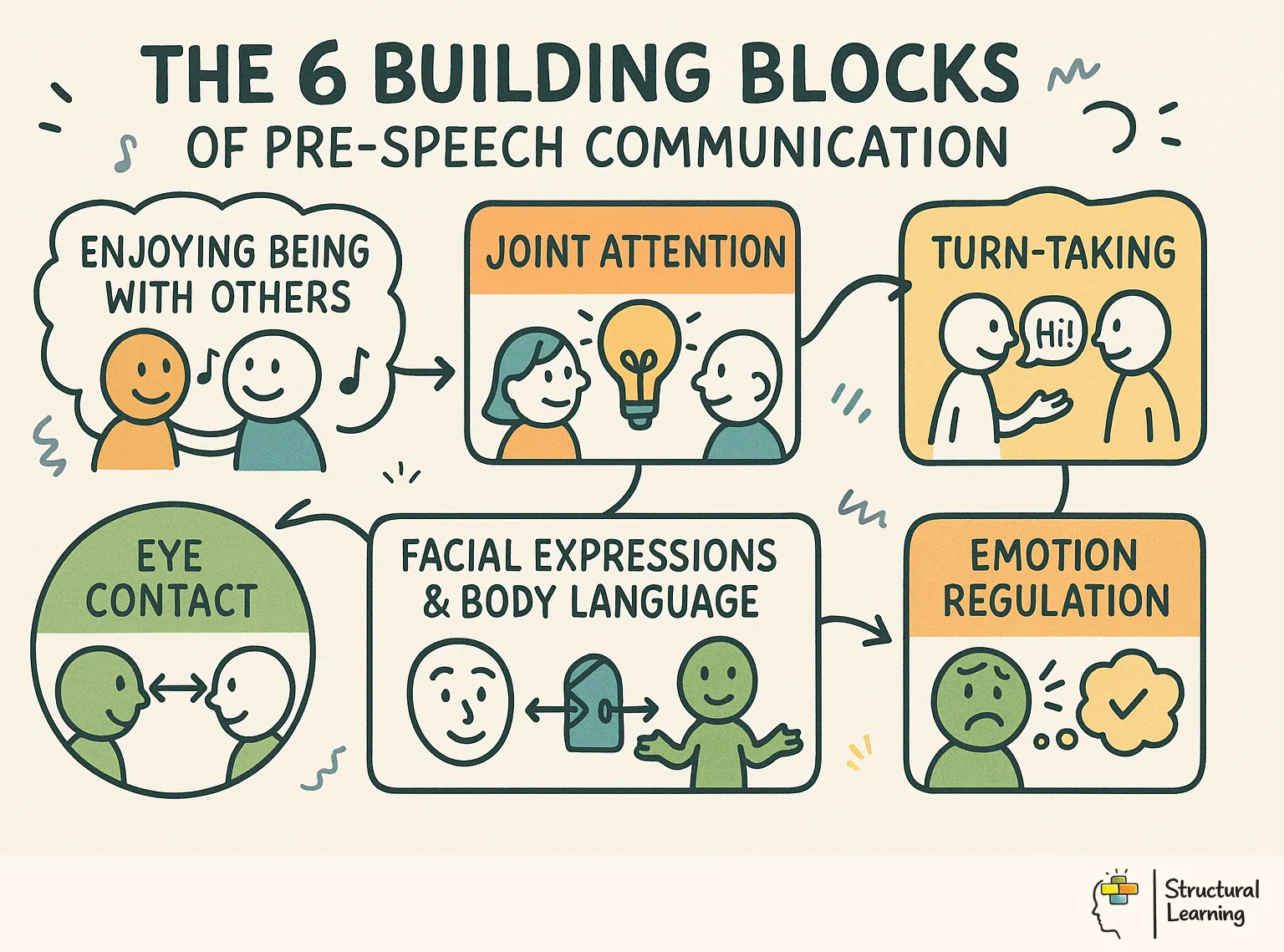
Master the Six Pre-Speech Foundations: Before attempting any language development, ensure pupils have these building blocks: enjoying being with others, joint attention, turn-taking, using and reading eye contact, understanding facial expressions and body language, and regulating emotions. Assess which foundations are missing and focus your interactions on developing these specific areas first.
Mirror and Respond Rather Than Direct: Abandon traditional teacher-led activities and instead copy your learner's existing behaviours, whether that's rocking, tapping, or vocalising. This mirroring approach validates their current communication attempts and creates a shared language that builds naturally from what they already do.
Remove All Performance Pressure: Conduct sessions without goals, targets, or expected outcomes, focusing solely on the quality of the interaction itself. This taskless approach eliminates anxiety and allows genuine connection to develop, which paradoxically leads to more rapid communication progress than traditional goal-oriented methods.
Let Sessions Evolve Naturally: Start with interactions lasting just seconds or minutes, watching carefully for signs the learner has had enough, such as looking away or increased agitation. As comfort and skills develop over weeks and months, sessions will naturally extend without forcing duration, ensuring the learner remains engaged and positive about communication.
The 6 Building Blocks of Pre-Speech Communication
���
Key Takeaways
The Fundamentals of Communication: Intensive Interaction teaches six pre-speech skills: enjoying being with others, joint attention, turn-taking, using and reading eye contact, understanding facial expressions and body language, and regulating emotions. These must be in place before language can develop
Follow, Do Not Lead: The practitioner mirrors and responds to the learner's existing behaviours rather than directing the interaction. If the learner rocks, you rock. If they vocalise, you vocalise back. Their actions become your shared language
Taskless and Pressure-Free: There are no goals, targets, or outcomes to achieve during sessions. The quality of the interaction itself is the purpose. This removes performance anxiety and creates genuine connection
Sessions Grow Organically: Start with brief interactions lasting seconds or minutes. As the learner's comfort and skills develop, sessions naturally extend. Never force duration; let the learner indicate when they have had enough
What is Intensive Interaction?
Intensive Interaction is a teaching approach developed by Dave Hewett and Melanie Nind in the 1980s for individuals with severe learning difficulties and autism. The method mirrors natural caregiver-infant communication patterns to develop fundamental social interaction skills before speech development begins.
The 6 Building Blocks of Pre-Speech Communication
Intensive Interaction is a practical approach for developing communication with people who are at early stages of communication development. The approach is particularly effective for individuals with profound and multiple learning difficulties (PMLD), severe autism, and those who are pre-verbal or have very limited communication.
The approach is based on a simple observation: typically developing infants learn the foundations of communication through playful, responsive interactions with their caregivers. These early exchanges, often called "proto-conversations," teach babies to take turns, share attention, read facial expressions, and enjoy being with another person. For various reasons, some individuals miss or do not fully develop these foundational skills.
Intensive Interaction recreates the conditions of these early learning experiences, regardless of the person's chronological age. A 15-year-old or a 40-year-old can benefit from this approach just as much as a young child.
The approach was developed during the 1980s by Dave Hewett and Melanie Nind while working at Harperbury Hospital School in Hertfordshire. They observed that existing behavioural approaches were not meeting the communication needs of their students, and sought an alternative grounded in developmental psychology.
Six Pre-Speech Communication Stages
Pre-speech communication development follows six fundamental stages: enjoying being with others, developing joint attention, learning turn-taking, using eye contact, understanding facial expressions and body language, and regulating emotions. These stages form the essential foundation before any language development can occur successfully.
Intensive Interaction focuses on developing six foundational communication abilities. These "fundamentals" must typically be in place before formal language can develop:
1. Enjoying Being With Others
Before any communication can happen, a person must find being with another person rewarding rather than stressful or neutral. Many individuals with severe autism or learning difficulties find social contact overwhelming or simply not interesting.
What this looks like:
Showing pleasure when someone approaches
Seeking out interaction
Staying engaged rather than withdrawing
Displaying relaxed body language during shared time
2. Joint Attention
Joint attention means sharing focus with another person on the same thing, whether that is an object, an activity, or simply each other. This triangular relationship (you, me, and something we both attend to) is fundamental to all communication.
What this looks like:
Looking at what another person is looking at
Checking that someone else is sharing the experience
Following someone's gaze or point
Drawing attention to something of interest
3. Turn-Taking
All conversation is essentially sophisticated turn-taking. Before verbal exchanges can develop, the basic concept of "my turn, your turn" must be understood and enjoyed.
What this looks like:
Waiting for the other person to respond
Taking action after the other person has taken their turn
Anticipating that a response will come
Beginning to initiate exchanges
4. Using and Reading Eye Contact
Eye contact serves multiple communication functions: gaining attention, showing interest, signalling turns, and reading emotional states. Learning to use and interpret eye contact appropriately is crucial for social communication.
What this looks like:
Making brief eye contact during interactions
Looking at someone's face during shared activities
Using eye contact to initiate or maintain interaction
Understanding that eye contact signals engagement
5. Facial Expressions and Body Language
The majority of human communication is non-verbal. Understanding and using facial expressions, gestures, posture, and proximity are essential communication skills.
What this looks like:
Responding to another person's emotional expressions
Using facial expressions to communicate feelings
Reading body language cues
Adjusting behaviour based on non-verbal signals
6. Emotional Regulation
Being able to manage emotional arousal during social interaction is necessary for sustained engagement. Without some ability to regulate emotions, interactions become overwhelming or impossible.
What this looks like:
Staying calm enough to engage
Recovering from excitement or distress to continue interacting
Matching emotional tone appropriately
Managing the stimulation that comes with social contact
Core Intensive Interaction Principles
Intensive Interaction operates on four core principles: mirroring the learner's existing behaviours, removing all performance pressure and goals, following the learner's lead rather than directing, and allowing sessions to develop organically. These principles create anxiety-free environments that promote natural communication growth.
Principle 1: The Learner Leads
This is the defining characteristic of Intensive Interaction. The practitioner does not set an agenda, direct activities, or work towards predetermined goals. Instead, they observe what the learner is already doing and join in.
If the learner is rocking, the practitioner rocks alongside them. If the learner is making sounds, the practitioner echoes those sounds. If the learner is tapping a surface, the practitioner taps too. The learner's existing behaviours become the shared activity.
This approach honours the learner's communication where it currently exists and builds from that foundation, rather than trying to impose external communication forms.
Principle 2: Mutual Enjoyment Focus
Interactions must be enjoyable for both parties. This is not a chore or a task to be completed. When both the learner and practitioner are genuinely having fun, communication develops naturally.
Signs of mutual enjoyment include:
Smiling and laughter
Relaxed body language
Prolonged engagement
Attempts to continue or restart interactions
Positive vocalisations
Principle 3: No External Goals
Intensive Interaction is "taskless." There is no worksheet to complete, no target to achieve, no skill to demonstrate. The interaction itself is the purpose.
This can feel uncomfortable for educators trained to work towards measurable outcomes. However, removing the pressure of goals creates space for genuine connection and natural communication development.
Principle 4: Responsive Timing
Good Intensive Interaction involves careful attention to timing. The practitioner must:
Wait for the learner to initiate or respond
Allow processing time
Not rush to fill silences
Recognise when to pause and when to continue
Notice when the learner has had enough
The pace is always set by the learner, not the practitioner.
Essential Intensive Interaction Techniques
Mirroring
Copy what the learner does. If they clap, you clap. If they vocalise "ah-ah-ah," you respond "ah-ah-ah." This demonstrates that their actions have an effect on another person and creates a shared experience.
Mirroring should be:
Timely (not too delayed)
Approximate (not exact copying, which can feel mocking)
Warm (accompanied by engaged facial expression)
Responsive to changes (adapt as the learner adapts)
Following
Go where the learner goes, both literally and figuratively. If they move, move with them. If they change activity, change with them. Resist the urge to redirect or maintain your preferred activity.
Waiting
Create space for the learner to respond. Many practitioners fill silences too quickly. A pause that feels long to you may be exactly what the learner needs to process and formulate a response.
Commenting
Use brief, simple language to narrate what is happening. Keep words to a minimum (one or two words at a time) and match them to actions. "Clap!" "Jump!" "Again!"
Burst-Pause Patterns
Create rhythmic patterns of activity followed by pauses. This helps establish turn-taking as the learner begins to anticipate the next burst and may start to initiate.
Example pattern:
Rock together for a few seconds
Stop and wait
Look expectantly
Wait for the learner to signal continuation
Resume rocking
Setting Up Successful Intensive Interaction Sessions
Successful Intensive Interaction sessions require a quiet, distraction-free environment where practitioners position themselves at the learner's eye level. Sessions begin with brief interactions lasting seconds to minutes, focusing entirely on mirroring the learner's behaviours without predetermined goals or time limits.
Creating the Right Environment
Create conditions that support focused interaction:
There is no prescribed session length. Sessions should:
Start very short (even 30 seconds to a minute)
End when the learner has had enough
Happen frequently (multiple times daily if possible)
Fit naturally into daily routines
Physical Positioning for Success
Position yourself to enable interaction:
Face to face when appropriate
Side by side for some activities
At the learner's level
Close enough to interact but respecting personal space
Ready to adjust as needed
Recording Progress and Observations
While there are no session goals, recording what happens is valuable:
Brief notes after sessions
Video recording (with appropriate consent)
Noting what worked and what did not
Tracking changes over time
From Natural Development to Intensive Interaction
Troubleshooting Common Session Challenges
"What if nothing happens?"
Something is always happening. The learner may be processing, observing, becoming comfortable with your presence, or simply not ready. Periods of apparent inactivity are part of the process. Stay present, stay available, and trust the approach.
"How do I know it is working?"
Look for subtle changes over time:
Increased tolerance of your presence
Brief moments of eye contact
Small responses to your actions
Reduced anxiety during interactions
Any indication of anticipation or initiation
Progress may be slow and non-linear. Small changes are significant.
"Is it appropriate for older learners?"
Absolutely. Intensive Interaction is not "childish" or only for young children. The fundamentals of communication are the same regardless of age. Adaptations may be needed (such as using age-appropriate positioning), but the core approach works across the lifespan.
"What if the learner has challenging behaviours?"
Intensive Interaction often reduces challenging behaviours by:
Providing positive social experiences
Meeting communication needs
Reducing frustration
Building trust and connection
Offering predictable, responsive interaction
If behaviours escalate during sessions, end the session calmly and try again later.
"Does it work with verbal learners?"
Intensive Interaction is primarily designed for pre-verbal or minimally verbal individuals. However, elements of the approach (following the lead, mutual enjoyment, responsive timing) can enhance interactions with verbal learners too.
SEND Applications and Student Groups
Intensive Interaction for PMLD Students
Students with profound and multiple learning difficulties often have limited access to communication approaches designed for more able learners. Intensive Interaction provides a genuine pathway to social connection and communication development.
Key considerations:
Adapt positioning for physical needs
Work with physiotherapists on safe handling
Allow extra processing time
Be sensitive to sensory needs
Involve families in the approach
Intensive Interaction for Autistic Students
Many autistic students benefit from Intensive Interaction, particularly those who are pre-verbal or have significant communication difficulties. The approach:
Respects preferred interaction styles
Does not demand eye contact or social conformity
Builds from existing behaviours rather than replacing them
Provides predictable, low-pressure social experiences
Social Communication Difficulties: Targeted Strategies
Even students with some language may have gaps in the fundamentals of communication. Intensive Interaction can address these underlying skills alongside other approaches.
School-Wide Implementation Strategies
Structured Session Implementation
Timetabled sessions with trained staff in appropriate environments:
Daily or multiple times daily
Consistent timing helps learners anticipate
Protected time without interruptions
Documented and reviewed
Opportunistic Interaction Moments
The principles of Intensive Interaction can be applied throughout the day:
New practitioners often feel uncertain. Confidence builds through:
Starting with short, simple interactions
Celebrating small successes
Learning from what does not work
Supervision and support
Watching experienced practitioners
Research Evidence and Outcomes
Research evidence demonstrates that Intensive Interaction significantly improves social engagement, communication skills, and emotional regulation in individuals with severe learning difficulties and autism. Studies show measurable progress in pre-speech foundations including attention span, eye contact, and turn-taking abilities.
Intensive Interaction has a growing evidence base supporting its effectiveness:
Multiple case studies document positive outcomes in communication development
Research shows improvements in joint attention, turn-taking, and social engagement
Studies demonstrate reduced challenging behaviours in some learners
Qualitative research captures the experiences of practitioners and families
While large-scale randomised controlled trials are limited (as with many individualised interventions), the accumulated evidence from practise and research supports the approach's effectiveness for developing pre-speech communication skills.
Frequently Asked Questions
How long before we see progress?
This varies enormously between individuals. Some learners show responses within sessions; others may take weeks or months of consistent practise. Trust the process and look for small changes.
Can parents do Intensive Interaction at home?
Yes. Parents are often natural Intensive Interaction practitioners already. Formal training can help them understand and refine what they do. The approach works well across home and school settings.
How is this different from play?
Intensive Interaction may look like play, and it should be playful. The difference is the intentional focus on communication fundamentals and the careful, responsive approach of the practitioner. It is structured informality.
What equipment do we need?
None. Intensive Interaction requires no special equipment, toys, or technology. The interaction between two people is everything needed. This accessibility is one of the approach's strengths.
How do we measure progress?
Progress can be documented through:
Video recordings over time
Detailed session notes
Communication development profiles
Observation schedules
Narrative descriptions of changes
Avoid the temptation to create artificial metrics. Qualitative documentation often captures progress better than quantitative measures.
4 Essential Principles for Successful Sessions
Further Reading: Key Research Papers
These peer-reviewed studies provide deeper insights into the research behind this topic:
Podcasts’ effects on the EFL classroom: a socially relevant intervention 35 citations
Beatriz Chaves-Yuste & Cristina de-la Peña (2023)
This study demonstrates that podcasts significantly enhance EFL classroom engagement by promoting meaningful student interaction and developing digital competence. The research shows podcasts serve as effective ICT tools for encouraging opinion exchange and meaning negotiation amongst language learners. Teachers can integrate podcasts to create more socially relevant and interactive English language learning experiences. [Read the full study]
Research reveals that sensory and play-based approaches significantly improve English language acquisition for children with special educational needs in inclusive classrooms. The study validates new gamified teaching methods that engage multiple senses to support diverse learning requirements. Teachers can implement these strategies to create more accessible and effective English lessons for all pupils. [Read the full study]
A Speech Emotion Recognition System for Improved Communication and Enhancing Human-Machine Interaction 1 citations
Manasi Deshpande & Priyanka Savadekar (2024)
This research explores speech emotion recognition technology that could revolutionise classroom communication by analysing emotional context beyond spoken words. The system demonstrates potential for enhancing human-machine interaction in educational settings through emotion detection. Teachers may benefit from understanding how emotional analysis technology could support remote learning and student engagement assessment.
Speech and language therapy service provision to UK intensive care units: A national survey 1 citations
Claire S. Mills et al. (2023)
A national survey reveals insufficient speech and language therapy provision in UK intensive care units, highlighting gaps in specialised communication support services. The research benchmarks current SLT service levels and identifies areas requiring improvement in critical care settings. This study provides valuable insights for healthcare educators and communication specialists working in intensive care environments. [Read the full study]
RELATIONSHIP BETWEEN VERBAL AND NON-VERBAL COMMUNICATION OF NURSES WITH COMMUNICATION BARRIERS TO FAMILIES OF PRE-SURGERY PATIENTS IN THE INTENSIVE CARE ROOM AT THE ACEH GENERAL HOSPITAL IN 2020 1 citations
Wirda Hayati et al. (2022)
Research examines how nurses' verbal and non-verbal communication affects patient families' pre-surgery readiness, identifying key communication barriers in intensive care settings. The study reveals that unclear communication creates misperceptions and interaction difficulties between healthcare staff and families. Healthcare educators can use these findings to improve communication training programmes for nursing staff. [Read the full study]
Summary
Intensive Interaction offers a respectful, evidence-informed approach to developing communication with individuals who are at early stages of communication development. By following the learner's lead, creating mutual enjoyment, and focusing on the fundamentals of communication, practitioners can help individuals develop the foundation skills necessary for social connection and, potentially, further communication development.
The approach requires no special equipment, can be implemented throughout the day, and works across age groups. While it demands patience and a willingness to abandon traditional notions of teaching, the rewards for both learners and practitioners can be profound.
As Dave Hewett emphasises, Intensive Interaction is about learning and using the language that has meaning for an individual to build a relationship with them. It is not a quick fix or a cure, but a long-term commitment to genuine communication and connection.
Intensive Interaction is an approach for teaching the fundamentals of communication to children and adults with severe learning difficulties, autism, or communication difficulties. Developed by Dave Hewett and Melanie Nind at Harperbury Hospital School in the 1980s, this child-led approach draws on the natural communication patterns between caregivers and infants to help individuals develop the building blocks of social interaction.
Intensive Interaction Benefits Overview
Master the Six Pre-Speech Foundations: Before attempting any language development, ensure pupils have these building blocks: enjoying being with others, joint attention, turn-taking, using and reading eye contact, understanding facial expressions and body language, and regulating emotions. Assess which foundations are missing and focus your interactions on developing these specific areas first.
Mirror and Respond Rather Than Direct: Abandon traditional teacher-led activities and instead copy your learner's existing behaviours, whether that's rocking, tapping, or vocalising. This mirroring approach validates their current communication attempts and creates a shared language that builds naturally from what they already do.
Remove All Performance Pressure: Conduct sessions without goals, targets, or expected outcomes, focusing solely on the quality of the interaction itself. This taskless approach eliminates anxiety and allows genuine connection to develop, which paradoxically leads to more rapid communication progress than traditional goal-oriented methods.
Let Sessions Evolve Naturally: Start with interactions lasting just seconds or minutes, watching carefully for signs the learner has had enough, such as looking away or increased agitation. As comfort and skills develop over weeks and months, sessions will naturally extend without forcing duration, ensuring the learner remains engaged and positive about communication.
The 6 Building Blocks of Pre-Speech Communication
���
Key Takeaways
The Fundamentals of Communication: Intensive Interaction teaches six pre-speech skills: enjoying being with others, joint attention, turn-taking, using and reading eye contact, understanding facial expressions and body language, and regulating emotions. These must be in place before language can develop
Follow, Do Not Lead: The practitioner mirrors and responds to the learner's existing behaviours rather than directing the interaction. If the learner rocks, you rock. If they vocalise, you vocalise back. Their actions become your shared language
Taskless and Pressure-Free: There are no goals, targets, or outcomes to achieve during sessions. The quality of the interaction itself is the purpose. This removes performance anxiety and creates genuine connection
Sessions Grow Organically: Start with brief interactions lasting seconds or minutes. As the learner's comfort and skills develop, sessions naturally extend. Never force duration; let the learner indicate when they have had enough
What is Intensive Interaction?
Intensive Interaction is a teaching approach developed by Dave Hewett and Melanie Nind in the 1980s for individuals with severe learning difficulties and autism. The method mirrors natural caregiver-infant communication patterns to develop fundamental social interaction skills before speech development begins.
The 6 Building Blocks of Pre-Speech Communication
Intensive Interaction is a practical approach for developing communication with people who are at early stages of communication development. The approach is particularly effective for individuals with profound and multiple learning difficulties (PMLD), severe autism, and those who are pre-verbal or have very limited communication.
The approach is based on a simple observation: typically developing infants learn the foundations of communication through playful, responsive interactions with their caregivers. These early exchanges, often called "proto-conversations," teach babies to take turns, share attention, read facial expressions, and enjoy being with another person. For various reasons, some individuals miss or do not fully develop these foundational skills.
Intensive Interaction recreates the conditions of these early learning experiences, regardless of the person's chronological age. A 15-year-old or a 40-year-old can benefit from this approach just as much as a young child.
The approach was developed during the 1980s by Dave Hewett and Melanie Nind while working at Harperbury Hospital School in Hertfordshire. They observed that existing behavioural approaches were not meeting the communication needs of their students, and sought an alternative grounded in developmental psychology.
Six Pre-Speech Communication Stages
Pre-speech communication development follows six fundamental stages: enjoying being with others, developing joint attention, learning turn-taking, using eye contact, understanding facial expressions and body language, and regulating emotions. These stages form the essential foundation before any language development can occur successfully.
Intensive Interaction focuses on developing six foundational communication abilities. These "fundamentals" must typically be in place before formal language can develop:
1. Enjoying Being With Others
Before any communication can happen, a person must find being with another person rewarding rather than stressful or neutral. Many individuals with severe autism or learning difficulties find social contact overwhelming or simply not interesting.
What this looks like:
Showing pleasure when someone approaches
Seeking out interaction
Staying engaged rather than withdrawing
Displaying relaxed body language during shared time
2. Joint Attention
Joint attention means sharing focus with another person on the same thing, whether that is an object, an activity, or simply each other. This triangular relationship (you, me, and something we both attend to) is fundamental to all communication.
What this looks like:
Looking at what another person is looking at
Checking that someone else is sharing the experience
Following someone's gaze or point
Drawing attention to something of interest
3. Turn-Taking
All conversation is essentially sophisticated turn-taking. Before verbal exchanges can develop, the basic concept of "my turn, your turn" must be understood and enjoyed.
What this looks like:
Waiting for the other person to respond
Taking action after the other person has taken their turn
Anticipating that a response will come
Beginning to initiate exchanges
4. Using and Reading Eye Contact
Eye contact serves multiple communication functions: gaining attention, showing interest, signalling turns, and reading emotional states. Learning to use and interpret eye contact appropriately is crucial for social communication.
What this looks like:
Making brief eye contact during interactions
Looking at someone's face during shared activities
Using eye contact to initiate or maintain interaction
Understanding that eye contact signals engagement
5. Facial Expressions and Body Language
The majority of human communication is non-verbal. Understanding and using facial expressions, gestures, posture, and proximity are essential communication skills.
What this looks like:
Responding to another person's emotional expressions
Using facial expressions to communicate feelings
Reading body language cues
Adjusting behaviour based on non-verbal signals
6. Emotional Regulation
Being able to manage emotional arousal during social interaction is necessary for sustained engagement. Without some ability to regulate emotions, interactions become overwhelming or impossible.
What this looks like:
Staying calm enough to engage
Recovering from excitement or distress to continue interacting
Matching emotional tone appropriately
Managing the stimulation that comes with social contact
Core Intensive Interaction Principles
Intensive Interaction operates on four core principles: mirroring the learner's existing behaviours, removing all performance pressure and goals, following the learner's lead rather than directing, and allowing sessions to develop organically. These principles create anxiety-free environments that promote natural communication growth.
Principle 1: The Learner Leads
This is the defining characteristic of Intensive Interaction. The practitioner does not set an agenda, direct activities, or work towards predetermined goals. Instead, they observe what the learner is already doing and join in.
If the learner is rocking, the practitioner rocks alongside them. If the learner is making sounds, the practitioner echoes those sounds. If the learner is tapping a surface, the practitioner taps too. The learner's existing behaviours become the shared activity.
This approach honours the learner's communication where it currently exists and builds from that foundation, rather than trying to impose external communication forms.
Principle 2: Mutual Enjoyment Focus
Interactions must be enjoyable for both parties. This is not a chore or a task to be completed. When both the learner and practitioner are genuinely having fun, communication develops naturally.
Signs of mutual enjoyment include:
Smiling and laughter
Relaxed body language
Prolonged engagement
Attempts to continue or restart interactions
Positive vocalisations
Principle 3: No External Goals
Intensive Interaction is "taskless." There is no worksheet to complete, no target to achieve, no skill to demonstrate. The interaction itself is the purpose.
This can feel uncomfortable for educators trained to work towards measurable outcomes. However, removing the pressure of goals creates space for genuine connection and natural communication development.
Principle 4: Responsive Timing
Good Intensive Interaction involves careful attention to timing. The practitioner must:
Wait for the learner to initiate or respond
Allow processing time
Not rush to fill silences
Recognise when to pause and when to continue
Notice when the learner has had enough
The pace is always set by the learner, not the practitioner.
Essential Intensive Interaction Techniques
Mirroring
Copy what the learner does. If they clap, you clap. If they vocalise "ah-ah-ah," you respond "ah-ah-ah." This demonstrates that their actions have an effect on another person and creates a shared experience.
Mirroring should be:
Timely (not too delayed)
Approximate (not exact copying, which can feel mocking)
Warm (accompanied by engaged facial expression)
Responsive to changes (adapt as the learner adapts)
Following
Go where the learner goes, both literally and figuratively. If they move, move with them. If they change activity, change with them. Resist the urge to redirect or maintain your preferred activity.
Waiting
Create space for the learner to respond. Many practitioners fill silences too quickly. A pause that feels long to you may be exactly what the learner needs to process and formulate a response.
Commenting
Use brief, simple language to narrate what is happening. Keep words to a minimum (one or two words at a time) and match them to actions. "Clap!" "Jump!" "Again!"
Burst-Pause Patterns
Create rhythmic patterns of activity followed by pauses. This helps establish turn-taking as the learner begins to anticipate the next burst and may start to initiate.
Example pattern:
Rock together for a few seconds
Stop and wait
Look expectantly
Wait for the learner to signal continuation
Resume rocking
Setting Up Successful Intensive Interaction Sessions
Successful Intensive Interaction sessions require a quiet, distraction-free environment where practitioners position themselves at the learner's eye level. Sessions begin with brief interactions lasting seconds to minutes, focusing entirely on mirroring the learner's behaviours without predetermined goals or time limits.
Creating the Right Environment
Create conditions that support focused interaction:
There is no prescribed session length. Sessions should:
Start very short (even 30 seconds to a minute)
End when the learner has had enough
Happen frequently (multiple times daily if possible)
Fit naturally into daily routines
Physical Positioning for Success
Position yourself to enable interaction:
Face to face when appropriate
Side by side for some activities
At the learner's level
Close enough to interact but respecting personal space
Ready to adjust as needed
Recording Progress and Observations
While there are no session goals, recording what happens is valuable:
Brief notes after sessions
Video recording (with appropriate consent)
Noting what worked and what did not
Tracking changes over time
From Natural Development to Intensive Interaction
Troubleshooting Common Session Challenges
"What if nothing happens?"
Something is always happening. The learner may be processing, observing, becoming comfortable with your presence, or simply not ready. Periods of apparent inactivity are part of the process. Stay present, stay available, and trust the approach.
"How do I know it is working?"
Look for subtle changes over time:
Increased tolerance of your presence
Brief moments of eye contact
Small responses to your actions
Reduced anxiety during interactions
Any indication of anticipation or initiation
Progress may be slow and non-linear. Small changes are significant.
"Is it appropriate for older learners?"
Absolutely. Intensive Interaction is not "childish" or only for young children. The fundamentals of communication are the same regardless of age. Adaptations may be needed (such as using age-appropriate positioning), but the core approach works across the lifespan.
"What if the learner has challenging behaviours?"
Intensive Interaction often reduces challenging behaviours by:
Providing positive social experiences
Meeting communication needs
Reducing frustration
Building trust and connection
Offering predictable, responsive interaction
If behaviours escalate during sessions, end the session calmly and try again later.
"Does it work with verbal learners?"
Intensive Interaction is primarily designed for pre-verbal or minimally verbal individuals. However, elements of the approach (following the lead, mutual enjoyment, responsive timing) can enhance interactions with verbal learners too.
SEND Applications and Student Groups
Intensive Interaction for PMLD Students
Students with profound and multiple learning difficulties often have limited access to communication approaches designed for more able learners. Intensive Interaction provides a genuine pathway to social connection and communication development.
Key considerations:
Adapt positioning for physical needs
Work with physiotherapists on safe handling
Allow extra processing time
Be sensitive to sensory needs
Involve families in the approach
Intensive Interaction for Autistic Students
Many autistic students benefit from Intensive Interaction, particularly those who are pre-verbal or have significant communication difficulties. The approach:
Respects preferred interaction styles
Does not demand eye contact or social conformity
Builds from existing behaviours rather than replacing them
Provides predictable, low-pressure social experiences
Social Communication Difficulties: Targeted Strategies
Even students with some language may have gaps in the fundamentals of communication. Intensive Interaction can address these underlying skills alongside other approaches.
School-Wide Implementation Strategies
Structured Session Implementation
Timetabled sessions with trained staff in appropriate environments:
Daily or multiple times daily
Consistent timing helps learners anticipate
Protected time without interruptions
Documented and reviewed
Opportunistic Interaction Moments
The principles of Intensive Interaction can be applied throughout the day:
New practitioners often feel uncertain. Confidence builds through:
Starting with short, simple interactions
Celebrating small successes
Learning from what does not work
Supervision and support
Watching experienced practitioners
Research Evidence and Outcomes
Research evidence demonstrates that Intensive Interaction significantly improves social engagement, communication skills, and emotional regulation in individuals with severe learning difficulties and autism. Studies show measurable progress in pre-speech foundations including attention span, eye contact, and turn-taking abilities.
Intensive Interaction has a growing evidence base supporting its effectiveness:
Multiple case studies document positive outcomes in communication development
Research shows improvements in joint attention, turn-taking, and social engagement
Studies demonstrate reduced challenging behaviours in some learners
Qualitative research captures the experiences of practitioners and families
While large-scale randomised controlled trials are limited (as with many individualised interventions), the accumulated evidence from practise and research supports the approach's effectiveness for developing pre-speech communication skills.
Frequently Asked Questions
How long before we see progress?
This varies enormously between individuals. Some learners show responses within sessions; others may take weeks or months of consistent practise. Trust the process and look for small changes.
Can parents do Intensive Interaction at home?
Yes. Parents are often natural Intensive Interaction practitioners already. Formal training can help them understand and refine what they do. The approach works well across home and school settings.
How is this different from play?
Intensive Interaction may look like play, and it should be playful. The difference is the intentional focus on communication fundamentals and the careful, responsive approach of the practitioner. It is structured informality.
What equipment do we need?
None. Intensive Interaction requires no special equipment, toys, or technology. The interaction between two people is everything needed. This accessibility is one of the approach's strengths.
How do we measure progress?
Progress can be documented through:
Video recordings over time
Detailed session notes
Communication development profiles
Observation schedules
Narrative descriptions of changes
Avoid the temptation to create artificial metrics. Qualitative documentation often captures progress better than quantitative measures.
4 Essential Principles for Successful Sessions
Further Reading: Key Research Papers
These peer-reviewed studies provide deeper insights into the research behind this topic:
Podcasts’ effects on the EFL classroom: a socially relevant intervention 35 citations
Beatriz Chaves-Yuste & Cristina de-la Peña (2023)
This study demonstrates that podcasts significantly enhance EFL classroom engagement by promoting meaningful student interaction and developing digital competence. The research shows podcasts serve as effective ICT tools for encouraging opinion exchange and meaning negotiation amongst language learners. Teachers can integrate podcasts to create more socially relevant and interactive English language learning experiences. [Read the full study]
Research reveals that sensory and play-based approaches significantly improve English language acquisition for children with special educational needs in inclusive classrooms. The study validates new gamified teaching methods that engage multiple senses to support diverse learning requirements. Teachers can implement these strategies to create more accessible and effective English lessons for all pupils. [Read the full study]
A Speech Emotion Recognition System for Improved Communication and Enhancing Human-Machine Interaction 1 citations
Manasi Deshpande & Priyanka Savadekar (2024)
This research explores speech emotion recognition technology that could revolutionise classroom communication by analysing emotional context beyond spoken words. The system demonstrates potential for enhancing human-machine interaction in educational settings through emotion detection. Teachers may benefit from understanding how emotional analysis technology could support remote learning and student engagement assessment.
Speech and language therapy service provision to UK intensive care units: A national survey 1 citations
Claire S. Mills et al. (2023)
A national survey reveals insufficient speech and language therapy provision in UK intensive care units, highlighting gaps in specialised communication support services. The research benchmarks current SLT service levels and identifies areas requiring improvement in critical care settings. This study provides valuable insights for healthcare educators and communication specialists working in intensive care environments. [Read the full study]
RELATIONSHIP BETWEEN VERBAL AND NON-VERBAL COMMUNICATION OF NURSES WITH COMMUNICATION BARRIERS TO FAMILIES OF PRE-SURGERY PATIENTS IN THE INTENSIVE CARE ROOM AT THE ACEH GENERAL HOSPITAL IN 2020 1 citations
Wirda Hayati et al. (2022)
Research examines how nurses' verbal and non-verbal communication affects patient families' pre-surgery readiness, identifying key communication barriers in intensive care settings. The study reveals that unclear communication creates misperceptions and interaction difficulties between healthcare staff and families. Healthcare educators can use these findings to improve communication training programmes for nursing staff. [Read the full study]
Summary
Intensive Interaction offers a respectful, evidence-informed approach to developing communication with individuals who are at early stages of communication development. By following the learner's lead, creating mutual enjoyment, and focusing on the fundamentals of communication, practitioners can help individuals develop the foundation skills necessary for social connection and, potentially, further communication development.
The approach requires no special equipment, can be implemented throughout the day, and works across age groups. While it demands patience and a willingness to abandon traditional notions of teaching, the rewards for both learners and practitioners can be profound.
As Dave Hewett emphasises, Intensive Interaction is about learning and using the language that has meaning for an individual to build a relationship with them. It is not a quick fix or a cure, but a long-term commitment to genuine communication and connection.