Dough Disco: The Evidence-Based Guide to Fine Motor Skills Development in Early Years
|
January 20, 2026
Learn to implement Dough Disco effectively for fine motor development. Includes the evidence base, core movements, 6-week progression framework, and troubleshooting guide for EYFS settings.
<p>Main, P. (2026, January 20). Dough Disco: The Evidence-Based Guide to Fine Motor Skills Development in Early Years. Retrieved from <a href="https://www.structural-learning.com/post/dough-disco-evidence-based-guide-fine-motor">https://www.structural-learning.com/post/dough-disco-evidence-based-guide-fine-motor</a></p>
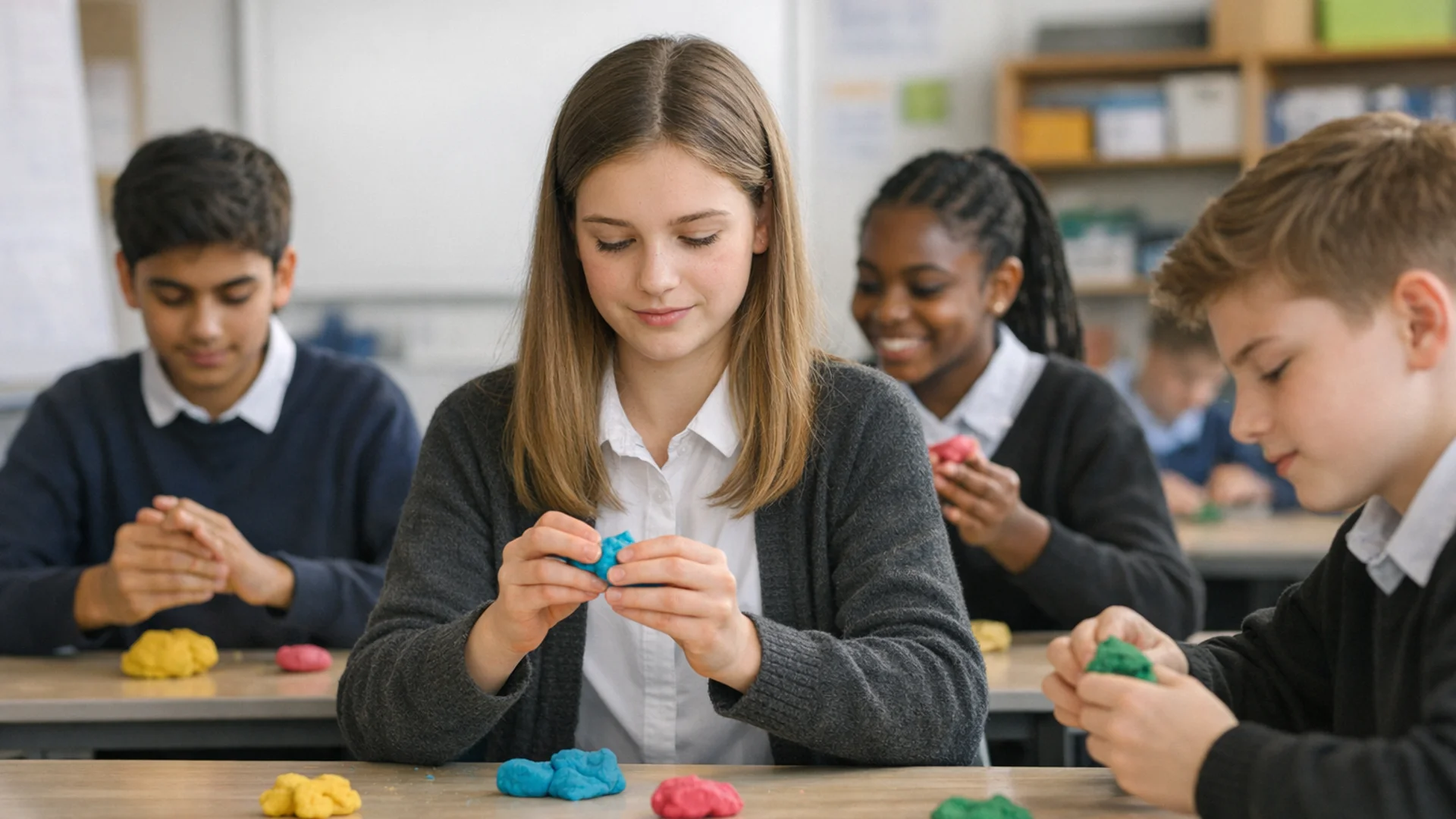
Dough Disco has become one of the most popular fine motor interventions in UK early years settings, with thousands of nurseries and reception classes using the approach daily. Created by early years specialist Shonette Bason, this three-minute daily routine combines playdough manipulation with music, building the hand strength, finger control, and coordination that children need for successful handwriting.
The appeal of Dough Disco lies in its simplicity: no expensive equipment, minimal preparation, maximum engagement. Children squeeze, roll, pinch, and stretch playdough in time with music, developing the intrinsic hand muscles that many modern children lack due to reduced opportunities for traditional hands-on play. This guide provides everything teachers need to implement Dough Disco effectively, including the evidence base, progression frameworks, and troubleshooting guidance.
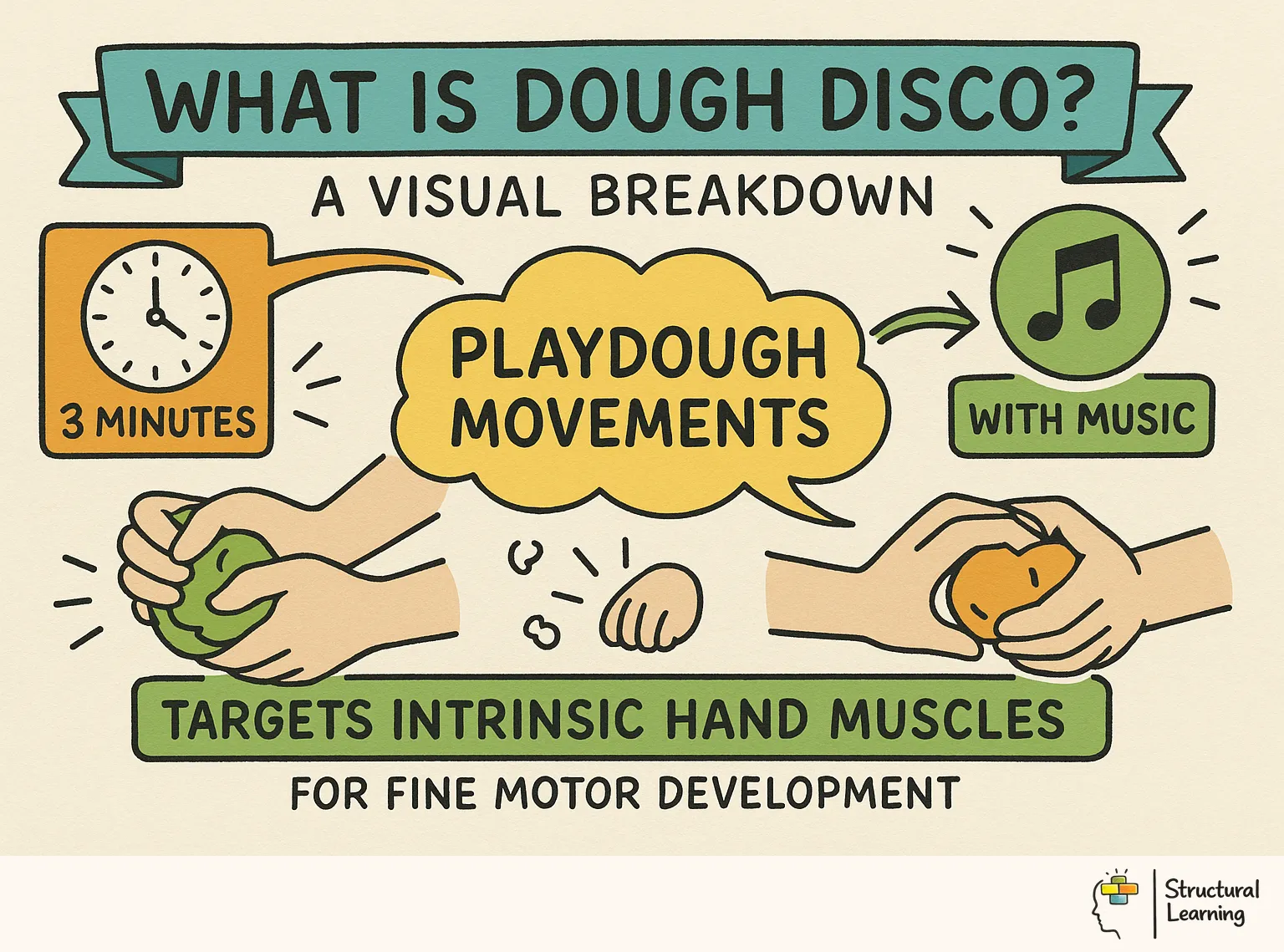
What Is Dough Disco? A Visual Breakdown
Key Takeaways
Three minutes with significant impact: Daily Dough Disco sessions of just three minutes can substantially improve fine motor skills and handwriting readiness when implemented consistently over 6-8 weeks
Targets intrinsic hand muscles: The specific movements in Dough Disco strengthen the small muscles within the hand that control finger movements, not just the larger arm muscles used in gross motor activities
Addresses modern fine motor deficit: Many children now enter school with weaker hand strength and finger control than previous generations due to reduced opportunities for traditional play, crafts, and manipulation activities
Progression matters: While any Dough Disco is better than none, following a structured progression from gross motor movements to refined finger isolation maximises developmental benefit
What Is Dough Disco?
Dough Disco is a fine motor intervention that combines playdough manipulation with music, creating an engaging daily routine that develops the hand strength and finger control children need for writing. The approach was developed by Shonette Bason, who drew on her experience as an early years teacher to create an activity that children love while building essential pre-writing skills.
Each Dough Disco session lasts approximately three minutes and follows a sequence of movements performed in time with music. Children hold a ball of playdough and manipulate it through various actions: squeezing, rolling, pinching, poking, stretching, and more complex movements as they progress. The musical accompaniment adds rhythm and enjoyment, transforming what could be tedious exercises into an anticipated daily activity.
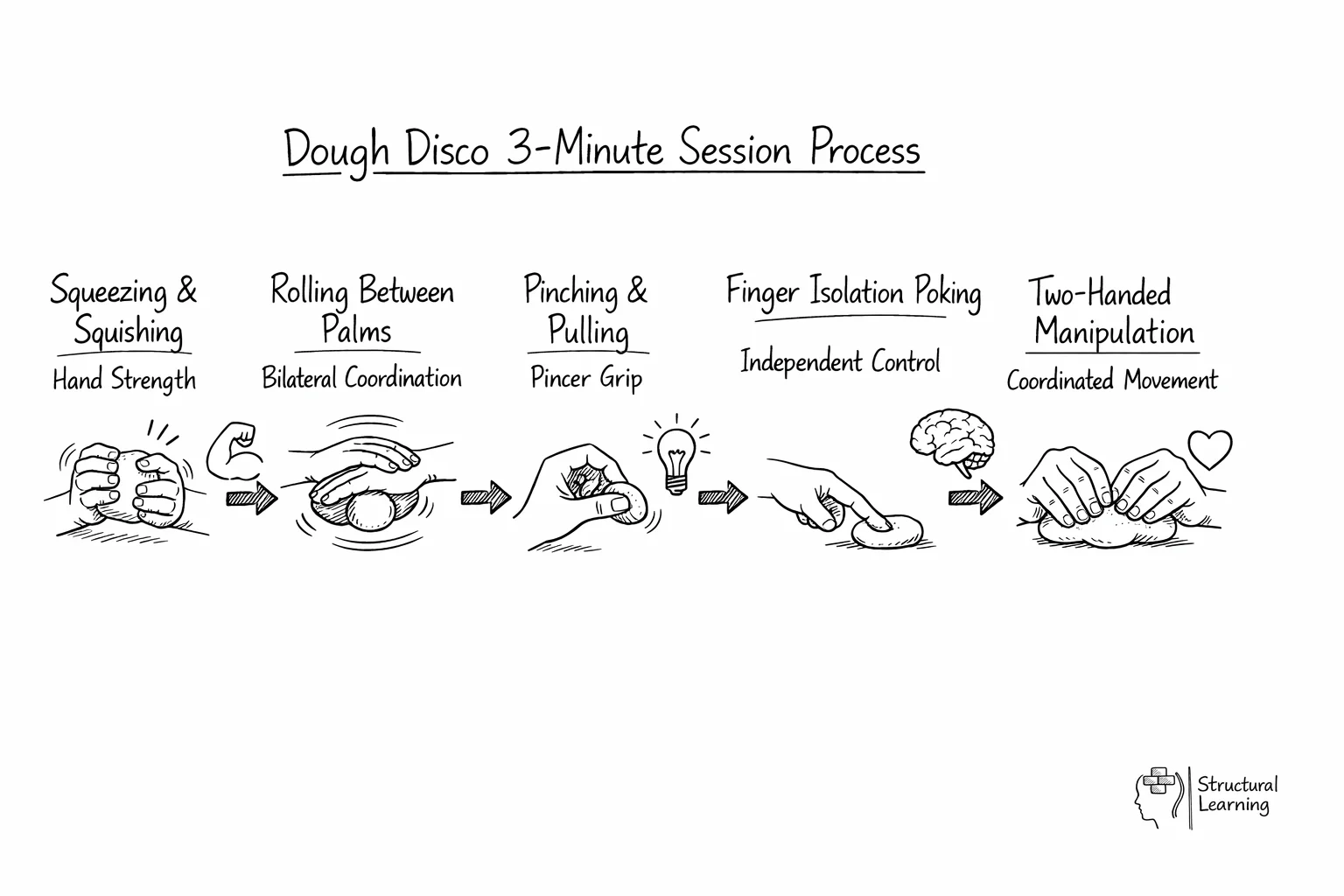
The movements target specific muscle groups and coordination patterns:
Squeezing and squishing develops overall hand strength and grip, working the larger hand muscles that provide the foundation for finer movements.
Rolling between palms builds bilateral coordination and proprioceptive awareness, helping children understand where their hands are in space.
Pinching and pulling develops the pincer grip essential for holding writing tools correctly, working the small muscles between thumb and fingers.
Finger isolation movements where children poke with individual fingers, builds the independent finger control needed for typing and detailed manipulation.
Two-handed manipulation where children roll snakes or form shapes, develops the coordinated hand movements used in everyday activities from buttoning to using scissors.
The Evidence Base for Fine Motor Development
While Dough Disco itself has limited formal research, it draws on well-established evidence about fine motor development and the importance of hand strength for writing readiness.
Hand strength predicts handwriting success: Research consistently shows that children with weaker hand strength struggle more with handwriting fluency and legibility. The muscles used for writing tire easily when weak, leading to fatigue, poor letter formation, and resistance to writing tasks.
Intrinsic muscles are essential: The intrinsic muscles of the hand, the small muscles located within the hand itself, control the fine finger movements needed for writing. These muscles are distinct from the extrinsic muscles in the forearm that provide power grip. Effective pre-writing activities should target both muscle groups.
Modern children have weaker hands: Occupational therapists increasingly report that children enter school with weaker hand strength and poorer fine motor skills than in previous decades. Factors include reduced outdoor play, decreased time with construction toys and crafts, and increased screen time that provides visual-motor practice but not the resistance needed to build strength.
Neurological development requires practice: The neural pathways controlling fine motor movements strengthen through repeated practice. Children need many thousands of repetitions of fine motor actions to develop fluent, automatic control. Short daily practice is more effective than occasional longer sessions.
Music enhances motor learning: Research on motor learning shows that rhythmic accompaniment improves movement timing, coordination, and retention. The musical element of Dough Disco is not merely decorative but serves a developmental function.
Engagement predicts outcomes: Perhaps most importantly, children must actually do an activity regularly for it to be effective. Dough Disco's high engagement levels mean children willingly participate daily, accumulating the practice time needed for skill development.
The Core Dough Disco Movements
Understanding the specific movements and their developmental purposes helps teachers implement Dough Disco with intention rather than simply following along. Each movement targets particular muscle groups and coordination patterns.
Squeeze and Release: Children squeeze the dough ball as tightly as possible, then release. This works overall grip strength, targeting both intrinsic and extrinsic hand muscles. Cue: "Squeeze it like you're juicing a lemon!"
Roll into a Ball: Using both palms, children roll the dough into a sphere. This develops bilateral coordination and proprioceptive awareness. The circular motion also builds shoulder stability. Cue: "Roll it round and round between your hands."
Pat Pat Pat: Children pat the dough ball on one palm with the other hand. This develops hand-eye coordination and alternating hand movements. Cue: "Pat the dough like a drum!"
Poke with Fingers: Children poke the dough with different fingers, starting with the index finger and progressing to pinky. This develops finger isolation, the ability to move individual fingers independently. Cue: "Poke, poke, poke with your pointy finger!"
Pinch and Pull: Children pinch pieces off the main ball using thumb and fingertips. This specifically targets the pincer grip used for holding pencils. Cue: "Pinch and pull like you're picking tiny flowers."
Roll a Snake: Children roll the dough between their palm and a flat surface to create a long snake shape. This develops wrist rotation and even pressure application. Cue: "Roll it back and forth to make a long, long snake."
Squeeze and Twist: Children squeeze while rotating their wrists. This combines grip strength with wrist mobility. Cue: "Squeeze and twist like you're wringing out a cloth."
Finger Walking: Children press their fingers into the dough one at a time, like fingers walking. This develops sequential finger control. Cue: "Let your fingers walk across the dough."
Progression Framework for Dough Disco
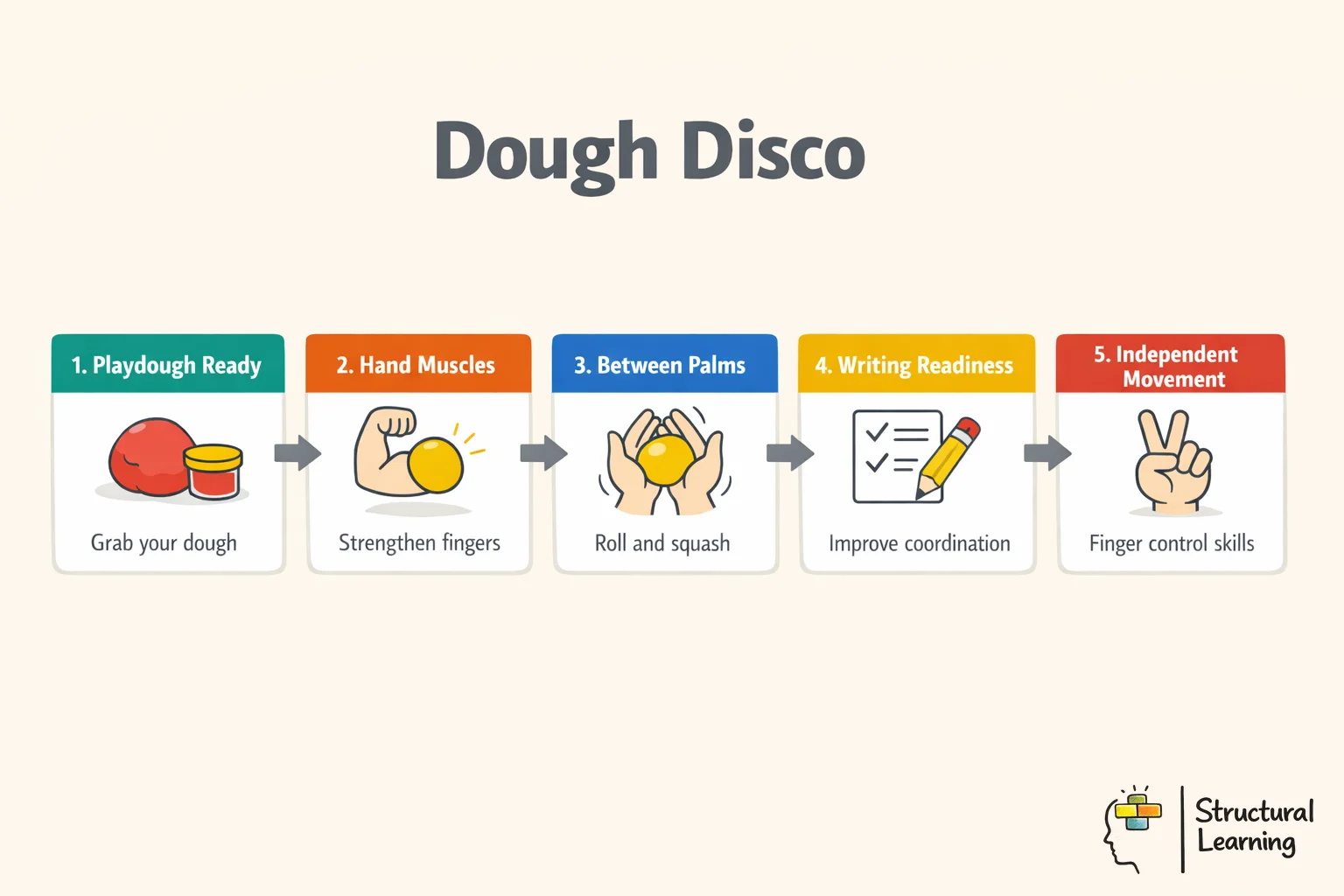
While Dough Disco can be done at any level, structured progression maximises developmental benefit. This framework guides progression from gross motor foundations to refined finger control over a 6-8 week period.
Focus on gross motor hand movements and basic bilateral coordination. Children new to fine motor activities need to build foundational strength before attempting refined movements.
Key movements:
Squeezing and releasing
Rolling between palms
Pat pat pat
Basic poking with whole hand pressure
Success indicators:
Children can maintain grip throughout the session
Dough forms a recognisable ball when rolled
Children can follow the rhythm with basic movements
Phase 2: Strengthening (Weeks 3-4)
Increase intensity and add movements requiring greater strength and control. Children should notice their hands becoming stronger.
Key movements:
All Phase 1 movements with longer holds
Roll a snake (requires sustained pressure)
Squeeze and twist
Pinch and pull small pieces
Success indicators:
Children can squeeze hard enough to leave finger impressions
Snakes maintain even thickness
Pinched pieces come away cleanly
Phase 3: Refinement (Weeks 5-6)
Introduce movements requiring finger isolation and precise control. These movements directly prepare for pencil grip and letter formation.
Timing: Schedule Dough Disco at the same time daily to establish routine. Many settings use it as a transition activity before writing or mark-making tasks. Morning sessions prepare hands for the day's fine motor demands.
Equipment: Each child needs their own ball of playdough, approximately the size of a tennis ball. Homemade playdough works well and can be made in school colours. Keep playdough fresh in airtight containers; dry, crumbly dough is harder to manipulate and less engaging.
Space: Children need enough space to move their arms freely. Tables work well but are not essential. Some settings use floor time with children sitting cross-legged.
Music: While official Dough Disco music is available (Spread the Happiness), any music with a clear beat works. Upbeat songs around 100-120 BPM suit most movements. Vary the music to maintain engagement.
Adult role: Adults should model movements enthusiastically. Initially, direct instruction helps children learn the movements. Over time, children can follow the music more independently while adults circulate to check technique.
Observation: Note children who struggle with particular movements, maintain grip, or show frustration. This identifies children who may need additional fine motor support.
The Dough Disco Movement Sequence
When Children Struggle: Troubleshooting Guide
Some children find Dough Disco challenging. Understanding why helps teachers provide appropriate support.
Child cannot maintain grip throughout the session:
Hands may fatigue quickly due to low baseline strength
Shorten sessions initially (start with one minute)
Offer rest breaks within the session
Check dough consistency; very stiff dough is harder to squeeze
Consider whether the child needs broader fine motor assessment
Child avoids poking with individual fingers:
Finger isolation develops later than whole-hand movements
Ensure Phase 1 and 2 are solid before expecting finger isolation
Make it playful: "Can your pointy finger find the buried treasure?"
Some children benefit from hand-over-hand guidance initially
Child finds the activity aversive:
Sensory sensitivities may make dough texture unpleasant
Try different dough recipes (some children prefer smoother textures)
Allow the child to use a utensil initially, then gradually transition
For children with significant sensory issues, consult occupational therapy
Child cannot follow the rhythm:
Rhythmic timing is a separate skill from motor ability
Start with slower music
Accept that movements may lag behind the beat initially
Focus on movement quality rather than perfect timing
No improvement despite consistent practice:
Consider whether fine motor difficulties reflect broader developmental concerns
Compare performance on Dough Disco with other fine motor tasks
Consult with occupational therapist or educational psychologist
Some children need more intensive, individualised intervention
Complementary Fine Motor Activities
Dough Disco works best as part of a rich fine motor environment, not as the sole intervention. Complementary activities reinforce skills and provide variety.
Construction activities: Lego, Duplo, and other construction toys develop grip strength and bilateral coordination. Threading beads develops pincer grip and eye-hand coordination.
Scissor skills: Cutting develops the same muscles as writing and provides excellent bilateral coordination practice. Progress from snipping to cutting straight lines to cutting curves.
Finger rhymes and games: Traditional finger plays like "Incy Wincy Spider" develop finger isolation and sequential control. Finger puppets encourage individual finger movement.
Messy play: Sensory activities like sand, water, and foam provide resistance training for hands. Finger painting develops finger isolation and pressure control.
Daily living skills: Buttons, zips, and laces all develop fine motor skills. Allow children time for self-care rather than rushing these activities.
Writing tools variety: Before conventional pencils, children benefit from chunky crayons, short chalks, and triangular pencils. Varying tools develops adaptive grip.
Vertical surfaces: Drawing and writing on vertical surfaces (easels, wall-mounted boards) develops shoulder stability and appropriate wrist position.
Assessment of Fine Motor Progress
Monitoring progress helps identify children who need additional support and demonstrates programme effectiveness.
Informal observation: Note changes in grip strength, movement quality, and stamina during Dough Disco. Can children maintain grip for longer? Are movements becoming more precise?
Writing observation: Track changes in pencil grip, pressure, stamina, and letter formation. Children with improving fine motor skills should show more comfortable, controlled writing.
Standardised assessments: Tools like the Movement ABC or Bruininks-Oseretsky Test of Motor Proficiency provide formal fine motor assessment. Consider using these for children whose progress seems atypical.
Progress indicators to track:
Duration of sustained grip
Quality of pincer grip (thumb-finger opposition)
Finger isolation ability (can they move fingers independently?)
Bilateral coordination (can they roll smoothly with two hands?)
Stamina (do they fatigue less quickly?)
Transfer (do skills appear in other fine motor tasks?)
Photography and video: Record children doing Dough Disco at the start of the year and termly thereafter. Visual comparison often shows progress that is hard to capture otherwise.
Working with Parents
Parent involvement extends fine motor development beyond the school day.
Communication about Dough Disco: Explain to parents why the school uses Dough Disco and how it supports writing readiness. Some parents may initially question time spent on "play" activities.
Home activities: Suggest simple home activities that develop similar skills: helping with cooking (kneading dough, stirring), playdough play, construction toys, threading activities, buttoning practice.
Dough recipes: Share homemade playdough recipes so families can continue activities at home. Basic recipes require only flour, salt, water, oil, and food colouring.
Cautions: Advise parents that forcing writing practice is counterproductive if hand strength is not yet sufficient. Building foundations through play is more effective than premature formal instruction.
Referral conversations: If concerns arise about a child's fine motor development, discuss with parents early. Occupational therapy referral may be appropriate for children with significant difficulties.
Frequently Asked Questions
How long before we see results?
Most teachers report noticeable improvements in hand strength and writing stamina after 4-6 weeks of daily practice. More refined skills like finger isolation take longer. Consistency is key; sporadic implementation produces limited results.
What if we do not have official Dough Disco music?
Any music with a clear, moderate beat works well. Many teachers create playlists of familiar songs. The key is rhythmic support for movements, not specific music.
Can older children benefit?
While developed for early years, Dough Disco benefits any child with weak hand strength or poor fine motor control. Year 1 and Year 2 children with writing difficulties often benefit. Older children may prefer to call it "hand strength exercises" rather than Dough Disco.
What about children with allergies?
Standard playdough contains wheat, which concerns some families. Gluten-free alternatives using rice flour or cornflour work well. For severe allergies, theraputty or similar products provide alternatives.
Is three minutes really enough?
Research on motor learning suggests short, frequent practice is more effective than occasional long sessions. Three minutes daily accumulates to fifteen minutes per week and an hour per month; enough practice to build skills without tedium.
Should we do Dough Disco every day?
Ideally, yes. Daily practice builds neural pathways more effectively than sporadic sessions. If daily is impossible, aim for at least three times weekly, understanding that progress may be slower.
More Than Ever infographic for teachers" loading="lazy">
Why Modern Children Need Dough Disco More Than Ever
Further Reading: Key Research Papers
Fine Motor Skills Predict Handwriting SuccessView study ↗ by Cameron et al. (2012) examines the relationship between early fine motor abilities and later handwriting outcomes. The researchers followed children from preschool through early primary years, finding that fine motor skills at school entry strongly predicted handwriting fluency and legibility. This research supports the rationale for pre-writing interventions like Dough Disco.
The Development of Fine Motor Skills in Young ChildrenView study ↗ by Suggate, Pufke, and Stoeger (2018) reviews the developmental trajectory of fine motor control and factors that influence it. The authors discuss the role of intrinsic hand muscles, the importance of varied practice activities, and the relationship between fine motor skills and academic achievement. Teachers will find useful frameworks for understanding fine motor development stages.
Effects of Music on Motor Learning and PerformanceView study ↗ by Thaut and Abiru (2010) explores how rhythmic auditory stimulation affects motor skill acquisition and performance. The research demonstrates that music enhances motor timing, coordination, and learning transfer. This provides neuroscientific support for the musical component of Dough Disco.
The Decline in Children's Fine Motor SkillsView study ↗ by Marr, Cermak, Cohn, and Henderson (2003) documents changes in children's fine motor abilities over time and explores contributing factors. The authors report that occupational therapists increasingly see children with weaker hand strength and poorer dexterity than in previous decades, attributing this to changes in play patterns and lifestyle. This research contextualises why interventions like Dough Disco are increasingly necessary.
Handwriting Development in Young ChildrenView study ↗ by Feder and Majnemer (2007) provides a comprehensive review of factors affecting handwriting acquisition, including fine motor prerequisites. The authors discuss the hand strength and coordination needed for writing and review evidence for various pre-writing interventions. This paper helps teachers understand how Dough Disco fits within broader handwriting development.
Dough Disco has become one of the most popular fine motor interventions in UK early years settings, with thousands of nurseries and reception classes using the approach daily. Created by early years specialist Shonette Bason, this three-minute daily routine combines playdough manipulation with music, building the hand strength, finger control, and coordination that children need for successful handwriting.
The appeal of Dough Disco lies in its simplicity: no expensive equipment, minimal preparation, maximum engagement. Children squeeze, roll, pinch, and stretch playdough in time with music, developing the intrinsic hand muscles that many modern children lack due to reduced opportunities for traditional hands-on play. This guide provides everything teachers need to implement Dough Disco effectively, including the evidence base, progression frameworks, and troubleshooting guidance.
What Is Dough Disco? A Visual Breakdown
Key Takeaways
Three minutes with significant impact: Daily Dough Disco sessions of just three minutes can substantially improve fine motor skills and handwriting readiness when implemented consistently over 6-8 weeks
Targets intrinsic hand muscles: The specific movements in Dough Disco strengthen the small muscles within the hand that control finger movements, not just the larger arm muscles used in gross motor activities
Addresses modern fine motor deficit: Many children now enter school with weaker hand strength and finger control than previous generations due to reduced opportunities for traditional play, crafts, and manipulation activities
Progression matters: While any Dough Disco is better than none, following a structured progression from gross motor movements to refined finger isolation maximises developmental benefit
What Is Dough Disco?
Dough Disco is a fine motor intervention that combines playdough manipulation with music, creating an engaging daily routine that develops the hand strength and finger control children need for writing. The approach was developed by Shonette Bason, who drew on her experience as an early years teacher to create an activity that children love while building essential pre-writing skills.
Each Dough Disco session lasts approximately three minutes and follows a sequence of movements performed in time with music. Children hold a ball of playdough and manipulate it through various actions: squeezing, rolling, pinching, poking, stretching, and more complex movements as they progress. The musical accompaniment adds rhythm and enjoyment, transforming what could be tedious exercises into an anticipated daily activity.
The movements target specific muscle groups and coordination patterns:
Squeezing and squishing develops overall hand strength and grip, working the larger hand muscles that provide the foundation for finer movements.
Rolling between palms builds bilateral coordination and proprioceptive awareness, helping children understand where their hands are in space.
Pinching and pulling develops the pincer grip essential for holding writing tools correctly, working the small muscles between thumb and fingers.
Finger isolation movements where children poke with individual fingers, builds the independent finger control needed for typing and detailed manipulation.
Two-handed manipulation where children roll snakes or form shapes, develops the coordinated hand movements used in everyday activities from buttoning to using scissors.
The Evidence Base for Fine Motor Development
While Dough Disco itself has limited formal research, it draws on well-established evidence about fine motor development and the importance of hand strength for writing readiness.
Hand strength predicts handwriting success: Research consistently shows that children with weaker hand strength struggle more with handwriting fluency and legibility. The muscles used for writing tire easily when weak, leading to fatigue, poor letter formation, and resistance to writing tasks.
Intrinsic muscles are essential: The intrinsic muscles of the hand, the small muscles located within the hand itself, control the fine finger movements needed for writing. These muscles are distinct from the extrinsic muscles in the forearm that provide power grip. Effective pre-writing activities should target both muscle groups.
Modern children have weaker hands: Occupational therapists increasingly report that children enter school with weaker hand strength and poorer fine motor skills than in previous decades. Factors include reduced outdoor play, decreased time with construction toys and crafts, and increased screen time that provides visual-motor practice but not the resistance needed to build strength.
Neurological development requires practice: The neural pathways controlling fine motor movements strengthen through repeated practice. Children need many thousands of repetitions of fine motor actions to develop fluent, automatic control. Short daily practice is more effective than occasional longer sessions.
Music enhances motor learning: Research on motor learning shows that rhythmic accompaniment improves movement timing, coordination, and retention. The musical element of Dough Disco is not merely decorative but serves a developmental function.
Engagement predicts outcomes: Perhaps most importantly, children must actually do an activity regularly for it to be effective. Dough Disco's high engagement levels mean children willingly participate daily, accumulating the practice time needed for skill development.
The Core Dough Disco Movements
Understanding the specific movements and their developmental purposes helps teachers implement Dough Disco with intention rather than simply following along. Each movement targets particular muscle groups and coordination patterns.
Squeeze and Release: Children squeeze the dough ball as tightly as possible, then release. This works overall grip strength, targeting both intrinsic and extrinsic hand muscles. Cue: "Squeeze it like you're juicing a lemon!"
Roll into a Ball: Using both palms, children roll the dough into a sphere. This develops bilateral coordination and proprioceptive awareness. The circular motion also builds shoulder stability. Cue: "Roll it round and round between your hands."
Pat Pat Pat: Children pat the dough ball on one palm with the other hand. This develops hand-eye coordination and alternating hand movements. Cue: "Pat the dough like a drum!"
Poke with Fingers: Children poke the dough with different fingers, starting with the index finger and progressing to pinky. This develops finger isolation, the ability to move individual fingers independently. Cue: "Poke, poke, poke with your pointy finger!"
Pinch and Pull: Children pinch pieces off the main ball using thumb and fingertips. This specifically targets the pincer grip used for holding pencils. Cue: "Pinch and pull like you're picking tiny flowers."
Roll a Snake: Children roll the dough between their palm and a flat surface to create a long snake shape. This develops wrist rotation and even pressure application. Cue: "Roll it back and forth to make a long, long snake."
Squeeze and Twist: Children squeeze while rotating their wrists. This combines grip strength with wrist mobility. Cue: "Squeeze and twist like you're wringing out a cloth."
Finger Walking: Children press their fingers into the dough one at a time, like fingers walking. This develops sequential finger control. Cue: "Let your fingers walk across the dough."
Progression Framework for Dough Disco
While Dough Disco can be done at any level, structured progression maximises developmental benefit. This framework guides progression from gross motor foundations to refined finger control over a 6-8 week period.
Focus on gross motor hand movements and basic bilateral coordination. Children new to fine motor activities need to build foundational strength before attempting refined movements.
Key movements:
Squeezing and releasing
Rolling between palms
Pat pat pat
Basic poking with whole hand pressure
Success indicators:
Children can maintain grip throughout the session
Dough forms a recognisable ball when rolled
Children can follow the rhythm with basic movements
Phase 2: Strengthening (Weeks 3-4)
Increase intensity and add movements requiring greater strength and control. Children should notice their hands becoming stronger.
Key movements:
All Phase 1 movements with longer holds
Roll a snake (requires sustained pressure)
Squeeze and twist
Pinch and pull small pieces
Success indicators:
Children can squeeze hard enough to leave finger impressions
Snakes maintain even thickness
Pinched pieces come away cleanly
Phase 3: Refinement (Weeks 5-6)
Introduce movements requiring finger isolation and precise control. These movements directly prepare for pencil grip and letter formation.
Timing: Schedule Dough Disco at the same time daily to establish routine. Many settings use it as a transition activity before writing or mark-making tasks. Morning sessions prepare hands for the day's fine motor demands.
Equipment: Each child needs their own ball of playdough, approximately the size of a tennis ball. Homemade playdough works well and can be made in school colours. Keep playdough fresh in airtight containers; dry, crumbly dough is harder to manipulate and less engaging.
Space: Children need enough space to move their arms freely. Tables work well but are not essential. Some settings use floor time with children sitting cross-legged.
Music: While official Dough Disco music is available (Spread the Happiness), any music with a clear beat works. Upbeat songs around 100-120 BPM suit most movements. Vary the music to maintain engagement.
Adult role: Adults should model movements enthusiastically. Initially, direct instruction helps children learn the movements. Over time, children can follow the music more independently while adults circulate to check technique.
Observation: Note children who struggle with particular movements, maintain grip, or show frustration. This identifies children who may need additional fine motor support.
The Dough Disco Movement Sequence
When Children Struggle: Troubleshooting Guide
Some children find Dough Disco challenging. Understanding why helps teachers provide appropriate support.
Child cannot maintain grip throughout the session:
Hands may fatigue quickly due to low baseline strength
Shorten sessions initially (start with one minute)
Offer rest breaks within the session
Check dough consistency; very stiff dough is harder to squeeze
Consider whether the child needs broader fine motor assessment
Child avoids poking with individual fingers:
Finger isolation develops later than whole-hand movements
Ensure Phase 1 and 2 are solid before expecting finger isolation
Make it playful: "Can your pointy finger find the buried treasure?"
Some children benefit from hand-over-hand guidance initially
Child finds the activity aversive:
Sensory sensitivities may make dough texture unpleasant
Try different dough recipes (some children prefer smoother textures)
Allow the child to use a utensil initially, then gradually transition
For children with significant sensory issues, consult occupational therapy
Child cannot follow the rhythm:
Rhythmic timing is a separate skill from motor ability
Start with slower music
Accept that movements may lag behind the beat initially
Focus on movement quality rather than perfect timing
No improvement despite consistent practice:
Consider whether fine motor difficulties reflect broader developmental concerns
Compare performance on Dough Disco with other fine motor tasks
Consult with occupational therapist or educational psychologist
Some children need more intensive, individualised intervention
Complementary Fine Motor Activities
Dough Disco works best as part of a rich fine motor environment, not as the sole intervention. Complementary activities reinforce skills and provide variety.
Construction activities: Lego, Duplo, and other construction toys develop grip strength and bilateral coordination. Threading beads develops pincer grip and eye-hand coordination.
Scissor skills: Cutting develops the same muscles as writing and provides excellent bilateral coordination practice. Progress from snipping to cutting straight lines to cutting curves.
Finger rhymes and games: Traditional finger plays like "Incy Wincy Spider" develop finger isolation and sequential control. Finger puppets encourage individual finger movement.
Messy play: Sensory activities like sand, water, and foam provide resistance training for hands. Finger painting develops finger isolation and pressure control.
Daily living skills: Buttons, zips, and laces all develop fine motor skills. Allow children time for self-care rather than rushing these activities.
Writing tools variety: Before conventional pencils, children benefit from chunky crayons, short chalks, and triangular pencils. Varying tools develops adaptive grip.
Vertical surfaces: Drawing and writing on vertical surfaces (easels, wall-mounted boards) develops shoulder stability and appropriate wrist position.
Assessment of Fine Motor Progress
Monitoring progress helps identify children who need additional support and demonstrates programme effectiveness.
Informal observation: Note changes in grip strength, movement quality, and stamina during Dough Disco. Can children maintain grip for longer? Are movements becoming more precise?
Writing observation: Track changes in pencil grip, pressure, stamina, and letter formation. Children with improving fine motor skills should show more comfortable, controlled writing.
Standardised assessments: Tools like the Movement ABC or Bruininks-Oseretsky Test of Motor Proficiency provide formal fine motor assessment. Consider using these for children whose progress seems atypical.
Progress indicators to track:
Duration of sustained grip
Quality of pincer grip (thumb-finger opposition)
Finger isolation ability (can they move fingers independently?)
Bilateral coordination (can they roll smoothly with two hands?)
Stamina (do they fatigue less quickly?)
Transfer (do skills appear in other fine motor tasks?)
Photography and video: Record children doing Dough Disco at the start of the year and termly thereafter. Visual comparison often shows progress that is hard to capture otherwise.
Working with Parents
Parent involvement extends fine motor development beyond the school day.
Communication about Dough Disco: Explain to parents why the school uses Dough Disco and how it supports writing readiness. Some parents may initially question time spent on "play" activities.
Home activities: Suggest simple home activities that develop similar skills: helping with cooking (kneading dough, stirring), playdough play, construction toys, threading activities, buttoning practice.
Dough recipes: Share homemade playdough recipes so families can continue activities at home. Basic recipes require only flour, salt, water, oil, and food colouring.
Cautions: Advise parents that forcing writing practice is counterproductive if hand strength is not yet sufficient. Building foundations through play is more effective than premature formal instruction.
Referral conversations: If concerns arise about a child's fine motor development, discuss with parents early. Occupational therapy referral may be appropriate for children with significant difficulties.
Frequently Asked Questions
How long before we see results?
Most teachers report noticeable improvements in hand strength and writing stamina after 4-6 weeks of daily practice. More refined skills like finger isolation take longer. Consistency is key; sporadic implementation produces limited results.
What if we do not have official Dough Disco music?
Any music with a clear, moderate beat works well. Many teachers create playlists of familiar songs. The key is rhythmic support for movements, not specific music.
Can older children benefit?
While developed for early years, Dough Disco benefits any child with weak hand strength or poor fine motor control. Year 1 and Year 2 children with writing difficulties often benefit. Older children may prefer to call it "hand strength exercises" rather than Dough Disco.
What about children with allergies?
Standard playdough contains wheat, which concerns some families. Gluten-free alternatives using rice flour or cornflour work well. For severe allergies, theraputty or similar products provide alternatives.
Is three minutes really enough?
Research on motor learning suggests short, frequent practice is more effective than occasional long sessions. Three minutes daily accumulates to fifteen minutes per week and an hour per month; enough practice to build skills without tedium.
Should we do Dough Disco every day?
Ideally, yes. Daily practice builds neural pathways more effectively than sporadic sessions. If daily is impossible, aim for at least three times weekly, understanding that progress may be slower.
More Than Ever infographic for teachers" loading="lazy">
Why Modern Children Need Dough Disco More Than Ever
Further Reading: Key Research Papers
Fine Motor Skills Predict Handwriting SuccessView study ↗ by Cameron et al. (2012) examines the relationship between early fine motor abilities and later handwriting outcomes. The researchers followed children from preschool through early primary years, finding that fine motor skills at school entry strongly predicted handwriting fluency and legibility. This research supports the rationale for pre-writing interventions like Dough Disco.
The Development of Fine Motor Skills in Young ChildrenView study ↗ by Suggate, Pufke, and Stoeger (2018) reviews the developmental trajectory of fine motor control and factors that influence it. The authors discuss the role of intrinsic hand muscles, the importance of varied practice activities, and the relationship between fine motor skills and academic achievement. Teachers will find useful frameworks for understanding fine motor development stages.
Effects of Music on Motor Learning and PerformanceView study ↗ by Thaut and Abiru (2010) explores how rhythmic auditory stimulation affects motor skill acquisition and performance. The research demonstrates that music enhances motor timing, coordination, and learning transfer. This provides neuroscientific support for the musical component of Dough Disco.
The Decline in Children's Fine Motor SkillsView study ↗ by Marr, Cermak, Cohn, and Henderson (2003) documents changes in children's fine motor abilities over time and explores contributing factors. The authors report that occupational therapists increasingly see children with weaker hand strength and poorer dexterity than in previous decades, attributing this to changes in play patterns and lifestyle. This research contextualises why interventions like Dough Disco are increasingly necessary.
Handwriting Development in Young ChildrenView study ↗ by Feder and Majnemer (2007) provides a comprehensive review of factors affecting handwriting acquisition, including fine motor prerequisites. The authors discuss the hand strength and coordination needed for writing and review evidence for various pre-writing interventions. This paper helps teachers understand how Dough Disco fits within broader handwriting development.