Updated on
February 17, 2026
ELSA: A Teacher's Guide to Emotional Literacy Support Assistants
|
February 17, 2026


Updated on
February 17, 2026
|
February 17, 2026
Emotional literacy is the foundation of successful learning in any classroom. When children cannot manage their feelings, they often struggle to access the curriculum. This guide examines the role of Emotional Literacy Support Assistants, commonly known as ELSAs. It provides a roadmap for Special Educational Needs Coordinators and teachers to integrate this support effectively.
The ELSA project recognises that children learn better when their emotional needs are met. It is an evidence-based intervention that has grown significantly across the United Kingdom. By providing targeted support, schools can help pupils build the internal tools they need for resilience. This article explains how the programme works and why it remains a popular choice for primary and secondary schools.

* ELSAs are trained members of staff who support the emotional needs of pupils within a school setting.
* The programme was developed by Sheila Burton to help schools build their internal capacity for emotional support.
* Training and regular supervision from Educational Psychologists are essential components of the role.
* Interventions are usually short term and focused on specific, measurable goals for each child.
* Support covers five core areas: emotional awareness, social skills, self-esteem, anger management, and loss.
* Success is measured through observation, pupil feedback, and standardized tools like the Strengths and Difficulties Questionnaire.
* The ELSA role is distinct from counselling or therapy, focusing instead on teaching emotional skills.
ELSA stands for Emotional Literacy Support Assistant. This role was established by Sheila Burton, a Senior Educational Psychologist, to address a gap in school provision. She noticed that many children required emotional support that did not meet the threshold for external clinical services. ELSAs are typically Teaching Assistants who undergo specialised training to deliver these interventions.
The primary goal is to help pupils recognise, understand, and manage their emotions. Daniel Goleman, a leading figure in emotional intelligence research, argues that these skills are as important as academic IQ. He suggests that self-awareness and empathy are the building blocks of a successful life. ELSAs put these theories into practise by working directly with children in a school environment.
Katherine Weare has also influenced this field through her work on social and emotional learning. She emphasizes that emotional well-being should be integrated into the whole school culture. The ELSA programme aligns with this view by enabling school staff to lead the change. It moves away from the idea that emotional support is only for a small minority of pupils.
Instead, the programme suggests that emotional literacy is a skill that can be taught. It is not an innate trait that children either have or do not have. Through consistent, structured sessions, children can learn to navigate complex social situations. This approach reduces the pressure on teachers and creates a more harmonious classroom atmosphere.
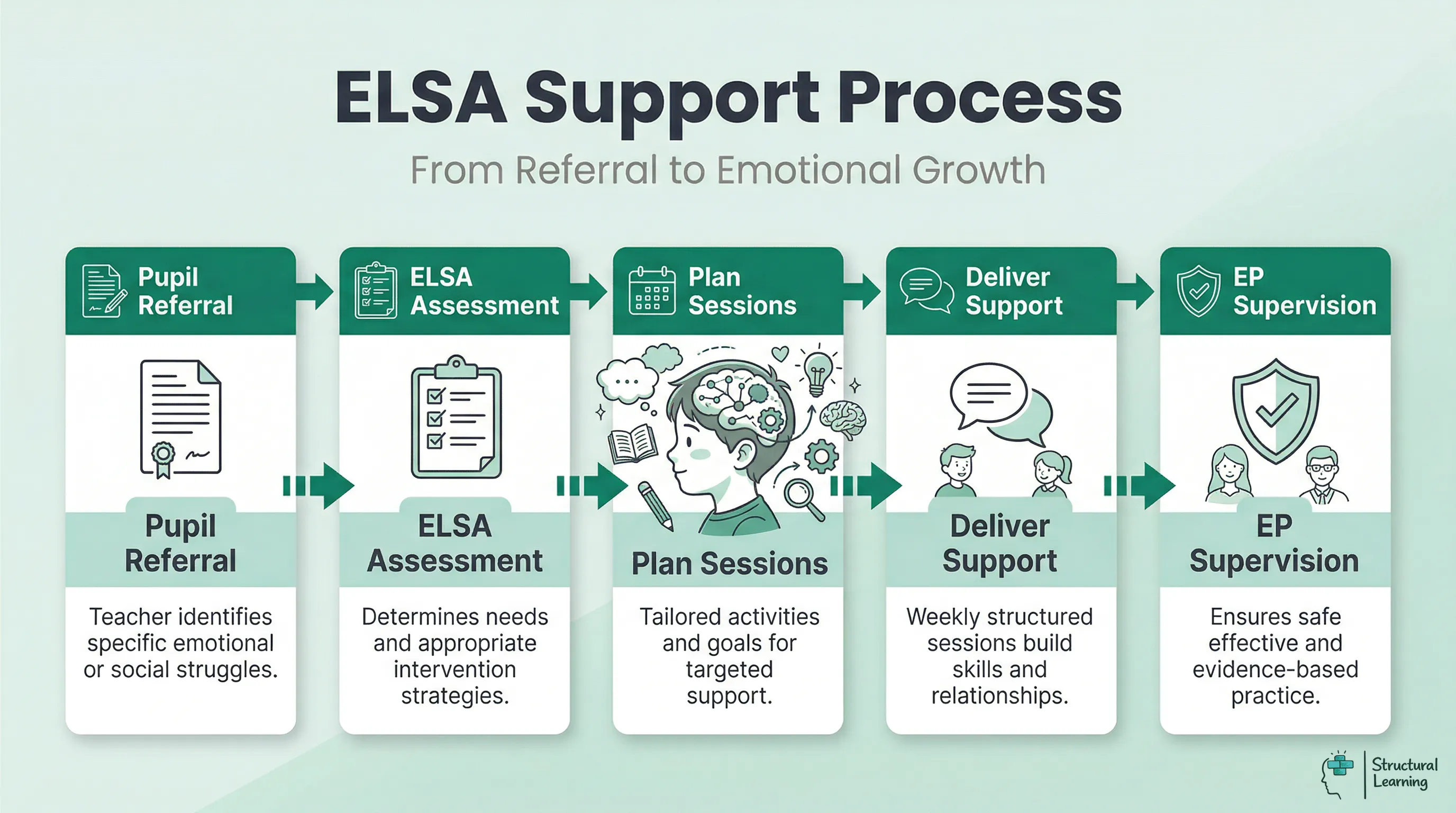
The ELSA programme follows a structured process to ensure that support reaches those who need it most. It begins with a referral, usually made by a class teacher or the SENCO. This referral identifies specific areas where a pupil is struggling, such as making friends or managing frustration. The ELSA then assesses the child to determine the best course of action.
Once a pupil is accepted for support, the ELSA plans a series of sessions. These sessions are usually held once a week and last between thirty and forty-five minutes. Each session is designed to be engaging and age-appropriate, often using games, drawing, or stories. The focus remains on building a trusting relationship between the pupil and the assistant.
Supervision is a non-negotiable part of how the programme functions. ELSAs must meet regularly with Educational Psychologists to discuss their work. This ensures that the interventions remain safe and effective for the children involved. It also provides the ELSA with a space to reflect on their own professional development.
The sessions themselves follow a consistent structure to provide a sense of security. They typically start with a check-in to see how the child is feeling that day. This is followed by a main activity focused on the child's specific goals. The session concludes with a calming activity or a review of what has been learned.
The ELSA curriculum is built around five core areas of development. Each area addresses a different aspect of a child's emotional life. By focusing on these skills, ELSAs provide a balanced approach to emotional growth.
This skill involves helping children identify and name their feelings. Many pupils struggle because they cannot distinguish between sadness, frustration, or fear. They might react to every negative emotion with physical aggression or total withdrawal. ELSAs use tools like "emotion wheels" to help children expand their emotional vocabulary.
Research by Daniel Goleman shows that naming an emotion can reduce its intensity. When a child can say "I feel anxious," they are one step closer to managing that anxiety. This awareness also extends to recognising emotions in others. Empathy is built on the ability to read facial expressions and body language accurately.
Social skills are essential for building and maintaining friendships. Some children find it difficult to take turns, share, or listen to their peers. ELSAs work on these areas through role-play and social stories. These activities allow children to practise social interactions in a safe, controlled environment.
Alex Padesky's work on cognitive-behavioural patterns is often reflected in how social skills are taught. By changing how a child thinks about a social situation, they can change their behaviour. For example, a child might learn that a peer bumping into them was an accident rather than a deliberate attack. This shift in perspective can prevent many playground conflicts.
High self-esteem is a protective factor against many mental health challenges. Children with low self-esteem often give up easily or avoid new challenges altogether. ELSAs help these pupils by identifying their strengths and celebrating their successes. They focus on building a "growth mindset" where mistakes are seen as opportunities to learn.
Building self-esteem is not about empty praise. It is about helping children develop a realistic and positive sense of self. ELSAs might create a "success journal" with a pupil to track their daily achievements. This tangible evidence helps the child internalise their capabilities over time.
Anger is a natural emotion, but it can become a problem when it leads to destructive behaviour. ELSAs teach children to recognise the physical signs of anger before it boils over. This might include a racing heart, clenched fists, or a hot face. Once these signs are identified, the child can use "calm-down" strategies.
These strategies often include deep breathing, counting to ten, or finding a quiet space. The goal is to give the child a "buffer" between the feeling of anger and their reaction. By slowing down the process, children learn that they have a choice in how they respond. This skill is vital for maintaining a safe and productive classroom environment.
Dealing with loss is one of the most difficult challenges a child can face. This is not limited to the death of a loved one; it can also include parental separation or a friend moving away. ELSAs provide a compassionate space for children to process their grief. They use memory boxes and specialised books to help children express their feelings.
The ELSA does not act as a bereavement counsellor, but they offer vital early support. They help children understand that their feelings of sadness and confusion are normal. This validation can prevent long-term emotional distress and help the child feel less isolated. It allows the school to be a place of stability during a time of great change.
Becoming an ELSA requires a significant commitment to professional learning. The initial training usually lasts five or six days and is delivered by Educational Psychologists. This course covers the psychological theories behind emotional literacy and practical intervention strategies. Participants learn how to plan sessions, set goals, and monitor progress.
The role of the Educational Psychologist (EP) does not end once the training is finished. EPs provide ongoing supervision to ELSAs throughout the school year. These sessions allow assistants to share their successes and seek advice on difficult cases. It ensures that the support provided is grounded in current psychological research.
Ongoing CPD is also a key feature of the programme. Schools are encouraged to allow ELSAs time to attend local networking meetings. These meetings provide opportunities to share resources and learn from the experiences of other assistants. It creates a community of practise that benefits both the staff and the pupils.
Without this supervision and training, the ELSA role would lack the necessary professional boundaries. The EP ensures that ELSAs do not take on work that should be handled by a qualified therapist. This structure protects the well-being of the assistant as well as the child. It maintains the integrity of the programme as a school-based, educational intervention.

Schools often use various programmes to support emotional well-being. It is helpful to understand how ELSA compares to other popular models. The following table outlines the key differences.
| Approach | Focus | Delivery | Key Characteristics |
| :--- | :--- | :--- | :--- |
| ELSA | Emotional Literacy | Trained TA | EP-supervised, goal-oriented, school-based. |
| Thrive | Neuroscience/Attachment | Thrive Practitioner | Focuses on developmental gaps and brain science. |
| Place2Be | Mental Health | Qualified Counsellors | Clinical approach, 1:1 counselling, parent support. |
| Zones of Regulation | Self-Regulation | Class Teacher/TA | Cognitive-behavioural, uses four colour-coded zones. |
| Nurture Groups | Social/Emotional Gaps | Teacher & TA | Small group setting, mirrors home environment. |
While ELSA focuses on teaching specific emotional skills, Thrive looks more at early developmental stages. Place2Be provides a more clinical level of support that may be needed for children with complex mental health needs. Zones of Regulation is often used as a whole-class tool to help children monitor their energy levels. Nurture Groups provide a more immersive, long-term environment for children who find the main classroom overwhelming.
Choosing the right approach depends on the specific needs of the pupil and the resources of the school. Many schools find that a combination of these methods works best. For example, Zones of Regulation might be used across the school, while ELSA provides targeted support for individuals. This tiered approach ensures that every child receives the appropriate level of care.
It is vital to demonstrate that ELSA interventions are making a difference. Without clear evidence, it is difficult to justify the time and expense of the programme. Schools use several different methods to measure the impact of the support.
One common tool is the Strengths and Difficulties Questionnaire (SDQ). This is a brief behavioural screening tool that can be completed by teachers, parents, and older children. By comparing scores before and after the intervention, schools can see changes in emotional symptoms or peer problems. It provides a standardised way to track progress over several months.
Qualitative feedback is also highly valuable. ELSAs often collect "pupil voice" data to see how the children feel about the sessions. A child might report that they feel more confident in the playground or better at staying calm in class. Teachers can also provide feedback on changes they have observed in the child's classroom behaviour.
Academic progress can sometimes be used as an indirect measure of success. When a child's emotional barriers are removed, they are often better able to focus on their lessons. While ELSA is not an academic intervention, the link between well-being and attainment is well-documented. Improved attendance and a reduction in behavioural incidents are also clear indicators of a positive impact.
Implementing an ELSA programme requires careful planning and support from senior leadership. The following tips can help ensure the programme is successful in your school.
1. Secure a Dedicated Space. Children need a quiet, safe, and private area for their ELSA sessions. This space should be consistent so the child knows where they are going each week. It does not need to be a large room, but it should be comfortable and free from interruptions.
2. Protect the ELSA's Time. The most common barrier to success is the ELSA being pulled away for other duties. If an assistant is constantly asked to cover classes or do playground duty, their sessions will suffer. It is essential that the ELSA has a fixed timetable that is respected by all staff.
3. Involve the Whole Staff. Emotional literacy should not be seen as the sole responsibility of the ELSA. All staff should understand the goals of the programme and how to support them in the classroom. Briefing teachers on the strategies being taught to their pupils allows for consistency.
4. Communicate with Parents. Parents should be involved from the very beginning of the process. They need to understand what the ELSA role is and why their child has been referred. Sharing strategies with parents allows them to support their child's emotional growth at home.
5. Monitor and Evaluate Regularly. Use the tools mentioned earlier to keep track of the programme's impact. Share these findings with the senior leadership team and the governing body. Demonstrating the value of the programme will help secure its long-term future in the school.
6. Prioritize ELSA Well-being. Supporting children with complex emotional needs can be draining. Ensure that your ELSA feels supported by the SENCO and the wider school team. Make sure they never miss their supervision sessions with the Educational Psychologist.
Can any Teaching Assistant become an ELSA?
Most Teaching Assistants have the potential to become an ELSA if they have a natural empathy and an interest in emotional well-being. However, they must be willing to undergo the required training and engage in regular supervision. It is important to select staff members who are patient, non-judgmental, and good listeners.
How long does a typical ELSA intervention last?
Interventions are usually short-term, typically lasting between six and twelve weeks. The goal is to give the child specific skills that they can then use independently. If a child needs support beyond this period, the ELSA and SENCO will review the situation.
Is ELSA support the same as counselling?
No, ELSA is an educational intervention rather than a therapeutic one. ELSAs teach children specific skills and strategies to manage their emotions and social interactions. If a child has deep-seated psychological issues, they should be referred to a qualified professional.
How do we choose which children get ELSA support?
Pupils are usually referred by their class teacher because they are showing signs of emotional or social difficulty. The SENCO and the ELSA then prioritise these referrals based on the severity of the need. The focus is on children who are likely to benefit from a short-term, skills-based intervention.
Does ELSA work for secondary school students?
Yes, the ELSA programme is very effective in secondary schools. The interventions are adapted to be age-appropriate and often focus on areas like exam stress, peer pressure, and self-identity. Many secondary schools find that having an ELSA reduces the number of students being excluded or sent out of class.
What happens if a child doesn't want to attend the sessions?
ELSA sessions are voluntary, and it is important that the child feels comfortable participating. If a child is reluctant, the ELSA will spend time building a relationship and explaining the benefits of the sessions. Often, once a child sees that the sessions are fun and helpful, their reluctance disappears.

Conduct a brief audit of your school's current emotional support provision. Identify three pupils who would benefit from targeted emotional literacy support but do not currently receive it. Use this data to start a conversation with your senior leadership team about the potential benefits of introducing or expanding the ELSA role in your school.
These studies examine the evidence for emotional literacy interventions and the role of teaching assistants in supporting pupil well-being.
Emotional Intelligence: Why It Can Matter More Than IQ View study ↗
12,000+ citations
Goleman, D. (1995)
Goleman's foundational work established that emotional competence predicts life outcomes as strongly as cognitive ability. His framework of self-awareness, self-regulation, empathy, and social skills directly shaped the five core areas that ELSA interventions target in schools.
Social and Emotional Learning in Schools: A Meta-Analysis View study ↗
5,200+ citations
Durlak, J.A. et al. (2011)
This landmark meta-analysis of 213 SEL programmes found that school-based emotional interventions improve academic achievement by 11 percentile points on average. It provides the strongest evidence that programmes like ELSA benefit both emotional well-being and attainment simultaneously.
What Works in Promoting Social and Emotional Well-being in Schools View study ↗
1,800+ citations
Weare, K. & Nind, M. (2011)
Katherine Weare's review identifies the characteristics of effective emotional well-being programmes in schools. She emphasises that successful approaches are embedded in whole-school culture, use trained staff with ongoing supervision, and focus on teaching skills rather than addressing deficits.
The ELSA Programme: Evaluation of Impact on Pupil Outcomes View study ↗
150+ citations
Burton, S. (2008)
Sheila Burton's evaluation of the ELSA programme she created shows significant improvements in pupil emotional literacy scores after intervention. The study confirms that trained teaching assistants with EP supervision can deliver effective emotional support that would otherwise require external specialist services.
The Impact of Emotional Regulation on Academic Achievement View study ↗
2,100+ citations
Mega, C., Ronconi, L. & De Beni, R. (2014)
This study establishes a direct pathway between emotional regulation skills and academic performance, mediated by self-regulated learning. It demonstrates why investing in emotional literacy through programmes like ELSA has measurable academic returns, not just well-being benefits.
Select an emotional literacy skill and year group to generate a suggested 30-minute session plan with three ready-to-use activities.
These plans are suggestions. Adapt activities to match individual and group needs, developmental levels, and wellbeing.
From Structural Learning | structural-learning.com

Emotional literacy is the foundation of successful learning in any classroom. When children cannot manage their feelings, they often struggle to access the curriculum. This guide examines the role of Emotional Literacy Support Assistants, commonly known as ELSAs. It provides a roadmap for Special Educational Needs Coordinators and teachers to integrate this support effectively.
The ELSA project recognises that children learn better when their emotional needs are met. It is an evidence-based intervention that has grown significantly across the United Kingdom. By providing targeted support, schools can help pupils build the internal tools they need for resilience. This article explains how the programme works and why it remains a popular choice for primary and secondary schools.

* ELSAs are trained members of staff who support the emotional needs of pupils within a school setting.
* The programme was developed by Sheila Burton to help schools build their internal capacity for emotional support.
* Training and regular supervision from Educational Psychologists are essential components of the role.
* Interventions are usually short term and focused on specific, measurable goals for each child.
* Support covers five core areas: emotional awareness, social skills, self-esteem, anger management, and loss.
* Success is measured through observation, pupil feedback, and standardized tools like the Strengths and Difficulties Questionnaire.
* The ELSA role is distinct from counselling or therapy, focusing instead on teaching emotional skills.
ELSA stands for Emotional Literacy Support Assistant. This role was established by Sheila Burton, a Senior Educational Psychologist, to address a gap in school provision. She noticed that many children required emotional support that did not meet the threshold for external clinical services. ELSAs are typically Teaching Assistants who undergo specialised training to deliver these interventions.
The primary goal is to help pupils recognise, understand, and manage their emotions. Daniel Goleman, a leading figure in emotional intelligence research, argues that these skills are as important as academic IQ. He suggests that self-awareness and empathy are the building blocks of a successful life. ELSAs put these theories into practise by working directly with children in a school environment.
Katherine Weare has also influenced this field through her work on social and emotional learning. She emphasizes that emotional well-being should be integrated into the whole school culture. The ELSA programme aligns with this view by enabling school staff to lead the change. It moves away from the idea that emotional support is only for a small minority of pupils.
Instead, the programme suggests that emotional literacy is a skill that can be taught. It is not an innate trait that children either have or do not have. Through consistent, structured sessions, children can learn to navigate complex social situations. This approach reduces the pressure on teachers and creates a more harmonious classroom atmosphere.
The ELSA programme follows a structured process to ensure that support reaches those who need it most. It begins with a referral, usually made by a class teacher or the SENCO. This referral identifies specific areas where a pupil is struggling, such as making friends or managing frustration. The ELSA then assesses the child to determine the best course of action.
Once a pupil is accepted for support, the ELSA plans a series of sessions. These sessions are usually held once a week and last between thirty and forty-five minutes. Each session is designed to be engaging and age-appropriate, often using games, drawing, or stories. The focus remains on building a trusting relationship between the pupil and the assistant.
Supervision is a non-negotiable part of how the programme functions. ELSAs must meet regularly with Educational Psychologists to discuss their work. This ensures that the interventions remain safe and effective for the children involved. It also provides the ELSA with a space to reflect on their own professional development.
The sessions themselves follow a consistent structure to provide a sense of security. They typically start with a check-in to see how the child is feeling that day. This is followed by a main activity focused on the child's specific goals. The session concludes with a calming activity or a review of what has been learned.
The ELSA curriculum is built around five core areas of development. Each area addresses a different aspect of a child's emotional life. By focusing on these skills, ELSAs provide a balanced approach to emotional growth.
This skill involves helping children identify and name their feelings. Many pupils struggle because they cannot distinguish between sadness, frustration, or fear. They might react to every negative emotion with physical aggression or total withdrawal. ELSAs use tools like "emotion wheels" to help children expand their emotional vocabulary.
Research by Daniel Goleman shows that naming an emotion can reduce its intensity. When a child can say "I feel anxious," they are one step closer to managing that anxiety. This awareness also extends to recognising emotions in others. Empathy is built on the ability to read facial expressions and body language accurately.
Social skills are essential for building and maintaining friendships. Some children find it difficult to take turns, share, or listen to their peers. ELSAs work on these areas through role-play and social stories. These activities allow children to practise social interactions in a safe, controlled environment.
Alex Padesky's work on cognitive-behavioural patterns is often reflected in how social skills are taught. By changing how a child thinks about a social situation, they can change their behaviour. For example, a child might learn that a peer bumping into them was an accident rather than a deliberate attack. This shift in perspective can prevent many playground conflicts.
High self-esteem is a protective factor against many mental health challenges. Children with low self-esteem often give up easily or avoid new challenges altogether. ELSAs help these pupils by identifying their strengths and celebrating their successes. They focus on building a "growth mindset" where mistakes are seen as opportunities to learn.
Building self-esteem is not about empty praise. It is about helping children develop a realistic and positive sense of self. ELSAs might create a "success journal" with a pupil to track their daily achievements. This tangible evidence helps the child internalise their capabilities over time.
Anger is a natural emotion, but it can become a problem when it leads to destructive behaviour. ELSAs teach children to recognise the physical signs of anger before it boils over. This might include a racing heart, clenched fists, or a hot face. Once these signs are identified, the child can use "calm-down" strategies.
These strategies often include deep breathing, counting to ten, or finding a quiet space. The goal is to give the child a "buffer" between the feeling of anger and their reaction. By slowing down the process, children learn that they have a choice in how they respond. This skill is vital for maintaining a safe and productive classroom environment.
Dealing with loss is one of the most difficult challenges a child can face. This is not limited to the death of a loved one; it can also include parental separation or a friend moving away. ELSAs provide a compassionate space for children to process their grief. They use memory boxes and specialised books to help children express their feelings.
The ELSA does not act as a bereavement counsellor, but they offer vital early support. They help children understand that their feelings of sadness and confusion are normal. This validation can prevent long-term emotional distress and help the child feel less isolated. It allows the school to be a place of stability during a time of great change.
Becoming an ELSA requires a significant commitment to professional learning. The initial training usually lasts five or six days and is delivered by Educational Psychologists. This course covers the psychological theories behind emotional literacy and practical intervention strategies. Participants learn how to plan sessions, set goals, and monitor progress.
The role of the Educational Psychologist (EP) does not end once the training is finished. EPs provide ongoing supervision to ELSAs throughout the school year. These sessions allow assistants to share their successes and seek advice on difficult cases. It ensures that the support provided is grounded in current psychological research.
Ongoing CPD is also a key feature of the programme. Schools are encouraged to allow ELSAs time to attend local networking meetings. These meetings provide opportunities to share resources and learn from the experiences of other assistants. It creates a community of practise that benefits both the staff and the pupils.
Without this supervision and training, the ELSA role would lack the necessary professional boundaries. The EP ensures that ELSAs do not take on work that should be handled by a qualified therapist. This structure protects the well-being of the assistant as well as the child. It maintains the integrity of the programme as a school-based, educational intervention.

Schools often use various programmes to support emotional well-being. It is helpful to understand how ELSA compares to other popular models. The following table outlines the key differences.
| Approach | Focus | Delivery | Key Characteristics |
| :--- | :--- | :--- | :--- |
| ELSA | Emotional Literacy | Trained TA | EP-supervised, goal-oriented, school-based. |
| Thrive | Neuroscience/Attachment | Thrive Practitioner | Focuses on developmental gaps and brain science. |
| Place2Be | Mental Health | Qualified Counsellors | Clinical approach, 1:1 counselling, parent support. |
| Zones of Regulation | Self-Regulation | Class Teacher/TA | Cognitive-behavioural, uses four colour-coded zones. |
| Nurture Groups | Social/Emotional Gaps | Teacher & TA | Small group setting, mirrors home environment. |
While ELSA focuses on teaching specific emotional skills, Thrive looks more at early developmental stages. Place2Be provides a more clinical level of support that may be needed for children with complex mental health needs. Zones of Regulation is often used as a whole-class tool to help children monitor their energy levels. Nurture Groups provide a more immersive, long-term environment for children who find the main classroom overwhelming.
Choosing the right approach depends on the specific needs of the pupil and the resources of the school. Many schools find that a combination of these methods works best. For example, Zones of Regulation might be used across the school, while ELSA provides targeted support for individuals. This tiered approach ensures that every child receives the appropriate level of care.
It is vital to demonstrate that ELSA interventions are making a difference. Without clear evidence, it is difficult to justify the time and expense of the programme. Schools use several different methods to measure the impact of the support.
One common tool is the Strengths and Difficulties Questionnaire (SDQ). This is a brief behavioural screening tool that can be completed by teachers, parents, and older children. By comparing scores before and after the intervention, schools can see changes in emotional symptoms or peer problems. It provides a standardised way to track progress over several months.
Qualitative feedback is also highly valuable. ELSAs often collect "pupil voice" data to see how the children feel about the sessions. A child might report that they feel more confident in the playground or better at staying calm in class. Teachers can also provide feedback on changes they have observed in the child's classroom behaviour.
Academic progress can sometimes be used as an indirect measure of success. When a child's emotional barriers are removed, they are often better able to focus on their lessons. While ELSA is not an academic intervention, the link between well-being and attainment is well-documented. Improved attendance and a reduction in behavioural incidents are also clear indicators of a positive impact.
Implementing an ELSA programme requires careful planning and support from senior leadership. The following tips can help ensure the programme is successful in your school.
1. Secure a Dedicated Space. Children need a quiet, safe, and private area for their ELSA sessions. This space should be consistent so the child knows where they are going each week. It does not need to be a large room, but it should be comfortable and free from interruptions.
2. Protect the ELSA's Time. The most common barrier to success is the ELSA being pulled away for other duties. If an assistant is constantly asked to cover classes or do playground duty, their sessions will suffer. It is essential that the ELSA has a fixed timetable that is respected by all staff.
3. Involve the Whole Staff. Emotional literacy should not be seen as the sole responsibility of the ELSA. All staff should understand the goals of the programme and how to support them in the classroom. Briefing teachers on the strategies being taught to their pupils allows for consistency.
4. Communicate with Parents. Parents should be involved from the very beginning of the process. They need to understand what the ELSA role is and why their child has been referred. Sharing strategies with parents allows them to support their child's emotional growth at home.
5. Monitor and Evaluate Regularly. Use the tools mentioned earlier to keep track of the programme's impact. Share these findings with the senior leadership team and the governing body. Demonstrating the value of the programme will help secure its long-term future in the school.
6. Prioritize ELSA Well-being. Supporting children with complex emotional needs can be draining. Ensure that your ELSA feels supported by the SENCO and the wider school team. Make sure they never miss their supervision sessions with the Educational Psychologist.
Can any Teaching Assistant become an ELSA?
Most Teaching Assistants have the potential to become an ELSA if they have a natural empathy and an interest in emotional well-being. However, they must be willing to undergo the required training and engage in regular supervision. It is important to select staff members who are patient, non-judgmental, and good listeners.
How long does a typical ELSA intervention last?
Interventions are usually short-term, typically lasting between six and twelve weeks. The goal is to give the child specific skills that they can then use independently. If a child needs support beyond this period, the ELSA and SENCO will review the situation.
Is ELSA support the same as counselling?
No, ELSA is an educational intervention rather than a therapeutic one. ELSAs teach children specific skills and strategies to manage their emotions and social interactions. If a child has deep-seated psychological issues, they should be referred to a qualified professional.
How do we choose which children get ELSA support?
Pupils are usually referred by their class teacher because they are showing signs of emotional or social difficulty. The SENCO and the ELSA then prioritise these referrals based on the severity of the need. The focus is on children who are likely to benefit from a short-term, skills-based intervention.
Does ELSA work for secondary school students?
Yes, the ELSA programme is very effective in secondary schools. The interventions are adapted to be age-appropriate and often focus on areas like exam stress, peer pressure, and self-identity. Many secondary schools find that having an ELSA reduces the number of students being excluded or sent out of class.
What happens if a child doesn't want to attend the sessions?
ELSA sessions are voluntary, and it is important that the child feels comfortable participating. If a child is reluctant, the ELSA will spend time building a relationship and explaining the benefits of the sessions. Often, once a child sees that the sessions are fun and helpful, their reluctance disappears.

Conduct a brief audit of your school's current emotional support provision. Identify three pupils who would benefit from targeted emotional literacy support but do not currently receive it. Use this data to start a conversation with your senior leadership team about the potential benefits of introducing or expanding the ELSA role in your school.
These studies examine the evidence for emotional literacy interventions and the role of teaching assistants in supporting pupil well-being.
Emotional Intelligence: Why It Can Matter More Than IQ View study ↗
12,000+ citations
Goleman, D. (1995)
Goleman's foundational work established that emotional competence predicts life outcomes as strongly as cognitive ability. His framework of self-awareness, self-regulation, empathy, and social skills directly shaped the five core areas that ELSA interventions target in schools.
Social and Emotional Learning in Schools: A Meta-Analysis View study ↗
5,200+ citations
Durlak, J.A. et al. (2011)
This landmark meta-analysis of 213 SEL programmes found that school-based emotional interventions improve academic achievement by 11 percentile points on average. It provides the strongest evidence that programmes like ELSA benefit both emotional well-being and attainment simultaneously.
What Works in Promoting Social and Emotional Well-being in Schools View study ↗
1,800+ citations
Weare, K. & Nind, M. (2011)
Katherine Weare's review identifies the characteristics of effective emotional well-being programmes in schools. She emphasises that successful approaches are embedded in whole-school culture, use trained staff with ongoing supervision, and focus on teaching skills rather than addressing deficits.
The ELSA Programme: Evaluation of Impact on Pupil Outcomes View study ↗
150+ citations
Burton, S. (2008)
Sheila Burton's evaluation of the ELSA programme she created shows significant improvements in pupil emotional literacy scores after intervention. The study confirms that trained teaching assistants with EP supervision can deliver effective emotional support that would otherwise require external specialist services.
The Impact of Emotional Regulation on Academic Achievement View study ↗
2,100+ citations
Mega, C., Ronconi, L. & De Beni, R. (2014)
This study establishes a direct pathway between emotional regulation skills and academic performance, mediated by self-regulated learning. It demonstrates why investing in emotional literacy through programmes like ELSA has measurable academic returns, not just well-being benefits.
Select an emotional literacy skill and year group to generate a suggested 30-minute session plan with three ready-to-use activities.
These plans are suggestions. Adapt activities to match individual and group needs, developmental levels, and wellbeing.
From Structural Learning | structural-learning.com

{"@context":"https://schema.org","@graph":[{"@type":"Article","@id":"https://www.structural-learning.com/post/elsa-teachers-guide-emotional-literacy#article","headline":"ELSA: A Teacher's Guide to Emotional Literacy Support Assistants","description":"Learn about ELSA: A Teacher's Guide to Emotional Literacy Support Assistants. A comprehensive guide for teachers.","datePublished":"2026-02-17T10:18:02.650Z","dateModified":"2026-02-17T13:57:37.338Z","author":{"@type":"Person","name":"Paul Main","url":"https://www.structural-learning.com/team/paulmain","jobTitle":"Founder & Educational Consultant"},"publisher":{"@type":"Organization","name":"Structural Learning","url":"https://www.structural-learning.com","logo":{"@type":"ImageObject","url":"https://cdn.prod.website-files.com/5b69a01ba2e409e5d5e055c6/6040bf0426cb415ba2fc7882_newlogoblue.svg"}},"mainEntityOfPage":{"@type":"WebPage","@id":"https://www.structural-learning.com/post/elsa-teachers-guide-emotional-literacy"},"image":"https://cdn.prod.website-files.com/5b69a01ba2e409501de055d1/6994405a2923abe0cc881962_69943fe63e35f73acc67f539_elsa-a-teacher-s-guide-to-emot-framework-1771323365687.webp","wordCount":2692},{"@type":"BreadcrumbList","@id":"https://www.structural-learning.com/post/elsa-teachers-guide-emotional-literacy#breadcrumb","itemListElement":[{"@type":"ListItem","position":1,"name":"Home","item":"https://www.structural-learning.com/"},{"@type":"ListItem","position":2,"name":"Blog","item":"https://www.structural-learning.com/blog"},{"@type":"ListItem","position":3,"name":"ELSA: A Teacher's Guide to Emotional Literacy Support Assistants","item":"https://www.structural-learning.com/post/elsa-teachers-guide-emotional-literacy"}]}]}